
Abdul Syahid & Leny Mahdalena
Debate
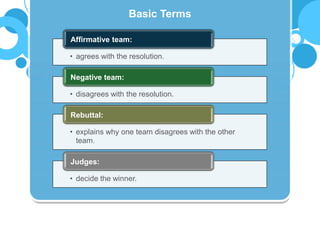
Basic Terms
• a game in which two opposing
teams make speeches to support
their arguments and disagree
with those of the other team.
Debate:
• the opinion about which two
teams argue.
Resolution:
Basic Terms
• agrees with the resolution.
Affirmative team:
• disagrees with the resolution.
Negative team:
• explains why one team disagrees with the other
team.
Rebuttal:
• decide the winner.
Judges:
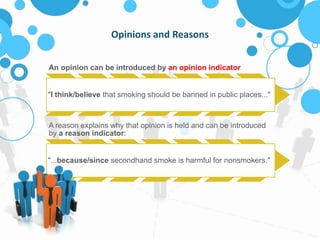
Opinions and Reasons
An opinion can be introduced by an opinion indicator
"I think/believe that smoking should be banned in public places..."
A reason explains why that opinion is held and can be introduced
by a reason indicator:
"...because/since secondhand smoke is harmful for nonsmokers."
STRONG REASONS VERSUS WEAK
REASONS
it is convincing to a
majority of people.
it logically supports the
opinion.
it is specific and states
the idea clearly.
A strong reason
1
2
3
Smoking should be banned in public
places because:
it is bad.
it gives people bad breath
and makes their teeth yellow.
secondhand smoke is harmful
for nonsmokers.
 
 
 
Giving Support for Your Reasons
Support consists of evidence.
• from your own experience or from what you heard or read.
Example:
• things that you believe everybody knows.
Common Sense:
• the opinions of experts -- this comes from research.
Expert Opinion:
• this also comes from research.
Statistics: numbers --
With Your Partner, Think of at Least One Strong
Reason for Each Resolution
Women should quit their
job after they get married.
Love is more important
than money.
It is better to be married
than single.
Now Compare Your Reasons
with Another Pair;
Decide Whose Reasons are
Stronger;
Why.
Have a great debate!

Introduction to Debate

  • 1.
    Abdul Syahid &Leny Mahdalena Debate
  • 2.
    Basic Terms • agame in which two opposing teams make speeches to support their arguments and disagree with those of the other team. Debate: • the opinion about which two teams argue. Resolution:
  • 3.
    Basic Terms • agreeswith the resolution. Affirmative team: • disagrees with the resolution. Negative team: • explains why one team disagrees with the other team. Rebuttal: • decide the winner. Judges:
  • 4.
    Opinions and Reasons Anopinion can be introduced by an opinion indicator "I think/believe that smoking should be banned in public places..." A reason explains why that opinion is held and can be introduced by a reason indicator: "...because/since secondhand smoke is harmful for nonsmokers."
  • 5.
  • 6.
    it is convincingto a majority of people. it logically supports the opinion. it is specific and states the idea clearly. A strong reason 1 2 3
  • 7.
    Smoking should bebanned in public places because: it is bad. it gives people bad breath and makes their teeth yellow. secondhand smoke is harmful for nonsmokers.      
  • 8.
    Giving Support forYour Reasons Support consists of evidence. • from your own experience or from what you heard or read. Example: • things that you believe everybody knows. Common Sense: • the opinions of experts -- this comes from research. Expert Opinion: • this also comes from research. Statistics: numbers --
  • 9.
    With Your Partner,Think of at Least One Strong Reason for Each Resolution Women should quit their job after they get married. Love is more important than money. It is better to be married than single.
  • 10.
    Now Compare YourReasons with Another Pair; Decide Whose Reasons are Stronger; Why.
  • 11.
    Have a greatdebate!