Introduction to British Parliamentary Debating The best way to learn and improve British Parliamentary Debating is by doing Pro Am and Freehills! Ask Ash Feurtado for more details. Colette Mintz
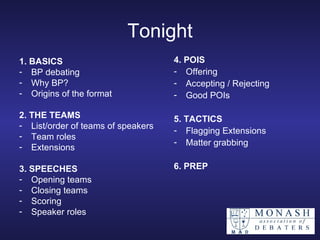
Tonight 1. BASICS BP debating Why BP? Origins of the format 2. THE TEAMS List/order of teams of speakers Team roles Extensions 3. SPEECHES Opening teams Closing teams Scoring Speaker roles 4. POIS Offering Accepting / Rejecting Good POIs 5. TACTICS Flagging Extensions Matter grabbing 6. PREP
Why British Parliamentary Debating? The World Championships used to be held in the debating style of the host country Worlds Council decided to use the same style every year British Parliamentary debating is now the style used at Worlds
British Parliamentary Debating Key differences to 3 on 3 debating Four teams and two people in each team Points of information (questions asked during speeches) More complicated, more rules, more tactics Language eg “house, speaker, Prime Minister” etc Other jargon: halves, benches, diagonals.. Prep time – 15 minutes Emphasis on role fulfillment At tournaments: points system But… Still a debate (argumentative style persuasion) Still definition, model, split, method, manner, matter etc
Origins of the format Based on a Westminster Parliament Coalition Government Coalition Opposition Government and Opposition clash Each coalition party is consistent with their partner but try to do a better job
List/order of teams and speakers Four teams Opening Government OG Opening Opposition OO Closing Government CG Closing Opposition CO Eight speakers Prime Minister OG Opposition Leader OO Deputy Prime Minister OG Deputy Opposition Leader OO Government Member CG Opposition Member CO Government Whip CG Opposition Whip CO
Team Roles Opening teams essentially do what the Affirmative and Negative team do in a 3 on 3 debate eg Context Definition Model Split Arguments Rebuttal Clash ALSO: May try to matter grab
Team roles Closing teams support the model of their opening team but present something new to support it, this is called an EXTENSION. They must also rebut and clash with both opposite teams
Extensions Closing teams must have them It is something new, distinct, particular, important that supports the opening teams case. BUT STILL RELEVANT! Deeper analysis Re-package   This house would abolish taxes on alcohol and cigarettes that go beyond normal sales taxes This house would partition the Sudan Banning the Burqa – Women’s GF 2009 (extension about the EU) Ban Porn   Funding for IVF Worlds GF 2010
All teams Must be active and involved in the debate through the use of POIs
Speech 7 minutes The first and last minute of each speech are protected This means that no questions (POIs) can be offered One knock at 1 min and 6 mins to mark protected minutes Two knocks at 7 minutes to mark end of speech
Scoring Technically scores out of 100 In reality scores between 60-90  Best Speaker at Koc Worlds 2010 averaged 86.2. Australs best speaker 77.56 (2010) Average is still 75 Manner and Matter worth 50 marks each Method?
Speaker roles PM – Context, define, model, split, arguments OL – Clash, countermodel, rebut, split, arguments DPM – Rebut, support contention/model with new arguments DOL – Rebut, support contention/model with new arguments
Speaker roles GM – Extension, rebut, arguments OM – Extension, rebut, arguments GW – Rebut and summarise focussing on Extension OW – Rebut and summarise focussing on Extension
Points of Information Question can be offered to the speaker by members of the  opposite  bench Questions may be accepted or rejected by the speaker
Offering POIs How to offer? Stand up How many to offer? 10 per speech  How to deliver if accepted? 15 seconds Be ready. Even great debaters need to write them down in advance… "rich people are better with money than poor people... don't you think? "don't you think your model might have (awkward pause) violence...making...consequences?"
Accepting / Rejecting POIs You can accept or reject How to reject? Wave down How to accept?  How to answer? Directly, don’t waste too much time!
Good POIs Short sharp and direct Tom Chapman:  If the number of representatives of your Asian parliament is going to be determined by population is it true that Indonesia (population of over 230,000,000) is going to have 46 times the number of members than Singapore (approx 5,000,000)?  Attacking/ rebutting Clarification Closing teams: Flagging Early on in the debate: be careful about what you ask!
Tactics ‘ Flagging your extension’ ‘ Matter grabbing’ ‘ Shutting out’ ‘ Staying in’
Prep – Closing teams List Flesh out a few

Colette - Introduction to BP

  • 1.
    Introduction to BritishParliamentary Debating The best way to learn and improve British Parliamentary Debating is by doing Pro Am and Freehills! Ask Ash Feurtado for more details. Colette Mintz
  • 2.
    Tonight 1. BASICSBP debating Why BP? Origins of the format 2. THE TEAMS List/order of teams of speakers Team roles Extensions 3. SPEECHES Opening teams Closing teams Scoring Speaker roles 4. POIS Offering Accepting / Rejecting Good POIs 5. TACTICS Flagging Extensions Matter grabbing 6. PREP
  • 3.
    Why British ParliamentaryDebating? The World Championships used to be held in the debating style of the host country Worlds Council decided to use the same style every year British Parliamentary debating is now the style used at Worlds
  • 4.
    British Parliamentary DebatingKey differences to 3 on 3 debating Four teams and two people in each team Points of information (questions asked during speeches) More complicated, more rules, more tactics Language eg “house, speaker, Prime Minister” etc Other jargon: halves, benches, diagonals.. Prep time – 15 minutes Emphasis on role fulfillment At tournaments: points system But… Still a debate (argumentative style persuasion) Still definition, model, split, method, manner, matter etc
  • 5.
    Origins of theformat Based on a Westminster Parliament Coalition Government Coalition Opposition Government and Opposition clash Each coalition party is consistent with their partner but try to do a better job
  • 6.
    List/order of teamsand speakers Four teams Opening Government OG Opening Opposition OO Closing Government CG Closing Opposition CO Eight speakers Prime Minister OG Opposition Leader OO Deputy Prime Minister OG Deputy Opposition Leader OO Government Member CG Opposition Member CO Government Whip CG Opposition Whip CO
  • 7.
    Team Roles Openingteams essentially do what the Affirmative and Negative team do in a 3 on 3 debate eg Context Definition Model Split Arguments Rebuttal Clash ALSO: May try to matter grab
  • 8.
    Team roles Closingteams support the model of their opening team but present something new to support it, this is called an EXTENSION. They must also rebut and clash with both opposite teams
  • 9.
    Extensions Closing teamsmust have them It is something new, distinct, particular, important that supports the opening teams case. BUT STILL RELEVANT! Deeper analysis Re-package This house would abolish taxes on alcohol and cigarettes that go beyond normal sales taxes This house would partition the Sudan Banning the Burqa – Women’s GF 2009 (extension about the EU) Ban Porn Funding for IVF Worlds GF 2010
  • 10.
    All teams Mustbe active and involved in the debate through the use of POIs
  • 11.
    Speech 7 minutesThe first and last minute of each speech are protected This means that no questions (POIs) can be offered One knock at 1 min and 6 mins to mark protected minutes Two knocks at 7 minutes to mark end of speech
  • 12.
    Scoring Technically scoresout of 100 In reality scores between 60-90 Best Speaker at Koc Worlds 2010 averaged 86.2. Australs best speaker 77.56 (2010) Average is still 75 Manner and Matter worth 50 marks each Method?
  • 13.
    Speaker roles PM– Context, define, model, split, arguments OL – Clash, countermodel, rebut, split, arguments DPM – Rebut, support contention/model with new arguments DOL – Rebut, support contention/model with new arguments
  • 14.
    Speaker roles GM– Extension, rebut, arguments OM – Extension, rebut, arguments GW – Rebut and summarise focussing on Extension OW – Rebut and summarise focussing on Extension
  • 15.
    Points of InformationQuestion can be offered to the speaker by members of the opposite bench Questions may be accepted or rejected by the speaker
  • 16.
    Offering POIs Howto offer? Stand up How many to offer? 10 per speech How to deliver if accepted? 15 seconds Be ready. Even great debaters need to write them down in advance… "rich people are better with money than poor people... don't you think? "don't you think your model might have (awkward pause) violence...making...consequences?"
  • 17.
    Accepting / RejectingPOIs You can accept or reject How to reject? Wave down How to accept? How to answer? Directly, don’t waste too much time!
  • 18.
    Good POIs Shortsharp and direct Tom Chapman: If the number of representatives of your Asian parliament is going to be determined by population is it true that Indonesia (population of over 230,000,000) is going to have 46 times the number of members than Singapore (approx 5,000,000)? Attacking/ rebutting Clarification Closing teams: Flagging Early on in the debate: be careful about what you ask!
  • 19.
    Tactics ‘ Flaggingyour extension’ ‘ Matter grabbing’ ‘ Shutting out’ ‘ Staying in’
  • 20.
    Prep – Closingteams List Flesh out a few