Significance of Death in the
Existence
of the Person
what if
What if death can be a choice, at what
age will you choose to die? In what way
will you want to die? What are the 5
important things that you will do before
you die and why?
How do you want to be remembered
by your loved ones?
Write down your
answers using the matrix below:
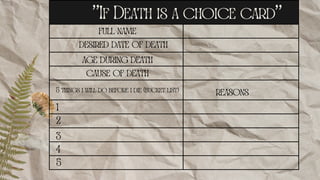
"If Death is a choice card"
full name
desired date of death
age during death
cause of death
5 things i will do before i die (bucket list)
1
2
3
4
5
reasons
how do i remembered by loved ones, co-
workers and friends?
20 15 10 5
5 4 3 2
5 4 3 2
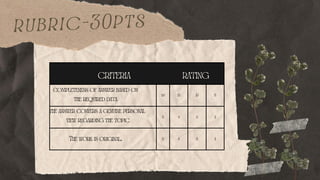
rubric-30pts
criteria rating
completeness of answer based on
the required data
the answer convers a genuine personal
view regarding the topic
The work is original.
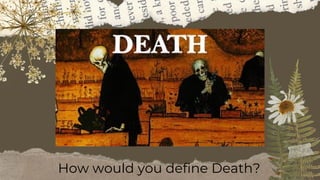
How would you define Death?
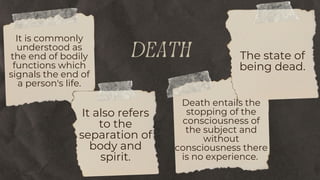
death
It is commonly
understood as
the end of bodily
functions which
signals the end of
a person's life.
It also refers
to the
separation of
body and
spirit.
The state of
being dead.
Death entails the
stopping of the
consciousness of
the subject and
without
consciousness there
is no experience.
Why does people dislike
talking and thinking about
death?
The Fear Stems two possible:
1. The mainstream scientific belief that death means permanent
annihilations of consciousness.
2. Religious belief of the possibility of going to hell.
Both beliefs are horribly scary. Spiritually people who don’t
accept either of these beliefs are quite happy to talk about death.
What are some ways
people deny that death
is part of life?
According to
Sigmund Freud, Otto Rank and Ernest Becker.........
The desire to deny the reality of death, the theory
goes, makes us want to find a way to “live on,”
whether through our children, or by attaching
ourselves to causes that will not be buried along
with us.
How does the
reality of death
define our lives?
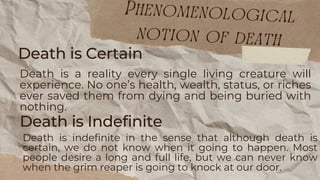
Death is Indefinite
Death is indefinite in the sense that although death is
certain, we do not know when it going to happen. Most
people desire a long and full life, but we can never know
when the grim reaper is going to knock at our door.
Death is Certain
Death is a reality every single living creature will
experience. No one’s health, wealth, status, or riches
ever saved them from dying and being buried with
nothing.
Phenomenological
notion of death
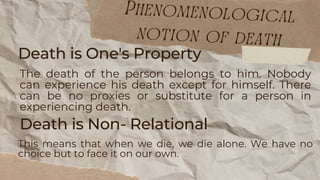
Death is Non- Relational
This means that when we die, we die alone. We have no
choice but to face it on our own.
Death is One's Property
The death of the person belongs to him. Nobody
can experience his death except for himself. There
can be no proxies or substitute for a person in
experiencing death.
Phenomenological
notion of death
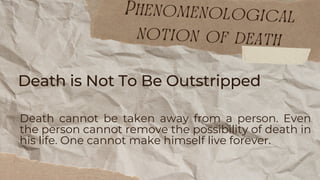
Death is Not To Be Outstripped
Death cannot be taken away from a person. Even
the person cannot remove the possibility of death in
his life. One cannot make himself live forever.
Phenomenological
notion of death
All people, young and old, should ask
these fundamental questions in their
lives:
1. What is my purpose of existence?
What am I here for?
2. Is there a God? If there is a God, then I
should attempt to know Him.
3. What is my vision for my own life? Is it
to be rich and successful, or something
that transcends my life now
What Happens After Death
in Different Religions?
Christian beliefs focus on the gift of life and the
notion that death isn't something that should be
feared as one will be able to connect on a
different level with god after passing away. They
also believe in heaven and hell and may focus on
forgiveness during the dying process.
Christian Beliefs on Death
and Dying
Muslim individuals tend to have a strong belief in
life after death with a preset amount of time, set
forth by Allah, that someone is supposed to be
living. While the passing away of a loved one is
painful, many Muslim individuals find comfort
through prayer, as well as the notion that they
will see their loved ones once again in Paradise.
Islamic Thoughts on Death
Hinduism believes that the soul carries on after
someone has passed away. The soul not only
continues on, but is reborn according to karmic
deeds, with the ultimate goal of Moksha. Moksha
means that the cycle of death and rebirth ends
and one is able to join god. Death is viewed as
natural and that the amount of pain someone
experiences in their life and during the dying
process is related to their karma.
Hindu Beliefs
Buddhism sees death as a natural part of human
existence, as well as the suffering and pain that
may accompany it. Buddhism focuses on the
here and now, which can impact how individuals
internalize the dying process. Buddhists believe
in reincarnation and aim to reach Nirvana.
Cremation and burial are both acceptable,
although the majority of Buddhist individuals
choose cremation.
Death and Buddhism
Individuals who identify as Jewish tend to have fairly
structured customs when it comes to moving through
the grieving process, as well as burial practices. After
someone has passed away, funerals are held very
quickly after, ideally one day after the person has died
and services are led by a Rabbi. Jewish individuals
typically do not support cremation and opt for burials
in most circumstances. Funerals are viewed as a
celebration of the individual's life and death is
conceptualized as a natural aspect of being human.
Jewish Death and Dying
Customs
Those who identify as Atheist do not believe in a higher
power and look to science for explanations of everyday
occurrences. Based on personal rationale, individuals
may or may not believe that something occurs after
death, therefore death and dying practices will vary.
Atheist Beliefs About Passing
Away
People are always been not ready for the
confrontation of death and many of us fear
this because once we leave the world, it is
automatically game over for us.
And as death is something that we can’t
escape, we must live our lives to the fullest
and exercise our purpose to its extent so
that we will manage to leave a remarkable
mark as we pass by.
the meaning
of life
What is the goal you want to
achieve in life?
In your perception, what is
your own meaning of life?
How can you make your life
meaningful for others?
How can I determine if I’m
seeking the right purpose in
life?
Recognize the Meaning of One’s Life
Socrates
-Socrates believes that knowing oneself is a condition to solve the
present problem.
-For Socrates, for a person to be happy, he has to live a virtuous life.
-Virtue is not something to be taught or acquired through
education, but rather it is merely an awakening of the seeds of
good deeds that lay dormant in the mind and heart of a person.
-Knowing what is in the mind and heart of a human being is
achieved through self-knowledge.
-True knowledge means wisdom, which in turn, means virtue.
-Unethical actions harm the person who performs
them more than the people they victimize
Nothing lasts forever
(walang forever). The
cycle of being born,
growing up and growing
old and dying is a reality.
We have limited time here
on earth and whether we
like it or not, we are bound
to die. Death is real. It is a
part of our being.

Death and The Human Person-.pdf

  • 1.
    Significance of Deathin the Existence of the Person
  • 2.
    what if What ifdeath can be a choice, at what age will you choose to die? In what way will you want to die? What are the 5 important things that you will do before you die and why? How do you want to be remembered by your loved ones? Write down your answers using the matrix below:
  • 3.
    "If Death isa choice card" full name desired date of death age during death cause of death 5 things i will do before i die (bucket list) 1 2 3 4 5 reasons
  • 4.
    how do iremembered by loved ones, co- workers and friends?
  • 5.
    20 15 105 5 4 3 2 5 4 3 2 rubric-30pts criteria rating completeness of answer based on the required data the answer convers a genuine personal view regarding the topic The work is original.
  • 6.
    How would youdefine Death?
  • 7.
    death It is commonly understoodas the end of bodily functions which signals the end of a person's life. It also refers to the separation of body and spirit. The state of being dead. Death entails the stopping of the consciousness of the subject and without consciousness there is no experience.
  • 8.
    Why does peopledislike talking and thinking about death?
  • 9.
    The Fear Stemstwo possible: 1. The mainstream scientific belief that death means permanent annihilations of consciousness. 2. Religious belief of the possibility of going to hell. Both beliefs are horribly scary. Spiritually people who don’t accept either of these beliefs are quite happy to talk about death.
  • 10.
    What are someways people deny that death is part of life?
  • 11.
    According to Sigmund Freud,Otto Rank and Ernest Becker......... The desire to deny the reality of death, the theory goes, makes us want to find a way to “live on,” whether through our children, or by attaching ourselves to causes that will not be buried along with us.
  • 12.
    How does the realityof death define our lives?
  • 13.
    Death is Indefinite Deathis indefinite in the sense that although death is certain, we do not know when it going to happen. Most people desire a long and full life, but we can never know when the grim reaper is going to knock at our door. Death is Certain Death is a reality every single living creature will experience. No one’s health, wealth, status, or riches ever saved them from dying and being buried with nothing. Phenomenological notion of death
  • 14.
    Death is Non-Relational This means that when we die, we die alone. We have no choice but to face it on our own. Death is One's Property The death of the person belongs to him. Nobody can experience his death except for himself. There can be no proxies or substitute for a person in experiencing death. Phenomenological notion of death
  • 15.
    Death is NotTo Be Outstripped Death cannot be taken away from a person. Even the person cannot remove the possibility of death in his life. One cannot make himself live forever. Phenomenological notion of death
  • 16.
    All people, youngand old, should ask these fundamental questions in their lives: 1. What is my purpose of existence? What am I here for? 2. Is there a God? If there is a God, then I should attempt to know Him. 3. What is my vision for my own life? Is it to be rich and successful, or something that transcends my life now
  • 17.
    What Happens AfterDeath in Different Religions?
  • 18.
    Christian beliefs focuson the gift of life and the notion that death isn't something that should be feared as one will be able to connect on a different level with god after passing away. They also believe in heaven and hell and may focus on forgiveness during the dying process. Christian Beliefs on Death and Dying
  • 19.
    Muslim individuals tendto have a strong belief in life after death with a preset amount of time, set forth by Allah, that someone is supposed to be living. While the passing away of a loved one is painful, many Muslim individuals find comfort through prayer, as well as the notion that they will see their loved ones once again in Paradise. Islamic Thoughts on Death
  • 20.
    Hinduism believes thatthe soul carries on after someone has passed away. The soul not only continues on, but is reborn according to karmic deeds, with the ultimate goal of Moksha. Moksha means that the cycle of death and rebirth ends and one is able to join god. Death is viewed as natural and that the amount of pain someone experiences in their life and during the dying process is related to their karma. Hindu Beliefs
  • 21.
    Buddhism sees deathas a natural part of human existence, as well as the suffering and pain that may accompany it. Buddhism focuses on the here and now, which can impact how individuals internalize the dying process. Buddhists believe in reincarnation and aim to reach Nirvana. Cremation and burial are both acceptable, although the majority of Buddhist individuals choose cremation. Death and Buddhism
  • 22.
    Individuals who identifyas Jewish tend to have fairly structured customs when it comes to moving through the grieving process, as well as burial practices. After someone has passed away, funerals are held very quickly after, ideally one day after the person has died and services are led by a Rabbi. Jewish individuals typically do not support cremation and opt for burials in most circumstances. Funerals are viewed as a celebration of the individual's life and death is conceptualized as a natural aspect of being human. Jewish Death and Dying Customs
  • 23.
    Those who identifyas Atheist do not believe in a higher power and look to science for explanations of everyday occurrences. Based on personal rationale, individuals may or may not believe that something occurs after death, therefore death and dying practices will vary. Atheist Beliefs About Passing Away
  • 24.
    People are alwaysbeen not ready for the confrontation of death and many of us fear this because once we leave the world, it is automatically game over for us. And as death is something that we can’t escape, we must live our lives to the fullest and exercise our purpose to its extent so that we will manage to leave a remarkable mark as we pass by. the meaning of life
  • 25.
    What is thegoal you want to achieve in life?
  • 26.
    In your perception,what is your own meaning of life?
  • 27.
    How can youmake your life meaningful for others?
  • 28.
    How can Idetermine if I’m seeking the right purpose in life?
  • 29.
    Recognize the Meaningof One’s Life Socrates -Socrates believes that knowing oneself is a condition to solve the present problem. -For Socrates, for a person to be happy, he has to live a virtuous life. -Virtue is not something to be taught or acquired through education, but rather it is merely an awakening of the seeds of good deeds that lay dormant in the mind and heart of a person. -Knowing what is in the mind and heart of a human being is achieved through self-knowledge. -True knowledge means wisdom, which in turn, means virtue. -Unethical actions harm the person who performs them more than the people they victimize
  • 30.
    Nothing lasts forever (walangforever). The cycle of being born, growing up and growing old and dying is a reality. We have limited time here on earth and whether we like it or not, we are bound to die. Death is real. It is a part of our being.