


Page 1 of 16
Department of Education
Bureau of Learning Delivery
Teaching and Learning Division
Supplementary Learning Modules
for Senior High School Learners
Grade Levels: Grade 11
Specialized Subject: Introduction to World Religions and Belief
Systems
Semester: First Semester (Week 11)
*Explain the uniqueness and similarities of Mahayana
and Theravada Buddhism
LEARNING COMPETENCY:
Page 2 of 16
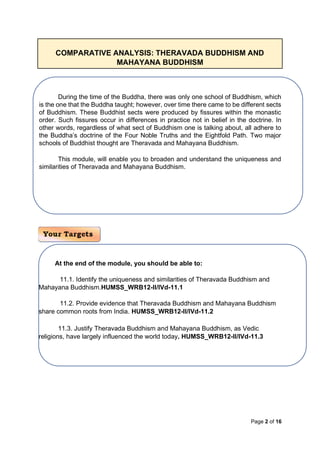
COMPARATIVE ANALYSIS: THERAVADA BUDDHISM AND
MAHAYANA BUDDHISM
During the time of the Buddha, there was only one school of Buddhism, which
is the one that the Buddha taught; however, over time there came to be different sects
of Buddhism. These Buddhist sects were produced by fissures within the monastic
order. Such fissures occur in differences in practice not in belief in the doctrine. In
other words, regardless of what sect of Buddhism one is talking about, all adhere to
the Buddha’s doctrine of the Four Noble Truths and the Eightfold Path. Two major
schools of Buddhist thought are Theravada and Mahayana Buddhism.
This module, will enable you to broaden and understand the uniqueness and
similarities of Theravada and Mahayana Buddhism.
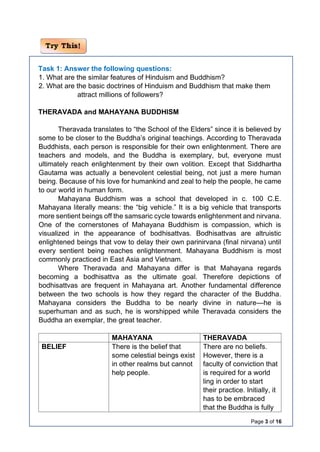
At the end of the module, you should be able to:
11.1. Identify the uniqueness and similarities of Theravada Buddhism and
Mahayana Buddhism.HUMSS_WRB12-II/IVd-11.1
11.2. Provide evidence that Theravada Buddhism and Mahayana Buddhism
share common roots from India. HUMSS_WRB12-II/IVd-11.2
11.3. Justify Theravada Buddhism and Mahayana Buddhism, as Vedic
religions, have largely influenced the world today. HUMSS_WRB12-II/IVd-11.3
Page 3 of 16
Task 1: Answer the following questions:
1. What are the similar features of Hinduism and Buddhism?
2. What are the basic doctrines of Hinduism and Buddhism that make them
attract millions of followers?
THERAVADA and MAHAYANA BUDDHISM
Theravada translates to “the School of the Elders” since it is believed by
some to be closer to the Buddha’s original teachings. According to Theravada
Buddhists, each person is responsible for their own enlightenment. There are
teachers and models, and the Buddha is exemplary, but, everyone must
ultimately reach enlightenment by their own volition. Except that Siddhartha
Gautama was actually a benevolent celestial being, not just a mere human
being. Because of his love for humankind and zeal to help the people, he came
to our world in human form.
Mahayana Buddhism was a school that developed in c. 100 C.E.
Mahayana literally means: the “big vehicle.” It is a big vehicle that transports
more sentient beings off the samsaric cycle towards enlightenment and nirvana.
One of the cornerstones of Mahayana Buddhism is compassion, which is
visualized in the appearance of bodhisattvas. Bodhisattvas are altruistic
enlightened beings that vow to delay their own parinirvana (final nirvana) until
every sentient being reaches enlightenment. Mahayana Buddhism is most
commonly practiced in East Asia and Vietnam.
Where Theravada and Mahayana differ is that Mahayana regards
becoming a bodhisattva as the ultimate goal. Therefore depictions of
bodhisattvas are frequent in Mahayana art. Another fundamental difference
between the two schools is how they regard the character of the Buddha.
Mahayana considers the Buddha to be nearly divine in nature—he is
superhuman and as such, he is worshipped while Theravada considers the
Buddha an exemplar, the great teacher.
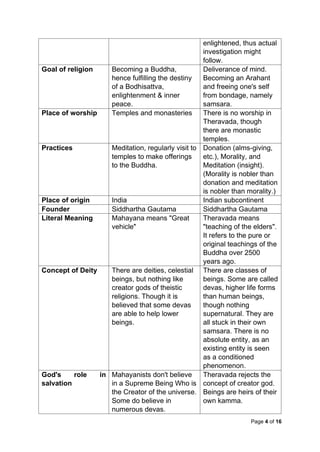
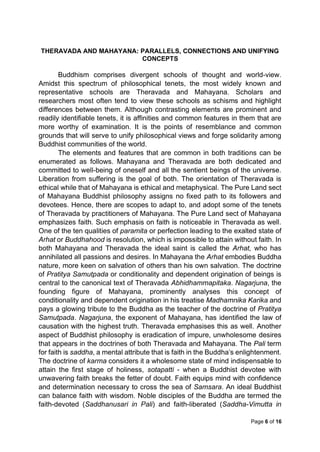
MAHAYANA THERAVADA
BELIEF There is the belief that
some celestial beings exist
in other realms but cannot
help people.
There are no beliefs.
However, there is a
faculty of conviction that
is required for a world
ling in order to start
their practice. Initially, it
has to be embraced
that the Buddha is fully
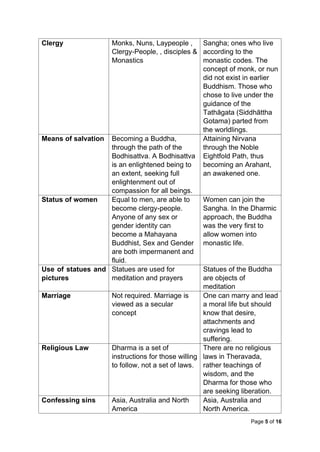
Page 4 of 16
enlightened, thus actual
investigation might
follow.
Goal of religion Becoming a Buddha,
hence fulfilling the destiny
of a Bodhisattva,
enlightenment & inner
peace.
Deliverance of mind.
Becoming an Arahant
and freeing one's self
from bondage, namely
samsara.
Place of worship Temples and monasteries There is no worship in
Theravada, though
there are monastic
temples.
Practices Meditation, regularly visit to
temples to make offerings
to the Buddha.
Donation (alms-giving,
etc.), Morality, and
Meditation (insight).
(Morality is nobler than
donation and meditation
is nobler than morality.)
Place of origin India Indian subcontinent
Founder Siddhartha Gautama Siddhartha Gautama
Literal Meaning Mahayana means "Great
vehicle"
Theravada means
"teaching of the elders".
It refers to the pure or
original teachings of the
Buddha over 2500
years ago.
Concept of Deity There are deities, celestial
beings, but nothing like
creator gods of theistic
religions. Though it is
believed that some devas
are able to help lower
beings.
There are classes of
beings. Some are called
devas, higher life forms
than human beings,
though nothing
supernatural. They are
all stuck in their own
samsara. There is no
absolute entity, as an
existing entity is seen
as a conditioned
phenomenon.
God's role in
salvation
Mahayanists don't believe
in a Supreme Being Who is
the Creator of the universe.
Some do believe in
numerous devas.
Theravada rejects the
concept of creator god.
Beings are heirs of their
own kamma.
Page 5 of 16
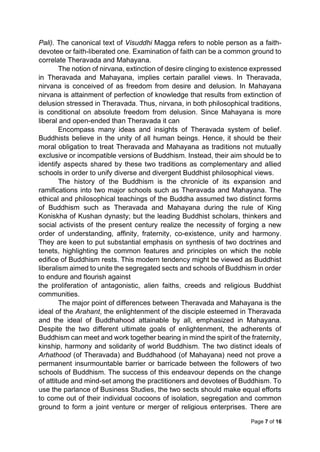
Clergy Monks, Nuns, Laypeople ,
Clergy-People, , disciples &
Monastics
Sangha; ones who live
according to the
monastic codes. The
concept of monk, or nun
did not exist in earlier
Buddhism. Those who
chose to live under the
guidance of the
Tathāgata (Siddhāttha
Gotama) parted from
the worldlings.
Means of salvation Becoming a Buddha,
through the path of the
Bodhisattva. A Bodhisattva
is an enlightened being to
an extent, seeking full
enlightenment out of
compassion for all beings.
Attaining Nirvana
through the Noble
Eightfold Path, thus
becoming an Arahant,
an awakened one.
Status of women Equal to men, are able to
become clergy-people.
Anyone of any sex or
gender identity can
become a Mahayana
Buddhist, Sex and Gender
are both impermanent and
fluid.
Women can join the
Sangha. In the Dharmic
approach, the Buddha
was the very first to
allow women into
monastic life.
Use of statues and
pictures
Statues are used for
meditation and prayers
Statues of the Buddha
are objects of
meditation
Marriage Not required. Marriage is
viewed as a secular
concept
One can marry and lead
a moral life but should
know that desire,
attachments and
cravings lead to
suffering.
Religious Law Dharma is a set of
instructions for those willing
to follow, not a set of laws.
There are no religious
laws in Theravada,
rather teachings of
wisdom, and the
Dharma for those who
are seeking liberation.
Confessing sins Asia, Australia and North
America
Asia, Australia and
North America.
Page 6 of 16
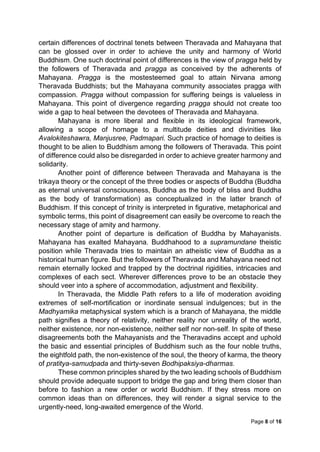
THERAVADA AND MAHAYANA: PARALLELS, CONNECTIONS AND UNIFYING
CONCEPTS
Buddhism comprises divergent schools of thought and world-view.
Amidst this spectrum of philosophical tenets, the most widely known and
representative schools are Theravada and Mahayana. Scholars and
researchers most often tend to view these schools as schisms and highlight
differences between them. Although contrasting elements are prominent and
readily identifiable tenets, it is affinities and common features in them that are
more worthy of examination. It is the points of resemblance and common
grounds that will serve to unify philosophical views and forge solidarity among
Buddhist communities of the world.
The elements and features that are common in both traditions can be
enumerated as follows. Mahayana and Theravada are both dedicated and
committed to well-being of oneself and all the sentient beings of the universe.
Liberation from suffering is the goal of both. The orientation of Theravada is
ethical while that of Mahayana is ethical and metaphysical. The Pure Land sect
of Mahayana Buddhist philosophy assigns no fixed path to its followers and
devotees. Hence, there are scopes to adapt to, and adopt some of the tenets
of Theravada by practitioners of Mahayana. The Pure Land sect of Mahayana
emphasizes faith. Such emphasis on faith is noticeable in Theravada as well.
One of the ten qualities of paramita or perfection leading to the exalted state of
Arhat or Buddhahood is resolution, which is impossible to attain without faith. In
both Mahayana and Theravada the ideal saint is called the Arhat, who has
annihilated all passions and desires. In Mahayana the Arhat embodies Buddha
nature, more keen on salvation of others than his own salvation. The doctrine
of Pratitya Samutpada or conditionality and dependent origination of beings is
central to the canonical text of Theravada Abhidhammapitaka. Nagarjuna, the
founding figure of Mahayana, prominently analyses this concept of
conditionality and dependent origination in his treatise Madhamnika Karika and
pays a glowing tribute to the Buddha as the teacher of the doctrine of Pratitya
Samutpada. Nagarjuna, the exponent of Mahayana, has identified the law of
causation with the highest truth. Theravada emphasises this as well. Another
aspect of Buddhist philosophy is eradication of impure, unwholesome desires
that appears in the doctrines of both Theravada and Mahayana. The Pali term
for faith is saddha, a mental attribute that is faith in the Buddha’s enlightenment.
The doctrine of karma considers it a wholesome state of mind indispensable to
attain the first stage of holiness, sotapatti - when a Buddhist devotee with
unwavering faith breaks the fetter of doubt. Faith equips mind with confidence
and determination necessary to cross the sea of Samsara. An ideal Buddhist
can balance faith with wisdom. Noble disciples of the Buddha are termed the
faith-devoted (Saddhanusari in Pali) and faith-liberated (Saddha-Vimutta in
Page 7 of 16
Pali). The canonical text of Visuddhi Magga refers to noble person as a faith-
devotee or faith-liberated one. Examination of faith can be a common ground to
correlate Theravada and Mahayana.
The notion of nirvana, extinction of desire clinging to existence expressed
in Theravada and Mahayana, implies certain parallel views. In Theravada,
nirvana is conceived of as freedom from desire and delusion. In Mahayana
nirvana is attainment of perfection of knowledge that results from extinction of
delusion stressed in Theravada. Thus, nirvana, in both philosophical traditions,
is conditional on absolute freedom from delusion. Since Mahayana is more
liberal and open-ended than Theravada it can
Encompass many ideas and insights of Theravada system of belief.
Buddhists believe in the unity of all human beings. Hence, it should be their
moral obligation to treat Theravada and Mahayana as traditions not mutually
exclusive or incompatible versions of Buddhism. Instead, their aim should be to
identify aspects shared by these two traditions as complementary and allied
schools in order to unify diverse and divergent Buddhist philosophical views.
The history of the Buddhism is the chronicle of its expansion and
ramifications into two major schools such as Theravada and Mahayana. The
ethical and philosophical teachings of the Buddha assumed two distinct forms
of Buddhism such as Theravada and Mahayana during the rule of King
Koniskha of Kushan dynasty; but the leading Buddhist scholars, thinkers and
social activists of the present century realize the necessity of forging a new
order of understanding, affinity, fraternity, co-existence, unity and harmony.
They are keen to put substantial emphasis on synthesis of two doctrines and
tenets, highlighting the common features and principles on which the noble
edifice of Buddhism rests. This modern tendency might be viewed as Buddhist
liberalism aimed to unite the segregated sects and schools of Buddhism in order
to endure and flourish against
the proliferation of antagonistic, alien faiths, creeds and religious Buddhist
communities.
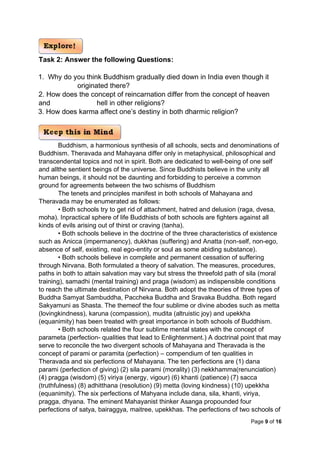
The major point of differences between Theravada and Mahayana is the
ideal of the Arahant, the enlightenment of the disciple esteemed in Theravada
and the ideal of Buddhahood attainable by all, emphasized in Mahayana.
Despite the two different ultimate goals of enlightenment, the adherents of
Buddhism can meet and work together bearing in mind the spirit of the fraternity,
kinship, harmony and solidarity of world Buddhism. The two distinct ideals of
Arhathood (of Theravada) and Buddhahood (of Mahayana) need not prove a
permanent insurmountable barrier or barricade between the followers of two
schools of Buddhism. The success of this endeavour depends on the change
of attitude and mind-set among the practitioners and devotees of Buddhism. To
use the parlance of Business Studies, the two sects should make equal efforts
to come out of their individual cocoons of isolation, segregation and common
ground to form a joint venture or merger of religious enterprises. There are
Page 8 of 16
certain differences of doctrinal tenets between Theravada and Mahayana that
can be glossed over in order to achieve the unity and harmony of World
Buddhism. One such doctrinal point of differences is the view of pragga held by
the followers of Theravada and pragga as conceived by the adherents of
Mahayana. Pragga is the mostesteemed goal to attain Nirvana among
Theravada Buddhists; but the Mahayana community associates pragga with
compassion. Pragga without compassion for suffering beings is valueless in
Mahayana. This point of divergence regarding pragga should not create too
wide a gap to heal between the devotees of Theravada and Mahayana.
Mahayana is more liberal and flexible in its ideological framework,
allowing a scope of homage to a multitude deities and divinities like
Avalokiteshawra, Manjusree, Padmapari. Such practice of homage to deities is
thought to be alien to Buddhism among the followers of Theravada. This point
of difference could also be disregarded in order to achieve greater harmony and
solidarity.
Another point of difference between Theravada and Mahayana is the
trikaya theory or the concept of the three bodies or aspects of Buddha (Buddha
as eternal universal consciousness, Buddha as the body of bliss and Buddha
as the body of transformation) as conceptualized in the latter branch of
Buddhism. If this concept of trinity is interpreted in figurative, metaphorical and
symbolic terms, this point of disagreement can easily be overcome to reach the
necessary stage of amity and harmony.
Another point of departure is deification of Buddha by Mahayanists.
Mahayana has exalted Mahayana. Buddhahood to a supramundane theistic
position while Theravada tries to maintain an atheistic view of Buddha as a
historical human figure. But the followers of Theravada and Mahayana need not
remain eternally locked and trapped by the doctrinal rigidities, intricacies and
complexes of each sect. Wherever differences prove to be an obstacle they
should veer into a sphere of accommodation, adjustment and flexibility.
In Theravada, the Middle Path refers to a life of moderation avoiding
extremes of self-mortification or inordinate sensual indulgences; but in the
Madhyamika metaphysical system which is a branch of Mahayana, the middle
path signifies a theory of relativity, neither reality nor unreality of the world,
neither existence, nor non-existence, neither self nor non-self. In spite of these
disagreements both the Mahayanists and the Theravadins accept and uphold
the basic and essential principles of Buddhism such as the four noble truths,
the eightfold path, the non-existence of the soul, the theory of karma, the theory
of pratitya-samudpada and thirty-seven Bodhipaksiya-dharmas.
These common principles shared by the two leading schools of Buddhism
should provide adequate support to bridge the gap and bring them closer than
before to fashion a new order or world Buddhism. If they stress more on
common ideas than on differences, they will render a signal service to the
urgently-need, long-awaited emergence of the World.
Page 9 of 16
Task 2: Answer the following Questions:
1. Why do you think Buddhism gradually died down in India even though it
originated there?
2. How does the concept of reincarnation differ from the concept of heaven
and hell in other religions?
3. How does karma affect one’s destiny in both dharmic religion?
Buddhism, a harmonious synthesis of all schools, sects and denominations of
Buddhism. Theravada and Mahayana differ only in metaphysical, philosophical and
transcendental topics and not in spirit. Both are dedicated to well-being of one self
and allthe sentient beings of the universe. Since Buddhists believe in the unity all
human beings, it should not be daunting and forbidding to perceive a common
ground for agreements between the two schisms of Buddhism
The tenets and principles manifest in both schools of Mahayana and
Theravada may be enumerated as follows:
• Both schools try to get rid of attachment, hatred and delusion (raga, dvesa,
moha). Inpractical sphere of life Buddhists of both schools are fighters against all
kinds of evils arising out of thirst or craving (tanha).
• Both schools believe in the doctrine of the three characteristics of existence
such as Anicca (impermanency), dukkhas (suffering) and Anatta (non-self, non-ego,
absence of self, existing, real ego-entity or soul as some abiding substance).
• Both schools believe in complete and permanent cessation of suffering
through Nirvana. Both formulated a theory of salvation. The measures, procedures,
paths in both to attain salvation may vary but stress the threefold path of sila (moral
training), samadhi (mental training) and praga (wisdom) as indispensible conditions
to reach the ultimate destination of Nirvana. Both adopt the theories of three types of
Buddha Samyat Sambuddha, Paccheka Buddha and Sravaka Buddha. Both regard
Sakyamuni as Shasta. The themeof the four sublime or divine abodes such as metta
(lovingkindness), karuna (compassion), mudita (altruistic joy) and upekkha
(equanimity) has been treated with great importance in both schools of Buddhism.
• Both schools related the four sublime mental states with the concept of
parameta (perfection- qualities that lead to Enlightenment.) A doctrinal point that may
serve to reconcile the two divergent schools of Mahayana and Theravada is the
concept of parami or paramita (perfection) – compendium of ten qualities in
Theravada and six perfections of Mahayana. The ten perfections are (1) dana
parami (perfection of giving) (2) sila parami (morality) (3) nekkhamma(renunciation)
(4) pragga (wisdom) (5) viriya (energy, vigour) (6) khanti (patience) (7) sacca
(truthfulness) (8) adhitthana (resolution) (9) metta (loving kindness) (10) upekkha
(equanimity). The six perfections of Mahyana include dana, sila, khanti, viriya,
pragga, dhyana. The eminent Mahayanist thinker Asanga propounded four
perfections of satya, bairaggya, maitree, upekkhas. The perfections of two schools of
Page 10 of 16
Buddhism are analogues to, and identifiable with, then paramitas of Theravada are
parallel to six paramitas of Mahayana. The concept of perfections could be an area
to reconcile and harmonise differences.
Affinities in point of view can be instrumental in establishing a rapport and
forming an alliance between the two different, mutually detached, schools of
Buddhism. Further common philosophical premises that Mahayana and Theravada
share are as follows:
1. Emancipation from fetters of attachment, hatred and delusion
(raga, desa, moha).
2. The cosmic universe is a continuum without beginning or end
(anamataggo ayam sansara).
3. All worldy beings and objects are transient (anitya), momentary (ksanika)
and are in a state of perpetual flux (samantana) and are without any real substance
(anatmakam).
4. The law of causation or dependent origination, the doctrine of protitya
samudpada, the conditionality and dependent nature of all unsubstantial physical
and psychical phenomena or elements. In Theravada this doctrine of causation is
analyzed in Dhamma-sangani and patthana (the first and last books of Abhidhamma-
Pitaka). Its parallel enunciation in Mahayana is Nagarjuna’s treatise Madhyamika
Karika where he identifies the law of causation with the highest truth and its
incarnation is Buddha. In the words of Nagarjuna: The worldly beings and objects,
which arise out of causes, do not exist. One who realizes this unreality of worldly
beings and objects visualizes the truth and therefore visualizes the Buddha, the
embodiment of truth.
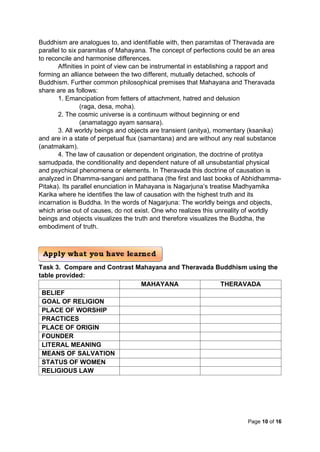
Task 3. Compare and Contrast Mahayana and Theravada Buddhism using the
table provided:
MAHAYANA THERAVADA
BELIEF
GOAL OF RELIGION
PLACE OF WORSHIP
PRACTICES
PLACE OF ORIGIN
FOUNDER
LITERAL MEANING
MEANS OF SALVATION
STATUS OF WOMEN
RELIGIOUS LAW
Page 11 of 16
Reflect on what you have learned about the topic.
Write an essay about the differences in popularity between Theravada and
Mahayana Buddhism. You will be graded based on the rubric given:
RUBRIC FOR PAPER
CRITERIA DESCRIPTION POINTS POINTS
OBTAINED
Organization The concept was clearly
and creatively conveyed
10
Content Concepts are clearly used
and explained
5
Presentation The idea was clearly
presented based on the
word used.
5
TOTAL: 20
I have learned that ________________
________________
______.
I have realized that ________________
_________________
_____.
I will apply _____________
_________________
_______________.
Page 12 of 16
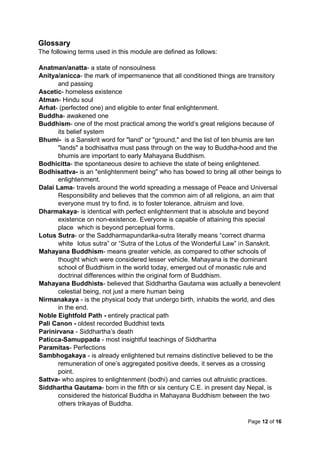
Glossary
The following terms used in this module are defined as follows:
Anatman/anatta- a state of nonsoulness
Anitya/anicca- the mark of impermanence that all conditioned things are transitory
and passing
Ascetic- homeless existence
Atman- Hindu soul
Arhat- (perfected one) and eligible to enter final enlightenment.
Buddha- awakened one
Buddhism- one of the most practical among the world’s great religions because of
its belief system
Bhumi- is a Sanskrit word for "land" or "ground," and the list of ten bhumis are ten
"lands" a bodhisattva must pass through on the way to Buddha-hood and the
bhumis are important to early Mahayana Buddhism.
Bodhicitta- the spontaneous desire to achieve the state of being enlightened.
Bodhisattva- is an "enlightenment being" who has bowed to bring all other beings to
enlightenment.
Dalai Lama- travels around the world spreading a message of Peace and Universal
Responsibility and believes that the common aim of all religions, an aim that
everyone must try to find, is to foster tolerance, altruism and love.
Dharmakaya- is identical with perfect enlightenment that is absolute and beyond
existence on non-existence. Everyone is capable of attaining this special
place which is beyond perceptual forms.
Lotus Sutra- or the Saddharmapundarika-sutra literally means “correct dharma
white lotus sutra” or “Sutra of the Lotus of the Wonderful Law” in Sanskrit.
Mahayana Buddhism- means greater vehicle, as compared to other schools of
thought which were considered lesser vehicle. Mahayana is the dominant
school of Buddhism in the world today, emerged out of monastic rule and
doctrinal differences within the original form of Buddhism.
Mahayana Buddhists- believed that Siddhartha Gautama was actually a benevolent
celestial being, not just a mere human being
Nirmanakaya - is the physical body that undergo birth, inhabits the world, and dies
in the end.
Noble Eightfold Path - entirely practical path
Pali Canon - oldest recorded Buddhist texts
Parinirvana - Siddhartha’s death
Paticca-Samuppada - most insightful teachings of Siddhartha
Paramitas- Perfections
Sambhogakaya - is already enlightened but remains distinctive believed to be the
remuneration of one’s aggregated positive deeds, it serves as a crossing
point.
Sattva- who aspires to enlightenment (bodhi) and carries out altruistic practices.
Siddhartha Gautama- born in the fifth or six century C.E. in present day Nepal, is
considered the historical Buddha in Mahayana Buddhism between the two
others trikayas of Buddha.
Page 13 of 16
Sutra- pertains to one of the discourses of the historical Buddha that comprise the
basic text of Buddhist sacred writing. The teachings of Siddhartha Gautama are
generally recorded in a wide corpus of sutras and often taking the form of
dialogues instead of analytically explicating a certain viewpoint.
Tantra - the main type of Buddhism in India at the time, it was that which became
established in Tibet.
Trikaya- (“three bodies”) pertains to the teaching of Mahayana Buddhism about the
nature of Buddha and reality.
Page 14 of 16
Answer Keys:
Task 1: Students answer may vary
Task 2: Students answer may vary
Task 3: TABLE (Refer to the table given in the lesson)
Task 4. ESSAY (Students answer may vary)
References:
INTERNET SOURCES
Hinduism and Buddhism, an introduction – Smart history
https://smarthistory.org/hinduism-and-buddhism-an-introduction/
Mahayana vs Theravada - Difference and Comparison
https://www.diffen.com/difference/Mahayana_vs_Theravada
Mahayana Buddhism - Ancient History Encyclopedia
https://www.ancient.eu/Mahayana_Buddhism/
Theravada and Mahayana: Parallels, Connections and ...
http://www.undv.org/vesak2012/iabudoc/05JinabodhiFINAL.pdf
Bodhisattva | Soka Gakkai International (SGI)
https://www.sgi.org/about-us/buddhist-concepts/bodhisattva.htm
Bhumis of Buddhism - Stages of the Bodhisattva Path
https://www.learnreligions.com/ten-bhumis-of-buddhism-450015
Paramitas: The Ten Perfections of Mahayana Buddhism
https://www.learnreligions.com/paramitas-the-ten-perfections-of-mahayana-
buddhism-
Mahayana Buddhism - Rituals and Worship - Patheos
https://www.patheos.com/library/mahayana-buddhism/ritual-worship-devotion-
symbolis
Mahayana Buddhism: Tibetan Buddhism, Dalai Lama.
http://www.buddhanet.net/e-learning/buddhistworld/tibet-txt.htm
BuddhaSasana by Binh Anson - Main Index
https://www.budsas.org
Buddhist Studies: Buddhism & Women: Position of Women
http://www.buddhanet.net/e-learning/history/position.htm
Buddhist Festivals and Special Days - BuddhaNet
http://www.buddhanet.net/festival.htm
Page 15 of 16
The Buddhist Concept of Impermanence - Urban Dharma
https://www.urbandharma.org/udharma8/imperm.html
The Sangha: The Buddhist Community | Religious Literacy .
https://rlp.hds.harvard.edu/religions/buddhism/sangha-buddhist-community
Theravada Buddhism | Introduction | Red Zambala
http://buddhism.redzambala.com/buddhism/philosophy/theravada-buddhism-
introducti
Theravada Buddhism—History and Teachings - Learn Religions
https://www.learnreligions.com/theravada-buddhism-45011
Tripitaka or Pali Canon – Religion Facts
http://www.religionfacts.com/tripitaka
TEXTBOOK
Ong, J. A. and Jose, M. D. dl. (2016). Introduction to World Religions and Belief
Systems (Senior High School Textbook) Ground Floor, Bonifacio Bldg., DepEd
Complex Meralco Avenue, Pasig City, Philippines 1600, Vibal Group
Bapat, P.V. “India and Buddhism” in 2500 Year of Buddhism, P.V. Bapat (ed.),
Publications Division, Ministry of Information and Broadcasting, Government of
India, New Delhi, 1976.
Conze Edward. A Short History of Buddhism, George Allen and Unwin, London,
1980.
Dutta, Nalinaksha, Aspect of Mahayana Buddhism and Its Relation to Hinayana,
Firma KLM Private Ltd. Kolkata, 1930.
Narada, The Buddha and His Teachings, Buddhist Missionary Society, Malaysia,
1988.
Prepared by:
FLORECIL L. BALLENER
Teacher II
Schools Division of Passi City
Region VI
Evaluated by:
NESCEL P. PANES, PhD JUNAL M. MARCON, PhD
Education Program Supervisor Master Teacher I
Schools Division of Passi City Schools Division of Passi City
Region VI Region VI

Week-11.pdf

  • 1.
    Page 1 of16 Department of Education Bureau of Learning Delivery Teaching and Learning Division Supplementary Learning Modules for Senior High School Learners Grade Levels: Grade 11 Specialized Subject: Introduction to World Religions and Belief Systems Semester: First Semester (Week 11) *Explain the uniqueness and similarities of Mahayana and Theravada Buddhism LEARNING COMPETENCY:
  • 2.
    Page 2 of16 COMPARATIVE ANALYSIS: THERAVADA BUDDHISM AND MAHAYANA BUDDHISM During the time of the Buddha, there was only one school of Buddhism, which is the one that the Buddha taught; however, over time there came to be different sects of Buddhism. These Buddhist sects were produced by fissures within the monastic order. Such fissures occur in differences in practice not in belief in the doctrine. In other words, regardless of what sect of Buddhism one is talking about, all adhere to the Buddha’s doctrine of the Four Noble Truths and the Eightfold Path. Two major schools of Buddhist thought are Theravada and Mahayana Buddhism. This module, will enable you to broaden and understand the uniqueness and similarities of Theravada and Mahayana Buddhism. At the end of the module, you should be able to: 11.1. Identify the uniqueness and similarities of Theravada Buddhism and Mahayana Buddhism.HUMSS_WRB12-II/IVd-11.1 11.2. Provide evidence that Theravada Buddhism and Mahayana Buddhism share common roots from India. HUMSS_WRB12-II/IVd-11.2 11.3. Justify Theravada Buddhism and Mahayana Buddhism, as Vedic religions, have largely influenced the world today. HUMSS_WRB12-II/IVd-11.3
  • 3.
    Page 3 of16 Task 1: Answer the following questions: 1. What are the similar features of Hinduism and Buddhism? 2. What are the basic doctrines of Hinduism and Buddhism that make them attract millions of followers? THERAVADA and MAHAYANA BUDDHISM Theravada translates to “the School of the Elders” since it is believed by some to be closer to the Buddha’s original teachings. According to Theravada Buddhists, each person is responsible for their own enlightenment. There are teachers and models, and the Buddha is exemplary, but, everyone must ultimately reach enlightenment by their own volition. Except that Siddhartha Gautama was actually a benevolent celestial being, not just a mere human being. Because of his love for humankind and zeal to help the people, he came to our world in human form. Mahayana Buddhism was a school that developed in c. 100 C.E. Mahayana literally means: the “big vehicle.” It is a big vehicle that transports more sentient beings off the samsaric cycle towards enlightenment and nirvana. One of the cornerstones of Mahayana Buddhism is compassion, which is visualized in the appearance of bodhisattvas. Bodhisattvas are altruistic enlightened beings that vow to delay their own parinirvana (final nirvana) until every sentient being reaches enlightenment. Mahayana Buddhism is most commonly practiced in East Asia and Vietnam. Where Theravada and Mahayana differ is that Mahayana regards becoming a bodhisattva as the ultimate goal. Therefore depictions of bodhisattvas are frequent in Mahayana art. Another fundamental difference between the two schools is how they regard the character of the Buddha. Mahayana considers the Buddha to be nearly divine in nature—he is superhuman and as such, he is worshipped while Theravada considers the Buddha an exemplar, the great teacher. MAHAYANA THERAVADA BELIEF There is the belief that some celestial beings exist in other realms but cannot help people. There are no beliefs. However, there is a faculty of conviction that is required for a world ling in order to start their practice. Initially, it has to be embraced that the Buddha is fully
  • 4.
    Page 4 of16 enlightened, thus actual investigation might follow. Goal of religion Becoming a Buddha, hence fulfilling the destiny of a Bodhisattva, enlightenment & inner peace. Deliverance of mind. Becoming an Arahant and freeing one's self from bondage, namely samsara. Place of worship Temples and monasteries There is no worship in Theravada, though there are monastic temples. Practices Meditation, regularly visit to temples to make offerings to the Buddha. Donation (alms-giving, etc.), Morality, and Meditation (insight). (Morality is nobler than donation and meditation is nobler than morality.) Place of origin India Indian subcontinent Founder Siddhartha Gautama Siddhartha Gautama Literal Meaning Mahayana means "Great vehicle" Theravada means "teaching of the elders". It refers to the pure or original teachings of the Buddha over 2500 years ago. Concept of Deity There are deities, celestial beings, but nothing like creator gods of theistic religions. Though it is believed that some devas are able to help lower beings. There are classes of beings. Some are called devas, higher life forms than human beings, though nothing supernatural. They are all stuck in their own samsara. There is no absolute entity, as an existing entity is seen as a conditioned phenomenon. God's role in salvation Mahayanists don't believe in a Supreme Being Who is the Creator of the universe. Some do believe in numerous devas. Theravada rejects the concept of creator god. Beings are heirs of their own kamma.
  • 5.
    Page 5 of16 Clergy Monks, Nuns, Laypeople , Clergy-People, , disciples & Monastics Sangha; ones who live according to the monastic codes. The concept of monk, or nun did not exist in earlier Buddhism. Those who chose to live under the guidance of the Tathāgata (Siddhāttha Gotama) parted from the worldlings. Means of salvation Becoming a Buddha, through the path of the Bodhisattva. A Bodhisattva is an enlightened being to an extent, seeking full enlightenment out of compassion for all beings. Attaining Nirvana through the Noble Eightfold Path, thus becoming an Arahant, an awakened one. Status of women Equal to men, are able to become clergy-people. Anyone of any sex or gender identity can become a Mahayana Buddhist, Sex and Gender are both impermanent and fluid. Women can join the Sangha. In the Dharmic approach, the Buddha was the very first to allow women into monastic life. Use of statues and pictures Statues are used for meditation and prayers Statues of the Buddha are objects of meditation Marriage Not required. Marriage is viewed as a secular concept One can marry and lead a moral life but should know that desire, attachments and cravings lead to suffering. Religious Law Dharma is a set of instructions for those willing to follow, not a set of laws. There are no religious laws in Theravada, rather teachings of wisdom, and the Dharma for those who are seeking liberation. Confessing sins Asia, Australia and North America Asia, Australia and North America.
  • 6.
    Page 6 of16 THERAVADA AND MAHAYANA: PARALLELS, CONNECTIONS AND UNIFYING CONCEPTS Buddhism comprises divergent schools of thought and world-view. Amidst this spectrum of philosophical tenets, the most widely known and representative schools are Theravada and Mahayana. Scholars and researchers most often tend to view these schools as schisms and highlight differences between them. Although contrasting elements are prominent and readily identifiable tenets, it is affinities and common features in them that are more worthy of examination. It is the points of resemblance and common grounds that will serve to unify philosophical views and forge solidarity among Buddhist communities of the world. The elements and features that are common in both traditions can be enumerated as follows. Mahayana and Theravada are both dedicated and committed to well-being of oneself and all the sentient beings of the universe. Liberation from suffering is the goal of both. The orientation of Theravada is ethical while that of Mahayana is ethical and metaphysical. The Pure Land sect of Mahayana Buddhist philosophy assigns no fixed path to its followers and devotees. Hence, there are scopes to adapt to, and adopt some of the tenets of Theravada by practitioners of Mahayana. The Pure Land sect of Mahayana emphasizes faith. Such emphasis on faith is noticeable in Theravada as well. One of the ten qualities of paramita or perfection leading to the exalted state of Arhat or Buddhahood is resolution, which is impossible to attain without faith. In both Mahayana and Theravada the ideal saint is called the Arhat, who has annihilated all passions and desires. In Mahayana the Arhat embodies Buddha nature, more keen on salvation of others than his own salvation. The doctrine of Pratitya Samutpada or conditionality and dependent origination of beings is central to the canonical text of Theravada Abhidhammapitaka. Nagarjuna, the founding figure of Mahayana, prominently analyses this concept of conditionality and dependent origination in his treatise Madhamnika Karika and pays a glowing tribute to the Buddha as the teacher of the doctrine of Pratitya Samutpada. Nagarjuna, the exponent of Mahayana, has identified the law of causation with the highest truth. Theravada emphasises this as well. Another aspect of Buddhist philosophy is eradication of impure, unwholesome desires that appears in the doctrines of both Theravada and Mahayana. The Pali term for faith is saddha, a mental attribute that is faith in the Buddha’s enlightenment. The doctrine of karma considers it a wholesome state of mind indispensable to attain the first stage of holiness, sotapatti - when a Buddhist devotee with unwavering faith breaks the fetter of doubt. Faith equips mind with confidence and determination necessary to cross the sea of Samsara. An ideal Buddhist can balance faith with wisdom. Noble disciples of the Buddha are termed the faith-devoted (Saddhanusari in Pali) and faith-liberated (Saddha-Vimutta in
  • 7.
    Page 7 of16 Pali). The canonical text of Visuddhi Magga refers to noble person as a faith- devotee or faith-liberated one. Examination of faith can be a common ground to correlate Theravada and Mahayana. The notion of nirvana, extinction of desire clinging to existence expressed in Theravada and Mahayana, implies certain parallel views. In Theravada, nirvana is conceived of as freedom from desire and delusion. In Mahayana nirvana is attainment of perfection of knowledge that results from extinction of delusion stressed in Theravada. Thus, nirvana, in both philosophical traditions, is conditional on absolute freedom from delusion. Since Mahayana is more liberal and open-ended than Theravada it can Encompass many ideas and insights of Theravada system of belief. Buddhists believe in the unity of all human beings. Hence, it should be their moral obligation to treat Theravada and Mahayana as traditions not mutually exclusive or incompatible versions of Buddhism. Instead, their aim should be to identify aspects shared by these two traditions as complementary and allied schools in order to unify diverse and divergent Buddhist philosophical views. The history of the Buddhism is the chronicle of its expansion and ramifications into two major schools such as Theravada and Mahayana. The ethical and philosophical teachings of the Buddha assumed two distinct forms of Buddhism such as Theravada and Mahayana during the rule of King Koniskha of Kushan dynasty; but the leading Buddhist scholars, thinkers and social activists of the present century realize the necessity of forging a new order of understanding, affinity, fraternity, co-existence, unity and harmony. They are keen to put substantial emphasis on synthesis of two doctrines and tenets, highlighting the common features and principles on which the noble edifice of Buddhism rests. This modern tendency might be viewed as Buddhist liberalism aimed to unite the segregated sects and schools of Buddhism in order to endure and flourish against the proliferation of antagonistic, alien faiths, creeds and religious Buddhist communities. The major point of differences between Theravada and Mahayana is the ideal of the Arahant, the enlightenment of the disciple esteemed in Theravada and the ideal of Buddhahood attainable by all, emphasized in Mahayana. Despite the two different ultimate goals of enlightenment, the adherents of Buddhism can meet and work together bearing in mind the spirit of the fraternity, kinship, harmony and solidarity of world Buddhism. The two distinct ideals of Arhathood (of Theravada) and Buddhahood (of Mahayana) need not prove a permanent insurmountable barrier or barricade between the followers of two schools of Buddhism. The success of this endeavour depends on the change of attitude and mind-set among the practitioners and devotees of Buddhism. To use the parlance of Business Studies, the two sects should make equal efforts to come out of their individual cocoons of isolation, segregation and common ground to form a joint venture or merger of religious enterprises. There are
  • 8.
    Page 8 of16 certain differences of doctrinal tenets between Theravada and Mahayana that can be glossed over in order to achieve the unity and harmony of World Buddhism. One such doctrinal point of differences is the view of pragga held by the followers of Theravada and pragga as conceived by the adherents of Mahayana. Pragga is the mostesteemed goal to attain Nirvana among Theravada Buddhists; but the Mahayana community associates pragga with compassion. Pragga without compassion for suffering beings is valueless in Mahayana. This point of divergence regarding pragga should not create too wide a gap to heal between the devotees of Theravada and Mahayana. Mahayana is more liberal and flexible in its ideological framework, allowing a scope of homage to a multitude deities and divinities like Avalokiteshawra, Manjusree, Padmapari. Such practice of homage to deities is thought to be alien to Buddhism among the followers of Theravada. This point of difference could also be disregarded in order to achieve greater harmony and solidarity. Another point of difference between Theravada and Mahayana is the trikaya theory or the concept of the three bodies or aspects of Buddha (Buddha as eternal universal consciousness, Buddha as the body of bliss and Buddha as the body of transformation) as conceptualized in the latter branch of Buddhism. If this concept of trinity is interpreted in figurative, metaphorical and symbolic terms, this point of disagreement can easily be overcome to reach the necessary stage of amity and harmony. Another point of departure is deification of Buddha by Mahayanists. Mahayana has exalted Mahayana. Buddhahood to a supramundane theistic position while Theravada tries to maintain an atheistic view of Buddha as a historical human figure. But the followers of Theravada and Mahayana need not remain eternally locked and trapped by the doctrinal rigidities, intricacies and complexes of each sect. Wherever differences prove to be an obstacle they should veer into a sphere of accommodation, adjustment and flexibility. In Theravada, the Middle Path refers to a life of moderation avoiding extremes of self-mortification or inordinate sensual indulgences; but in the Madhyamika metaphysical system which is a branch of Mahayana, the middle path signifies a theory of relativity, neither reality nor unreality of the world, neither existence, nor non-existence, neither self nor non-self. In spite of these disagreements both the Mahayanists and the Theravadins accept and uphold the basic and essential principles of Buddhism such as the four noble truths, the eightfold path, the non-existence of the soul, the theory of karma, the theory of pratitya-samudpada and thirty-seven Bodhipaksiya-dharmas. These common principles shared by the two leading schools of Buddhism should provide adequate support to bridge the gap and bring them closer than before to fashion a new order or world Buddhism. If they stress more on common ideas than on differences, they will render a signal service to the urgently-need, long-awaited emergence of the World.
  • 9.
    Page 9 of16 Task 2: Answer the following Questions: 1. Why do you think Buddhism gradually died down in India even though it originated there? 2. How does the concept of reincarnation differ from the concept of heaven and hell in other religions? 3. How does karma affect one’s destiny in both dharmic religion? Buddhism, a harmonious synthesis of all schools, sects and denominations of Buddhism. Theravada and Mahayana differ only in metaphysical, philosophical and transcendental topics and not in spirit. Both are dedicated to well-being of one self and allthe sentient beings of the universe. Since Buddhists believe in the unity all human beings, it should not be daunting and forbidding to perceive a common ground for agreements between the two schisms of Buddhism The tenets and principles manifest in both schools of Mahayana and Theravada may be enumerated as follows: • Both schools try to get rid of attachment, hatred and delusion (raga, dvesa, moha). Inpractical sphere of life Buddhists of both schools are fighters against all kinds of evils arising out of thirst or craving (tanha). • Both schools believe in the doctrine of the three characteristics of existence such as Anicca (impermanency), dukkhas (suffering) and Anatta (non-self, non-ego, absence of self, existing, real ego-entity or soul as some abiding substance). • Both schools believe in complete and permanent cessation of suffering through Nirvana. Both formulated a theory of salvation. The measures, procedures, paths in both to attain salvation may vary but stress the threefold path of sila (moral training), samadhi (mental training) and praga (wisdom) as indispensible conditions to reach the ultimate destination of Nirvana. Both adopt the theories of three types of Buddha Samyat Sambuddha, Paccheka Buddha and Sravaka Buddha. Both regard Sakyamuni as Shasta. The themeof the four sublime or divine abodes such as metta (lovingkindness), karuna (compassion), mudita (altruistic joy) and upekkha (equanimity) has been treated with great importance in both schools of Buddhism. • Both schools related the four sublime mental states with the concept of parameta (perfection- qualities that lead to Enlightenment.) A doctrinal point that may serve to reconcile the two divergent schools of Mahayana and Theravada is the concept of parami or paramita (perfection) – compendium of ten qualities in Theravada and six perfections of Mahayana. The ten perfections are (1) dana parami (perfection of giving) (2) sila parami (morality) (3) nekkhamma(renunciation) (4) pragga (wisdom) (5) viriya (energy, vigour) (6) khanti (patience) (7) sacca (truthfulness) (8) adhitthana (resolution) (9) metta (loving kindness) (10) upekkha (equanimity). The six perfections of Mahyana include dana, sila, khanti, viriya, pragga, dhyana. The eminent Mahayanist thinker Asanga propounded four perfections of satya, bairaggya, maitree, upekkhas. The perfections of two schools of
  • 10.
    Page 10 of16 Buddhism are analogues to, and identifiable with, then paramitas of Theravada are parallel to six paramitas of Mahayana. The concept of perfections could be an area to reconcile and harmonise differences. Affinities in point of view can be instrumental in establishing a rapport and forming an alliance between the two different, mutually detached, schools of Buddhism. Further common philosophical premises that Mahayana and Theravada share are as follows: 1. Emancipation from fetters of attachment, hatred and delusion (raga, desa, moha). 2. The cosmic universe is a continuum without beginning or end (anamataggo ayam sansara). 3. All worldy beings and objects are transient (anitya), momentary (ksanika) and are in a state of perpetual flux (samantana) and are without any real substance (anatmakam). 4. The law of causation or dependent origination, the doctrine of protitya samudpada, the conditionality and dependent nature of all unsubstantial physical and psychical phenomena or elements. In Theravada this doctrine of causation is analyzed in Dhamma-sangani and patthana (the first and last books of Abhidhamma- Pitaka). Its parallel enunciation in Mahayana is Nagarjuna’s treatise Madhyamika Karika where he identifies the law of causation with the highest truth and its incarnation is Buddha. In the words of Nagarjuna: The worldly beings and objects, which arise out of causes, do not exist. One who realizes this unreality of worldly beings and objects visualizes the truth and therefore visualizes the Buddha, the embodiment of truth. Task 3. Compare and Contrast Mahayana and Theravada Buddhism using the table provided: MAHAYANA THERAVADA BELIEF GOAL OF RELIGION PLACE OF WORSHIP PRACTICES PLACE OF ORIGIN FOUNDER LITERAL MEANING MEANS OF SALVATION STATUS OF WOMEN RELIGIOUS LAW
  • 11.
    Page 11 of16 Reflect on what you have learned about the topic. Write an essay about the differences in popularity between Theravada and Mahayana Buddhism. You will be graded based on the rubric given: RUBRIC FOR PAPER CRITERIA DESCRIPTION POINTS POINTS OBTAINED Organization The concept was clearly and creatively conveyed 10 Content Concepts are clearly used and explained 5 Presentation The idea was clearly presented based on the word used. 5 TOTAL: 20 I have learned that ________________ ________________ ______. I have realized that ________________ _________________ _____. I will apply _____________ _________________ _______________.
  • 12.
    Page 12 of16 Glossary The following terms used in this module are defined as follows: Anatman/anatta- a state of nonsoulness Anitya/anicca- the mark of impermanence that all conditioned things are transitory and passing Ascetic- homeless existence Atman- Hindu soul Arhat- (perfected one) and eligible to enter final enlightenment. Buddha- awakened one Buddhism- one of the most practical among the world’s great religions because of its belief system Bhumi- is a Sanskrit word for "land" or "ground," and the list of ten bhumis are ten "lands" a bodhisattva must pass through on the way to Buddha-hood and the bhumis are important to early Mahayana Buddhism. Bodhicitta- the spontaneous desire to achieve the state of being enlightened. Bodhisattva- is an "enlightenment being" who has bowed to bring all other beings to enlightenment. Dalai Lama- travels around the world spreading a message of Peace and Universal Responsibility and believes that the common aim of all religions, an aim that everyone must try to find, is to foster tolerance, altruism and love. Dharmakaya- is identical with perfect enlightenment that is absolute and beyond existence on non-existence. Everyone is capable of attaining this special place which is beyond perceptual forms. Lotus Sutra- or the Saddharmapundarika-sutra literally means “correct dharma white lotus sutra” or “Sutra of the Lotus of the Wonderful Law” in Sanskrit. Mahayana Buddhism- means greater vehicle, as compared to other schools of thought which were considered lesser vehicle. Mahayana is the dominant school of Buddhism in the world today, emerged out of monastic rule and doctrinal differences within the original form of Buddhism. Mahayana Buddhists- believed that Siddhartha Gautama was actually a benevolent celestial being, not just a mere human being Nirmanakaya - is the physical body that undergo birth, inhabits the world, and dies in the end. Noble Eightfold Path - entirely practical path Pali Canon - oldest recorded Buddhist texts Parinirvana - Siddhartha’s death Paticca-Samuppada - most insightful teachings of Siddhartha Paramitas- Perfections Sambhogakaya - is already enlightened but remains distinctive believed to be the remuneration of one’s aggregated positive deeds, it serves as a crossing point. Sattva- who aspires to enlightenment (bodhi) and carries out altruistic practices. Siddhartha Gautama- born in the fifth or six century C.E. in present day Nepal, is considered the historical Buddha in Mahayana Buddhism between the two others trikayas of Buddha.
  • 13.
    Page 13 of16 Sutra- pertains to one of the discourses of the historical Buddha that comprise the basic text of Buddhist sacred writing. The teachings of Siddhartha Gautama are generally recorded in a wide corpus of sutras and often taking the form of dialogues instead of analytically explicating a certain viewpoint. Tantra - the main type of Buddhism in India at the time, it was that which became established in Tibet. Trikaya- (“three bodies”) pertains to the teaching of Mahayana Buddhism about the nature of Buddha and reality.
  • 14.
    Page 14 of16 Answer Keys: Task 1: Students answer may vary Task 2: Students answer may vary Task 3: TABLE (Refer to the table given in the lesson) Task 4. ESSAY (Students answer may vary) References: INTERNET SOURCES Hinduism and Buddhism, an introduction – Smart history https://smarthistory.org/hinduism-and-buddhism-an-introduction/ Mahayana vs Theravada - Difference and Comparison https://www.diffen.com/difference/Mahayana_vs_Theravada Mahayana Buddhism - Ancient History Encyclopedia https://www.ancient.eu/Mahayana_Buddhism/ Theravada and Mahayana: Parallels, Connections and ... http://www.undv.org/vesak2012/iabudoc/05JinabodhiFINAL.pdf Bodhisattva | Soka Gakkai International (SGI) https://www.sgi.org/about-us/buddhist-concepts/bodhisattva.htm Bhumis of Buddhism - Stages of the Bodhisattva Path https://www.learnreligions.com/ten-bhumis-of-buddhism-450015 Paramitas: The Ten Perfections of Mahayana Buddhism https://www.learnreligions.com/paramitas-the-ten-perfections-of-mahayana- buddhism- Mahayana Buddhism - Rituals and Worship - Patheos https://www.patheos.com/library/mahayana-buddhism/ritual-worship-devotion- symbolis Mahayana Buddhism: Tibetan Buddhism, Dalai Lama. http://www.buddhanet.net/e-learning/buddhistworld/tibet-txt.htm BuddhaSasana by Binh Anson - Main Index https://www.budsas.org Buddhist Studies: Buddhism & Women: Position of Women http://www.buddhanet.net/e-learning/history/position.htm Buddhist Festivals and Special Days - BuddhaNet http://www.buddhanet.net/festival.htm
  • 15.
    Page 15 of16 The Buddhist Concept of Impermanence - Urban Dharma https://www.urbandharma.org/udharma8/imperm.html The Sangha: The Buddhist Community | Religious Literacy . https://rlp.hds.harvard.edu/religions/buddhism/sangha-buddhist-community Theravada Buddhism | Introduction | Red Zambala http://buddhism.redzambala.com/buddhism/philosophy/theravada-buddhism- introducti Theravada Buddhism—History and Teachings - Learn Religions https://www.learnreligions.com/theravada-buddhism-45011 Tripitaka or Pali Canon – Religion Facts http://www.religionfacts.com/tripitaka TEXTBOOK Ong, J. A. and Jose, M. D. dl. (2016). Introduction to World Religions and Belief Systems (Senior High School Textbook) Ground Floor, Bonifacio Bldg., DepEd Complex Meralco Avenue, Pasig City, Philippines 1600, Vibal Group Bapat, P.V. “India and Buddhism” in 2500 Year of Buddhism, P.V. Bapat (ed.), Publications Division, Ministry of Information and Broadcasting, Government of India, New Delhi, 1976. Conze Edward. A Short History of Buddhism, George Allen and Unwin, London, 1980. Dutta, Nalinaksha, Aspect of Mahayana Buddhism and Its Relation to Hinayana, Firma KLM Private Ltd. Kolkata, 1930. Narada, The Buddha and His Teachings, Buddhist Missionary Society, Malaysia, 1988. Prepared by: FLORECIL L. BALLENER Teacher II Schools Division of Passi City Region VI Evaluated by: NESCEL P. PANES, PhD JUNAL M. MARCON, PhD Education Program Supervisor Master Teacher I Schools Division of Passi City Schools Division of Passi City Region VI Region VI