Deadlock in Operating System
By
Mrs.R.SABITHA .,M.Sc.,M.Phil.,
Assistant Professor,
Department of Computer Science(SF)
V.V.Vanniaperumal College for Women,
Virudhunagar.
Contents
 System Model
 Deadlock Characterization
 Methods for Handling Deadlocks
 Deadlock Prevention
 Deadlock Avoidance
 Deadlock Detection
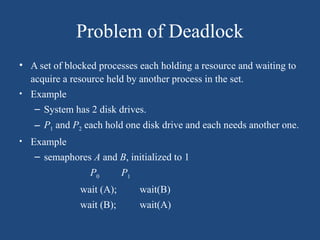
Problem of Deadlock
• A set of blocked processes each holding a resource and waiting to
acquire a resource held by another process in the set.
• Example
– System has 2 disk drives.
– P1 and P2 each hold one disk drive and each needs another one.
• Example
– semaphores A and B, initialized to 1
P0 P1
wait (A); wait(B)
wait (B); wait(A)
Bridge Crossing Example
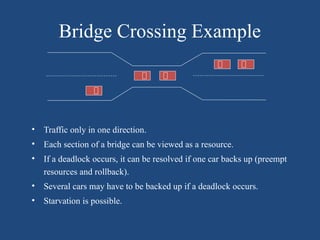
• Traffic only in one direction.
• Each section of a bridge can be viewed as a resource.
• If a deadlock occurs, it can be resolved if one car backs up (preempt
resources and rollback).
• Several cars may have to be backed up if a deadlock occurs.
• Starvation is possible.
System Model
• Resource types R1, R2, . . ., Rm
CPU cycles, memory space, I/O devices
• Each resource type Ri has Wi instances.
• Each process utilizes a resource as follows:
– request
– use
– release
Deadlock Characterization
Deadlock can arise if four conditions hold simultaneously.
• Mutual exclusion: only one process at a time can use a resource.
• Hold and wait: a process holding at least one resource is waiting to acquire additional
resources held by other processes.
• No preemption: a resource can be released only voluntarily by the process holding it, after
that process has completed its task.
• Circular wait: there exists a set {P0, P1, …, P0} of waiting processes such that P0 is waiting
for a resource that is held by P1, P1 is waiting for a resource that is held by
P2, …, Pn–1 is waiting for a resource that is held by
Pn, and P0 is waiting for a resource that is held by P0.
Resource-Allocation Graph
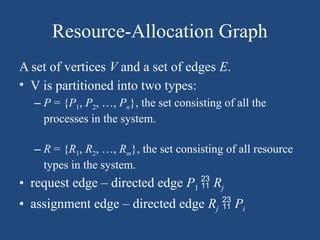
A set of vertices V and a set of edges E.
• V is partitioned into two types:
– P = {P1, P2, …, Pn}, the set consisting of all the
processes in the system.
– R = {R1, R2, …, Rm}, the set consisting of all resource
types in the system.
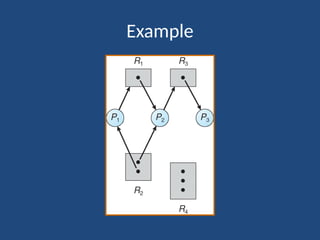
• request edge – directed edge P1  Rj
• assignment edge – directed edge Rj  Pi
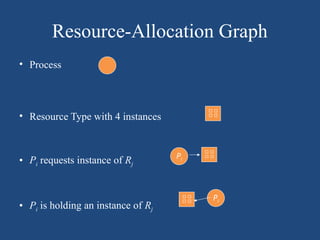
Resource-Allocation Graph
• Process
• Resource Type with 4 instances
• Pi requests instance of Rj
• Pi is holding an instance of Rj
Pi
Pi
Example
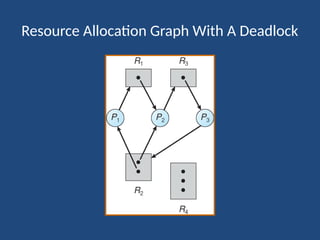
Resource Allocation Graph With A Deadlock
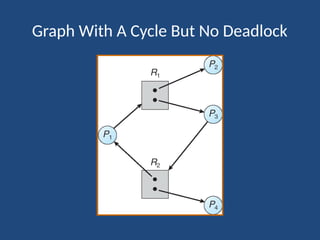
Graph With A Cycle But No Deadlock
Basic Facts
• If graph contains no cycles  no deadlock.
• If graph contains a cycle 
– if only one instance per resource type, then
deadlock.
– if several instances per resource type, possibility of
deadlock.
Methods for Handling Deadlocks
• Deadlock Prevention
- Ensure that the system will never enter
a deadlock state.
Deadlock Avoidance
-Allow the system to enter a deadlock
state and then recover.
Deadlock Detection
-Ignore the problem and pretend that deadlocks never
occur in the system
Deadlock Avoidance
• Simplest and most useful model requires that each
process declare the maximum number of resources of
each type that it may need.
• The deadlock-avoidance algorithm dynamically examines
the resource-allocation state to ensure that there can
never be a circular-wait condition.
• Resource-allocation state is defined by the number of
available and allocated resources, and the maximum
demands of the processes.
Safe State
• System is in safe state if there exists a sequence <P1, P2, …, Pn>
of ALL the processes is the systems such that for each Pi, the
resources that Pi can still request can be satisfied by currently
available resources + resources held by all the Pj, with j < i.
• That is:
– If Pi resource needs are not immediately available, then Pi can wait
until all Pj have finished.
– When Pj is finished, Pi can obtain needed resources, execute, return
allocated resources, and terminate.
– When Pi terminates, Pi +1 can obtain its needed resources, and so on.
Basic Facts
• If a system is in safe state  no deadlocks.
• If a system is in unsafe state  possibility of
deadlock.
• Avoidance  ensure that a system will never
enter an unsafe state
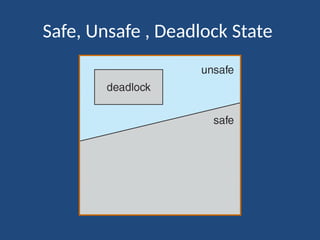
Safe, Unsafe , Deadlock State
• Multiple instances.
• Each process must a priori claim maximum use.
• When a process requests a resource it may have
to wait.
• When a process gets all its resources it must
return them in a finite amount of time
Banker’s Algorithm
Steps for Banker’s Algorithm
Let n = number of processes, and m = number of resources types.
• Available: Vector of length m. If available [j] = k, there are k
instances of resource type Rj available.
• Max: n x m matrix. If Max [i,j] = k, then process Pi may request
at most k instances of resource type Rj.
• Allocation: n x m matrix. If Allocation[i,j] = k then Pi is currently
allocated k instances of Rj.
• Need: n x m matrix. If Need[i,j] = k, then Pi may need k more
instances of Rj to complete its task.
Need [i,j] = Max[i,j] – Allocation [i,j].
Resource-Request Algorithm for Process Pi
Request = request vector for process Pi. If Requesti [j] = k then
process Pi wants k instances of resource type Rj.
1. If Requesti  Needi go to step 2. Otherwise, raise error condition,
since process has exceeded its maximum claim.
2. If Requesti  Available, go to step 3. Otherwise Pi must wait, since
resources are not available.
3. Pretend to allocate requested resources to Pi by modifying the
state as follows:
Available = Available – Request;
Allocationi = Allocationi + Requesti;
Needi = Needi – Requesti;
 If safe  the resources are allocated to Pi.
 If unsafe  Pi must wait, and the old resource-allocation state is restored
Example of Banker’s Algorithm
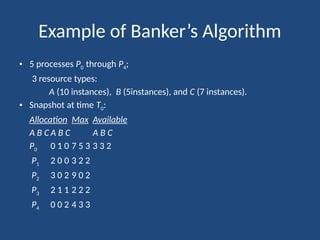
• 5 processes P0 through P4;
3 resource types:
A (10 instances), B (5instances), and C (7 instances).
• Snapshot at time T0:
Allocation Max Available
A B C A B C A B C
P0 0 1 0 7 5 3 3 3 2
P1 2 0 0 3 2 2
P2 3 0 2 9 0 2
P3 2 1 1 2 2 2
P4 0 0 2 4 3 3
Example
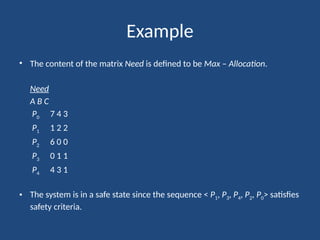
• The content of the matrix Need is defined to be Max – Allocation.
Need
A B C
P0 7 4 3
P1 1 2 2
P2 6 0 0
P3 0 1 1
P4 4 3 1
• The system is in a safe state since the sequence < P1, P3, P4, P2, P0> satisfies
safety criteria.
Recovery from Deadlock: Process
Termination
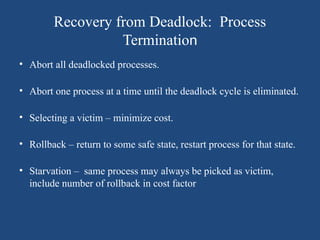
• Abort all deadlocked processes.
• Abort one process at a time until the deadlock cycle is eliminated.
• Selecting a victim – minimize cost.
• Rollback – return to some safe state, restart process for that state.
• Starvation – same process may always be picked as victim,
include number of rollback in cost factor
Thank You

Deadlock in Operating SystemSystem Model Deadlock Characterization

  • 1.
    Deadlock in OperatingSystem By Mrs.R.SABITHA .,M.Sc.,M.Phil., Assistant Professor, Department of Computer Science(SF) V.V.Vanniaperumal College for Women, Virudhunagar.
  • 2.
    Contents  System Model Deadlock Characterization  Methods for Handling Deadlocks  Deadlock Prevention  Deadlock Avoidance  Deadlock Detection
  • 3.
    Problem of Deadlock •A set of blocked processes each holding a resource and waiting to acquire a resource held by another process in the set. • Example – System has 2 disk drives. – P1 and P2 each hold one disk drive and each needs another one. • Example – semaphores A and B, initialized to 1 P0 P1 wait (A); wait(B) wait (B); wait(A)
  • 4.
    Bridge Crossing Example •Traffic only in one direction. • Each section of a bridge can be viewed as a resource. • If a deadlock occurs, it can be resolved if one car backs up (preempt resources and rollback). • Several cars may have to be backed up if a deadlock occurs. • Starvation is possible.
  • 5.
    System Model • Resourcetypes R1, R2, . . ., Rm CPU cycles, memory space, I/O devices • Each resource type Ri has Wi instances. • Each process utilizes a resource as follows: – request – use – release
  • 6.
    Deadlock Characterization Deadlock canarise if four conditions hold simultaneously. • Mutual exclusion: only one process at a time can use a resource. • Hold and wait: a process holding at least one resource is waiting to acquire additional resources held by other processes. • No preemption: a resource can be released only voluntarily by the process holding it, after that process has completed its task. • Circular wait: there exists a set {P0, P1, …, P0} of waiting processes such that P0 is waiting for a resource that is held by P1, P1 is waiting for a resource that is held by P2, …, Pn–1 is waiting for a resource that is held by Pn, and P0 is waiting for a resource that is held by P0.
  • 7.
    Resource-Allocation Graph A setof vertices V and a set of edges E. • V is partitioned into two types: – P = {P1, P2, …, Pn}, the set consisting of all the processes in the system. – R = {R1, R2, …, Rm}, the set consisting of all resource types in the system. • request edge – directed edge P1  Rj • assignment edge – directed edge Rj  Pi
  • 8.
    Resource-Allocation Graph • Process •Resource Type with 4 instances • Pi requests instance of Rj • Pi is holding an instance of Rj Pi Pi
  • 9.
  • 10.
  • 11.
    Graph With ACycle But No Deadlock
  • 12.
    Basic Facts • Ifgraph contains no cycles  no deadlock. • If graph contains a cycle  – if only one instance per resource type, then deadlock. – if several instances per resource type, possibility of deadlock.
  • 13.
    Methods for HandlingDeadlocks • Deadlock Prevention - Ensure that the system will never enter a deadlock state. Deadlock Avoidance -Allow the system to enter a deadlock state and then recover. Deadlock Detection -Ignore the problem and pretend that deadlocks never occur in the system
  • 14.
    Deadlock Avoidance • Simplestand most useful model requires that each process declare the maximum number of resources of each type that it may need. • The deadlock-avoidance algorithm dynamically examines the resource-allocation state to ensure that there can never be a circular-wait condition. • Resource-allocation state is defined by the number of available and allocated resources, and the maximum demands of the processes.
  • 15.
    Safe State • Systemis in safe state if there exists a sequence <P1, P2, …, Pn> of ALL the processes is the systems such that for each Pi, the resources that Pi can still request can be satisfied by currently available resources + resources held by all the Pj, with j < i. • That is: – If Pi resource needs are not immediately available, then Pi can wait until all Pj have finished. – When Pj is finished, Pi can obtain needed resources, execute, return allocated resources, and terminate. – When Pi terminates, Pi +1 can obtain its needed resources, and so on.
  • 16.
    Basic Facts • Ifa system is in safe state  no deadlocks. • If a system is in unsafe state  possibility of deadlock. • Avoidance  ensure that a system will never enter an unsafe state
  • 17.
    Safe, Unsafe ,Deadlock State
  • 18.
    • Multiple instances. •Each process must a priori claim maximum use. • When a process requests a resource it may have to wait. • When a process gets all its resources it must return them in a finite amount of time Banker’s Algorithm
  • 19.
    Steps for Banker’sAlgorithm Let n = number of processes, and m = number of resources types. • Available: Vector of length m. If available [j] = k, there are k instances of resource type Rj available. • Max: n x m matrix. If Max [i,j] = k, then process Pi may request at most k instances of resource type Rj. • Allocation: n x m matrix. If Allocation[i,j] = k then Pi is currently allocated k instances of Rj. • Need: n x m matrix. If Need[i,j] = k, then Pi may need k more instances of Rj to complete its task. Need [i,j] = Max[i,j] – Allocation [i,j].
  • 20.
    Resource-Request Algorithm forProcess Pi Request = request vector for process Pi. If Requesti [j] = k then process Pi wants k instances of resource type Rj. 1. If Requesti  Needi go to step 2. Otherwise, raise error condition, since process has exceeded its maximum claim. 2. If Requesti  Available, go to step 3. Otherwise Pi must wait, since resources are not available. 3. Pretend to allocate requested resources to Pi by modifying the state as follows: Available = Available – Request; Allocationi = Allocationi + Requesti; Needi = Needi – Requesti;  If safe  the resources are allocated to Pi.  If unsafe  Pi must wait, and the old resource-allocation state is restored
  • 21.
    Example of Banker’sAlgorithm • 5 processes P0 through P4; 3 resource types: A (10 instances), B (5instances), and C (7 instances). • Snapshot at time T0: Allocation Max Available A B C A B C A B C P0 0 1 0 7 5 3 3 3 2 P1 2 0 0 3 2 2 P2 3 0 2 9 0 2 P3 2 1 1 2 2 2 P4 0 0 2 4 3 3
  • 22.
    Example • The contentof the matrix Need is defined to be Max – Allocation. Need A B C P0 7 4 3 P1 1 2 2 P2 6 0 0 P3 0 1 1 P4 4 3 1 • The system is in a safe state since the sequence < P1, P3, P4, P2, P0> satisfies safety criteria.
  • 23.
    Recovery from Deadlock:Process Termination • Abort all deadlocked processes. • Abort one process at a time until the deadlock cycle is eliminated. • Selecting a victim – minimize cost. • Rollback – return to some safe state, restart process for that state. • Starvation – same process may always be picked as victim, include number of rollback in cost factor
  • 24.