CS 2110
CS 2110
Operating System
Operating System
Lecture #7
Lecture #7
Deadlock
Deadlock
Lecture Outline
Lecture Outline
Introduction
Introduction
What is Deadlock?
What is Deadlock?
A set of blocked processes each holding a resource
and waiting to acquire a resource held by another
process in the set
Example
Example
o System has 2 tape drives
o P1 and P2 each hold one tape drive and each
needs another one
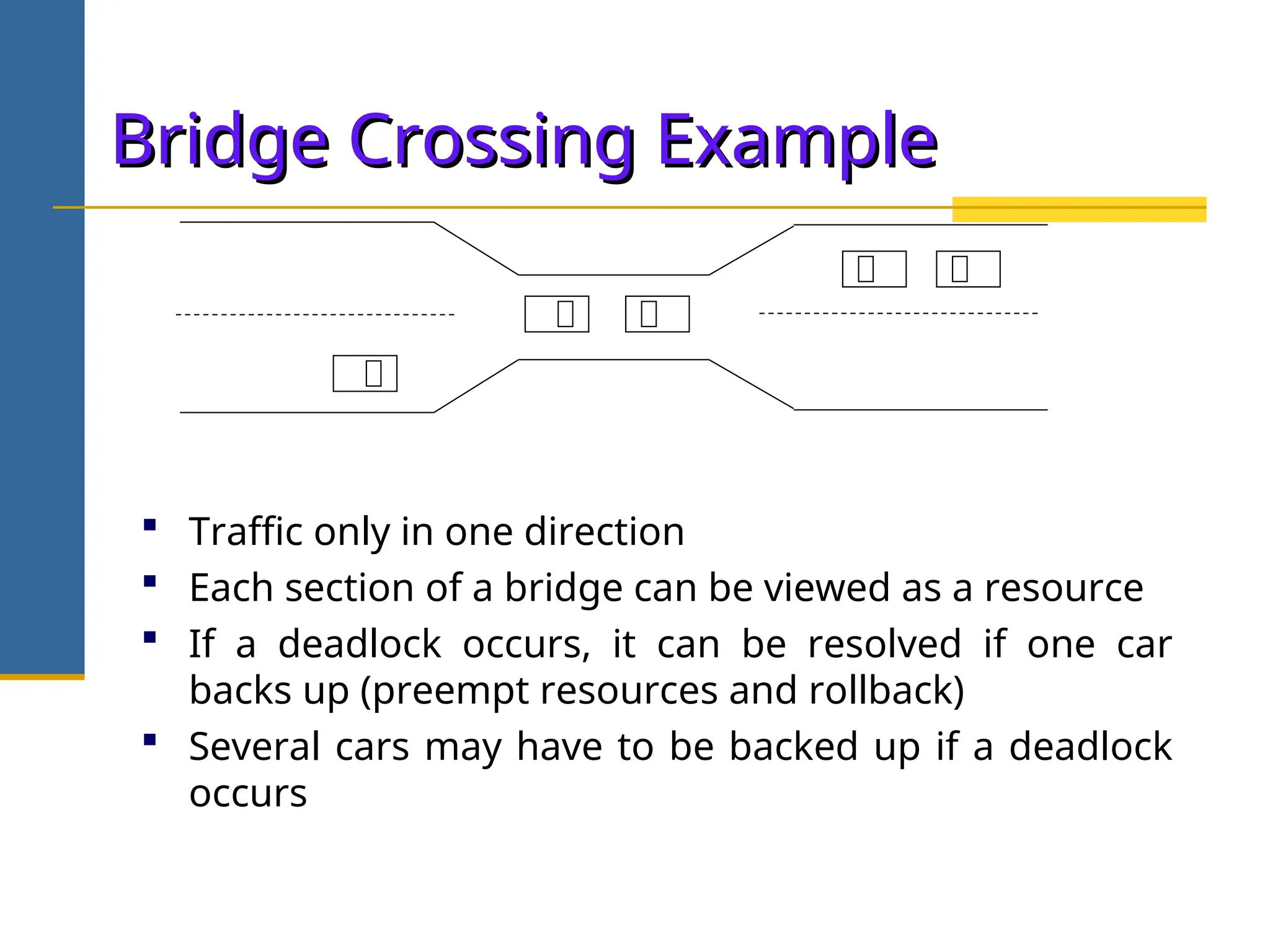
Bridge Crossing Example
 Traffic only in one direction
 Each section of a bridge can be viewed as a resource
 If a deadlock occurs, it can be resolved if one car
backs up (preempt resources and rollback)
 Several cars may have to be backed up if a deadlock
occurs
System Model
System Model
 Resource types R1, R2, . . ., Rm
o CPU cycles, memory space, I/O devices
 Each resource type Ri has Wi instances.
 Each process utilizes a resource as follows:
o request
o use
o release
Deadlock Characterization
 Mutual exclusion:
Mutual exclusion: only one process at a time can use a
resource.
 Hold and wait:
Hold and wait: a process holding at least one resource
is waiting to acquire additional resources held by other
processes.
 No preemption:
No preemption: a resource can be released only
voluntarily by the process holding it, after that process
has completed its task.
 Circular wait:
Circular wait: there exists a set {P0, P1, …, Pn} of waiting
processes such that P0 is waiting for a resource that is
held by P1, P1 is waiting for a resource that is held by
 P2, …, Pn–1 is waiting for a resource that is held by
Pn, and P0 is waiting for a resource that is held by Pn.
Deadlock can arise if four conditions hold simultaneously.
Resource-Allocation Graph
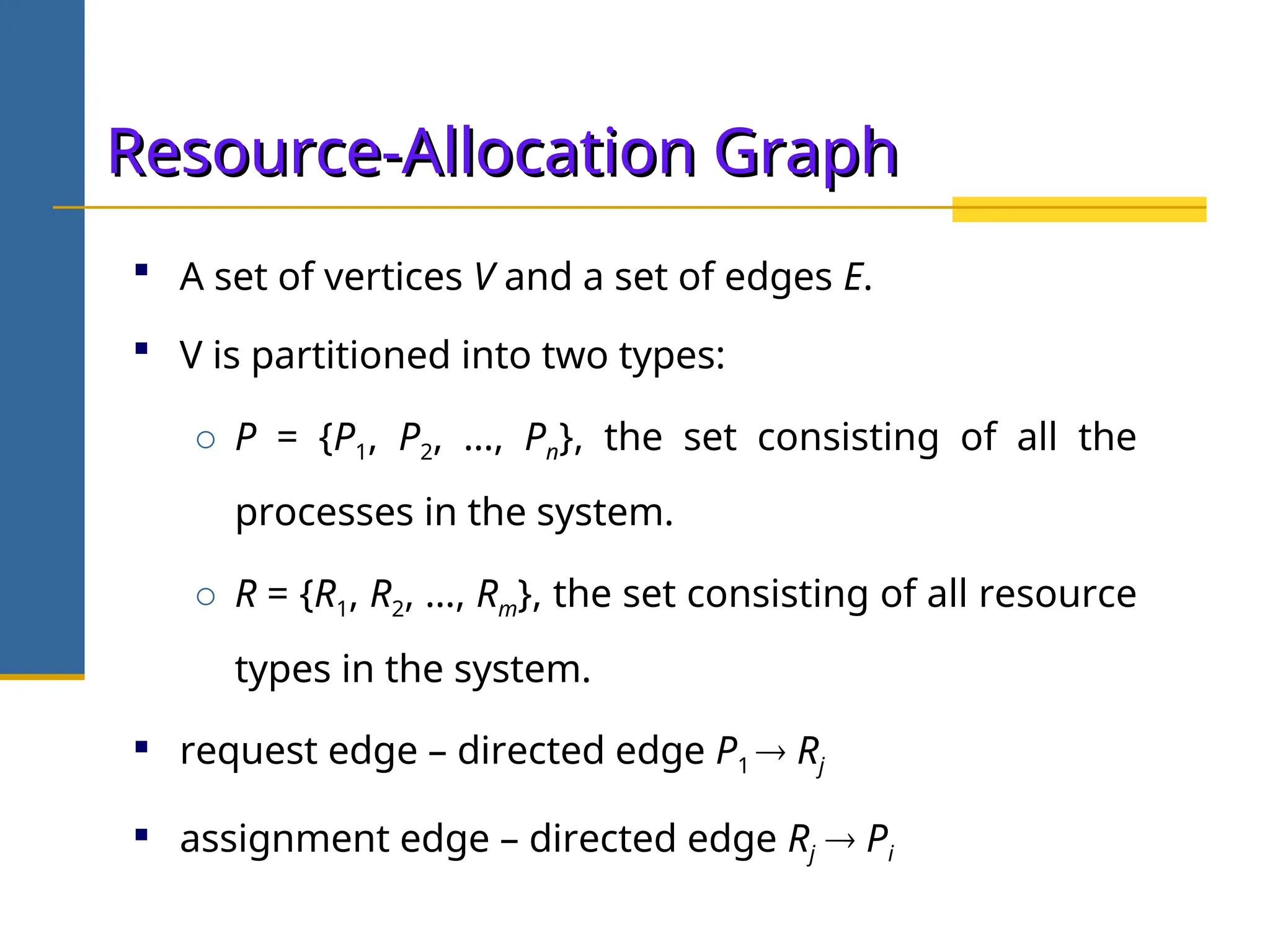
 A set of vertices V and a set of edges E.
 V is partitioned into two types:
o P = {P1, P2, …, Pn}, the set consisting of all the
processes in the system.
o R = {R1, R2, …, Rm}, the set consisting of all resource
types in the system.
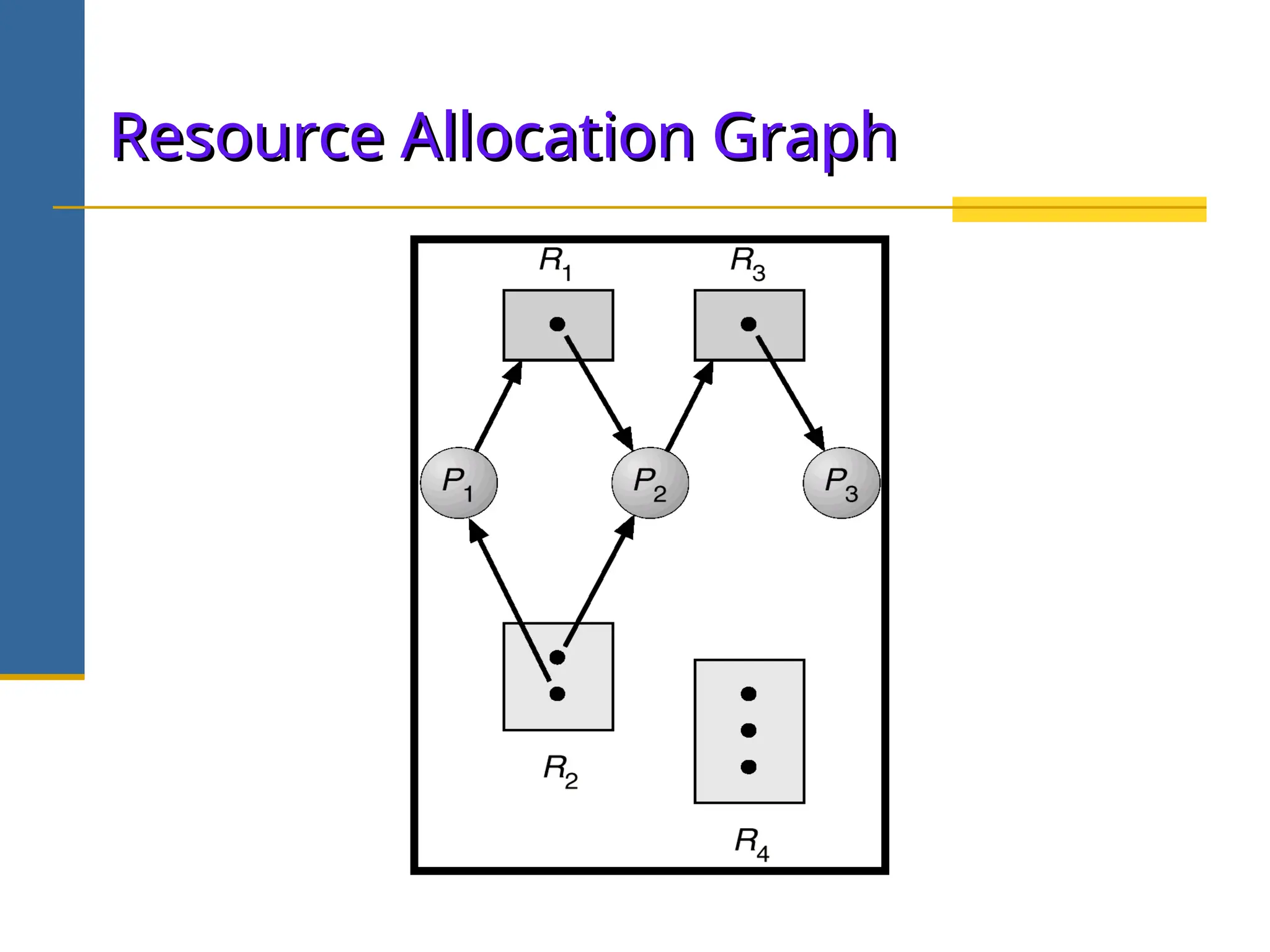
 request edge – directed edge P1  Rj
 assignment edge – directed edge Rj  Pi
Resource-Allocation Graph
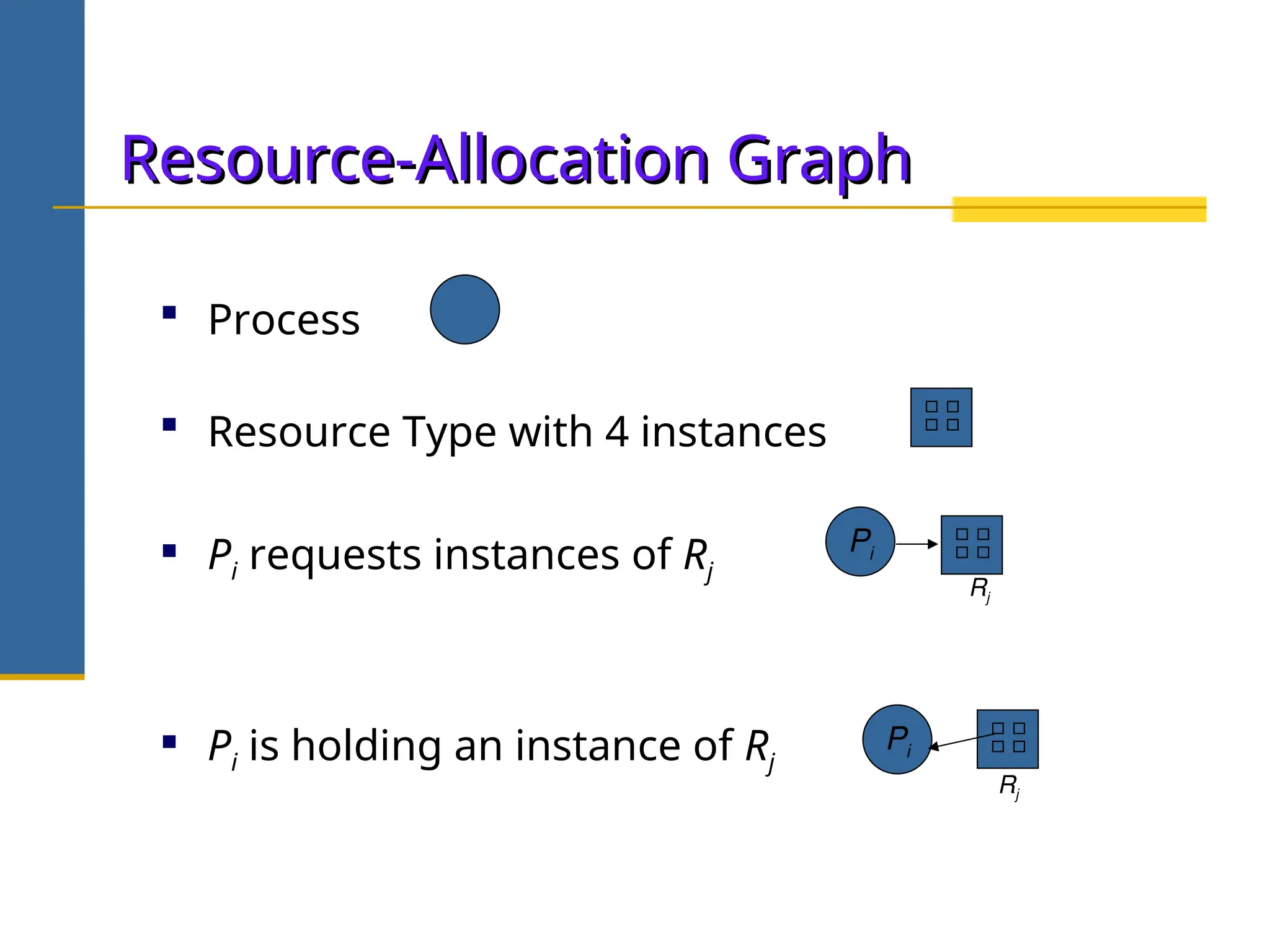
 Process
 Resource Type with 4 instances
 Pi requests instances of Rj
 Pi is holding an instance of Rj
Pi
Rj
Rj
Pi
Resource Allocation Graph
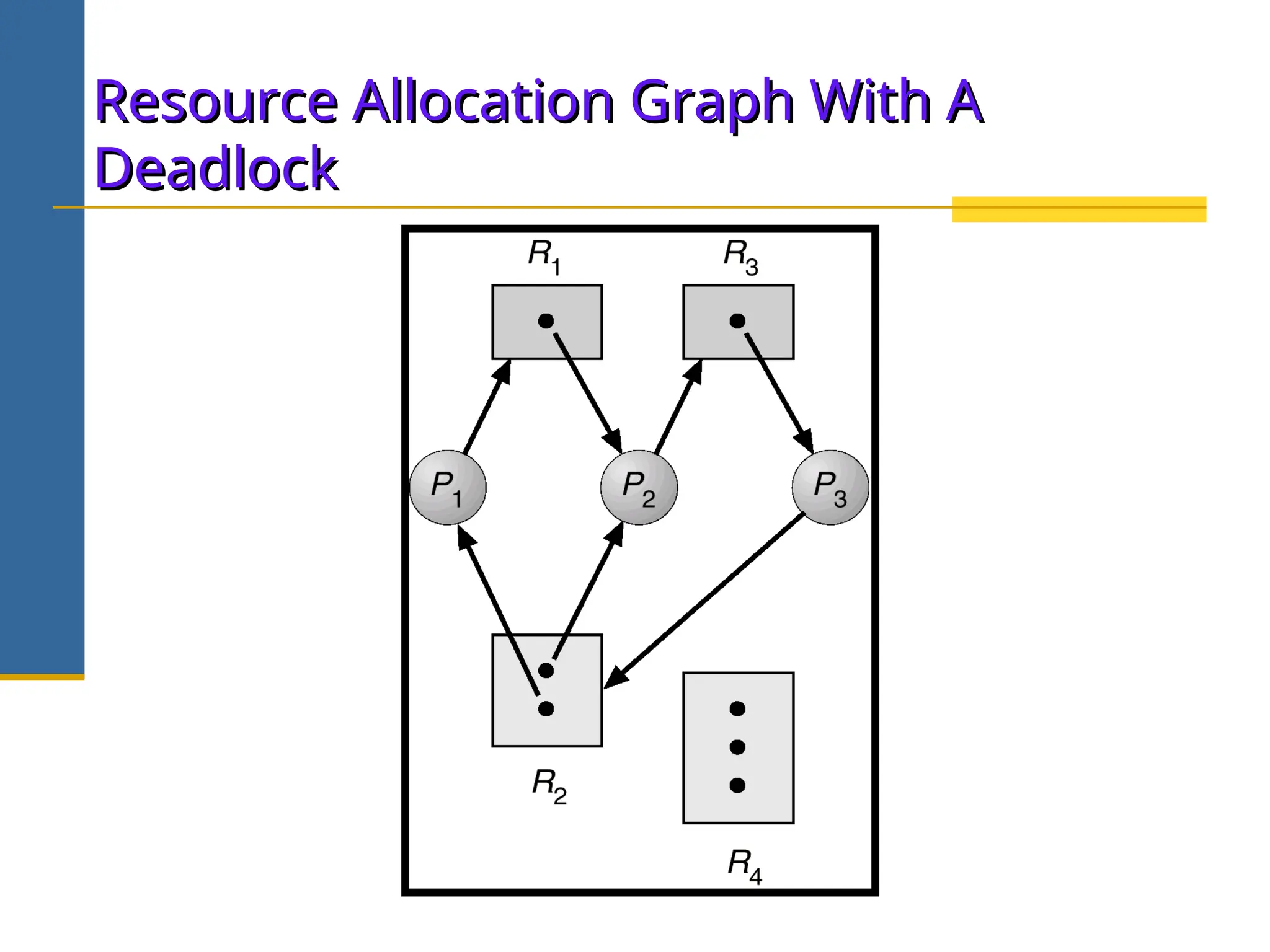
Resource Allocation Graph With A
Deadlock
Deadlock
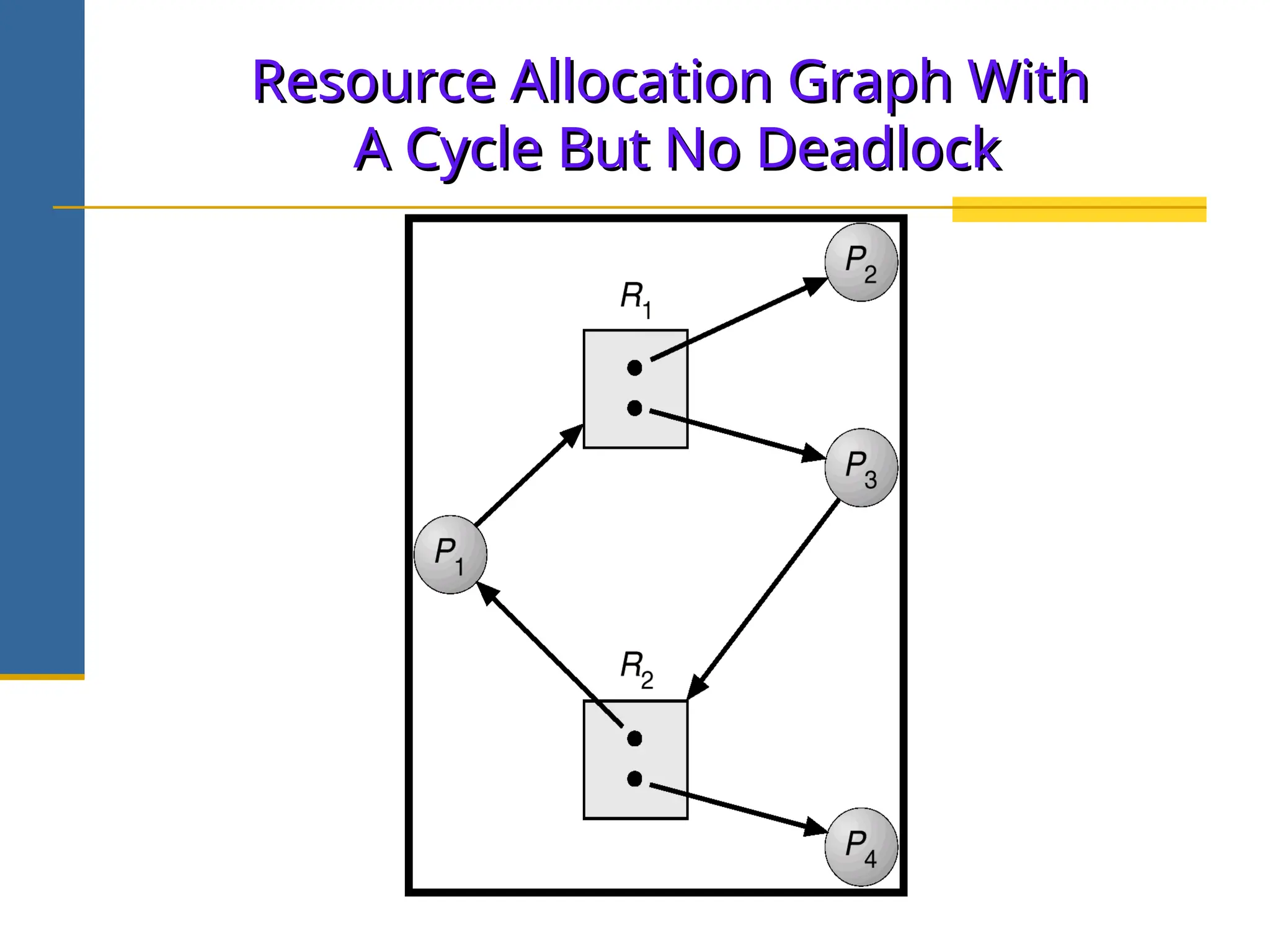
Resource Allocation Graph With
A Cycle But No Deadlock
Basic Facts
Basic Facts
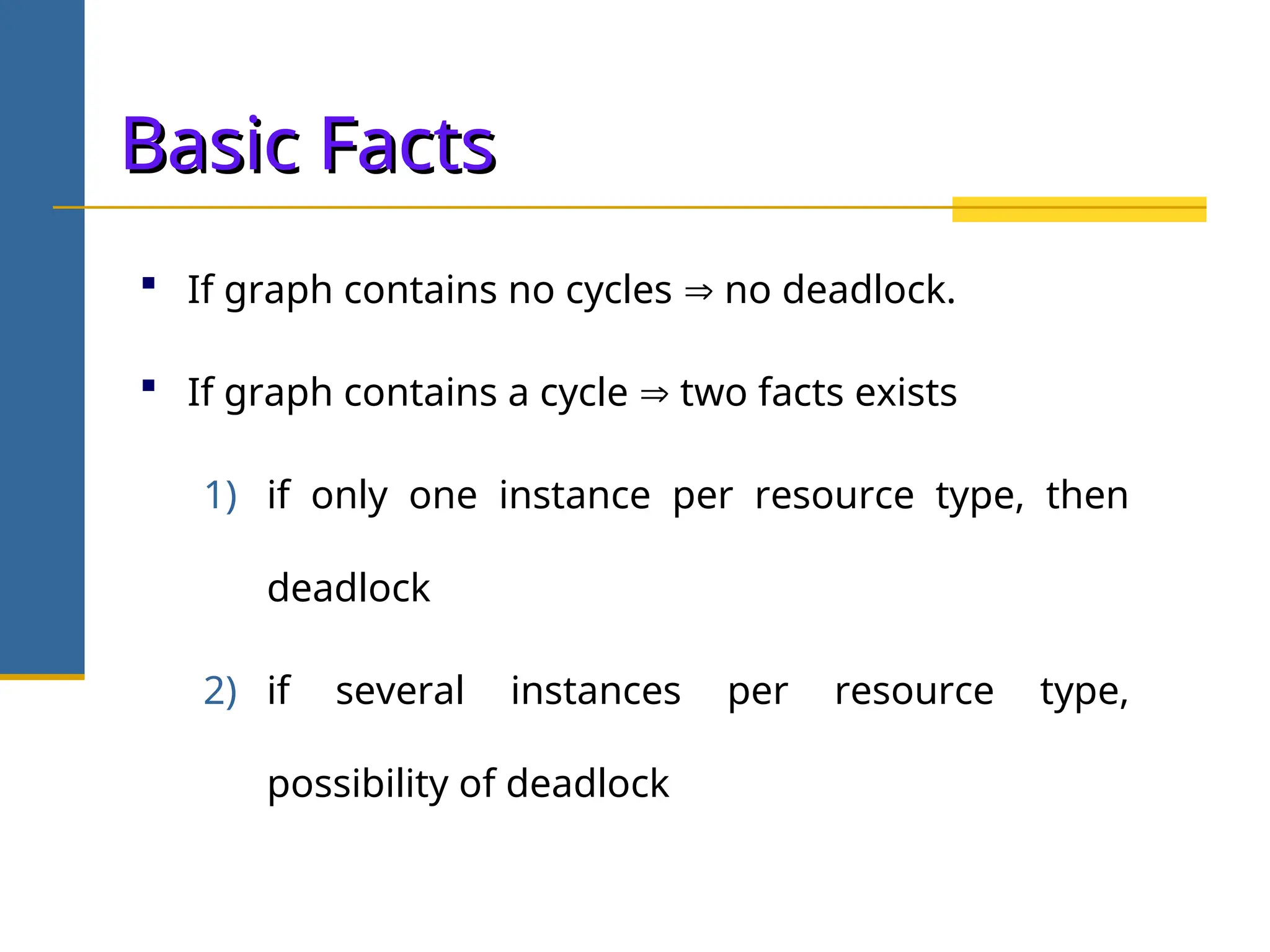
 If graph contains no cycles  no deadlock.
 If graph contains a cycle  two facts exists
1) if only one instance per resource type, then
deadlock
2) if several instances per resource type,
possibility of deadlock
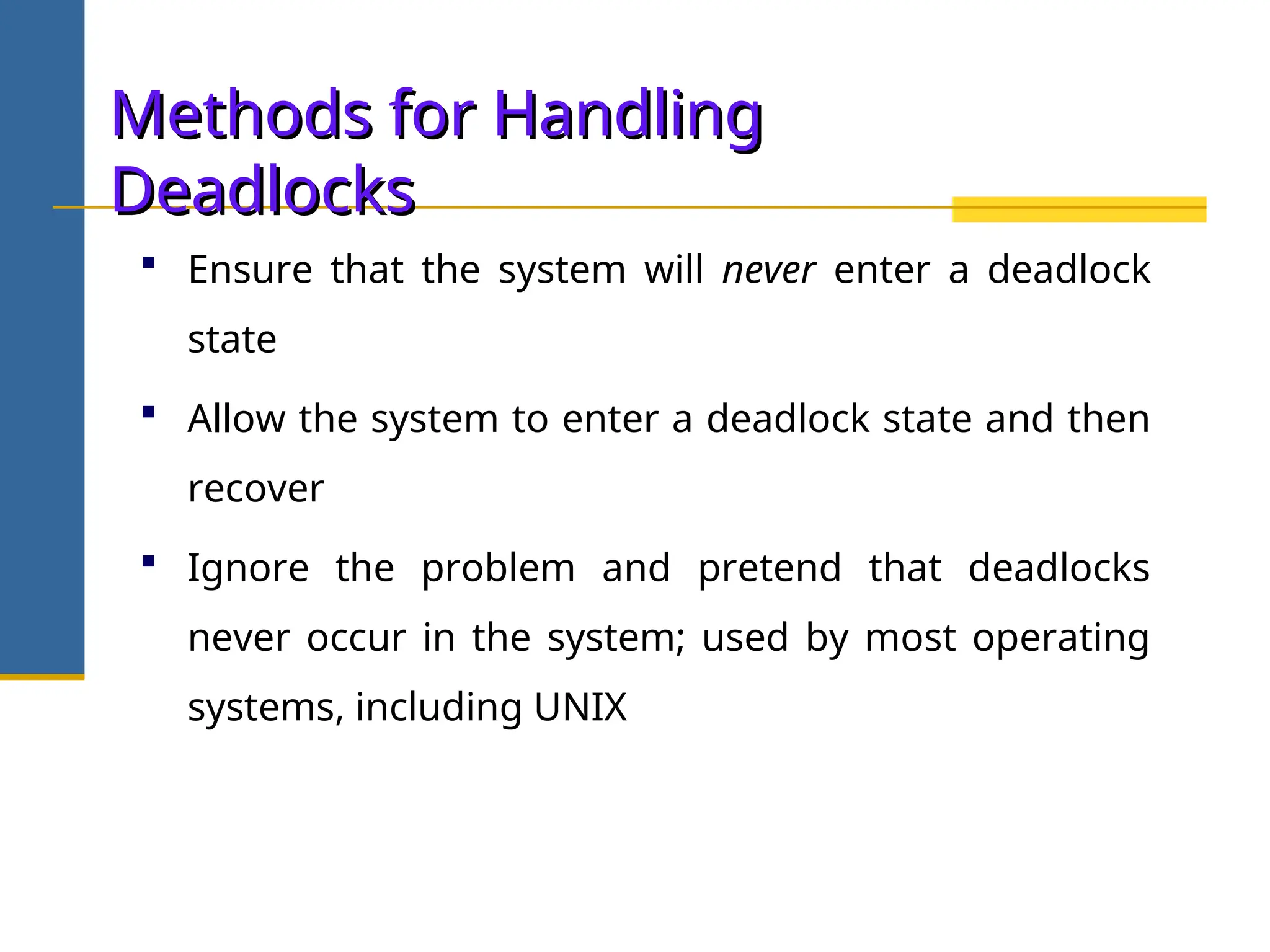
Methods for Handling
Deadlocks
Deadlocks
 Ensure that the system will never enter a deadlock
state
 Allow the system to enter a deadlock state and then
recover
 Ignore the problem and pretend that deadlocks
never occur in the system; used by most operating
systems, including UNIX
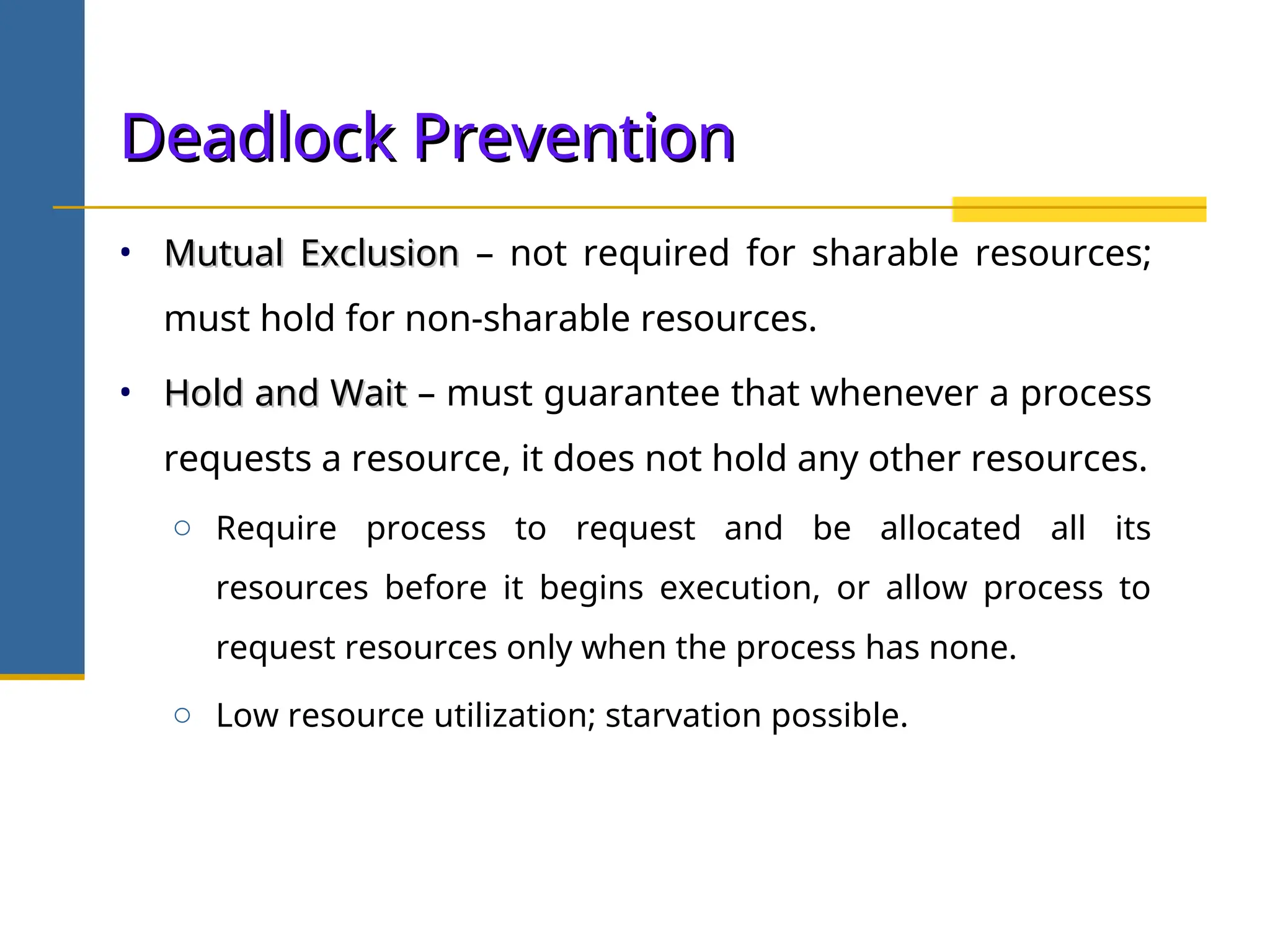
Deadlock Prevention
Deadlock Prevention
• Mutual Exclusion
Mutual Exclusion – not required for sharable resources;
must hold for non-sharable resources.
• Hold and Wait
Hold and Wait – must guarantee that whenever a process
requests a resource, it does not hold any other resources.
o Require process to request and be allocated all its
resources before it begins execution, or allow process to
request resources only when the process has none.
o Low resource utilization; starvation possible.
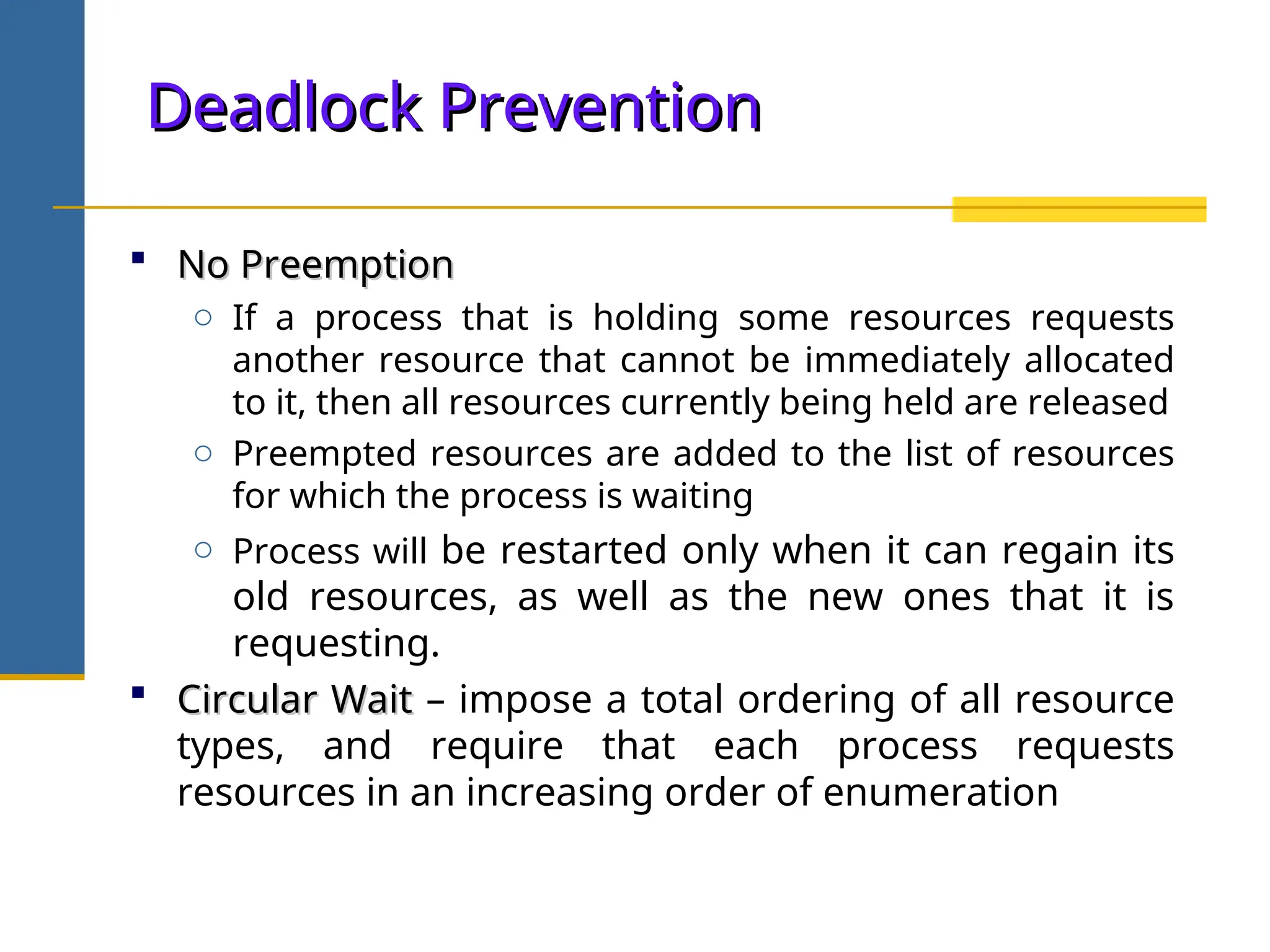
Deadlock Prevention
Deadlock Prevention
 No Preemption
No Preemption
o If a process that is holding some resources requests
another resource that cannot be immediately allocated
to it, then all resources currently being held are released
o Preempted resources are added to the list of resources
for which the process is waiting
o Process will be restarted only when it can regain its
old resources, as well as the new ones that it is
requesting.
 Circular Wait
Circular Wait – impose a total ordering of all resource
types, and require that each process requests
resources in an increasing order of enumeration
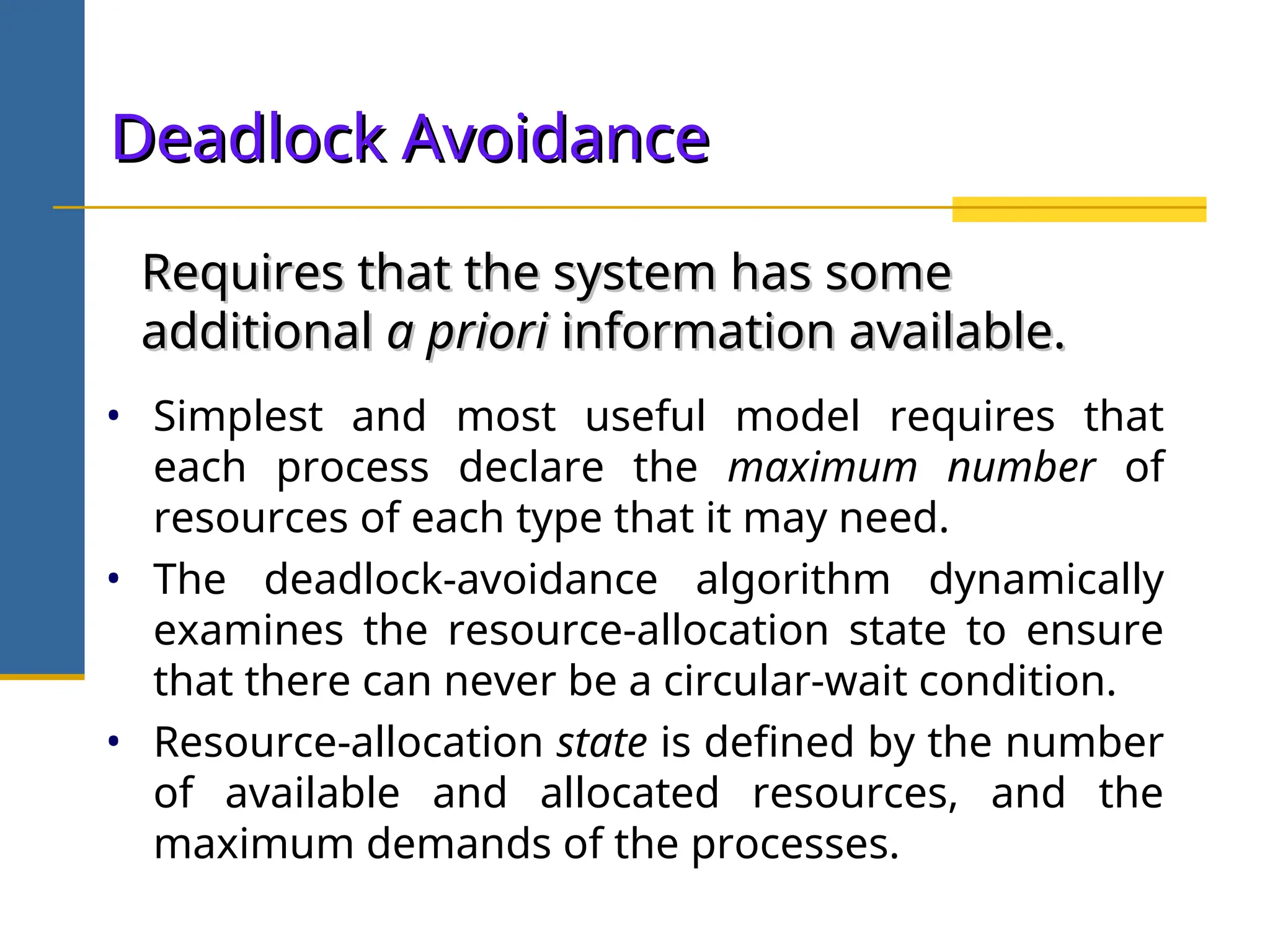
Deadlock Avoidance
Deadlock Avoidance
• Simplest and most useful model requires that
each process declare the maximum number of
resources of each type that it may need.
• The deadlock-avoidance algorithm dynamically
examines the resource-allocation state to ensure
that there can never be a circular-wait condition.
• Resource-allocation state is defined by the number
of available and allocated resources, and the
maximum demands of the processes.
Requires that the system has some
additional
additional a priori
a priori information available.
information available.
Safe State
Safe State
• When a process requests an available resource,
system must decide if immediate allocation
leaves the system in a safe state.
• System is in safe state if there exists a safe
sequence of all processes.
• Sequence <P1, P2, …, Pn> is safe if for each Pi, the resources that
Pi can still request can be satisfied by currently available
resources + resources held by all the Pj, with j<i.
− If Pi resource needs are not immediately available, then Pi
can wait until all Pj have finished.
− When Pj is finished, Pi can obtain needed resources,
execute, return allocated resources, and terminate.
− When Pi terminates, Pi+1 can obtain its needed resources,
and so on.
Safe State
Safe State
Basic Facts
Basic Facts
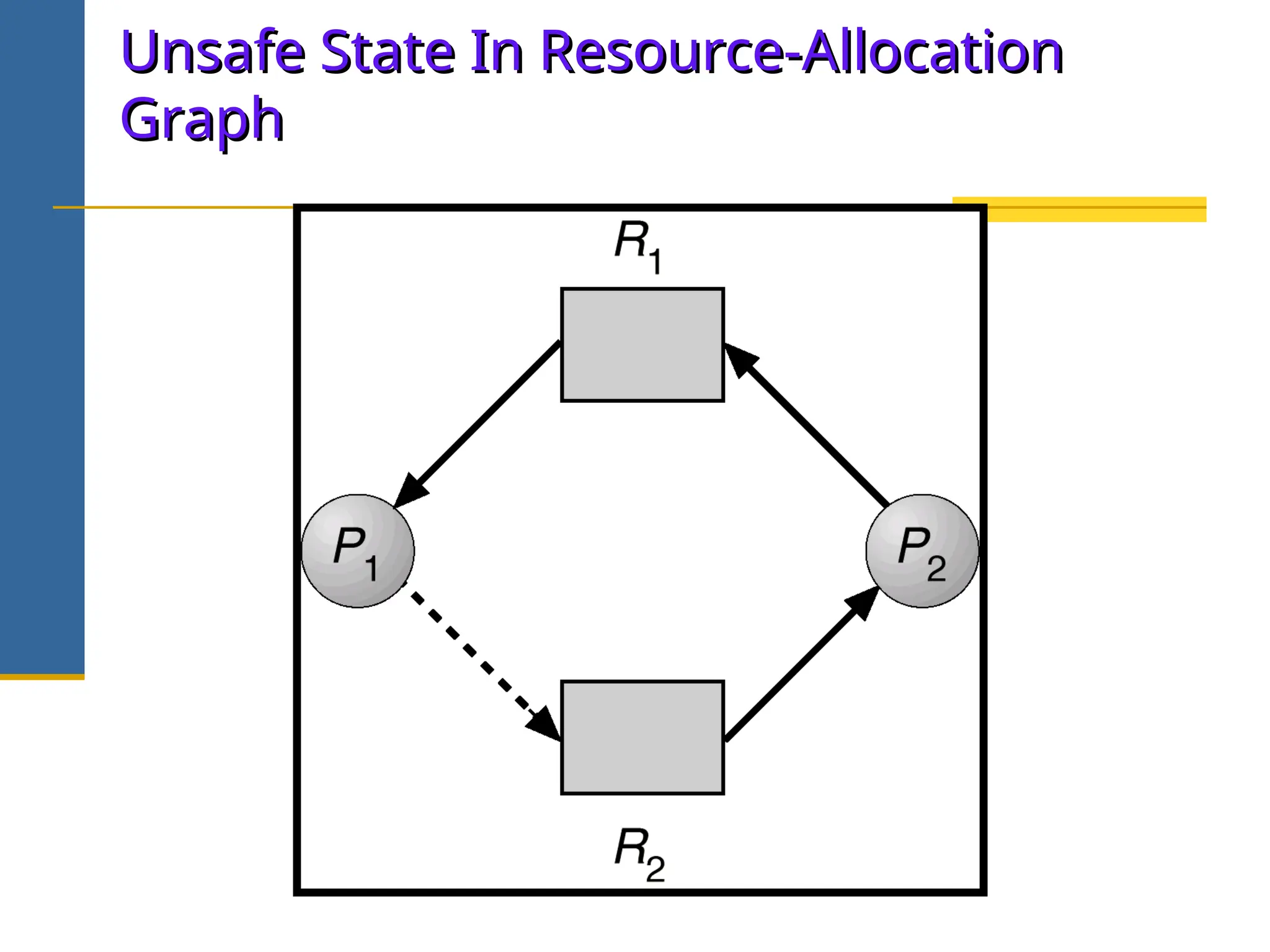
• If a system is in safe state  no deadlocks.
• If a system is in unsafe state  possibility of
deadlock.
• Avoidance  ensure that a system will never enter
an unsafe state.
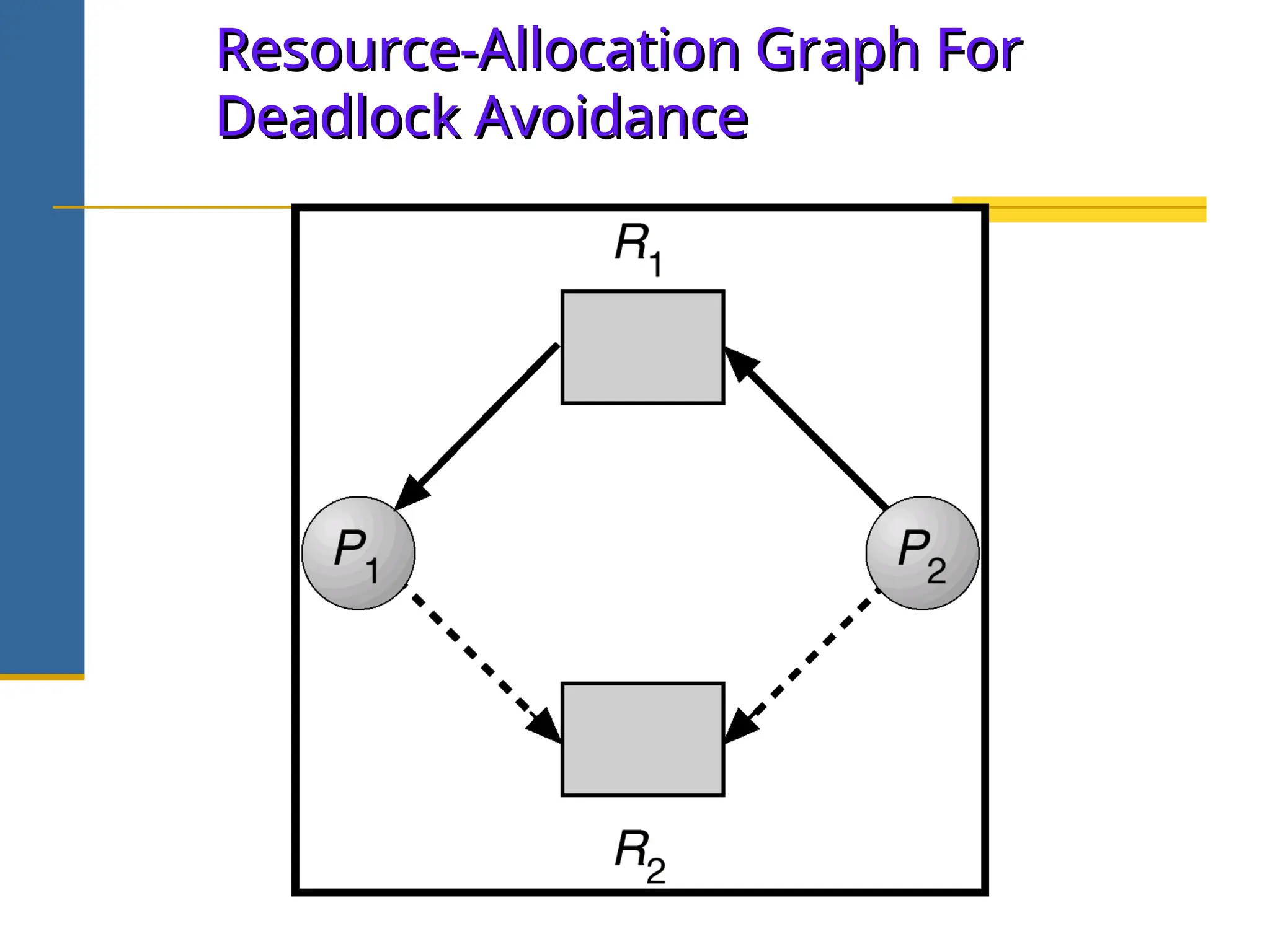
Resource-Allocation Graph Algorithm
• Claim edge P
Pi
i  R
Rj
j indicated that process P
Pi
i may
request resource Rj; represented by a dashed line.
• Claim edge converts to request edge when a
process requests a resource
• When a resource is released by a process,
assignment edge reconverts to a claim edge.
• Resources must be claimed a priori in the system.
Resource-Allocation Graph For
Deadlock Avoidance
Deadlock Avoidance
Unsafe State In Resource-Allocation
Graph
Graph
Deadlock Detection
Deadlock Detection
• Allow system to enter deadlock state
• Detection algorithm
• Recovery scheme
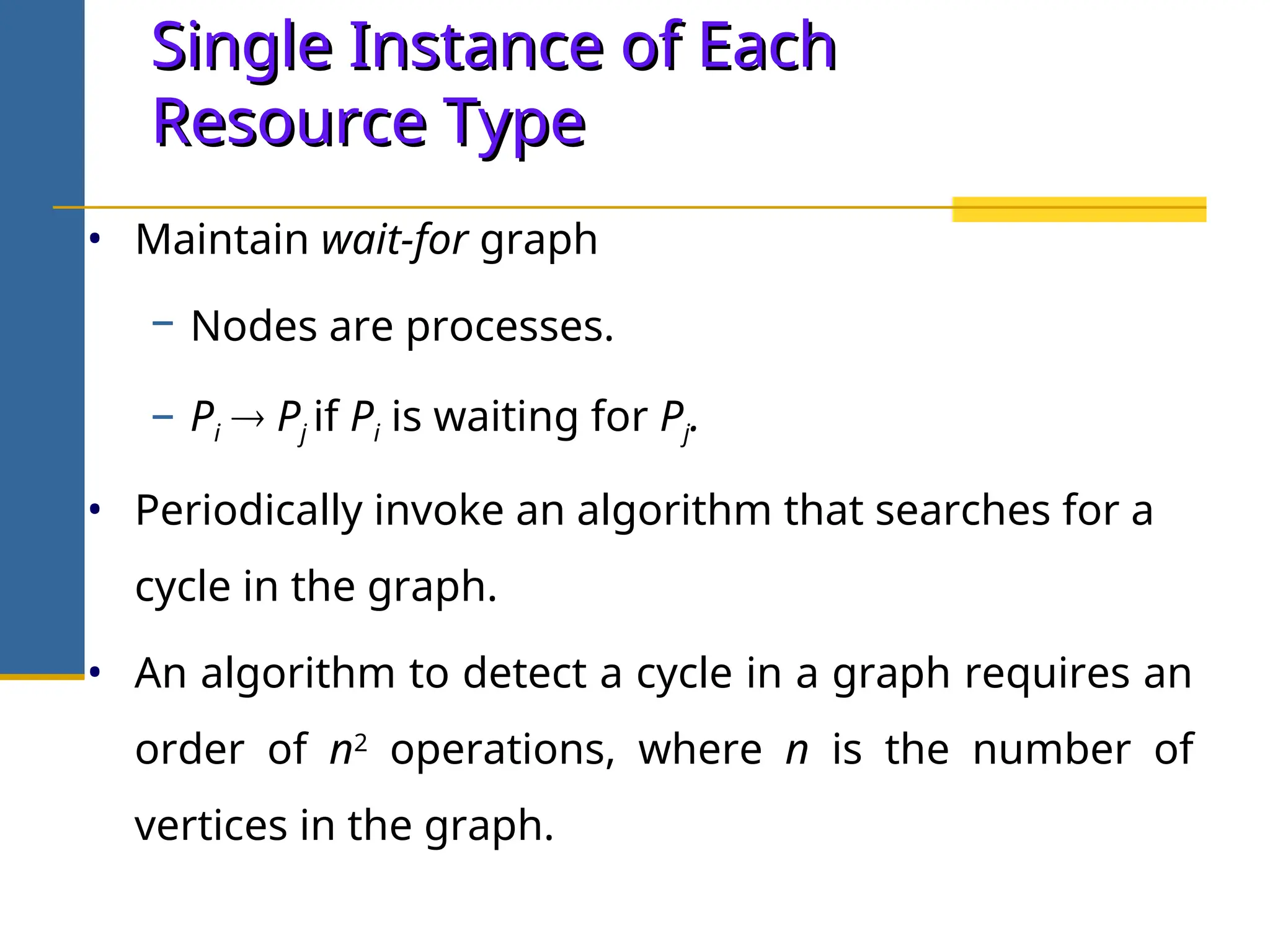
Single Instance of Each
Resource Type
Resource Type
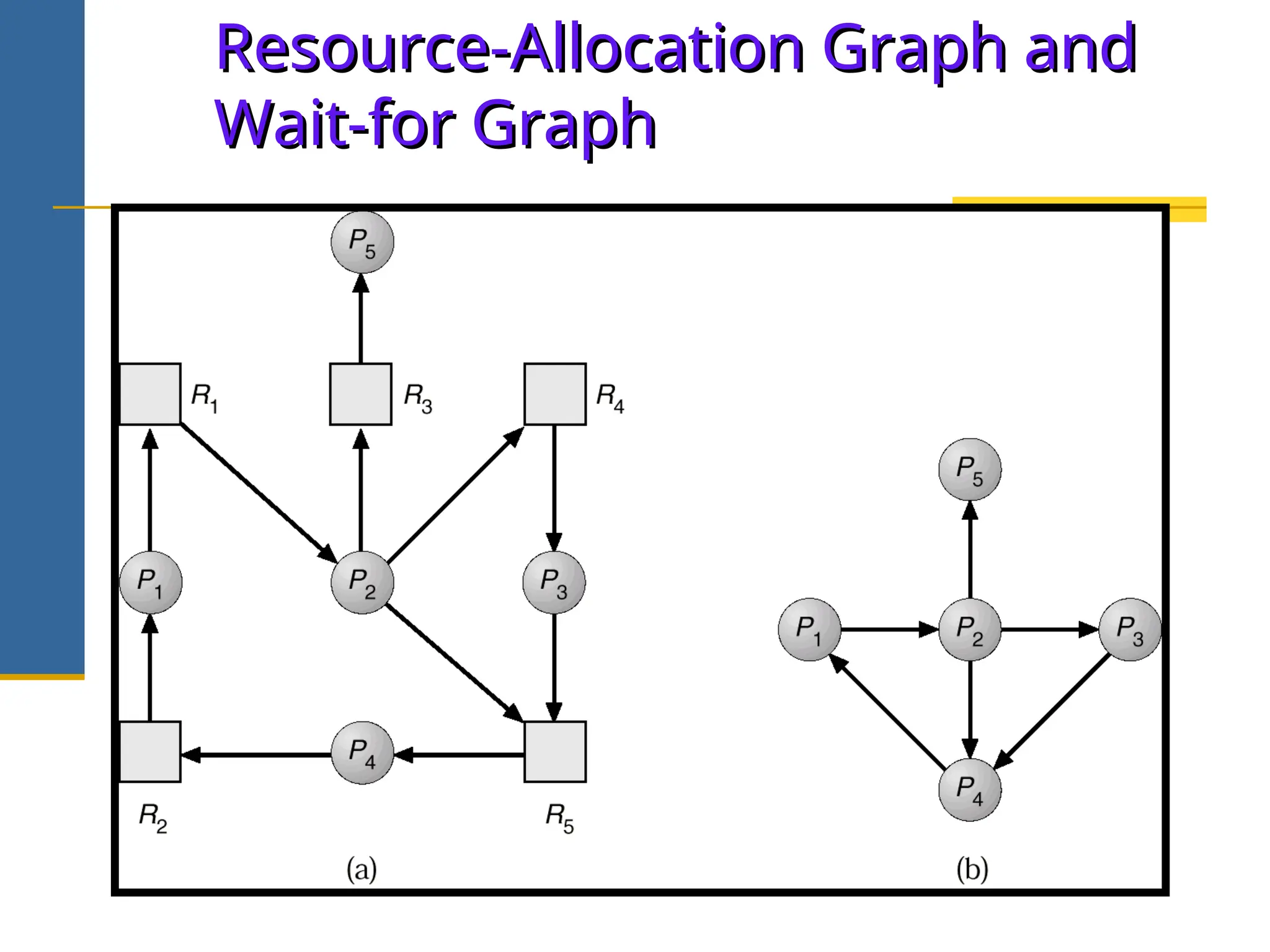
• Maintain wait-for graph
− Nodes are processes.
− Pi  Pj if Pi is waiting for Pj.
• Periodically invoke an algorithm that searches for a
cycle in the graph.
• An algorithm to detect a cycle in a graph requires an
order of n2
operations, where n is the number of
vertices in the graph.
Resource-Allocation Graph and
Wait-for Graph
Wait-for Graph
Several Instances of a Resource
Type
Type
• Available:
Available: A vector of length m indicates the number
of available resources of each type.
• Allocation:
Allocation: An n x m matrix defines the number of
resources of each type currently allocated to each
process.
• Request:
Request: An n x m matrix indicates the current request
of each process. If Request [ij] = k, then process Pi is
requesting k more instances of resource type. Rj.
Banker’s Algorithm
Banker’s Algorithm
• Banker's algorithm is a deadlock avoidance algorithm
deadlock avoidance algorithm.
• It is named so because this algorithm is used in
banking systems to determine whether a loan can be
granted or not.
• Consider there are N account holders in a bank and
the sum of the money in all of their accounts is S
• Every time a loan has to be granted by the bank, it
subtracts the loan amount
loan amount from the total money
total money the
bank has.
• Then it checks if that difference is greater than S
• It is done because, only then, the bank would have
enough money even if all the N account holders
draw all their money at once
• Banker's algorithm works in a similar way in
computers
• Whenever a new process is created, it must specify
the maximum instances of each resource type that
it needs, exactly.
Banker’s Algorithm
Banker’s Algorithm
• Let us assume that there are n processes
and m resource types.
• Some data structures that are used to implement
the banker's algorithm are:
 Available
Available
• It is an array of length m. It represents the number of
available resources of each type. If Available[j] = k, then
there are k instances available, of resource type R(j).
 Max
Max
• It is an n x m matrix which represents the maximum
number of instances of each resource that a
process can request. If Max[i][j] = k, then the
process P(i) can request atmost k instances of
resource type R(j).
Banker’s Algorithm
Banker’s Algorithm
Allocation
Allocation
•It is an n x m matrix which represents the number
of resources of each type currently allocated to
each process. If Allocation[i][j] = k, then
process P(i) is currently allocated k instances of
resource type R(j).
Need
Need
•It is an n x m matrix which indicates the
remaining resource needs of each process.
If Need[i][j] = k, then process P(i) may need k more
instances of resource type R(j) to complete its task.
Banker’s Algorithm
Banker’s Algorithm
Data Structures for the
Banker’s Algorithm
Banker’s Algorithm
• Available: Vector of length m. If available [j] = k,
there are k instances of resource type Rj available.
• Max: n x m matrix. If Max [i,j] = k, then process Pi
may request at most k instances of resource type Rj.
• Allocation: n x m matrix. If Allocation[i,j] = k then Pi
is currently allocated k instances of Rj.
• Need: n x m matrix. If Need[i,j] = k, then Pi may need
k more instances of Rj to complete its task.
• Need [i,j] = Max[i,j] – Allocation [i,j].
Let n = number of processes, and m = number of
resources types.
Safety Algorithm
Safety Algorithm
1. Let Work and Finish be vectors of length m
and n, respectively. Initialize:
Work = Available
Finish [i] = false for i = 1,2,3, …, n.
2. Find and i such that both:
(a) Finish [i] = false
(b) Needi  Work
If no such i exists, go to step 4.
3. Work = Work + Allocationi
Finish [i] = true
go to step 2.
4. If Finish [i] == true for all i, then the system is
in a safe state.
Resource-Request Algorithm
for Process
for Process P
Pi
i
Request = request vector for process Pi. If Requesti [j] = k then
process Pi wants k instances of resource type Rj.
1. If Requesti  Needi go to step 2. Otherwise, raise error
condition, since process has exceeded its maximum
claim.
2. If Requesti  Available, go to step 3. Otherwise Pi must
wait, since resources are not available.
3. Pretend to allocate requested resources to Pi by
modifying the state as follows:
Available = Available + Requesti;
Allocationi = Allocationi + Requesti;
Needi = Needi – Requesti;;
• If safe  the resources are allocated to Pi.
• If unsafe  Pi must wait, and the old resource-
allocation state is restored
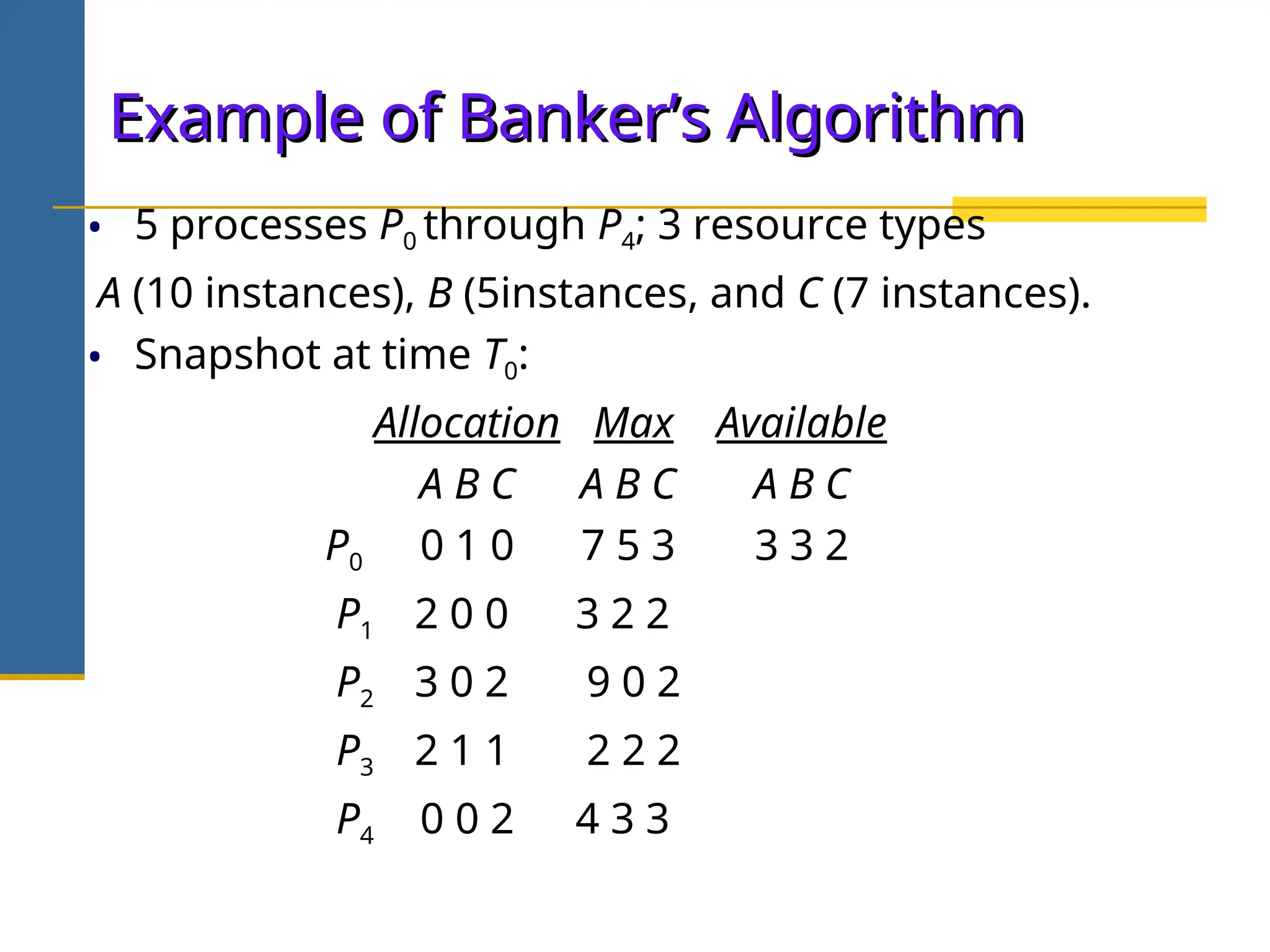
Example of Banker’s Algorithm
• 5 processes P0 through P4; 3 resource types
A (10 instances), B (5instances, and C (7 instances).
• Snapshot at time T0:
Allocation Max Available
A B C A B C A B C
P0 0 1 0 7 5 3 3 3 2
P1 2 0 0 3 2 2
P2 3 0 2 9 0 2
P3 2 1 1 2 2 2
P4 0 0 2 4 3 3
Example (Cont.)
Example (Cont.)
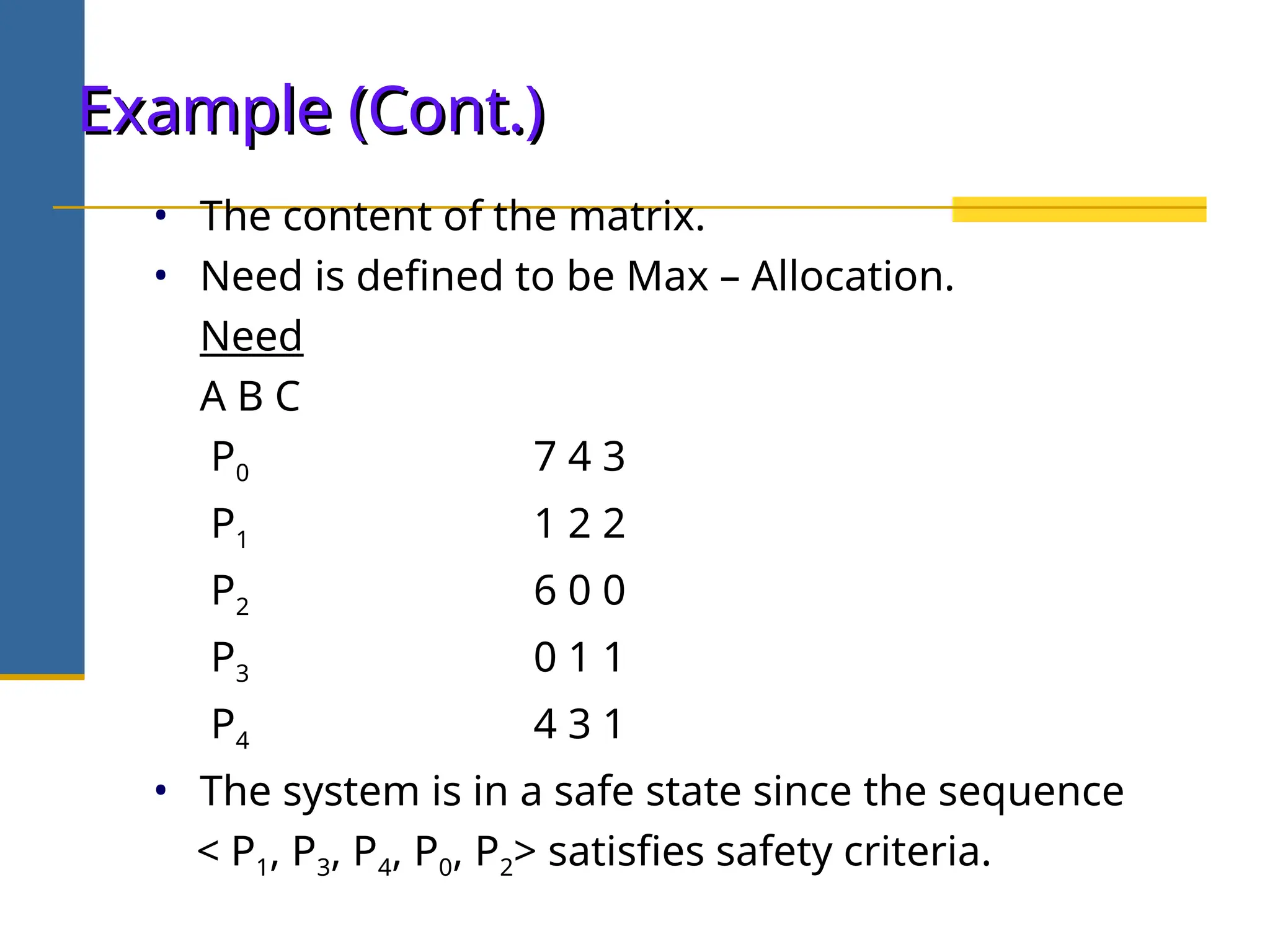
• The content of the matrix.
• Need is defined to be Max – Allocation.
Need
A B C
P0 7 4 3
P1 1 2 2
P2 6 0 0
P3 0 1 1
P4 4 3 1
• The system is in a safe state since the sequence
< P1, P3, P4, P0, P2> satisfies safety criteria.
Example
Example P
P1
1 Request (1,0,2)
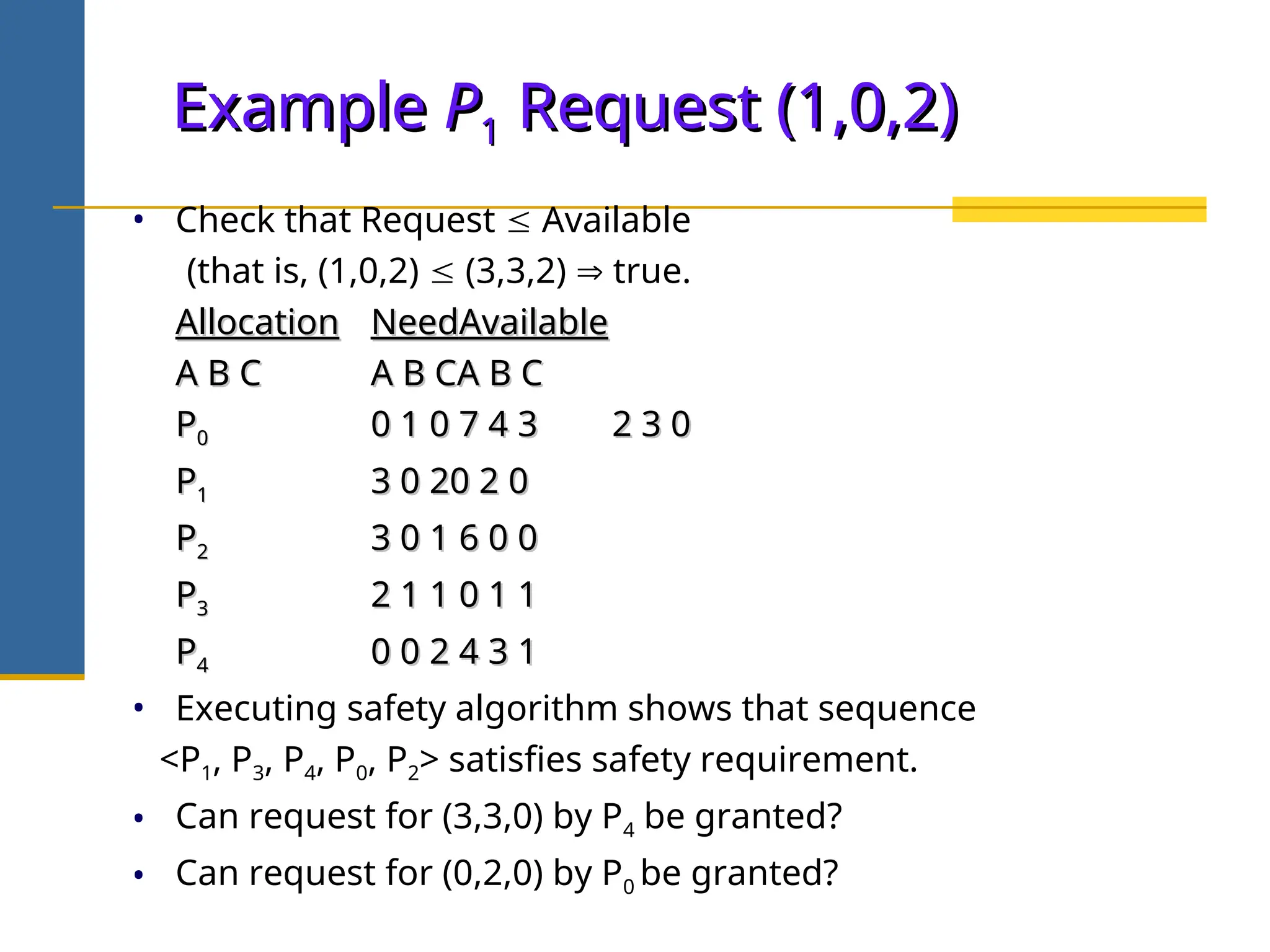
Request (1,0,2)
• Check that Request  Available
(that is, (1,0,2)  (3,3,2)  true.
Allocation
Allocation Need
NeedAvailable
Available
A B C
A B C A B C
A B CA B C
A B C
P
P0
0 0 1 0
0 1 0 7 4 3
7 4 3 2 3 0
2 3 0
P
P1
1 3 0 2
3 0 20 2 0
0 2 0
P
P2
2 3 0 1
3 0 1 6 0 0
6 0 0
P
P3
3 2 1 1
2 1 1 0 1 1
0 1 1
P
P4
4 0 0 2
0 0 2 4 3 1
4 3 1
• Executing safety algorithm shows that sequence
<P1, P3, P4, P0, P2> satisfies safety requirement.
• Can request for (3,3,0) by P4 be granted?
• Can request for (0,2,0) by P0 be granted?
Detection Algorithm
Detection Algorithm
1. Let Work and Finish be vectors of length m and n,
respectively Initialize:
(a) Work = Available
(b)For i = 1,2, …, n, if Allocationi  0, then
Finish[i] = false;otherwise, Finish[i] = true.
2. Find an index i such that both:
(a)Finish[i] == false
(b)Requesti  Work
If no such i exists, go to step 4.
Detection Algorithm
Detection Algorithm
3. Work = Work + Allocationi
Finish[i] = true
go to step 2.
4. If Finish[i] == false, for some i, 1  i  n, then the system is in
deadlock state. Moreover, if Finish[i] == false, then Pi is deadlocked.
Algorithm requires an order of O(m x n2)
operations
to detect whether the system is in deadlocked state.
Example of Detection Algorithm
• Five processes P0 through P4; three resource types
A (7 instances), B (2 instances), and C (6 instances).
• Snapshot at time T0:
Allocation Request Available
A B C
A B C A B C
A B C A B C
A B C
P
P0
0 0 1 0
0 1 0 0 0 0
0 0 0 0 0 0
0 0 0
P
P1
1 2 0 0
2 0 0 2 0 2
2 0 2
P
P2
2 3 0 3
3 0 30 0 0
0 0 0
P
P3
3 2 1 1
2 1 1 1 0 0
1 0 0
P
P4
4 0 0 2
0 0 2 0 0 2
0 0 2
• Sequence <P0, P2, P3, P1, P4> will result in Finish[i] = true
for all i.
Example
Example
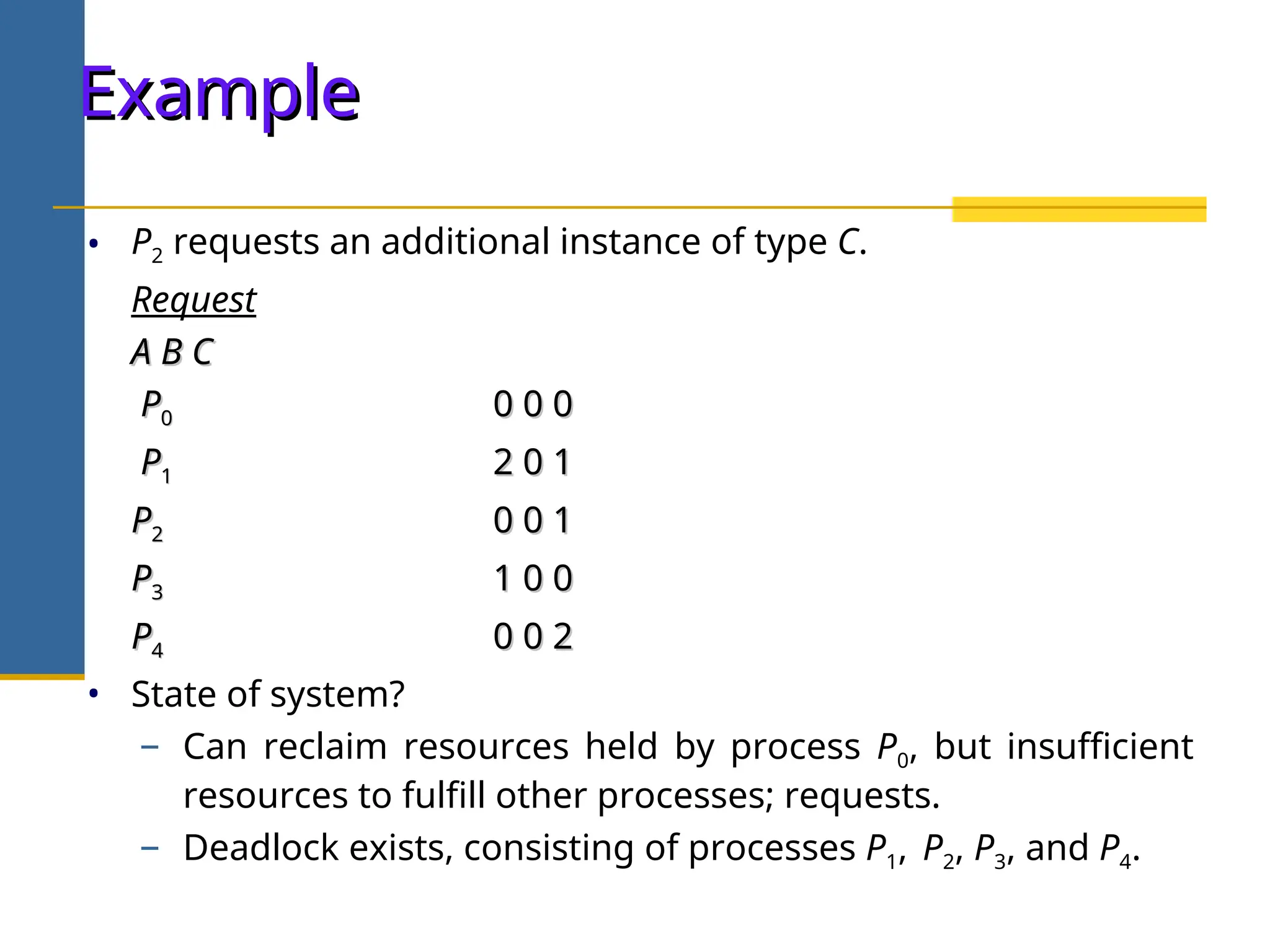
• P2 requests an additional instance of type C.
Request
A B C
A B C
P
P0
0 0 0 0
0 0 0
P
P1
1 2 0 1
2 0 1
P
P2
2 0 0 1
0 0 1
P
P3
3 1 0 0
1 0 0
P
P4
4 0 0 2
0 0 2
• State of system?
− Can reclaim resources held by process P0, but insufficient
resources to fulfill other processes; requests.
− Deadlock exists, consisting of processes P1, P2, P3, and P4.
Detection-Algorithm Usage
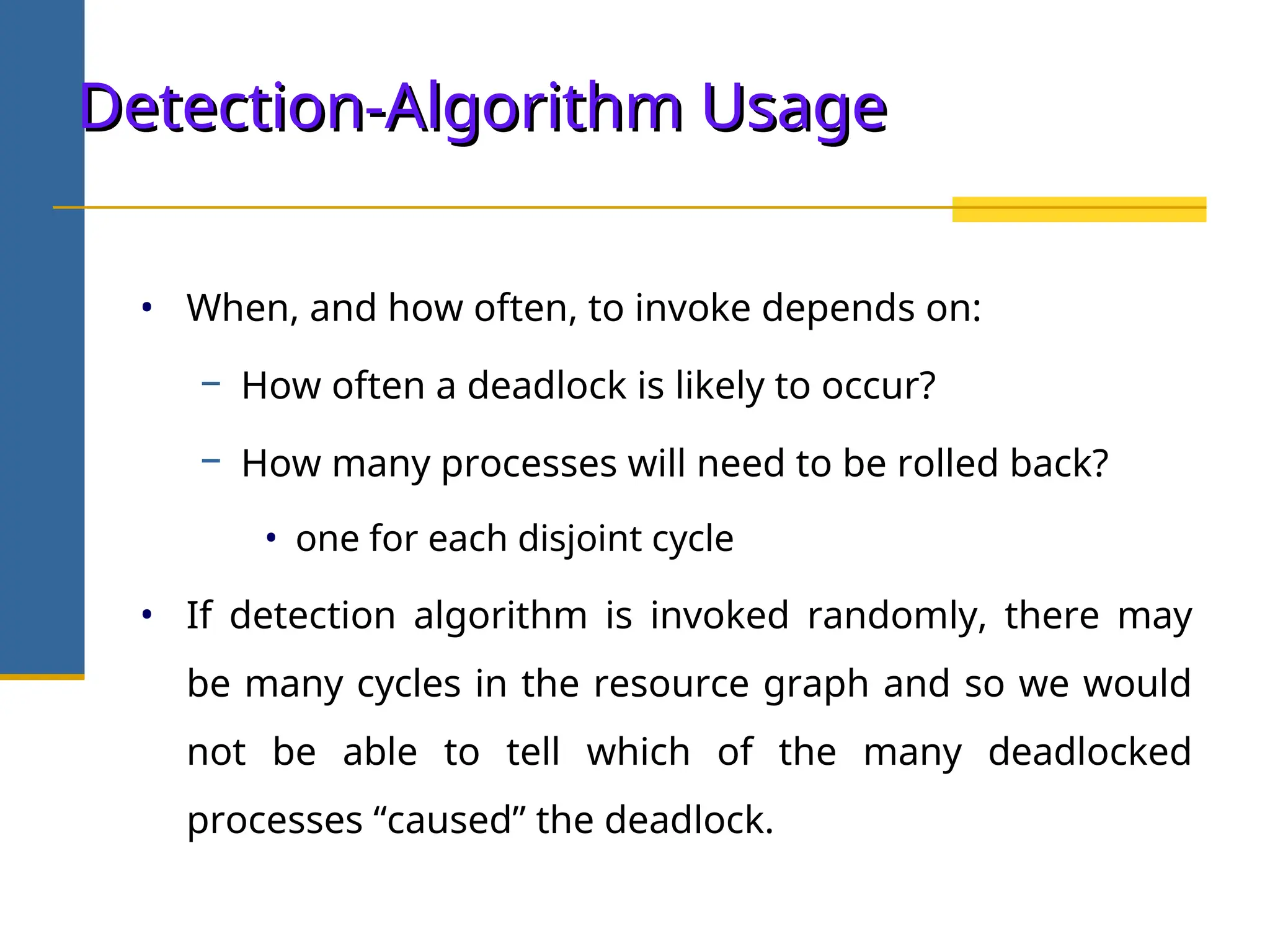
• When, and how often, to invoke depends on:
− How often a deadlock is likely to occur?
− How many processes will need to be rolled back?
• one for each disjoint cycle
• If detection algorithm is invoked randomly, there may
be many cycles in the resource graph and so we would
not be able to tell which of the many deadlocked
processes “caused” the deadlock.
Recovery from Deadlock
 Process Termination
Process Termination
• Abort all deadlocked processes.
• Abort one process at a time until the deadlock cycle
is eliminated.
• In which order should we choose to abort?
− Priority of the process.
− How long process has computed, and how much
longer to completion.
− Resources the process has used.
− Resources process needs to complete.
− How many processes will need to be terminated.
− Is process interactive or batch?
Recovery from Deadlock
-Resource Preemption
• Selecting a victim
Selecting a victim – minimize cost.
• Rollback
Rollback – return to some safe state, restart
process for that state.
• Starvation
Starvation – same process may always be
picked as victim, include number of rollback in
cost factor.
Combined Approach to
Deadlock Handling
Deadlock Handling
• Combine the three basic approaches
− prevention
− avoidance
− detection
allowing the use of the optimal approach for each of
resources in the system.
• Partition resources into hierarchically ordered classes.
• Use most appropriate technique for handling deadlocks
within each class.
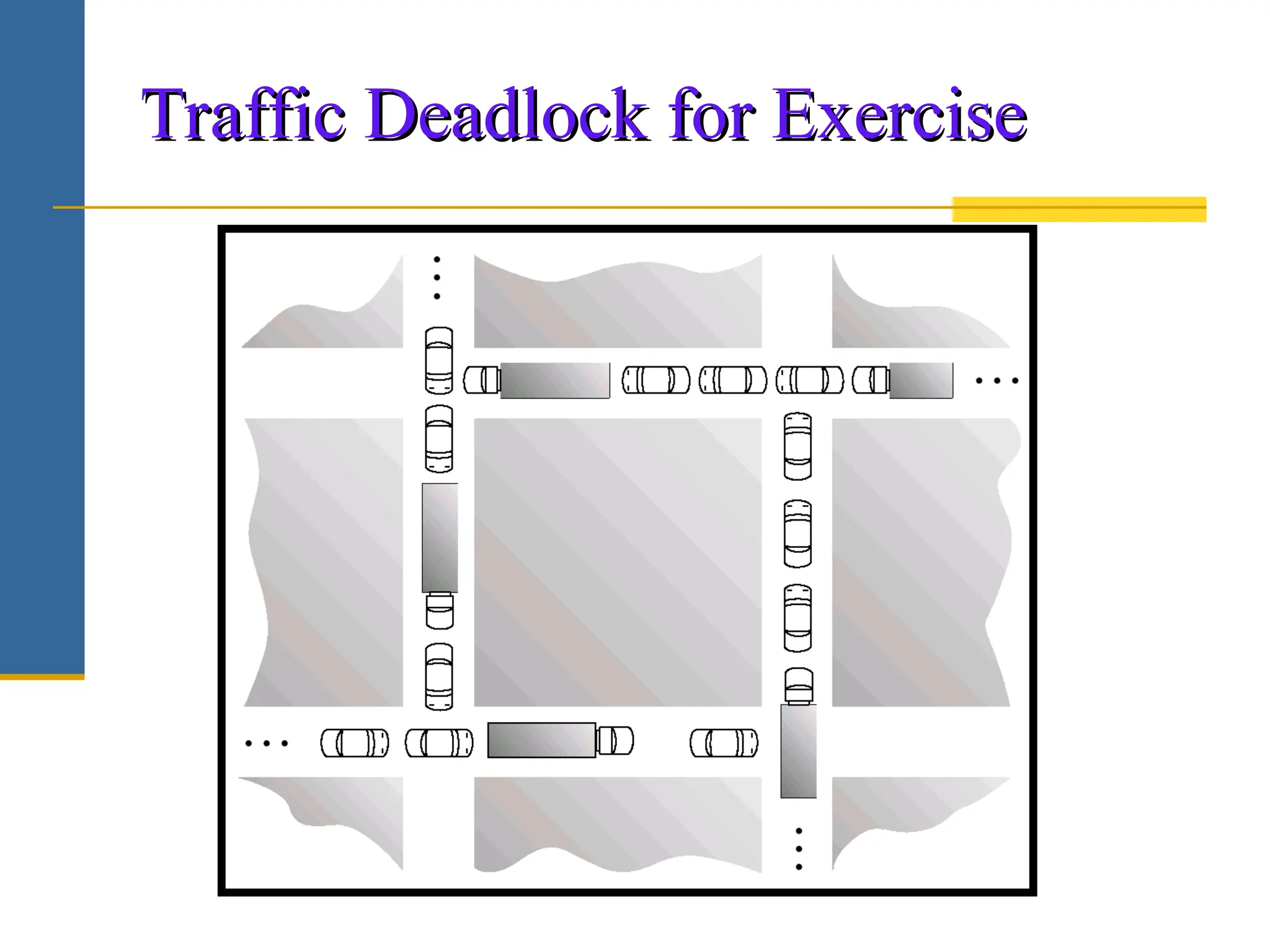
Traffic Deadlock for Exercise

Lecture 8 - Memory Management. It deals with memory management

  • 1.
    CS 2110 CS 2110 OperatingSystem Operating System Lecture #7 Lecture #7 Deadlock Deadlock
  • 2.
  • 3.
    Introduction Introduction What is Deadlock? Whatis Deadlock? A set of blocked processes each holding a resource and waiting to acquire a resource held by another process in the set Example Example o System has 2 tape drives o P1 and P2 each hold one tape drive and each needs another one
  • 4.
    Bridge Crossing Example BridgeCrossing Example  Traffic only in one direction  Each section of a bridge can be viewed as a resource  If a deadlock occurs, it can be resolved if one car backs up (preempt resources and rollback)  Several cars may have to be backed up if a deadlock occurs
  • 5.
    System Model System Model Resource types R1, R2, . . ., Rm o CPU cycles, memory space, I/O devices  Each resource type Ri has Wi instances.  Each process utilizes a resource as follows: o request o use o release
  • 6.
    Deadlock Characterization Deadlock Characterization Mutual exclusion: Mutual exclusion: only one process at a time can use a resource.  Hold and wait: Hold and wait: a process holding at least one resource is waiting to acquire additional resources held by other processes.  No preemption: No preemption: a resource can be released only voluntarily by the process holding it, after that process has completed its task.  Circular wait: Circular wait: there exists a set {P0, P1, …, Pn} of waiting processes such that P0 is waiting for a resource that is held by P1, P1 is waiting for a resource that is held by  P2, …, Pn–1 is waiting for a resource that is held by Pn, and P0 is waiting for a resource that is held by Pn. Deadlock can arise if four conditions hold simultaneously.
  • 7.
    Resource-Allocation Graph Resource-Allocation Graph A set of vertices V and a set of edges E.  V is partitioned into two types: o P = {P1, P2, …, Pn}, the set consisting of all the processes in the system. o R = {R1, R2, …, Rm}, the set consisting of all resource types in the system.  request edge – directed edge P1  Rj  assignment edge – directed edge Rj  Pi
  • 8.
    Resource-Allocation Graph Resource-Allocation Graph Process  Resource Type with 4 instances  Pi requests instances of Rj  Pi is holding an instance of Rj Pi Rj Rj Pi
  • 9.
  • 10.
    Resource Allocation GraphWith A Resource Allocation Graph With A Deadlock Deadlock
  • 11.
    Resource Allocation GraphWith Resource Allocation Graph With A Cycle But No Deadlock A Cycle But No Deadlock
  • 12.
    Basic Facts Basic Facts If graph contains no cycles  no deadlock.  If graph contains a cycle  two facts exists 1) if only one instance per resource type, then deadlock 2) if several instances per resource type, possibility of deadlock
  • 13.
    Methods for Handling Methodsfor Handling Deadlocks Deadlocks  Ensure that the system will never enter a deadlock state  Allow the system to enter a deadlock state and then recover  Ignore the problem and pretend that deadlocks never occur in the system; used by most operating systems, including UNIX
  • 14.
    Deadlock Prevention Deadlock Prevention •Mutual Exclusion Mutual Exclusion – not required for sharable resources; must hold for non-sharable resources. • Hold and Wait Hold and Wait – must guarantee that whenever a process requests a resource, it does not hold any other resources. o Require process to request and be allocated all its resources before it begins execution, or allow process to request resources only when the process has none. o Low resource utilization; starvation possible.
  • 15.
    Deadlock Prevention Deadlock Prevention No Preemption No Preemption o If a process that is holding some resources requests another resource that cannot be immediately allocated to it, then all resources currently being held are released o Preempted resources are added to the list of resources for which the process is waiting o Process will be restarted only when it can regain its old resources, as well as the new ones that it is requesting.  Circular Wait Circular Wait – impose a total ordering of all resource types, and require that each process requests resources in an increasing order of enumeration
  • 16.
    Deadlock Avoidance Deadlock Avoidance •Simplest and most useful model requires that each process declare the maximum number of resources of each type that it may need. • The deadlock-avoidance algorithm dynamically examines the resource-allocation state to ensure that there can never be a circular-wait condition. • Resource-allocation state is defined by the number of available and allocated resources, and the maximum demands of the processes. Requires that the system has some Requires that the system has some additional additional a priori a priori information available. information available.
  • 17.
    Safe State Safe State •When a process requests an available resource, system must decide if immediate allocation leaves the system in a safe state. • System is in safe state if there exists a safe sequence of all processes.
  • 18.
    • Sequence <P1,P2, …, Pn> is safe if for each Pi, the resources that Pi can still request can be satisfied by currently available resources + resources held by all the Pj, with j<i. − If Pi resource needs are not immediately available, then Pi can wait until all Pj have finished. − When Pj is finished, Pi can obtain needed resources, execute, return allocated resources, and terminate. − When Pi terminates, Pi+1 can obtain its needed resources, and so on. Safe State Safe State
  • 19.
    Basic Facts Basic Facts •If a system is in safe state  no deadlocks. • If a system is in unsafe state  possibility of deadlock. • Avoidance  ensure that a system will never enter an unsafe state.
  • 20.
    Resource-Allocation Graph Algorithm Resource-AllocationGraph Algorithm • Claim edge P Pi i  R Rj j indicated that process P Pi i may request resource Rj; represented by a dashed line. • Claim edge converts to request edge when a process requests a resource • When a resource is released by a process, assignment edge reconverts to a claim edge. • Resources must be claimed a priori in the system.
  • 21.
    Resource-Allocation Graph For Resource-AllocationGraph For Deadlock Avoidance Deadlock Avoidance
  • 22.
    Unsafe State InResource-Allocation Unsafe State In Resource-Allocation Graph Graph
  • 23.
    Deadlock Detection Deadlock Detection •Allow system to enter deadlock state • Detection algorithm • Recovery scheme
  • 24.
    Single Instance ofEach Single Instance of Each Resource Type Resource Type • Maintain wait-for graph − Nodes are processes. − Pi  Pj if Pi is waiting for Pj. • Periodically invoke an algorithm that searches for a cycle in the graph. • An algorithm to detect a cycle in a graph requires an order of n2 operations, where n is the number of vertices in the graph.
  • 25.
    Resource-Allocation Graph and Resource-AllocationGraph and Wait-for Graph Wait-for Graph
  • 26.
    Several Instances ofa Resource Several Instances of a Resource Type Type • Available: Available: A vector of length m indicates the number of available resources of each type. • Allocation: Allocation: An n x m matrix defines the number of resources of each type currently allocated to each process. • Request: Request: An n x m matrix indicates the current request of each process. If Request [ij] = k, then process Pi is requesting k more instances of resource type. Rj.
  • 27.
    Banker’s Algorithm Banker’s Algorithm •Banker's algorithm is a deadlock avoidance algorithm deadlock avoidance algorithm. • It is named so because this algorithm is used in banking systems to determine whether a loan can be granted or not. • Consider there are N account holders in a bank and the sum of the money in all of their accounts is S • Every time a loan has to be granted by the bank, it subtracts the loan amount loan amount from the total money total money the bank has.
  • 28.
    • Then itchecks if that difference is greater than S • It is done because, only then, the bank would have enough money even if all the N account holders draw all their money at once • Banker's algorithm works in a similar way in computers • Whenever a new process is created, it must specify the maximum instances of each resource type that it needs, exactly. Banker’s Algorithm Banker’s Algorithm
  • 29.
    • Let usassume that there are n processes and m resource types. • Some data structures that are used to implement the banker's algorithm are:  Available Available • It is an array of length m. It represents the number of available resources of each type. If Available[j] = k, then there are k instances available, of resource type R(j).  Max Max • It is an n x m matrix which represents the maximum number of instances of each resource that a process can request. If Max[i][j] = k, then the process P(i) can request atmost k instances of resource type R(j). Banker’s Algorithm Banker’s Algorithm
  • 30.
    Allocation Allocation •It is ann x m matrix which represents the number of resources of each type currently allocated to each process. If Allocation[i][j] = k, then process P(i) is currently allocated k instances of resource type R(j). Need Need •It is an n x m matrix which indicates the remaining resource needs of each process. If Need[i][j] = k, then process P(i) may need k more instances of resource type R(j) to complete its task. Banker’s Algorithm Banker’s Algorithm
  • 31.
    Data Structures forthe Data Structures for the Banker’s Algorithm Banker’s Algorithm • Available: Vector of length m. If available [j] = k, there are k instances of resource type Rj available. • Max: n x m matrix. If Max [i,j] = k, then process Pi may request at most k instances of resource type Rj. • Allocation: n x m matrix. If Allocation[i,j] = k then Pi is currently allocated k instances of Rj. • Need: n x m matrix. If Need[i,j] = k, then Pi may need k more instances of Rj to complete its task. • Need [i,j] = Max[i,j] – Allocation [i,j]. Let n = number of processes, and m = number of resources types.
  • 32.
    Safety Algorithm Safety Algorithm 1.Let Work and Finish be vectors of length m and n, respectively. Initialize: Work = Available Finish [i] = false for i = 1,2,3, …, n. 2. Find and i such that both: (a) Finish [i] = false (b) Needi  Work If no such i exists, go to step 4. 3. Work = Work + Allocationi Finish [i] = true go to step 2. 4. If Finish [i] == true for all i, then the system is in a safe state.
  • 33.
    Resource-Request Algorithm Resource-Request Algorithm forProcess for Process P Pi i Request = request vector for process Pi. If Requesti [j] = k then process Pi wants k instances of resource type Rj. 1. If Requesti  Needi go to step 2. Otherwise, raise error condition, since process has exceeded its maximum claim. 2. If Requesti  Available, go to step 3. Otherwise Pi must wait, since resources are not available. 3. Pretend to allocate requested resources to Pi by modifying the state as follows: Available = Available + Requesti; Allocationi = Allocationi + Requesti; Needi = Needi – Requesti;; • If safe  the resources are allocated to Pi. • If unsafe  Pi must wait, and the old resource- allocation state is restored
  • 34.
    Example of Banker’sAlgorithm Example of Banker’s Algorithm • 5 processes P0 through P4; 3 resource types A (10 instances), B (5instances, and C (7 instances). • Snapshot at time T0: Allocation Max Available A B C A B C A B C P0 0 1 0 7 5 3 3 3 2 P1 2 0 0 3 2 2 P2 3 0 2 9 0 2 P3 2 1 1 2 2 2 P4 0 0 2 4 3 3
  • 35.
    Example (Cont.) Example (Cont.) •The content of the matrix. • Need is defined to be Max – Allocation. Need A B C P0 7 4 3 P1 1 2 2 P2 6 0 0 P3 0 1 1 P4 4 3 1 • The system is in a safe state since the sequence < P1, P3, P4, P0, P2> satisfies safety criteria.
  • 36.
    Example Example P P1 1 Request(1,0,2) Request (1,0,2) • Check that Request  Available (that is, (1,0,2)  (3,3,2)  true. Allocation Allocation Need NeedAvailable Available A B C A B C A B C A B CA B C A B C P P0 0 0 1 0 0 1 0 7 4 3 7 4 3 2 3 0 2 3 0 P P1 1 3 0 2 3 0 20 2 0 0 2 0 P P2 2 3 0 1 3 0 1 6 0 0 6 0 0 P P3 3 2 1 1 2 1 1 0 1 1 0 1 1 P P4 4 0 0 2 0 0 2 4 3 1 4 3 1 • Executing safety algorithm shows that sequence <P1, P3, P4, P0, P2> satisfies safety requirement. • Can request for (3,3,0) by P4 be granted? • Can request for (0,2,0) by P0 be granted?
  • 37.
    Detection Algorithm Detection Algorithm 1.Let Work and Finish be vectors of length m and n, respectively Initialize: (a) Work = Available (b)For i = 1,2, …, n, if Allocationi  0, then Finish[i] = false;otherwise, Finish[i] = true. 2. Find an index i such that both: (a)Finish[i] == false (b)Requesti  Work If no such i exists, go to step 4.
  • 38.
    Detection Algorithm Detection Algorithm 3.Work = Work + Allocationi Finish[i] = true go to step 2. 4. If Finish[i] == false, for some i, 1  i  n, then the system is in deadlock state. Moreover, if Finish[i] == false, then Pi is deadlocked. Algorithm requires an order of O(m x n2) operations to detect whether the system is in deadlocked state.
  • 39.
    Example of DetectionAlgorithm Example of Detection Algorithm • Five processes P0 through P4; three resource types A (7 instances), B (2 instances), and C (6 instances). • Snapshot at time T0: Allocation Request Available A B C A B C A B C A B C A B C A B C P P0 0 0 1 0 0 1 0 0 0 0 0 0 0 0 0 0 0 0 0 P P1 1 2 0 0 2 0 0 2 0 2 2 0 2 P P2 2 3 0 3 3 0 30 0 0 0 0 0 P P3 3 2 1 1 2 1 1 1 0 0 1 0 0 P P4 4 0 0 2 0 0 2 0 0 2 0 0 2 • Sequence <P0, P2, P3, P1, P4> will result in Finish[i] = true for all i.
  • 40.
    Example Example • P2 requestsan additional instance of type C. Request A B C A B C P P0 0 0 0 0 0 0 0 P P1 1 2 0 1 2 0 1 P P2 2 0 0 1 0 0 1 P P3 3 1 0 0 1 0 0 P P4 4 0 0 2 0 0 2 • State of system? − Can reclaim resources held by process P0, but insufficient resources to fulfill other processes; requests. − Deadlock exists, consisting of processes P1, P2, P3, and P4.
  • 41.
    Detection-Algorithm Usage Detection-Algorithm Usage •When, and how often, to invoke depends on: − How often a deadlock is likely to occur? − How many processes will need to be rolled back? • one for each disjoint cycle • If detection algorithm is invoked randomly, there may be many cycles in the resource graph and so we would not be able to tell which of the many deadlocked processes “caused” the deadlock.
  • 42.
    Recovery from Deadlock Recoveryfrom Deadlock  Process Termination Process Termination • Abort all deadlocked processes. • Abort one process at a time until the deadlock cycle is eliminated. • In which order should we choose to abort? − Priority of the process. − How long process has computed, and how much longer to completion. − Resources the process has used. − Resources process needs to complete. − How many processes will need to be terminated. − Is process interactive or batch?
  • 43.
    Recovery from Deadlock Recoveryfrom Deadlock -Resource Preemption -Resource Preemption • Selecting a victim Selecting a victim – minimize cost. • Rollback Rollback – return to some safe state, restart process for that state. • Starvation Starvation – same process may always be picked as victim, include number of rollback in cost factor.
  • 44.
    Combined Approach to CombinedApproach to Deadlock Handling Deadlock Handling • Combine the three basic approaches − prevention − avoidance − detection allowing the use of the optimal approach for each of resources in the system. • Partition resources into hierarchically ordered classes. • Use most appropriate technique for handling deadlocks within each class.
  • 45.
    Traffic Deadlock forExercise Traffic Deadlock for Exercise