MSN 7702
Tamieka Bugam
Rebecca Poole
DeQuervains
Tenosynovitis
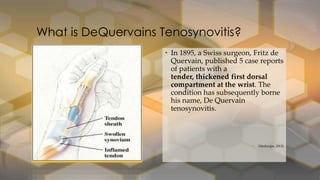
• In 1895, a Swiss surgeon, Fritz de
Quervain, published 5 case reports
of patients with a
tender, thickened first dorsal
compartment at the wrist. The
condition has subsequently borne
his name, De Quervain
tenosynovitis.
• (Medscape, 2013)
What is DeQuervains Tenosynovitis?
• De Quervain's Tenosynovitis occurs when tendons on the thumb
side of the wrist are swollen or irritated. The irritation causes the
lining (synovium) around the tendon to swell, which changes the
shape of the compartment. De Quervain tenosynovitis is an
entrapment tendinitis of the tendons contained within the first
dorsal compartment at the wrist; it causes pain during thumb
motion.
• DeQuervains Tenosynovitis may be caused by overuse. It can be
seen in association with pregnancy. It may be found in
inflammatory arthritis, such as rheumatoid disease. This condition
is usually most common in middle-aged women.
• (American Academy of Orthopedic Surgeons, 2013)
Causes of DeQuervains Tenosynovitis
Frequency Mortality/Morbidity Race Sex Age
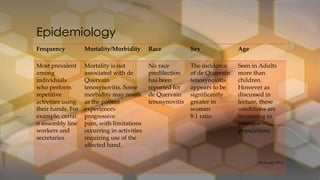
Most prevalent
among
individuals
who perform
repetitive
activities using
their hands. For
example, certai
n assembly line
workers and
secretaries
Mortality is not
associated with de
Quervain
tenosynovitis. Some
morbidity may result
as the patient
experiences
progressive
pain, with limitations
occurring in activities
requiring use of the
affected hand.
No race
predilection
has been
reported for
de Quervain
tenosynovitis
The incidence
of de Quervain
tenosynovitis
appears to be
significantly
greater in
women
8:1 ratio
Seen in Adults
more than
children.
However as
discussed in
lecture, these
conditions are
increasing in
younger
populations.
• (Medscape, 2013)
Epidemiology
Diagnosis- Finkelstein’s Test
• 1Instruct the patient to sit on an examination table or in an elevated chair.
He or she should be as comfortable and relaxed as possible.
• 2Have the patient hold the afflicted hand in the air. The other arm should
be resting against his or her body.
• 3Grasp the patient's hand and rotate it toward the outside of the forearm,
a position known as ulnar deviation. The wrist won't move very much, so
don't force it beyond 20 degrees of flexion.
• 4Pull the patient's thumb across the palm of his or her hand. This places
tension on the extensor tendons of the thumb.
• 5Ask the patient if he or she feels pain radiating up the inside of his or her
arm from the thumb. If the patient reports noticeable pain, the
Finkelstein's Test is positive, and De Quervain syndrome is present
(eHow, 2013)
Instructions on how to perform the
Finkelstein Test
How is De Quervain's tenosynovitis
treated?
• Excellent. The patient can
generally return to full function
after the inflammation quiets
down with treatment.
Sometimes bracing is used
during future activities that
involve repetitive wrist motion.
What is the outlook (prognosis) with De
Quervain's tenosynovitis?
• American Academy of Orthopedic Surgeons (2013). DeQuervains
tenosynovitis. Retrieved on October 2, 2013 from
http://orthoinfo.aaos.org/topic.cfm?topic=a00007
• Medscape. (2013). DeQuervains tenosynovitis. Retrieved on October 2,
2013 from http://emedicine.medscape.com/article/1243387-overview
• The Pain Source (2011, December 15). Finkelstein’s test.*YouTube video+.
Retrieved on October 2, 2013 from
http://www.youtube.com/watch?v=eL2Uzfd26SA
• eHow.(2013). How to perform finkelstein’s test of the hand. Retrieved
October 2, 2013 fromhttp://www.ehow.com/how_2212413_perform-
finkelsteins-test-hand.html#ixzz2gcMtg9oG
References

De quervains tenosynovitis

  • 1.
    MSN 7702 Tamieka Bugam RebeccaPoole DeQuervains Tenosynovitis
  • 2.
    • In 1895,a Swiss surgeon, Fritz de Quervain, published 5 case reports of patients with a tender, thickened first dorsal compartment at the wrist. The condition has subsequently borne his name, De Quervain tenosynovitis. • (Medscape, 2013) What is DeQuervains Tenosynovitis?
  • 3.
    • De Quervain'sTenosynovitis occurs when tendons on the thumb side of the wrist are swollen or irritated. The irritation causes the lining (synovium) around the tendon to swell, which changes the shape of the compartment. De Quervain tenosynovitis is an entrapment tendinitis of the tendons contained within the first dorsal compartment at the wrist; it causes pain during thumb motion. • DeQuervains Tenosynovitis may be caused by overuse. It can be seen in association with pregnancy. It may be found in inflammatory arthritis, such as rheumatoid disease. This condition is usually most common in middle-aged women. • (American Academy of Orthopedic Surgeons, 2013) Causes of DeQuervains Tenosynovitis
  • 4.
    Frequency Mortality/Morbidity RaceSex Age Most prevalent among individuals who perform repetitive activities using their hands. For example, certai n assembly line workers and secretaries Mortality is not associated with de Quervain tenosynovitis. Some morbidity may result as the patient experiences progressive pain, with limitations occurring in activities requiring use of the affected hand. No race predilection has been reported for de Quervain tenosynovitis The incidence of de Quervain tenosynovitis appears to be significantly greater in women 8:1 ratio Seen in Adults more than children. However as discussed in lecture, these conditions are increasing in younger populations. • (Medscape, 2013) Epidemiology
  • 5.
  • 6.
    • 1Instruct thepatient to sit on an examination table or in an elevated chair. He or she should be as comfortable and relaxed as possible. • 2Have the patient hold the afflicted hand in the air. The other arm should be resting against his or her body. • 3Grasp the patient's hand and rotate it toward the outside of the forearm, a position known as ulnar deviation. The wrist won't move very much, so don't force it beyond 20 degrees of flexion. • 4Pull the patient's thumb across the palm of his or her hand. This places tension on the extensor tendons of the thumb. • 5Ask the patient if he or she feels pain radiating up the inside of his or her arm from the thumb. If the patient reports noticeable pain, the Finkelstein's Test is positive, and De Quervain syndrome is present (eHow, 2013) Instructions on how to perform the Finkelstein Test
  • 7.
    How is DeQuervain's tenosynovitis treated?
  • 8.
    • Excellent. Thepatient can generally return to full function after the inflammation quiets down with treatment. Sometimes bracing is used during future activities that involve repetitive wrist motion. What is the outlook (prognosis) with De Quervain's tenosynovitis?
  • 9.
    • American Academyof Orthopedic Surgeons (2013). DeQuervains tenosynovitis. Retrieved on October 2, 2013 from http://orthoinfo.aaos.org/topic.cfm?topic=a00007 • Medscape. (2013). DeQuervains tenosynovitis. Retrieved on October 2, 2013 from http://emedicine.medscape.com/article/1243387-overview • The Pain Source (2011, December 15). Finkelstein’s test.*YouTube video+. Retrieved on October 2, 2013 from http://www.youtube.com/watch?v=eL2Uzfd26SA • eHow.(2013). How to perform finkelstein’s test of the hand. Retrieved October 2, 2013 fromhttp://www.ehow.com/how_2212413_perform- finkelsteins-test-hand.html#ixzz2gcMtg9oG References