




mobile

Giusepe Grasso
Notes Developer
Agenda
• Part A - Lotus on mobile
• Part B - Cool things you can do on mobile
  devices
  – Geolocation
  – Working Offline
  – Forms
Lotus on mobile
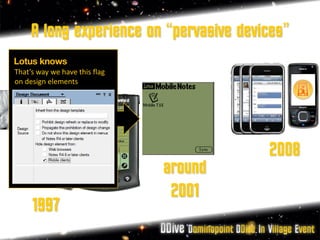
A long experience on “pervasive devices”
That’s way we have this flag
on design elements


                                         2008
                               around
                                2001
     1997
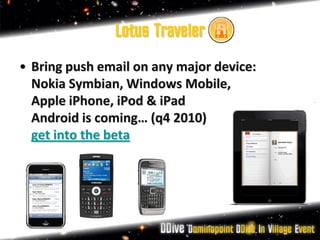
Lotus Traveler
• Bring push email on any major device:
  Nokia Symbian, Windows Mobile,
  Apple iPhone, iPod & iPad
  Android is coming… (q4 2010)
  get into the beta
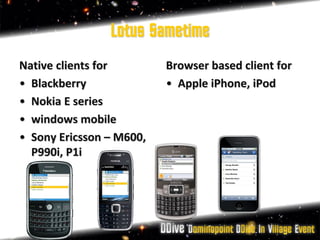
Lotus Sametime
Native clients for        Browser based client for
• Blackberry              • Apple iPhone, iPod
• Nokia E series
• windows mobile
• Sony Ericsson – M600,
  P990i, P1i
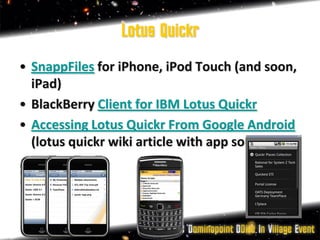
Lotus Quickr
• SnappFiles for iPhone, iPod Touch (and soon,
  iPad)
• BlackBerry Client for IBM Lotus Quickr
• Accessing Lotus Quickr From Google Android
  (lotus quickr wiki article with app source)
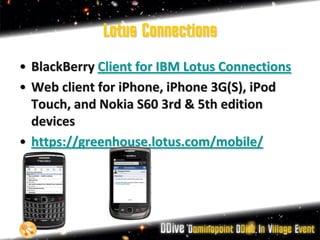
Lotus Connections
• BlackBerry Client for IBM Lotus Connections
• Web client for iPhone, iPhone 3G(S), iPod
  Touch, and Nokia S60 3rd & 5th edition
  devices
• https://greenhouse.lotus.com/mobile/
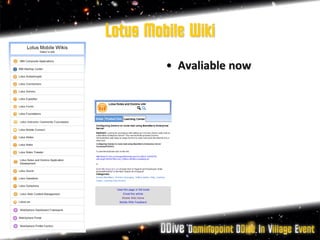
Lotus Mobile Wiki
         • Avaliable now
Mobile Portal Accelerator
• http://lotus2010.com
Lotus on mobile:
other third parties
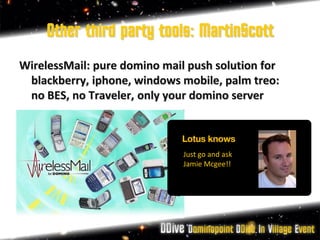
Other third party tools: MartinScott
WirelessMail: pure domino mail push solution for
 blackberry, iphone, windows mobile, palm treo:
 no BES, no Traveler, only your domino server


                              Just go and ask
                              Jamie Mcgee!!
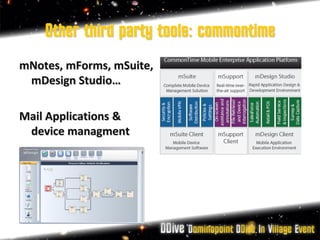
Other third party tools: commontime
mNotes, mForms, mSuite,
 mDesign Studio…

Mail Applications &
 device managment
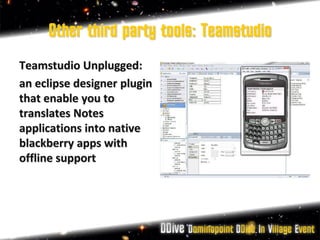
Other third party tools: Teamstudio
Teamstudio Unplugged:
an eclipse designer plugin
that enable you to
translates Notes
applications into native
blackberry apps with
offline support
Now for the developers part
But first…
Some basics to keep in mind:
• Mobile users can be with limited or no data
   connectivity (no plan, roaming, no
   coverage) and little bandwidth
• Do not overload the cpu, a charged battery
   makes an happy user!
• Ergonomics and usage patterns are way
   different from desktop
Basic markup you need to know
• Tell the device you’re a friend:
  <meta name="HandheldFriendly" content="True" />
• Avoid viewport zoom
  <meta name="viewport" content="width=device-
  width,minimum-scale=1.0,maximum-scale=1.0"/>
  or
  <meta name="viewport" content="width=device-width,initial-
  scale=1.0,user-scalable=no"/>
Cool things you can do on mobile devices
Detect mobile devices
• No simple answer
• Using http headers
• Css media query
WURFL
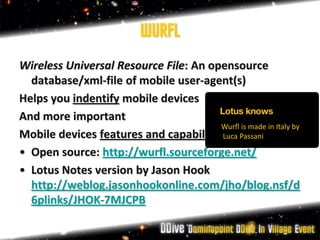
Wireless Universal Resource File: An opensource
  database/xml-file of mobile user-agent(s)
Helps you indentify mobile devices
And more important
                                       Wurfl is made in Italy by
Mobile devices features and capabilities Passani
                                       Luca

• Open source: http://wurfl.sourceforge.net/
• Lotus Notes version by Jason Hook
  http://weblog.jasonhookonline.com/jho/blog.nsf/d
  6plinks/JHOK-7MJCPB
WURFL
• Open source: http://wurfl.sourceforge.net/
• Lotus Notes version by Jason Hook
  http://weblog.jasonhookonline.com/jho/blo
  g.nsf/d6plinks/JHOK-7MJCPB
• I’ve made some updates to Jason database
  and you’ll find my version on DDive DVD
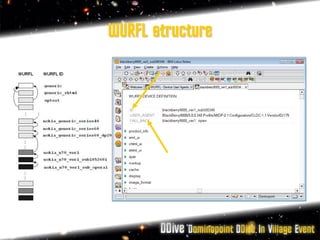
WURFL structure
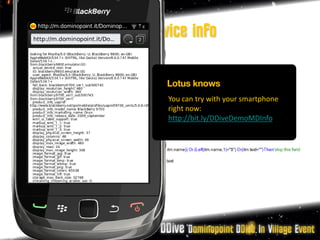
WURFL device info


         You can try with your smartphone
         right now:
         http://bit.ly/DDiveDemoMDInfo
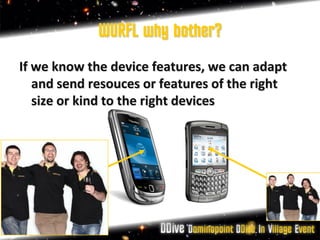
WURFL why bother?
If we know the device features, we can adapt
   and send resouces or features of the right
   size or kind to the right devices
Other http headers of interest
HTTP headers sent by mobile devices but not by
  desktop browser:
• x-wap-profile: links to UAProfile (standard by
  Open Mobile Alliance)
• X-OperaMini-Features: set by opera mini
  browser, gives CSV of phone features

We can use this http headers to “guess” that a
 device is mobile
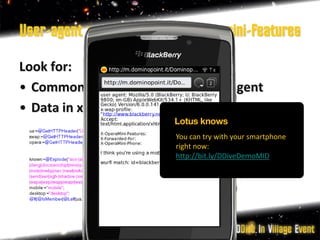
User-agent x-wap-profile & x-operamini-features
Look for:
• Common mobile patterns in user-agent
• Data in x-wap-profile or x-operamini-features
                          You can try with your smartphone
                          right now:
                          http://bit.ly/DDiveDemoMID
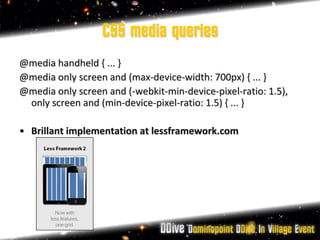
CSS media queries
@media handheld { ... }
@media only screen and (max-device-width: 700px) { ... }
@media only screen and (-webkit-min-device-pixel-ratio: 1.5),
 only screen and (min-device-pixel-ratio: 1.5) { ... }

• Brillant implementation at lessframework.com
CSS media queries
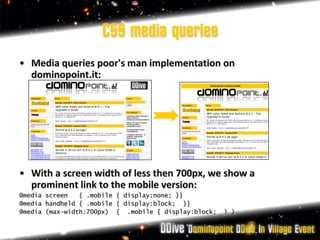
• Media queries poor's man implementation on
  dominopoint.it:


• With a screen width of less then 700px, we show a
  prominent link to the mobile version:
@media screen   { .mobile { display:none; }}
@media handheld { .mobile { display:block; }}
@media (max-width:700px) { .mobile { display:block;   } }
geolocation
Three way:
1. IP Based: I know where your gateway is (or
   I can use a service like ipinfodb.com)
2. Based on Gps, wifi (kown position of nearby
   access points) or cell tower (triangulation)
3. Ask the user
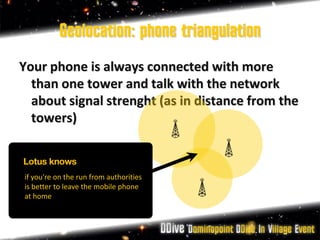
Geolocation: phone triangulation
Your phone is always connected with more
  than one tower and talk with the network
  about signal strenght (as in distance from the
  towers)


if you're on the run from authorities
   You Are here
is better to leave the mobile phone
at home
geolocation
 As usual, different ways of doing this
 • blackberry.location on FW >=4.1 <=5
 • Google gears geolocation api (deprecated)
 • New standard: W3C Geolocation API
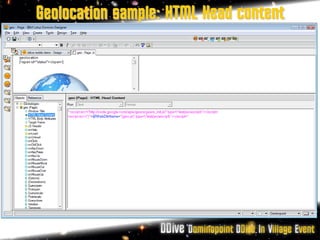
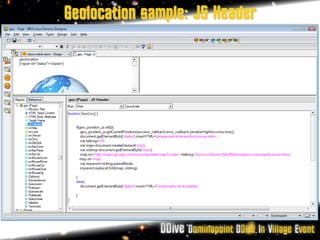
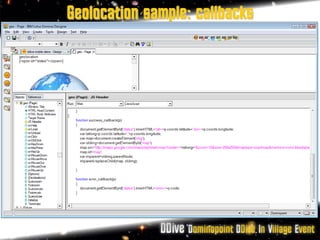
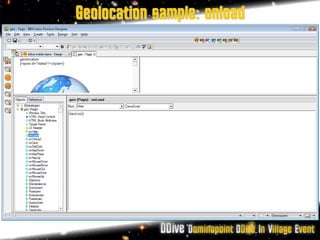
There’s a nice open source geo location
  framework for mobile that supports iPhone,
  gears, old and new blackberries, nokia web
  runtime etc.: geo-location-javascript
Geolocation sample: HTML Head content
Geolocation sample: JS Header
Geolocation sample: callbacks
Geolocation sample: onload
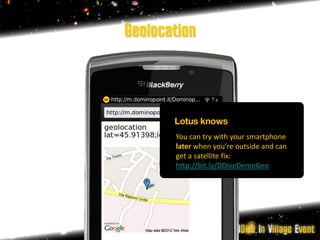
Geolocation


       You can try with your smartphone
       later when you’re outside and can
       get a satellite fix:
       http://bit.ly/DDiveDemoGeo
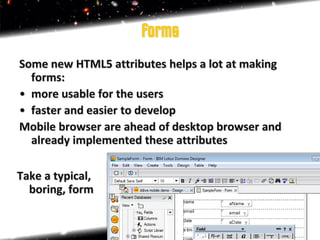
forms
Some new HTML5 attributes helps a lot at making
  forms:
• more usable for the users
• faster and easier to develop
Mobile browser are ahead of desktop browser and
  already implemented these attributes

Take a typical,
  boring, form
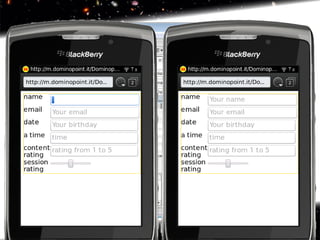
Forms autofocus & placeholder
autofocus attribute will set the default focus on
  the field element
placeholder will set a text that disappear as
  soon as the field gets focus (just like the
  search box in your browser)
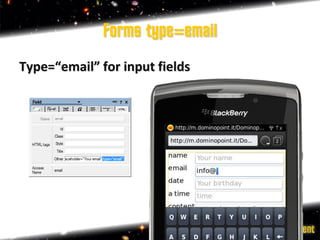
Forms type=email
Type=“email” for input fields
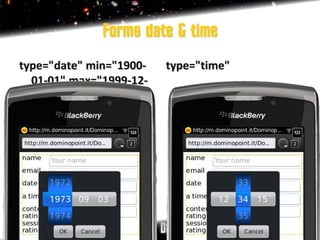
Forms date & time
type="date" min="1900-   type="time"
  01-01" max="1999-12-
  31“
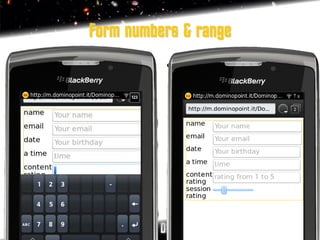
Form numbers & range
• type="number"      • type="range" min="1"
                       max="5" step="1"
Work offline
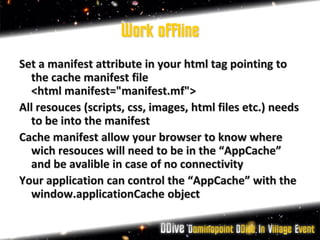
Set a manifest attribute in your html tag pointing to
  the cache manifest file
  <html manifest="manifest.mf">
All resouces (scripts, css, images, html files etc.) needs
  to be into the manifest
Cache manifest allow your browser to know where
  wich resouces will need to be in the “AppCache”
  and be avalible in case of no connectivity
Your application can control the “AppCache” with the
  window.applicationCache object
Work offline: manifest file
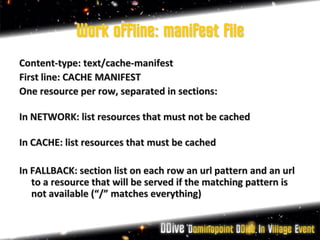
Content-type: text/cache-manifest
First line: CACHE MANIFEST
One resource per row, separated in sections:

In NETWORK: list resources that must not be cached

In CACHE: list resources that must be cached

In FALLBACK: section list on each row an url pattern and an url
   to a resource that will be served if the matching pattern is
   not available (“/” matches everything)
widgets
An application developed with web
   technologies (html, css, javascript) that can
   be installed as a native application on the
   device and works online & offline.
Still an evolving area, with a W3C candidate
   reccomandation
   http://www.w3.org/TR/widgets/
It mostly involves an xml configuration file and
   a package format (ie .zip) for the resources
widgets
Widgets also usually offer some kind of
 persistent storage, like html5 storage or
 google gears
Widgets can get access to system features not
 available from web apps (exposed as
 javascript objects) ie filesystem, battery,
 signal, camera and native agenda, messaging
 and calendar services
widgets
Anyway, there’s a lot of fragmentation and still
 no adopted standard:
Nokia WRT, BlackBerry Widget SDK, Opera
 Widget Manager, Vodafone & Verizion JIL
 all are similar but all are different!
Questions?
Resources
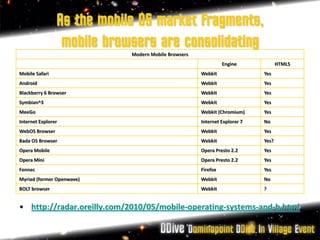
As the mobile OS market fragments,
                 mobile browsers are consolidating
                            Modern Mobile Browsers
                                                               Engine             HTML5
Mobile Safari                                        Webkit                Yes
Android                                              Webkit                Yes
Blackberry 6 Browser                                 Webkit                Yes
Symbian^3                                            Webkit                Yes
MeeGo                                                Webkit (Chromium)     Yes
Internet Explorer                                    Internet Explorer 7   No
WebOS Browser                                        Webkit                Yes
Bada OS Browser                                      Webkit                Yes?
Opera Mobile                                         Opera Presto 2.2      Yes
Opera Mini                                           Opera Presto 2.2      Yes
Fennec                                               Firefox               Yes
Myriad (former Openwave)                             Webkit                No
BOLT browser                                         Webkit                ?


• http://radar.oreilly.com/2010/05/mobile-operating-systems-and-b.html
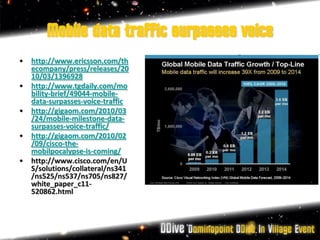
Mobile data traffic surpasses voice
•   http://www.ericsson.com/th
    ecompany/press/releases/20
    10/03/1396928
•   http://www.tgdaily.com/mo
    bility-brief/49044-mobile-
    data-surpasses-voice-traffic
•   http://gigaom.com/2010/03
    /24/mobile-milestone-data-
    surpasses-voice-traffic/
•   http://gigaom.com/2010/02
    /09/cisco-the-
    mobilpocalypse-is-coming/
•   http://www.cisco.com/en/U
    S/solutions/collateral/ns341
    /ns525/ns537/ns705/ns827/
    white_paper_c11-
    520862.html
Mobile cache file sizes
• http://www.stevesouders.com/blog/2010/0
  7/12/mobile-cache-file-sizes/

DDive- Giuseppe Grasso - mobile su Lotus

  • 1.
  • 3.
    Agenda • Part A- Lotus on mobile • Part B - Cool things you can do on mobile devices – Geolocation – Working Offline – Forms
  • 4.
  • 5.
    A long experienceon “pervasive devices” That’s way we have this flag on design elements 2008 around 2001 1997
  • 6.
    Lotus Traveler • Bringpush email on any major device: Nokia Symbian, Windows Mobile, Apple iPhone, iPod & iPad Android is coming… (q4 2010) get into the beta
  • 7.
    Lotus Sametime Native clientsfor Browser based client for • Blackberry • Apple iPhone, iPod • Nokia E series • windows mobile • Sony Ericsson – M600, P990i, P1i
  • 8.
    Lotus Quickr • SnappFilesfor iPhone, iPod Touch (and soon, iPad) • BlackBerry Client for IBM Lotus Quickr • Accessing Lotus Quickr From Google Android (lotus quickr wiki article with app source)
  • 9.
    Lotus Connections • BlackBerryClient for IBM Lotus Connections • Web client for iPhone, iPhone 3G(S), iPod Touch, and Nokia S60 3rd & 5th edition devices • https://greenhouse.lotus.com/mobile/
  • 10.
    Lotus Mobile Wiki • Avaliable now
  • 11.
    Mobile Portal Accelerator •http://lotus2010.com
  • 12.
  • 13.
    Other third partytools: MartinScott WirelessMail: pure domino mail push solution for blackberry, iphone, windows mobile, palm treo: no BES, no Traveler, only your domino server Just go and ask Jamie Mcgee!!
  • 14.
    Other third partytools: commontime mNotes, mForms, mSuite, mDesign Studio… Mail Applications & device managment
  • 15.
    Other third partytools: Teamstudio Teamstudio Unplugged: an eclipse designer plugin that enable you to translates Notes applications into native blackberry apps with offline support
  • 16.
    Now for thedevelopers part
  • 17.
    But first… Some basicsto keep in mind: • Mobile users can be with limited or no data connectivity (no plan, roaming, no coverage) and little bandwidth • Do not overload the cpu, a charged battery makes an happy user! • Ergonomics and usage patterns are way different from desktop
  • 18.
    Basic markup youneed to know • Tell the device you’re a friend: <meta name="HandheldFriendly" content="True" /> • Avoid viewport zoom <meta name="viewport" content="width=device- width,minimum-scale=1.0,maximum-scale=1.0"/> or <meta name="viewport" content="width=device-width,initial- scale=1.0,user-scalable=no"/>
  • 19.
    Cool things youcan do on mobile devices
  • 20.
    Detect mobile devices •No simple answer • Using http headers • Css media query
  • 21.
    WURFL Wireless Universal ResourceFile: An opensource database/xml-file of mobile user-agent(s) Helps you indentify mobile devices And more important Wurfl is made in Italy by Mobile devices features and capabilities Passani Luca • Open source: http://wurfl.sourceforge.net/ • Lotus Notes version by Jason Hook http://weblog.jasonhookonline.com/jho/blog.nsf/d 6plinks/JHOK-7MJCPB
  • 22.
    WURFL • Open source:http://wurfl.sourceforge.net/ • Lotus Notes version by Jason Hook http://weblog.jasonhookonline.com/jho/blo g.nsf/d6plinks/JHOK-7MJCPB • I’ve made some updates to Jason database and you’ll find my version on DDive DVD
  • 23.
  • 24.
    WURFL device info You can try with your smartphone right now: http://bit.ly/DDiveDemoMDInfo
  • 25.
    WURFL why bother? Ifwe know the device features, we can adapt and send resouces or features of the right size or kind to the right devices
  • 26.
    Other http headersof interest HTTP headers sent by mobile devices but not by desktop browser: • x-wap-profile: links to UAProfile (standard by Open Mobile Alliance) • X-OperaMini-Features: set by opera mini browser, gives CSV of phone features We can use this http headers to “guess” that a device is mobile
  • 27.
    User-agent x-wap-profile &x-operamini-features Look for: • Common mobile patterns in user-agent • Data in x-wap-profile or x-operamini-features You can try with your smartphone right now: http://bit.ly/DDiveDemoMID
  • 28.
    CSS media queries @mediahandheld { ... } @media only screen and (max-device-width: 700px) { ... } @media only screen and (-webkit-min-device-pixel-ratio: 1.5), only screen and (min-device-pixel-ratio: 1.5) { ... } • Brillant implementation at lessframework.com
  • 29.
    CSS media queries •Media queries poor's man implementation on dominopoint.it: • With a screen width of less then 700px, we show a prominent link to the mobile version: @media screen { .mobile { display:none; }} @media handheld { .mobile { display:block; }} @media (max-width:700px) { .mobile { display:block; } }
  • 30.
    geolocation Three way: 1. IPBased: I know where your gateway is (or I can use a service like ipinfodb.com) 2. Based on Gps, wifi (kown position of nearby access points) or cell tower (triangulation) 3. Ask the user
  • 31.
    Geolocation: phone triangulation Yourphone is always connected with more than one tower and talk with the network about signal strenght (as in distance from the towers) if you're on the run from authorities You Are here is better to leave the mobile phone at home
  • 32.
    geolocation As usual,different ways of doing this • blackberry.location on FW >=4.1 <=5 • Google gears geolocation api (deprecated) • New standard: W3C Geolocation API There’s a nice open source geo location framework for mobile that supports iPhone, gears, old and new blackberries, nokia web runtime etc.: geo-location-javascript
  • 33.
  • 34.
  • 35.
  • 36.
  • 37.
    Geolocation You can try with your smartphone later when you’re outside and can get a satellite fix: http://bit.ly/DDiveDemoGeo
  • 38.
    forms Some new HTML5attributes helps a lot at making forms: • more usable for the users • faster and easier to develop Mobile browser are ahead of desktop browser and already implemented these attributes Take a typical, boring, form
  • 39.
    Forms autofocus &placeholder autofocus attribute will set the default focus on the field element placeholder will set a text that disappear as soon as the field gets focus (just like the search box in your browser)
  • 40.
  • 41.
    Forms date &time type="date" min="1900- type="time" 01-01" max="1999-12- 31“
  • 42.
    Form numbers &range • type="number" • type="range" min="1" max="5" step="1"
  • 43.
    Work offline Set amanifest attribute in your html tag pointing to the cache manifest file <html manifest="manifest.mf"> All resouces (scripts, css, images, html files etc.) needs to be into the manifest Cache manifest allow your browser to know where wich resouces will need to be in the “AppCache” and be avalible in case of no connectivity Your application can control the “AppCache” with the window.applicationCache object
  • 44.
    Work offline: manifestfile Content-type: text/cache-manifest First line: CACHE MANIFEST One resource per row, separated in sections: In NETWORK: list resources that must not be cached In CACHE: list resources that must be cached In FALLBACK: section list on each row an url pattern and an url to a resource that will be served if the matching pattern is not available (“/” matches everything)
  • 45.
    widgets An application developedwith web technologies (html, css, javascript) that can be installed as a native application on the device and works online & offline. Still an evolving area, with a W3C candidate reccomandation http://www.w3.org/TR/widgets/ It mostly involves an xml configuration file and a package format (ie .zip) for the resources
  • 46.
    widgets Widgets also usuallyoffer some kind of persistent storage, like html5 storage or google gears Widgets can get access to system features not available from web apps (exposed as javascript objects) ie filesystem, battery, signal, camera and native agenda, messaging and calendar services
  • 47.
    widgets Anyway, there’s alot of fragmentation and still no adopted standard: Nokia WRT, BlackBerry Widget SDK, Opera Widget Manager, Vodafone & Verizion JIL all are similar but all are different!
  • 48.
  • 49.
  • 50.
    As the mobileOS market fragments, mobile browsers are consolidating Modern Mobile Browsers Engine HTML5 Mobile Safari Webkit Yes Android Webkit Yes Blackberry 6 Browser Webkit Yes Symbian^3 Webkit Yes MeeGo Webkit (Chromium) Yes Internet Explorer Internet Explorer 7 No WebOS Browser Webkit Yes Bada OS Browser Webkit Yes? Opera Mobile Opera Presto 2.2 Yes Opera Mini Opera Presto 2.2 Yes Fennec Firefox Yes Myriad (former Openwave) Webkit No BOLT browser Webkit ? • http://radar.oreilly.com/2010/05/mobile-operating-systems-and-b.html
  • 51.
    Mobile data trafficsurpasses voice • http://www.ericsson.com/th ecompany/press/releases/20 10/03/1396928 • http://www.tgdaily.com/mo bility-brief/49044-mobile- data-surpasses-voice-traffic • http://gigaom.com/2010/03 /24/mobile-milestone-data- surpasses-voice-traffic/ • http://gigaom.com/2010/02 /09/cisco-the- mobilpocalypse-is-coming/ • http://www.cisco.com/en/U S/solutions/collateral/ns341 /ns525/ns537/ns705/ns827/ white_paper_c11- 520862.html
  • 52.
    Mobile cache filesizes • http://www.stevesouders.com/blog/2010/0 7/12/mobile-cache-file-sizes/