a centre of expertise in data curation and preservation


  Saving private data, sharing
           Open Data?
Role of libraries and institutional
 repositories in a data world...
                Chris Rusbridge
         CURL/SCONUL e-Research Task
          Force meeting 14 June 2007
                                                                                                 Funded by:
  This work is licensed under the Creative Commons Attribution-NonCommercial-ShareAlike 2.5
  UK: Scotland License. To view a copy of this license, visit http://creativecommons
  .org/licenses/by-nc-sa/2.5/scotland/ ; or, (b) send a letter to Creative Commons, 543 Howard
  Street, 5th Floor, San Francisco, California, 94105, USA.
a centre of expertise in data curation and preservation


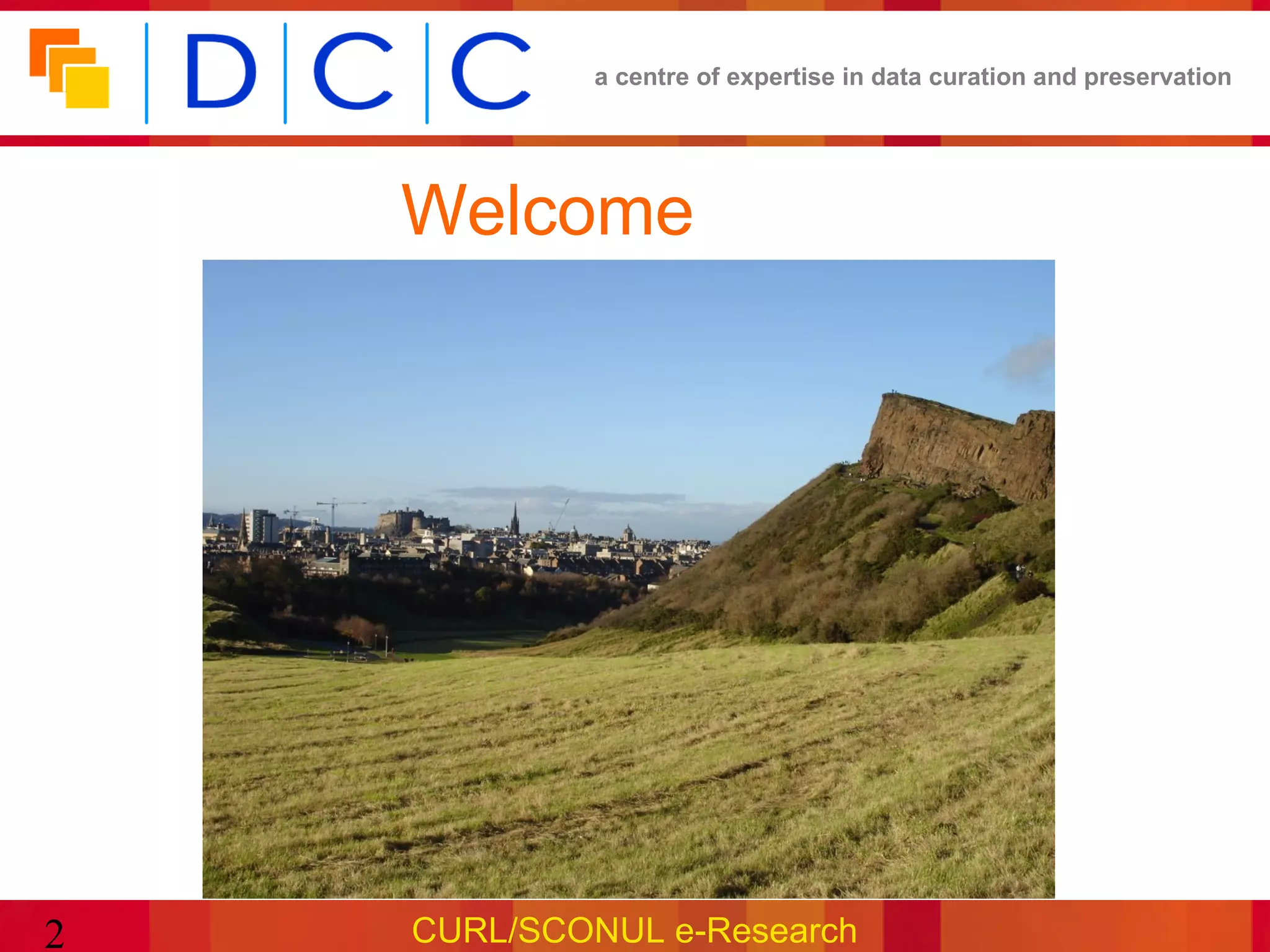
    Welcome


2   CURL/SCONUL e-Research
a centre of expertise in data curation and preservation


                 Contents
    • Role of libraries
    • How we should start dealing with data
    • AHDS decision implications…


3                CURL/SCONUL e-Research
a centre of expertise in data curation and preservation


Digital Curation Centre Mission
    “The over-riding purpose of the DCC is to
    support and promote continuing improvement
    in the quality of data curation, and of
    associated digital preservation”


4             CURL/SCONUL e-Research
a centre of expertise in data curation and preservation


    Role of Research Libraries?
    •   Research Collections
    •   Special collections
    •   Research space & facilities
    •   Services (eg ILL)
    •   +++


5                  CURL/SCONUL e-Research
a centre of expertise in data curation and preservation


    Role of Research Libraries?
    •   Research Collections… going virtual
    •   Special collections
    •   Research space & facilities… for students
    •   Services (eg ILL)… going virtual
    •   Diminishing strategic importance?


6                  CURL/SCONUL e-Research
a centre of expertise in data curation and preservation


    Role of Research Libraries?
    • Major service organisation at heart of
      University
    • Addresses institutional priorities
    • Skills in organisation of knowledge
    • Significant budget
    • “Hearts & Minds”


7                 CURL/SCONUL e-Research
a centre of expertise in data curation and preservation


    Role of Research Libraries?
    • The right place to build infrastructure for
      institutional knowledge capital?
       •   Yes! But don’t under-estimate…
       •   The scale of change needed
       •   How much your legacy (and skills!) drag you back
       •   The need for domain knowledge


                        Data are different!


8                    CURL/SCONUL e-Research
a centre of expertise in data curation and preservation


     “The Records of Science”
    • Data increasingly important as evidence
       • Key part of the scholarly record (public good)
           • Unrepeatable observations & experiments
           • Value for public money (eg OECD)
    • Experimental verifiability (the basis of science)
       • Would Chang retractions have been reduced if his first data
         were available?
               CHANG, G., ROTH, C. B., REYES, C. L., PORNILLOS, O., CHEN, Y.-J. & CHEN, A. P. (2006)
               Retraction of Pornillos et al., Science 310 (5756) 1950-1953. Retraction of Reyes and Chang,
               Science 308 (5724) 1028-1031. Retraction of Chang and Roth, Science 293 (5536) 1793-1800.
               Science Magazine, 314. http://www.sciencemag.org/cgi/content/full/314/5807/1875b

    • Allows additional interpretations
    • Legal and compliance (eg emerging RC mandates)

9                         CURL/SCONUL e-Research
a centre of expertise in data curation and preservation


                 OECD declaration
     • “…Work towards the establishment of access regimes for digital
       research data from public funding in accordance with the following
       objectives and principles:
         •   Openness
         •   Transparency
         •   Legal conformity
         •   Formal responsibility
         •   Professionalism
         •   Protection of intellectual property
         •   Interoperability
         •   Quality and security
         •   Efficiency
         •   Accountability”


10                          CURL/SCONUL e-Research
a centre of expertise in data curation and preservation


                    Repositories
     • Document / article repositories
        • simple metadata (discovery, description)
        • ePrints, DSpace, Fedora, ePubs….
     • e-Research repositories
        • more complex metadata (discovery, description, usage control,
          software parameters…)
        • ‘homebrew’ systems – portals to research datasets and software


                                                                       •Slide from Keith Jeffery

11                      CURL/SCONUL e-Research
a centre of expertise in data curation and preservation


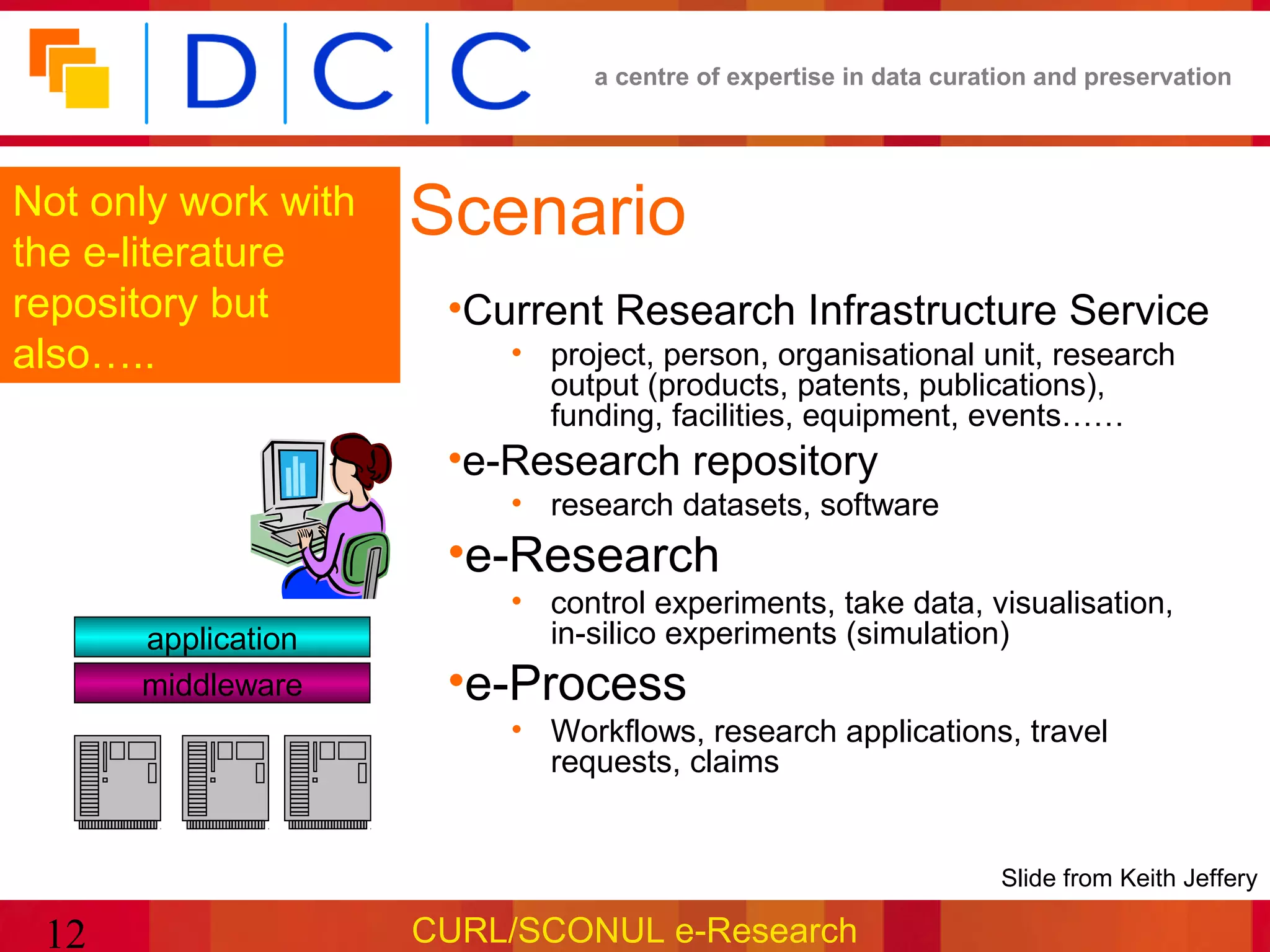
Not only work with
the e-literature
                     Scenario
repository but        •Current Research Infrastructure Service
also…..                  • project, person, organisational unit, research
                           output (products, patents, publications),
                           funding, facilities, equipment, events……
                      •e-Research repository
                         • research datasets, software
                      •e-Research
                         • control experiments, take data, visualisation,
      application          in-silico experiments (simulation)
      middleware      •e-Process
                         • Workflows, research applications, travel
                           requests, claims


                                                                 •Slide from Keith Jeffery

 12                  CURL/SCONUL e-Research
a centre of expertise in data curation and preservation


Retaining research data means…
     • Data secure against loss (within group)
     • Communal repository (secure data store)
     • Re-usable, sharable information
     • As above, plus active curation (eg bio-
       informatics)
     • Long term preservation of information

     • Be clear what you are trying to do!

13                 CURL/SCONUL e-Research
a centre of expertise in data curation and preservation


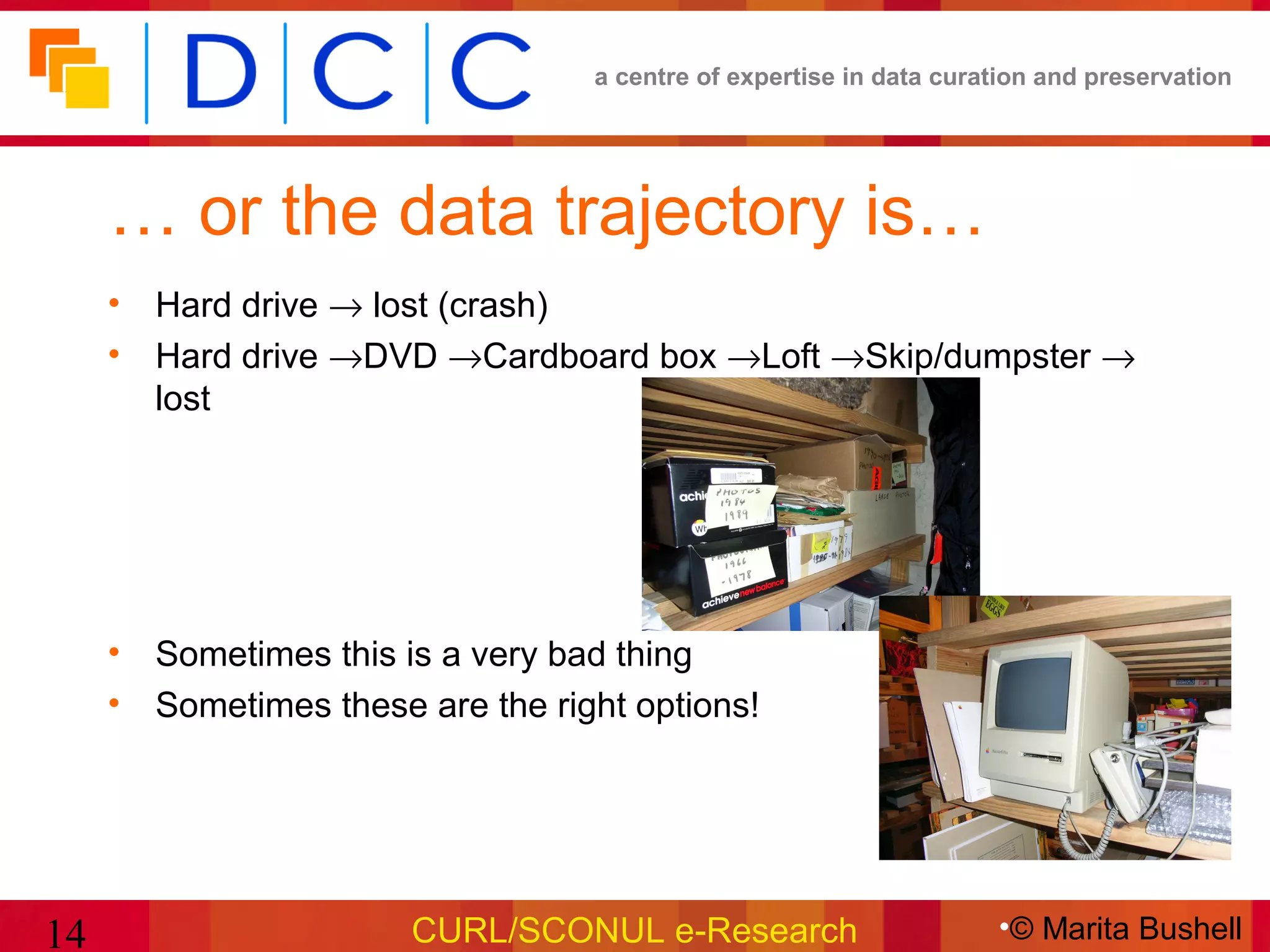
     … or the data trajectory is…
     • Hard drive → lost (crash)
     • Hard drive →DVD →Cardboard box →Loft →Skip/dumpster →
       lost


     • Sometimes this is a very bad thing
     • Sometimes these are the right options!


14                     CURL/SCONUL e-Research                       •© Marita Bushell
a centre of expertise in data curation and preservation


            Preservation risks
     •   Not caring enough to try
     •   No permissions to do it (or don’t know what permissions we have!)
     •   Insufficient contextual information to interpret
     •   Human error
     •   Media failure
     •   Lack of money
     •   Policy failure
     •   Deliberate attack
     •   Obsolescence of format


15                    CURL/SCONUL e-Research
a centre of expertise in data curation and preservation


                Preservation
     • “Preservation starts before creation”
       • Not in many IRs!
     • Where must lifecycle involvement start?


16                 CURL/SCONUL e-Research
a centre of expertise in data curation and preservation


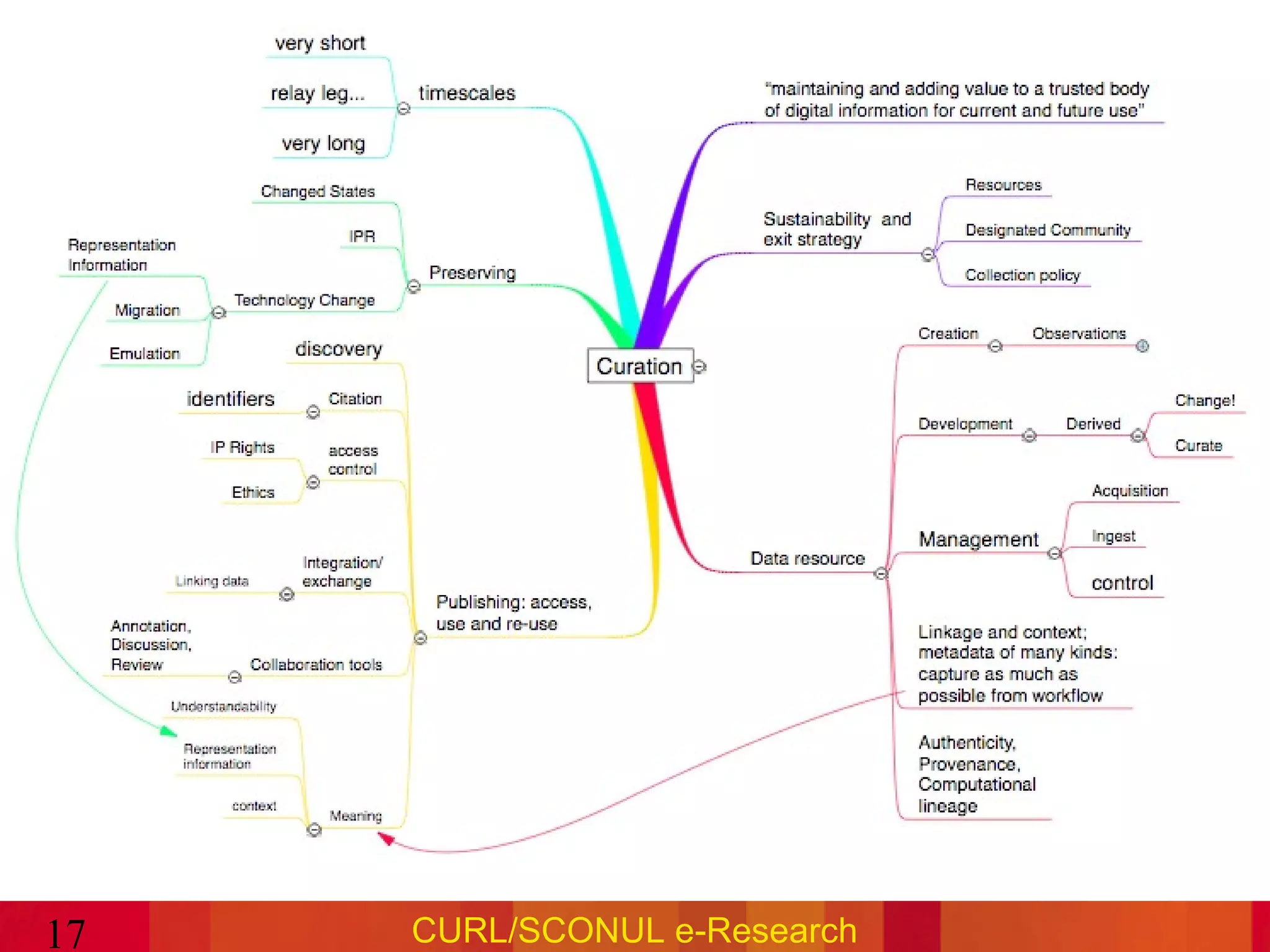
17   CURL/SCONUL e-Research
a centre of expertise in data curation and preservation


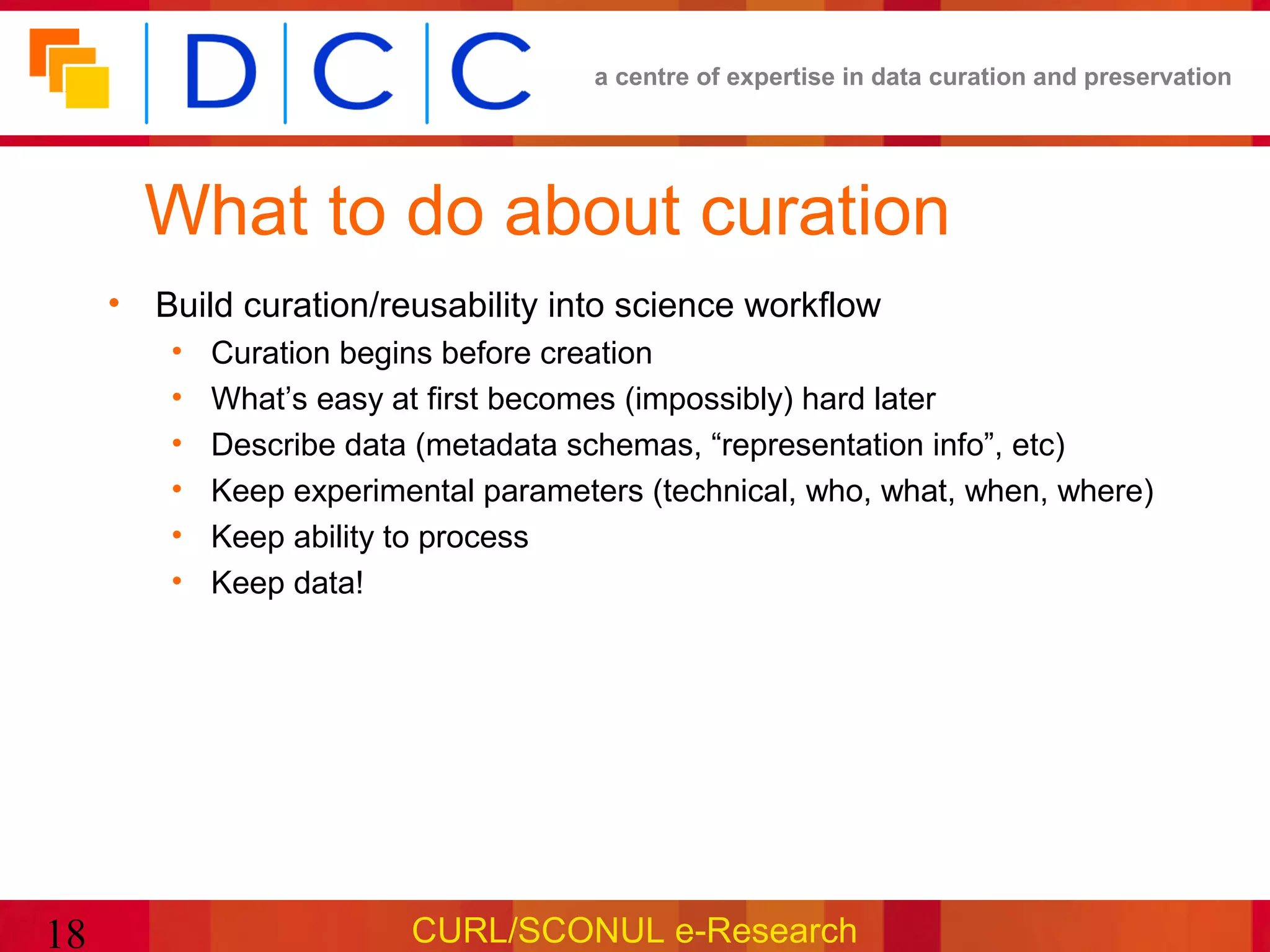
       What to do about curation
     • Build curation/reusability into science workflow
         •   Curation begins before creation
         •   What’s easy at first becomes (impossibly) hard later
         •   Describe data (metadata schemas, “representation info”, etc)
         •   Keep experimental parameters (technical, who, what, when, where)
         •   Keep ability to process
         •   Keep data!


18                        CURL/SCONUL e-Research
a centre of expertise in data curation and preservation


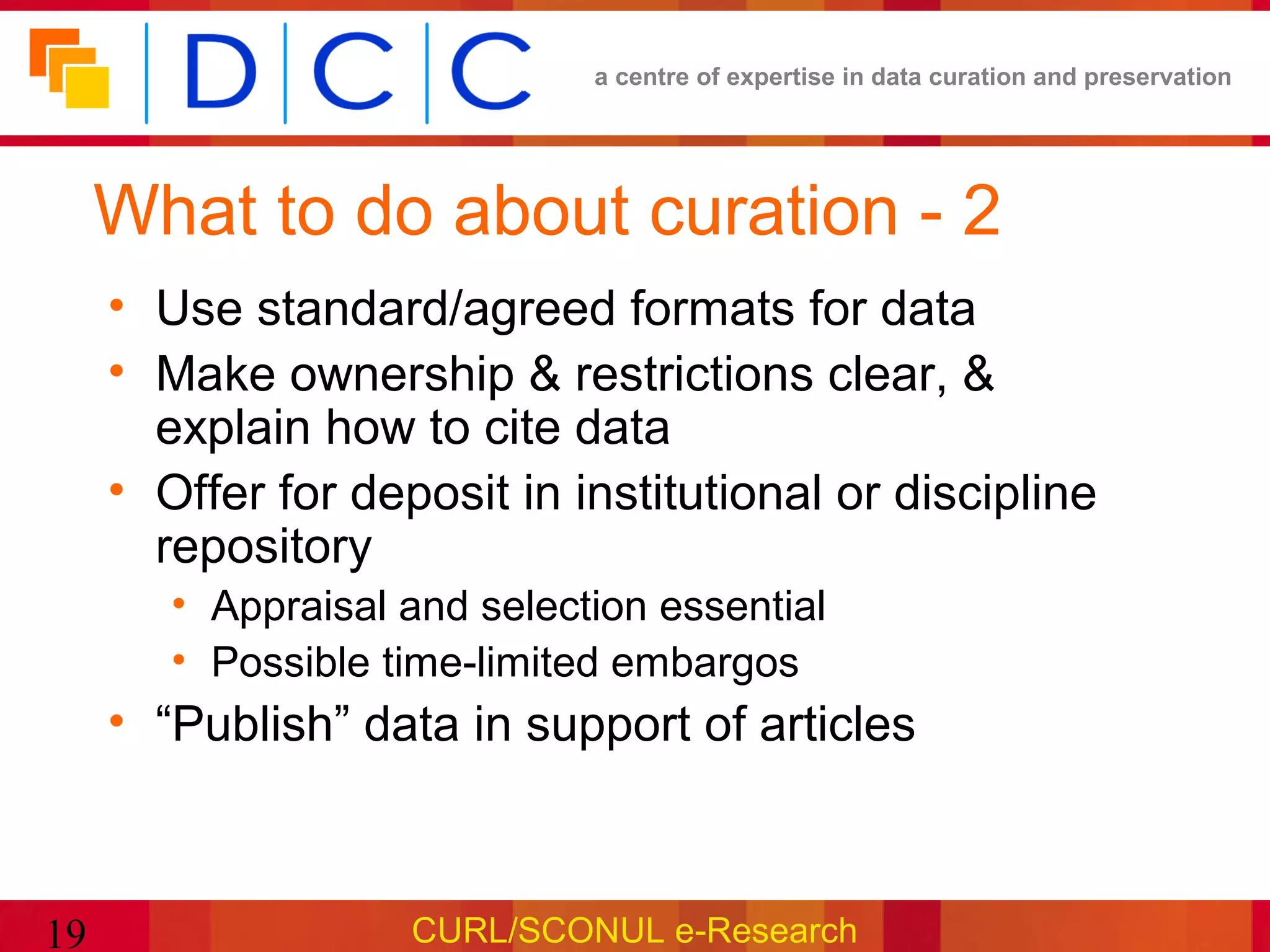
     What to do about curation - 2
     • Use standard/agreed formats for data
     • Make ownership & restrictions clear, &
       explain how to cite data
     • Offer for deposit in institutional or discipline
       repository
        • Appraisal and selection essential
        • Possible time-limited embargos
     • “Publish” data in support of articles


19                  CURL/SCONUL e-Research
a centre of expertise in data curation and preservation


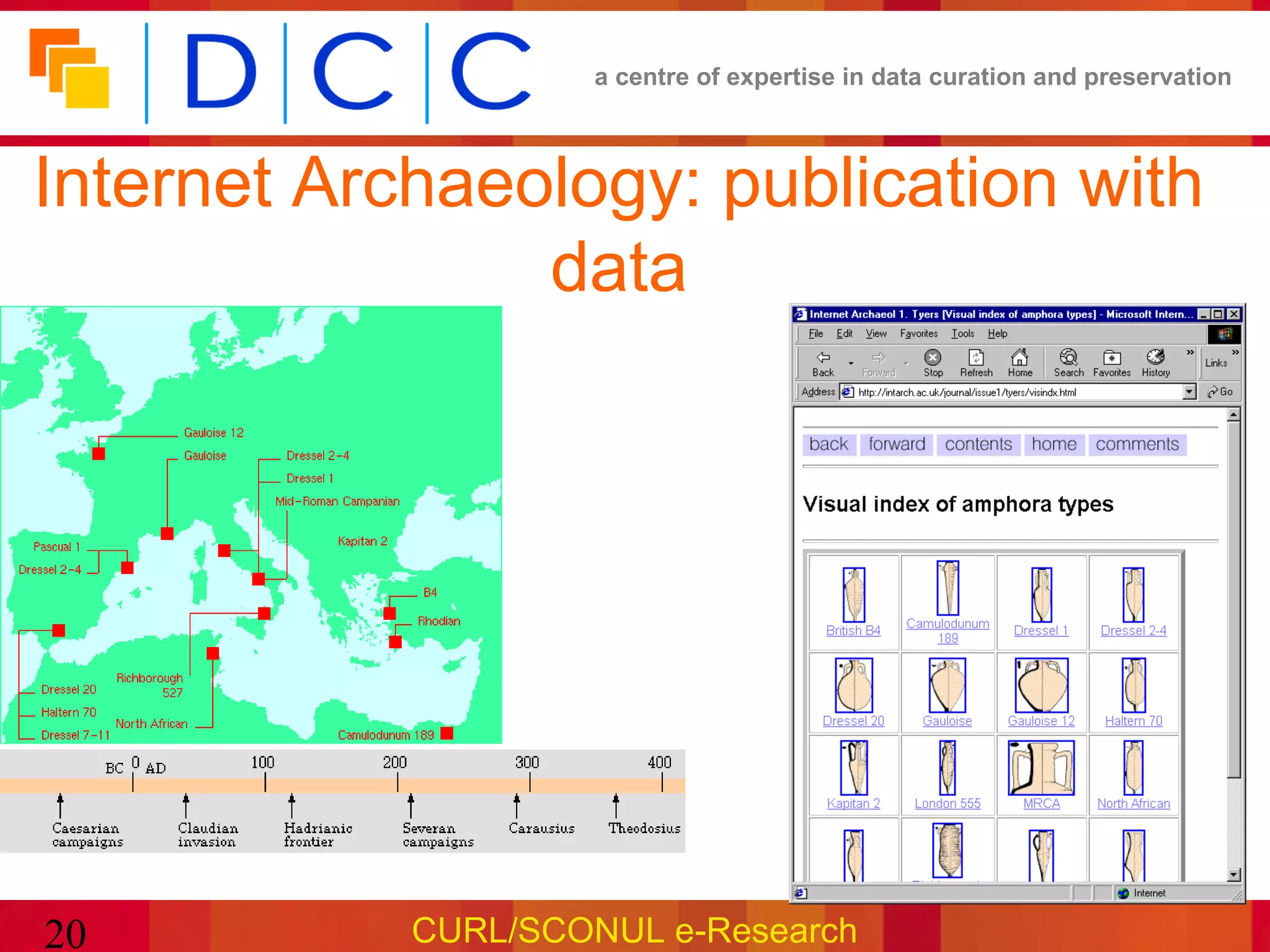
Internet Archaeology: publication with
                data


20          CURL/SCONUL e-Research
a centre of expertise in data curation and preservation


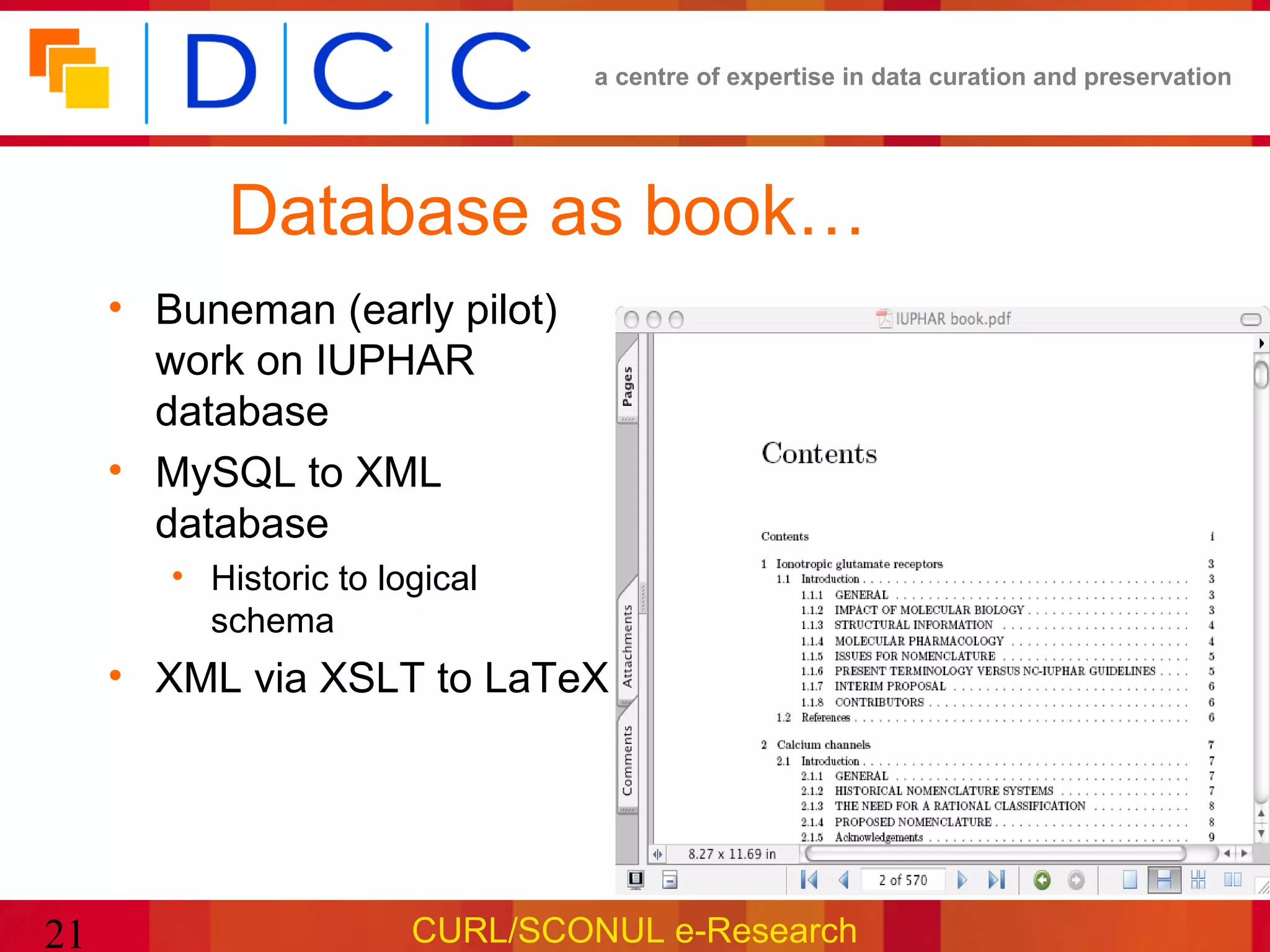
           Database as book…
     • Buneman (early pilot)
       work on IUPHAR
       database
     • MySQL to XML
       database
        • Historic to logical
          schema
     • XML via XSLT to LaTeX


21                      CURL/SCONUL e-Research
a centre of expertise in data curation and preservation


Institutional repositories and data
     • Institutional repository managers
        • Make contact with emerging institutional data services
        • Start raising awareness of the need to curate rather than just dump
          data
        • Start thinking about the relationship of data to publications
          (especially e-theses)
        • Start thinking about the metadata needed to find and re-use data
        • Make contact with key researchers
        • Start thinking about their data…


22                      CURL/SCONUL e-Research
a centre of expertise in data curation and preservation


           What kinds of data?
     • Observations
        • eg UARS (Upper Atmosphere) Level 0: telemetry
        • UARS Level 1: measured physical parameters (post
          calibration?)
     • Derived data
        • UARS Level 2: calculated geophysical? profiles
        • UARS level 3: gridded, interpolated?
     • Combined data
     • Crafted data
        • Eg annotated gene/protein databases
     • Descriptive (meta)data


23                    CURL/SCONUL e-Research
a centre of expertise in data curation and preservation


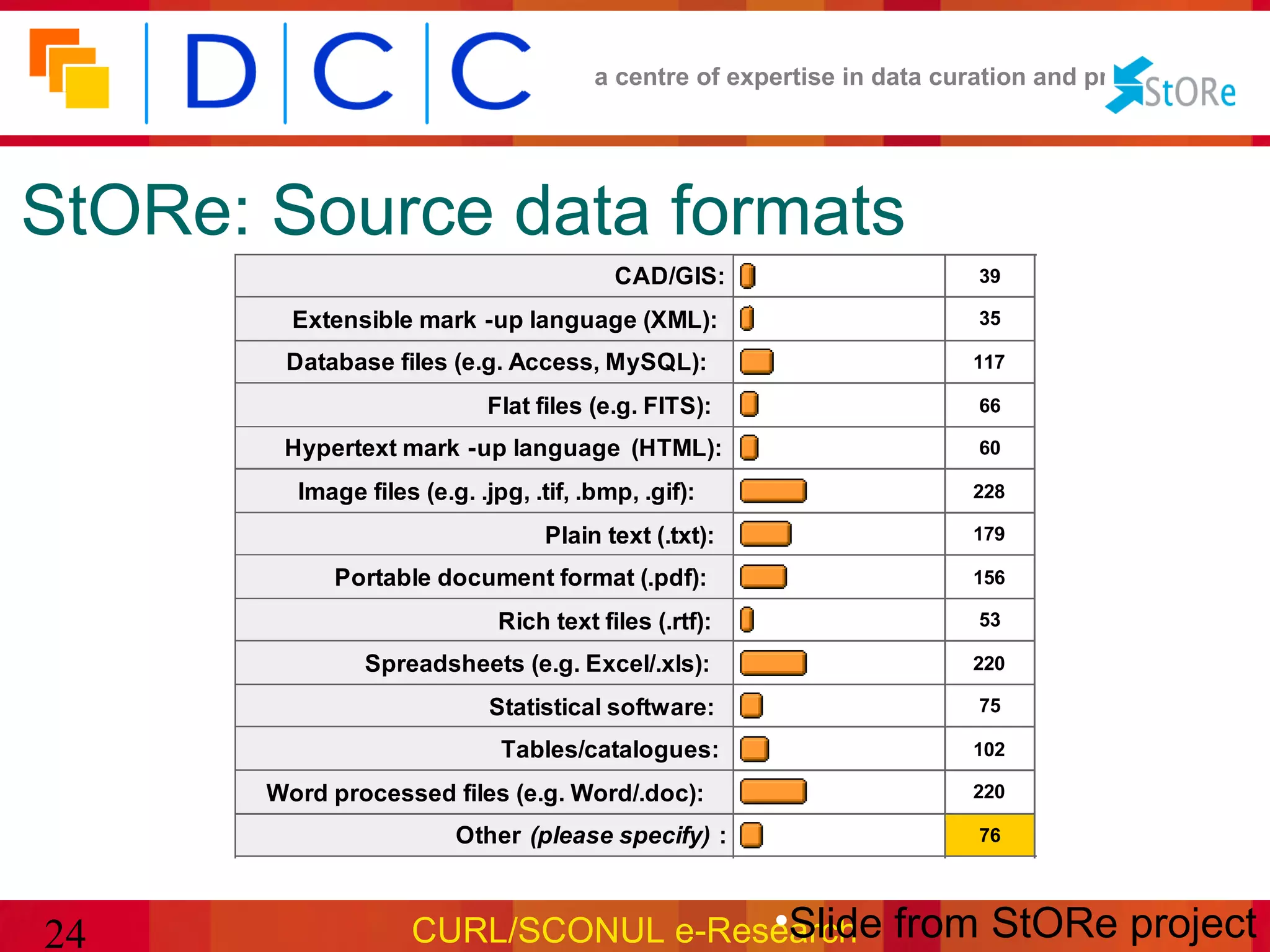
StORe: Source data formats
                                          CAD/GIS:                       39

         Extensible mark -up language (XML):                             35

        Database files (e.g. Access, MySQL):                            117

                             Flat files (e.g. FITS):                     66

        Hypertext mark -up language (HTML):                              60

         Image files (e.g. .jpg, .tif, .bmp, .gif):                     228

                                   Plain text (.txt):                   179

            Portable document format (.pdf):                            156

                              Rich text files (.rtf):                    53

                Spreadsheets (e.g. Excel/.xls):                         220

                             Statistical software:                       75

                              Tables/catalogues:                        102

       Word processed files (e.g. Word/.doc):                           220

                         Other (please specify) :                        76


24                                   •Slide
                    CURL/SCONUL e-Research from StORe project
a centre of expertise in data curation and preservation


StORe: the other data formats?
     They said the 76 other formats included:
       +latex+.cc source code, .cif (crystallographic data),
       .pdb, .mtz, .pool, .root, .raw, .swf, .fla, .raw, .mpg,
       binary files, chemdraw cdx, xwin nmr files, .ps files,
       .fla, .swf, masslynx files, derived data in PAw-format
       ntuples, raw mass spectrometry data, X-ray
       diffraction data, kaleidagraphs, Atlas/ti hermeneutic
       unit files, C++/shell scripts, Fourier induction decay
       files, etc., etc., etc., etc………..


25                                    •Slide
                     CURL/SCONUL e-Research from StORe project
a centre of expertise in data curation and preservation


StORe: the other data formats - more
 They also said such things as:
   “It is stored in a database, but nothing so simple as an
   Access file! It's one of the largest databases in the world!
   The format is Kanga/Root and previously was
   Objectivity. I think it's of the order of Picobytes in size.”
 And:
   “God preserve us from idiots who archive data in
   proprietary commercial formats (Excel spreadsheets and
   MS-word documents)!”


26                                   •Slide
                    CURL/SCONUL e-Research from StORe project
a centre of expertise in data curation and preservation


         Data resource stages
     • Curated data is created…
       • Observations? Fixed!
     • Or Acquired…
       • Data brought/bought from outside
       • Ingest
     • Development
       • Derived, refined, combined, processed data
       • Potentially many stages


27                 CURL/SCONUL e-Research
a centre of expertise in data curation and preservation


What are the reusability issues?
     • Data not neutral; highly contextual!
     • Hard to know the risks & pitfalls of a particular
       dataset
     • Data not self-describing: hard to find
       appropriate data (but see Murray-Rust on
       Googling InChI etc)
     • Hard to “understand” data once found
        • Really need information, not data!
     • Hard to use data once understood

28                  CURL/SCONUL e-Research
a centre of expertise in data curation and preservation


                   Context
     • Data meaningless without context
       • Metadata of many kinds
       • Representation information… from data to
         information
       • Linkage and connection between datasets
     • Provenance
       • Authenticity/integrity
       • Computational lineage


29                 CURL/SCONUL e-Research
a centre of expertise in data curation and preservation


 But the problem with metadata is
     •It takes too much effort for the researcher to put it in
     (many web-form-screens)
     •So have to input incrementally, no repetition, using the
     workflow..
     •And not re-keying data stored already elsewhere in
     other (linked-up) systems


                                                                 •Slide from Keith Jeffery

30                   CURL/SCONUL e-Research
a centre of expertise in data curation and preservation


           Access and re-use
     • Ethics and rights control access
       • Weak in expressing this long-term
     • Collaboration tools
       • Annotation, discussion, review (see DART…)
       • Re-use leading to change and development
     • “Publication”
       • Not just in “print”
       • Underlying data should be “published”, too


31                 CURL/SCONUL e-Research
a centre of expertise in data curation and preservation


              Data citation issues…
     •   Citation for human readers and machine use cases
     •   Granularity: database, record, item
     •   Citation of changing objects
          •   Version change (eg W3C practice: no version = latest, vs bibliographic: no
              version = first)
          •   An efficient way to reference and access “archived” past states of more rapidly
              changing dataset, eg Genomics… datasets that result from the combined work
              of curators, or contain opinions or facts likely to change (work in progress,
              Buneman et al)
     •   Standards conflict and immature (NLM best?)

     •   Citation ESSENTIAL for motivating quality academic work on data
         management and curation


32                            CURL/SCONUL e-Research
a centre of expertise in data curation and preservation


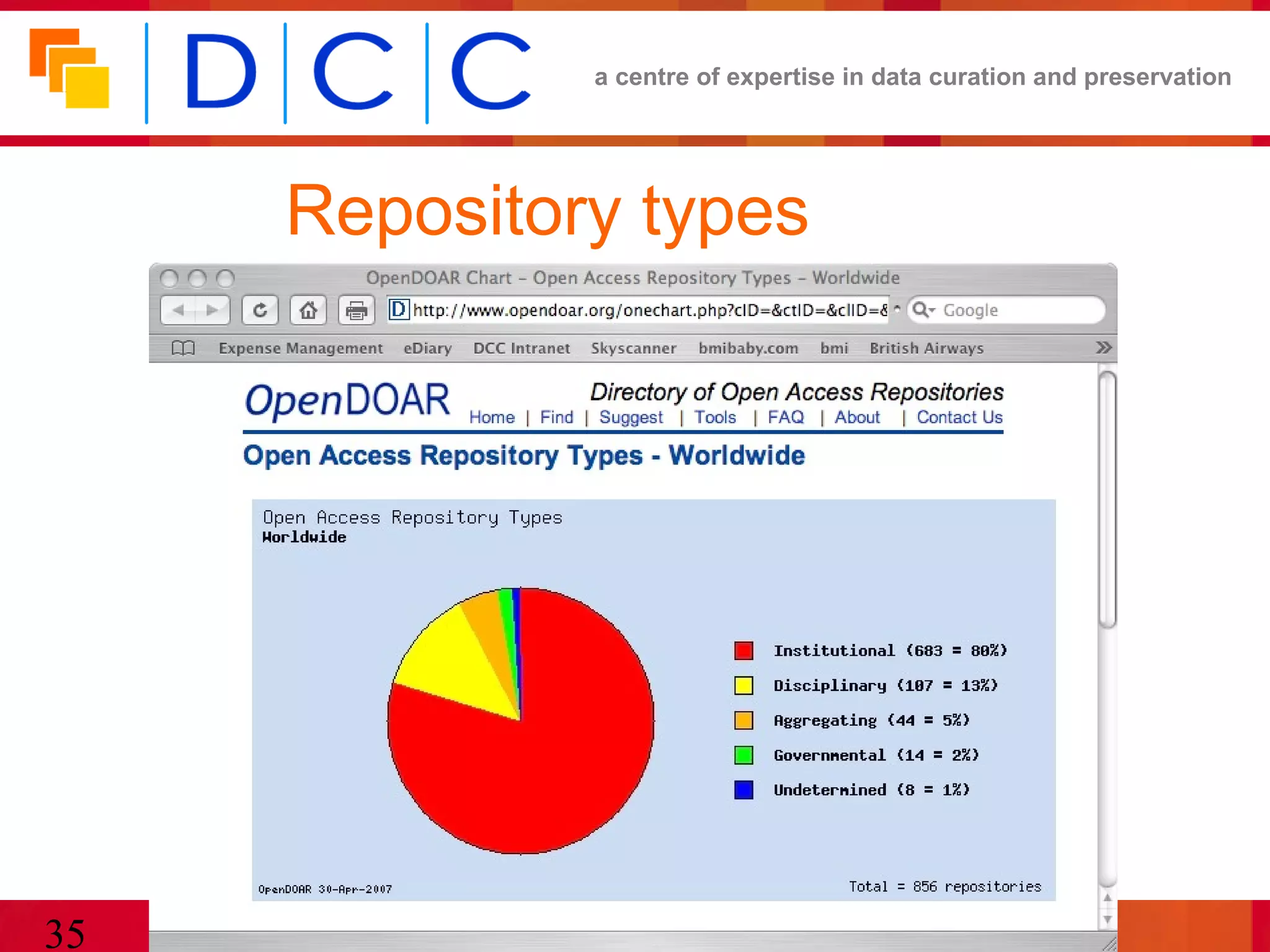
        Institutional Repositories
     • Now largely text
     • OpenDOAR: only 5 Institutional Repositories claim to include
       datasets
        •   Bristol
        •   Cambridge
        •   Edinburgh
        •   Leicester
        •   Southampton
     • …and some of these seem doubtful on inspection!
        • … of course not all research data are “datasets”


33                        CURL/SCONUL e-Research
a centre of expertise in data curation and preservation


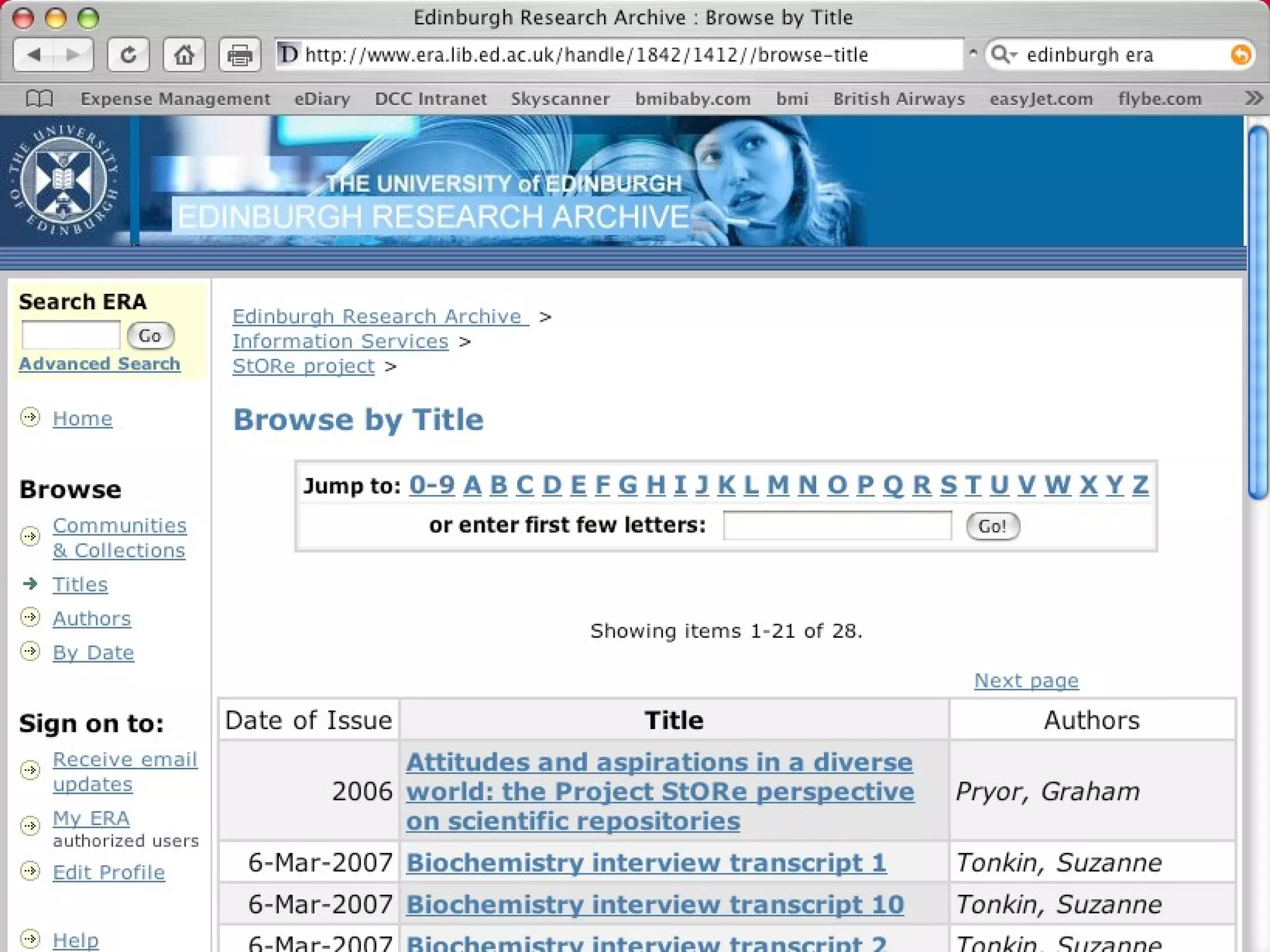
        ERA


34   CURL/SCONUL e-Research
a centre of expertise in data curation and preservation


     Repository types


35      CURL/SCONUL e-Research
a centre of expertise in data curation and preservation


            Repository challenges
     • Data are different: you’ll need access to some domain knowledge
     • Appraisal/selection harder
     • Broader range of formats
        • Appropriate “standards” for longevity? XML-based?
     • What metadata are needed?
        •   Descriptive, to find the dataset
        •   Context and background
        •   Provenance
        •   “Representation information” to connect data to information (whatever
            gives meaning to data for the “designated community”)


36                        CURL/SCONUL e-Research
a centre of expertise in data curation and preservation


       Repository challenges - 2
     • May distort your repository
        •   Size
        •   Number of objects
        •   Rate of deposit
        •   Nature of use
     • Databases may be dynamic
     • Databases may need to be accessed in situ
     • Rights and ethical limitations hard to describe and
       enforce
     • Need to build links to publications (cf StORe)
     • Need to build discipline links across repositories…

37                     CURL/SCONUL e-Research
a centre of expertise in data curation and preservation


      Repository challenges - 3
     • Is your platform suitable?
     • Most successful (ie older) data repositories
       are DIY
     • Data also held in repositories built on Dspace,
       ePrints and Fedora


38                 CURL/SCONUL e-Research
a centre of expertise in data curation and preservation


                 Repositories?
     • SH: “The trouble with many Institutional Repositories is
       that they are not run by researchers but by permissions
       professionals...”
     • PMR: “I have had similar thoughts. I got the distinct
       impression that some IRs are run like Victorian
       museums - look but don’t touch. The very word
       repository suggests a funereal process - it’s no surprise
       that having put much of my stuff into DSpace I find it’s
       an enormous effort to get it out. Why don’t we build
       disseminatories instead?”


                                                           •From Peter Murray Rust’s blog

39                    CURL/SCONUL e-Research
a centre of expertise in data curation and preservation


What is a Repository? - revisited
     • from the perspective of the content consumer a
       repository is just a Web site
     • think existing Web presences… think BBC… think
       museum… think Flickr…
     • think content management systems
     • are these Web sites or repositories?
     • who cares?
     • but conceptualising the repository as a Web site
       changes priorities
        • Web architecture, Google, usability, accessibility, …

                                                                    •Slide from Andy Powell

40                    CURL/SCONUL e-Research
a centre of expertise in data curation and preservation


           Real Open Access?
     • PMR: But the problem with the repositories is that
       there is no indication that the actual thesis is
       OpenAccess. The Edinburgh repository announces:
       All items in ERA are protected by copyright, with all
       rights reserved… which discourages the visitor for
       looking for an Open Licence within the thesis.
     • PMR: Here is a very simple idea: Add dc:rights to
       the splash page and metadata and proudly proclaim
       in large letters:
       THIS THESIS CARRIES A CREATIVE COMMONS
                         LICENCE - ENJOY!

                                                         •From Peter Murray Rust’s blog

41                   CURL/SCONUL e-Research
a centre of expertise in data curation and preservation


                 Open Data
     • More than open access…
     • Includes the right to process the content
     • Plus the capability to process the content
       • Implies data-oriented metadata within the content
       • Microformats?


                        Datuments?

42                 CURL/SCONUL e-Research
a centre of expertise in data curation and preservation


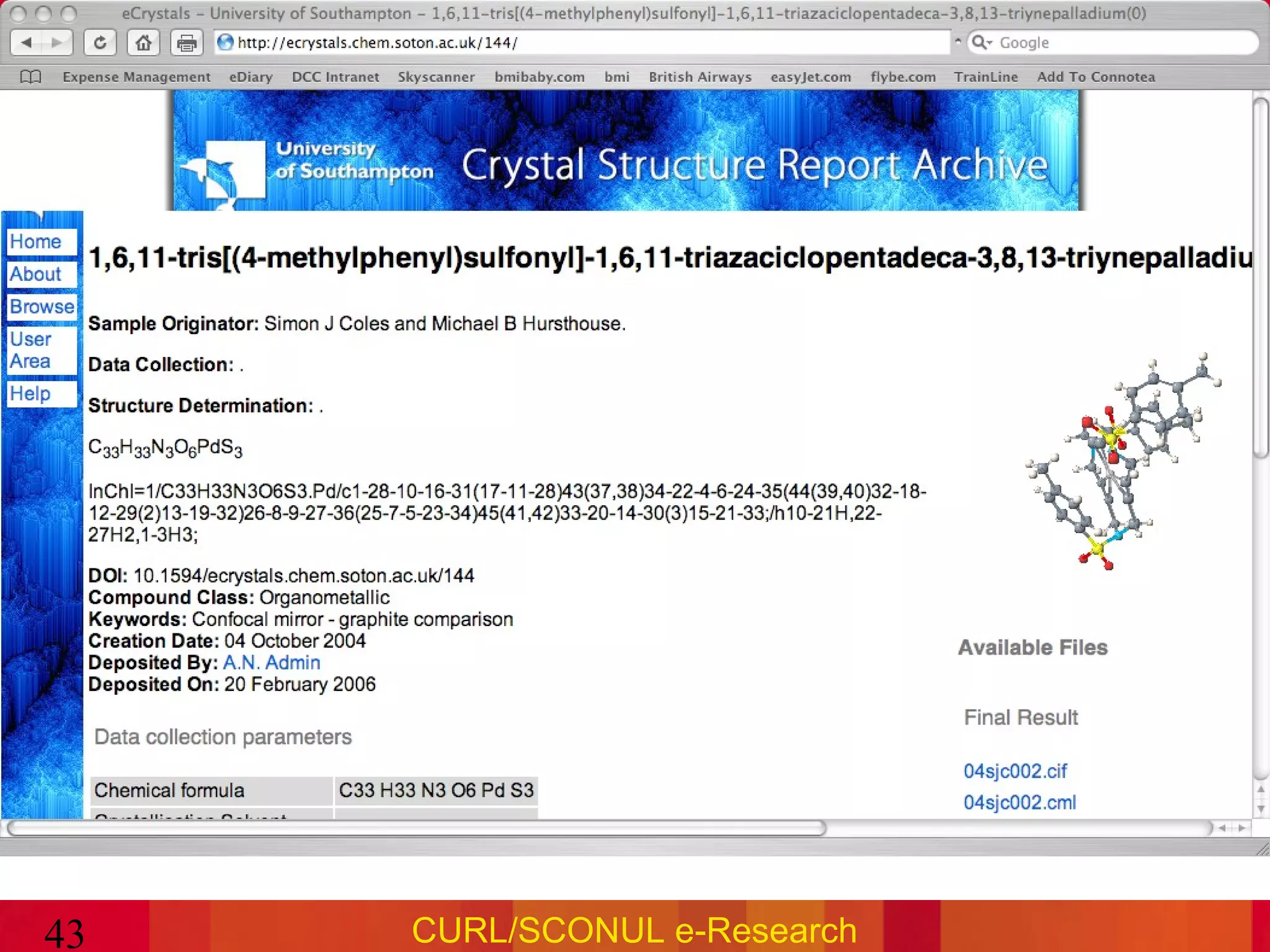
43   CURL/SCONUL e-Research
a centre of expertise in data curation and preservation


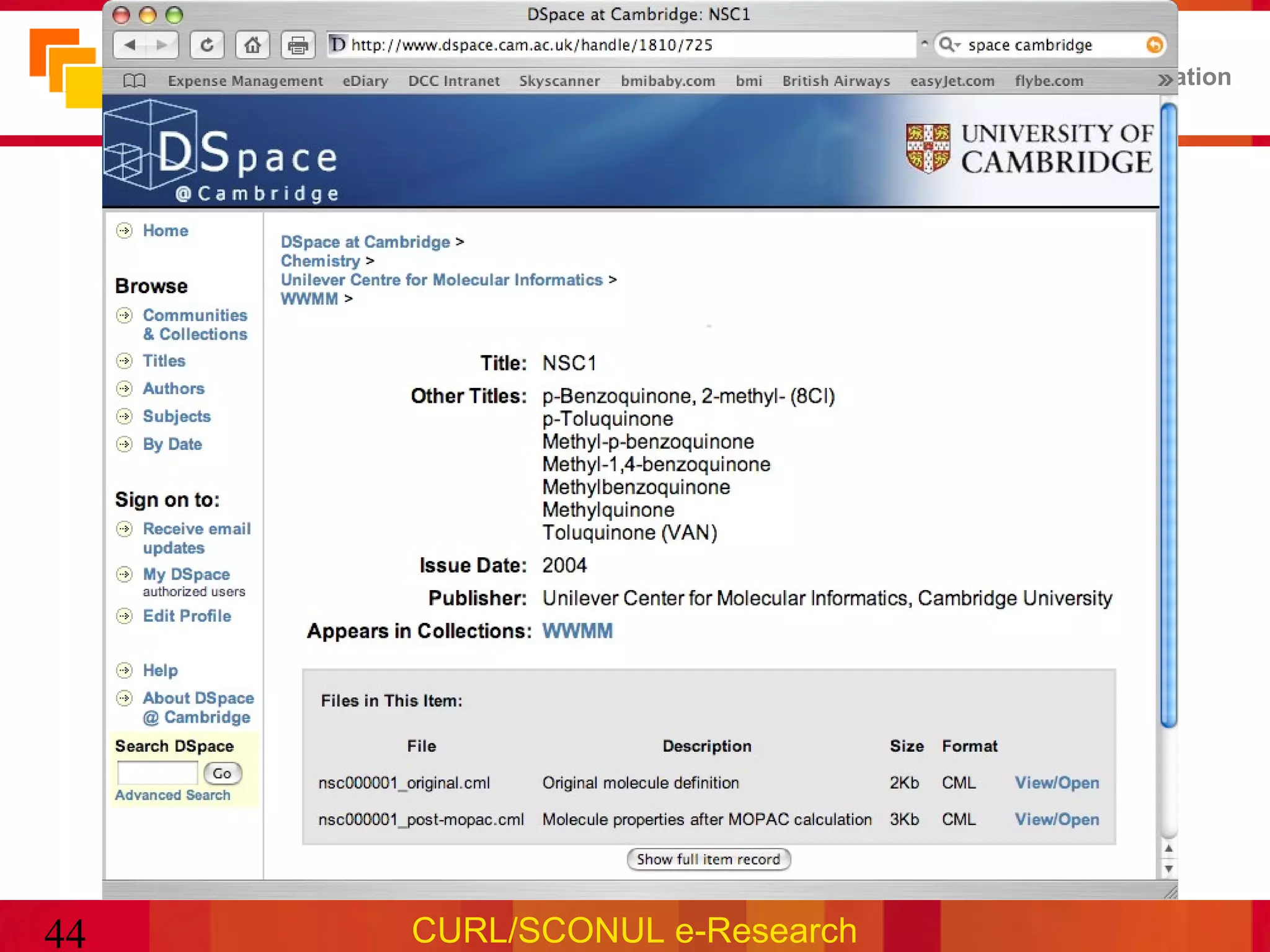
44   CURL/SCONUL e-Research
a centre of expertise in data curation and preservation


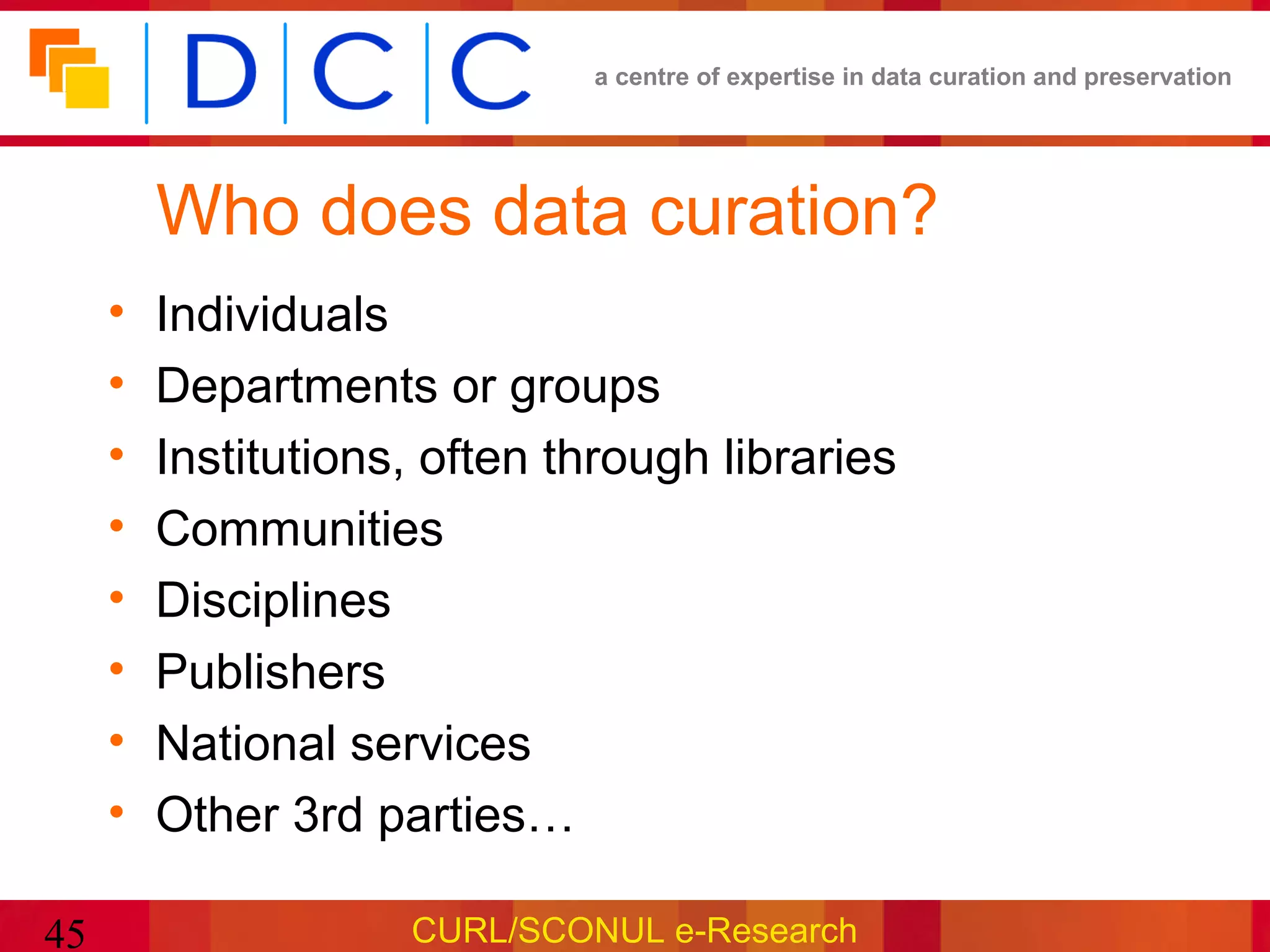
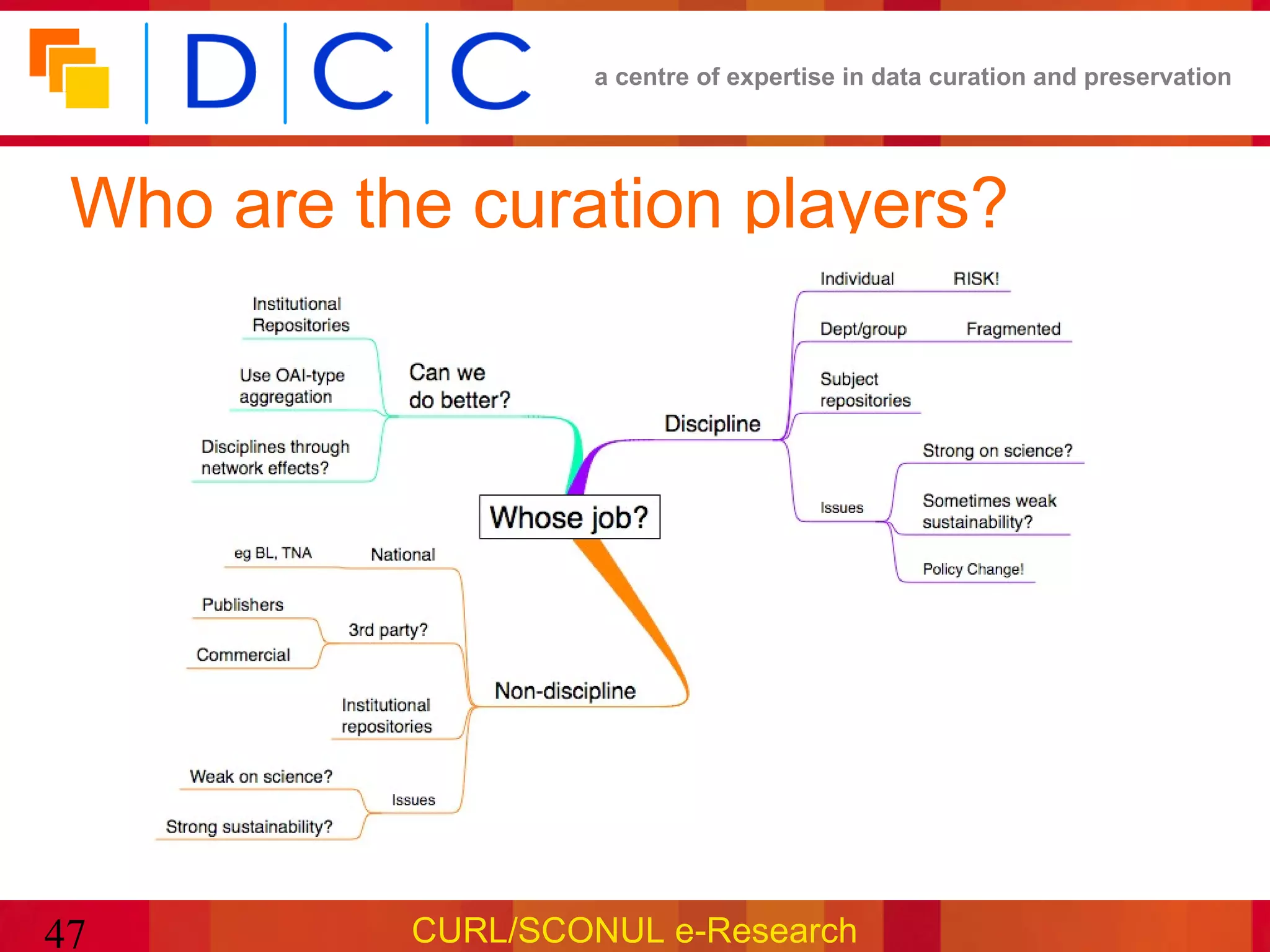
         Who does data curation?
     •   Individuals
     •   Departments or groups
     •   Institutions, often through libraries
     •   Communities
     •   Disciplines
     •   Publishers
     •   National services
     •   Other 3rd parties…

45                   CURL/SCONUL e-Research
a centre of expertise in data curation and preservation


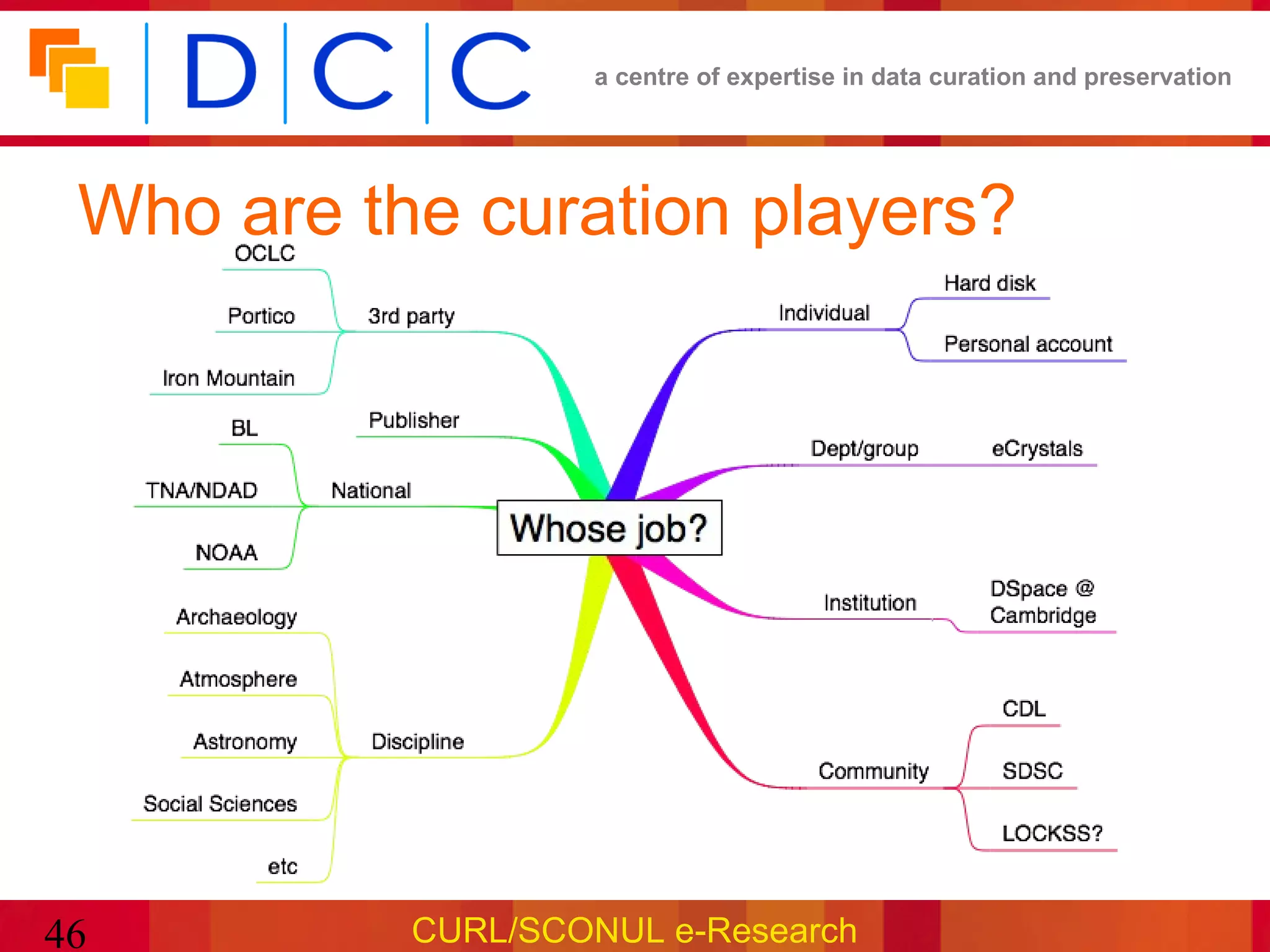
 Who are the curation players?


46         CURL/SCONUL e-Research
a centre of expertise in data curation and preservation


 Who are the curation players?


47         CURL/SCONUL e-Research
a centre of expertise in data curation and preservation


                              AHDS
     • “AHRC Council has decided to cease funding the Arts and
       Humanities Data Service (AHDS) from March 2008. […] Grant
       holders must make materials they had planned to deposit with the
       AHDS available in an accessible depository for at least three years
       after the end of their grant”
             • AHRC Press Release 14/05/2007
             • (Note petition at http://petitions.pm.gov.uk/AHDSfunding/)
         • Does not apply to Archaeology: ADS still funded?
     • “Council believes that long term storage of digital materials and
       sustainability is best dealt with by an active engagement with HEIs
       rather than through a centralised service”
     • “JISC has decided that it is unable to fund the service alone and
       that therefore its own funding of the service will, in its current form,
       cease on the same date. […] exploring with the AHDS … and the
       wider community alternative approaches to maintaining strong
       support for that community beyond March 2008”
             • JISC Press Release 13/06/2007
48                          CURL/SCONUL e-Research
a centre of expertise in data curation and preservation


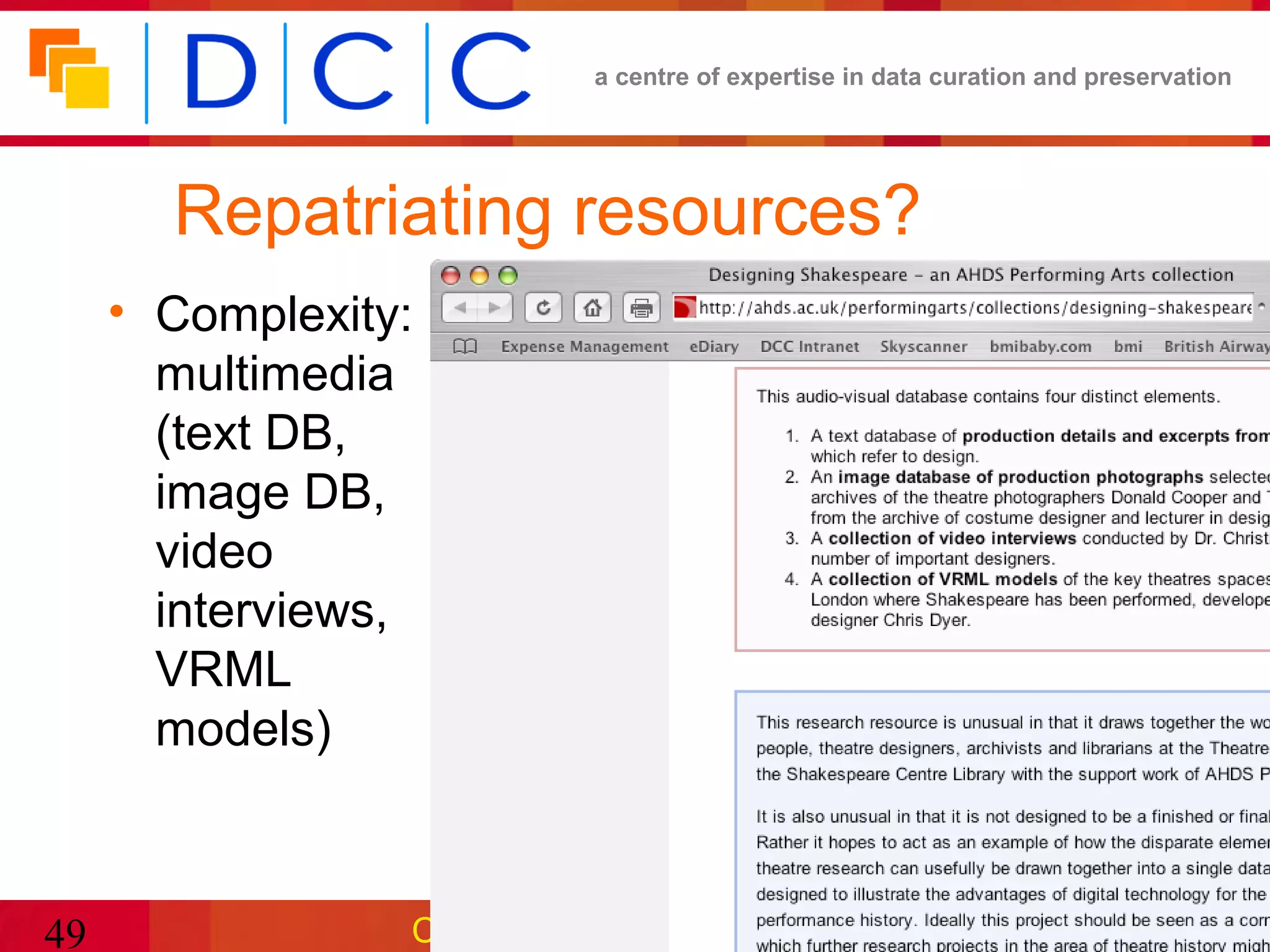
       Repatriating resources?
     • Complexity:
       multimedia
       (text DB,
       image DB,
       video
       interviews,
       VRML
       models)


49               CURL/SCONUL e-Research
a centre of expertise in data curation and preservation


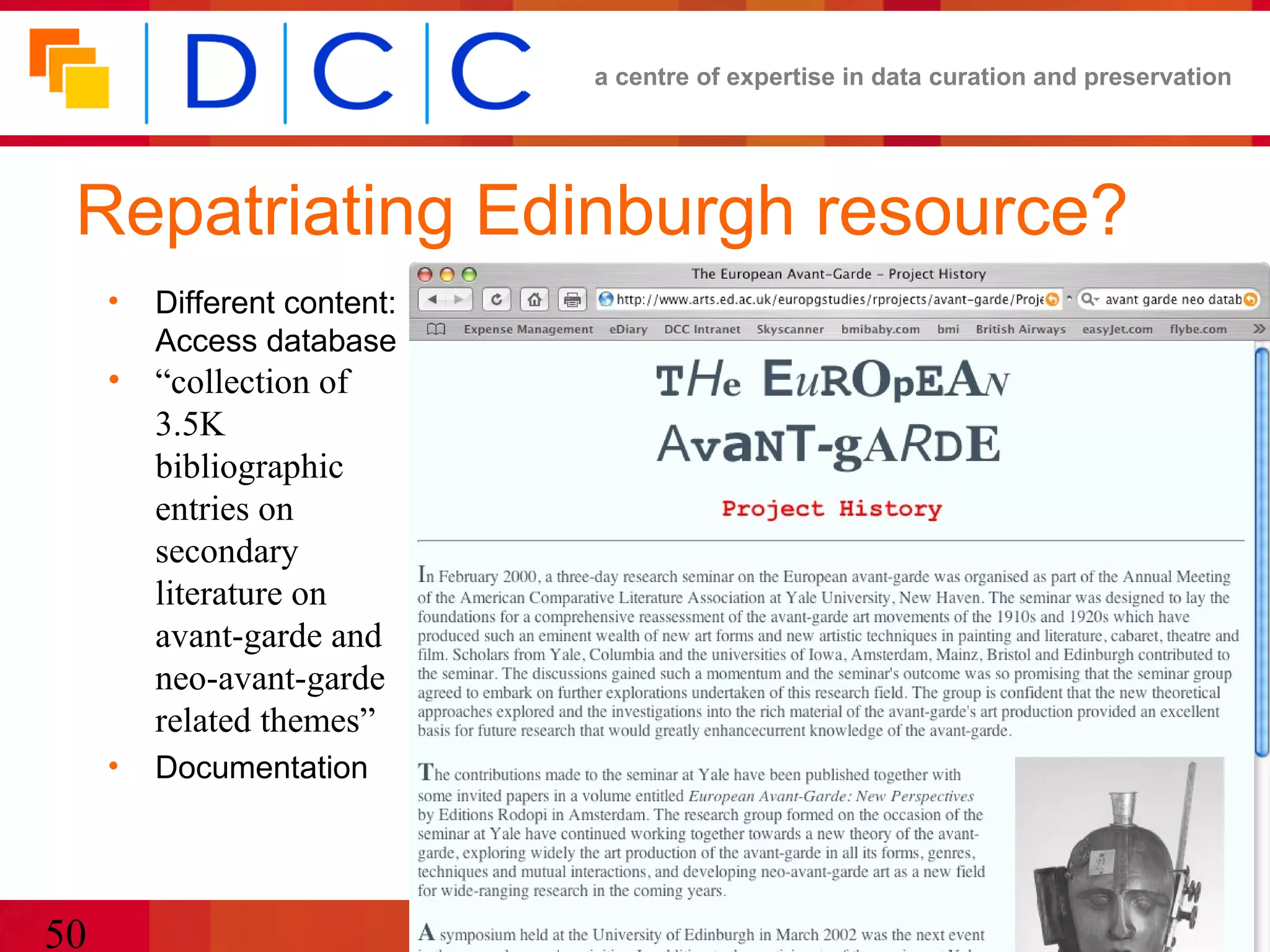
 Repatriating Edinburgh resource?
     •   Different content:
         Access database
     • “collection of
       3.5K
       bibliographic
       entries on
       secondary
       literature on
       avant-garde and
       neo-avant-garde
       related themes”
     •   Documentation


50                            CURL/SCONUL e-Research
a centre of expertise in data curation and preservation


             New challenge?
     • Can we find a way to combine sustainability
       (but generality) of institutional repositories
       with science focus (aiming to reduce the high
       risk) of domain repositories?
       • Some sort of domain repository in the network
         space?


51                 CURL/SCONUL e-Research
a centre of expertise in data curation and preservation


              Cultural change
     • If we build it, will they come? NO!!
     • Outreach important: communication with
       scientists and researchers is hard graft
     • Cultural change to new approach requires more:
       • Incentives, rewards and mandates
       • Successful exemplars (well publicised)
       • Discipline-oriented approach (one size does not fit all)


52                  CURL/SCONUL e-Research
a centre of expertise in data curation and preservation


Financial sustainability: the 8 pillars
            of wisdom?
     • Someone has to pay…
        • Consumer pays: subscription or usage?
        • Depositor pays (ie grant or institution)?
        • Institution pays (IR, cf library/archive/museum)
        • Community (discipline repository?) pays
            • Government, or science funder
            • Learned society?
            • Volunteers (cf open source, social computing, LOCKSS)?
        • Side effect (advertiser) pays (unlikely for much data?)
        • Endowment or donor pays…
     • Diversity?


53                      CURL/SCONUL e-Research
a centre of expertise in data curation and preservation


              Role of libraries
     • 2-4% of university budgets (“There’s plenty of
       money… there’s just not plenty of money for
       everything!” Courant)?
     • Traditional role in sustaining the raw material
       of scholarship
       • Looking for new roles in the digital world?
       • Many unsaid assumptions from publishing
         paradigm?
       • Domain knowledge: wide but not deep
       • Involvement in data creation low


54                  CURL/SCONUL e-Research
a centre of expertise in data curation and preservation


           Thank you
     c.rusbridge@ed.ac.uk


55   CURL/SCONUL e-Research

Saving private data, sharing Open Data? Role of libraries and institutional repositories in a data world

  • 1.
    a centre ofexpertise in data curation and preservation Saving private data, sharing Open Data? Role of libraries and institutional repositories in a data world... Chris Rusbridge CURL/SCONUL e-Research Task Force meeting 14 June 2007 Funded by: This work is licensed under the Creative Commons Attribution-NonCommercial-ShareAlike 2.5 UK: Scotland License. To view a copy of this license, visit http://creativecommons .org/licenses/by-nc-sa/2.5/scotland/ ; or, (b) send a letter to Creative Commons, 543 Howard Street, 5th Floor, San Francisco, California, 94105, USA.
  • 2.
    a centre ofexpertise in data curation and preservation Welcome 2 CURL/SCONUL e-Research
  • 3.
    a centre ofexpertise in data curation and preservation Contents • Role of libraries • How we should start dealing with data • AHDS decision implications… 3 CURL/SCONUL e-Research
  • 4.
    a centre ofexpertise in data curation and preservation Digital Curation Centre Mission “The over-riding purpose of the DCC is to support and promote continuing improvement in the quality of data curation, and of associated digital preservation” 4 CURL/SCONUL e-Research
  • 5.
    a centre ofexpertise in data curation and preservation Role of Research Libraries? • Research Collections • Special collections • Research space & facilities • Services (eg ILL) • +++ 5 CURL/SCONUL e-Research
  • 6.
    a centre ofexpertise in data curation and preservation Role of Research Libraries? • Research Collections… going virtual • Special collections • Research space & facilities… for students • Services (eg ILL)… going virtual • Diminishing strategic importance? 6 CURL/SCONUL e-Research
  • 7.
    a centre ofexpertise in data curation and preservation Role of Research Libraries? • Major service organisation at heart of University • Addresses institutional priorities • Skills in organisation of knowledge • Significant budget • “Hearts & Minds” 7 CURL/SCONUL e-Research
  • 8.
    a centre ofexpertise in data curation and preservation Role of Research Libraries? • The right place to build infrastructure for institutional knowledge capital? • Yes! But don’t under-estimate… • The scale of change needed • How much your legacy (and skills!) drag you back • The need for domain knowledge Data are different! 8 CURL/SCONUL e-Research
  • 9.
    a centre ofexpertise in data curation and preservation “The Records of Science” • Data increasingly important as evidence • Key part of the scholarly record (public good) • Unrepeatable observations & experiments • Value for public money (eg OECD) • Experimental verifiability (the basis of science) • Would Chang retractions have been reduced if his first data were available? CHANG, G., ROTH, C. B., REYES, C. L., PORNILLOS, O., CHEN, Y.-J. & CHEN, A. P. (2006) Retraction of Pornillos et al., Science 310 (5756) 1950-1953. Retraction of Reyes and Chang, Science 308 (5724) 1028-1031. Retraction of Chang and Roth, Science 293 (5536) 1793-1800. Science Magazine, 314. http://www.sciencemag.org/cgi/content/full/314/5807/1875b • Allows additional interpretations • Legal and compliance (eg emerging RC mandates) 9 CURL/SCONUL e-Research
  • 10.
    a centre ofexpertise in data curation and preservation OECD declaration • “…Work towards the establishment of access regimes for digital research data from public funding in accordance with the following objectives and principles: • Openness • Transparency • Legal conformity • Formal responsibility • Professionalism • Protection of intellectual property • Interoperability • Quality and security • Efficiency • Accountability” 10 CURL/SCONUL e-Research
  • 11.
    a centre ofexpertise in data curation and preservation Repositories • Document / article repositories • simple metadata (discovery, description) • ePrints, DSpace, Fedora, ePubs…. • e-Research repositories • more complex metadata (discovery, description, usage control, software parameters…) • ‘homebrew’ systems – portals to research datasets and software •Slide from Keith Jeffery 11 CURL/SCONUL e-Research
  • 12.
    a centre ofexpertise in data curation and preservation Not only work with the e-literature Scenario repository but •Current Research Infrastructure Service also….. • project, person, organisational unit, research output (products, patents, publications), funding, facilities, equipment, events…… •e-Research repository • research datasets, software •e-Research • control experiments, take data, visualisation, application in-silico experiments (simulation) middleware •e-Process • Workflows, research applications, travel requests, claims •Slide from Keith Jeffery 12 CURL/SCONUL e-Research
  • 13.
    a centre ofexpertise in data curation and preservation Retaining research data means… • Data secure against loss (within group) • Communal repository (secure data store) • Re-usable, sharable information • As above, plus active curation (eg bio- informatics) • Long term preservation of information • Be clear what you are trying to do! 13 CURL/SCONUL e-Research
  • 14.
    a centre ofexpertise in data curation and preservation … or the data trajectory is… • Hard drive → lost (crash) • Hard drive →DVD →Cardboard box →Loft →Skip/dumpster → lost • Sometimes this is a very bad thing • Sometimes these are the right options! 14 CURL/SCONUL e-Research •© Marita Bushell
  • 15.
    a centre ofexpertise in data curation and preservation Preservation risks • Not caring enough to try • No permissions to do it (or don’t know what permissions we have!) • Insufficient contextual information to interpret • Human error • Media failure • Lack of money • Policy failure • Deliberate attack • Obsolescence of format 15 CURL/SCONUL e-Research
  • 16.
    a centre ofexpertise in data curation and preservation Preservation • “Preservation starts before creation” • Not in many IRs! • Where must lifecycle involvement start? 16 CURL/SCONUL e-Research
  • 17.
    a centre ofexpertise in data curation and preservation 17 CURL/SCONUL e-Research
  • 18.
    a centre ofexpertise in data curation and preservation What to do about curation • Build curation/reusability into science workflow • Curation begins before creation • What’s easy at first becomes (impossibly) hard later • Describe data (metadata schemas, “representation info”, etc) • Keep experimental parameters (technical, who, what, when, where) • Keep ability to process • Keep data! 18 CURL/SCONUL e-Research
  • 19.
    a centre ofexpertise in data curation and preservation What to do about curation - 2 • Use standard/agreed formats for data • Make ownership & restrictions clear, & explain how to cite data • Offer for deposit in institutional or discipline repository • Appraisal and selection essential • Possible time-limited embargos • “Publish” data in support of articles 19 CURL/SCONUL e-Research
  • 20.
    a centre ofexpertise in data curation and preservation Internet Archaeology: publication with data 20 CURL/SCONUL e-Research
  • 21.
    a centre ofexpertise in data curation and preservation Database as book… • Buneman (early pilot) work on IUPHAR database • MySQL to XML database • Historic to logical schema • XML via XSLT to LaTeX 21 CURL/SCONUL e-Research
  • 22.
    a centre ofexpertise in data curation and preservation Institutional repositories and data • Institutional repository managers • Make contact with emerging institutional data services • Start raising awareness of the need to curate rather than just dump data • Start thinking about the relationship of data to publications (especially e-theses) • Start thinking about the metadata needed to find and re-use data • Make contact with key researchers • Start thinking about their data… 22 CURL/SCONUL e-Research
  • 23.
    a centre ofexpertise in data curation and preservation What kinds of data? • Observations • eg UARS (Upper Atmosphere) Level 0: telemetry • UARS Level 1: measured physical parameters (post calibration?) • Derived data • UARS Level 2: calculated geophysical? profiles • UARS level 3: gridded, interpolated? • Combined data • Crafted data • Eg annotated gene/protein databases • Descriptive (meta)data 23 CURL/SCONUL e-Research
  • 24.
    a centre ofexpertise in data curation and preservation StORe: Source data formats CAD/GIS: 39 Extensible mark -up language (XML): 35 Database files (e.g. Access, MySQL): 117 Flat files (e.g. FITS): 66 Hypertext mark -up language (HTML): 60 Image files (e.g. .jpg, .tif, .bmp, .gif): 228 Plain text (.txt): 179 Portable document format (.pdf): 156 Rich text files (.rtf): 53 Spreadsheets (e.g. Excel/.xls): 220 Statistical software: 75 Tables/catalogues: 102 Word processed files (e.g. Word/.doc): 220 Other (please specify) : 76 24 •Slide CURL/SCONUL e-Research from StORe project
  • 25.
    a centre ofexpertise in data curation and preservation StORe: the other data formats? They said the 76 other formats included: +latex+.cc source code, .cif (crystallographic data), .pdb, .mtz, .pool, .root, .raw, .swf, .fla, .raw, .mpg, binary files, chemdraw cdx, xwin nmr files, .ps files, .fla, .swf, masslynx files, derived data in PAw-format ntuples, raw mass spectrometry data, X-ray diffraction data, kaleidagraphs, Atlas/ti hermeneutic unit files, C++/shell scripts, Fourier induction decay files, etc., etc., etc., etc……….. 25 •Slide CURL/SCONUL e-Research from StORe project
  • 26.
    a centre ofexpertise in data curation and preservation StORe: the other data formats - more They also said such things as: “It is stored in a database, but nothing so simple as an Access file! It's one of the largest databases in the world! The format is Kanga/Root and previously was Objectivity. I think it's of the order of Picobytes in size.” And: “God preserve us from idiots who archive data in proprietary commercial formats (Excel spreadsheets and MS-word documents)!” 26 •Slide CURL/SCONUL e-Research from StORe project
  • 27.
    a centre ofexpertise in data curation and preservation Data resource stages • Curated data is created… • Observations? Fixed! • Or Acquired… • Data brought/bought from outside • Ingest • Development • Derived, refined, combined, processed data • Potentially many stages 27 CURL/SCONUL e-Research
  • 28.
    a centre ofexpertise in data curation and preservation What are the reusability issues? • Data not neutral; highly contextual! • Hard to know the risks & pitfalls of a particular dataset • Data not self-describing: hard to find appropriate data (but see Murray-Rust on Googling InChI etc) • Hard to “understand” data once found • Really need information, not data! • Hard to use data once understood 28 CURL/SCONUL e-Research
  • 29.
    a centre ofexpertise in data curation and preservation Context • Data meaningless without context • Metadata of many kinds • Representation information… from data to information • Linkage and connection between datasets • Provenance • Authenticity/integrity • Computational lineage 29 CURL/SCONUL e-Research
  • 30.
    a centre ofexpertise in data curation and preservation But the problem with metadata is •It takes too much effort for the researcher to put it in (many web-form-screens) •So have to input incrementally, no repetition, using the workflow.. •And not re-keying data stored already elsewhere in other (linked-up) systems •Slide from Keith Jeffery 30 CURL/SCONUL e-Research
  • 31.
    a centre ofexpertise in data curation and preservation Access and re-use • Ethics and rights control access • Weak in expressing this long-term • Collaboration tools • Annotation, discussion, review (see DART…) • Re-use leading to change and development • “Publication” • Not just in “print” • Underlying data should be “published”, too 31 CURL/SCONUL e-Research
  • 32.
    a centre ofexpertise in data curation and preservation Data citation issues… • Citation for human readers and machine use cases • Granularity: database, record, item • Citation of changing objects • Version change (eg W3C practice: no version = latest, vs bibliographic: no version = first) • An efficient way to reference and access “archived” past states of more rapidly changing dataset, eg Genomics… datasets that result from the combined work of curators, or contain opinions or facts likely to change (work in progress, Buneman et al) • Standards conflict and immature (NLM best?) • Citation ESSENTIAL for motivating quality academic work on data management and curation 32 CURL/SCONUL e-Research
  • 33.
    a centre ofexpertise in data curation and preservation Institutional Repositories • Now largely text • OpenDOAR: only 5 Institutional Repositories claim to include datasets • Bristol • Cambridge • Edinburgh • Leicester • Southampton • …and some of these seem doubtful on inspection! • … of course not all research data are “datasets” 33 CURL/SCONUL e-Research
  • 34.
    a centre ofexpertise in data curation and preservation ERA 34 CURL/SCONUL e-Research
  • 35.
    a centre ofexpertise in data curation and preservation Repository types 35 CURL/SCONUL e-Research
  • 36.
    a centre ofexpertise in data curation and preservation Repository challenges • Data are different: you’ll need access to some domain knowledge • Appraisal/selection harder • Broader range of formats • Appropriate “standards” for longevity? XML-based? • What metadata are needed? • Descriptive, to find the dataset • Context and background • Provenance • “Representation information” to connect data to information (whatever gives meaning to data for the “designated community”) 36 CURL/SCONUL e-Research
  • 37.
    a centre ofexpertise in data curation and preservation Repository challenges - 2 • May distort your repository • Size • Number of objects • Rate of deposit • Nature of use • Databases may be dynamic • Databases may need to be accessed in situ • Rights and ethical limitations hard to describe and enforce • Need to build links to publications (cf StORe) • Need to build discipline links across repositories… 37 CURL/SCONUL e-Research
  • 38.
    a centre ofexpertise in data curation and preservation Repository challenges - 3 • Is your platform suitable? • Most successful (ie older) data repositories are DIY • Data also held in repositories built on Dspace, ePrints and Fedora 38 CURL/SCONUL e-Research
  • 39.
    a centre ofexpertise in data curation and preservation Repositories? • SH: “The trouble with many Institutional Repositories is that they are not run by researchers but by permissions professionals...” • PMR: “I have had similar thoughts. I got the distinct impression that some IRs are run like Victorian museums - look but don’t touch. The very word repository suggests a funereal process - it’s no surprise that having put much of my stuff into DSpace I find it’s an enormous effort to get it out. Why don’t we build disseminatories instead?” •From Peter Murray Rust’s blog 39 CURL/SCONUL e-Research
  • 40.
    a centre ofexpertise in data curation and preservation What is a Repository? - revisited • from the perspective of the content consumer a repository is just a Web site • think existing Web presences… think BBC… think museum… think Flickr… • think content management systems • are these Web sites or repositories? • who cares? • but conceptualising the repository as a Web site changes priorities • Web architecture, Google, usability, accessibility, … •Slide from Andy Powell 40 CURL/SCONUL e-Research
  • 41.
    a centre ofexpertise in data curation and preservation Real Open Access? • PMR: But the problem with the repositories is that there is no indication that the actual thesis is OpenAccess. The Edinburgh repository announces: All items in ERA are protected by copyright, with all rights reserved… which discourages the visitor for looking for an Open Licence within the thesis. • PMR: Here is a very simple idea: Add dc:rights to the splash page and metadata and proudly proclaim in large letters: THIS THESIS CARRIES A CREATIVE COMMONS LICENCE - ENJOY! •From Peter Murray Rust’s blog 41 CURL/SCONUL e-Research
  • 42.
    a centre ofexpertise in data curation and preservation Open Data • More than open access… • Includes the right to process the content • Plus the capability to process the content • Implies data-oriented metadata within the content • Microformats? Datuments? 42 CURL/SCONUL e-Research
  • 43.
    a centre ofexpertise in data curation and preservation 43 CURL/SCONUL e-Research
  • 44.
    a centre ofexpertise in data curation and preservation 44 CURL/SCONUL e-Research
  • 45.
    a centre ofexpertise in data curation and preservation Who does data curation? • Individuals • Departments or groups • Institutions, often through libraries • Communities • Disciplines • Publishers • National services • Other 3rd parties… 45 CURL/SCONUL e-Research
  • 46.
    a centre ofexpertise in data curation and preservation Who are the curation players? 46 CURL/SCONUL e-Research
  • 47.
    a centre ofexpertise in data curation and preservation Who are the curation players? 47 CURL/SCONUL e-Research
  • 48.
    a centre ofexpertise in data curation and preservation AHDS • “AHRC Council has decided to cease funding the Arts and Humanities Data Service (AHDS) from March 2008. […] Grant holders must make materials they had planned to deposit with the AHDS available in an accessible depository for at least three years after the end of their grant” • AHRC Press Release 14/05/2007 • (Note petition at http://petitions.pm.gov.uk/AHDSfunding/) • Does not apply to Archaeology: ADS still funded? • “Council believes that long term storage of digital materials and sustainability is best dealt with by an active engagement with HEIs rather than through a centralised service” • “JISC has decided that it is unable to fund the service alone and that therefore its own funding of the service will, in its current form, cease on the same date. […] exploring with the AHDS … and the wider community alternative approaches to maintaining strong support for that community beyond March 2008” • JISC Press Release 13/06/2007 48 CURL/SCONUL e-Research
  • 49.
    a centre ofexpertise in data curation and preservation Repatriating resources? • Complexity: multimedia (text DB, image DB, video interviews, VRML models) 49 CURL/SCONUL e-Research
  • 50.
    a centre ofexpertise in data curation and preservation Repatriating Edinburgh resource? • Different content: Access database • “collection of 3.5K bibliographic entries on secondary literature on avant-garde and neo-avant-garde related themes” • Documentation 50 CURL/SCONUL e-Research
  • 51.
    a centre ofexpertise in data curation and preservation New challenge? • Can we find a way to combine sustainability (but generality) of institutional repositories with science focus (aiming to reduce the high risk) of domain repositories? • Some sort of domain repository in the network space? 51 CURL/SCONUL e-Research
  • 52.
    a centre ofexpertise in data curation and preservation Cultural change • If we build it, will they come? NO!! • Outreach important: communication with scientists and researchers is hard graft • Cultural change to new approach requires more: • Incentives, rewards and mandates • Successful exemplars (well publicised) • Discipline-oriented approach (one size does not fit all) 52 CURL/SCONUL e-Research
  • 53.
    a centre ofexpertise in data curation and preservation Financial sustainability: the 8 pillars of wisdom? • Someone has to pay… • Consumer pays: subscription or usage? • Depositor pays (ie grant or institution)? • Institution pays (IR, cf library/archive/museum) • Community (discipline repository?) pays • Government, or science funder • Learned society? • Volunteers (cf open source, social computing, LOCKSS)? • Side effect (advertiser) pays (unlikely for much data?) • Endowment or donor pays… • Diversity? 53 CURL/SCONUL e-Research
  • 54.
    a centre ofexpertise in data curation and preservation Role of libraries • 2-4% of university budgets (“There’s plenty of money… there’s just not plenty of money for everything!” Courant)? • Traditional role in sustaining the raw material of scholarship • Looking for new roles in the digital world? • Many unsaid assumptions from publishing paradigm? • Domain knowledge: wide but not deep • Involvement in data creation low 54 CURL/SCONUL e-Research
  • 55.
    a centre ofexpertise in data curation and preservation Thank you c.rusbridge@ed.ac.uk 55 CURL/SCONUL e-Research

Editor's Notes

  • #31 Slide 24 - And also link up sources of information, internal (HR, LDAP..) and external (bibliographic databases, citebase, crossref, funder grant databases…) to make sure that if data is available online somewhere, the researcher does not have to rekey it. I know you go on to make this point in the context of CERIF, but the point is broader than that and we can make progress beyond CERIF-compliant systems.