ELECTRICAL MACHINES 1
DC MOTORS
By SUNIL JARALIKAR
Definition & working principle of DC Motor
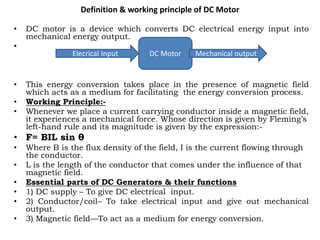
• DC motor is a device which converts DC electrical energy input into
mechanical energy output.
•
• This energy conversion takes place in the presence of magnetic field
which acts as a medium for facilitating the energy conversion process.
• Working Principle:-
• Whenever we place a current carrying conductor inside a magnetic field,
it experiences a mechanical force. Whose direction is given by Fleming’s
left-hand rule and its magnitude is given by the expression:-
• F= BIL sin θ
• Where B is the flux density of the field, I is the current flowing through
the conductor.
• L is the length of the conductor that comes under the influence of that
magnetic field.
• Essential parts of DC Generators & their functions
• 1) DC supply – To give DC electrical input.
• 2) Conductor/coil– To take electrical input and give out mechanical
output.
• 3) Magnetic field—To act as a medium for energy conversion.
DC Motor
Elecrical Input Mechanical output
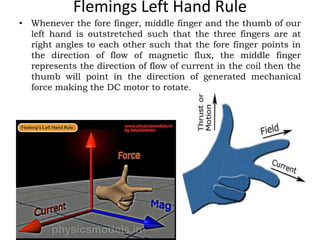
Flemings Left Hand Rule
• Whenever the fore finger, middle finger and the thumb of our
left hand is outstretched such that the three fingers are at
right angles to each other such that the fore finger points in
the direction of flow of magnetic flux, the middle finger
represents the direction of flow of current in the coil then the
thumb will point in the direction of generated mechanical
force making the DC motor to rotate.
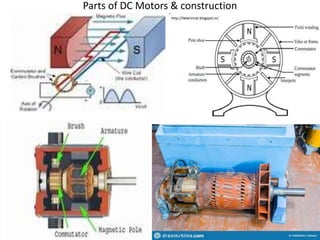
Parts of DC Motors & construction
1)The Magnetic Field:- It comprises of following three sub parts
i) Magnetic frame or Yoke, ii) Magnetic Pole comprising of pole core & pole shoe, iii) Field winding,
2) The conductor or coil or Armature:- It is made up of following two parts:-
i) Armature winding & ii) Armature core
3) Dc supply:- Can not be considered as a part of DC motor because in spite of it being necessary for
operation of generator, it is external to the DC motor.
4) Other parts or acessories:-
i) Commutator or split rings, ii) Brushes, iii) Brush holders, iv) Shaft,
v) Bearings, vi) Terminal block, vii) Cooling fan, viii) Foundation, ix) Eye bolt
Construction of the parts, material used & their functions
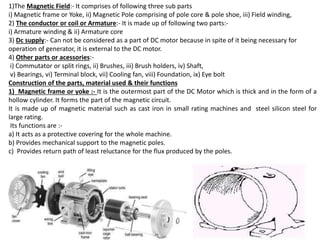
1) Magnetic frame or yoke :- It is the outermost part of the DC Motor which is thick and in the form of a
hollow cylinder. It forms the part of the magnetic circuit.
It is made up of magnetic material such as cast iron in small rating machines and steel silicon steel for
large rating.
Its functions are :-
a) It acts as a protective covering for the whole machine.
b) Provides mechanical support to the magnetic poles.
c) Provides return path of least reluctance for the flux produced by the poles.
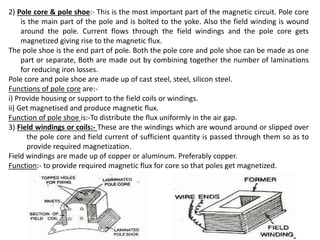
2) Pole core & pole shoe:- This is the most important part of the magnetic circuit. Pole core
is the main part of the pole and is bolted to the yoke. Also the field winding is wound
around the pole. Current flows through the field windings and the pole core gets
magnetized giving rise to the magnetic flux.
The pole shoe is the end part of pole. Both the pole core and pole shoe can be made as one
part or separate, Both are made out by combining together the number of laminations
for reducing iron losses.
Pole core and pole shoe are made up of cast steel, steel, silicon steel.
Functions of pole core are:-
i) Provide housing or support to the field coils or windings.
ii) Get magnetised and produce magnetic flux.
Function of pole shoe is:-To distribute the flux uniformly in the air gap.
3) Field windings or coils:- These are the windings which are wound around or slipped over
the pole core and field current of sufficient quantity is passed through them so as to
provide required magnetization.
Field windings are made up of copper or aluminum. Preferably copper.
Function:- to provide required magnetic flux for core so that poles get magnetized.
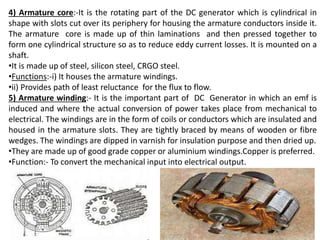
4) Armature core:-It is the rotating part of the DC generator which is cylindrical in
shape with slots cut over its periphery for housing the armature conductors inside it.
The armature core is made up of thin laminations and then pressed together to
form one cylindrical structure so as to reduce eddy current losses. It is mounted on a
shaft.
•It is made up of steel, silicon steel, CRGO steel.
•Functions:-i) It houses the armature windings.
•ii) Provides path of least reluctance for the flux to flow.
5) Armature winding:- It is the important part of DC Generator in which an emf is
induced and where the actual conversion of power takes place from mechanical to
electrical. The windings are in the form of coils or conductors which are insulated and
housed in the armature slots. They are tightly braced by means of wooden or fibre
wedges. The windings are dipped in varnish for insulation purpose and then dried up.
•They are made up of good grade copper or aluminium windings.Copper is preferred.
•Function:- To convert the mechanical input into electrical output.
T
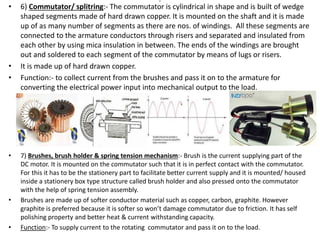
• 6) Commutator/ splitring:- The commutator is cylindrical in shape and is built of wedge
shaped segments made of hard drawn copper. It is mounted on the shaft and it is made
up of as many number of segments as there are nos. of windings. All these segments are
connected to the armature conductors through risers and separated and insulated from
each other by using mica insulation in between. The ends of the windings are brought
out and soldered to each segment of the commutator by means of lugs or risers.
• It is made up of hard drawn copper.
• Function:- to collect current from the brushes and pass it on to the armature for
converting the electrical power input into mechanical output to the load.
• 7) Brushes, brush holder & spring tension mechanism:- Brush is the current supplying part of the
DC motor. It is mounted on the commutator such that it is in perfect contact with the commutator.
For this it has to be the stationery part to facilitate better current supply and it is mounted/ housed
inside a stationery box type structure called brush holder and also pressed onto the commutator
with the help of spring tension assembly.
• Brushes are made up of softer conductor material such as copper, carbon, graphite. However
graphite is preferred because it is softer so won’t damage commutator due to friction. It has self
polishing property and better heat & current withstanding capacity.
• Function:- To supply current to the rotating commutator and pass it on to the load.
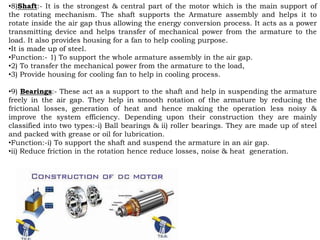
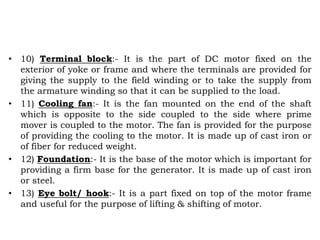
•8)Shaft:- It is the strongest & central part of the motor which is the main support of
the rotating mechanism. The shaft supports the Armature assembly and helps it to
rotate inside the air gap thus allowing the energy conversion process. It acts as a power
transmitting device and helps transfer of mechanical power from the armature to the
load. It also provides housing for a fan to help cooling purpose.
•It is made up of steel.
•Function:- 1) To support the whole armature assembly in the air gap.
•2) To transfer the mechanical power from the armature to the load,
•3) Provide housing for cooling fan to help in cooling process.
•9) Bearings:- These act as a support to the shaft and help in suspending the armature
freely in the air gap. They help in smooth rotation of the armature by reducing the
frictional losses, generation of heat and hence making the operation less noisy &
improve the system efficiency. Depending upon their construction they are mainly
classified into two types:-i) Ball bearings & ii) roller bearings. They are made up of steel
and packed with grease or oil for lubrication.
•Function:-i) To support the shaft and suspend the armature in an air gap.
•ii) Reduce friction in the rotation hence reduce losses, noise & heat generation.
• 10) Terminal block:- It is the part of DC motor fixed on the
exterior of yoke or frame and where the terminals are provided for
giving the supply to the field winding or to take the supply from
the armature winding so that it can be supplied to the load.
• 11) Cooling fan:- It is the fan mounted on the end of the shaft
which is opposite to the side coupled to the side where prime
mover is coupled to the motor. The fan is provided for the purpose
of providing the cooling to the motor. It is made up of cast iron or
of fiber for reduced weight.
• 12) Foundation:- It is the base of the motor which is important for
providing a firm base for the generator. It is made up of cast iron
or steel.
• 13) Eye bolt/ hook:- It is a part fixed on top of the motor frame
and useful for the purpose of lifting & shifting of motor.
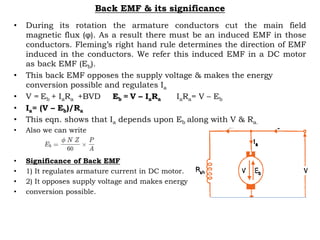
Back EMF & its significance
• During its rotation the armature conductors cut the main field
magnetic flux (φ). As a result there must be an induced EMF in those
conductors. Fleming’s right hand rule determines the direction of EMF
induced in the conductors. We refer this induced EMF in a DC motor
as back EMF (Eb).
• This back EMF opposes the supply voltage & makes the energy
conversion possible and regulates Ia
• V = Eb + IaRa +BVD Eb = V – IaRa IaRa= V – Eb
• Ia= (V – Eb)/Ra
• This eqn. shows that Ia depends upon Eb along with V & Ra.
• Also we can write
• Significance of Back EMF
• 1) It regulates armature current in DC motor.
• 2) It opposes supply voltage and makes energy
• conversion possible.
Torque in motor
• Ta > Tsh i.e. Ta – Tsh = Tlost
• In shunt motor Ta α Ia since Ø is constant.
• In series motor & Ø α Ia
Ta α Ia
2
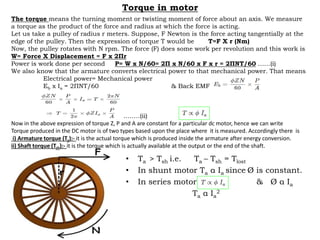
The torque means the turning moment or twisting moment of force about an axis. We measure
a torque as the product of the force and radius at which the force is acting.
Let us take a pulley of radius r meters. Suppose, F Newton is the force acting tangentially at the
edge of the pulley. Then the expression of torque T would be T=F X r (Nm)
Now, the pulley rotates with N rpm. The force (F) does some work per revolution and this work is
W= Force X Displacement = F x 2Пr
Power is work done per second P= W x N/60= 2П x N/60 x F x r = 2ПNT/60 ……(i)
We also know that the armature converts electrical power to that mechanical power. That means
Electrical power= Mechanical power
Eb x Ia = 2ПNT/60 & Back EMF
……….(ii)
Now in the above expression of torque Z, P and A are constant for a particular dc motor, hence we can write
Torque produced in the DC motor is of two types based upon the place where it is measured. Accordingly there is
i) Armature torque (Ta):- it is the actual torque which is produced inside the armature after energy conversion.
ii) Shaft torque (Tsh):- it is the torque which is actually available at the output or the end of the shaft.
Classification of DC Motors
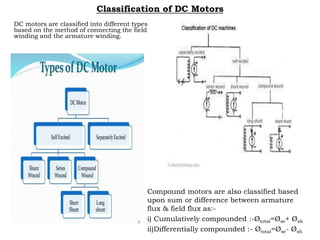
DC motors are classified into different types
based on the method of connecting the field
winding and the armature winding.
Compound motors are also classified based
upon sum or difference between armature
flux & field flux as:-
i) Cumulatively compounded :-Øtotal=Øse+ Øsh
ii)Differentially compounded :- Øtotal=Øse- Øsh
Types of motors & their Equations
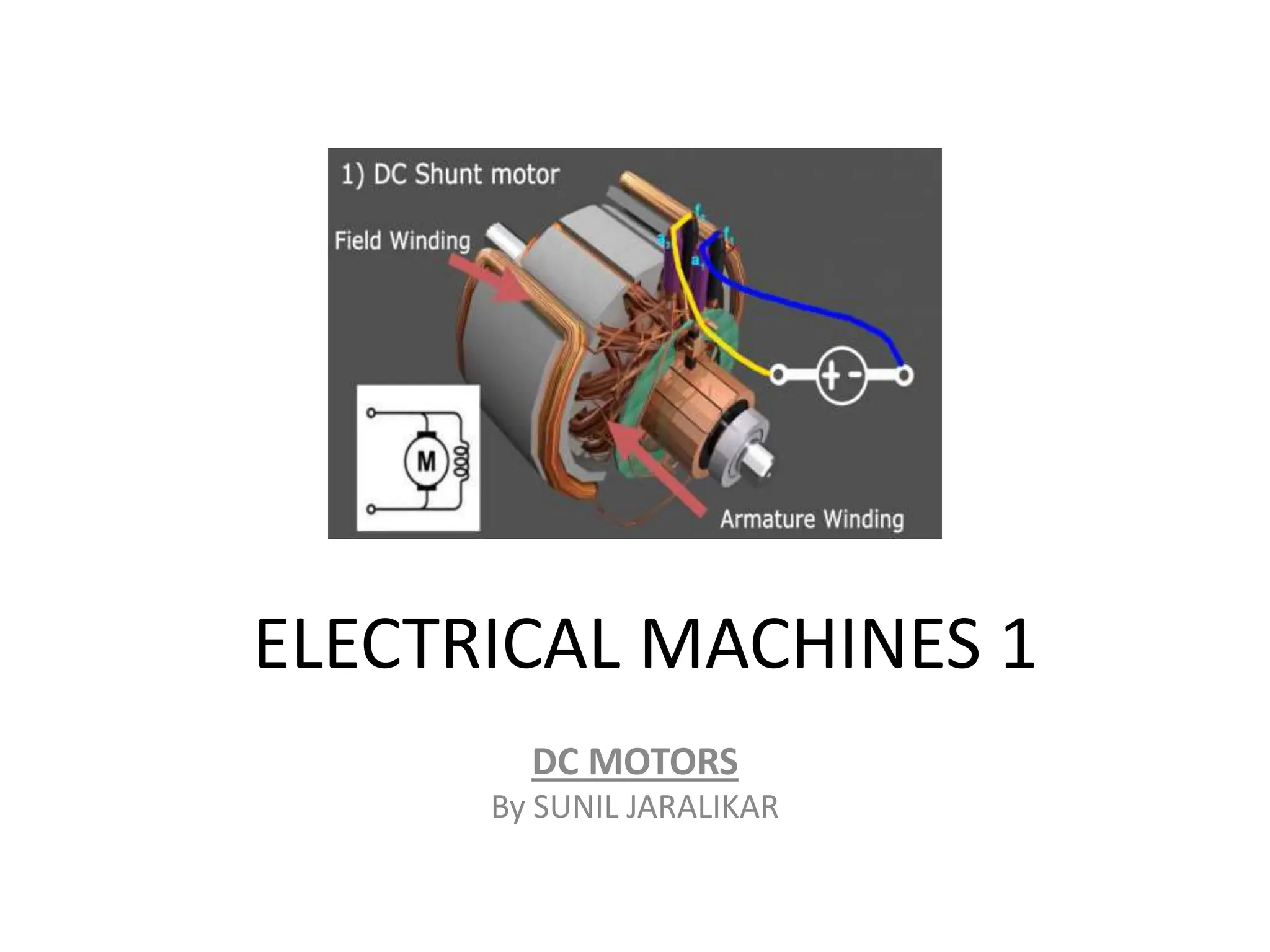
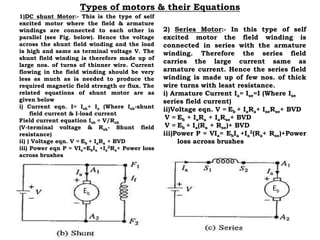
1)DC shunt Motor:- This is the type of self
excited motor where the field & armature
windings are connected to each other in
parallel (see Fig. below). Hence the voltage
across the shunt field winding and the load
is high and same as terminal voltage V. The
shunt field winding is therefore made up of
large nos. of turns of thinner wire. Current
flowing in the field winding should be very
less as much as is needed to produce the
required magnetic field strength or flux. The
related equations of shunt motor are as
given below
i) Current eqn. I= Ish+ Ia (Where Ish-shunt
field current & I-load current
Field current equation Ish = V/Rsh
(V-terminal voltage & Rsh- Shunt field
resistance)
ii) ) Voltage eqn. V = Eb + IaRa + BVD
iii) Power eqn P = VIa=EbIa +Ia
2Ra+ Power loss
across brushes
2) Series Motor:- In this type of self
excited motor the field winding is
connected in series with the armature
winding. Therefore the series field
carries the large current same as
armature current. Hence the series field
winding is made up of few nos. of thick
wire turns with least resistance.
i) Armature Current Ia= Ise=I (Where Ise
series field current)
ii)Voltage eqn. V = Eb + IaRa+ IseRse+ BVD
V = Eb + IaRa + IaRse+ BVD
V = Eb + Ia(Ra + Rse)+ BVD
iii)Power P = VIa= EbIa +Ia
2(Ra+ Rse)+Power
loss across brushes
Eb
Eb
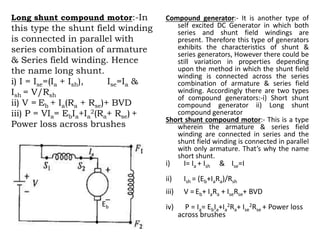
Long shunt compound motor:-In
this type the shunt field winding
is connected in parallel with
series combination of armature
& Series field winding. Hence
the name long shunt.
i) I = Ise=(Ia + Ish), Ise=Ia &
Ish = V/Rsh
ii) V = Eb + Ia(Ra + Rse)+ BVD
iii) P = VIa= EbIa+Ia
2(Ra+ Rse) +
Power loss across brushes
Compound generator:- It is another type of
self excited DC Generator in which both
series and shunt field windings are
present. Therefore this type of generators
exhibits the characteristics of shunt &
series generators, However there could be
still variation in properties depending
upon the method in which the shunt field
winding is connected across the series
combination of armature & series field
winding. Accordingly there are two types
of compound generators:-i) Short shunt
compound generator ii) Long shunt
compound generator
Short shunt compound motor:- This is a type
wherein the armature & series field
winding are connected in series and the
shunt field winding is connected in parallel
with only armature. That’s why the name
short shunt.
i) I= Ia + Ish & Ise=I
ii) Ish = (Eb+IaRa)/Rsh
iii) V = Eb+ IaRa + IseRse+ BVD
iv) P = Ia= EbIa+Ia
2Ra+ Ise
2Rse + Power loss
across brushes
Eb
Speed control of DC motors
Factors Controlling the Speed of a DC
Motor
From the above expression of speed, we
can conclude
i) The speed of a DC motor is inversely
proportional to its field flux (φ).
ii) it also varies with the supply voltage (V)
iii) it depends on the value of armature
resistance drop (IaRa),
So, by varying the above three
parameters, we can control the speed of a
DC motor.
Accordingly we have following methods of
speed control:- i) Armature control, ii)
Flux or field control & iii) Voltage control
Speed control of DC shunt motor
i) Armature control method:- In this
method, we connect a rheostat in series
with the armature circuit. No changes are
made in the field circuit.
By doing this, we can increase the
resistance of the armature circuit causing
increased IaRa voltage drop thus reducing
the numerator or voltage across the
armature.
As can be seen the result of decreased
numerator is the decrease in the motor
speed below the rated speed.
Adv:-1) Can get speeds below rated speed.
Lim:-1) Can not get speeds above rated speed.
2) Leads to additional voltage drop and
power loss across the extra resistance.
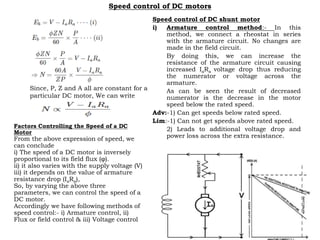
Since, P, Z and A all are constant for a
particular DC motor, We can write
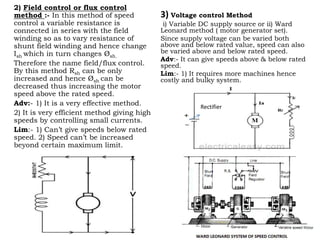
2) Field control or flux control
method :- In this method of speed
control a variable resistance is
connected in series with the field
winding so as to vary resistance of
shunt field winding and hence change
Ish which in turn changes Øsh.
Therefore the name field/flux control.
By this method Rsh can be only
increased and hence Øsh can be
decreased thus increasing the motor
speed above the rated speed.
Adv:- 1) It is a very effective method.
2) It is very efficient method giving high
speeds by controlling small currents.
Lim:- 1) Can’t give speeds below rated
speed. 2) Speed can’t be increased
beyond certain maximum limit.
3) Voltage control Method
i) Variable DC supply source or ii) Ward
Leonard method ( motor generator set).
Since supply voltage can be varied both
above and below rated value, speed can also
be varied above and below rated speed.
Adv:- It can give speeds above & below rated
speed.
Lim:- 1) It requires more machines hence
costly and bulky system.
Rectifier
Speed control of DC Series motor
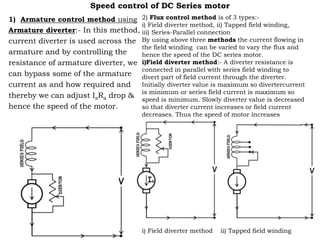
1) Armature control method using
Armature diverter:- In this method,
current diverter is used across the
armature and by controlling the
resistance of armature diverter, we
can bypass some of the armature
current as and how required and
thereby we can adjust IaRa drop &
hence the speed of the motor.
2) Flux control method is of 3 types:-
i) Field diverter method, ii) Tapped field winding,
iii) Series-Parallel connection
By using above three methods the current flowing in
the field winding can be varied to vary the flux and
hence the speed of the DC series motor.
i)Field diverter method:- A diverter resistance is
connected in parallel with series field winding to
divert part of field current through the diverter.
Initially diverter value is maximum so divertercurrent
is minimum or series field current is maximum so
speed is minimum. Slowly diverter value is decreased
so that diverter current increases or field current
decreases. Thus the speed of motor increases
i) Field diverter method ii) Tapped field winding
h
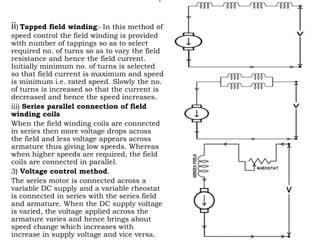
ii) Tapped field winding:- In this method of
speed control the field winding is provided
with number of tappings so as to select
required no. of turns so as to vary the field
resistance and hence the field current.
Initially minimum no. of turns is selected
so that field current is maximum and speed
is minimum i.e. rated speed. Slowly the no.
of turns is increased so that the current is
decreased and hence the speed increases.
iii) Series parallel connection of field
winding coils
When the field winding coils are connected
in series then more voltage drops across
the field and less voltage appears across
armature thus giving low speeds. Whereas
when higher speeds are required, the field
coils are connected in parallel.
3) Voltage control method.
The series motor is connected across a
variable DC supply and a variable rheostat
is connected in series with the series field
and armature. When the DC supply voltage
is varied, the voltage applied across the
armature varies and hence brings about
speed change which increases with
increase in supply voltage and vice versa.
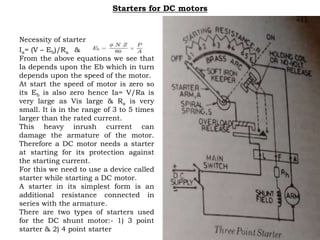
Starters for DC motors
Necessity of starter
Ia= (V – Eb)/Ra &
From the above equations we see that
Ia depends upon the Eb which in turn
depends upon the speed of the motor.
At start the speed of motor is zero so
its Eb is also zero hence Ia= V/Ra is
very large as Vis large & Ra is very
small. It is in the range of 3 to 5 times
larger than the rated current.
This heavy inrush current can
damage the armature of the motor.
Therefore a DC motor needs a starter
at starting for its protection against
the starting current.
For this we need to use a device called
starter while starting a DC motor.
A starter in its simplest form is an
additional resistance connected in
series with the armature.
There are two types of starters used
for the DC shunt motor:- 1) 3 point
starter & 2) 4 point starter
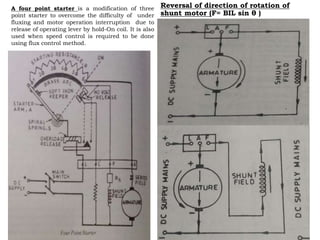
A four point starter is a modification of three
point starter to overcome the difficulty of under
fluxing and motor operation interruption due to
release of operating lever by hold-On coil. It is also
used when speed control is required to be done
using flux control method.
Reversal of direction of rotation of
shunt motor (F= BIL sin θ )
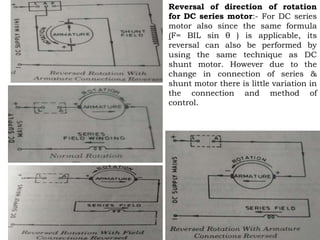
Reversal of direction of rotation
for DC series motor:- For DC series
motor also since the same formula
(F= BIL sin θ ) is applicable, its
reversal can also be performed by
using the same technique as DC
shunt motor. However due to the
change in connection of series &
shunt motor there is little variation in
the connection and method of
control.
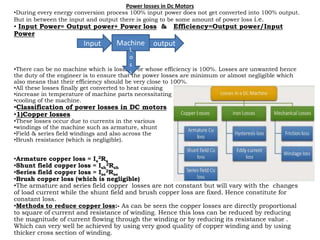
Power losses in Dc Motors
•During every energy conversion process 100% input power does not get converted into 100% output.
But in between the input and output there is going to be some amount of power loss i.e.
• Input Power= Output power+ Power loss & Efficiency=Output power/Input
Power
•There can be no machine which is lossless or whose efficiency is 100%. Losses are unwanted hence
the duty of the engineer is to ensure that the power losses are minimum or almost negligible which
also means that their efficiency should be very close to 100%.
•All these losses finally get converted to heat causing
•increase in temperature of machine parts necessitating
•cooling of the machine.
•Classification of power losses in DC motors
•1)Copper losses
•These losses occur due to currents in the various
•windings of the machine such as armature, shunt
•Field & series field windings and also across the
•Brush resistance (which is negligible).
•Armature copper loss = Ia
2Ra
•Shunt field copper loss = Ish
2Rsh
•Series field copper loss = Ise
2Rse
•Brush copper loss (which is negligible)
•The armature and series field copper losses are not constant but will vary with the changes
of load current while the shunt field and brush copper loss are fixed. Hence constitute for
constant loss.
•Methods to reduce copper loss:- As can be seen the copper losses are directly proportional
to square of current and resistance of winding. Hence this loss can be reduced by reducing
the magnitude of current flowing through the winding or by reducing its resistance value .
Which can very well be achieved by using very good quality of copper winding and by using
thicker cross section of winding.
Machine
Input output
L
o
s
s
Iron Losses
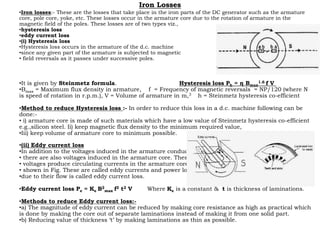
•Iron losses:- These are the losses that take place in the iron parts of the DC generator such as the armature
core, pole core, yoke, etc. These losses occur in the armature core due to the rotation of armature in the
magnetic field of the poles. These losses are of two types viz.,
•hysteresis loss
•eddy current loss
•(i) Hysteresis loss
•Hysteresis loss occurs in the armature of the d.c. machine
•since any given part of the armature is subjected to magnetic
• field reversals as it passes under successive poles.
•It is given by Steinmetz formula. Hysteresis loss Ph = η Bmax
1.6 f V
•Bmax = Maximum flux density in armature, f = Frequency of magnetic reversals = NP/120 (where N
is speed of rotation in r.p.m.), V = Volume of armature in m,3 h = Steinmetz hysteresis co-efficient
•Method to reduce Hysteresis loss :- In order to reduce this loss in a d.c. machine following can be
done:-
• i) armature core is made of such materials which have a low value of Steinmetz hysteresis co-efficient
e.g.,silicon steel. Ii) keep magnetic flux density to the minimum required value,
•Iii) keep volume of armature core to minimum possible.
•(ii) Eddy current loss
•In addition to the voltages induced in the armature conductors,
• there are also voltages induced in the armature core. These
• voltages produce circulating currents in the armature core as
• shown in Fig. These are called eddy currents and power loss
•due to their flow is called eddy current loss.
•Eddy current loss Pe = Ke B2
max f2 t2 V Where Ke is a constant & t is thickness of laminations.
•Methods to reduce Eddy current loss:-
•a) The magnitude of eddy current can be reduced by making core resistance as high as practical which
is done by making the core out of separate laminations instead of making it from one solid part.
•b) Reducing value of thickness ‘t’ by making laminations as thin as possible.
Mechanical losses
• Mechanical Losses:- These are the losses which take place in the
mechanical parts of DC motor only due to frictional loss on account
of movement/rotation of these parts.
• These losses are due to friction and windage i.e friction between
moving surfaces and friction of air with the moving parts
respectively.
• i)friction loss e.g., bearing friction, brush friction etc.
• ii)windage loss i.e., air friction of rotating armature In the air
gap.
• These losses depend upon the speed of the machine. But for a given
speed, they are practically constant.
Note:- Iron losses and mechanical losses together are called
constant losses because their value doesn't depend upon connected
load.
• Total losses= Cu losses+ Iron loss + Mechanical losses.
• Total losses= Variable losses+ Constant losses.
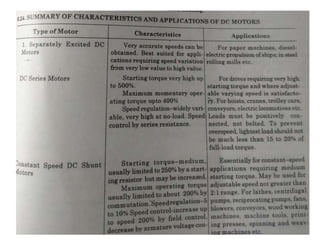
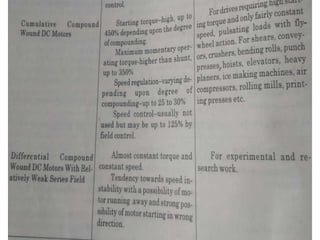
Characteristics of DC motors
Characteristics of a machine is the graph or
curve which shows a relation between two
or more parameters of a machine. It shows
the behavior of a machine under different
operating conditions.
In case of motors there are three types of
characteristics which are important
namely:-
i)Electrical characteristics Ta v/s Ia ,
ii) N v/s Ia &
iii) Mechanical characteristics N v/s Ta
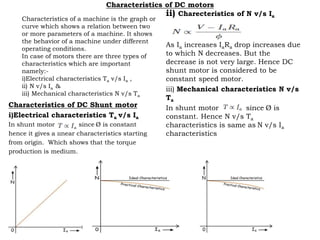
Characteristics of DC Shunt motor
i)Electrical characteristics Ta v/s Ia
In shunt motor since Ø is constant
hence it gives a linear characteristics starting
from origin. Which shows that the torque
production is medium.
ii) Charecteristics of N v/s Ia
As Ia increases IaRa drop increases due
to which N decreases. But the
decrease is not very large. Hence DC
shunt motor is considered to be
constant speed motor.
iii) Mechanical characteristics N v/s
Ta
In shunt motor since Ø is
constant. Hence N v/s Ta
characteristics is same as N v/s Ia
characteristics
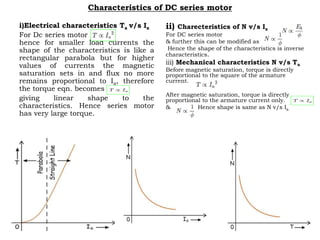
Characteristics of DC series motor
i)Electrical characteristics Ta v/s Ia
For Dc series motor
hence for smaller load currents the
shape of the characteristics is like a
rectangular parabola but for higher
values of currents the magnetic
saturation sets in and flux no more
remains proportional to Ia, therefore
the torque eqn. becomes
giving linear shape to the
characteristics. Hence series motor
has very large torque.
ii) Charecteristics of N v/s Ia
For DC series motor
& further this can be modified as
Hence the shape of the characteristics is inverse
characteristics.
iii) Mechanical characteristics N v/s Ta
Before magnetic saturation, torque is directly
proportional to the square of the armature
current.
After magnetic saturation, torque is directly
proportional to the armature current only.
& Hence shape is same as N v/s Ia
DC Motor Presentation.pptx

DC Motor Presentation.pptx

  • 1.
    ELECTRICAL MACHINES 1 DCMOTORS By SUNIL JARALIKAR
  • 2.
    Definition & workingprinciple of DC Motor • DC motor is a device which converts DC electrical energy input into mechanical energy output. • • This energy conversion takes place in the presence of magnetic field which acts as a medium for facilitating the energy conversion process. • Working Principle:- • Whenever we place a current carrying conductor inside a magnetic field, it experiences a mechanical force. Whose direction is given by Fleming’s left-hand rule and its magnitude is given by the expression:- • F= BIL sin θ • Where B is the flux density of the field, I is the current flowing through the conductor. • L is the length of the conductor that comes under the influence of that magnetic field. • Essential parts of DC Generators & their functions • 1) DC supply – To give DC electrical input. • 2) Conductor/coil– To take electrical input and give out mechanical output. • 3) Magnetic field—To act as a medium for energy conversion. DC Motor Elecrical Input Mechanical output
  • 3.
    Flemings Left HandRule • Whenever the fore finger, middle finger and the thumb of our left hand is outstretched such that the three fingers are at right angles to each other such that the fore finger points in the direction of flow of magnetic flux, the middle finger represents the direction of flow of current in the coil then the thumb will point in the direction of generated mechanical force making the DC motor to rotate.
  • 5.
    Parts of DCMotors & construction
  • 6.
    1)The Magnetic Field:-It comprises of following three sub parts i) Magnetic frame or Yoke, ii) Magnetic Pole comprising of pole core & pole shoe, iii) Field winding, 2) The conductor or coil or Armature:- It is made up of following two parts:- i) Armature winding & ii) Armature core 3) Dc supply:- Can not be considered as a part of DC motor because in spite of it being necessary for operation of generator, it is external to the DC motor. 4) Other parts or acessories:- i) Commutator or split rings, ii) Brushes, iii) Brush holders, iv) Shaft, v) Bearings, vi) Terminal block, vii) Cooling fan, viii) Foundation, ix) Eye bolt Construction of the parts, material used & their functions 1) Magnetic frame or yoke :- It is the outermost part of the DC Motor which is thick and in the form of a hollow cylinder. It forms the part of the magnetic circuit. It is made up of magnetic material such as cast iron in small rating machines and steel silicon steel for large rating. Its functions are :- a) It acts as a protective covering for the whole machine. b) Provides mechanical support to the magnetic poles. c) Provides return path of least reluctance for the flux produced by the poles.
  • 7.
    2) Pole core& pole shoe:- This is the most important part of the magnetic circuit. Pole core is the main part of the pole and is bolted to the yoke. Also the field winding is wound around the pole. Current flows through the field windings and the pole core gets magnetized giving rise to the magnetic flux. The pole shoe is the end part of pole. Both the pole core and pole shoe can be made as one part or separate, Both are made out by combining together the number of laminations for reducing iron losses. Pole core and pole shoe are made up of cast steel, steel, silicon steel. Functions of pole core are:- i) Provide housing or support to the field coils or windings. ii) Get magnetised and produce magnetic flux. Function of pole shoe is:-To distribute the flux uniformly in the air gap. 3) Field windings or coils:- These are the windings which are wound around or slipped over the pole core and field current of sufficient quantity is passed through them so as to provide required magnetization. Field windings are made up of copper or aluminum. Preferably copper. Function:- to provide required magnetic flux for core so that poles get magnetized.
  • 8.
    4) Armature core:-Itis the rotating part of the DC generator which is cylindrical in shape with slots cut over its periphery for housing the armature conductors inside it. The armature core is made up of thin laminations and then pressed together to form one cylindrical structure so as to reduce eddy current losses. It is mounted on a shaft. •It is made up of steel, silicon steel, CRGO steel. •Functions:-i) It houses the armature windings. •ii) Provides path of least reluctance for the flux to flow. 5) Armature winding:- It is the important part of DC Generator in which an emf is induced and where the actual conversion of power takes place from mechanical to electrical. The windings are in the form of coils or conductors which are insulated and housed in the armature slots. They are tightly braced by means of wooden or fibre wedges. The windings are dipped in varnish for insulation purpose and then dried up. •They are made up of good grade copper or aluminium windings.Copper is preferred. •Function:- To convert the mechanical input into electrical output.
  • 9.
    T • 6) Commutator/splitring:- The commutator is cylindrical in shape and is built of wedge shaped segments made of hard drawn copper. It is mounted on the shaft and it is made up of as many number of segments as there are nos. of windings. All these segments are connected to the armature conductors through risers and separated and insulated from each other by using mica insulation in between. The ends of the windings are brought out and soldered to each segment of the commutator by means of lugs or risers. • It is made up of hard drawn copper. • Function:- to collect current from the brushes and pass it on to the armature for converting the electrical power input into mechanical output to the load. • 7) Brushes, brush holder & spring tension mechanism:- Brush is the current supplying part of the DC motor. It is mounted on the commutator such that it is in perfect contact with the commutator. For this it has to be the stationery part to facilitate better current supply and it is mounted/ housed inside a stationery box type structure called brush holder and also pressed onto the commutator with the help of spring tension assembly. • Brushes are made up of softer conductor material such as copper, carbon, graphite. However graphite is preferred because it is softer so won’t damage commutator due to friction. It has self polishing property and better heat & current withstanding capacity. • Function:- To supply current to the rotating commutator and pass it on to the load.
  • 10.
    •8)Shaft:- It isthe strongest & central part of the motor which is the main support of the rotating mechanism. The shaft supports the Armature assembly and helps it to rotate inside the air gap thus allowing the energy conversion process. It acts as a power transmitting device and helps transfer of mechanical power from the armature to the load. It also provides housing for a fan to help cooling purpose. •It is made up of steel. •Function:- 1) To support the whole armature assembly in the air gap. •2) To transfer the mechanical power from the armature to the load, •3) Provide housing for cooling fan to help in cooling process. •9) Bearings:- These act as a support to the shaft and help in suspending the armature freely in the air gap. They help in smooth rotation of the armature by reducing the frictional losses, generation of heat and hence making the operation less noisy & improve the system efficiency. Depending upon their construction they are mainly classified into two types:-i) Ball bearings & ii) roller bearings. They are made up of steel and packed with grease or oil for lubrication. •Function:-i) To support the shaft and suspend the armature in an air gap. •ii) Reduce friction in the rotation hence reduce losses, noise & heat generation.
  • 11.
    • 10) Terminalblock:- It is the part of DC motor fixed on the exterior of yoke or frame and where the terminals are provided for giving the supply to the field winding or to take the supply from the armature winding so that it can be supplied to the load. • 11) Cooling fan:- It is the fan mounted on the end of the shaft which is opposite to the side coupled to the side where prime mover is coupled to the motor. The fan is provided for the purpose of providing the cooling to the motor. It is made up of cast iron or of fiber for reduced weight. • 12) Foundation:- It is the base of the motor which is important for providing a firm base for the generator. It is made up of cast iron or steel. • 13) Eye bolt/ hook:- It is a part fixed on top of the motor frame and useful for the purpose of lifting & shifting of motor.
  • 12.
    Back EMF &its significance • During its rotation the armature conductors cut the main field magnetic flux (φ). As a result there must be an induced EMF in those conductors. Fleming’s right hand rule determines the direction of EMF induced in the conductors. We refer this induced EMF in a DC motor as back EMF (Eb). • This back EMF opposes the supply voltage & makes the energy conversion possible and regulates Ia • V = Eb + IaRa +BVD Eb = V – IaRa IaRa= V – Eb • Ia= (V – Eb)/Ra • This eqn. shows that Ia depends upon Eb along with V & Ra. • Also we can write • Significance of Back EMF • 1) It regulates armature current in DC motor. • 2) It opposes supply voltage and makes energy • conversion possible.
  • 13.
    Torque in motor •Ta > Tsh i.e. Ta – Tsh = Tlost • In shunt motor Ta α Ia since Ø is constant. • In series motor & Ø α Ia Ta α Ia 2 The torque means the turning moment or twisting moment of force about an axis. We measure a torque as the product of the force and radius at which the force is acting. Let us take a pulley of radius r meters. Suppose, F Newton is the force acting tangentially at the edge of the pulley. Then the expression of torque T would be T=F X r (Nm) Now, the pulley rotates with N rpm. The force (F) does some work per revolution and this work is W= Force X Displacement = F x 2Пr Power is work done per second P= W x N/60= 2П x N/60 x F x r = 2ПNT/60 ……(i) We also know that the armature converts electrical power to that mechanical power. That means Electrical power= Mechanical power Eb x Ia = 2ПNT/60 & Back EMF ……….(ii) Now in the above expression of torque Z, P and A are constant for a particular dc motor, hence we can write Torque produced in the DC motor is of two types based upon the place where it is measured. Accordingly there is i) Armature torque (Ta):- it is the actual torque which is produced inside the armature after energy conversion. ii) Shaft torque (Tsh):- it is the torque which is actually available at the output or the end of the shaft.
  • 14.
    Classification of DCMotors DC motors are classified into different types based on the method of connecting the field winding and the armature winding. Compound motors are also classified based upon sum or difference between armature flux & field flux as:- i) Cumulatively compounded :-Øtotal=Øse+ Øsh ii)Differentially compounded :- Øtotal=Øse- Øsh
  • 15.
    Types of motors& their Equations 1)DC shunt Motor:- This is the type of self excited motor where the field & armature windings are connected to each other in parallel (see Fig. below). Hence the voltage across the shunt field winding and the load is high and same as terminal voltage V. The shunt field winding is therefore made up of large nos. of turns of thinner wire. Current flowing in the field winding should be very less as much as is needed to produce the required magnetic field strength or flux. The related equations of shunt motor are as given below i) Current eqn. I= Ish+ Ia (Where Ish-shunt field current & I-load current Field current equation Ish = V/Rsh (V-terminal voltage & Rsh- Shunt field resistance) ii) ) Voltage eqn. V = Eb + IaRa + BVD iii) Power eqn P = VIa=EbIa +Ia 2Ra+ Power loss across brushes 2) Series Motor:- In this type of self excited motor the field winding is connected in series with the armature winding. Therefore the series field carries the large current same as armature current. Hence the series field winding is made up of few nos. of thick wire turns with least resistance. i) Armature Current Ia= Ise=I (Where Ise series field current) ii)Voltage eqn. V = Eb + IaRa+ IseRse+ BVD V = Eb + IaRa + IaRse+ BVD V = Eb + Ia(Ra + Rse)+ BVD iii)Power P = VIa= EbIa +Ia 2(Ra+ Rse)+Power loss across brushes Eb Eb
  • 16.
    Long shunt compoundmotor:-In this type the shunt field winding is connected in parallel with series combination of armature & Series field winding. Hence the name long shunt. i) I = Ise=(Ia + Ish), Ise=Ia & Ish = V/Rsh ii) V = Eb + Ia(Ra + Rse)+ BVD iii) P = VIa= EbIa+Ia 2(Ra+ Rse) + Power loss across brushes Compound generator:- It is another type of self excited DC Generator in which both series and shunt field windings are present. Therefore this type of generators exhibits the characteristics of shunt & series generators, However there could be still variation in properties depending upon the method in which the shunt field winding is connected across the series combination of armature & series field winding. Accordingly there are two types of compound generators:-i) Short shunt compound generator ii) Long shunt compound generator Short shunt compound motor:- This is a type wherein the armature & series field winding are connected in series and the shunt field winding is connected in parallel with only armature. That’s why the name short shunt. i) I= Ia + Ish & Ise=I ii) Ish = (Eb+IaRa)/Rsh iii) V = Eb+ IaRa + IseRse+ BVD iv) P = Ia= EbIa+Ia 2Ra+ Ise 2Rse + Power loss across brushes Eb
  • 17.
    Speed control ofDC motors Factors Controlling the Speed of a DC Motor From the above expression of speed, we can conclude i) The speed of a DC motor is inversely proportional to its field flux (φ). ii) it also varies with the supply voltage (V) iii) it depends on the value of armature resistance drop (IaRa), So, by varying the above three parameters, we can control the speed of a DC motor. Accordingly we have following methods of speed control:- i) Armature control, ii) Flux or field control & iii) Voltage control Speed control of DC shunt motor i) Armature control method:- In this method, we connect a rheostat in series with the armature circuit. No changes are made in the field circuit. By doing this, we can increase the resistance of the armature circuit causing increased IaRa voltage drop thus reducing the numerator or voltage across the armature. As can be seen the result of decreased numerator is the decrease in the motor speed below the rated speed. Adv:-1) Can get speeds below rated speed. Lim:-1) Can not get speeds above rated speed. 2) Leads to additional voltage drop and power loss across the extra resistance. Since, P, Z and A all are constant for a particular DC motor, We can write
  • 18.
    2) Field controlor flux control method :- In this method of speed control a variable resistance is connected in series with the field winding so as to vary resistance of shunt field winding and hence change Ish which in turn changes Øsh. Therefore the name field/flux control. By this method Rsh can be only increased and hence Øsh can be decreased thus increasing the motor speed above the rated speed. Adv:- 1) It is a very effective method. 2) It is very efficient method giving high speeds by controlling small currents. Lim:- 1) Can’t give speeds below rated speed. 2) Speed can’t be increased beyond certain maximum limit. 3) Voltage control Method i) Variable DC supply source or ii) Ward Leonard method ( motor generator set). Since supply voltage can be varied both above and below rated value, speed can also be varied above and below rated speed. Adv:- It can give speeds above & below rated speed. Lim:- 1) It requires more machines hence costly and bulky system. Rectifier
  • 19.
    Speed control ofDC Series motor 1) Armature control method using Armature diverter:- In this method, current diverter is used across the armature and by controlling the resistance of armature diverter, we can bypass some of the armature current as and how required and thereby we can adjust IaRa drop & hence the speed of the motor. 2) Flux control method is of 3 types:- i) Field diverter method, ii) Tapped field winding, iii) Series-Parallel connection By using above three methods the current flowing in the field winding can be varied to vary the flux and hence the speed of the DC series motor. i)Field diverter method:- A diverter resistance is connected in parallel with series field winding to divert part of field current through the diverter. Initially diverter value is maximum so divertercurrent is minimum or series field current is maximum so speed is minimum. Slowly diverter value is decreased so that diverter current increases or field current decreases. Thus the speed of motor increases i) Field diverter method ii) Tapped field winding
  • 20.
    h ii) Tapped fieldwinding:- In this method of speed control the field winding is provided with number of tappings so as to select required no. of turns so as to vary the field resistance and hence the field current. Initially minimum no. of turns is selected so that field current is maximum and speed is minimum i.e. rated speed. Slowly the no. of turns is increased so that the current is decreased and hence the speed increases. iii) Series parallel connection of field winding coils When the field winding coils are connected in series then more voltage drops across the field and less voltage appears across armature thus giving low speeds. Whereas when higher speeds are required, the field coils are connected in parallel. 3) Voltage control method. The series motor is connected across a variable DC supply and a variable rheostat is connected in series with the series field and armature. When the DC supply voltage is varied, the voltage applied across the armature varies and hence brings about speed change which increases with increase in supply voltage and vice versa.
  • 21.
    Starters for DCmotors Necessity of starter Ia= (V – Eb)/Ra & From the above equations we see that Ia depends upon the Eb which in turn depends upon the speed of the motor. At start the speed of motor is zero so its Eb is also zero hence Ia= V/Ra is very large as Vis large & Ra is very small. It is in the range of 3 to 5 times larger than the rated current. This heavy inrush current can damage the armature of the motor. Therefore a DC motor needs a starter at starting for its protection against the starting current. For this we need to use a device called starter while starting a DC motor. A starter in its simplest form is an additional resistance connected in series with the armature. There are two types of starters used for the DC shunt motor:- 1) 3 point starter & 2) 4 point starter
  • 22.
    A four pointstarter is a modification of three point starter to overcome the difficulty of under fluxing and motor operation interruption due to release of operating lever by hold-On coil. It is also used when speed control is required to be done using flux control method. Reversal of direction of rotation of shunt motor (F= BIL sin θ )
  • 23.
    Reversal of directionof rotation for DC series motor:- For DC series motor also since the same formula (F= BIL sin θ ) is applicable, its reversal can also be performed by using the same technique as DC shunt motor. However due to the change in connection of series & shunt motor there is little variation in the connection and method of control.
  • 24.
    Power losses inDc Motors •During every energy conversion process 100% input power does not get converted into 100% output. But in between the input and output there is going to be some amount of power loss i.e. • Input Power= Output power+ Power loss & Efficiency=Output power/Input Power •There can be no machine which is lossless or whose efficiency is 100%. Losses are unwanted hence the duty of the engineer is to ensure that the power losses are minimum or almost negligible which also means that their efficiency should be very close to 100%. •All these losses finally get converted to heat causing •increase in temperature of machine parts necessitating •cooling of the machine. •Classification of power losses in DC motors •1)Copper losses •These losses occur due to currents in the various •windings of the machine such as armature, shunt •Field & series field windings and also across the •Brush resistance (which is negligible). •Armature copper loss = Ia 2Ra •Shunt field copper loss = Ish 2Rsh •Series field copper loss = Ise 2Rse •Brush copper loss (which is negligible) •The armature and series field copper losses are not constant but will vary with the changes of load current while the shunt field and brush copper loss are fixed. Hence constitute for constant loss. •Methods to reduce copper loss:- As can be seen the copper losses are directly proportional to square of current and resistance of winding. Hence this loss can be reduced by reducing the magnitude of current flowing through the winding or by reducing its resistance value . Which can very well be achieved by using very good quality of copper winding and by using thicker cross section of winding. Machine Input output L o s s
  • 25.
    Iron Losses •Iron losses:-These are the losses that take place in the iron parts of the DC generator such as the armature core, pole core, yoke, etc. These losses occur in the armature core due to the rotation of armature in the magnetic field of the poles. These losses are of two types viz., •hysteresis loss •eddy current loss •(i) Hysteresis loss •Hysteresis loss occurs in the armature of the d.c. machine •since any given part of the armature is subjected to magnetic • field reversals as it passes under successive poles. •It is given by Steinmetz formula. Hysteresis loss Ph = η Bmax 1.6 f V •Bmax = Maximum flux density in armature, f = Frequency of magnetic reversals = NP/120 (where N is speed of rotation in r.p.m.), V = Volume of armature in m,3 h = Steinmetz hysteresis co-efficient •Method to reduce Hysteresis loss :- In order to reduce this loss in a d.c. machine following can be done:- • i) armature core is made of such materials which have a low value of Steinmetz hysteresis co-efficient e.g.,silicon steel. Ii) keep magnetic flux density to the minimum required value, •Iii) keep volume of armature core to minimum possible. •(ii) Eddy current loss •In addition to the voltages induced in the armature conductors, • there are also voltages induced in the armature core. These • voltages produce circulating currents in the armature core as • shown in Fig. These are called eddy currents and power loss •due to their flow is called eddy current loss. •Eddy current loss Pe = Ke B2 max f2 t2 V Where Ke is a constant & t is thickness of laminations. •Methods to reduce Eddy current loss:- •a) The magnitude of eddy current can be reduced by making core resistance as high as practical which is done by making the core out of separate laminations instead of making it from one solid part. •b) Reducing value of thickness ‘t’ by making laminations as thin as possible.
  • 26.
    Mechanical losses • MechanicalLosses:- These are the losses which take place in the mechanical parts of DC motor only due to frictional loss on account of movement/rotation of these parts. • These losses are due to friction and windage i.e friction between moving surfaces and friction of air with the moving parts respectively. • i)friction loss e.g., bearing friction, brush friction etc. • ii)windage loss i.e., air friction of rotating armature In the air gap. • These losses depend upon the speed of the machine. But for a given speed, they are practically constant. Note:- Iron losses and mechanical losses together are called constant losses because their value doesn't depend upon connected load. • Total losses= Cu losses+ Iron loss + Mechanical losses. • Total losses= Variable losses+ Constant losses.
  • 27.
    Characteristics of DCmotors Characteristics of a machine is the graph or curve which shows a relation between two or more parameters of a machine. It shows the behavior of a machine under different operating conditions. In case of motors there are three types of characteristics which are important namely:- i)Electrical characteristics Ta v/s Ia , ii) N v/s Ia & iii) Mechanical characteristics N v/s Ta Characteristics of DC Shunt motor i)Electrical characteristics Ta v/s Ia In shunt motor since Ø is constant hence it gives a linear characteristics starting from origin. Which shows that the torque production is medium. ii) Charecteristics of N v/s Ia As Ia increases IaRa drop increases due to which N decreases. But the decrease is not very large. Hence DC shunt motor is considered to be constant speed motor. iii) Mechanical characteristics N v/s Ta In shunt motor since Ø is constant. Hence N v/s Ta characteristics is same as N v/s Ia characteristics
  • 28.
    Characteristics of DCseries motor i)Electrical characteristics Ta v/s Ia For Dc series motor hence for smaller load currents the shape of the characteristics is like a rectangular parabola but for higher values of currents the magnetic saturation sets in and flux no more remains proportional to Ia, therefore the torque eqn. becomes giving linear shape to the characteristics. Hence series motor has very large torque. ii) Charecteristics of N v/s Ia For DC series motor & further this can be modified as Hence the shape of the characteristics is inverse characteristics. iii) Mechanical characteristics N v/s Ta Before magnetic saturation, torque is directly proportional to the square of the armature current. After magnetic saturation, torque is directly proportional to the armature current only. & Hence shape is same as N v/s Ia