Dr. Amiya Ranjan Panda
Assistant Professor [II]
School of Computer Engineering,
Kalinga Institute of Industrial Technology (KIIT),
Deemed to be University,Odisha
Enhanced ER-Model
KALINGA INSTITUTE OF INDUSTRIAL
TECHNOLOGY
School Of Computer
Engineering
4 Credit Lecture Note 08
Chapter Contents
q Specialization
q Generalization
q Constraints on Generalization/Specialization
q Aggregation
2
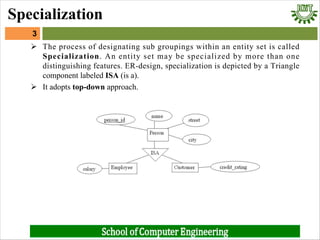
Ø The process of designating sub groupings within an entity set is called
Specialization. An entity set may be specialized by more than one
distinguishing features. ER-design, specialization is depicted by a Triangle
component labeled ISA (is a).
Ø It adopts top-down approach.
3
Specialization
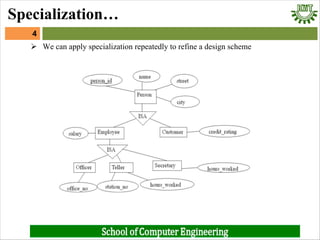
Ø We can apply specialization repeatedly to refine a design scheme
4
Specialization…
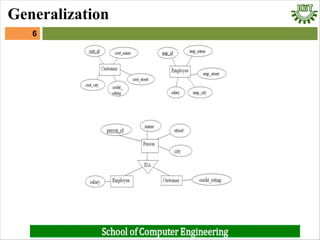
Ø The commonality can be expressed by Generalization, which is a containment
relationship that exists between a higher-level entity set and one or more low-
level entity sets..
ü To create a generalization, the attributes must given a common name and
represented with the higher-level entity
ü Generalization is a simple inversion of specialization
ü Specialization adopts top-down approach, while Generalization adopts
bottom-up approach
ü A crucial property of the higher-level and lower-level entities created by
specialization and generalization is attribute inheritance
ü A lower-level entity set (or subclass) also inherits participation in the
relationship sets in which its higher-level entity (or superclass) participates
5
Generalization
6
Generalization
Ø Condition defined or not:
ü Condition-defined: In condition defined lower-level entity sets,
membership is evaluated on the basis of whether or not an entity satisfies an
explicit condition or predicate. Since all the lower-level entities are evaluated
on the basis of the same attribute, this type of generalization is also said to be
attribute-defined.
ü User-defined: User-defined lower-level entity sets are not constrained by a
membership condition; rather, the database user assigns entities to a given
entity set.
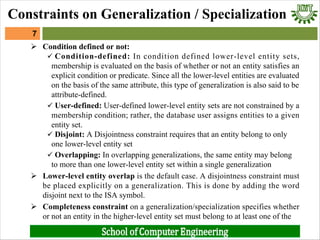
ü Disjoint: A Disjointness constraint requires that an entity belong to only
one lower-level entity set
ü Overlapping: In overlapping generalizations, the same entity may belong
to more than one lower-level entity set within a single generalization
Ø Lower-level entity overlap is the default case. A disjointness constraint must
be placed explicitly on a generalization. This is done by adding the word
disjoint next to the ISA symbol.
Ø Completeness constraint on a generalization/specialization specifies whether
or not an entity in the higher-level entity set must belong to at least one of the
7
Constraints on Generalization / Specialization
8
Constraints on Generalization / Specialization
lower-level entity sets within the generalization/specialization.
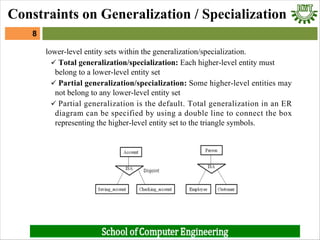
ü Total generalization/specialization: Each higher-level entity must
belong to a lower-level entity set
ü Partial generalization/specialization: Some higher-level entities may
not belong to any lower-level entity set
ü Partial generalization is the default. Total generalization in an ER
diagram can be specified by using a double line to connect the box
representing the higher-level entity set to the triangle symbols.
9
Aggregation
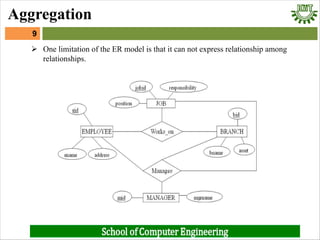
Ø One limitation of the ER model is that it can not express relationship among
relationships.
10
Aggregation…
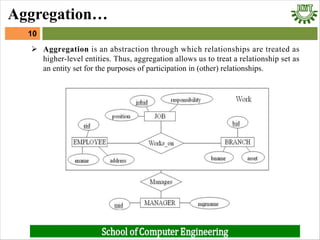
Ø Aggregation is an abstraction through which relationships are treated as
higher-level entities. Thus, aggregation allows us to treat a relationship set as
an entity set for the purposes of participation in (other) relationships.
11

Dbms 8: Enhanced ER Model

  • 1.
    Dr. Amiya RanjanPanda Assistant Professor [II] School of Computer Engineering, Kalinga Institute of Industrial Technology (KIIT), Deemed to be University,Odisha Enhanced ER-Model KALINGA INSTITUTE OF INDUSTRIAL TECHNOLOGY School Of Computer Engineering 4 Credit Lecture Note 08
  • 2.
    Chapter Contents q Specialization qGeneralization q Constraints on Generalization/Specialization q Aggregation 2
  • 3.
    Ø The processof designating sub groupings within an entity set is called Specialization. An entity set may be specialized by more than one distinguishing features. ER-design, specialization is depicted by a Triangle component labeled ISA (is a). Ø It adopts top-down approach. 3 Specialization
  • 4.
    Ø We canapply specialization repeatedly to refine a design scheme 4 Specialization…
  • 5.
    Ø The commonalitycan be expressed by Generalization, which is a containment relationship that exists between a higher-level entity set and one or more low- level entity sets.. ü To create a generalization, the attributes must given a common name and represented with the higher-level entity ü Generalization is a simple inversion of specialization ü Specialization adopts top-down approach, while Generalization adopts bottom-up approach ü A crucial property of the higher-level and lower-level entities created by specialization and generalization is attribute inheritance ü A lower-level entity set (or subclass) also inherits participation in the relationship sets in which its higher-level entity (or superclass) participates 5 Generalization
  • 6.
  • 7.
    Ø Condition definedor not: ü Condition-defined: In condition defined lower-level entity sets, membership is evaluated on the basis of whether or not an entity satisfies an explicit condition or predicate. Since all the lower-level entities are evaluated on the basis of the same attribute, this type of generalization is also said to be attribute-defined. ü User-defined: User-defined lower-level entity sets are not constrained by a membership condition; rather, the database user assigns entities to a given entity set. ü Disjoint: A Disjointness constraint requires that an entity belong to only one lower-level entity set ü Overlapping: In overlapping generalizations, the same entity may belong to more than one lower-level entity set within a single generalization Ø Lower-level entity overlap is the default case. A disjointness constraint must be placed explicitly on a generalization. This is done by adding the word disjoint next to the ISA symbol. Ø Completeness constraint on a generalization/specialization specifies whether or not an entity in the higher-level entity set must belong to at least one of the 7 Constraints on Generalization / Specialization
  • 8.
    8 Constraints on Generalization/ Specialization lower-level entity sets within the generalization/specialization. ü Total generalization/specialization: Each higher-level entity must belong to a lower-level entity set ü Partial generalization/specialization: Some higher-level entities may not belong to any lower-level entity set ü Partial generalization is the default. Total generalization in an ER diagram can be specified by using a double line to connect the box representing the higher-level entity set to the triangle symbols.
  • 9.
    9 Aggregation Ø One limitationof the ER model is that it can not express relationship among relationships.
  • 10.
    10 Aggregation… Ø Aggregation isan abstraction through which relationships are treated as higher-level entities. Thus, aggregation allows us to treat a relationship set as an entity set for the purposes of participation in (other) relationships.
  • 11.