Science Corner!
     Day 3
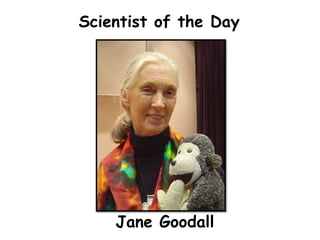
Scientist of the Day


    Jane Goodall
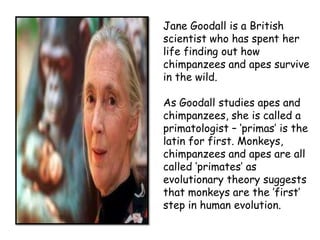
Jane Goodall is a British
scientist who has spent her
life finding out how
chimpanzees and apes survive
in the wild.

As Goodall studies apes and
chimpanzees, she is called a
primatologist – ‘primas’ is the
latin for first. Monkeys,
chimpanzees and apes are all
called ‘primates’ as
evolutionary theory suggests
that monkeys are the ’first’
step in human evolution.
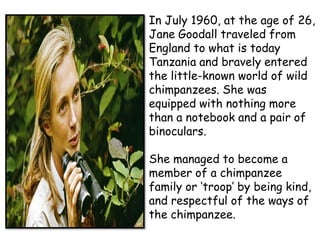
In July 1960, at the age of 26,
Jane Goodall traveled from
England to what is today
Tanzania and bravely entered
the little-known world of wild
chimpanzees. She was
equipped with nothing more
than a notebook and a pair of
binoculars.

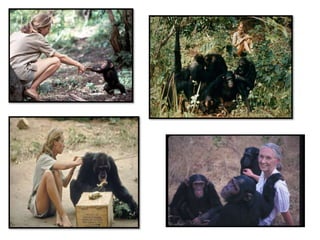
She managed to become a
member of a chimpanzee
family or ‘troop’ by being kind,
and respectful of the ways of
the chimpanzee.
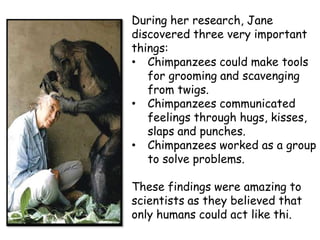
During her research, Jane
discovered three very important
things:
• Chimpanzees could make tools
   for grooming and scavenging
   from twigs.
• Chimpanzees communicated
   feelings through hugs, kisses,
   slaps and punches.
• Chimpanzees worked as a group
   to solve problems.

These findings were amazing to
scientists as they believed that
only humans could act like thi.
Space Facts
• Footprints and tyre tracks left behind
  by astronauts on the moon will stay
  there forever as there is no wind to
  blow them away.
• Jupiter's 4 biggest moons are named
  Europa, Ganymede, Callisto and Io.
• Halley’s Comet was last seen in the
  inner Solar System in 1986, it will be
  visible again from Earth sometime in
  2061 (get your camera ready).
• Because of lower gravity, a person
  who weighs 100kg on earth would only
  weigh 38kg on the surface of Mars.
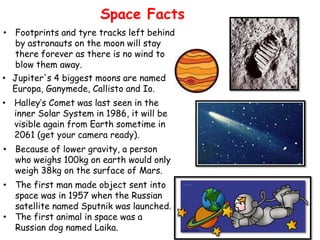
• The first man made object sent into
  space was in 1957 when the Russian
  satellite named Sputnik was launched.
• The first animal in space was a
  Russian dog named Laika.
Science Picture of the Day
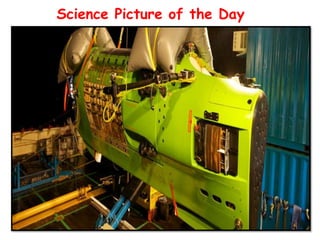
Say hello to the ‘Deepsea Challenger’!

On March 26th 2012, James Cameron (the man who
directed Titanic) navigated this submarine down to
the bottom of the Marianas Trench, the deepest
place on Earth hidden under a huge volume of water.
This had not been done since 1960.

It took Cameron over 70 minutes to travel the 7
miles down to the bottom of Earth to take videos
and to collect scientific data of the plant and animal
life that live in this deep and dark place.

Day4

  • 1.
  • 2.
    Scientist of theDay Jane Goodall
  • 3.
    Jane Goodall isa British scientist who has spent her life finding out how chimpanzees and apes survive in the wild. As Goodall studies apes and chimpanzees, she is called a primatologist – ‘primas’ is the latin for first. Monkeys, chimpanzees and apes are all called ‘primates’ as evolutionary theory suggests that monkeys are the ’first’ step in human evolution.
  • 4.
    In July 1960,at the age of 26, Jane Goodall traveled from England to what is today Tanzania and bravely entered the little-known world of wild chimpanzees. She was equipped with nothing more than a notebook and a pair of binoculars. She managed to become a member of a chimpanzee family or ‘troop’ by being kind, and respectful of the ways of the chimpanzee.
  • 5.
    During her research,Jane discovered three very important things: • Chimpanzees could make tools for grooming and scavenging from twigs. • Chimpanzees communicated feelings through hugs, kisses, slaps and punches. • Chimpanzees worked as a group to solve problems. These findings were amazing to scientists as they believed that only humans could act like thi.
  • 8.
    Space Facts • Footprintsand tyre tracks left behind by astronauts on the moon will stay there forever as there is no wind to blow them away. • Jupiter's 4 biggest moons are named Europa, Ganymede, Callisto and Io. • Halley’s Comet was last seen in the inner Solar System in 1986, it will be visible again from Earth sometime in 2061 (get your camera ready). • Because of lower gravity, a person who weighs 100kg on earth would only weigh 38kg on the surface of Mars. • The first man made object sent into space was in 1957 when the Russian satellite named Sputnik was launched. • The first animal in space was a Russian dog named Laika.
  • 10.
  • 11.
    Say hello tothe ‘Deepsea Challenger’! On March 26th 2012, James Cameron (the man who directed Titanic) navigated this submarine down to the bottom of the Marianas Trench, the deepest place on Earth hidden under a huge volume of water. This had not been done since 1960. It took Cameron over 70 minutes to travel the 7 miles down to the bottom of Earth to take videos and to collect scientific data of the plant and animal life that live in this deep and dark place.