Science Corner!
     Day 2
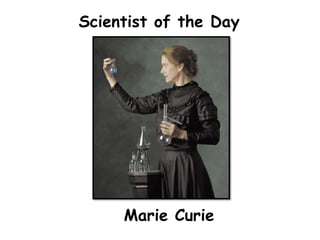
Scientist of the Day


     Marie Curie
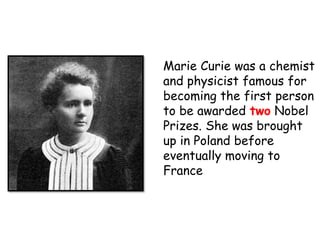
Marie Curie was a chemist
and physicist famous for
becoming the first person
to be awarded two Nobel
Prizes. She was brought
up in Poland before
eventually moving to
France
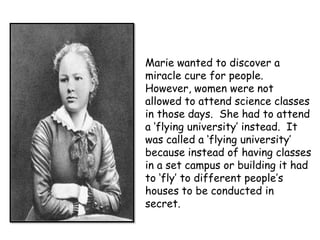
Marie wanted to discover a
miracle cure for people.
However, women were not
allowed to attend science classes
in those days. She had to attend
a ‘flying university’ instead. It
was called a ‘flying university’
because instead of having classes
in a set campus or building it had
to ‘fly’ to different people’s
houses to be conducted in
secret.
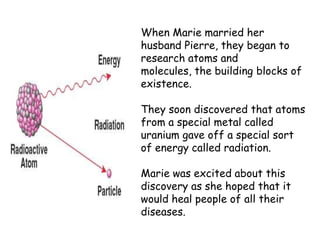
When Marie married her
husband Pierre, they began to
research atoms and
molecules, the building blocks of
existence.

They soon discovered that atoms
from a special metal called
uranium gave off a special sort
of energy called radiation.

Marie was excited about this
discovery as she hoped that it
would heal people of all their
diseases.
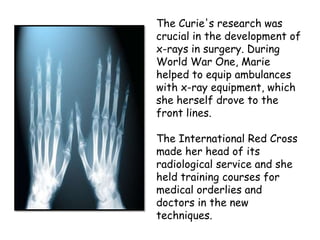
The Curie's research was
crucial in the development of
x-rays in surgery. During
World War One, Marie
helped to equip ambulances
with x-ray equipment, which
she herself drove to the
front lines.

The International Red Cross
made her head of its
radiological service and she
held training courses for
medical orderlies and
doctors in the new
techniques.
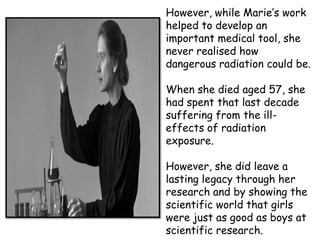
However, while Marie’s work
helped to develop an
important medical tool, she
never realised how
dangerous radiation could be.

When she died aged 57, she
had spent that last decade
suffering from the ill-
effects of radiation
exposure.

However, she did leave a
lasting legacy through her
research and by showing the
scientific world that girls
were just as good as boys at
scientific research.
Timeline
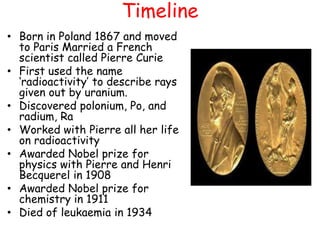
• Born in Poland 1867 and moved
  to Paris Married a French
  scientist called Pierre Curie
• First used the name
  ‘radioactivity’ to describe rays
  given out by uranium.
• Discovered polonium, Po, and
  radium, Ra
• Worked with Pierre all her life
  on radioactivity
• Awarded Nobel prize for
  physics with Pierre and Henri
  Becquerel in 1908
• Awarded Nobel prize for
  chemistry in 1911
• Died of leukaemia in 1934
Earth Facts
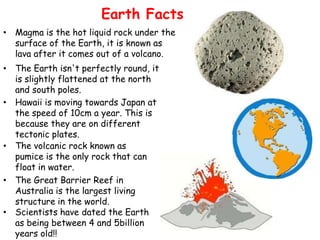
• Magma is the hot liquid rock under the
  surface of the Earth, it is known as
  lava after it comes out of a volcano.
• The Earth isn't perfectly round, it
  is slightly flattened at the north
  and south poles.
• Hawaii is moving towards Japan at
  the speed of 10cm a year. This is
  because they are on different
  tectonic plates.
• The volcanic rock known as
  pumice is the only rock that can
  float in water.
• The Great Barrier Reef in
  Australia is the largest living
  structure in the world.
• Scientists have dated the Earth
  as being between 4 and 5billion
  years old!!
Science Picture of the Day
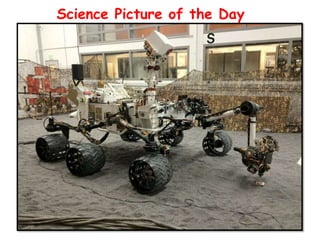
This is a picture of ‘Curiosity’ on Earth before it was
sent into space to land on the surface of Mars.

On August 5 2012, after a journey lasting more than
8 months, Curiosity landed on Mars. The vehicle is
basically a science lab. Its mission: to search for
evidence that the Red Planet might once have hosted
life — even if the organisms were only one-celled
microbes.

This six-wheeled all-terrain vehicle weighs 900
kilograms (about 1 U.S. ton). Roughly 2.8 meters (9
feet) long, it carries 10 research instruments.
Seventeen separate cameras (including one on the
rover’s belly, to scan below it) will survey the
landscape and record experiments.

Science Week, Day 2

  • 1.
  • 2.
    Scientist of theDay Marie Curie
  • 3.
    Marie Curie wasa chemist and physicist famous for becoming the first person to be awarded two Nobel Prizes. She was brought up in Poland before eventually moving to France
  • 4.
    Marie wanted todiscover a miracle cure for people. However, women were not allowed to attend science classes in those days. She had to attend a ‘flying university’ instead. It was called a ‘flying university’ because instead of having classes in a set campus or building it had to ‘fly’ to different people’s houses to be conducted in secret.
  • 5.
    When Marie marriedher husband Pierre, they began to research atoms and molecules, the building blocks of existence. They soon discovered that atoms from a special metal called uranium gave off a special sort of energy called radiation. Marie was excited about this discovery as she hoped that it would heal people of all their diseases.
  • 6.
    The Curie's researchwas crucial in the development of x-rays in surgery. During World War One, Marie helped to equip ambulances with x-ray equipment, which she herself drove to the front lines. The International Red Cross made her head of its radiological service and she held training courses for medical orderlies and doctors in the new techniques.
  • 7.
    However, while Marie’swork helped to develop an important medical tool, she never realised how dangerous radiation could be. When she died aged 57, she had spent that last decade suffering from the ill- effects of radiation exposure. However, she did leave a lasting legacy through her research and by showing the scientific world that girls were just as good as boys at scientific research.
  • 8.
    Timeline • Born inPoland 1867 and moved to Paris Married a French scientist called Pierre Curie • First used the name ‘radioactivity’ to describe rays given out by uranium. • Discovered polonium, Po, and radium, Ra • Worked with Pierre all her life on radioactivity • Awarded Nobel prize for physics with Pierre and Henri Becquerel in 1908 • Awarded Nobel prize for chemistry in 1911 • Died of leukaemia in 1934
  • 10.
    Earth Facts • Magmais the hot liquid rock under the surface of the Earth, it is known as lava after it comes out of a volcano. • The Earth isn't perfectly round, it is slightly flattened at the north and south poles. • Hawaii is moving towards Japan at the speed of 10cm a year. This is because they are on different tectonic plates. • The volcanic rock known as pumice is the only rock that can float in water. • The Great Barrier Reef in Australia is the largest living structure in the world. • Scientists have dated the Earth as being between 4 and 5billion years old!!
  • 12.
  • 13.
    This is apicture of ‘Curiosity’ on Earth before it was sent into space to land on the surface of Mars. On August 5 2012, after a journey lasting more than 8 months, Curiosity landed on Mars. The vehicle is basically a science lab. Its mission: to search for evidence that the Red Planet might once have hosted life — even if the organisms were only one-celled microbes. This six-wheeled all-terrain vehicle weighs 900 kilograms (about 1 U.S. ton). Roughly 2.8 meters (9 feet) long, it carries 10 research instruments. Seventeen separate cameras (including one on the rover’s belly, to scan below it) will survey the landscape and record experiments.

Editor's Notes

  • #5 http://www.ducksters.com/biography/women_leaders/marie_curie.php
  • #13 This is a picture of ‘Curiosity’ on Earth before it was sent into space to land on the surface of Mars. Click on this link to look at some of the components of this machine: http://www.businessinsider.com/mars-rover-curiosity-honeybee-robotics-2012-8#honeybee-co-founder-and-chairman-steve-gorevan-left-stands-proudly-with-the-mars-science-laboratory-during-testing-in-july-the-rover-is-about-the-size-of-a-mini-cooper-1CLICK ON THE PICTURE OR THIS LINK TO SEE THIS MACHINE BROADCAST BACK TO NASA WHAT THE SURFACE OF MARS LOOKS LIKE http://www.guardian.co.uk/science/video/2012/aug/10/nasa-curiosity-images-surface-mars-video