Feedable, portable, mashable, DITAble  Michael Priestley, Lead IBM ®  DITA Architect March 2008
Overview What is DITA? What about Web 2.0? The problem The solution (or part of it) Scenarios: DITA and Wikis Scenarios: DITA and mashups Insights
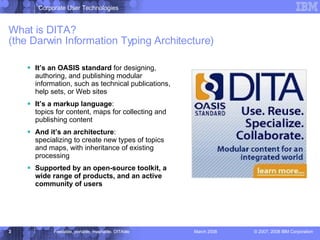
What is DITA? (the Darwin Information Typing Architecture) It’s an OASIS standard  for designing, authoring, and publishing modular information, such as technical publications, help sets, or Web sites It’s a markup language : topics for content, maps for collecting and publishing content And it’s an architecture :   specializing to create new types of topics and maps, with inheritance of existing processing Supported by an open-source toolkit, a wide range of products, and an active community of users
Vendor response http://dita.xml.org/products-services "PTC expects that by the end of 2008, up to 80% of all new XML publishing installations will be based on DITA."   From PTC news release on Arbortext(R) 5.3 . "Nearly 50% of the respondents estimated they reuse their content and are investigating the implementation of DITA within their organization.” From results of web survey by Astoria Software. And others: Elkera, Doczone, DITA Storm, in.Vision…
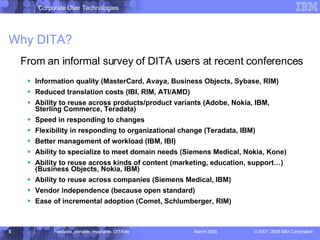
Why DITA? Information quality (MasterCard, Avaya, Business Objects, Sybase, RIM) Reduced translation costs (IBI, RIM, ATI/AMD) Ability to reuse across products/product variants (Adobe, Nokia, IBM, Sterling Commerce, Teradata) Speed in responding to changes Flexibility in responding to organizational change (Teradata, IBM) Better management of workload (IBM, IBI) Ability to specialize to meet domain needs (Siemens Medical, Nokia, Kone) Ability to reuse across kinds of content (marketing, education, support…) (Business Objects, Nokia, IBM) Ability to reuse across companies (Siemens Medical, IBM) Vendor independence (because open standard) Ease of incremental adoption (Comet, Schlumberger, RIM) From an informal survey of DITA users at recent conferences
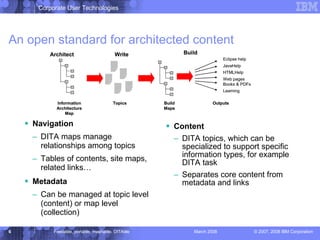
An open standard for architected content Navigation DITA maps manage relationships among topics Tables of contents, site maps, related links… Metadata Can be managed at topic level (content) or map level (collection) Content DITA topics, which can be specialized to support specific information types, for example DITA task Separates core content from metadata and links
What about Web 2.0? “ Web 2.0 is of course a piece of jargon, nobody even knows what it means.” -- Tim Berners-Lee (that guy who invented the Web) “ Web 2.0  … refers to a perceived or proposed second generation of Internet-based services—such as social networking sites, wikis, communication tools, and folksonomies —that emphasize  online collaboration and sharing among users .” -- http://en.wikipedia.org/wiki/Web_2.0
Pick 2 Wikis – Create content collaboratively Blogs Social networking Mashups – Combine content from multiple sources Folksonomies
Why Wikis and mashups? Powerful enterprise tools Enable fast, easy, open collaboration on content using Wikis Create new content quickly Enable fast, flexible development of tactical applications using mashups Leverage investment in trusted content/data Easier collaboration, faster innovation
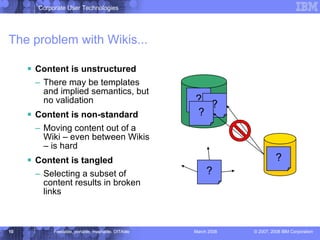
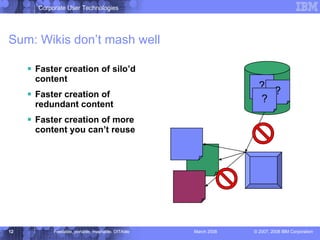
The problem with Wikis... Content is unstructured There may be templates and implied semantics, but no validation Content is non-standard Moving content out of a Wiki – even between Wikis – is hard Content is tangled Selecting a subset of content results in broken links ? ? ? ? ?
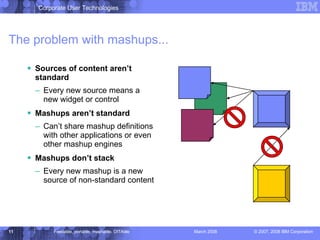
The problem with mashups... Sources of content aren’t standard Every new source means a new widget or control Mashups aren’t standard Can’t share mashup definitions with other applications or even other mashup engines Mashups don’t stack Every new mashup is a new source of non-standard content
Sum: Wikis don’t mash well Faster creation of silo’d content Faster creation of redundant content Faster creation of more content you can’t reuse ? ? ?
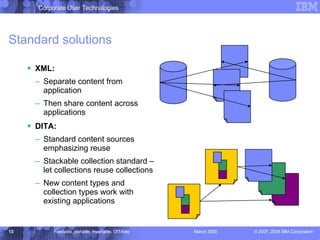
Standard solutions XML: Separate content from application Then share content across applications DITA: Standard content sources emphasizing reuse Stackable collection standard – let collections reuse collections New content types and collection types work with existing applications
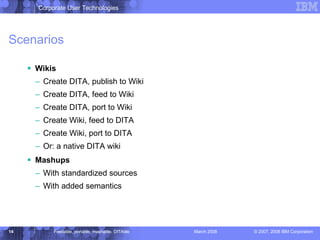
Scenarios Wikis Create DITA, publish to Wiki Create DITA, feed to Wiki Create DITA, port to Wiki Create Wiki, feed to DITA Create Wiki, port to DITA Or: a native DITA wiki Mashups With standardized sources With added semantics
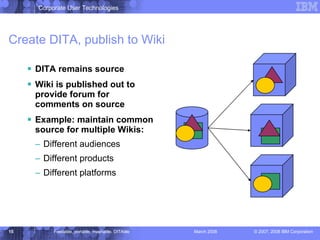
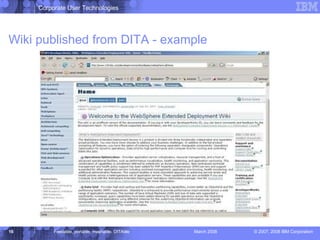
Create DITA, publish to Wiki DITA remains source Wiki is published out to provide forum for comments on source Example: maintain common source for multiple Wikis: Different audiences Different products Different platforms
Wiki published from DITA - example
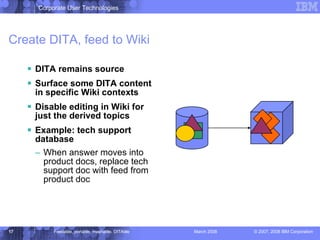
Create DITA, feed to Wiki DITA remains source Surface some DITA content in specific Wiki contexts Disable editing in Wiki for just the derived topics Example: tech support database When answer moves into product docs, replace tech support doc with feed from product doc
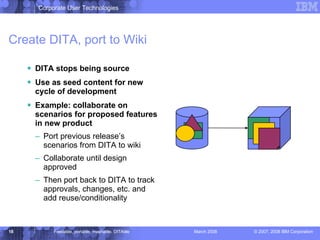
Create DITA, port to Wiki DITA stops being source Use as seed content for new cycle of development Example: collaborate on scenarios for proposed features in new product Port previous release’s scenarios from DITA to wiki Collaborate until design approved Then port back to DITA to track approvals, changes, etc. and add reuse/conditionality
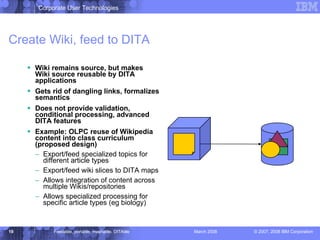
Create Wiki, feed to DITA Wiki remains source, but makes Wiki source reusable by DITA applications Gets rid of dangling links, formalizes semantics Does not provide validation, conditional processing, advanced DITA features Example: OLPC reuse of Wikipedia content into class curriculum (proposed design) Export/feed specialized topics for different article types Export/feed wiki slices to DITA maps Allows integration of content across  multiple Wikis/repositories Allows specialized processing for specific article types (eg biology)
Create Wiki, port to DITA DITA becomes source Example: After brainstorming to create newscenarios, move into DITA for formal use Begin topic analysis and associate requirements, tasks, features etc. Begin reusing – identifying parts of scenario that apply to multiple products, etc.
Or: a native DITA wiki Feed back and forth between systems with no loss of semantics Port content to the system that meets its needs easily, reliably, repeatably Integrate with new systems quickly based on shared content standards
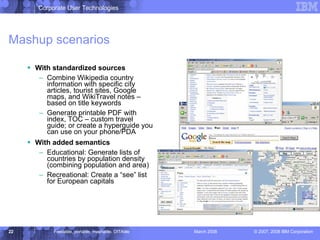
Mashup scenarios With standardized sources Combine Wikipedia country information with specific city articles, tourist sites, Google maps, and WikiTravel notes – based on title keywords Generate printable PDF with index, TOC – custom travel guide; or create a hyperguide you can use on your phone/PDA With added semantics Educational: Generate lists of countries by population density (combining population and area) Recreational: Create a “see” list for European capitals
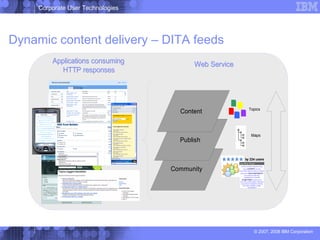
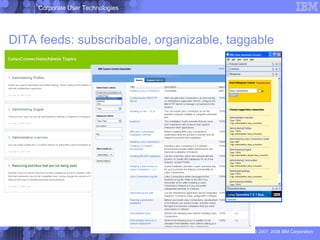
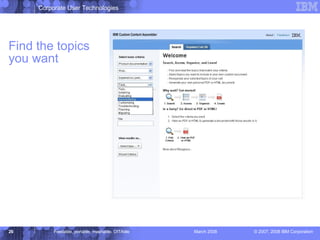
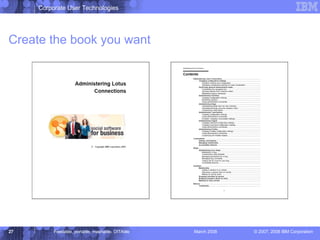
DITA mashup example IBM ®  Custom Content Assembler DITA feeds for Lotus ®  product documentation Dynamic publishing for user-selected and –organized topics User-created collections are themselves searchable and reusable Collection includes DITA standard content types plus DITA specialized content for learning/training, plus DITA metadata wrappers for multimedia/Flash
Dynamic content delivery – DITA feeds
DITA feeds: subscribable, organizable, taggable
Find the topics  you want
Create the book you want
Insights Lots of different types of content in Wikis Range of formality/structure, range of mechanisms for enforcing Not a single type of content: a phase in the content lifecycle As requirements change over time, let content move to the application that best supports those requirements The conflict between structure and collaboration is resolvable All you need is standardized modular content
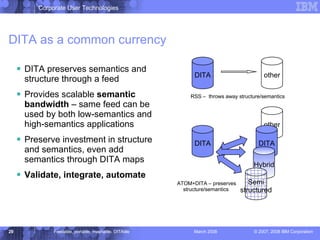
DITA as a common currency DITA preserves semantics and structure through a feed Provides scalable  semantic bandwidth  – same feed can be used by both low-semantics and high-semantics applications Preserve investment in structure and semantics, even add semantics through DITA maps  Validate, integrate, automate other DITA other RSS –  throws away structure/semantics DITA DITA Hybrid Semi structured ATOM+DITA – preserves structure/semantics
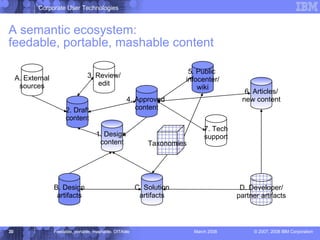
A semantic ecosystem: feedable, portable, mashable content 2. Draft content 3. Review/ edit 4. Approved  content 1. Design  content 5. Public  infocenter/ wiki 6. Articles/ new content 7. Tech support B. Design artifacts C. Solution artifacts D. Developer/ partner artifacts A. External sources Taxonomies
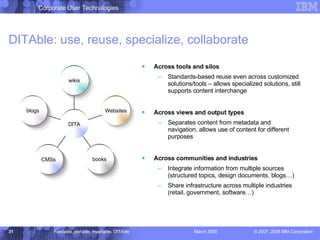
DITAble: use, reuse, specialize, collaborate Across tools and silos Standards-based reuse even across customized solutions/tools – allows specialized solutions, still supports content interchange Across views and output types Separates content from metadata and navigation, allows use of content for different purposes Across communities and industries Integrate information from multiple sources (structured topics, design documents, blogs…)  Share infrastructure across multiple industries (retail, government, software…) blogs CMSs books Websites wikis DITA
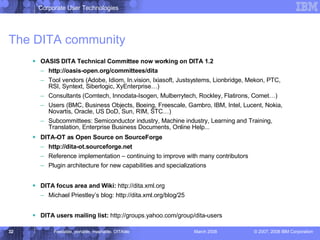
The DITA community OASIS DITA Technical Committee now working on DITA 1.2 http://oasis-open.org/committees/dita Tool vendors (Adobe, Idiom, In.vision, Ixiasoft, Justsystems, Lionbridge, Mekon, PTC, RSI, Syntext, Siberlogic, XyEnterprise…)  Consultants (Comtech, Innodata-Isogen, Mulberrytech, Rockley, Flatirons, Comet…)  Users (BMC, Business Objects, Boeing, Freescale, Gambro, IBM, Intel, Lucent, Nokia, Novartis, Oracle, US DoD, Sun, RIM, STC…) Subcommittees: Semiconductor industry, Machine industry, Learning and Training, Translation, Enterprise Business Documents, Online Help... DITA-OT as Open Source on SourceForge http://dita-ot.sourceforge.net Reference implementation – continuing to improve with many contributors Plugin architecture for new capabilities and specializations DITA focus area and Wiki:  http://dita.xml.org Michael Priestley’s blog: http://dita.xml.org/blog/25 DITA users mailing list:  http://groups.yahoo.com/group/dita-users
Backup
DITA and the Web The Semantic Web The Structured Web The Social Web
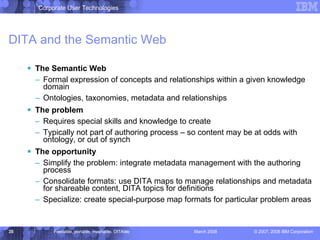
DITA and the Semantic Web The Semantic Web Formal expression of concepts and relationships within a given knowledge domain Ontologies, taxonomies, metadata and relationships The problem Requires special skills and knowledge to create  Typically not part of authoring process – so content may be at odds with ontology, or out of synch The opportunity Simplify the problem: integrate metadata management with the authoring process Consolidate formats: use DITA maps to manage relationships and metadata for shareable content, DITA topics for definitions Specialize: create special-purpose map formats for particular problem areas
DITA and the Structured Web The Structured Web The convergence of structured authoring and information architecture  Adding structure and semantics to the way information is designed, organized, and delivered The problem   Requires specialized skills and tools to create structured content Information architecture gets out of synch with content The opportunity Simplify the tooling: use DITA as common base for structured content Integrate processes: keep information architecture relevant by making it part of delivery architecture using DITA maps
DITA and the Social Web The Social Web Easy to create content, collaborate, and manage relationships Easy to build new applications The problem Hard to move content between systems – content can easily become silo’d Hard to integrate structure – most content is lowest common denomenator The content assets are out of the reach of existing business processes and applications, such as workflow, translation, etc. The opportunity Standardize content: Use DITA to integrate/share/move content between systems, reduce translation and republishing costs Support specialization: Structure and semantics at source allows robust integration with enterprise processes, like regulatory workflows, legal requirements
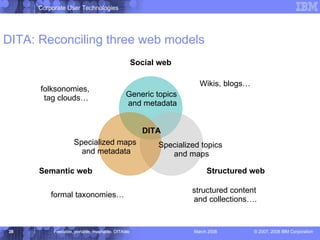
DITA: Reconciling three web models Social web Structured web Semantic web Wikis, blogs…  structured content  and collections…. folksonomies,  tag clouds… formal taxonomies… Generic topics  and metadata Specialized topics  and maps Specialized maps  and metadata DITA

Feedable, Portable, Mashable, DITAble

  • 1.
    Feedable, portable, mashable,DITAble Michael Priestley, Lead IBM ® DITA Architect March 2008
  • 2.
    Overview What isDITA? What about Web 2.0? The problem The solution (or part of it) Scenarios: DITA and Wikis Scenarios: DITA and mashups Insights
  • 3.
    What is DITA?(the Darwin Information Typing Architecture) It’s an OASIS standard for designing, authoring, and publishing modular information, such as technical publications, help sets, or Web sites It’s a markup language : topics for content, maps for collecting and publishing content And it’s an architecture : specializing to create new types of topics and maps, with inheritance of existing processing Supported by an open-source toolkit, a wide range of products, and an active community of users
  • 4.
    Vendor response http://dita.xml.org/products-services"PTC expects that by the end of 2008, up to 80% of all new XML publishing installations will be based on DITA."  From PTC news release on Arbortext(R) 5.3 . "Nearly 50% of the respondents estimated they reuse their content and are investigating the implementation of DITA within their organization.” From results of web survey by Astoria Software. And others: Elkera, Doczone, DITA Storm, in.Vision…
  • 5.
    Why DITA? Informationquality (MasterCard, Avaya, Business Objects, Sybase, RIM) Reduced translation costs (IBI, RIM, ATI/AMD) Ability to reuse across products/product variants (Adobe, Nokia, IBM, Sterling Commerce, Teradata) Speed in responding to changes Flexibility in responding to organizational change (Teradata, IBM) Better management of workload (IBM, IBI) Ability to specialize to meet domain needs (Siemens Medical, Nokia, Kone) Ability to reuse across kinds of content (marketing, education, support…) (Business Objects, Nokia, IBM) Ability to reuse across companies (Siemens Medical, IBM) Vendor independence (because open standard) Ease of incremental adoption (Comet, Schlumberger, RIM) From an informal survey of DITA users at recent conferences
  • 6.
    An open standardfor architected content Navigation DITA maps manage relationships among topics Tables of contents, site maps, related links… Metadata Can be managed at topic level (content) or map level (collection) Content DITA topics, which can be specialized to support specific information types, for example DITA task Separates core content from metadata and links
  • 7.
    What about Web2.0? “ Web 2.0 is of course a piece of jargon, nobody even knows what it means.” -- Tim Berners-Lee (that guy who invented the Web) “ Web 2.0 … refers to a perceived or proposed second generation of Internet-based services—such as social networking sites, wikis, communication tools, and folksonomies —that emphasize online collaboration and sharing among users .” -- http://en.wikipedia.org/wiki/Web_2.0
  • 8.
    Pick 2 Wikis– Create content collaboratively Blogs Social networking Mashups – Combine content from multiple sources Folksonomies
  • 9.
    Why Wikis andmashups? Powerful enterprise tools Enable fast, easy, open collaboration on content using Wikis Create new content quickly Enable fast, flexible development of tactical applications using mashups Leverage investment in trusted content/data Easier collaboration, faster innovation
  • 10.
    The problem withWikis... Content is unstructured There may be templates and implied semantics, but no validation Content is non-standard Moving content out of a Wiki – even between Wikis – is hard Content is tangled Selecting a subset of content results in broken links ? ? ? ? ?
  • 11.
    The problem withmashups... Sources of content aren’t standard Every new source means a new widget or control Mashups aren’t standard Can’t share mashup definitions with other applications or even other mashup engines Mashups don’t stack Every new mashup is a new source of non-standard content
  • 12.
    Sum: Wikis don’tmash well Faster creation of silo’d content Faster creation of redundant content Faster creation of more content you can’t reuse ? ? ?
  • 13.
    Standard solutions XML:Separate content from application Then share content across applications DITA: Standard content sources emphasizing reuse Stackable collection standard – let collections reuse collections New content types and collection types work with existing applications
  • 14.
    Scenarios Wikis CreateDITA, publish to Wiki Create DITA, feed to Wiki Create DITA, port to Wiki Create Wiki, feed to DITA Create Wiki, port to DITA Or: a native DITA wiki Mashups With standardized sources With added semantics
  • 15.
    Create DITA, publishto Wiki DITA remains source Wiki is published out to provide forum for comments on source Example: maintain common source for multiple Wikis: Different audiences Different products Different platforms
  • 16.
    Wiki published fromDITA - example
  • 17.
    Create DITA, feedto Wiki DITA remains source Surface some DITA content in specific Wiki contexts Disable editing in Wiki for just the derived topics Example: tech support database When answer moves into product docs, replace tech support doc with feed from product doc
  • 18.
    Create DITA, portto Wiki DITA stops being source Use as seed content for new cycle of development Example: collaborate on scenarios for proposed features in new product Port previous release’s scenarios from DITA to wiki Collaborate until design approved Then port back to DITA to track approvals, changes, etc. and add reuse/conditionality
  • 19.
    Create Wiki, feedto DITA Wiki remains source, but makes Wiki source reusable by DITA applications Gets rid of dangling links, formalizes semantics Does not provide validation, conditional processing, advanced DITA features Example: OLPC reuse of Wikipedia content into class curriculum (proposed design) Export/feed specialized topics for different article types Export/feed wiki slices to DITA maps Allows integration of content across multiple Wikis/repositories Allows specialized processing for specific article types (eg biology)
  • 20.
    Create Wiki, portto DITA DITA becomes source Example: After brainstorming to create newscenarios, move into DITA for formal use Begin topic analysis and associate requirements, tasks, features etc. Begin reusing – identifying parts of scenario that apply to multiple products, etc.
  • 21.
    Or: a nativeDITA wiki Feed back and forth between systems with no loss of semantics Port content to the system that meets its needs easily, reliably, repeatably Integrate with new systems quickly based on shared content standards
  • 22.
    Mashup scenarios Withstandardized sources Combine Wikipedia country information with specific city articles, tourist sites, Google maps, and WikiTravel notes – based on title keywords Generate printable PDF with index, TOC – custom travel guide; or create a hyperguide you can use on your phone/PDA With added semantics Educational: Generate lists of countries by population density (combining population and area) Recreational: Create a “see” list for European capitals
  • 23.
    DITA mashup exampleIBM ® Custom Content Assembler DITA feeds for Lotus ® product documentation Dynamic publishing for user-selected and –organized topics User-created collections are themselves searchable and reusable Collection includes DITA standard content types plus DITA specialized content for learning/training, plus DITA metadata wrappers for multimedia/Flash
  • 24.
  • 25.
    DITA feeds: subscribable,organizable, taggable
  • 26.
    Find the topics you want
  • 27.
  • 28.
    Insights Lots ofdifferent types of content in Wikis Range of formality/structure, range of mechanisms for enforcing Not a single type of content: a phase in the content lifecycle As requirements change over time, let content move to the application that best supports those requirements The conflict between structure and collaboration is resolvable All you need is standardized modular content
  • 29.
    DITA as acommon currency DITA preserves semantics and structure through a feed Provides scalable semantic bandwidth – same feed can be used by both low-semantics and high-semantics applications Preserve investment in structure and semantics, even add semantics through DITA maps Validate, integrate, automate other DITA other RSS – throws away structure/semantics DITA DITA Hybrid Semi structured ATOM+DITA – preserves structure/semantics
  • 30.
    A semantic ecosystem:feedable, portable, mashable content 2. Draft content 3. Review/ edit 4. Approved content 1. Design content 5. Public infocenter/ wiki 6. Articles/ new content 7. Tech support B. Design artifacts C. Solution artifacts D. Developer/ partner artifacts A. External sources Taxonomies
  • 31.
    DITAble: use, reuse,specialize, collaborate Across tools and silos Standards-based reuse even across customized solutions/tools – allows specialized solutions, still supports content interchange Across views and output types Separates content from metadata and navigation, allows use of content for different purposes Across communities and industries Integrate information from multiple sources (structured topics, design documents, blogs…) Share infrastructure across multiple industries (retail, government, software…) blogs CMSs books Websites wikis DITA
  • 32.
    The DITA communityOASIS DITA Technical Committee now working on DITA 1.2 http://oasis-open.org/committees/dita Tool vendors (Adobe, Idiom, In.vision, Ixiasoft, Justsystems, Lionbridge, Mekon, PTC, RSI, Syntext, Siberlogic, XyEnterprise…) Consultants (Comtech, Innodata-Isogen, Mulberrytech, Rockley, Flatirons, Comet…) Users (BMC, Business Objects, Boeing, Freescale, Gambro, IBM, Intel, Lucent, Nokia, Novartis, Oracle, US DoD, Sun, RIM, STC…) Subcommittees: Semiconductor industry, Machine industry, Learning and Training, Translation, Enterprise Business Documents, Online Help... DITA-OT as Open Source on SourceForge http://dita-ot.sourceforge.net Reference implementation – continuing to improve with many contributors Plugin architecture for new capabilities and specializations DITA focus area and Wiki: http://dita.xml.org Michael Priestley’s blog: http://dita.xml.org/blog/25 DITA users mailing list: http://groups.yahoo.com/group/dita-users
  • 33.
  • 34.
    DITA and theWeb The Semantic Web The Structured Web The Social Web
  • 35.
    DITA and theSemantic Web The Semantic Web Formal expression of concepts and relationships within a given knowledge domain Ontologies, taxonomies, metadata and relationships The problem Requires special skills and knowledge to create Typically not part of authoring process – so content may be at odds with ontology, or out of synch The opportunity Simplify the problem: integrate metadata management with the authoring process Consolidate formats: use DITA maps to manage relationships and metadata for shareable content, DITA topics for definitions Specialize: create special-purpose map formats for particular problem areas
  • 36.
    DITA and theStructured Web The Structured Web The convergence of structured authoring and information architecture Adding structure and semantics to the way information is designed, organized, and delivered The problem Requires specialized skills and tools to create structured content Information architecture gets out of synch with content The opportunity Simplify the tooling: use DITA as common base for structured content Integrate processes: keep information architecture relevant by making it part of delivery architecture using DITA maps
  • 37.
    DITA and theSocial Web The Social Web Easy to create content, collaborate, and manage relationships Easy to build new applications The problem Hard to move content between systems – content can easily become silo’d Hard to integrate structure – most content is lowest common denomenator The content assets are out of the reach of existing business processes and applications, such as workflow, translation, etc. The opportunity Standardize content: Use DITA to integrate/share/move content between systems, reduce translation and republishing costs Support specialization: Structure and semantics at source allows robust integration with enterprise processes, like regulatory workflows, legal requirements
  • 38.
    DITA: Reconciling threeweb models Social web Structured web Semantic web Wikis, blogs… structured content and collections…. folksonomies, tag clouds… formal taxonomies… Generic topics and metadata Specialized topics and maps Specialized maps and metadata DITA