LOR Overview and BCcampus Initiative Scott Leslie July 28, 2005
Outline State of Play in Repositories Possible approaches and common features BCcampus Repository Initiative
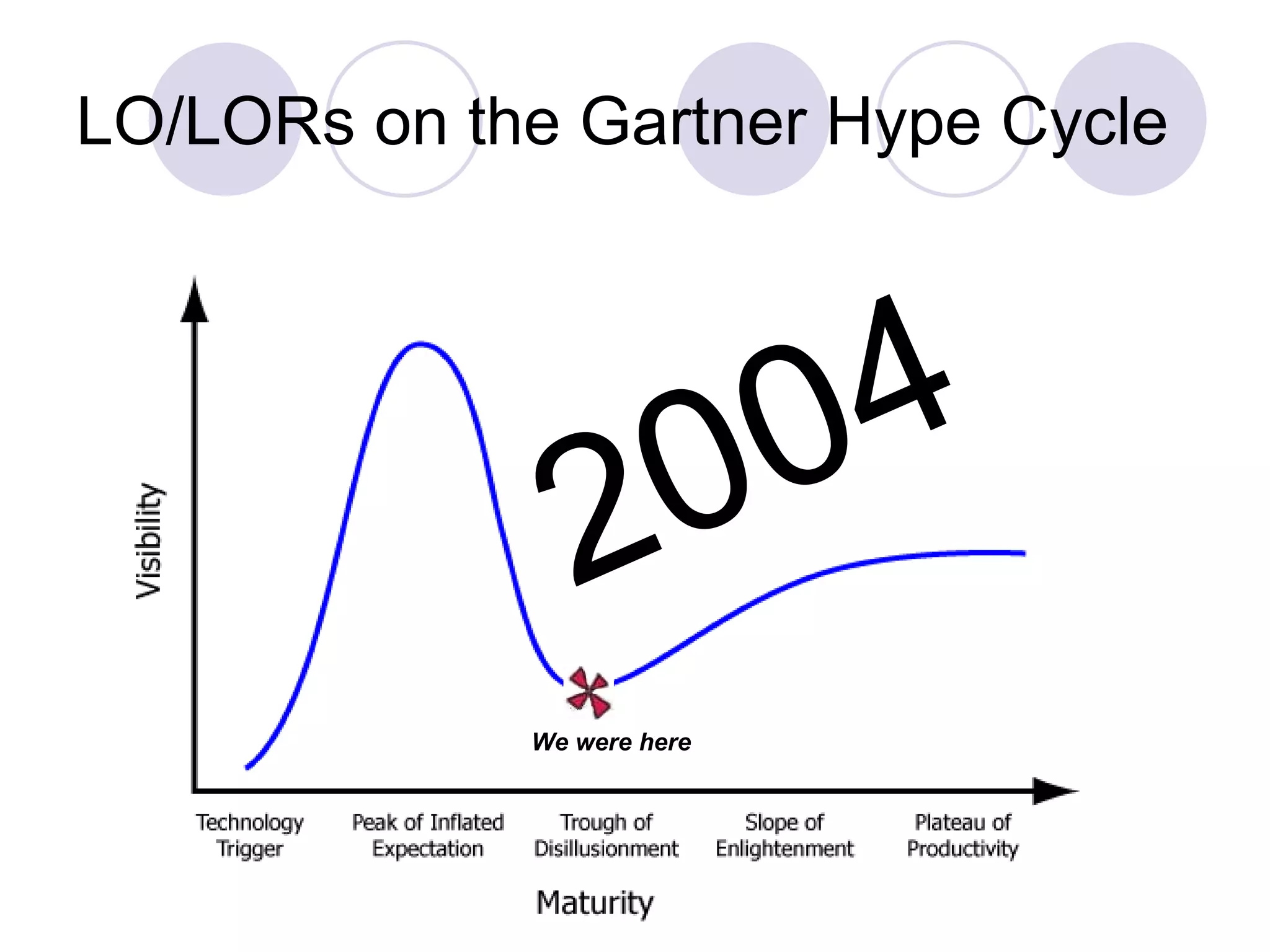
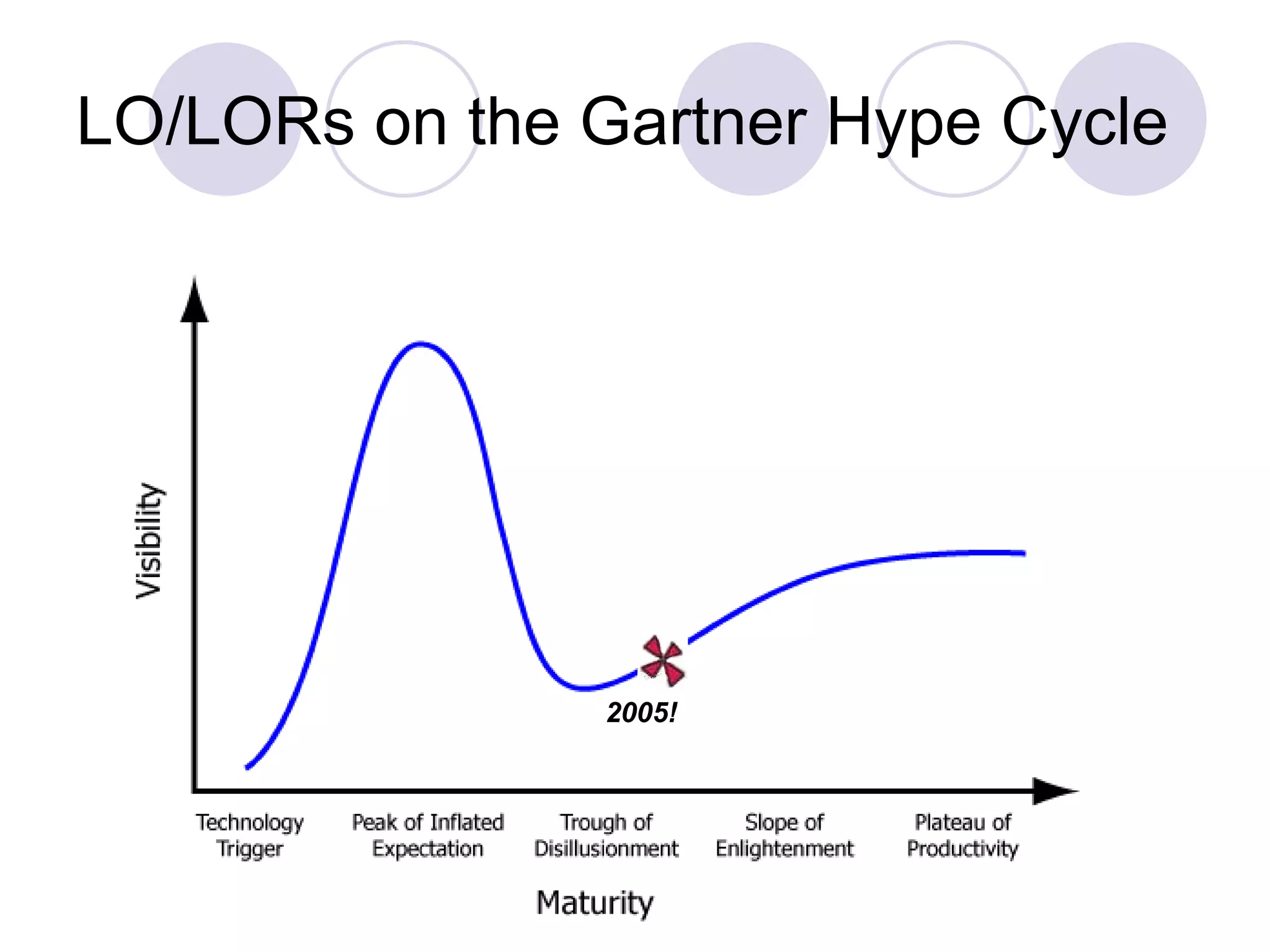
LO/LORs on the Gartner Hype Cycle 2004 We were here
Maturity of Problem LORs address  LORs still struggling to define precisely the problem that is trying to be solved with them? Is it discovery and sharing of resources? Is it the management of content development? Is it the facilitation of content re-use? Is it the creation of communities of practitioners? Is it the archiving of learning materials? Is it the ingestion and re-composition of complex multimedia objects? All of the above? 2004
Maturity of Problem LORs address  LORs getting better at defining the problem they are trying to solve Is it discovery and sharing of resources? Is it the management of content development? Is it the facilitation of content re-use? Is it the creation of communities of practitioners? Is it the archiving of learning materials? Is it the ingestion and re-composition of complex multimedia objects? All of the above? 2005
Maturity of LOR Market The market for learning object repository technology is very immature and has some fundamental risks involved unclear how large a market there will ever be for repository technology vendors are trying to amortize their R&D efforts across too few customers and too short a period leading to hefty licensing prices considering the actual technology involved if the problem is expanded to include the LCMS field, it becomes a broader and deeper market, but pricing for corporate-style LCMS out of line with higher ed expectations and abilities to pay 2004
LOR Market Maturing…Slowly While the market for learning object repository technology is still quite immature Had a number large RFPs and purchases occur over the last 12 months UNAM system in Mexico – 1million+ seats for Harvest Road Flordia Virtual School System – also Harvest Road JISC JORUM Repository – UK-wide - Intrallect BC/Alberta RFP – The Learning Edge Starting to see some leaders emerge and certain different approaches to sharing/re-use problem (DAM, LCMS, LOR, IR) 2005
Open Source LORs Very few examples (outside of library world) of open source repository software that has been widely taken up by community of implementers Many initial projects were developed institutionally on soft money and haven’t been transitioned that well to being inclusive  ‘open source’ projects 2004
Open Source LORs Still too few examples of open source repository software that has been widely taken up by community of implementers Lots of the money is drying up/moving on to other areas As problem space gets better understood, people looking to related technologies (Content Mgmt Systems, P2P, referatories, IR) as alternative approaches Large consortial approachs to LORs, where instead of sharing risk through open sourcing, sharing risk through size of project team and initiative 2005
LO/LORs on the Gartner Hype Cycle 2005!
Some phenomena shaping directions of LORs Service Oriented Architecture/Approaches Modularization E-Learning Frameworks Course Management Systems Peer-to-Peer Computing ‘Social Software’
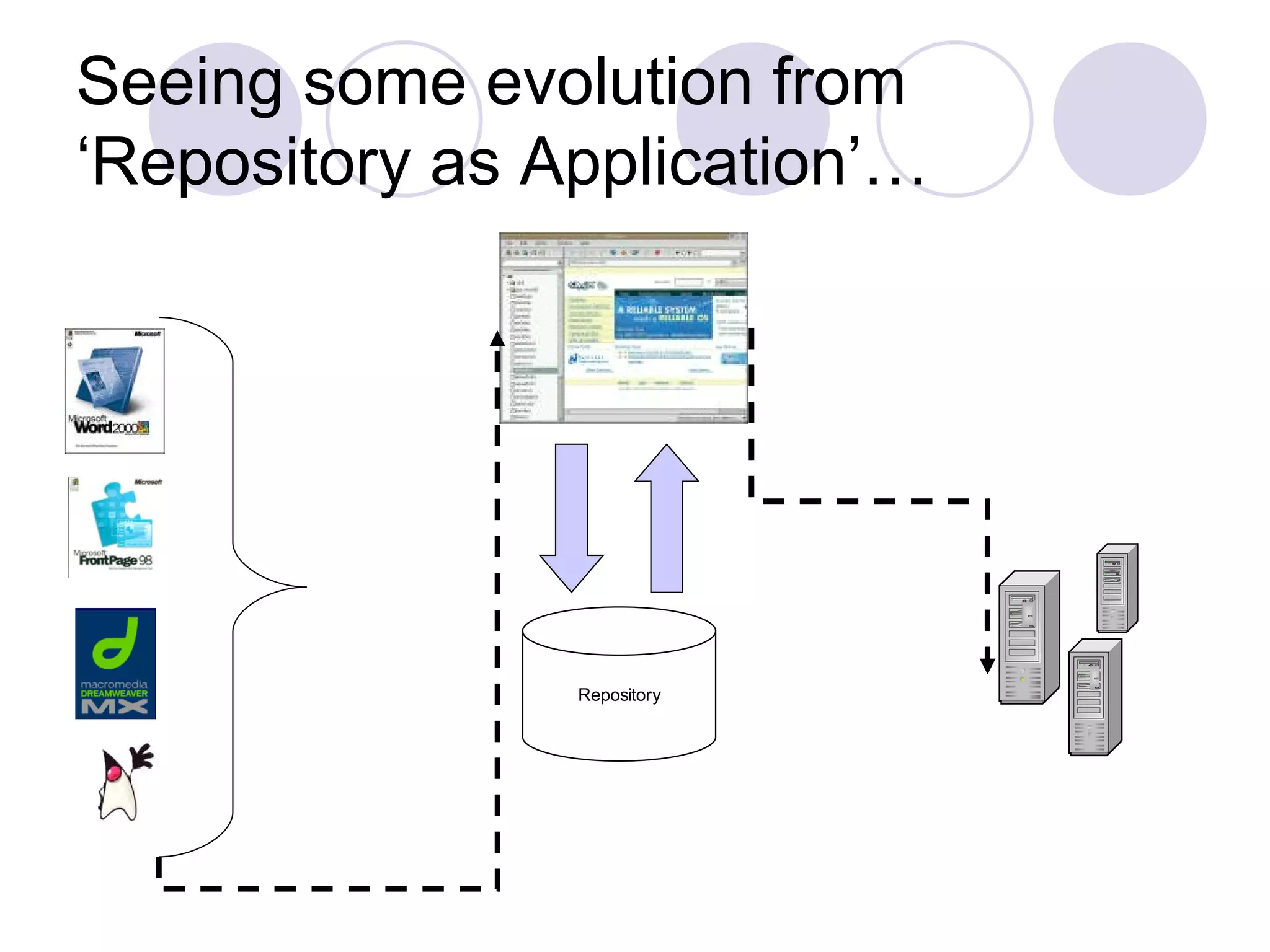
Seeing some evolution from ‘Repository as Application’…
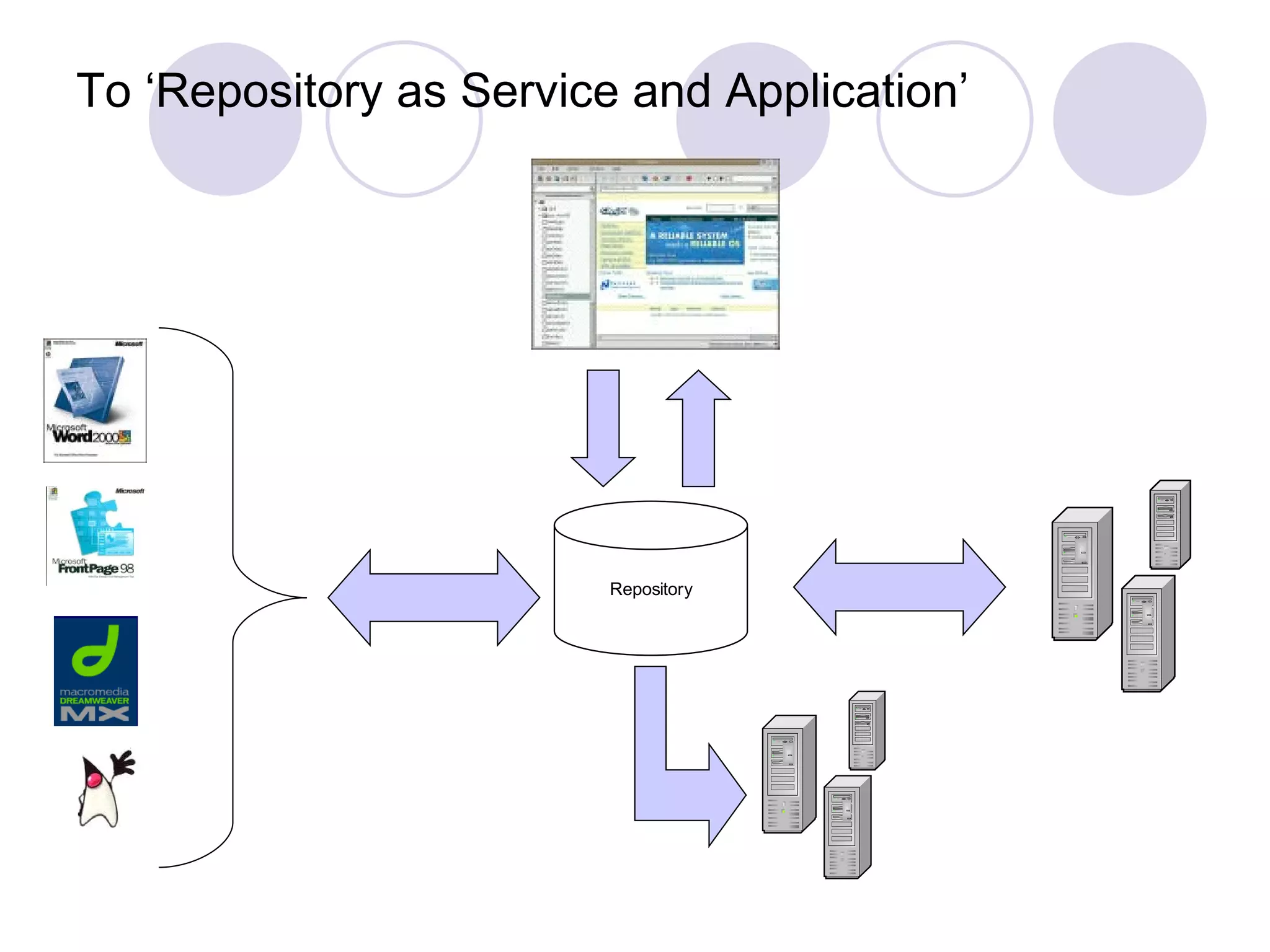
To ‘Repository as Service and Application’
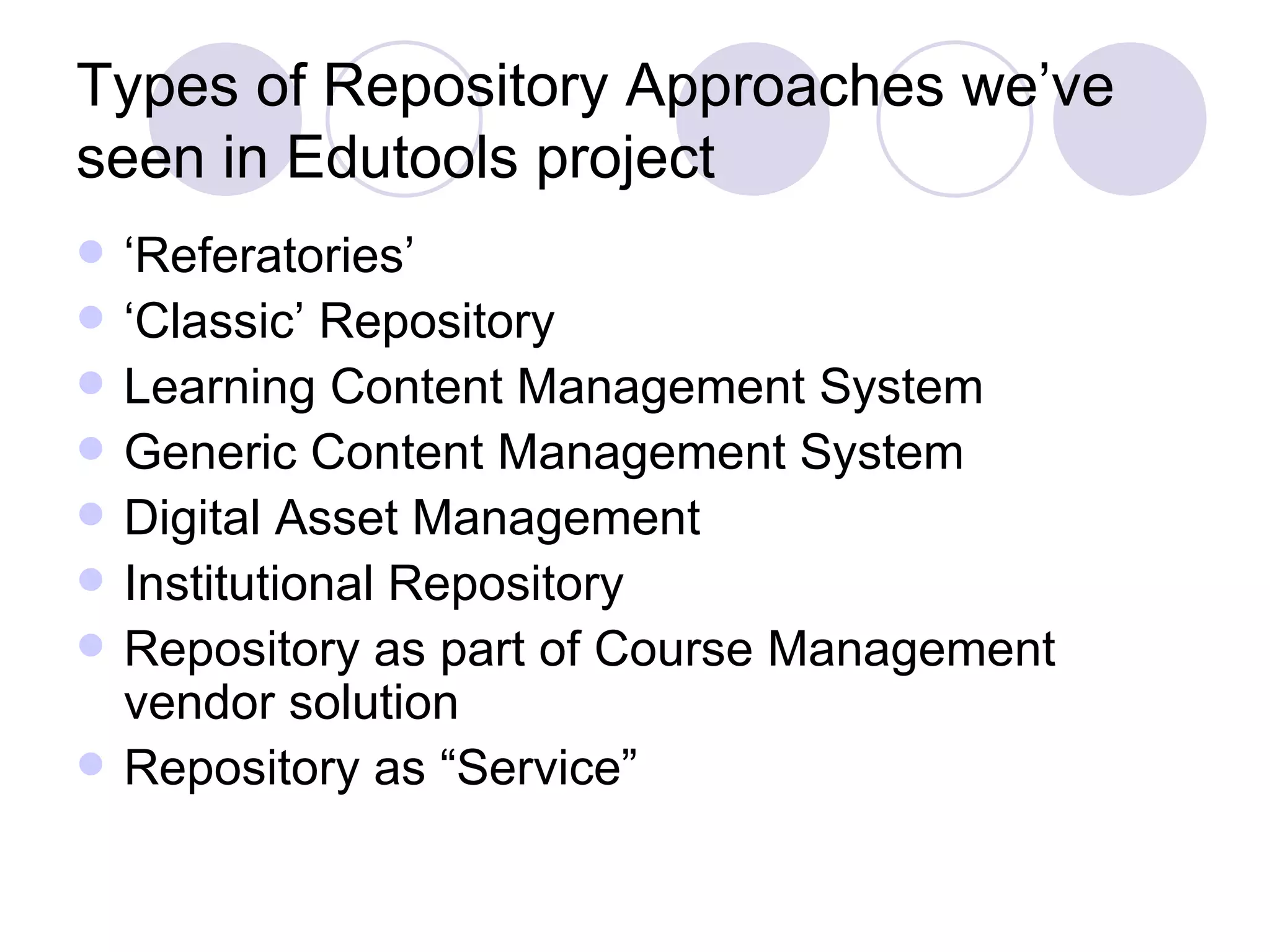
Types of Repository Approaches we’ve seen in Edutools project ‘ Referatories’ ‘ Classic’ Repository Learning Content Management System Generic Content Management System Digital Asset Management Institutional Repository Repository as part of Course Management vendor solution Repository as “Service”
We found that the defining characteristics of these systems, in terms of widespread feature support, were: Support for searching and browsing of records Metatagging tools, and standards-based schema support Support for federation and harvesting  2004
2005, we found that the defining characteristics of these systems, in terms of widespread feature support, were: Support for searching and browsing of records Metatagging tools, and standards-based schema support Support for federation and harvesting More support for content packaging and aggregation, content management Increased support for syndication, and notification
Overall, we found support lacking for the following features across all of the products: Syndication and Notification  Community & Evaluation features (e.g. evaluation system, wish lists and context of usage illustrators)  Time-based Media support  Content Aggregation and Packaging tool  2004
In 2005, generally we found support lacking for the following features across all of the products: Time-based Media support XML Content Supports DRM, specifically Payment and Fulfillment User Profiles
Edutools Research Results More details available at http://www.edutools.info/lor/
BCcampus LOR Project Began as joint project between BCcampus, Open School BC, later joined by Alberta Online Consortium Project began in February 2004 Joint project to select and implement (open source) learning object repository software Project will result in 2 repositories for BC, one for the K-12 system, one within the post-secondary
About the Organizations BCcampus established in 2002 mandate to provide British Columbia learners with a web-based access point to online learning programs and services delivered by the 26 post-secondary institutions themselves OpenSchoolBC (OSBC) provider of K-12 distance educational materials Operating as a managed partnership between the New Westminster SD No. 40 and the Queen's Printer of B.C.
Motivations for Starting the Project BCcampus administer system-wide Online Program Development Fund fund mandates content be shareable with rest of system ‘ BCcommons’ or CreativeCommons license OSBC transition from older print and full course-based models to more atomic ‘learning objects’ both a way to distribute their own content and a service to other K-12 publishers and school boards to share content run as a cost recovery service
Initial search led us to partner with University of Calgary around software named ‘Apollo’.  7 months later, we cancelled our involvement due to the lack of progress in deploying a solution But not all was lost… Project History…
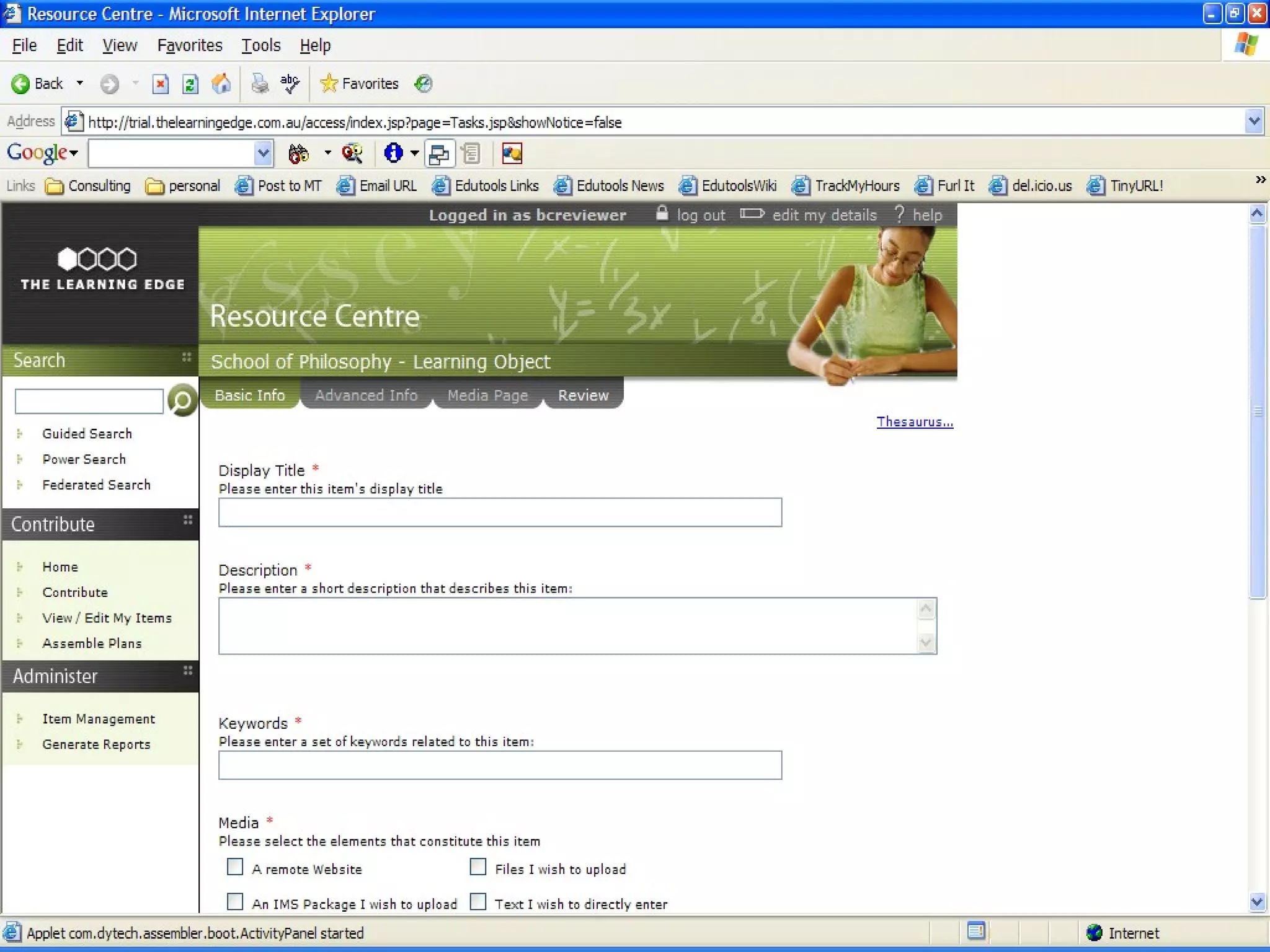
First Phase Outcomes Metadata profiles for both K-12 and Post-secondary sectors were developed Based on Cancore application profiles, with some variations on vocabulary to reflect local needs Workflow pattern established for both K-12 and Post-secondary sectors  Interfaces for both the K-12 and Post-secondary repositories have been prototyped and can easily be implemented on new software
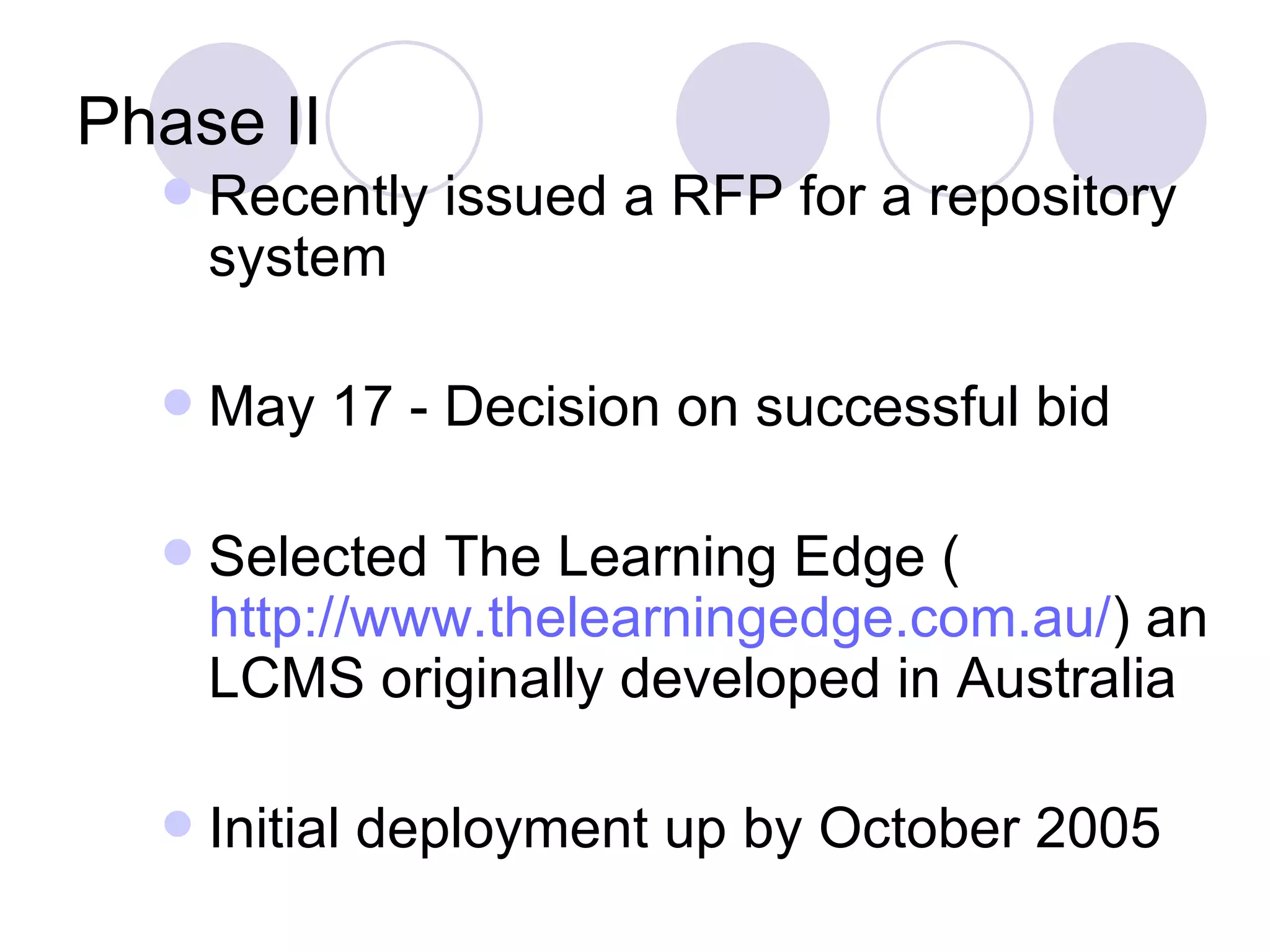
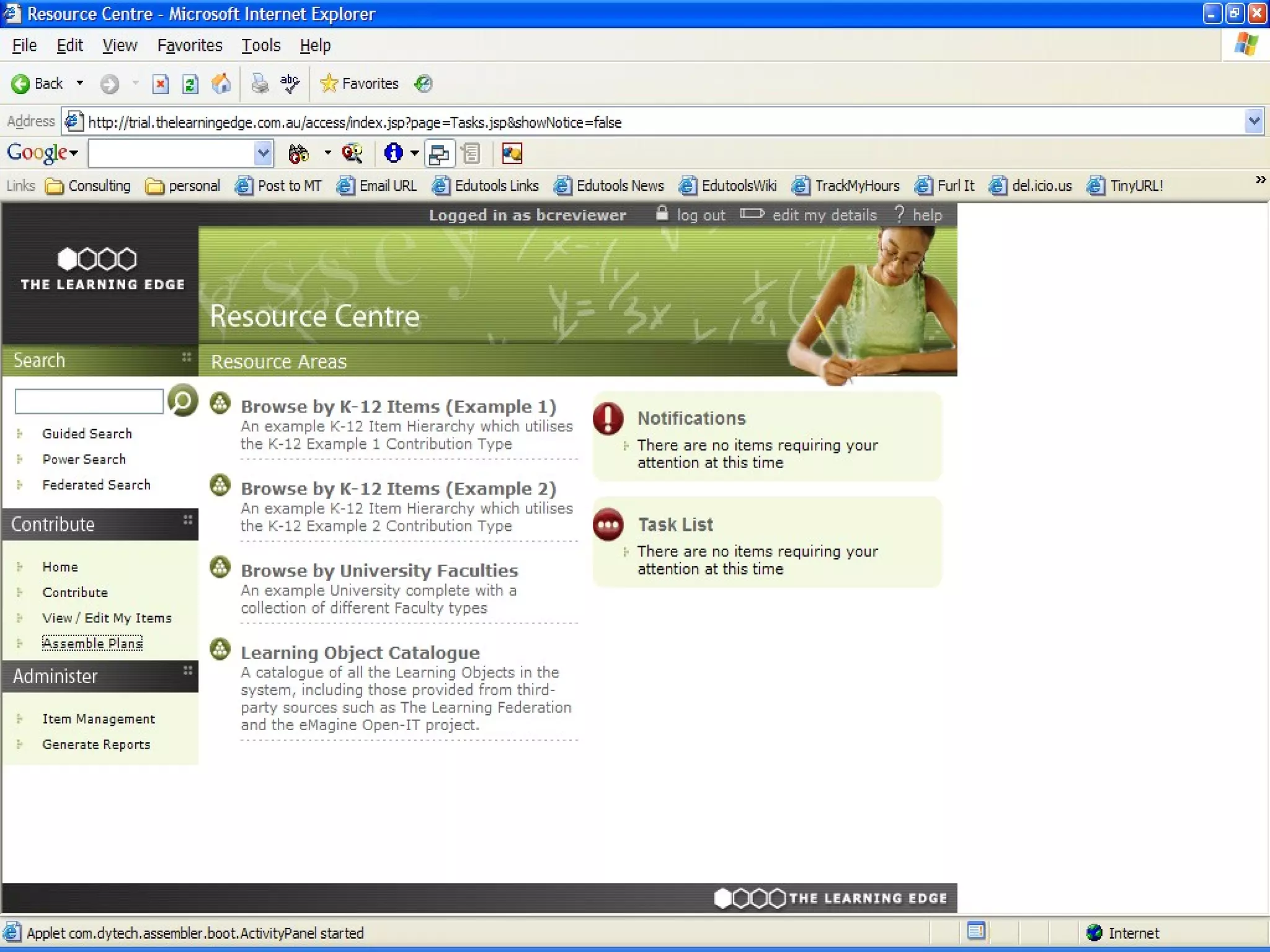
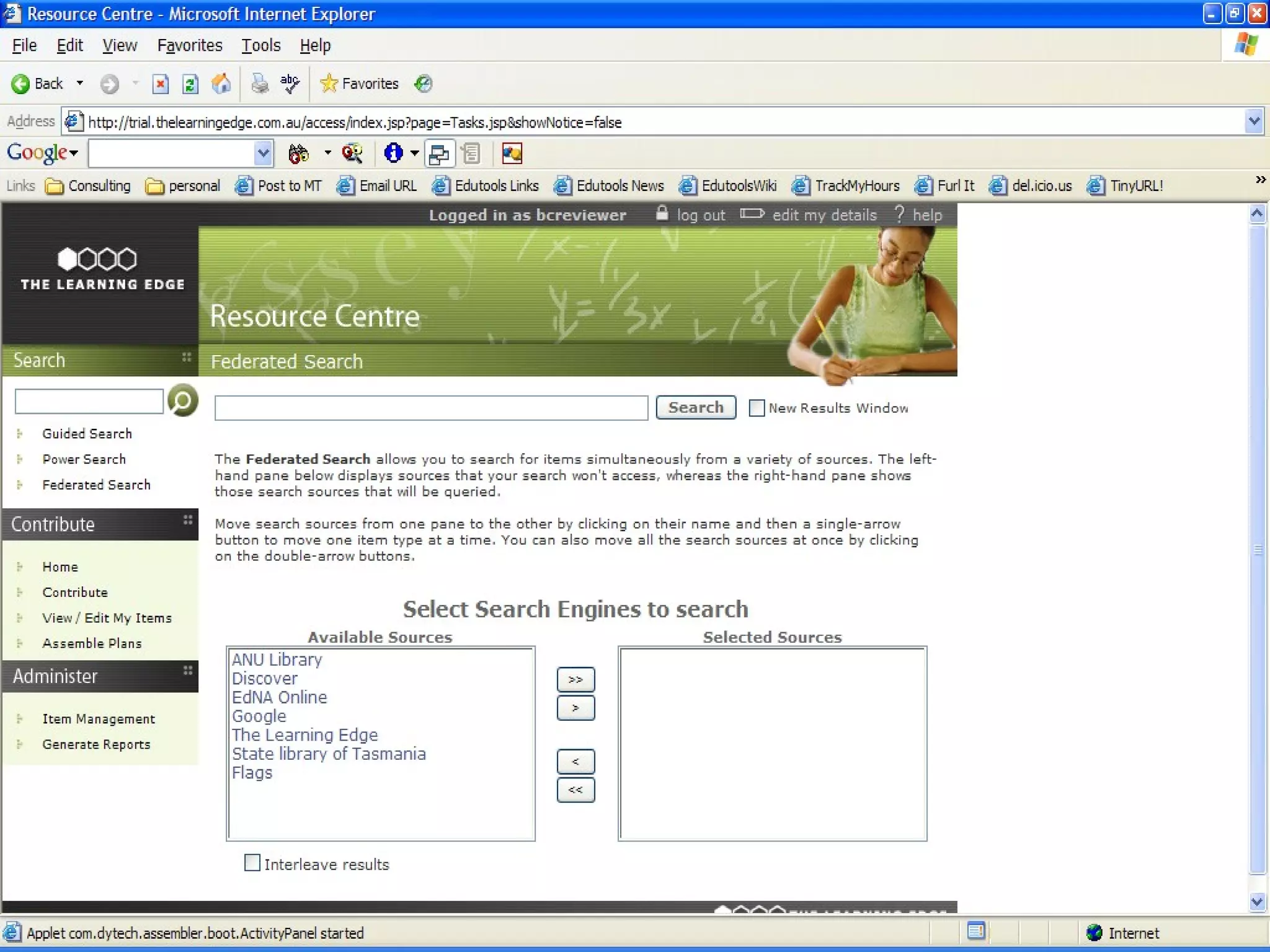
Phase II Recently issued a RFP for a repository system May 17 - Decision on successful bid Selected The Learning Edge ( http://www.thelearningedge.com.au/ ) an LCMS originally developed in Australia Initial deployment up by October 2005
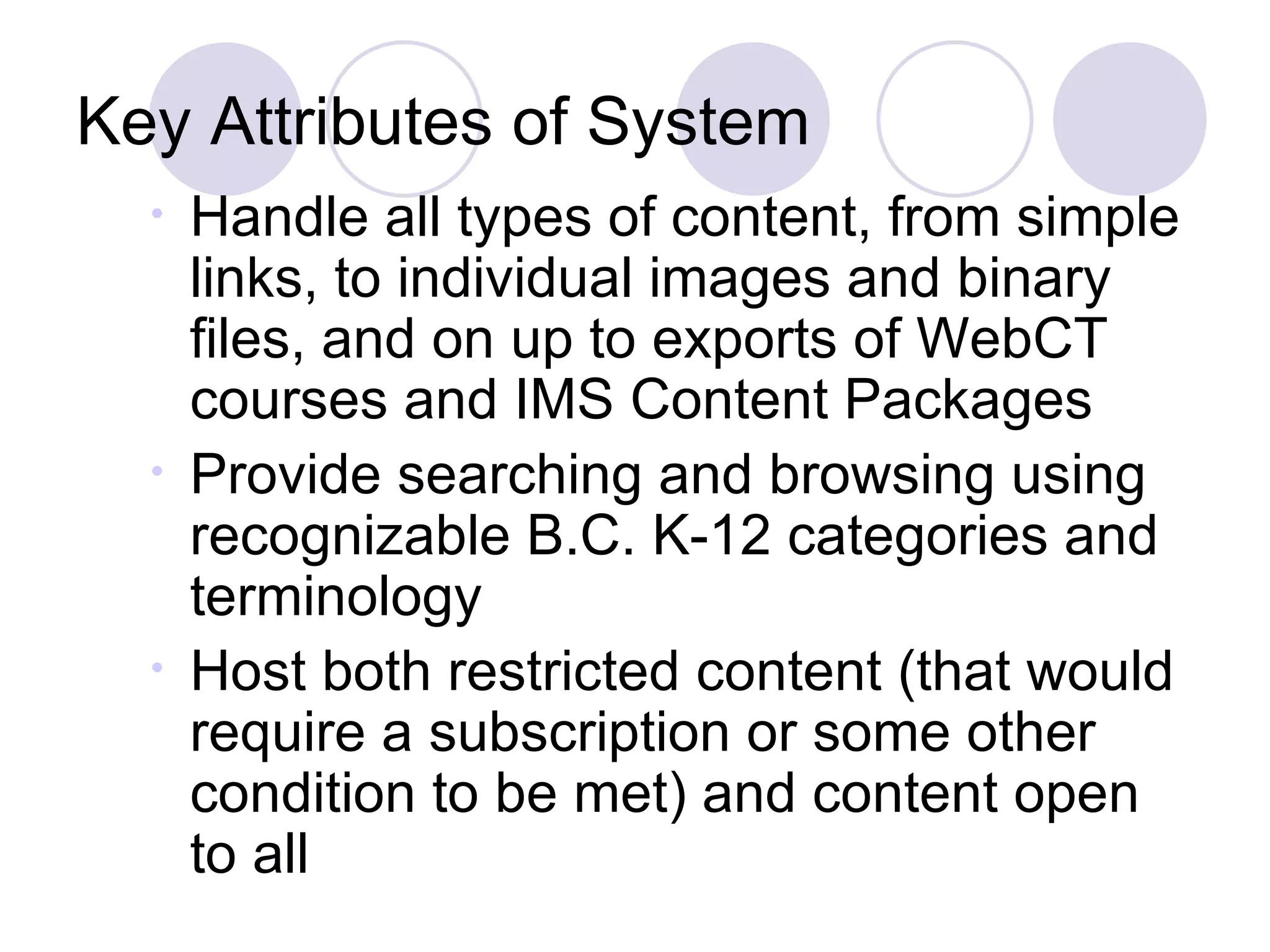
Key Attributes of System Handle all types of content, from simple links, to individual images and binary files, and on up to exports of WebCT courses and IMS Content Packages Provide searching and browsing using recognizable B.C. K-12 categories and terminology Host both restricted content (that would require a subscription or some other condition to be met) and content open to all
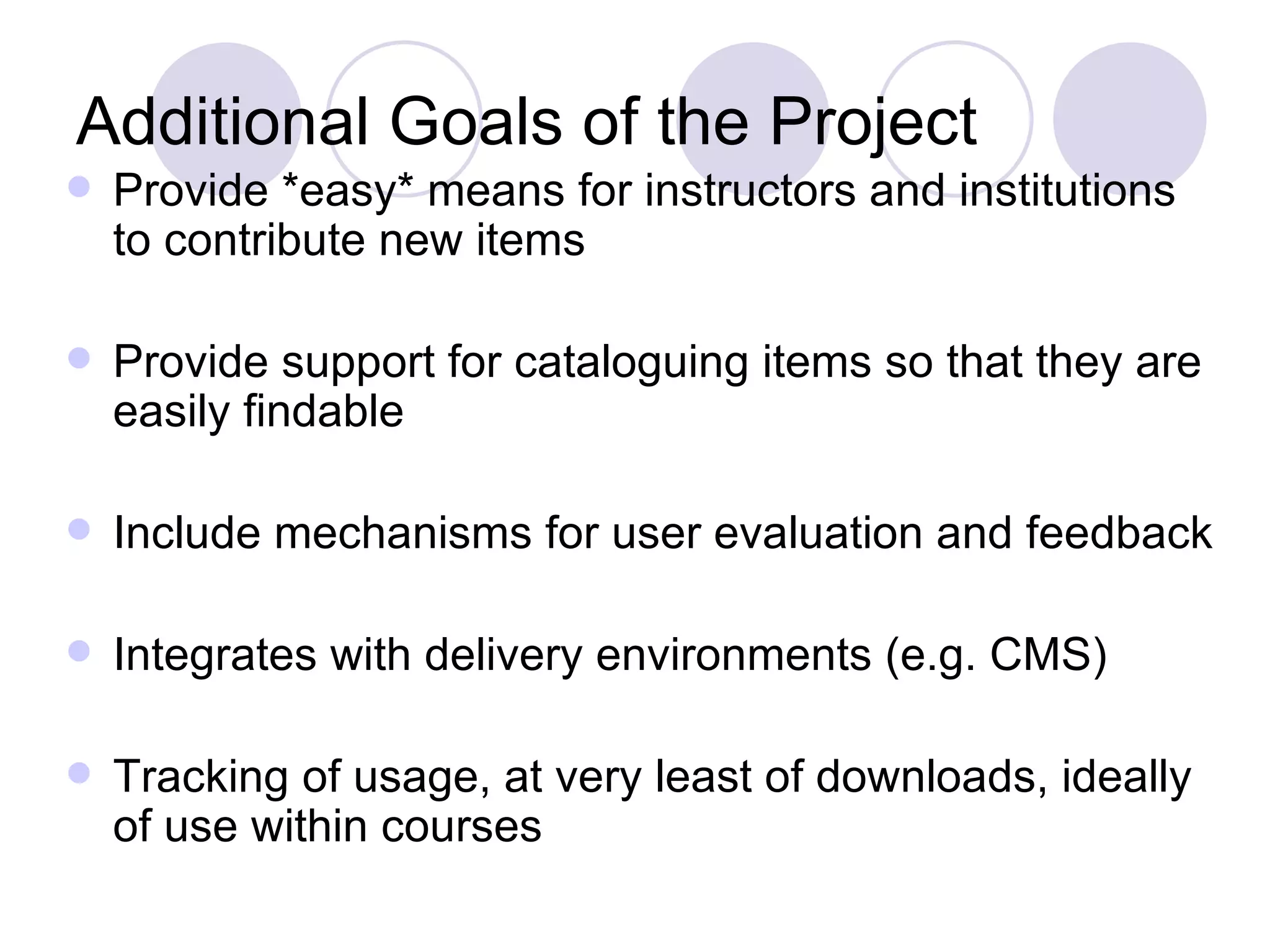
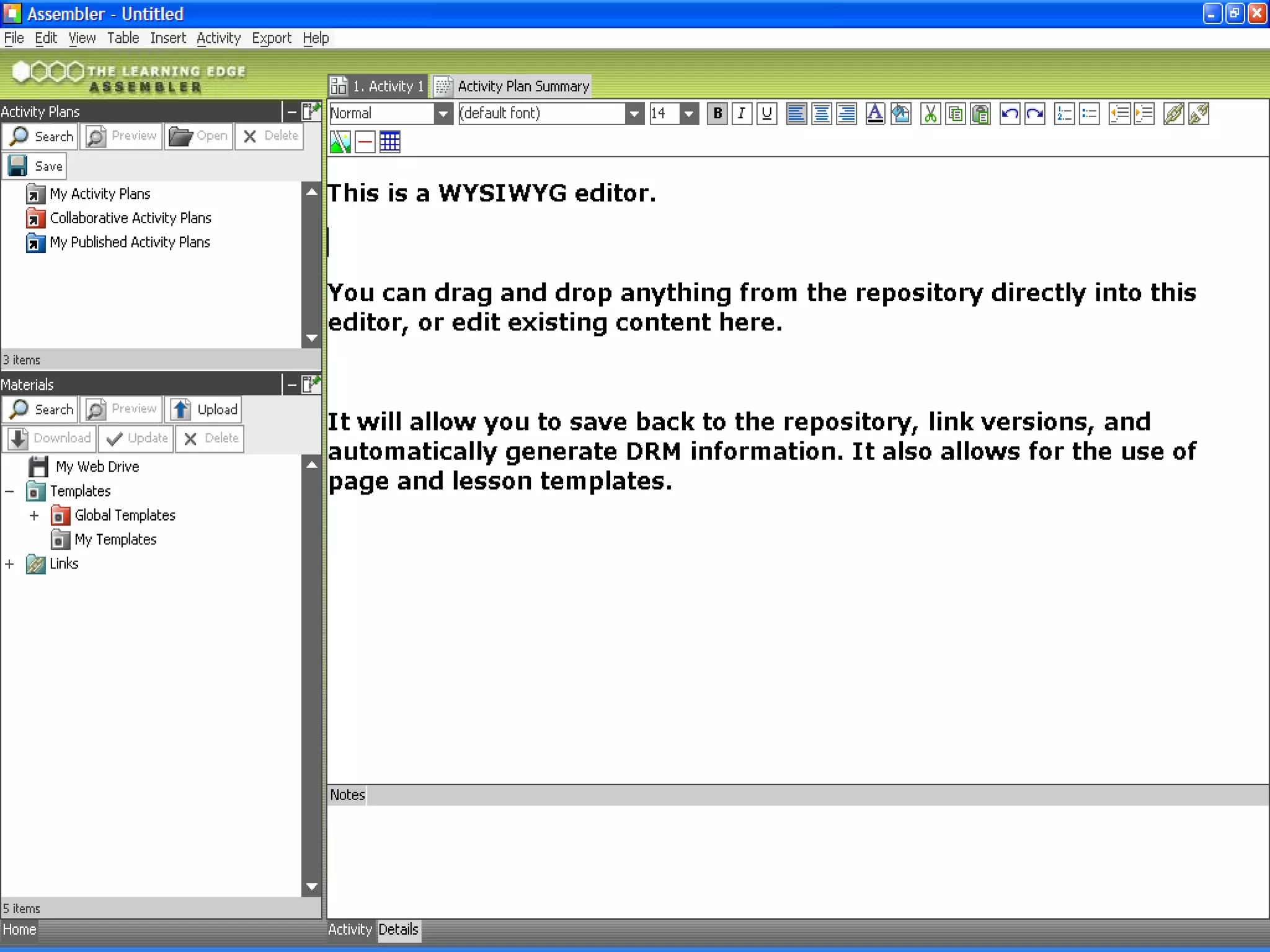
Additional Goals of the Project Provide *easy* means for instructors and institutions to contribute new items Provide support for cataloguing items so that they are easily findable Include mechanisms for user evaluation and feedback Integrates with delivery environments (e.g. CMS) Tracking of usage, at very least of downloads, ideally of use within courses


LOR Characteristics and Considerations

  • 1.
    LOR Overview andBCcampus Initiative Scott Leslie July 28, 2005
  • 2.
    Outline State ofPlay in Repositories Possible approaches and common features BCcampus Repository Initiative
  • 3.
    LO/LORs on theGartner Hype Cycle 2004 We were here
  • 4.
    Maturity of ProblemLORs address LORs still struggling to define precisely the problem that is trying to be solved with them? Is it discovery and sharing of resources? Is it the management of content development? Is it the facilitation of content re-use? Is it the creation of communities of practitioners? Is it the archiving of learning materials? Is it the ingestion and re-composition of complex multimedia objects? All of the above? 2004
  • 5.
    Maturity of ProblemLORs address LORs getting better at defining the problem they are trying to solve Is it discovery and sharing of resources? Is it the management of content development? Is it the facilitation of content re-use? Is it the creation of communities of practitioners? Is it the archiving of learning materials? Is it the ingestion and re-composition of complex multimedia objects? All of the above? 2005
  • 6.
    Maturity of LORMarket The market for learning object repository technology is very immature and has some fundamental risks involved unclear how large a market there will ever be for repository technology vendors are trying to amortize their R&D efforts across too few customers and too short a period leading to hefty licensing prices considering the actual technology involved if the problem is expanded to include the LCMS field, it becomes a broader and deeper market, but pricing for corporate-style LCMS out of line with higher ed expectations and abilities to pay 2004
  • 7.
    LOR Market Maturing…SlowlyWhile the market for learning object repository technology is still quite immature Had a number large RFPs and purchases occur over the last 12 months UNAM system in Mexico – 1million+ seats for Harvest Road Flordia Virtual School System – also Harvest Road JISC JORUM Repository – UK-wide - Intrallect BC/Alberta RFP – The Learning Edge Starting to see some leaders emerge and certain different approaches to sharing/re-use problem (DAM, LCMS, LOR, IR) 2005
  • 8.
    Open Source LORsVery few examples (outside of library world) of open source repository software that has been widely taken up by community of implementers Many initial projects were developed institutionally on soft money and haven’t been transitioned that well to being inclusive ‘open source’ projects 2004
  • 9.
    Open Source LORsStill too few examples of open source repository software that has been widely taken up by community of implementers Lots of the money is drying up/moving on to other areas As problem space gets better understood, people looking to related technologies (Content Mgmt Systems, P2P, referatories, IR) as alternative approaches Large consortial approachs to LORs, where instead of sharing risk through open sourcing, sharing risk through size of project team and initiative 2005
  • 10.
    LO/LORs on theGartner Hype Cycle 2005!
  • 11.
    Some phenomena shapingdirections of LORs Service Oriented Architecture/Approaches Modularization E-Learning Frameworks Course Management Systems Peer-to-Peer Computing ‘Social Software’
  • 12.
    Seeing some evolutionfrom ‘Repository as Application’…
  • 13.
    To ‘Repository asService and Application’
  • 14.
    Types of RepositoryApproaches we’ve seen in Edutools project ‘ Referatories’ ‘ Classic’ Repository Learning Content Management System Generic Content Management System Digital Asset Management Institutional Repository Repository as part of Course Management vendor solution Repository as “Service”
  • 15.
    We found thatthe defining characteristics of these systems, in terms of widespread feature support, were: Support for searching and browsing of records Metatagging tools, and standards-based schema support Support for federation and harvesting 2004
  • 16.
    2005, we foundthat the defining characteristics of these systems, in terms of widespread feature support, were: Support for searching and browsing of records Metatagging tools, and standards-based schema support Support for federation and harvesting More support for content packaging and aggregation, content management Increased support for syndication, and notification
  • 17.
    Overall, we foundsupport lacking for the following features across all of the products: Syndication and Notification Community & Evaluation features (e.g. evaluation system, wish lists and context of usage illustrators) Time-based Media support Content Aggregation and Packaging tool 2004
  • 18.
    In 2005, generallywe found support lacking for the following features across all of the products: Time-based Media support XML Content Supports DRM, specifically Payment and Fulfillment User Profiles
  • 19.
    Edutools Research ResultsMore details available at http://www.edutools.info/lor/
  • 20.
    BCcampus LOR ProjectBegan as joint project between BCcampus, Open School BC, later joined by Alberta Online Consortium Project began in February 2004 Joint project to select and implement (open source) learning object repository software Project will result in 2 repositories for BC, one for the K-12 system, one within the post-secondary
  • 21.
    About the OrganizationsBCcampus established in 2002 mandate to provide British Columbia learners with a web-based access point to online learning programs and services delivered by the 26 post-secondary institutions themselves OpenSchoolBC (OSBC) provider of K-12 distance educational materials Operating as a managed partnership between the New Westminster SD No. 40 and the Queen's Printer of B.C.
  • 22.
    Motivations for Startingthe Project BCcampus administer system-wide Online Program Development Fund fund mandates content be shareable with rest of system ‘ BCcommons’ or CreativeCommons license OSBC transition from older print and full course-based models to more atomic ‘learning objects’ both a way to distribute their own content and a service to other K-12 publishers and school boards to share content run as a cost recovery service
  • 23.
    Initial search ledus to partner with University of Calgary around software named ‘Apollo’. 7 months later, we cancelled our involvement due to the lack of progress in deploying a solution But not all was lost… Project History…
  • 24.
    First Phase OutcomesMetadata profiles for both K-12 and Post-secondary sectors were developed Based on Cancore application profiles, with some variations on vocabulary to reflect local needs Workflow pattern established for both K-12 and Post-secondary sectors Interfaces for both the K-12 and Post-secondary repositories have been prototyped and can easily be implemented on new software
  • 25.
    Phase II Recentlyissued a RFP for a repository system May 17 - Decision on successful bid Selected The Learning Edge ( http://www.thelearningedge.com.au/ ) an LCMS originally developed in Australia Initial deployment up by October 2005
  • 26.
    Key Attributes ofSystem Handle all types of content, from simple links, to individual images and binary files, and on up to exports of WebCT courses and IMS Content Packages Provide searching and browsing using recognizable B.C. K-12 categories and terminology Host both restricted content (that would require a subscription or some other condition to be met) and content open to all
  • 27.
    Additional Goals ofthe Project Provide *easy* means for instructors and institutions to contribute new items Provide support for cataloguing items so that they are easily findable Include mechanisms for user evaluation and feedback Integrates with delivery environments (e.g. CMS) Tracking of usage, at very least of downloads, ideally of use within courses
  • 28.
  • 29.
  • 30.
  • 31.