
BUILDING YOUR ADAPTIVE MODEL
Setting Goals Using the Adaptive Content Maturity Model
Don Day, Learning by Wrote
& Jenny Magic, Raise Your Hand Texas
@DonRDay @JennyLMagic
@DonRDay • @JennyLMagic • #intelcontent
AGENDA
1. Adaptive Content Definitions
2. Milestones and Metrics
3. Adaptive Content Maturity Model
@DonRDay • @JennyLMagic • #intelcontent
1 Defining Adaptive Content
@DonRDay • @JennyLMagic • #intelcontent
ADAPTIVE CONTENT IS
INTELLIGENT CONTENT
APPLIED TO USER GOALS
@DonRDay • @JennyLMagic • #intelcontent
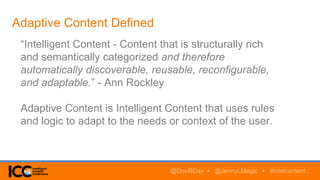
Adaptive Content Defined
“Intelligent Content - Content that is structurally rich
and semantically categorized and therefore
automatically discoverable, reusable, reconfigurable,
and adaptable.” - Ann Rockley
Adaptive Content is Intelligent Content that uses rules
and logic to adapt to the needs or context of the user.
@DonRDay • @JennyLMagic • #intelcontent
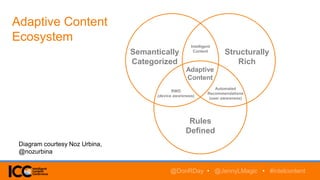
Adaptive Content
Ecosystem
Semantically
Categorized
Structurally
Rich
Rules
Defined
Intelligent
Content
Adaptive
Content
RWD
(device awareness)
Automated
Recommendations
(user awareness)
@DonRDay • @JennyLMagic • #intelcontent
Diagram courtesy Noz Urbina,
@nozurbina
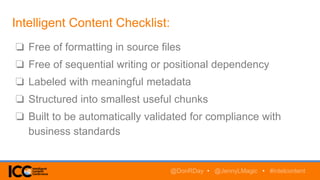
Intelligent Content Checklist:
@DonRDay • @JennyLMagic • #intelcontent
❏ Free of formatting in source files
❏ Free of sequential writing or positional dependency
❏ Labeled with meaningful metadata
❏ Structured into smallest useful chunks
❏ Built to be automatically validated for compliance with
business standards
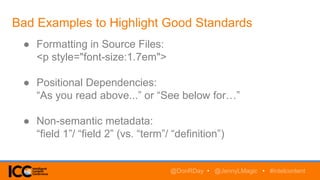
Bad Examples to Highlight Good Standards
@DonRDay • @JennyLMagic • #intelcontent
● Formatting in Source Files:
<p style="font-size:1.7em">
● Positional Dependencies:
“As you read above...” or “See below for…”
● Non-semantic metadata:
“field 1”/ “field 2” (vs. “term”/ “definition”)
ADAPTIVE CONTENT
IS THE HEART OF
HUMAN-CENTERED SYSTEMS
@DonRDay • @JennyLMagic • #intelcontent
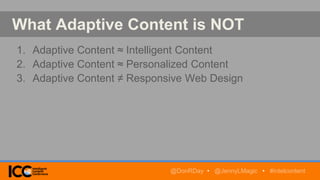
What Adaptive Content is NOT
1. Adaptive Content ≈ Intelligent Content
2. Adaptive Content ≈ Personalized Content
3. Adaptive Content ≠ Responsive Web Design
@DonRDay • @JennyLMagic • #intelcontent
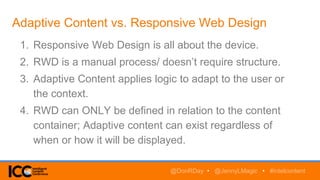
Adaptive Content vs. Responsive Web Design
1. Responsive Web Design is all about the device.
2. RWD is a manual process/ doesn’t require structure.
3. Adaptive Content applies logic to adapt to the user or
the context.
4. RWD can ONLY be defined in relation to the content
container; Adaptive content can exist regardless of
when or how it will be displayed.
@DonRDay • @JennyLMagic • #intelcontent
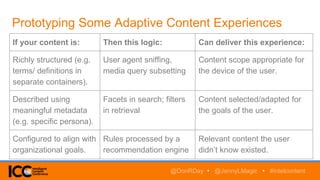
Prototyping Some Adaptive Content Experiences
@DonRDay • @JennyLMagic • #intelcontent
If your content is: Then this logic: Can deliver this experience:
Richly structured (e.g.
terms/ definitions in
separate containers).
User agent sniffing,
media query subsetting
Content scope appropriate for
the device of the user.
Described using
meaningful metadata
(e.g. specific persona).
Facets in search; filters
in retrieval
Content selected/adapted for
the goals of the user.
Configured to align with
organizational goals.
Rules processed by a
recommendation engine
Relevant content the user
didn’t know existed.
Benefits
Intelligent, Adaptive Content:
● Is future-proofed for uses and devices yet to be invented
● Is a business asset, rather than a storage nightmare
● Can become an archive for business knowledge and
culture
● Broadens the definition of personalization
● Adds scope and handles for adaptive, customized use
@DonRDay • @JennyLMagic • #intelcontent
STEPS TO ADAPTIVE CONTENT
1. Define the Content Strategy
2. Define the Rules
3. Build the Adaptive System
@DonRDay • @JennyLMagic • #intelcontent
Define the Content Strategy
1. Identify business goals and define content pathways
and patterns.
2. Model the information types and their relationships to
each other and user goals.
@DonRDay • @JennyLMagic • #intelcontent
Define the Rules
1. Express those requirements as reusable instructions
(i.e., guidelines, business rules, or schemas).
2. Apply documented requirements to both content and
business workflows.
@DonRDay • @JennyLMagic • #intelcontent
Build the Adaptive System
● Message the new goals to the organization and to
stakeholders.
● Train the writers and programmers as needed.
● Create/migrate content needed to drive adaptive
processing.
● Build/buy the logic that implements those rules.
@DonRDay • @JennyLMagic • #intelcontent
2 Adaptive Content Maturity Model
@DonRDay • @JennyLMagic • #intelcontent
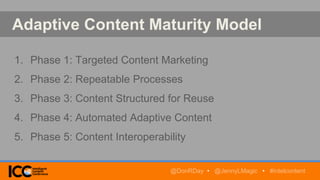
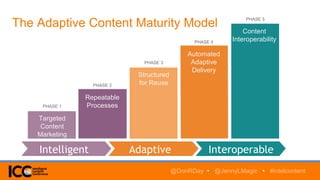
Adaptive Content Maturity Model
1. Phase 1: Targeted Content Marketing
2. Phase 2: Repeatable Processes
3. Phase 3: Content Structured for Reuse
4. Phase 4: Automated Adaptive Content
5. Phase 5: Content Interoperability
@DonRDay • @JennyLMagic • #intelcontent
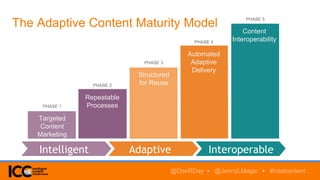
The Adaptive Content Maturity Model
@DonRDay • @JennyLMagic • #intelcontent
Intelligent Adaptive Interoperable
Targeted
Content
Marketing
Automated
Adaptive
Delivery
Structured
for Reuse
Repeatable
ProcessesPHASE 1
PHASE 2
PHASE 3
PHASE 4
PHASE 5
Content
Interoperability
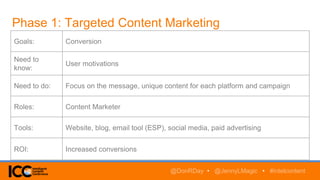
Phase 1: Targeted Content Marketing
Goals: Conversion
Need to
know:
User motivations
Need to do: Focus on the message, unique content for each platform and campaign
Roles: Content Marketer
Tools: Website, blog, email tool (ESP), social media, paid advertising
ROI: Increased conversions
@DonRDay • @JennyLMagic • #intelcontent
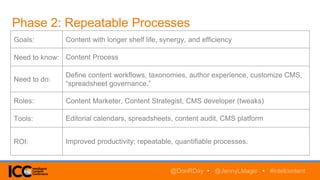
Phase 2: Repeatable Processes
Goals: Content with longer shelf life, synergy, and efficiency
Need to know: Content Process
Need to do:
Define content workflows, taxonomies, author experience, customize CMS,
“spreadsheet governance.”
Roles: Content Marketer, Content Strategist, CMS developer (tweaks)
Tools: Editorial calendars, spreadsheets, content audit, CMS platform
ROI: Improved productivity; repeatable, quantifiable processes.
@DonRDay • @JennyLMagic • #intelcontent
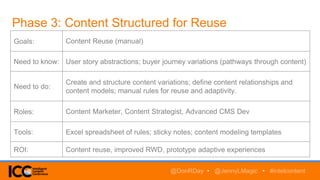
Phase 3: Content Structured for Reuse
Goals: Content Reuse (manual)
Need to know: User story abstractions; buyer journey variations (pathways through content)
Need to do:
Create and structure content variations; define content relationships and
content models; manual rules for reuse and adaptivity.
Roles: Content Marketer, Content Strategist, Advanced CMS Dev
Tools: Excel spreadsheet of rules; sticky notes; content modeling templates
ROI: Content reuse, improved RWD, prototype adaptive experiences
@DonRDay • @JennyLMagic • #intelcontent
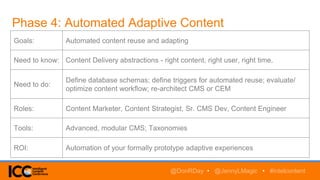
Phase 4: Automated Adaptive Content
Goals: Automated content reuse and adapting
Need to know: Content Delivery abstractions - right content, right user, right time.
Need to do:
Define database schemas; define triggers for automated reuse; evaluate/
optimize content workflow; re-architect CMS or CEM
Roles: Content Marketer, Content Strategist, Sr. CMS Dev, Content Engineer
Tools: Advanced, modular CMS; Taxonomies
ROI: Automation of your formally prototype adaptive experiences
@DonRDay • @JennyLMagic • #intelcontent
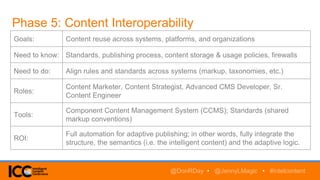
Phase 5: Content Interoperability
Goals: Content reuse across systems, platforms, and organizations
Need to know: Standards, publishing process, content storage & usage policies, firewalls
Need to do: Align rules and standards across systems (markup, taxonomies, etc.)
Roles:
Content Marketer, Content Strategist, Advanced CMS Developer, Sr.
Content Engineer
Tools:
Component Content Management System (CCMS); Standards (shared
markup conventions)
ROI:
Full automation for adaptive publishing; in other words, fully integrate the
structure, the semantics (i.e. the intelligent content) and the adaptive logic.
@DonRDay • @JennyLMagic • #intelcontent
The Adaptive Content Maturity Model
@DonRDay • @JennyLMagic • #intelcontent
Content
Interoperability
Intelligent Adaptive Interoperable
Targeted
Content
Marketing
Automated
Adaptive
Delivery
Structured
for Reuse
Repeatable
ProcessesPHASE 1
PHASE 2
PHASE 3
PHASE 4
PHASE 5
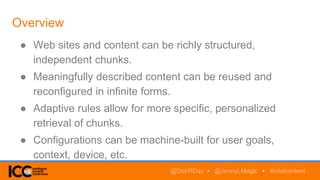
Overview
● Web sites and content can be richly structured,
independent chunks.
● Meaningfully described content can be reused and
reconfigured in infinite forms.
● Adaptive rules allow for more specific, personalized
retrieval of chunks.
● Configurations can be machine-built for user goals,
context, device, etc.
@DonRDay • @JennyLMagic • #intelcontent
Resources
● http://www.intelligentcontentconference.com/mother-of-content-strategy-embraces-content-marketing/
● http://contentmarketinginstitute.com/2015/01/evolution-content-marketing-include-intelligent-content/
● http://www.intelligentcontentconference.com/intelligent-content-elephant-parts/
● http://www.simplea.com/Resources/Choosing-the-Ideal-CMS/
● http://www.clevegibbon.com/content-modeling/
● http://www.slideshare.net/jlemmons/getting-started-with-adaptive-content
● http://www.sarawb.com/2012/12/12/introducing-content-everywhere/
● http://www.thelanguageofcontentstrategy.com/
● http://meetcontent.com/blog/structured-content-an-overview/
● http://www.digitalgov.gov/2013/07/29/how-to-create-open-structured-content/
@DonRDay • @JennyLMagic • #intelcontent
Don Day
Content Solutions Consultant
Learning by Wrote
Jenny Magic
Communications Strategist
Raise Your Hand Texas
@DonRDay • @JennyLMagic • #intelcontent

BUILDING YOUR ADAPTIVE MODEL: Setting Goals Using the Adaptive Content Maturity Model

  • 1.
    BUILDING YOUR ADAPTIVEMODEL Setting Goals Using the Adaptive Content Maturity Model Don Day, Learning by Wrote & Jenny Magic, Raise Your Hand Texas @DonRDay @JennyLMagic @DonRDay • @JennyLMagic • #intelcontent
  • 2.
    AGENDA 1. Adaptive ContentDefinitions 2. Milestones and Metrics 3. Adaptive Content Maturity Model @DonRDay • @JennyLMagic • #intelcontent
  • 3.
    1 Defining AdaptiveContent @DonRDay • @JennyLMagic • #intelcontent
  • 4.
    ADAPTIVE CONTENT IS INTELLIGENTCONTENT APPLIED TO USER GOALS @DonRDay • @JennyLMagic • #intelcontent
  • 5.
    Adaptive Content Defined “IntelligentContent - Content that is structurally rich and semantically categorized and therefore automatically discoverable, reusable, reconfigurable, and adaptable.” - Ann Rockley Adaptive Content is Intelligent Content that uses rules and logic to adapt to the needs or context of the user. @DonRDay • @JennyLMagic • #intelcontent
  • 6.
  • 7.
    Intelligent Content Checklist: @DonRDay• @JennyLMagic • #intelcontent ❏ Free of formatting in source files ❏ Free of sequential writing or positional dependency ❏ Labeled with meaningful metadata ❏ Structured into smallest useful chunks ❏ Built to be automatically validated for compliance with business standards
  • 8.
    Bad Examples toHighlight Good Standards @DonRDay • @JennyLMagic • #intelcontent ● Formatting in Source Files: <p style="font-size:1.7em"> ● Positional Dependencies: “As you read above...” or “See below for…” ● Non-semantic metadata: “field 1”/ “field 2” (vs. “term”/ “definition”)
  • 9.
    ADAPTIVE CONTENT IS THEHEART OF HUMAN-CENTERED SYSTEMS @DonRDay • @JennyLMagic • #intelcontent
  • 10.
    What Adaptive Contentis NOT 1. Adaptive Content ≈ Intelligent Content 2. Adaptive Content ≈ Personalized Content 3. Adaptive Content ≠ Responsive Web Design @DonRDay • @JennyLMagic • #intelcontent
  • 11.
    Adaptive Content vs.Responsive Web Design 1. Responsive Web Design is all about the device. 2. RWD is a manual process/ doesn’t require structure. 3. Adaptive Content applies logic to adapt to the user or the context. 4. RWD can ONLY be defined in relation to the content container; Adaptive content can exist regardless of when or how it will be displayed. @DonRDay • @JennyLMagic • #intelcontent
  • 12.
    Prototyping Some AdaptiveContent Experiences @DonRDay • @JennyLMagic • #intelcontent If your content is: Then this logic: Can deliver this experience: Richly structured (e.g. terms/ definitions in separate containers). User agent sniffing, media query subsetting Content scope appropriate for the device of the user. Described using meaningful metadata (e.g. specific persona). Facets in search; filters in retrieval Content selected/adapted for the goals of the user. Configured to align with organizational goals. Rules processed by a recommendation engine Relevant content the user didn’t know existed.
  • 13.
    Benefits Intelligent, Adaptive Content: ●Is future-proofed for uses and devices yet to be invented ● Is a business asset, rather than a storage nightmare ● Can become an archive for business knowledge and culture ● Broadens the definition of personalization ● Adds scope and handles for adaptive, customized use @DonRDay • @JennyLMagic • #intelcontent
  • 14.
    STEPS TO ADAPTIVECONTENT 1. Define the Content Strategy 2. Define the Rules 3. Build the Adaptive System @DonRDay • @JennyLMagic • #intelcontent
  • 15.
    Define the ContentStrategy 1. Identify business goals and define content pathways and patterns. 2. Model the information types and their relationships to each other and user goals. @DonRDay • @JennyLMagic • #intelcontent
  • 16.
    Define the Rules 1.Express those requirements as reusable instructions (i.e., guidelines, business rules, or schemas). 2. Apply documented requirements to both content and business workflows. @DonRDay • @JennyLMagic • #intelcontent
  • 17.
    Build the AdaptiveSystem ● Message the new goals to the organization and to stakeholders. ● Train the writers and programmers as needed. ● Create/migrate content needed to drive adaptive processing. ● Build/buy the logic that implements those rules. @DonRDay • @JennyLMagic • #intelcontent
  • 18.
    2 Adaptive ContentMaturity Model @DonRDay • @JennyLMagic • #intelcontent
  • 19.
    Adaptive Content MaturityModel 1. Phase 1: Targeted Content Marketing 2. Phase 2: Repeatable Processes 3. Phase 3: Content Structured for Reuse 4. Phase 4: Automated Adaptive Content 5. Phase 5: Content Interoperability @DonRDay • @JennyLMagic • #intelcontent
  • 20.
    The Adaptive ContentMaturity Model @DonRDay • @JennyLMagic • #intelcontent Intelligent Adaptive Interoperable Targeted Content Marketing Automated Adaptive Delivery Structured for Reuse Repeatable ProcessesPHASE 1 PHASE 2 PHASE 3 PHASE 4 PHASE 5 Content Interoperability
  • 21.
    Phase 1: TargetedContent Marketing Goals: Conversion Need to know: User motivations Need to do: Focus on the message, unique content for each platform and campaign Roles: Content Marketer Tools: Website, blog, email tool (ESP), social media, paid advertising ROI: Increased conversions @DonRDay • @JennyLMagic • #intelcontent
  • 22.
    Phase 2: RepeatableProcesses Goals: Content with longer shelf life, synergy, and efficiency Need to know: Content Process Need to do: Define content workflows, taxonomies, author experience, customize CMS, “spreadsheet governance.” Roles: Content Marketer, Content Strategist, CMS developer (tweaks) Tools: Editorial calendars, spreadsheets, content audit, CMS platform ROI: Improved productivity; repeatable, quantifiable processes. @DonRDay • @JennyLMagic • #intelcontent
  • 23.
    Phase 3: ContentStructured for Reuse Goals: Content Reuse (manual) Need to know: User story abstractions; buyer journey variations (pathways through content) Need to do: Create and structure content variations; define content relationships and content models; manual rules for reuse and adaptivity. Roles: Content Marketer, Content Strategist, Advanced CMS Dev Tools: Excel spreadsheet of rules; sticky notes; content modeling templates ROI: Content reuse, improved RWD, prototype adaptive experiences @DonRDay • @JennyLMagic • #intelcontent
  • 24.
    Phase 4: AutomatedAdaptive Content Goals: Automated content reuse and adapting Need to know: Content Delivery abstractions - right content, right user, right time. Need to do: Define database schemas; define triggers for automated reuse; evaluate/ optimize content workflow; re-architect CMS or CEM Roles: Content Marketer, Content Strategist, Sr. CMS Dev, Content Engineer Tools: Advanced, modular CMS; Taxonomies ROI: Automation of your formally prototype adaptive experiences @DonRDay • @JennyLMagic • #intelcontent
  • 25.
    Phase 5: ContentInteroperability Goals: Content reuse across systems, platforms, and organizations Need to know: Standards, publishing process, content storage & usage policies, firewalls Need to do: Align rules and standards across systems (markup, taxonomies, etc.) Roles: Content Marketer, Content Strategist, Advanced CMS Developer, Sr. Content Engineer Tools: Component Content Management System (CCMS); Standards (shared markup conventions) ROI: Full automation for adaptive publishing; in other words, fully integrate the structure, the semantics (i.e. the intelligent content) and the adaptive logic. @DonRDay • @JennyLMagic • #intelcontent
  • 26.
    The Adaptive ContentMaturity Model @DonRDay • @JennyLMagic • #intelcontent Content Interoperability Intelligent Adaptive Interoperable Targeted Content Marketing Automated Adaptive Delivery Structured for Reuse Repeatable ProcessesPHASE 1 PHASE 2 PHASE 3 PHASE 4 PHASE 5
  • 27.
    Overview ● Web sitesand content can be richly structured, independent chunks. ● Meaningfully described content can be reused and reconfigured in infinite forms. ● Adaptive rules allow for more specific, personalized retrieval of chunks. ● Configurations can be machine-built for user goals, context, device, etc. @DonRDay • @JennyLMagic • #intelcontent
  • 28.
    Resources ● http://www.intelligentcontentconference.com/mother-of-content-strategy-embraces-content-marketing/ ● http://contentmarketinginstitute.com/2015/01/evolution-content-marketing-include-intelligent-content/ ●http://www.intelligentcontentconference.com/intelligent-content-elephant-parts/ ● http://www.simplea.com/Resources/Choosing-the-Ideal-CMS/ ● http://www.clevegibbon.com/content-modeling/ ● http://www.slideshare.net/jlemmons/getting-started-with-adaptive-content ● http://www.sarawb.com/2012/12/12/introducing-content-everywhere/ ● http://www.thelanguageofcontentstrategy.com/ ● http://meetcontent.com/blog/structured-content-an-overview/ ● http://www.digitalgov.gov/2013/07/29/how-to-create-open-structured-content/ @DonRDay • @JennyLMagic • #intelcontent
  • 29.
    Don Day Content SolutionsConsultant Learning by Wrote Jenny Magic Communications Strategist Raise Your Hand Texas @DonRDay • @JennyLMagic • #intelcontent