Sunday, September 7th
, 2008
SPACE
Day/Night and Seasons
Day and Night
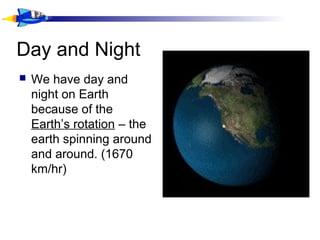
 We have day and
night on Earth
because of the
Earth’s rotation – the
earth spinning around
and around. (1670
km/hr)
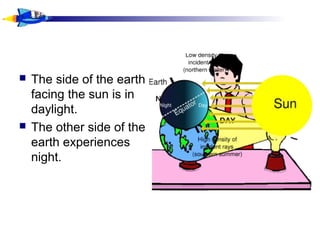
 The side of the earth
facing the sun is in
daylight.
 The other side of the
earth experiences
night.
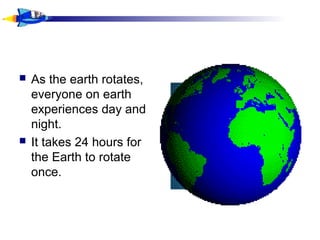
 As the earth rotates,
everyone on earth
experiences day and
night.
 It takes 24 hours for
the Earth to rotate
once.
Seasons
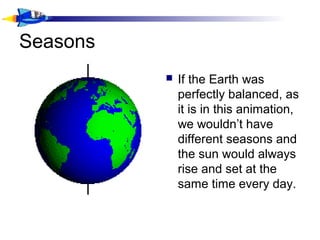
 If the Earth was
perfectly balanced, as
it is in this animation,
we wouldn’t have
different seasons and
the sun would always
rise and set at the
same time every day.
Seasons
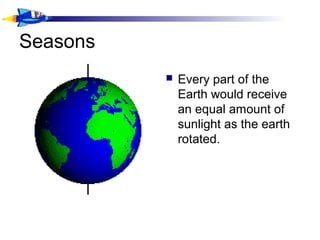
 Every part of the
Earth would receive
an equal amount of
sunlight as the earth
rotated.
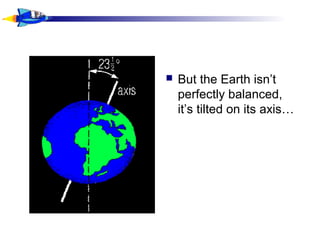
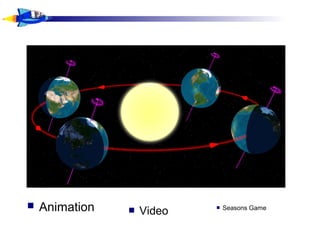
 But the Earth isn’t
perfectly balanced,
it’s tilted on its axis…
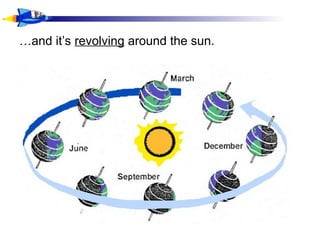
…and it’s revolving around the sun.
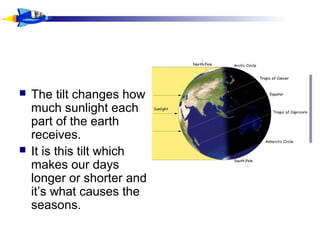
 The tilt changes how
much sunlight each
part of the earth
receives.
 It is this tilt which
makes our days
longer or shorter and
it’s what causes the
seasons.
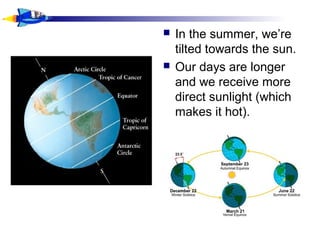
 In the summer, we’re
tilted towards the sun.
 Our days are longer
and we receive more
direct sunlight (which
makes it hot).
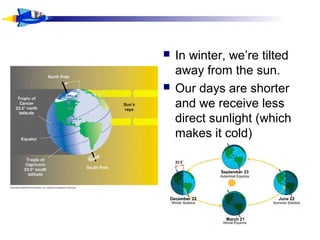
 In winter, we’re tilted
away from the sun.
 Our days are shorter
and we receive less
direct sunlight (which
makes it cold)
 Animation  Video  Seasons Game
Time and movement of earth and
moon around sun
 Animation

Day and night

  • 1.
    Sunday, September 7th ,2008 SPACE Day/Night and Seasons
  • 2.
    Day and Night We have day and night on Earth because of the Earth’s rotation – the earth spinning around and around. (1670 km/hr)
  • 3.
     The sideof the earth facing the sun is in daylight.  The other side of the earth experiences night.
  • 4.
     As theearth rotates, everyone on earth experiences day and night.  It takes 24 hours for the Earth to rotate once.
  • 5.
    Seasons  If theEarth was perfectly balanced, as it is in this animation, we wouldn’t have different seasons and the sun would always rise and set at the same time every day.
  • 6.
    Seasons  Every partof the Earth would receive an equal amount of sunlight as the earth rotated.
  • 7.
     But theEarth isn’t perfectly balanced, it’s tilted on its axis…
  • 8.
    …and it’s revolvingaround the sun.
  • 9.
     The tiltchanges how much sunlight each part of the earth receives.  It is this tilt which makes our days longer or shorter and it’s what causes the seasons.
  • 10.
     In thesummer, we’re tilted towards the sun.  Our days are longer and we receive more direct sunlight (which makes it hot).
  • 11.
     In winter,we’re tilted away from the sun.  Our days are shorter and we receive less direct sunlight (which makes it cold)
  • 12.
     Animation Video  Seasons Game
  • 13.
    Time and movementof earth and moon around sun  Animation