Bell Ringer
• Take out a sheet of paper, put your name, block
  number and date
• You may NOT use books or notes!
• Answer the following questions
• What are fossils?
• How do fossils form?
• How can you use tree rings to tell what the weather
  was like in the early 1600’s?
• If you found a cast and mold of a seashell and some
  petrified wood what can you assume about what the
  area use to be?

• When you are done, place it in your class bin
Bell Ringer
• Take out a piece of paper and answer the
  following questions
  – Write 2 rules that the class should be following
    during group work
  – Write 2 rules that the class should follow when
    listening to me
  – Write 1 thing you as students expect from me
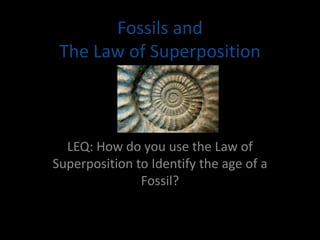
Fossils and
 The Law of Superposition


  LEQ: How do you use the Law of
Superposition to Identify the age of a
               Fossil?
Fossils and Superposition
 What is a fossil?
    The trace or remains of an organism
    that lived long ago, most commonly
    preserved in sedimentary rock

 What is a superposition?
    Younger rocks lie above older rocks
Relative Dating and Index Fossils
 What is relative dating?
  ◦ A method of determining if something is older or
    younger then another object.


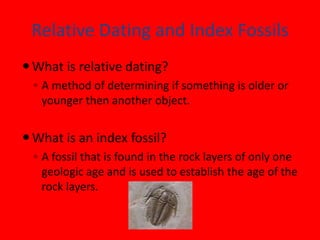
 What is an index fossil?
  ◦ A fossil that is found in the rock layers of only one
    geologic age and is used to establish the age of the
    rock layers.
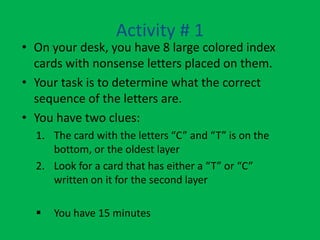
Activity # 1
• On your desk, you have 8 large colored index
  cards with nonsense letters placed on them.
• Your task is to determine what the correct
  sequence of the letters are.
• You have two clues:
  1. The card with the letters “C” and “T” is on the
     bottom, or the oldest layer
  2. Look for a card that has either a “T” or “C”
     written on it for the second layer

     You have 15 minutes
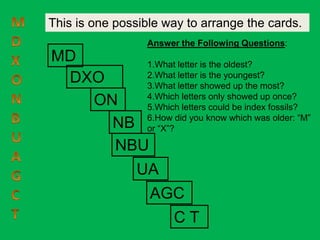
This is one possible way to arrange the cards.
                 Answer the Following Questions:
MD      1.What letter is the oldest?
 DXO    2.What letter is the youngest?
        3.What letter showed up the most?
        4.Which letters only showed up once?
   ON   5.Which letters could be index fossils?
        6.How did you know which was older: “M”
     NB or “X”?
     NBU
       UA
                  AGC
                    CT
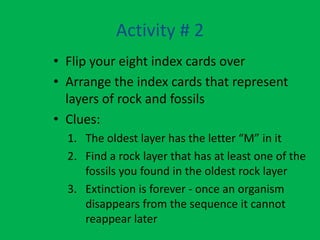
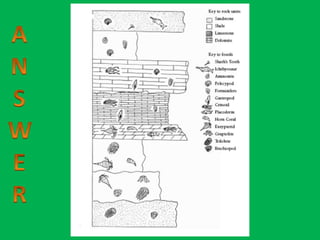
Activity # 2
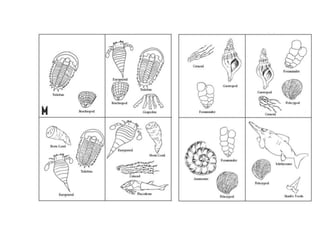
• Flip your eight index cards over
• Arrange the index cards that represent
  layers of rock and fossils
• Clues:
  1. The oldest layer has the letter “M” in it
  2. Find a rock layer that has at least one of the
     fossils you found in the oldest rock layer
  3. Extinction is forever - once an organism
     disappears from the sequence it cannot
     reappear later
Answer the Following Questions…
• In complete sentences
  – What problems did you run into when trying to
    arrange the fossils into the correct sequence?
  – Would this have been more difficult if you did not
    know which layer was the oldest to start the
    activity?
  – Which organism is the most complex of all the
    fossils and why?

Day 7 superposition fossils

  • 1.
    Bell Ringer • Takeout a sheet of paper, put your name, block number and date • You may NOT use books or notes! • Answer the following questions • What are fossils? • How do fossils form? • How can you use tree rings to tell what the weather was like in the early 1600’s? • If you found a cast and mold of a seashell and some petrified wood what can you assume about what the area use to be? • When you are done, place it in your class bin
  • 2.
    Bell Ringer • Takeout a piece of paper and answer the following questions – Write 2 rules that the class should be following during group work – Write 2 rules that the class should follow when listening to me – Write 1 thing you as students expect from me
  • 3.
    Fossils and TheLaw of Superposition LEQ: How do you use the Law of Superposition to Identify the age of a Fossil?
  • 4.
    Fossils and Superposition What is a fossil? The trace or remains of an organism that lived long ago, most commonly preserved in sedimentary rock  What is a superposition? Younger rocks lie above older rocks
  • 5.
    Relative Dating andIndex Fossils  What is relative dating? ◦ A method of determining if something is older or younger then another object.  What is an index fossil? ◦ A fossil that is found in the rock layers of only one geologic age and is used to establish the age of the rock layers.
  • 6.
    Activity # 1 •On your desk, you have 8 large colored index cards with nonsense letters placed on them. • Your task is to determine what the correct sequence of the letters are. • You have two clues: 1. The card with the letters “C” and “T” is on the bottom, or the oldest layer 2. Look for a card that has either a “T” or “C” written on it for the second layer  You have 15 minutes
  • 7.
    This is onepossible way to arrange the cards. Answer the Following Questions: MD 1.What letter is the oldest? DXO 2.What letter is the youngest? 3.What letter showed up the most? 4.Which letters only showed up once? ON 5.Which letters could be index fossils? 6.How did you know which was older: “M” NB or “X”? NBU UA AGC CT
  • 8.
    Activity # 2 •Flip your eight index cards over • Arrange the index cards that represent layers of rock and fossils • Clues: 1. The oldest layer has the letter “M” in it 2. Find a rock layer that has at least one of the fossils you found in the oldest rock layer 3. Extinction is forever - once an organism disappears from the sequence it cannot reappear later
  • 11.
    Answer the FollowingQuestions… • In complete sentences – What problems did you run into when trying to arrange the fossils into the correct sequence? – Would this have been more difficult if you did not know which layer was the oldest to start the activity? – Which organism is the most complex of all the fossils and why?