www.techvilla.org.in
TECHVILLA
www.techvilla.org.in
The Linux Kernel
 What is a kernel?
 History.
 Role of a kernel.
 Linux kernel.
 Kernel space vs user space
 Practical:Compile linux kernel.
www.techvilla.org.in
History
 UNIX: 1969 Thompson & Ritchie AT&T Bell Labs.
 BSD: 1978 Berkeley Software Distribution.
 Commercial Vendors: Sun, HP, IBM, SGI, DEC.
 GNU: 1984 Richard Stallman, FSF.
 POSIX: 1986 IEEE Portable Operating System unIX.
 Minix: 1987 Andy Tannenbaum.
 SVR4: 1989 AT&T and Sun.
 Linux: 1991 Linus Torvalds Intel 386 (i386).
 Open Source: GPL.
www.techvilla.org.in
Linux Features
 UNIX-like operating system.
 Features:
 Preemptive multitasking.
 Virtual memory (protected memory, paging).
 Shared libraries.
 Demand loading, dynamic kernel modules.
 Shared copy-on-write executables.
 TCP/IP networking.
 SMP support.
 Open source.
www.techvilla.org.in
Linux Memory Management
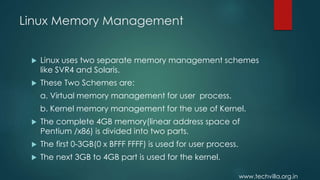
 Linux uses two separate memory management schemes
like SVR4 and Solaris.
 These Two Schemes are:
a. Virtual memory management for user process.
b. Kernel memory management for the use of Kernel.
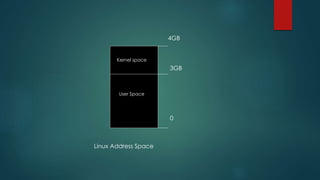
 The complete 4GB memory(linear address space of
Pentium /x86) is divided into two parts.
 The first 0-3GB(0 x BFFF FFFF) is used for user process.
 The next 3GB to 4GB part is used for the kernel.
0
3GB
4GB
Kernel space
User Space
Linux Address Space
www.techvilla.org.in
What’s a Kernel?
 AKA: executive, system monitor.
 Controls and mediates access to hardware.
 Implements and supports fundamental abstractions:
 Processes, files, devices etc.
 Schedules / allocates system resources:
 Memory, CPU, disk, descriptors, etc.
 Enforces security and protection.
 Responds to user requests for service (system calls).
 Etc…etc…
www.techvilla.org.in
Kernel Design Goals
 Performance: efficiency, speed.
 Utilize resources to capacity with low overhead.
 Stability: robustness, resilience.
 Uptime, graceful degradation.
 Capability: features, flexibility, compatibility.
 Security, protection.
 Protect users from each other & system from bad users.
 Portability.
 Extensibility.
www.techvilla.org.in
Architectural Approaches
 Monolithic.
 Layered.
 Modularized.
 Micro-kernel.
 Virtual machine.
www.techvilla.org.in
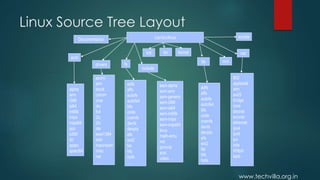
Linux Source Tree Layout
/usr/src/linuxDocumentation
arch
fs
init kernel
include
ipc
drivers
net
mmlib
scripts
alpha
arm
i386
ia64
m68k
mips
mips64
ppc
s390
sh
sparc
sparc64
acorn
atm
block
cdrom
char
dio
fc4
i2c
i2o
ide
ieee1394
isdn
macintosh
misc
net
…
adfs
affs
autofs
autofs4
bfs
code
cramfs
devfs
devpts
efs
ext2
fat
hfs
hpfs
…
asm-alpha
asm-arm
asm-generic
asm-i386
asm-ia64
asm-m68k
asm-mips
asm-mips64
linux
math-emu
net
pcmcia
scsi
video …
adfs
affs
autofs
autofs4
bfs
code
cramfs
devfs
devpts
efs
ext2
fat
hfs
hpfs …
802
appletalk
atm
ax25
bridge
core
decnet
econet
ethernet
ipv4
ipv6
ipx
irda
khttpd
lapb
…
www.techvilla.org.in
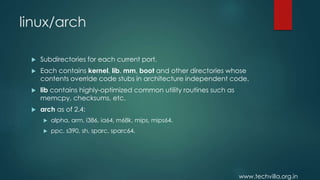
linux/arch
 Subdirectories for each current port.
 Each contains kernel, lib, mm, boot and other directories whose
contents override code stubs in architecture independent code.
 lib contains highly-optimized common utility routines such as
memcpy, checksums, etc.
 arch as of 2.4:
 alpha, arm, i386, ia64, m68k, mips, mips64.
 ppc, s390, sh, sparc, sparc64.
www.techvilla.org.in
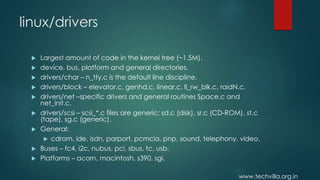
linux/drivers
 Largest amount of code in the kernel tree (~1.5M).
 device, bus, platform and general directories.
 drivers/char – n_tty.c is the default line discipline.
 drivers/block – elevator.c, genhd.c, linear.c, ll_rw_blk.c, raidN.c.
 drivers/net –specific drivers and general routines Space.c and
net_init.c.
 drivers/scsi – scsi_*.c files are generic; sd.c (disk), sr.c (CD-ROM), st.c
(tape), sg.c (generic).
 General:
 cdrom, ide, isdn, parport, pcmcia, pnp, sound, telephony, video.
 Buses – fc4, i2c, nubus, pci, sbus, tc, usb.
 Platforms – acorn, macintosh, s390, sgi.
www.techvilla.org.in
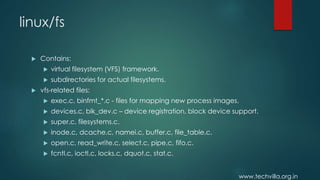
linux/fs
 Contains:
 virtual filesystem (VFS) framework.
 subdirectories for actual filesystems.
 vfs-related files:
 exec.c, binfmt_*.c - files for mapping new process images.
 devices.c, blk_dev.c – device registration, block device support.
 super.c, filesystems.c.
 inode.c, dcache.c, namei.c, buffer.c, file_table.c.
 open.c, read_write.c, select.c, pipe.c, fifo.c.
 fcntl.c, ioctl.c, locks.c, dquot.c, stat.c.
www.techvilla.org.in
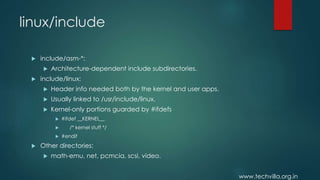
linux/include
 include/asm-*:
 Architecture-dependent include subdirectories.
 include/linux:
 Header info needed both by the kernel and user apps.
 Usually linked to /usr/include/linux.
 Kernel-only portions guarded by #ifdefs
 #ifdef __KERNEL__
 /* kernel stuff */
 #endif
 Other directories:
 math-emu, net, pcmcia, scsi, video.
www.techvilla.org.in
linux/init
 Just two files: version.c, main.c.
 version.c – contains the version banner that prints at boot.
 main.c – architecture-independent boot code.
 start_kernel is the primary entry point.
www.techvilla.org.in
linux/ipc
 System V IPC facilities.
 If disabled at compile-time, util.c exports stubs that simply return –
ENOSYS.
 One file for each facility:
 sem.c – semaphores.
 shm.c – shared memory.
 msg.c – message queues.
www.techvilla.org.in
linux/kernel
 The core kernel code.
 sched.c – “the main kernel file”:
 scheduler, wait queues, timers, alarms, task queues.
 Process control:
 fork.c, exec.c, signal.c, exit.c etc…
 Kernel module support:
 kmod.c, ksyms.c, module.c.
 Other operations:
 time.c, resource.c, dma.c, softirq.c, itimer.c.
 printk.c, info.c, panic.c, sysctl.c, sys.c.
www.techvilla.org.in
linux/lib
 kernel code cannot call standard C library routines.
 Files:
 brlock.c – “Big Reader” spinlocks.
 cmdline.c – kernel command line parsing routines.
 errno.c – global definition of errno.
 inflate.c – “gunzip” part of gzip.c used during boot.
 string.c – portable string code.
 Usually replaced by optimized, architecture-dependent routines.
 vsprintf.c – libc replacement.
www.techvilla.org.in
linux/mm
 Paging and swapping:
 swap.c, swapfile.c (paging devices), swap_state.c (cache).
 vmscan.c – paging policies, kswapd.
 page_io.c – low-level page transfer.
 Allocation and deallocation:
 slab.c – slab allocator.
 page_alloc.c – page-based allocator.
 vmalloc.c – kernel virtual-memory allocator.
 Memory mapping:
 memory.c – paging, fault-handling, page table code.
 filemap.c – file mapping.
 mmap.c, mremap.c, mlock.c, mprotect.c.
www.techvilla.org.in
linux/scripts
 Scripts for:
 Menu-based kernel configuration.
 Kernel patching.
 Generating kernel documentation.
www.techvilla.org.in
Summary
 Linux is a modular, UNIX-like monolithic kernel.
 Kernel is the heart of the OS that executes with special hardware
permission (kernel mode).
 “Core kernel” provides framework, data structures, support for
drivers, modules, subsystems.
 Architecture dependent source sub-trees live in /arch.

Rasperry pi Part 7

  • 1.
  • 2.
    www.techvilla.org.in The Linux Kernel What is a kernel?  History.  Role of a kernel.  Linux kernel.  Kernel space vs user space  Practical:Compile linux kernel.
  • 3.
    www.techvilla.org.in History  UNIX: 1969Thompson & Ritchie AT&T Bell Labs.  BSD: 1978 Berkeley Software Distribution.  Commercial Vendors: Sun, HP, IBM, SGI, DEC.  GNU: 1984 Richard Stallman, FSF.  POSIX: 1986 IEEE Portable Operating System unIX.  Minix: 1987 Andy Tannenbaum.  SVR4: 1989 AT&T and Sun.  Linux: 1991 Linus Torvalds Intel 386 (i386).  Open Source: GPL.
  • 4.
    www.techvilla.org.in Linux Features  UNIX-likeoperating system.  Features:  Preemptive multitasking.  Virtual memory (protected memory, paging).  Shared libraries.  Demand loading, dynamic kernel modules.  Shared copy-on-write executables.  TCP/IP networking.  SMP support.  Open source.
  • 5.
    www.techvilla.org.in Linux Memory Management Linux uses two separate memory management schemes like SVR4 and Solaris.  These Two Schemes are: a. Virtual memory management for user process. b. Kernel memory management for the use of Kernel.  The complete 4GB memory(linear address space of Pentium /x86) is divided into two parts.  The first 0-3GB(0 x BFFF FFFF) is used for user process.  The next 3GB to 4GB part is used for the kernel.
  • 6.
  • 7.
    www.techvilla.org.in What’s a Kernel? AKA: executive, system monitor.  Controls and mediates access to hardware.  Implements and supports fundamental abstractions:  Processes, files, devices etc.  Schedules / allocates system resources:  Memory, CPU, disk, descriptors, etc.  Enforces security and protection.  Responds to user requests for service (system calls).  Etc…etc…
  • 8.
    www.techvilla.org.in Kernel Design Goals Performance: efficiency, speed.  Utilize resources to capacity with low overhead.  Stability: robustness, resilience.  Uptime, graceful degradation.  Capability: features, flexibility, compatibility.  Security, protection.  Protect users from each other & system from bad users.  Portability.  Extensibility.
  • 9.
    www.techvilla.org.in Architectural Approaches  Monolithic. Layered.  Modularized.  Micro-kernel.  Virtual machine.
  • 10.
    www.techvilla.org.in Linux Source TreeLayout /usr/src/linuxDocumentation arch fs init kernel include ipc drivers net mmlib scripts alpha arm i386 ia64 m68k mips mips64 ppc s390 sh sparc sparc64 acorn atm block cdrom char dio fc4 i2c i2o ide ieee1394 isdn macintosh misc net … adfs affs autofs autofs4 bfs code cramfs devfs devpts efs ext2 fat hfs hpfs … asm-alpha asm-arm asm-generic asm-i386 asm-ia64 asm-m68k asm-mips asm-mips64 linux math-emu net pcmcia scsi video … adfs affs autofs autofs4 bfs code cramfs devfs devpts efs ext2 fat hfs hpfs … 802 appletalk atm ax25 bridge core decnet econet ethernet ipv4 ipv6 ipx irda khttpd lapb …
  • 11.
    www.techvilla.org.in linux/arch  Subdirectories foreach current port.  Each contains kernel, lib, mm, boot and other directories whose contents override code stubs in architecture independent code.  lib contains highly-optimized common utility routines such as memcpy, checksums, etc.  arch as of 2.4:  alpha, arm, i386, ia64, m68k, mips, mips64.  ppc, s390, sh, sparc, sparc64.
  • 12.
    www.techvilla.org.in linux/drivers  Largest amountof code in the kernel tree (~1.5M).  device, bus, platform and general directories.  drivers/char – n_tty.c is the default line discipline.  drivers/block – elevator.c, genhd.c, linear.c, ll_rw_blk.c, raidN.c.  drivers/net –specific drivers and general routines Space.c and net_init.c.  drivers/scsi – scsi_*.c files are generic; sd.c (disk), sr.c (CD-ROM), st.c (tape), sg.c (generic).  General:  cdrom, ide, isdn, parport, pcmcia, pnp, sound, telephony, video.  Buses – fc4, i2c, nubus, pci, sbus, tc, usb.  Platforms – acorn, macintosh, s390, sgi.
  • 13.
    www.techvilla.org.in linux/fs  Contains:  virtualfilesystem (VFS) framework.  subdirectories for actual filesystems.  vfs-related files:  exec.c, binfmt_*.c - files for mapping new process images.  devices.c, blk_dev.c – device registration, block device support.  super.c, filesystems.c.  inode.c, dcache.c, namei.c, buffer.c, file_table.c.  open.c, read_write.c, select.c, pipe.c, fifo.c.  fcntl.c, ioctl.c, locks.c, dquot.c, stat.c.
  • 14.
    www.techvilla.org.in linux/include  include/asm-*:  Architecture-dependentinclude subdirectories.  include/linux:  Header info needed both by the kernel and user apps.  Usually linked to /usr/include/linux.  Kernel-only portions guarded by #ifdefs  #ifdef __KERNEL__  /* kernel stuff */  #endif  Other directories:  math-emu, net, pcmcia, scsi, video.
  • 15.
    www.techvilla.org.in linux/init  Just twofiles: version.c, main.c.  version.c – contains the version banner that prints at boot.  main.c – architecture-independent boot code.  start_kernel is the primary entry point.
  • 16.
    www.techvilla.org.in linux/ipc  System VIPC facilities.  If disabled at compile-time, util.c exports stubs that simply return – ENOSYS.  One file for each facility:  sem.c – semaphores.  shm.c – shared memory.  msg.c – message queues.
  • 17.
    www.techvilla.org.in linux/kernel  The corekernel code.  sched.c – “the main kernel file”:  scheduler, wait queues, timers, alarms, task queues.  Process control:  fork.c, exec.c, signal.c, exit.c etc…  Kernel module support:  kmod.c, ksyms.c, module.c.  Other operations:  time.c, resource.c, dma.c, softirq.c, itimer.c.  printk.c, info.c, panic.c, sysctl.c, sys.c.
  • 18.
    www.techvilla.org.in linux/lib  kernel codecannot call standard C library routines.  Files:  brlock.c – “Big Reader” spinlocks.  cmdline.c – kernel command line parsing routines.  errno.c – global definition of errno.  inflate.c – “gunzip” part of gzip.c used during boot.  string.c – portable string code.  Usually replaced by optimized, architecture-dependent routines.  vsprintf.c – libc replacement.
  • 19.
    www.techvilla.org.in linux/mm  Paging andswapping:  swap.c, swapfile.c (paging devices), swap_state.c (cache).  vmscan.c – paging policies, kswapd.  page_io.c – low-level page transfer.  Allocation and deallocation:  slab.c – slab allocator.  page_alloc.c – page-based allocator.  vmalloc.c – kernel virtual-memory allocator.  Memory mapping:  memory.c – paging, fault-handling, page table code.  filemap.c – file mapping.  mmap.c, mremap.c, mlock.c, mprotect.c.
  • 20.
    www.techvilla.org.in linux/scripts  Scripts for: Menu-based kernel configuration.  Kernel patching.  Generating kernel documentation.
  • 21.
    www.techvilla.org.in Summary  Linux isa modular, UNIX-like monolithic kernel.  Kernel is the heart of the OS that executes with special hardware permission (kernel mode).  “Core kernel” provides framework, data structures, support for drivers, modules, subsystems.  Architecture dependent source sub-trees live in /arch.

Editor's Notes

  • #22 BOOKS Maxwell Chapter 4: System Initialization Rubini Chapter 16 pages 362-369 Beck 3.2.3 GUIDES Linux System Administrator’s Guide HOWTOs Bootdisk-HOWTO BootPrompt-HOWTO Diskless-HOWTO Diskless-root-NFS-HOWTO KERNEL DOC Documentation/initrd.txt Documentation/ramdisk.txt