For ELA/Literacy Common Core Standards Andrea Fontana Model Schools Coordinator, MORIC
The Case for Common Core One half to three quarters of all 2 year NYS community college students are being put into remedial courses for math and ELA American students can no longer compete internationally  Clear uniform set of student-based expectations & goals Knowledge and skills students need to succeed in college & workforce The use of media is integrated into all areas
The Value of Common Core
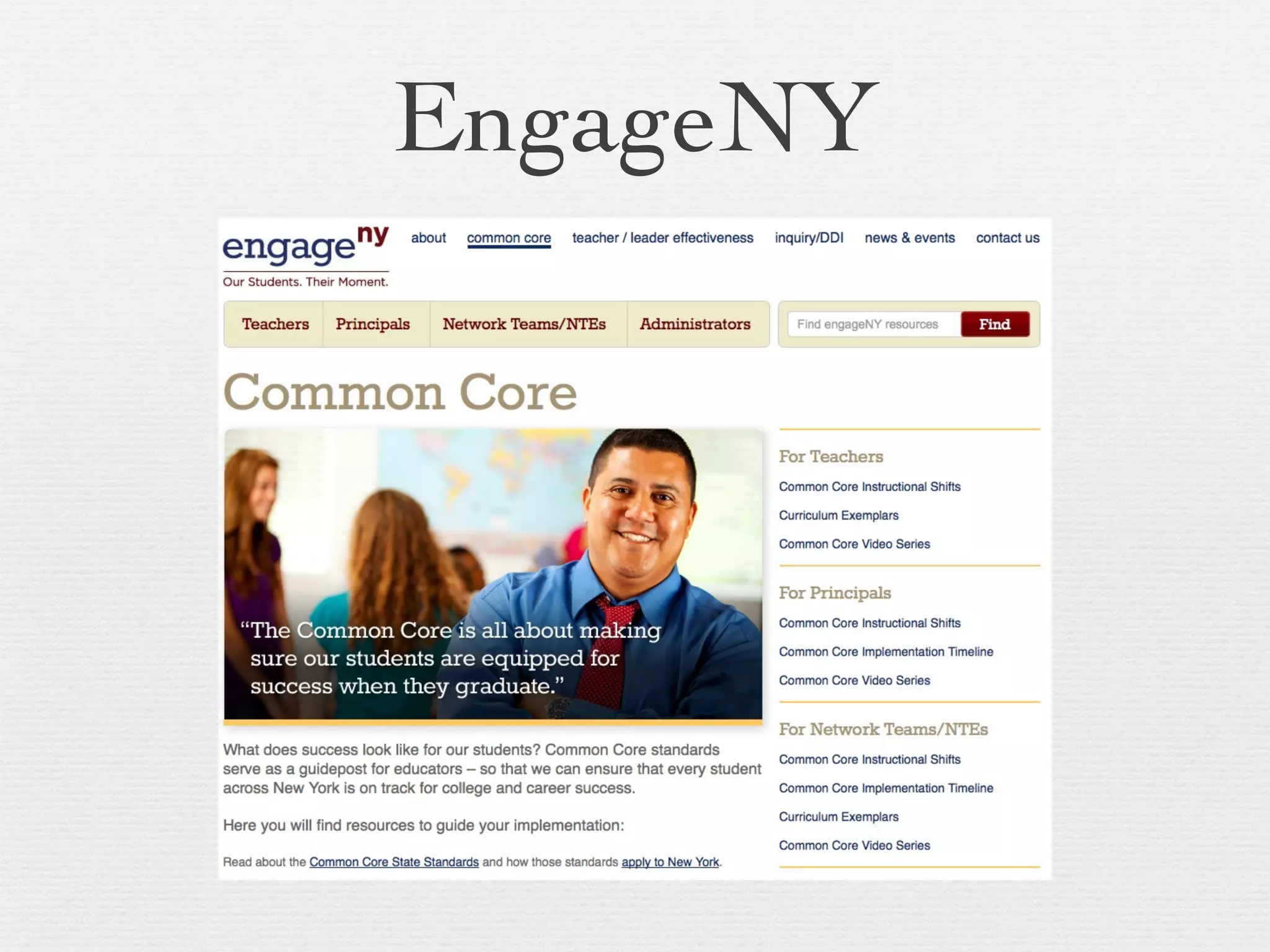
EngageNY
ELA/Literacy Instructional Shifts K-8 & 9-12 Standards The standards are separated into four strands:  Reading, Writing, Speaking & Listening, and Language Integrated Model of Literacy Focus on results Shared Responsibility
Instructional Shifts PK-5, Balancing Informational and Literary Texts 6-12, Knowledge in the Disciplines  Staircase of Complexity Text-based answers Writing from Sources Academic Vocabulary
Standards for ELA 6-12 College and Career Readiness Anchor Standards for Reading Key Ideas and Details Close reading, logical inferences, cite textual evidence, analyze development of central ideas/themes, summarize key details, analyze how and why individuals, events, and ideas develop and interact. Craft and Structure Interpret how words and phrases are used in a text and how they shape meaning Integration of Knowledge and Ideas Integrate diverse media, evaluate the arguments and claims made in texts in terms of reasoning and evidence, analyze texts of similar topic/theme build knowledge and compare authorial approach Range of Reading and Level of Text Complexity I ndependence and Proficiency   Responding to Literature Comprehend, reflect upon and interpret a variety of texts
Key Ideas and Details Note-taking applications Annotation Tools Summarization websites Graphic Organizers- compare/contrast, cause/effect, character web Notes and Graphic Organizers
Craft and Structure Word Choice and Meaning Lexipedia Vocab Ahead Confusing Words Structure and Author’s Purpose Digital Storytelling Blog Podcast
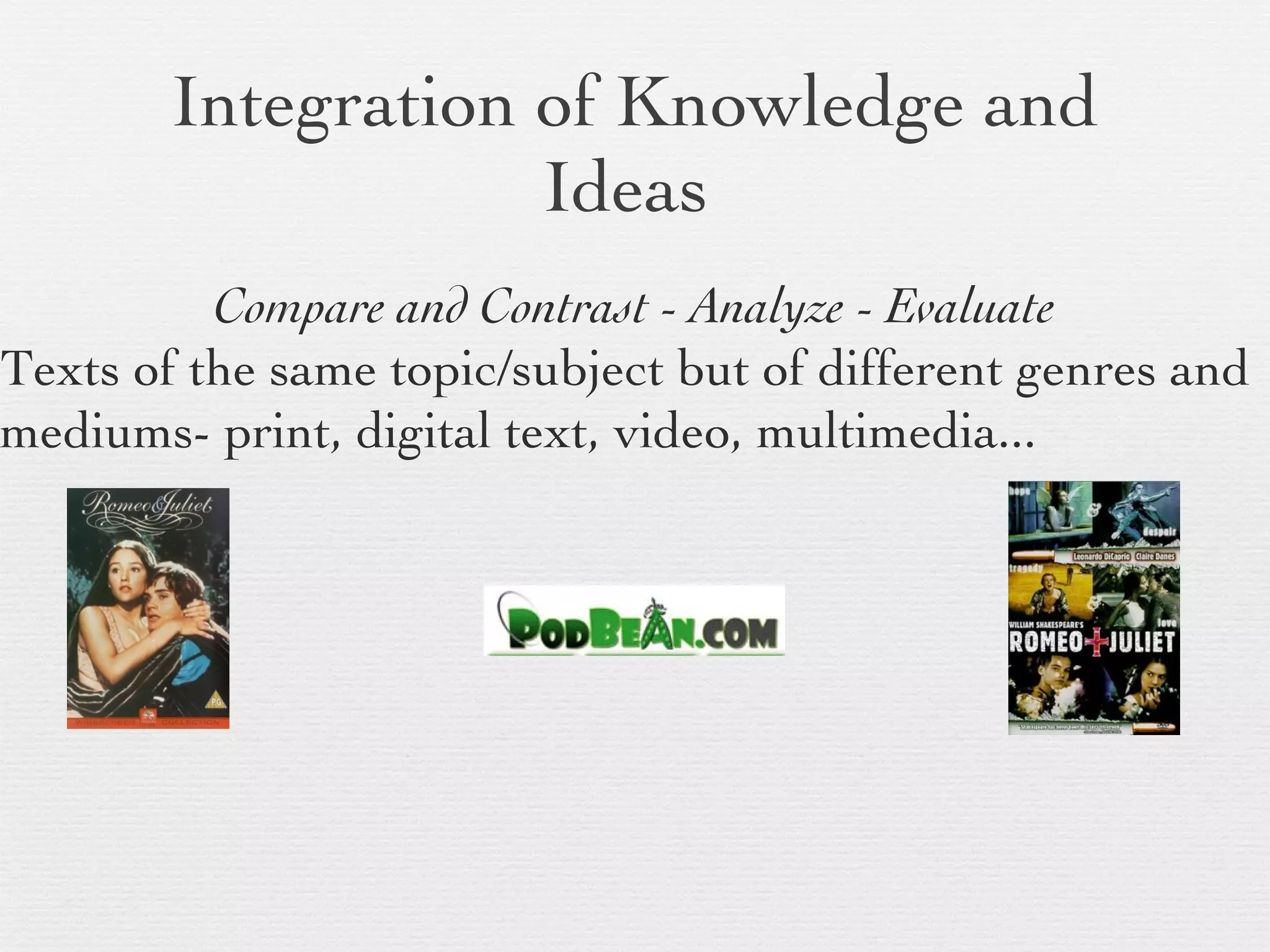
Integration of Knowledge and Ideas  Compare and Contrast - Analyze - Evaluate Texts of the same topic/subject but of different genres and mediums- print, digital text, video, multimedia...
Range of Reading and Level of Text Complexity Scaffold students to read more difficult texts independently-  Reading Comprehension Tools Wordle  Vocabulary Blog or Wiki My Fake Wall Voki Blabberize
Standards for ELA 6-12 College and Career Readiness Anchor Standards for Writing Text Type and Purposes Write arguments using valid reasoning and textual evidence to support claims Production and Distribution of Writing Produce writing with development, organization, and style appropriate to the task purpose audience; employ writing stages (planning, revising, etc.) to develop and strengthen writing, utilize technology to produce, publish, and interact/collaborate with others Research to Build and Present Knowledge Inquiry- based research, gathering from a multitude of sources, assess credibility and avoid plagiarism, use evidence to support analysis, reflection and research.  Range of Writing Write routinely- short-term and long-term pieces that vary in task, purpose, and audience. Responding to Literature Use writing as a means to develop connections.
Text Type and Purpose Organize Ideas-  bubbl.us Interactive Essay Outline:  ReadWriteThink Writing, Revising, Editing
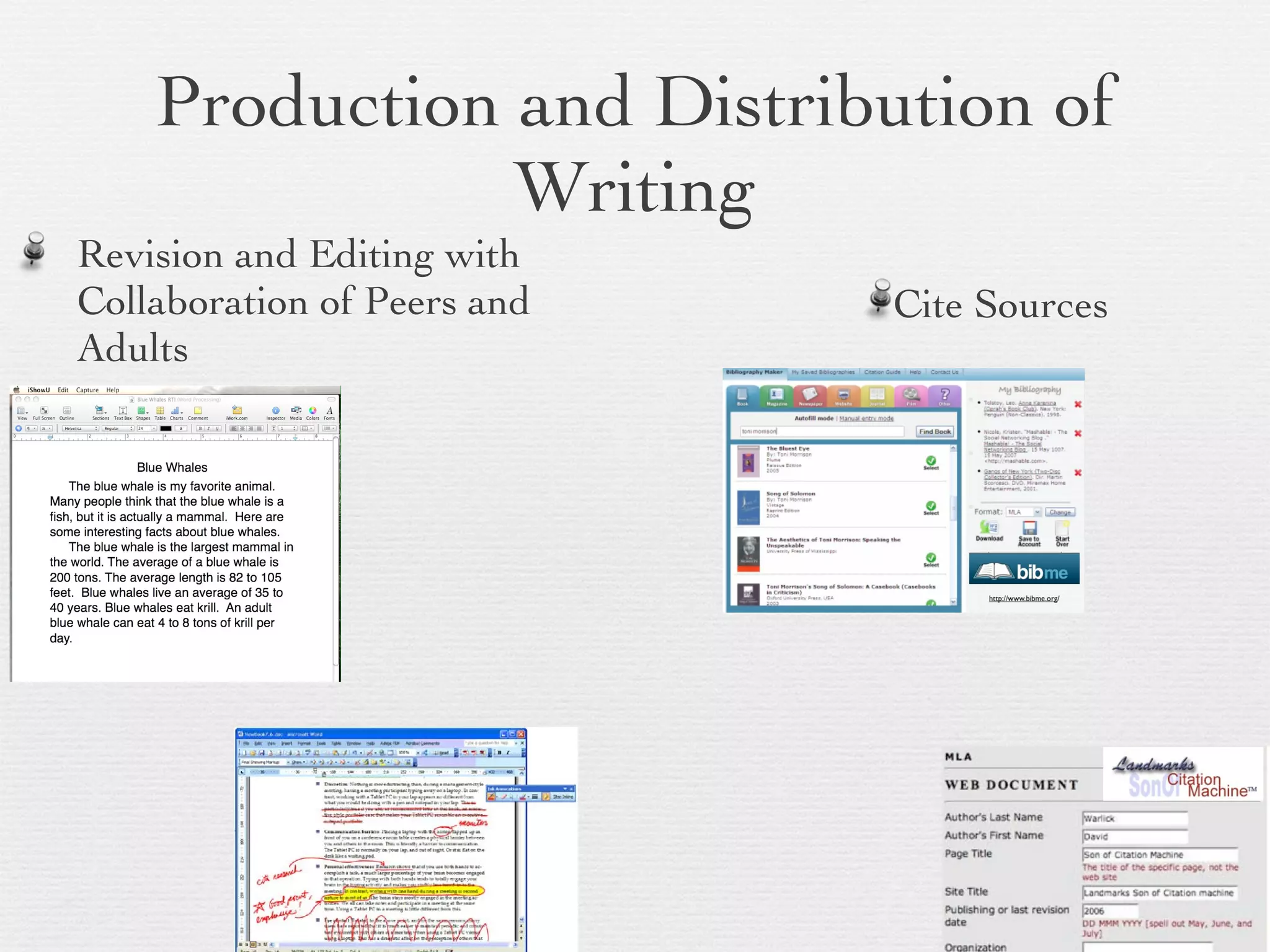
Production and Distribution of Writing Revision and Editing with Collaboration of Peers and Adults Cite Sources
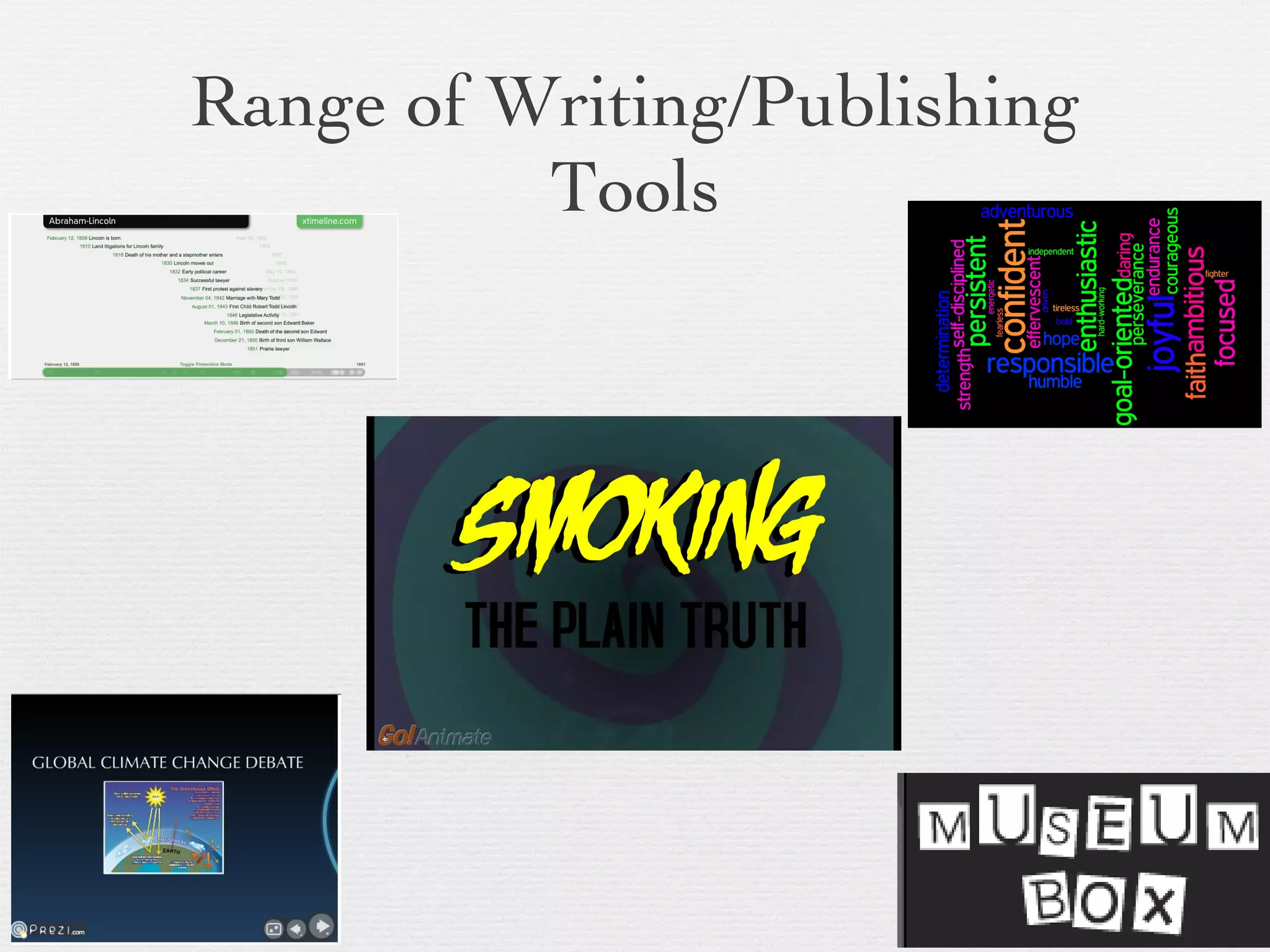
Range of Writing/Publishing Tools
Research to Build and Present Knowledge  Research Multiple Sources Webquests Avoid Plagiarism by using a plagiarism checker.
Standards for ELA 6-12 College and Career Readiness Anchor Standards for Speaking and Listening Comprehension and Collaboration Participate in conversations and collaborations with others by building in others’ ideas and expressing their own, integrate information in diverse media and formats, and evaluate speakers Presentation of Knowledge and Ideas Present in a manner that is appropriate to task, purpose, and audience so that listeners can follow the line of reasoning
Comprehension and Collaboration VoiceThread PBWorks Podcasts/Webcam
Standards for ELA 6-12 College and Career Readiness Anchor Standards for Language Conventions of Standard English  Demonstrate command of conventions in grammar, usage, capitalization, punctuation, and spelling:  Virtual Grammar Lab Knowledge of Language Knowledge and understanding of how language functions to make word choices comprehend more fully when reading/listening Vocabulary Acquisition and Use Determine/clarify meaning of unknown words, demonstrate understanding of figurative language, word relationships, and nuances in word meanings, demonstrate independence in acquiring and using a range of general academic  and domain-specific words and phrases.

Web 2.0 Tools for ELA Common Core Standards

  • 1.
    For ELA/Literacy CommonCore Standards Andrea Fontana Model Schools Coordinator, MORIC
  • 2.
    The Case forCommon Core One half to three quarters of all 2 year NYS community college students are being put into remedial courses for math and ELA American students can no longer compete internationally Clear uniform set of student-based expectations & goals Knowledge and skills students need to succeed in college & workforce The use of media is integrated into all areas
  • 3.
    The Value ofCommon Core
  • 4.
  • 5.
    ELA/Literacy Instructional ShiftsK-8 & 9-12 Standards The standards are separated into four strands: Reading, Writing, Speaking & Listening, and Language Integrated Model of Literacy Focus on results Shared Responsibility
  • 6.
    Instructional Shifts PK-5,Balancing Informational and Literary Texts 6-12, Knowledge in the Disciplines Staircase of Complexity Text-based answers Writing from Sources Academic Vocabulary
  • 7.
    Standards for ELA6-12 College and Career Readiness Anchor Standards for Reading Key Ideas and Details Close reading, logical inferences, cite textual evidence, analyze development of central ideas/themes, summarize key details, analyze how and why individuals, events, and ideas develop and interact. Craft and Structure Interpret how words and phrases are used in a text and how they shape meaning Integration of Knowledge and Ideas Integrate diverse media, evaluate the arguments and claims made in texts in terms of reasoning and evidence, analyze texts of similar topic/theme build knowledge and compare authorial approach Range of Reading and Level of Text Complexity I ndependence and Proficiency Responding to Literature Comprehend, reflect upon and interpret a variety of texts
  • 8.
    Key Ideas andDetails Note-taking applications Annotation Tools Summarization websites Graphic Organizers- compare/contrast, cause/effect, character web Notes and Graphic Organizers
  • 9.
    Craft and StructureWord Choice and Meaning Lexipedia Vocab Ahead Confusing Words Structure and Author’s Purpose Digital Storytelling Blog Podcast
  • 10.
    Integration of Knowledgeand Ideas Compare and Contrast - Analyze - Evaluate Texts of the same topic/subject but of different genres and mediums- print, digital text, video, multimedia...
  • 11.
    Range of Readingand Level of Text Complexity Scaffold students to read more difficult texts independently- Reading Comprehension Tools Wordle Vocabulary Blog or Wiki My Fake Wall Voki Blabberize
  • 12.
    Standards for ELA6-12 College and Career Readiness Anchor Standards for Writing Text Type and Purposes Write arguments using valid reasoning and textual evidence to support claims Production and Distribution of Writing Produce writing with development, organization, and style appropriate to the task purpose audience; employ writing stages (planning, revising, etc.) to develop and strengthen writing, utilize technology to produce, publish, and interact/collaborate with others Research to Build and Present Knowledge Inquiry- based research, gathering from a multitude of sources, assess credibility and avoid plagiarism, use evidence to support analysis, reflection and research. Range of Writing Write routinely- short-term and long-term pieces that vary in task, purpose, and audience. Responding to Literature Use writing as a means to develop connections.
  • 13.
    Text Type andPurpose Organize Ideas- bubbl.us Interactive Essay Outline: ReadWriteThink Writing, Revising, Editing
  • 14.
    Production and Distributionof Writing Revision and Editing with Collaboration of Peers and Adults Cite Sources
  • 15.
  • 16.
    Research to Buildand Present Knowledge Research Multiple Sources Webquests Avoid Plagiarism by using a plagiarism checker.
  • 17.
    Standards for ELA6-12 College and Career Readiness Anchor Standards for Speaking and Listening Comprehension and Collaboration Participate in conversations and collaborations with others by building in others’ ideas and expressing their own, integrate information in diverse media and formats, and evaluate speakers Presentation of Knowledge and Ideas Present in a manner that is appropriate to task, purpose, and audience so that listeners can follow the line of reasoning
  • 18.
    Comprehension and CollaborationVoiceThread PBWorks Podcasts/Webcam
  • 19.
    Standards for ELA6-12 College and Career Readiness Anchor Standards for Language Conventions of Standard English Demonstrate command of conventions in grammar, usage, capitalization, punctuation, and spelling: Virtual Grammar Lab Knowledge of Language Knowledge and understanding of how language functions to make word choices comprehend more fully when reading/listening Vocabulary Acquisition and Use Determine/clarify meaning of unknown words, demonstrate understanding of figurative language, word relationships, and nuances in word meanings, demonstrate independence in acquiring and using a range of general academic and domain-specific words and phrases.

Editor's Notes

  • #6 The standards for grades K-8 are listed by individual grade levels to make sure that they are specific to that level, where as the standards for grades 9-12 are in two-year bands to allow flexibility in high school course design. The standards are separated into four main strands: Reading, Writing, Speaking & Listening and Language. Even though the standards are broken into four strands, there are still connections between them. For example, students must be able to write about what they have read. The ELA standards emphasize required achievements. by doing this it leaves the teachers and administrators the opportunity to decide what strategies and writing processes they would like to choose. You will also notice that the ELA Standards are now applicable to other subject areas. The 6-12 standards are divided into two sections. One for ELA and the other for history/social studies, science and technical subjects. By doing this, it allows ELA teachers to develop literacy skills but also shows how teachers in other areas are involved in the process as well.
  • #9 Annotation Tools- browser add-ons, preview and adobe annotation tools. Summarization- Safari, Tools for Noobs, AutoSummarize in Word: Tools, AutoSummarize