Increasing Rigor – Preparing Students for College Level WritingMs. Kimberley DalyAfternoon Session 1:30-3:45August 3, 2010
Session ObjectivesTo understand the importance of persuasive writing at the high school levelTo understand how the practice of annotation is often connected to persuasive writingTo develop a unit or set of plans that increase student proficiency in persuasive writing
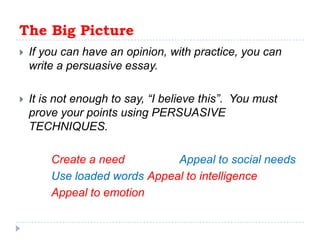
The Big Picture If you can have an opinion, with practice, you can write a persuasive essay.It is not enough to say, “I believe this”.  You must prove your points using PERSUASIVE TECHNIQUES.Create a need	Appeal to social needsUse loaded wordsAppeal to intelligenceAppeal to emotion
Some Strategies I Use:Engaging texts that immediately evoke a responseToolbox of persuasive techniques Time for peer review and discussionComprehensive feedback to ensure future improvement
Engaging TextsChoose texts that are high interest for students.Provide a mix of non-fiction and fiction pieces.Require students to annotate texts as pre-writing --- getting their thoughts down on paper is a prelude to developing an opinion about the issue, the subject or the writing.Allow students time to discuss and process the text.
Toolbox of Persuasive TechniquesTeach techniques slowlyProvide for guided and independent practice Showcase examples of techniques in texts read in classVideo Clip:  http://www.youtube.com/watch?v=5-Sjld5yy3Q&NR=1Questions for participants:  Why is this ad persuasive? Why it is appealing to students?
Peer Review and DiscussionAllow students time to share essays and undertake guided peer reviewProvide time for whole class discussion for general issuesFacilitate and guide small writing groups
Comprehensive Feedback After writing is completed, allow time for student reflection on process.Provide timely feedback using rubric.Identify areas for future improvement.
For More InformationPlease contact session presenter:Ms. Kimberley DalyIB English Teacher, Thomas A. Edison High Schoolkbdaly@fcps.edu / kdaly1@gmu.edu

Day 2_Session II_Increasing rigor_writing

  • 1.
    Increasing Rigor –Preparing Students for College Level WritingMs. Kimberley DalyAfternoon Session 1:30-3:45August 3, 2010
  • 2.
    Session ObjectivesTo understandthe importance of persuasive writing at the high school levelTo understand how the practice of annotation is often connected to persuasive writingTo develop a unit or set of plans that increase student proficiency in persuasive writing
  • 3.
    The Big PictureIf you can have an opinion, with practice, you can write a persuasive essay.It is not enough to say, “I believe this”. You must prove your points using PERSUASIVE TECHNIQUES.Create a need Appeal to social needsUse loaded wordsAppeal to intelligenceAppeal to emotion
  • 4.
    Some Strategies IUse:Engaging texts that immediately evoke a responseToolbox of persuasive techniques Time for peer review and discussionComprehensive feedback to ensure future improvement
  • 5.
    Engaging TextsChoose textsthat are high interest for students.Provide a mix of non-fiction and fiction pieces.Require students to annotate texts as pre-writing --- getting their thoughts down on paper is a prelude to developing an opinion about the issue, the subject or the writing.Allow students time to discuss and process the text.
  • 6.
    Toolbox of PersuasiveTechniquesTeach techniques slowlyProvide for guided and independent practice Showcase examples of techniques in texts read in classVideo Clip: http://www.youtube.com/watch?v=5-Sjld5yy3Q&NR=1Questions for participants: Why is this ad persuasive? Why it is appealing to students?
  • 7.
    Peer Review andDiscussionAllow students time to share essays and undertake guided peer reviewProvide time for whole class discussion for general issuesFacilitate and guide small writing groups
  • 8.
    Comprehensive Feedback Afterwriting is completed, allow time for student reflection on process.Provide timely feedback using rubric.Identify areas for future improvement.
  • 9.
    For More InformationPleasecontact session presenter:Ms. Kimberley DalyIB English Teacher, Thomas A. Edison High Schoolkbdaly@fcps.edu / kdaly1@gmu.edu

Editor's Notes

  • #4 Create a need - This type of persuasion appeals to a person’s fundamental needs for shelter, love, self-esteem, and self-actualization.Appeal to social needs – This method appeals to the need to be popular, prestigious, or similar to others. TV commercials are the best example of this. “Be like Mike.”Using loaded words – Includes the power of positive words but can also mean using negative words to make a point.Appeal to emotion – Puppies and babies, those things that tug on the heart strings of a reader. Also called pathos.Appeal to intelligence – Using facts and data to appeal to a reader’s reason and logic to come to your conclusions. Also called logos.
  • #6 Hand out texts: Climate of Fear - What does the writer do in this extract? Explain, supporting your points with examples.Cutting and Pasting: A Senior Thesis by (Insert Name) - Do you think schools and professors have gone too far to combat plagiarism? Why or why not?
  • #7 Can also ask students to specifically look for and mark persuasive techniques when annotating a text. Ad is persuasive because it plays on appeal to emotion – fear of your care being hit by a driver like this. For students it is appealing because they can all relate to the texting and the situation of the boy-girl dynamics so it holds interest as a teaching tool.I will bring copies of other texts to workshop. How many copies?
  • #9 IB Paper 1 and Paper 2 rubric – 2 pages
  • #10 Handouts: Persuasive Writing Prompts – 3 pages