STATE OF TEXAS ASSESSMENTS OF ACADEMIC READINESS (STAAR) STAAR Reading and Writing A New Assessment Design for Grades 3 – 8 Victoria Young Director of Reading, Writing, and Social Studies Assessments Texas Education Agency
Reading Test Design Fiction always considered a  readiness genre Student expectations –those that can be applied to any story– considered  readiness standards More specific student expectations that can be applied to only some stories considered  supporting standards
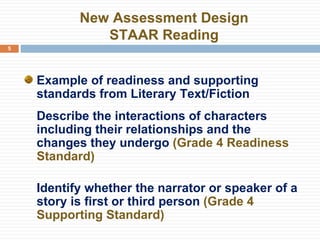
New Assessment Design STAAR Reading Example of readiness and supporting standards from Literary Text/Fiction Describe the interactions of characters including their relationships and the changes they undergo  (Grade 4 Readiness Standard) Identify whether the narrator or speaker of a story is first or third person  (Grade 4 Supporting Standard)
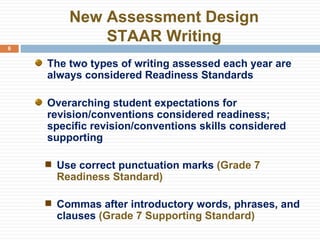
New Assessment Design STAAR Writing The two types of writing assessed each year are always considered Readiness Standards Overarching student expectations for revision/conventions considered readiness; specific revision/conventions skills considered supporting Use correct punctuation marks  (Grade 7 Readiness Standard) Commas after introductory words, phrases, and clauses  (Grade 7 Supporting Standard)
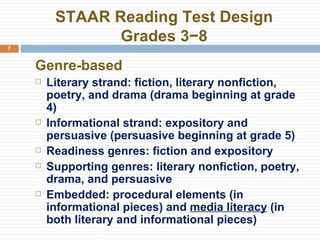
STAAR Reading Test Design Grades 3−8 Genre-based Literary strand: fiction, literary nonfiction, poetry, and drama (drama beginning at grade 4) Informational strand: expository and persuasive (persuasive beginning at grade 5) Readiness genres: fiction and expository Supporting genres: literary nonfiction, poetry, drama, and persuasive Embedded: procedural elements (in informational pieces) and  media literacy  (in both literary and informational pieces)
STAAR Reading Test Design Grades 3–8 Paired selections can mix strands and genres Paired selections begin at Grade 4 Literary−Literary (e.g., fiction−poetry, literary nonfiction−drama, fiction−literary nonfiction Informational−Informational (e.g., expository −expository, expository−persuasive) Literary−Informational (e.g., fiction−expository, poetry−expository, literary nonfiction−persuasive)
STAAR Reading Test Design Grades 3–8 STAAR reading assessments will emphasize students’ ability to understand how to use text evidence to confirm the validity of their ideas to make connections within and across texts (“across texts” begins at grade 4) to think critically/inferentially to “go beyond” a literal understanding of what they read
Student Success in Reading and STAAR Students must be provided in-depth instruction in  all  genres represented by the ELA/R TEKS Equal weight  must be given to fiction and expository genres at all grade levels Instruction must emphasize critical-thinking skills/infe rential thinking  rather than isolated skills
Writing Test Design Grade 7 Assessment split evenly over two days Day 1–All the multiple-choice questions and first composition Day 2–Second and third compositions Field tests for both multiple-choice and compositions embedded for grade 7
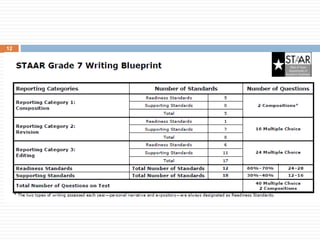
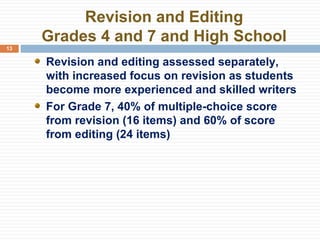
Revision and Editing Grades 4 and 7 and High School Revision and editing assessed separately, with increased focus on revision as students become more experienced and skilled writers For Grade 7, 40% of multiple-choice score from revision (16 items) and 60% of score from editing (24 items)
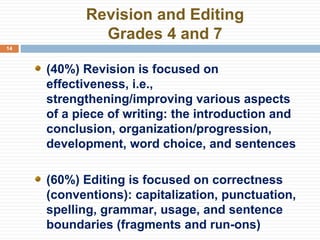
Revision and Editing Grades 4 and 7 (40%) Revision is focused on effectiveness, i.e., strengthening/improving various aspects of a piece of writing: the introduction and conclusion, organization/progression, development, word choice, and sentences (60%) Editing is focused on correctness (conventions): capitalization, punctuation, spelling, grammar, usage, and sentence boundaries (fragments and run-ons)
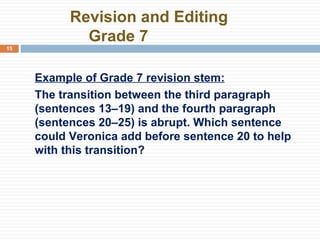
  Revision and Editing Grade 7 Example of Grade 7 revision stem: The transition between the third paragraph (sentences 13–19) and the fourth paragraph (sentences 20–25) is abrupt. Which sentence could Veronica add before sentence 20 to help with this transition?
Composition Grade 7  Students will write two one-page compositions addressing different types of writing. Personal Narrative with extension: Write a personal narrative that has a clearly defined focus and communicates the importance of or reasons for actions and/or consequences (TEKS−16A) Expository: Write a multi-paragraph essay to convey information about a topic (TEKS−17A; additional information is contained in 17A i−v)
Writing Prompts  Grades 4 and 7  Most personal narrative prompts appear with a photograph At grade 7, personal narrative prompts clearly incorporate the “extension” aspect (e.g., why the experience was important) Expository prompts contain a stimulus and are scaffolded:  Read, Think, Write, Be Sure to −
STAAR  Writing Rubrics  A rubric is being developed for each writing type, but three overarching aspects of writing are addressed in all rubrics: NO MORE 6 TRAITS. Organization/Progression Development of Ideas Use of Language/Conventions
Writing Rubrics Overview:  Common Elements  Organization/Progression the degree to which form or structure is appropriate to the purpose and demands of the prompt the degree to which the writer establishes and sustains focus (affecting unity and coherence of piece) the degree to which the writer controls progression with transitions and sentence-to-sentence connections and establishes the relationships among ideas
Writing Rubrics Overview: Common Elements Development of Ideas the degree to which details/examples are specific and well chosen the degree to which (1) the piece is thoughtful and engaging and (2) the writer demonstrates an understanding of the task
Writing Rubrics Overview:  Common Elements Use of Language/Conventions the degree to which word choice is thoughtful and appropriate to form, purpose, and tone the degree to which sentences are purposeful, varied, and controlled the degree to which the writer demonstrates a command of conventions so that the writing is fluent and clear
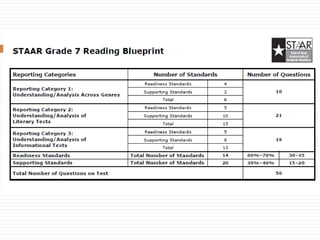
TEA STAAR Resources Currently available at http://www.tea.state.tx.us/student.assessment/staar/ General information about  STAAR—e.g., the overall assessment design and attributes Assessed curriculum (includes reporting categories and readiness/supporting standard designations for each SE) Test blueprints Test design schematics On the way in fall 2011: Educator guides—including sample  selections and items

STAAR

  • 1.
    STATE OF TEXASASSESSMENTS OF ACADEMIC READINESS (STAAR) STAAR Reading and Writing A New Assessment Design for Grades 3 – 8 Victoria Young Director of Reading, Writing, and Social Studies Assessments Texas Education Agency
  • 2.
    Reading Test DesignFiction always considered a readiness genre Student expectations –those that can be applied to any story– considered readiness standards More specific student expectations that can be applied to only some stories considered supporting standards
  • 5.
    New Assessment DesignSTAAR Reading Example of readiness and supporting standards from Literary Text/Fiction Describe the interactions of characters including their relationships and the changes they undergo (Grade 4 Readiness Standard) Identify whether the narrator or speaker of a story is first or third person (Grade 4 Supporting Standard)
  • 6.
    New Assessment DesignSTAAR Writing The two types of writing assessed each year are always considered Readiness Standards Overarching student expectations for revision/conventions considered readiness; specific revision/conventions skills considered supporting Use correct punctuation marks (Grade 7 Readiness Standard) Commas after introductory words, phrases, and clauses (Grade 7 Supporting Standard)
  • 7.
    STAAR Reading TestDesign Grades 3−8 Genre-based Literary strand: fiction, literary nonfiction, poetry, and drama (drama beginning at grade 4) Informational strand: expository and persuasive (persuasive beginning at grade 5) Readiness genres: fiction and expository Supporting genres: literary nonfiction, poetry, drama, and persuasive Embedded: procedural elements (in informational pieces) and media literacy (in both literary and informational pieces)
  • 8.
    STAAR Reading TestDesign Grades 3–8 Paired selections can mix strands and genres Paired selections begin at Grade 4 Literary−Literary (e.g., fiction−poetry, literary nonfiction−drama, fiction−literary nonfiction Informational−Informational (e.g., expository −expository, expository−persuasive) Literary−Informational (e.g., fiction−expository, poetry−expository, literary nonfiction−persuasive)
  • 9.
    STAAR Reading TestDesign Grades 3–8 STAAR reading assessments will emphasize students’ ability to understand how to use text evidence to confirm the validity of their ideas to make connections within and across texts (“across texts” begins at grade 4) to think critically/inferentially to “go beyond” a literal understanding of what they read
  • 10.
    Student Success inReading and STAAR Students must be provided in-depth instruction in all genres represented by the ELA/R TEKS Equal weight must be given to fiction and expository genres at all grade levels Instruction must emphasize critical-thinking skills/infe rential thinking rather than isolated skills
  • 11.
    Writing Test DesignGrade 7 Assessment split evenly over two days Day 1–All the multiple-choice questions and first composition Day 2–Second and third compositions Field tests for both multiple-choice and compositions embedded for grade 7
  • 13.
    Revision and EditingGrades 4 and 7 and High School Revision and editing assessed separately, with increased focus on revision as students become more experienced and skilled writers For Grade 7, 40% of multiple-choice score from revision (16 items) and 60% of score from editing (24 items)
  • 14.
    Revision and EditingGrades 4 and 7 (40%) Revision is focused on effectiveness, i.e., strengthening/improving various aspects of a piece of writing: the introduction and conclusion, organization/progression, development, word choice, and sentences (60%) Editing is focused on correctness (conventions): capitalization, punctuation, spelling, grammar, usage, and sentence boundaries (fragments and run-ons)
  • 15.
    Revisionand Editing Grade 7 Example of Grade 7 revision stem: The transition between the third paragraph (sentences 13–19) and the fourth paragraph (sentences 20–25) is abrupt. Which sentence could Veronica add before sentence 20 to help with this transition?
  • 16.
    Composition Grade 7 Students will write two one-page compositions addressing different types of writing. Personal Narrative with extension: Write a personal narrative that has a clearly defined focus and communicates the importance of or reasons for actions and/or consequences (TEKS−16A) Expository: Write a multi-paragraph essay to convey information about a topic (TEKS−17A; additional information is contained in 17A i−v)
  • 17.
    Writing Prompts Grades 4 and 7 Most personal narrative prompts appear with a photograph At grade 7, personal narrative prompts clearly incorporate the “extension” aspect (e.g., why the experience was important) Expository prompts contain a stimulus and are scaffolded: Read, Think, Write, Be Sure to −
  • 18.
    STAAR WritingRubrics A rubric is being developed for each writing type, but three overarching aspects of writing are addressed in all rubrics: NO MORE 6 TRAITS. Organization/Progression Development of Ideas Use of Language/Conventions
  • 19.
    Writing Rubrics Overview: Common Elements Organization/Progression the degree to which form or structure is appropriate to the purpose and demands of the prompt the degree to which the writer establishes and sustains focus (affecting unity and coherence of piece) the degree to which the writer controls progression with transitions and sentence-to-sentence connections and establishes the relationships among ideas
  • 20.
    Writing Rubrics Overview:Common Elements Development of Ideas the degree to which details/examples are specific and well chosen the degree to which (1) the piece is thoughtful and engaging and (2) the writer demonstrates an understanding of the task
  • 21.
    Writing Rubrics Overview: Common Elements Use of Language/Conventions the degree to which word choice is thoughtful and appropriate to form, purpose, and tone the degree to which sentences are purposeful, varied, and controlled the degree to which the writer demonstrates a command of conventions so that the writing is fluent and clear
  • 22.
    TEA STAAR ResourcesCurrently available at http://www.tea.state.tx.us/student.assessment/staar/ General information about STAAR—e.g., the overall assessment design and attributes Assessed curriculum (includes reporting categories and readiness/supporting standard designations for each SE) Test blueprints Test design schematics On the way in fall 2011: Educator guides—including sample selections and items