Semester 1 Review


     Groups B/C/D
  First Year Beginning
 Second Year Advanced
Rules
• ONE person may speak at a time
• Hand must be raised in order to answer
  (sorry... that rule is no fun)
• Opposing team can steal if question cannot be
  answered in a reasonable amount of time
• Interruptions will result in a 100 point
  deduction
• Winning team receives FAA “Crossing the
  Line” water bottles!!
How many people can speak at a time?


         ONE!!
Home - Categories
Basics of     Aircraft       Signs,      Traffic
 Flight     Instruments     Markings,    Pattern   Communication   Miscellaneous
                          and Diagrams

 100           100           100         100          100             100

 200           200           200         200          200             200

 300           300           300         300          300             300

 400           400           400         400          400             400

 500           500           500         500          500             500


                          FINAL JEOPARDY
HOME
             Basics of Flight: 100
 • What is the name of the scientific principle
   that allows an airfoil to create lift, and who is
   it credited to?


Bernoulli’s Principle, Daniel Bernoulli
HOME
            Basics of Flight: 200
 • What are the four forces of flight and in which
   directions do they act?


Lift, up; Weight/Gravity, down;
Thrust, forward; Drag, downward
HOME
              Basics of Flight: 300
  • Define the following terms:
     – Angle of Attack
     – Critical Angle of Attack


Angle of Attack - angle between wing
chord and relative wind
Critical Angle of Attack - AOA in
which the wing cannot produce
sufficient lift and stalls if exceeded
HOME
            Basics of Flight: 400
 • Explain in general how the control surfaces of
   the airplane work when manipulated.

When a control surface is lowered or
raised, it either adds to or takes
away from the available surface area
of that airfoil to produce lift. When
the control surface is lowered,
surface area is increased, therefore
lift is increased and vice versa.
HOME
                Basics of Flight: 500
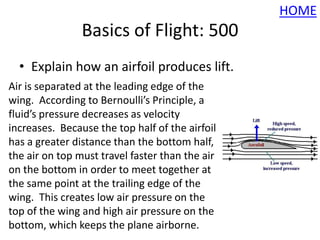
  • Explain how an airfoil produces lift.
Air is separated at the leading edge of the
wing. According to Bernoulli’s Principle, a
fluid’s pressure decreases as velocity
increases. Because the top half of the airfoil
has a greater distance than the bottom half,
the air on top must travel faster than the air
on the bottom in order to meet together at
the same point at the trailing edge of the
wing. This creates low air pressure on the
top of the wing and high air pressure on the
bottom, which keeps the plane airborne.
HOME
          Aircraft Instruments: 100
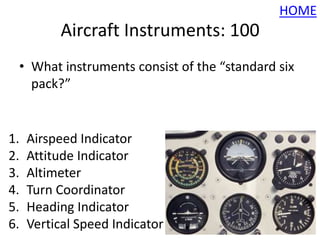
 • What instruments consist of the “standard six
   pack?”


1.   Airspeed Indicator
2.   Attitude Indicator
3.   Altimeter
4.   Turn Coordinator
5.   Heading Indicator
6.   Vertical Speed Indicator
HOME
        Aircraft Instruments: 200
 • Does the airspeed indicator indicate speed
   through the air or over the ground?


Through the air (AIRspeed indicator)
HOME
        Aircraft Instruments: 300
 • What three pieces of information does the
   attitude indicator tell you at a glance?


1. Degrees of pitch
2. Degrees of bank
3. Climb or descent
HOME
        Aircraft Instruments: 400
 • What outside element effects the changes for
   the altimeter and the vertical speed indicator
   and what measures this element?


Air pressure measured by static port
HOME
        Aircraft Instruments: 500
 • Your attitude indicator has just failed. What
   other instruments can you use that will tell
   you the same information and why?


1. Turn Coordinator - indicates bank
2. VSI - indicates climb or descent,
   remember 4 second delay!
HOME
 Signs, Markings, and Diagrams: 100
 • What do the colors of the backgrounds of
   signs on the field mean (red, yellow, black)?


1. red = caution
2. yellow = direction
3. black = location
HOME
 Signs, Markings, and Diagrams: 200
 • What are the two types of X’s, where are they
   found, and what do they mean?


Raised and painted; runways and
taxiways; closed
HOME
 Signs, Markings, and Diagrams: 300
 • What is the purpose of hold short lines? What
   are the consequences for crossing them
   without authorization?
Hold short lines are to keep planes
out of potentially hazardous areas
such as runways without an ATC
clearance. If crossed without a
clearance, pilots can get an
infraction warning from the FAA and
possibly have their license revoked.
HOME
 Signs, Markings, and Diagrams: 400
 • What do the amount of lines that consist of
   the threshold indicate to pilots?

By counting the amount of lines that
make up the runway threshold, a
pilot can determine the width (left to
right) of the runway. This is
especially useful in emergency
landing situations to ensure the
plane will fit on the runway.
HOME
     Signs, Markings, and Diagrams: 500
 • Give at least four examples of pertinent
   information that can be found on an airport
   diagram.
1.   airport information
2.   runways (dimensions/elevations)
3.   taxiways
4.   ramps
5.   world coordinates
6.   magnetic variation
7.   currency dates
HOME
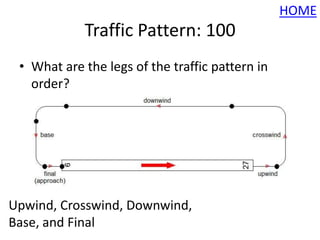
            Traffic Pattern: 100
 • What are the legs of the traffic pattern in
   order?


Upwind, Crosswind, Downwind,
Base, and Final
HOME
             Traffic Pattern: 200
 • How can the traffic pattern be related
   mathematically?


The traffic pattern represents a big
rectangle. With each turn,
depending on the direction, a
heading can be assigned to each leg
given the heading on takeoff.
HOME
            Traffic Pattern: 300
 • Which directional pattern is standard and
   what would be the reason for not following
   this standard?

standard: left-hand
We would fly a right-hand traffic
pattern in the case of parallel
runways because if both runways
use the left-hand pattern, the
patterns would overlap each other.
HOME
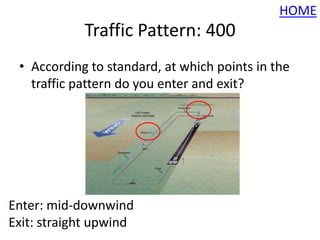
            Traffic Pattern: 400
 • According to standard, at which points in the
   traffic pattern do you enter and exit?


Enter: mid-downwind
Exit: straight upwind
HOME
               Traffic Pattern: 500
  • Describe the six major checkpoints
    throughout the traffic pattern.
1. upwind - begin crosswind turn
   approximately 700 ft. AGL
2. downwind - level off at 1,000 ft. AGL and
   power back to approximately 2300 RPM
3. downwind - abeam #s... power, pitch,
   flaps, 85 knots
4. base - flaps 20, 75 knots
5. final - flaps full, 65 knots
6. final - idle power and flare over
   threshold
HOME
             Communication: 100
 • What are the 4 Ws?


1.   Who you’re addressing
2.   Who you are
3.   Where you are
4.   What you want
HOME
           Communication: 200
 • Who controls ramps and taxiways, and who
   controls runways and airspace?


Ground: ramps/taxiways
Tower: runways/airspace
HOME
               Communication: 300
 • Transmit to Peachtree Ground given the
   following information:
    –   Peachtree Tower
    –   Cessna 78253
    –   Epps Ramp
    –   VFR to the north


Peachtree Tower, Cessna 78253 is on
the Epps ramp, VFR to the north
with information.
HOME
             Communication: 400
 • Read back the following ATC instructions:
    – Cessna 78253, Peachtree Tower. Cleared to land runway
      2L, number 3 behind the Mooney, advise traffic in sight.
      Winds are 30 at 4. Caution: cranes are operating in the
      vicinity and balloons are being released from the ground
      approximately 03 miles to the south of the field.


Peachtree Tower, Cessna 78253.
Cleared to land runway 2L, number 3
behind the Mooney and will advise.
HOME
             Communication: 500
 • Read back the following ATC instructions:
    – Cessna 78253, Peachtree Tower. Fly midfield at or above
      2,000, enter left downwind runway 2L and I’ll call your
      base.


Peachtree Tower, Cessna 78253. Fly
midfield at or below 2,000, left
downwind runway 2L.
HOME
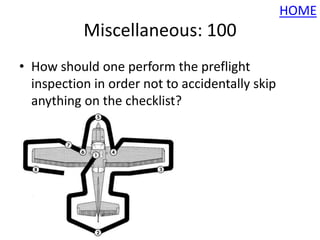
           Miscellaneous: 100
• How should one perform the preflight
  inspection in order not to accidentally skip
  anything on the checklist?
HOME
             Miscellaneous: 200
 • Why can ice be harmful when it builds up on
   the airframe of the plane?


                                       You don’t want this to
Ice buildup on the plane, especially   happen! By the way, this
on the wings, can drastically change   is an Airbus.

the shape of the airfoil, therefore
not allowing it to produce lift the
same way which is potentially
dangerous.
HOME
             Miscellaneous: 300
 • Why does Vs increase as the weight of the
   plane increases?


The more weight you put in the
plane, the more lift you need to
support that weight; therefore, the
stall speed will increase as you add
weight to the plane.
HOME
           Miscellaneous: 400
 • For how long should you hold the nose fuel
   sump?


Approximately 4 seconds
HOME
              Miscellaneous: 500
    • How many counterbalances does the aileron
      have?


3
FINISH
                 Final Jeopardy
              Place your wagers. Minimum = 100

 • What does ATP stand for and what is the main
   use of this certification?


Airline Transport Pilot - mostly used
for airline captains because the
captain is required to hold an ATP
Game Over
• Congratulations to the winning team!!!

Semester 1 Review (Groups B/C/D)

  • 1.
    Semester 1 Review Groups B/C/D First Year Beginning Second Year Advanced
  • 2.
    Rules • ONE personmay speak at a time • Hand must be raised in order to answer (sorry... that rule is no fun) • Opposing team can steal if question cannot be answered in a reasonable amount of time • Interruptions will result in a 100 point deduction • Winning team receives FAA “Crossing the Line” water bottles!!
  • 3.
    How many peoplecan speak at a time? ONE!!
  • 4.
    Home - Categories Basicsof Aircraft Signs, Traffic Flight Instruments Markings, Pattern Communication Miscellaneous and Diagrams 100 100 100 100 100 100 200 200 200 200 200 200 300 300 300 300 300 300 400 400 400 400 400 400 500 500 500 500 500 500 FINAL JEOPARDY
  • 5.
    HOME Basics of Flight: 100 • What is the name of the scientific principle that allows an airfoil to create lift, and who is it credited to? Bernoulli’s Principle, Daniel Bernoulli
  • 6.
    HOME Basics of Flight: 200 • What are the four forces of flight and in which directions do they act? Lift, up; Weight/Gravity, down; Thrust, forward; Drag, downward
  • 7.
    HOME Basics of Flight: 300 • Define the following terms: – Angle of Attack – Critical Angle of Attack Angle of Attack - angle between wing chord and relative wind Critical Angle of Attack - AOA in which the wing cannot produce sufficient lift and stalls if exceeded
  • 8.
    HOME Basics of Flight: 400 • Explain in general how the control surfaces of the airplane work when manipulated. When a control surface is lowered or raised, it either adds to or takes away from the available surface area of that airfoil to produce lift. When the control surface is lowered, surface area is increased, therefore lift is increased and vice versa.
  • 9.
    HOME Basics of Flight: 500 • Explain how an airfoil produces lift. Air is separated at the leading edge of the wing. According to Bernoulli’s Principle, a fluid’s pressure decreases as velocity increases. Because the top half of the airfoil has a greater distance than the bottom half, the air on top must travel faster than the air on the bottom in order to meet together at the same point at the trailing edge of the wing. This creates low air pressure on the top of the wing and high air pressure on the bottom, which keeps the plane airborne.
  • 10.
    HOME Aircraft Instruments: 100 • What instruments consist of the “standard six pack?” 1. Airspeed Indicator 2. Attitude Indicator 3. Altimeter 4. Turn Coordinator 5. Heading Indicator 6. Vertical Speed Indicator
  • 11.
    HOME Aircraft Instruments: 200 • Does the airspeed indicator indicate speed through the air or over the ground? Through the air (AIRspeed indicator)
  • 12.
    HOME Aircraft Instruments: 300 • What three pieces of information does the attitude indicator tell you at a glance? 1. Degrees of pitch 2. Degrees of bank 3. Climb or descent
  • 13.
    HOME Aircraft Instruments: 400 • What outside element effects the changes for the altimeter and the vertical speed indicator and what measures this element? Air pressure measured by static port
  • 14.
    HOME Aircraft Instruments: 500 • Your attitude indicator has just failed. What other instruments can you use that will tell you the same information and why? 1. Turn Coordinator - indicates bank 2. VSI - indicates climb or descent, remember 4 second delay!
  • 15.
    HOME Signs, Markings,and Diagrams: 100 • What do the colors of the backgrounds of signs on the field mean (red, yellow, black)? 1. red = caution 2. yellow = direction 3. black = location
  • 16.
    HOME Signs, Markings,and Diagrams: 200 • What are the two types of X’s, where are they found, and what do they mean? Raised and painted; runways and taxiways; closed
  • 17.
    HOME Signs, Markings,and Diagrams: 300 • What is the purpose of hold short lines? What are the consequences for crossing them without authorization? Hold short lines are to keep planes out of potentially hazardous areas such as runways without an ATC clearance. If crossed without a clearance, pilots can get an infraction warning from the FAA and possibly have their license revoked.
  • 18.
    HOME Signs, Markings,and Diagrams: 400 • What do the amount of lines that consist of the threshold indicate to pilots? By counting the amount of lines that make up the runway threshold, a pilot can determine the width (left to right) of the runway. This is especially useful in emergency landing situations to ensure the plane will fit on the runway.
  • 19.
    HOME Signs, Markings, and Diagrams: 500 • Give at least four examples of pertinent information that can be found on an airport diagram. 1. airport information 2. runways (dimensions/elevations) 3. taxiways 4. ramps 5. world coordinates 6. magnetic variation 7. currency dates
  • 20.
    HOME Traffic Pattern: 100 • What are the legs of the traffic pattern in order? Upwind, Crosswind, Downwind, Base, and Final
  • 21.
    HOME Traffic Pattern: 200 • How can the traffic pattern be related mathematically? The traffic pattern represents a big rectangle. With each turn, depending on the direction, a heading can be assigned to each leg given the heading on takeoff.
  • 22.
    HOME Traffic Pattern: 300 • Which directional pattern is standard and what would be the reason for not following this standard? standard: left-hand We would fly a right-hand traffic pattern in the case of parallel runways because if both runways use the left-hand pattern, the patterns would overlap each other.
  • 23.
    HOME Traffic Pattern: 400 • According to standard, at which points in the traffic pattern do you enter and exit? Enter: mid-downwind Exit: straight upwind
  • 24.
    HOME Traffic Pattern: 500 • Describe the six major checkpoints throughout the traffic pattern. 1. upwind - begin crosswind turn approximately 700 ft. AGL 2. downwind - level off at 1,000 ft. AGL and power back to approximately 2300 RPM 3. downwind - abeam #s... power, pitch, flaps, 85 knots 4. base - flaps 20, 75 knots 5. final - flaps full, 65 knots 6. final - idle power and flare over threshold
  • 25.
    HOME Communication: 100 • What are the 4 Ws? 1. Who you’re addressing 2. Who you are 3. Where you are 4. What you want
  • 26.
    HOME Communication: 200 • Who controls ramps and taxiways, and who controls runways and airspace? Ground: ramps/taxiways Tower: runways/airspace
  • 27.
    HOME Communication: 300 • Transmit to Peachtree Ground given the following information: – Peachtree Tower – Cessna 78253 – Epps Ramp – VFR to the north Peachtree Tower, Cessna 78253 is on the Epps ramp, VFR to the north with information.
  • 28.
    HOME Communication: 400 • Read back the following ATC instructions: – Cessna 78253, Peachtree Tower. Cleared to land runway 2L, number 3 behind the Mooney, advise traffic in sight. Winds are 30 at 4. Caution: cranes are operating in the vicinity and balloons are being released from the ground approximately 03 miles to the south of the field. Peachtree Tower, Cessna 78253. Cleared to land runway 2L, number 3 behind the Mooney and will advise.
  • 29.
    HOME Communication: 500 • Read back the following ATC instructions: – Cessna 78253, Peachtree Tower. Fly midfield at or above 2,000, enter left downwind runway 2L and I’ll call your base. Peachtree Tower, Cessna 78253. Fly midfield at or below 2,000, left downwind runway 2L.
  • 30.
    HOME Miscellaneous: 100 • How should one perform the preflight inspection in order not to accidentally skip anything on the checklist?
  • 31.
    HOME Miscellaneous: 200 • Why can ice be harmful when it builds up on the airframe of the plane? You don’t want this to Ice buildup on the plane, especially happen! By the way, this on the wings, can drastically change is an Airbus. the shape of the airfoil, therefore not allowing it to produce lift the same way which is potentially dangerous.
  • 32.
    HOME Miscellaneous: 300 • Why does Vs increase as the weight of the plane increases? The more weight you put in the plane, the more lift you need to support that weight; therefore, the stall speed will increase as you add weight to the plane.
  • 33.
    HOME Miscellaneous: 400 • For how long should you hold the nose fuel sump? Approximately 4 seconds
  • 34.
    HOME Miscellaneous: 500 • How many counterbalances does the aileron have? 3
  • 35.
    FINISH Final Jeopardy Place your wagers. Minimum = 100 • What does ATP stand for and what is the main use of this certification? Airline Transport Pilot - mostly used for airline captains because the captain is required to hold an ATP
  • 36.
    Game Over • Congratulationsto the winning team!!!