Colorectal cancer screening: overview & background January 8,2007 David A. Haggstrom, MD, MAS LEADERS SYMPOSIUM “ Strategic Planning to Inform a Funded Project on how to Achieve Workflow Integration in Developing  and Implementing CDS for CRC Screening”
Outline CRC screening practice guidelines Competing clinical demands for CRC screening Applied research for screening Clinical decision support Facilitators & barriers Practice-based interventions
Colorectal cancer screening Clinical practice guidelines Target population :  men & women 50 years of age & older at average risk for colorectal cancer Caveat (VA/DoD) :  providers should discuss screening with patients ages 80 & older, taking into account estimated life expectancy & presence of co-morbid disease
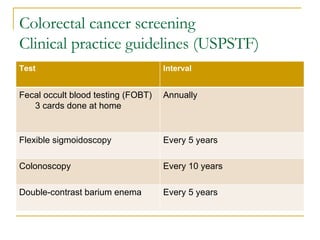
Colorectal cancer screening Clinical practice guidelines (USPSTF) Test Interval Fecal occult blood testing (FOBT) 3 cards done at home Annually Flexible sigmoidoscopy Every 5 years Colonoscopy Every 10 years Double-contrast barium enema Every 5 years
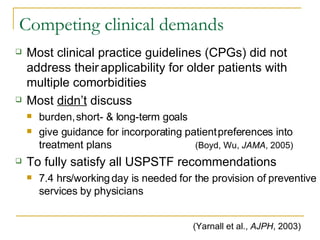
Competing clinical demands Most clinical practice guidelines (CPGs) did not address their   applicability for older patients with   multiple comorbidities Most  didn’t  discuss burden,   short- & long-term goals give guidance for incorporating patient   preferences into treatment plans (Boyd, Wu,  JAMA , 2005) To fully satisfy all USPSTF recommendations 7.4 hrs/working   day is needed for the provision of preventive services by physicians (Yarnall et al.,  AJPH , 2003)
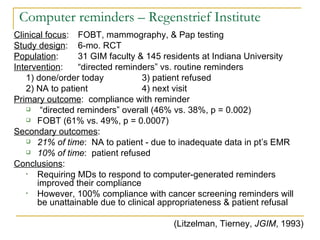
Computer reminders – Regenstrief Institute Clinical focus : FOBT, mammography, & Pap testing Study design : 6-mo. RCT Population : 31 GIM faculty & 145 residents at Indiana University Intervention : “directed reminders” vs. routine reminders 1) done/order today 3) patient refused 2) NA to patient 4) next visit Primary outcome :  compliance with reminder “ directed reminders” overall (46% vs. 38%, p = 0.002) FOBT (61% vs. 49%, p = 0.0007) Secondary outcomes : 21% of time :  NA to patient - due to inadequate data in pt’s EMR 10% of time :  patient refused Conclusions : Requiring MDs to respond to computer-generated reminders improved their compliance However, 100% compliance with cancer screening reminders will be unattainable due to clinical appropriateness & patient refusal (Litzelman, Tierney,  JGIM , 1993)
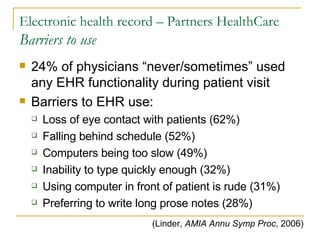
Electronic health record – Partners HealthCare Barriers to use 24% of physicians “never/sometimes” used any EHR functionality during patient visit Barriers to EHR use: Loss of eye contact with patients (62%) Falling behind schedule (52%) Computers being too slow (49%) Inability to type quickly enough (32%) Using computer in front of patient is rude (31%) Preferring to write long prose notes (28%) (Linder,  AMIA Annu Symp Proc , 2006)
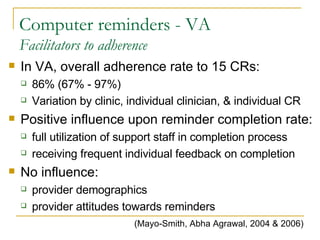
Computer reminders - VA Facilitators to adherence In VA, overall adherence rate to 15 CRs: 86% (67% - 97%) Variation by clinic, individual clinician, & individual CR Positive influence upon reminder completion rate: full utilization of support staff in completion process receiving frequent individual feedback on completion No influence: provider demographics provider attitudes towards reminders (Mayo-Smith, Abha Agrawal, 2004 & 2006)
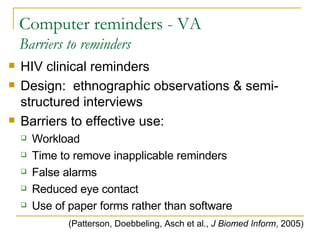
Computer reminders - VA Barriers to reminders HIV clinical reminders Design:  ethnographic observations & semi-structured interviews Barriers to effective use: Workload Time to remove inapplicable reminders False alarms Reduced eye contact Use of paper forms rather than software (Patterson, Doebbeling, Asch et al.,  J Biomed Inform , 2005)
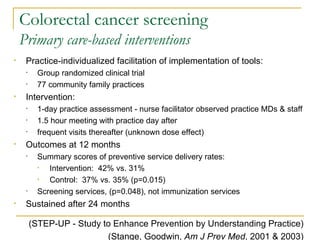
Colorectal cancer screening Primary care-based interventions Practice-individualized facilitation of implementation of tools: Group randomized clinical trial 77 community family practices Intervention: 1-day practice assessment - nurse facilitator observed practice MDs & staff 1.5 hour meeting with practice day after frequent visits thereafter (unknown dose effect) Outcomes at 12 months Summary scores of preventive service delivery rates: Intervention:  42% vs. 31% Control:  37% vs. 35% (p=0.015) Screening services, (p=0.048), not immunization services Sustained after 24 months (STEP-UP - Study to Enhance Prevention by Understanding Practice) (Stange, Goodwin,  Am J Prev Med , 2001 & 2003)
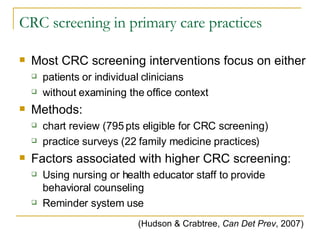
CRC screening in primary care practices Most CRC screening interventions focus on either patients or individual clinicians without examining the office context Methods: chart review (795 pts eligible for CRC screening) practice surveys (22 family medicine practices) Factors associated with higher CRC screening: Using nursing or health educator staff to provide behavioral counseling Reminder system use (Hudson & Crabtree,  Can Det Prev , 2007)
Conclusions Generally positive, but sometimes mixed, results for clinical, computer reminders Direct observation & qualitative methods provide opportunity to understand potential pathways for effectiveness of clinical reminders Computer reminders Need not only to incorporate evidence base, but address patient preferences & comorbidities Prior positive experience with practice change Computer reminder often key component Team-based approach also important, particularly to help address competing time demands
Questions or comments?
Systems engineering framework Identify system of interest Choose appropriate performance measure Select best modeling tool Study model properties & behavior under variety of scenarios Make design & operation decisions for implementation previous applications in hemodialysis, radiation therapy, & patient flow modeling (Kopach-Konrad, Doebbeling et al.,  JGIM , 2007)

David Haggstrom Slides from AHRQ Kick-Off Event

  • 1.
    Colorectal cancer screening:overview & background January 8,2007 David A. Haggstrom, MD, MAS LEADERS SYMPOSIUM “ Strategic Planning to Inform a Funded Project on how to Achieve Workflow Integration in Developing and Implementing CDS for CRC Screening”
  • 2.
    Outline CRC screeningpractice guidelines Competing clinical demands for CRC screening Applied research for screening Clinical decision support Facilitators & barriers Practice-based interventions
  • 3.
    Colorectal cancer screeningClinical practice guidelines Target population : men & women 50 years of age & older at average risk for colorectal cancer Caveat (VA/DoD) : providers should discuss screening with patients ages 80 & older, taking into account estimated life expectancy & presence of co-morbid disease
  • 4.
    Colorectal cancer screeningClinical practice guidelines (USPSTF) Test Interval Fecal occult blood testing (FOBT) 3 cards done at home Annually Flexible sigmoidoscopy Every 5 years Colonoscopy Every 10 years Double-contrast barium enema Every 5 years
  • 5.
    Competing clinical demandsMost clinical practice guidelines (CPGs) did not address their applicability for older patients with multiple comorbidities Most didn’t discuss burden, short- & long-term goals give guidance for incorporating patient preferences into treatment plans (Boyd, Wu, JAMA , 2005) To fully satisfy all USPSTF recommendations 7.4 hrs/working day is needed for the provision of preventive services by physicians (Yarnall et al., AJPH , 2003)
  • 6.
    Computer reminders –Regenstrief Institute Clinical focus : FOBT, mammography, & Pap testing Study design : 6-mo. RCT Population : 31 GIM faculty & 145 residents at Indiana University Intervention : “directed reminders” vs. routine reminders 1) done/order today 3) patient refused 2) NA to patient 4) next visit Primary outcome : compliance with reminder “ directed reminders” overall (46% vs. 38%, p = 0.002) FOBT (61% vs. 49%, p = 0.0007) Secondary outcomes : 21% of time : NA to patient - due to inadequate data in pt’s EMR 10% of time : patient refused Conclusions : Requiring MDs to respond to computer-generated reminders improved their compliance However, 100% compliance with cancer screening reminders will be unattainable due to clinical appropriateness & patient refusal (Litzelman, Tierney, JGIM , 1993)
  • 7.
    Electronic health record– Partners HealthCare Barriers to use 24% of physicians “never/sometimes” used any EHR functionality during patient visit Barriers to EHR use: Loss of eye contact with patients (62%) Falling behind schedule (52%) Computers being too slow (49%) Inability to type quickly enough (32%) Using computer in front of patient is rude (31%) Preferring to write long prose notes (28%) (Linder, AMIA Annu Symp Proc , 2006)
  • 8.
    Computer reminders -VA Facilitators to adherence In VA, overall adherence rate to 15 CRs: 86% (67% - 97%) Variation by clinic, individual clinician, & individual CR Positive influence upon reminder completion rate: full utilization of support staff in completion process receiving frequent individual feedback on completion No influence: provider demographics provider attitudes towards reminders (Mayo-Smith, Abha Agrawal, 2004 & 2006)
  • 9.
    Computer reminders -VA Barriers to reminders HIV clinical reminders Design: ethnographic observations & semi-structured interviews Barriers to effective use: Workload Time to remove inapplicable reminders False alarms Reduced eye contact Use of paper forms rather than software (Patterson, Doebbeling, Asch et al., J Biomed Inform , 2005)
  • 10.
    Colorectal cancer screeningPrimary care-based interventions Practice-individualized facilitation of implementation of tools: Group randomized clinical trial 77 community family practices Intervention: 1-day practice assessment - nurse facilitator observed practice MDs & staff 1.5 hour meeting with practice day after frequent visits thereafter (unknown dose effect) Outcomes at 12 months Summary scores of preventive service delivery rates: Intervention: 42% vs. 31% Control: 37% vs. 35% (p=0.015) Screening services, (p=0.048), not immunization services Sustained after 24 months (STEP-UP - Study to Enhance Prevention by Understanding Practice) (Stange, Goodwin, Am J Prev Med , 2001 & 2003)
  • 11.
    CRC screening inprimary care practices Most CRC screening interventions focus on either patients or individual clinicians without examining the office context Methods: chart review (795 pts eligible for CRC screening) practice surveys (22 family medicine practices) Factors associated with higher CRC screening: Using nursing or health educator staff to provide behavioral counseling Reminder system use (Hudson & Crabtree, Can Det Prev , 2007)
  • 12.
    Conclusions Generally positive,but sometimes mixed, results for clinical, computer reminders Direct observation & qualitative methods provide opportunity to understand potential pathways for effectiveness of clinical reminders Computer reminders Need not only to incorporate evidence base, but address patient preferences & comorbidities Prior positive experience with practice change Computer reminder often key component Team-based approach also important, particularly to help address competing time demands
  • 13.
  • 14.
    Systems engineering frameworkIdentify system of interest Choose appropriate performance measure Select best modeling tool Study model properties & behavior under variety of scenarios Make design & operation decisions for implementation previous applications in hemodialysis, radiation therapy, & patient flow modeling (Kopach-Konrad, Doebbeling et al., JGIM , 2007)