ASCO GI 2014 Update:
Personalized Medicine in CRC
Colon Cancer Alliance/Fight Colorectal Cancer
Webinar
February 19, 2014
Allyson J. Ocean, M.D.
Associate Professor of Clinical Medicine
Weill Cornell Medical College
ASCO GI 2014 Update

Allyson Ocean, M.D.

Melissa Bjorklund

Randy Henniger

Kim Ryan
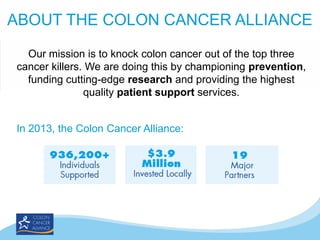
ABOUT THE COLON CANCER ALLIANCE
Our mission is to knock colon cancer out of the top three
cancer killers. We are doing this by championing prevention,
funding cutting-edge research and providing the highest
quality patient support services.
In 2013, the Colon Cancer Alliance:
OUR PILLARS
Prevention

Research

Patient Support
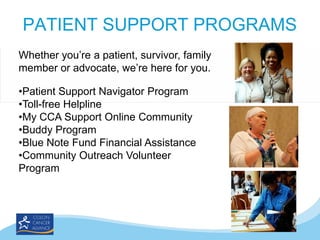
PATIENT SUPPORT PROGRAMS
Whether you’re a patient, survivor, family
member or advocate, we’re here for you.

•Patient Support Navigator Program
•Toll-free Helpline
•My CCA Support Online Community
•Buddy Program
•Blue Note Fund Financial Assistance
•Community Outreach Volunteer
Program
GET INVOLVED
March is National Colon Cancer Awareness Month!
Find an event or join us at coloncancermonth.org.
Upcoming events:
March 1 – Colon Cancer Awareness Month Kickoff
March 5 – Colon Cancer Survivor Day
March 7 – National Dress in Blue Day
FOR MORE INFORMATION &
REPLAY
www.ccalliance.org
(877) 422-2030
Fight Colorectal Cancer
FightColorectalCancer.org or call 1-877-427-2111
Mission
Fight Colorectal Cancer demands a cure for colon and rectal cancer. We
educate and support patients, push for changes in policy that will increase and
improve research, and empower survivors to raise their voices against the status
quo.

Facebook.com/FightCRC
Twitter.com/FightCRC
YouTube.com/FightCRC
Instagram.com/FightCRC
Pinterest.com/FightCRC
CRC: Epidemiology in 2013
 Fourth most common cancer
diagnosis in US[1]
 Estimated 142,820 new cases in
2013; 1:1 male:female ratio[2]

 Second leading cause of cancer
deaths in 2013 (estimated 50,830
deaths)[1]
 Steady decrease in age-adjusted
incidence rates of distal colon,
proximal colon, and rectal cancers
in 1976-2005[4]

Death Rates in 2008,
per 100,000[3], %
Male

Female

All races

20.2

14.1

White

19.5

13.6

Black

29.8

19.8

Asian/Pacific Islander

13.1

9.6

American Indian/ Alaska
Native

18.8

14.6

Hispanic

15.3

10.2

1. American Cancer Society. Cancer facts & figures. 2013. 2. Siegel R, et al. CA Cancer
J Clin. 2012;62:10-29. 3. SEER. Stat fact sheets: colon and rectum. 4. Cheng L, et al. Am Clin Oncol.
2011;34:573-580.
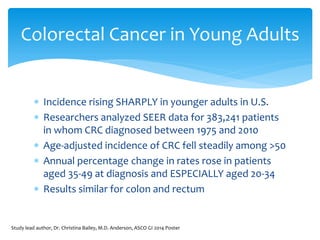
Colorectal Cancer in Young Adults
 Incidence rising SHARPLY in younger adults in U.S.
 Researchers analyzed SEER data for 383,241 patients
in whom CRC diagnosed between 1975 and 2010
 Age-adjusted incidence of CRC fell steadily among >50
 Annual percentage change in rates rose in patients
aged 35-49 at diagnosis and ESPECIALLY aged 20-34
 Results similar for colon and rectum

Study lead author, Dr. Christina Bailey, M.D. Anderson, ASCO GI 2014 Poster
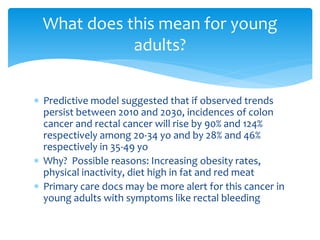
What does this mean for young
adults?
 Predictive model suggested that if observed trends
persist between 2010 and 2030, incidences of colon
cancer and rectal cancer will rise by 90% and 124%
respectively among 20-34 yo and by 28% and 46%
respectively in 35-49 yo
 Why? Possible reasons: Increasing obesity rates,
physical inactivity, diet high in fat and red meat
 Primary care docs may be more alert for this cancer in
young adults with symptoms like rectal bleeding
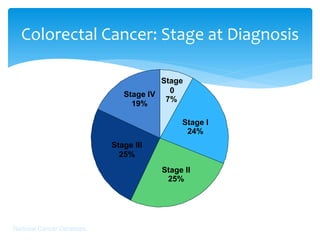
Colorectal Cancer: Stage at Diagnosis
Stage
0
Stage IV
7%
19%
Stage I
24%
Stage III
25%
Stage II
25%

National Cancer Database.
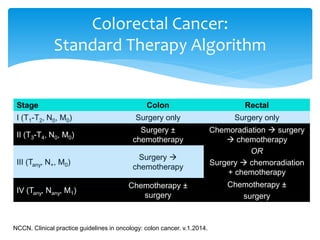
Colorectal Cancer:
Standard Therapy Algorithm

Stage

Colon

Rectal

I (T1-T2, N0, M0)

Surgery only

Surgery only

II (T3-T4, N0, M0)

Surgery ±
chemotherapy

III (Tany, N+, M0)

Surgery 
chemotherapy

Chemoradiation  surgery
 chemotherapy
OR
Surgery  chemoradiation
+ chemotherapy

IV (Tany, Nany, M1)

Chemotherapy ±
surgery

NCCN. Clinical practice guidelines in oncology: colon cancer. v.1.2014.

Chemotherapy ±
surgery
Early Stage Disease
Oncotype DX News
 Through an analysis of physician recommendations and patient
treatment preferences before and after receiving the Oncotype
DX colon cancer test results, this study demonstrated that the
test greatly increased concordance between physician and
patient treatment choice (from 66 percent to 96 percent).
 Recurrence Score® result influenced a majority of patients'
treatment decisions (85 percent) and physicians' treatment
recommendations (69 percent), and it increased physicians'
confidence in their own recommendations (84 percent).
 Patients' anxiety was also significantly reduced, which may
improve adherence to their treatment plan and ultimately lead
to better health outcomes.
Oncotype DX
 The review of four validation studies of the Oncotype DX
colon cancer test (3,315 patients) with early stage colon
cancer, consistently demonstrated a significant association
(p < 0.05) between the test results and recurrence risk and
cancer-specific survival.
 Three decision impact studies with a total of 502 patients
showed that the test changed treatment
recommendations in 29 to 45 percent of stage II colon
cancer cases, leading to a net reduction in adjuvant
chemotherapy use.
Final Results of NSABP R-04
 Phase III randomized trial in neoadjuvant rectal cancer- mature
results presented
 Combining preoperative radiation with oral capecitabine
(Xeloda) was equally as effective as our old standby, infusional
5-FU chemo, in terms of local-regional recurrence rates
 Largest clinical trial showing no difference in clinical benefit
 Provides for better quality of life for patients
 Not tied down to getting a catheter treatment and able to take
an oral agent
 Adding oxaliplatin to either treatment did not improve clinical
response rates
Allegra et. al ASCO GI 2014 Abstract 390
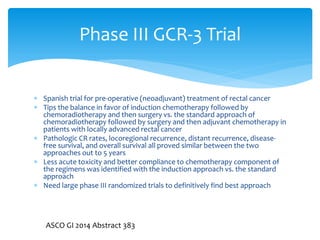
Phase III GCR-3 Trial
 Spanish trial for pre-operative (neoadjuvant) treatment of rectal cancer
 Tips the balance in favor of induction chemotherapy followed by
chemoradiotherapy and then surgery vs. the standard approach of
chemoradiotherapy followed by surgery and then adjuvant chemotherapy in
patients with locally advanced rectal cancer
 Pathologic CR rates, locoregional recurrence, distant recurrence, diseasefree survival, and overall survival all proved similar between the two
approaches out to 5 years
 Less acute toxicity and better compliance to chemotherapy component of
the regimens was identified with the induction approach vs. the standard
approach
 Need large phase III randomized trials to definitively find best approach

ASCO GI 2014 Abstract 383
Metastatic Disease
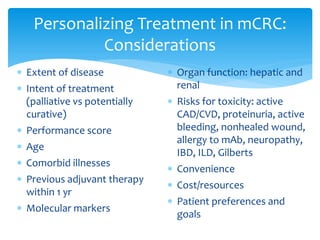
Personalizing Treatment in mCRC:
Considerations
 Extent of disease

 Intent of treatment
(palliative vs potentially
curative)
 Performance score
 Age
 Comorbid illnesses
 Previous adjuvant therapy
within 1 yr
 Molecular markers

 Organ function: hepatic and
renal
 Risks for toxicity: active
CAD/CVD, proteinuria, active
bleeding, nonhealed wound,
allergy to mAb, neuropathy,
IBD, ILD, Gilberts
 Convenience
 Cost/resources
 Patient preferences and
goals
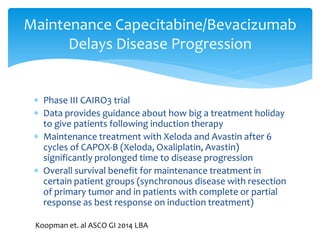
Maintenance Capecitabine/Bevacizumab
Delays Disease Progression

 Phase III CAIRO3 trial
 Data provides guidance about how big a treatment holiday
to give patients following induction therapy
 Maintenance treatment with Xeloda and Avastin after 6
cycles of CAPOX-B (Xeloda, Oxaliplatin, Avastin)
significantly prolonged time to disease progression
 Overall survival benefit for maintenance treatment in
certain patient groups (synchronous disease with resection
of primary tumor and in patients with complete or partial
response as best response on induction treatment)
Koopman et. al ASCO GI 2014 LBA
Improving outcome for CRC patients

 Studies focused on leveraging prognostic and predictive
information
 More extensive genetic testing for RAS gene mutations
beyond routine analysis of K-RAS exon 2 may soon become
a new standard of care to pinpoint which patients stand to
benefit from anti-EGFR therapy
 K-RAS mutations present in approximately 40-50% of mCRC
tumors
 If K-RAS mutation present- can’t use Erbitux or Vectibix
Peeters et. al, ASCO GI 2014 Abstract LBA387
Irinotecan drug-eluting beads
(DEBIRI)
 Addition of DEBIRI to 1st line FOLFOX in unresectable liver-limited
metastatic CRC enables downstaging and subsequent resection
in more than 1/3 of patients
 Placement of the beads in the hepatic artery did not increase
chemotherapy toxicity or compromise overall treatment delivery
 This phase II trial was conducted in 70 patients with CRC with
liver metastases
 Irinotecan beads administered to hepatic artery during off week
of chemotherapy; outpatient procedure
 Key is finding the patients most appropriate for this therapy

Martin et. al, ASCO GI 2014 Abstract 174
Thoughts/Conclusions/Questions
 Personalized medicine: What does it mean for YOU?
 Ask about the genetics of your tumor
 Ask about the K-RAS mutations of your tumor
 Ask about genome sequencing of your tumor

 Take advantage of educational websites
 CCA, Fight CRC, Michael’s Mission
 Connect with other patients and survivors
 Links to novel treatments

RESEARCH & TREATMENT NEWS: Highlights from the 2014 GI Cancer Symposium

  • 1.
    ASCO GI 2014Update: Personalized Medicine in CRC Colon Cancer Alliance/Fight Colorectal Cancer Webinar February 19, 2014 Allyson J. Ocean, M.D. Associate Professor of Clinical Medicine Weill Cornell Medical College
  • 2.
    ASCO GI 2014Update Allyson Ocean, M.D. Melissa Bjorklund Randy Henniger Kim Ryan
  • 3.
    ABOUT THE COLONCANCER ALLIANCE Our mission is to knock colon cancer out of the top three cancer killers. We are doing this by championing prevention, funding cutting-edge research and providing the highest quality patient support services. In 2013, the Colon Cancer Alliance:
  • 4.
  • 5.
    PATIENT SUPPORT PROGRAMS Whetheryou’re a patient, survivor, family member or advocate, we’re here for you. •Patient Support Navigator Program •Toll-free Helpline •My CCA Support Online Community •Buddy Program •Blue Note Fund Financial Assistance •Community Outreach Volunteer Program
  • 6.
    GET INVOLVED March isNational Colon Cancer Awareness Month! Find an event or join us at coloncancermonth.org. Upcoming events: March 1 – Colon Cancer Awareness Month Kickoff March 5 – Colon Cancer Survivor Day March 7 – National Dress in Blue Day
  • 7.
    FOR MORE INFORMATION& REPLAY www.ccalliance.org (877) 422-2030
  • 8.
    Fight Colorectal Cancer FightColorectalCancer.orgor call 1-877-427-2111 Mission Fight Colorectal Cancer demands a cure for colon and rectal cancer. We educate and support patients, push for changes in policy that will increase and improve research, and empower survivors to raise their voices against the status quo. Facebook.com/FightCRC Twitter.com/FightCRC YouTube.com/FightCRC Instagram.com/FightCRC Pinterest.com/FightCRC
  • 9.
    CRC: Epidemiology in2013  Fourth most common cancer diagnosis in US[1]  Estimated 142,820 new cases in 2013; 1:1 male:female ratio[2]  Second leading cause of cancer deaths in 2013 (estimated 50,830 deaths)[1]  Steady decrease in age-adjusted incidence rates of distal colon, proximal colon, and rectal cancers in 1976-2005[4] Death Rates in 2008, per 100,000[3], % Male Female All races 20.2 14.1 White 19.5 13.6 Black 29.8 19.8 Asian/Pacific Islander 13.1 9.6 American Indian/ Alaska Native 18.8 14.6 Hispanic 15.3 10.2 1. American Cancer Society. Cancer facts & figures. 2013. 2. Siegel R, et al. CA Cancer J Clin. 2012;62:10-29. 3. SEER. Stat fact sheets: colon and rectum. 4. Cheng L, et al. Am Clin Oncol. 2011;34:573-580.
  • 10.
    Colorectal Cancer inYoung Adults  Incidence rising SHARPLY in younger adults in U.S.  Researchers analyzed SEER data for 383,241 patients in whom CRC diagnosed between 1975 and 2010  Age-adjusted incidence of CRC fell steadily among >50  Annual percentage change in rates rose in patients aged 35-49 at diagnosis and ESPECIALLY aged 20-34  Results similar for colon and rectum Study lead author, Dr. Christina Bailey, M.D. Anderson, ASCO GI 2014 Poster
  • 11.
    What does thismean for young adults?  Predictive model suggested that if observed trends persist between 2010 and 2030, incidences of colon cancer and rectal cancer will rise by 90% and 124% respectively among 20-34 yo and by 28% and 46% respectively in 35-49 yo  Why? Possible reasons: Increasing obesity rates, physical inactivity, diet high in fat and red meat  Primary care docs may be more alert for this cancer in young adults with symptoms like rectal bleeding
  • 12.
    Colorectal Cancer: Stageat Diagnosis Stage 0 Stage IV 7% 19% Stage I 24% Stage III 25% Stage II 25% National Cancer Database.
  • 13.
    Colorectal Cancer: Standard TherapyAlgorithm Stage Colon Rectal I (T1-T2, N0, M0) Surgery only Surgery only II (T3-T4, N0, M0) Surgery ± chemotherapy III (Tany, N+, M0) Surgery  chemotherapy Chemoradiation  surgery  chemotherapy OR Surgery  chemoradiation + chemotherapy IV (Tany, Nany, M1) Chemotherapy ± surgery NCCN. Clinical practice guidelines in oncology: colon cancer. v.1.2014. Chemotherapy ± surgery
  • 14.
  • 15.
    Oncotype DX News Through an analysis of physician recommendations and patient treatment preferences before and after receiving the Oncotype DX colon cancer test results, this study demonstrated that the test greatly increased concordance between physician and patient treatment choice (from 66 percent to 96 percent).  Recurrence Score® result influenced a majority of patients' treatment decisions (85 percent) and physicians' treatment recommendations (69 percent), and it increased physicians' confidence in their own recommendations (84 percent).  Patients' anxiety was also significantly reduced, which may improve adherence to their treatment plan and ultimately lead to better health outcomes.
  • 16.
    Oncotype DX  Thereview of four validation studies of the Oncotype DX colon cancer test (3,315 patients) with early stage colon cancer, consistently demonstrated a significant association (p < 0.05) between the test results and recurrence risk and cancer-specific survival.  Three decision impact studies with a total of 502 patients showed that the test changed treatment recommendations in 29 to 45 percent of stage II colon cancer cases, leading to a net reduction in adjuvant chemotherapy use.
  • 17.
    Final Results ofNSABP R-04  Phase III randomized trial in neoadjuvant rectal cancer- mature results presented  Combining preoperative radiation with oral capecitabine (Xeloda) was equally as effective as our old standby, infusional 5-FU chemo, in terms of local-regional recurrence rates  Largest clinical trial showing no difference in clinical benefit  Provides for better quality of life for patients  Not tied down to getting a catheter treatment and able to take an oral agent  Adding oxaliplatin to either treatment did not improve clinical response rates Allegra et. al ASCO GI 2014 Abstract 390
  • 18.
    Phase III GCR-3Trial  Spanish trial for pre-operative (neoadjuvant) treatment of rectal cancer  Tips the balance in favor of induction chemotherapy followed by chemoradiotherapy and then surgery vs. the standard approach of chemoradiotherapy followed by surgery and then adjuvant chemotherapy in patients with locally advanced rectal cancer  Pathologic CR rates, locoregional recurrence, distant recurrence, diseasefree survival, and overall survival all proved similar between the two approaches out to 5 years  Less acute toxicity and better compliance to chemotherapy component of the regimens was identified with the induction approach vs. the standard approach  Need large phase III randomized trials to definitively find best approach ASCO GI 2014 Abstract 383
  • 19.
  • 20.
    Personalizing Treatment inmCRC: Considerations  Extent of disease  Intent of treatment (palliative vs potentially curative)  Performance score  Age  Comorbid illnesses  Previous adjuvant therapy within 1 yr  Molecular markers  Organ function: hepatic and renal  Risks for toxicity: active CAD/CVD, proteinuria, active bleeding, nonhealed wound, allergy to mAb, neuropathy, IBD, ILD, Gilberts  Convenience  Cost/resources  Patient preferences and goals
  • 21.
    Maintenance Capecitabine/Bevacizumab Delays DiseaseProgression  Phase III CAIRO3 trial  Data provides guidance about how big a treatment holiday to give patients following induction therapy  Maintenance treatment with Xeloda and Avastin after 6 cycles of CAPOX-B (Xeloda, Oxaliplatin, Avastin) significantly prolonged time to disease progression  Overall survival benefit for maintenance treatment in certain patient groups (synchronous disease with resection of primary tumor and in patients with complete or partial response as best response on induction treatment) Koopman et. al ASCO GI 2014 LBA
  • 22.
    Improving outcome forCRC patients  Studies focused on leveraging prognostic and predictive information  More extensive genetic testing for RAS gene mutations beyond routine analysis of K-RAS exon 2 may soon become a new standard of care to pinpoint which patients stand to benefit from anti-EGFR therapy  K-RAS mutations present in approximately 40-50% of mCRC tumors  If K-RAS mutation present- can’t use Erbitux or Vectibix Peeters et. al, ASCO GI 2014 Abstract LBA387
  • 23.
    Irinotecan drug-eluting beads (DEBIRI) Addition of DEBIRI to 1st line FOLFOX in unresectable liver-limited metastatic CRC enables downstaging and subsequent resection in more than 1/3 of patients  Placement of the beads in the hepatic artery did not increase chemotherapy toxicity or compromise overall treatment delivery  This phase II trial was conducted in 70 patients with CRC with liver metastases  Irinotecan beads administered to hepatic artery during off week of chemotherapy; outpatient procedure  Key is finding the patients most appropriate for this therapy Martin et. al, ASCO GI 2014 Abstract 174
  • 24.
    Thoughts/Conclusions/Questions  Personalized medicine:What does it mean for YOU?  Ask about the genetics of your tumor  Ask about the K-RAS mutations of your tumor  Ask about genome sequencing of your tumor  Take advantage of educational websites  CCA, Fight CRC, Michael’s Mission  Connect with other patients and survivors  Links to novel treatments