Implementation and Evaluation of  Revised CDS Tool January 8 th , 2008 LEADERS SYMPOSIUM “ Strategic Planning to Inform a Funded Project on how to Achieve Workflow Integration in Developing  and Implementing CDS for CRC Screening”
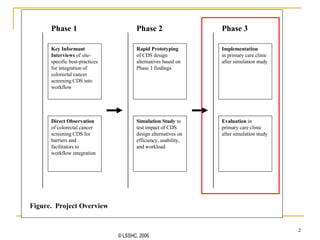
Key Informant Interviews  of site-specific best-practices for integration of colorectal cancer screening CDS into workflow Direct Observation  of colorectal cancer screening CDS for barriers and facilitators to workflow integration Implementation in primary care clinic after simulation study Rapid Prototyping  of CDS design alternatives based on Phase 1 findings Simulation Study  to test impact of CDS design alternatives on efficiency, usability, and workload Evaluation  in primary care clinic after simulation study Figure.  Project Overview Phase 1 Phase 2 Phase 3
Implementation/Evaluation Overview Following simulation study (months 18-21), implementation of the revised CRC CDS tool will occur in two primary care clinics at the Indianapolis VAMC. Measures used to evaluate the impact of the improved CDS, such as efficiency, usability, and workload, will be used as surrogate measures of workflow integration.
Implementation Oversight Project Steering Committee Project champions and sponsors from each of the participating clinics, and the co-I’s on the AHRQ project.  Responsible for project direction, goals, and objectives related to colorectal cancer screening CDS. Administrative Oversight Working Group Project champions from the implementation site, primary care clinic leader or manager, Co-I’s on the AHRQ project, and the project manager Responsible for the site specific tactical, operational, and administrative activities of the implementation, including: Coordinating the implementation team structure Review/Approval of the implementation plans Communication of the project activities among site level participants
Implementation Oversight (con’t) Implementation Teams Front-line staff, including physicians, nurses, nurse managers, other clinical practitioners directly involved in care delivery, and the systems engineer assigned to each team.  Tasked with partnering with systems engineering faculty to learn lean principles and  applying systems engineering methods  to redesign clinical workflow processes supporting effective and efficient screening for CRC
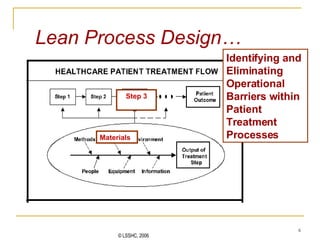
Lean Process Design… Identifying and Eliminating Operational Barriers within Patient Treatment Processes Materials Step 3
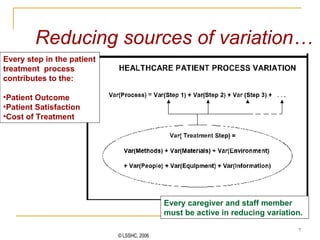
Reducing sources of variation… Every step in the patient treatment  process contributes to the: Patient Outcome Patient Satisfaction Cost of Treatment Every caregiver and staff member must be active in reducing variation.
What factors impact Diffusion? Perceived Benefit  -  organizational and personal Compatibility   with existing systems, values, beliefs, current needs Simplicity  –  Simple innovations spread faster than complicated ones due to the role of adaptation in spread of innovation.  Trialability  –  Changes should be tested and verified prior to full implementation. Observability  –  Tests of change should be conducted in such a way so as to be readily observable by other ‘early adopters’.  Berwick DM. Disseminating innovations in health care.  JAMA. 2003 Apr 16;289(15):1969-75
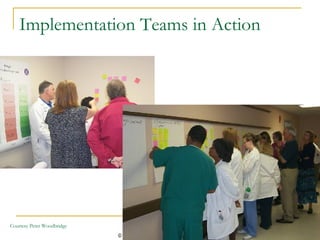
Implementation Teams in Action Courtesy Peter Woodbridge
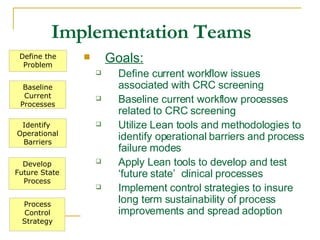
Goals:   Define current workflow issues associated with CRC screening Baseline current workflow processes related to CRC screening Utilize Lean tools and methodologies to identify operational barriers and process failure modes Apply Lean tools to develop and test  ‘future state’  clinical processes  Implement control strategies to insure long term sustainability of process improvements and spread adoption Implementation Teams Develop Future State Process Process Control Strategy Baseline Current Processes Identify  Operational Barriers Define the Problem
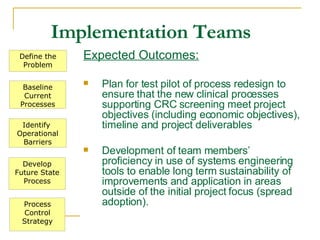
Expected Outcomes: Plan for test pilot of process redesign to ensure that the new clinical processes supporting CRC screening meet project objectives (including economic objectives), timeline and project deliverables Development of team members’ proficiency in use of systems engineering tools to enable long term sustainability of improvements and application in areas outside of the initial project focus (spread adoption).  Implementation Teams Develop Future State Process Process Control Strategy Baseline Current Processes Identify  Operational Barriers Define the Problem
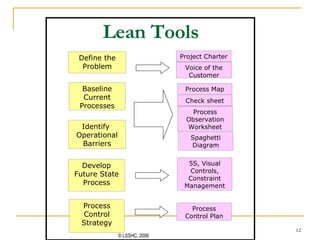
Lean Tools Develop Future State Process Process Control Strategy Baseline Current Processes Identify  Operational Barriers Define the Problem Process Observation Worksheet Spaghetti Diagram 5S, Visual Controls, Constraint Management Process Map Check sheet Process Control Plan Project Charter Voice of the Customer
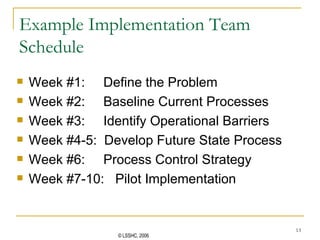
Example Implementation Team Schedule Week #1:  Define the Problem Week #2:  Baseline Current Processes Week #3:  Identify Operational Barriers Week #4-5:  Develop Future State Process Week #6:  Process Control Strategy Week #7-10:  Pilot Implementation
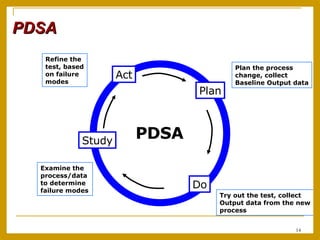
PDSA Plan PDSA Do Study Act Plan the process  change, collect Baseline Output data Try out the test, collect Output data from the new process Examine the process/data  to determine failure modes Refine the test, based on failure modes
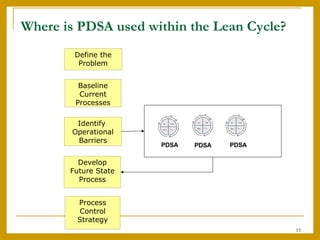
Where is PDSA used within the Lean Cycle? Develop Future State Process Process Control Strategy Baseline Current Processes Identify  Operational Barriers Define the Problem PDSA PDSA PDSA
Evaluation Workload measures will be provided by the computerized version of the NASA-TLX used earlier in the simulation phase.  A computerized version of the TLX rating scale will appear on the participants screen in a sample of approximately 30 volunteers after the colorectal cancer screening CDS is used  Three measures--efficiency, usability, and workload– will be used as indicators of costs and benefits of the redesign Comparisons of workload will be made between the two primary care clinics implementing the new CDS and the three remaining clinics using the standard CDS tool.

Heather Woodward Slides from AHRQ Kick-Off

  • 1.
    Implementation and Evaluationof Revised CDS Tool January 8 th , 2008 LEADERS SYMPOSIUM “ Strategic Planning to Inform a Funded Project on how to Achieve Workflow Integration in Developing and Implementing CDS for CRC Screening”
  • 2.
    Key Informant Interviews of site-specific best-practices for integration of colorectal cancer screening CDS into workflow Direct Observation of colorectal cancer screening CDS for barriers and facilitators to workflow integration Implementation in primary care clinic after simulation study Rapid Prototyping of CDS design alternatives based on Phase 1 findings Simulation Study to test impact of CDS design alternatives on efficiency, usability, and workload Evaluation in primary care clinic after simulation study Figure. Project Overview Phase 1 Phase 2 Phase 3
  • 3.
    Implementation/Evaluation Overview Followingsimulation study (months 18-21), implementation of the revised CRC CDS tool will occur in two primary care clinics at the Indianapolis VAMC. Measures used to evaluate the impact of the improved CDS, such as efficiency, usability, and workload, will be used as surrogate measures of workflow integration.
  • 4.
    Implementation Oversight ProjectSteering Committee Project champions and sponsors from each of the participating clinics, and the co-I’s on the AHRQ project. Responsible for project direction, goals, and objectives related to colorectal cancer screening CDS. Administrative Oversight Working Group Project champions from the implementation site, primary care clinic leader or manager, Co-I’s on the AHRQ project, and the project manager Responsible for the site specific tactical, operational, and administrative activities of the implementation, including: Coordinating the implementation team structure Review/Approval of the implementation plans Communication of the project activities among site level participants
  • 5.
    Implementation Oversight (con’t)Implementation Teams Front-line staff, including physicians, nurses, nurse managers, other clinical practitioners directly involved in care delivery, and the systems engineer assigned to each team. Tasked with partnering with systems engineering faculty to learn lean principles and applying systems engineering methods to redesign clinical workflow processes supporting effective and efficient screening for CRC
  • 6.
    Lean Process Design…Identifying and Eliminating Operational Barriers within Patient Treatment Processes Materials Step 3
  • 7.
    Reducing sources ofvariation… Every step in the patient treatment process contributes to the: Patient Outcome Patient Satisfaction Cost of Treatment Every caregiver and staff member must be active in reducing variation.
  • 8.
    What factors impactDiffusion? Perceived Benefit - organizational and personal Compatibility with existing systems, values, beliefs, current needs Simplicity – Simple innovations spread faster than complicated ones due to the role of adaptation in spread of innovation. Trialability – Changes should be tested and verified prior to full implementation. Observability – Tests of change should be conducted in such a way so as to be readily observable by other ‘early adopters’. Berwick DM. Disseminating innovations in health care. JAMA. 2003 Apr 16;289(15):1969-75
  • 9.
    Implementation Teams inAction Courtesy Peter Woodbridge
  • 10.
    Goals: Define current workflow issues associated with CRC screening Baseline current workflow processes related to CRC screening Utilize Lean tools and methodologies to identify operational barriers and process failure modes Apply Lean tools to develop and test ‘future state’ clinical processes Implement control strategies to insure long term sustainability of process improvements and spread adoption Implementation Teams Develop Future State Process Process Control Strategy Baseline Current Processes Identify Operational Barriers Define the Problem
  • 11.
    Expected Outcomes: Planfor test pilot of process redesign to ensure that the new clinical processes supporting CRC screening meet project objectives (including economic objectives), timeline and project deliverables Development of team members’ proficiency in use of systems engineering tools to enable long term sustainability of improvements and application in areas outside of the initial project focus (spread adoption). Implementation Teams Develop Future State Process Process Control Strategy Baseline Current Processes Identify Operational Barriers Define the Problem
  • 12.
    Lean Tools DevelopFuture State Process Process Control Strategy Baseline Current Processes Identify Operational Barriers Define the Problem Process Observation Worksheet Spaghetti Diagram 5S, Visual Controls, Constraint Management Process Map Check sheet Process Control Plan Project Charter Voice of the Customer
  • 13.
    Example Implementation TeamSchedule Week #1: Define the Problem Week #2: Baseline Current Processes Week #3: Identify Operational Barriers Week #4-5: Develop Future State Process Week #6: Process Control Strategy Week #7-10: Pilot Implementation
  • 14.
    PDSA Plan PDSADo Study Act Plan the process change, collect Baseline Output data Try out the test, collect Output data from the new process Examine the process/data to determine failure modes Refine the test, based on failure modes
  • 15.
    Where is PDSAused within the Lean Cycle? Develop Future State Process Process Control Strategy Baseline Current Processes Identify Operational Barriers Define the Problem PDSA PDSA PDSA
  • 16.
    Evaluation Workload measureswill be provided by the computerized version of the NASA-TLX used earlier in the simulation phase. A computerized version of the TLX rating scale will appear on the participants screen in a sample of approximately 30 volunteers after the colorectal cancer screening CDS is used Three measures--efficiency, usability, and workload– will be used as indicators of costs and benefits of the redesign Comparisons of workload will be made between the two primary care clinics implementing the new CDS and the three remaining clinics using the standard CDS tool.