Presented By:-
X Y z
Seminar on Virtual Keyboard Technology
Introduction
Qwerty keyboard
Virtual keyboard
Modules of Virtual keyboard
System Architecture
Advantages
Drawbacks
Applications
Conclusion
References
Introduction
The aim of this technology is to develop an “Augmented Reality” (AR)
solution for a handheld device that enables the user to write text.
A virtual keyboard is actually a key-in device, roughly a size of a fountain pen
& which uses highly advanced laser technology.
In a virtual keyboard, camera tracks the finger movements of the typist to get
the correct keystroke.
The software and hardware part recognizes the typed characters and pass it
to the computer.
The main features are: platform independent multilingual support for
keyboard text input, built-in language layout and setting, copy/paste etc.
 QWERTY is the most common keyboard layout on English-language
computer and typewriter keyboards.
 The processor in a keyboard has to understand several things that are
important to the utility of the keyboard, such as:
 Position of the key in the key matrix.
 The amount of bounce and how to filter it.
 The speed at which to transmit the typematics
Qwerty keyboard
The microprocessor and controller circuitry of a keyboard
A look at the key matrix
Virtual keyboard
 Virtual Keyboard is just another example of today’s computer trend of
"smaller and faster“.
 Virtual Keyboard uses sensor technology and artificial intelligence to let
users work on any surface as if it were a keyboard.
 The keyboard is projected optically on a flat surface and, as the user
touches the image of a key, the optical device detects the stroke and sends
it to the computer.
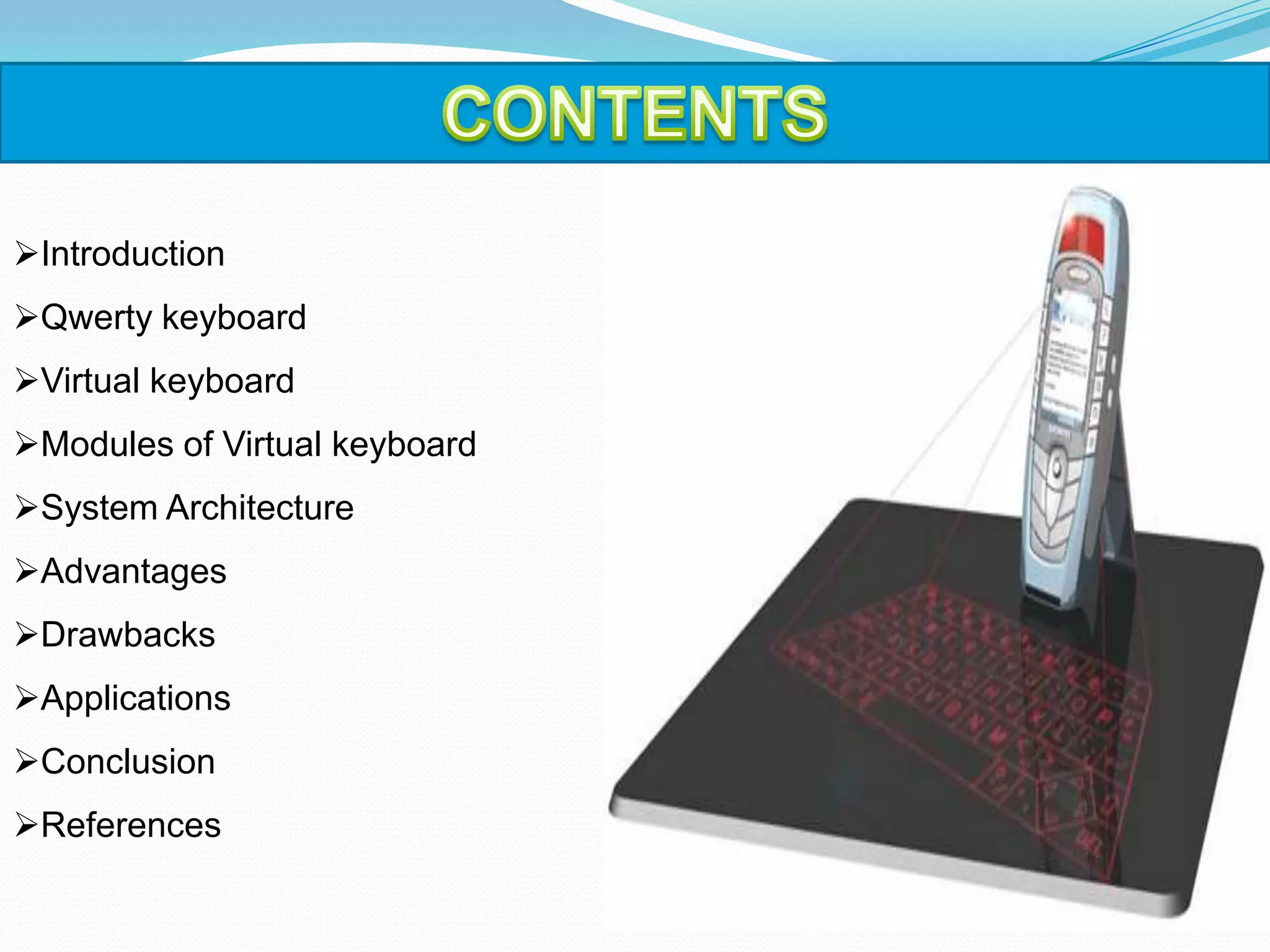
Virtual keyboard used in PDA’s
 A virtual keyboard is a keyboard that a user operates by typing on or within a wireless
or optical-detectable surface or area rather than by depressing physical keys.
 The Virtual Keyboard uses light to project a full-sized computer keyboard onto almost
any surface, and disappears when not in use.
 A virtual keyboard makes it possible for the user of a very small smart phone or a
wearable computer to have full keyboard capability.
The device detects movement when
fingers are pressed down. Those
movements are measured and the
device accurately determines the
intended keystrokes and translates
them into text .
Modules of Virtual Keyboard
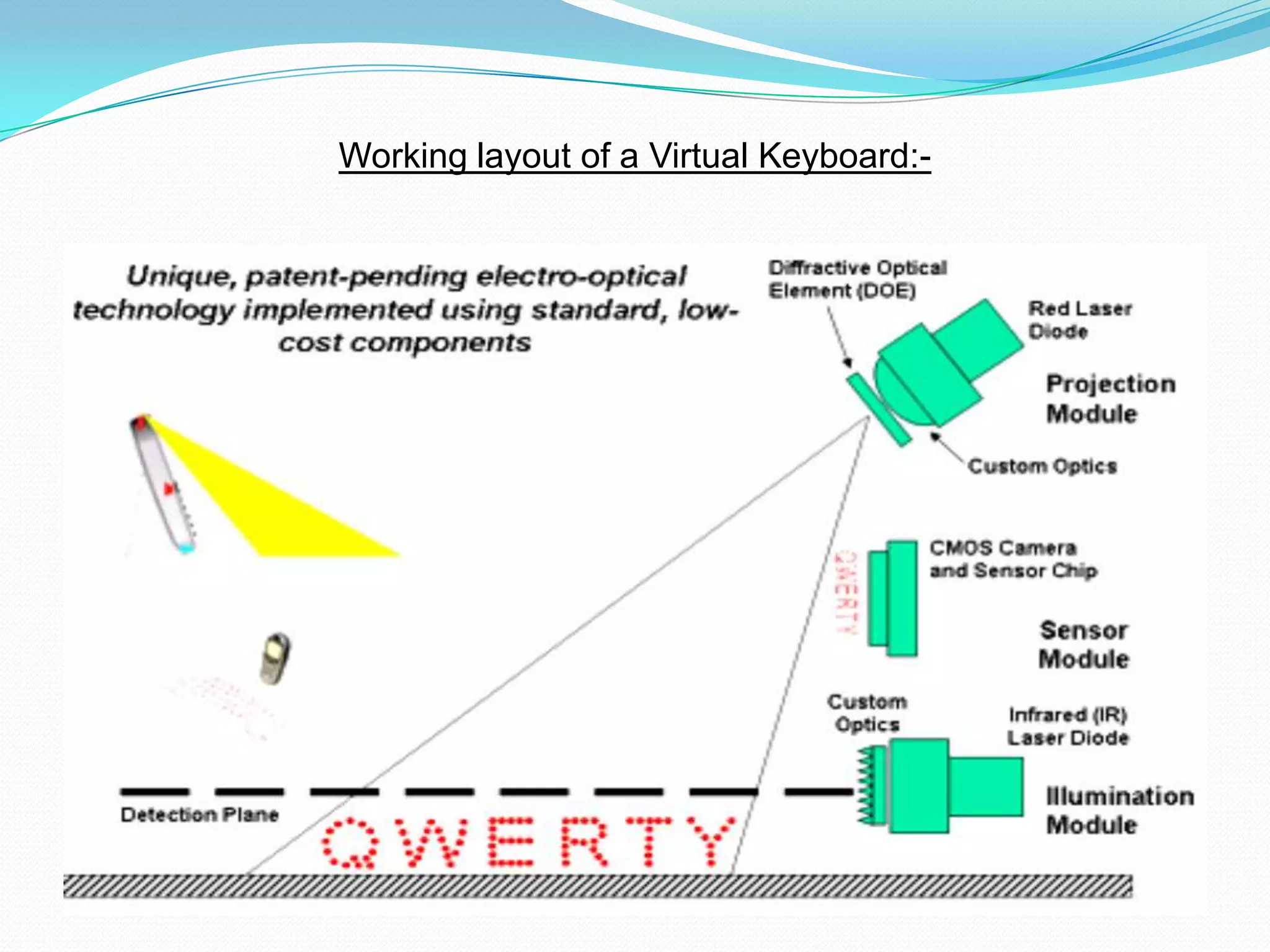
The Virtual Keyboard system comprises of three modules:-
 The sensor module
 IR-light source
 The pattern projector
Sensor module:
The Sensor Module serves as the eyes of
the Keyboard Perception technology .
The Sensor Module operates by locating
the user's fingers in 3-D space and tracking
the intended keystrokes.
Keystroke information processes and can
then be output to host devices.
IR Light source :
 The Infrared Light Source emits a beam of
infrared light .
 This light beam is designed to overlap the
area on which the keyboard pattern projector
or printed image resides.
 This helps in recognizing the hand
movements and the pressing of keys .
Pattern projector:
The Pattern Projector or optional printed image presents the image of the
keyboard
This image can be projected on any flat surface.
The projected image is that of a standard QWERTY keyboard, with all the
keys and control functions as in the keyboard.
System Architecture
This Fig. shows the physical setup
of the system:-
 The 3D range camera is placed
several cms over the input
surface, with a well-defined angle
facing the working area.
 The size of the working
area, limited by the spatial
resolution of the camera, is 15 cm
25 cm, which is comparable to
a full-size laptop-computer
keyboard.
Virtual-keyboard demonstration-system
setup
The display projector is mounted on the camera, facing the same area, which
would generate the visual feedback for the keyboard and input information.
Working layout of a Virtual Keyboard:-
Advantages
 Portability
 Accuracy
 Speed of text entry
 Lack of need for flat or large typing surface
 Ability to minimize the risk for repetitive strain injuries.
 No driver software necessary, It can be used as a plug and play device.
Drawbacks
 It is very costly.
 The room in which the virtual keyboard is used should not be very bright so
that the keyboard is properly visible.
 Virtual keyboard is hard to get used to. Since it involves typing in thin air, it
requires a little practice. Only people who are good at typing can use a
virtual keyboard efficiently.
Applications
 High-tech and industrial Sectors.
 Used with Smart phones, PDAs, email, word processing and spreadsheet
tasks.
 As computer/PDA input.
 Gaming control.
Conclusion
 A virtual key boards claim to provide the convenience of compactness with
the advantages of a QWERTY keyboard.
 A Virtual keyboard system based on a true-3D optical range camera.
 It is also used in 6th Sense Technology Device in which it is not depends on
surface. The feedback text and/or graphics may be integrated with such
projector, thus enabling truly virtual working area.
 Thus virtual keyboards will make typing easier, faster, and almost a pleasure.
References
http://en.wikipedia.org/wiki/Augmented_reality
 http://en.wikipedia.org/wiki/QWERTY_keyboard
http://encyclopedia2.thefreedictionary.com/typematic
http://en.wikipedia.org/wiki/Virtual_keyboard
http://whatis.techtarget.com/definition/virtual-keyboard
http://www.scribd.com/doc/27978273/12/Flow-Chart
http://www.webopedia.com/TERM/P/PDA.html
Virtual keyboard
Virtual keyboard

Virtual keyboard

  • 1.
    Presented By:- X Yz Seminar on Virtual Keyboard Technology
  • 2.
    Introduction Qwerty keyboard Virtual keyboard Modulesof Virtual keyboard System Architecture Advantages Drawbacks Applications Conclusion References
  • 3.
    Introduction The aim ofthis technology is to develop an “Augmented Reality” (AR) solution for a handheld device that enables the user to write text. A virtual keyboard is actually a key-in device, roughly a size of a fountain pen & which uses highly advanced laser technology. In a virtual keyboard, camera tracks the finger movements of the typist to get the correct keystroke. The software and hardware part recognizes the typed characters and pass it to the computer. The main features are: platform independent multilingual support for keyboard text input, built-in language layout and setting, copy/paste etc.
  • 4.
     QWERTY isthe most common keyboard layout on English-language computer and typewriter keyboards.  The processor in a keyboard has to understand several things that are important to the utility of the keyboard, such as:  Position of the key in the key matrix.  The amount of bounce and how to filter it.  The speed at which to transmit the typematics Qwerty keyboard
  • 5.
    The microprocessor andcontroller circuitry of a keyboard A look at the key matrix
  • 6.
    Virtual keyboard  VirtualKeyboard is just another example of today’s computer trend of "smaller and faster“.  Virtual Keyboard uses sensor technology and artificial intelligence to let users work on any surface as if it were a keyboard.  The keyboard is projected optically on a flat surface and, as the user touches the image of a key, the optical device detects the stroke and sends it to the computer.
  • 7.
    Virtual keyboard usedin PDA’s  A virtual keyboard is a keyboard that a user operates by typing on or within a wireless or optical-detectable surface or area rather than by depressing physical keys.  The Virtual Keyboard uses light to project a full-sized computer keyboard onto almost any surface, and disappears when not in use.  A virtual keyboard makes it possible for the user of a very small smart phone or a wearable computer to have full keyboard capability. The device detects movement when fingers are pressed down. Those movements are measured and the device accurately determines the intended keystrokes and translates them into text .
  • 8.
    Modules of VirtualKeyboard The Virtual Keyboard system comprises of three modules:-  The sensor module  IR-light source  The pattern projector
  • 9.
    Sensor module: The SensorModule serves as the eyes of the Keyboard Perception technology . The Sensor Module operates by locating the user's fingers in 3-D space and tracking the intended keystrokes. Keystroke information processes and can then be output to host devices.
  • 10.
    IR Light source:  The Infrared Light Source emits a beam of infrared light .  This light beam is designed to overlap the area on which the keyboard pattern projector or printed image resides.  This helps in recognizing the hand movements and the pressing of keys .
  • 11.
    Pattern projector: The PatternProjector or optional printed image presents the image of the keyboard This image can be projected on any flat surface. The projected image is that of a standard QWERTY keyboard, with all the keys and control functions as in the keyboard.
  • 12.
    System Architecture This Fig.shows the physical setup of the system:-  The 3D range camera is placed several cms over the input surface, with a well-defined angle facing the working area.  The size of the working area, limited by the spatial resolution of the camera, is 15 cm 25 cm, which is comparable to a full-size laptop-computer keyboard. Virtual-keyboard demonstration-system setup The display projector is mounted on the camera, facing the same area, which would generate the visual feedback for the keyboard and input information.
  • 13.
    Working layout ofa Virtual Keyboard:-
  • 14.
    Advantages  Portability  Accuracy Speed of text entry  Lack of need for flat or large typing surface  Ability to minimize the risk for repetitive strain injuries.  No driver software necessary, It can be used as a plug and play device.
  • 15.
    Drawbacks  It isvery costly.  The room in which the virtual keyboard is used should not be very bright so that the keyboard is properly visible.  Virtual keyboard is hard to get used to. Since it involves typing in thin air, it requires a little practice. Only people who are good at typing can use a virtual keyboard efficiently.
  • 16.
    Applications  High-tech andindustrial Sectors.  Used with Smart phones, PDAs, email, word processing and spreadsheet tasks.  As computer/PDA input.  Gaming control.
  • 17.
    Conclusion  A virtualkey boards claim to provide the convenience of compactness with the advantages of a QWERTY keyboard.  A Virtual keyboard system based on a true-3D optical range camera.  It is also used in 6th Sense Technology Device in which it is not depends on surface. The feedback text and/or graphics may be integrated with such projector, thus enabling truly virtual working area.  Thus virtual keyboards will make typing easier, faster, and almost a pleasure.
  • 18.

Editor's Notes