9:00 AM - 10:00 AM
Innovation Overload – Technology, Jobs and the Future
Room: Meeting Room 202A
Speaker: David Smith
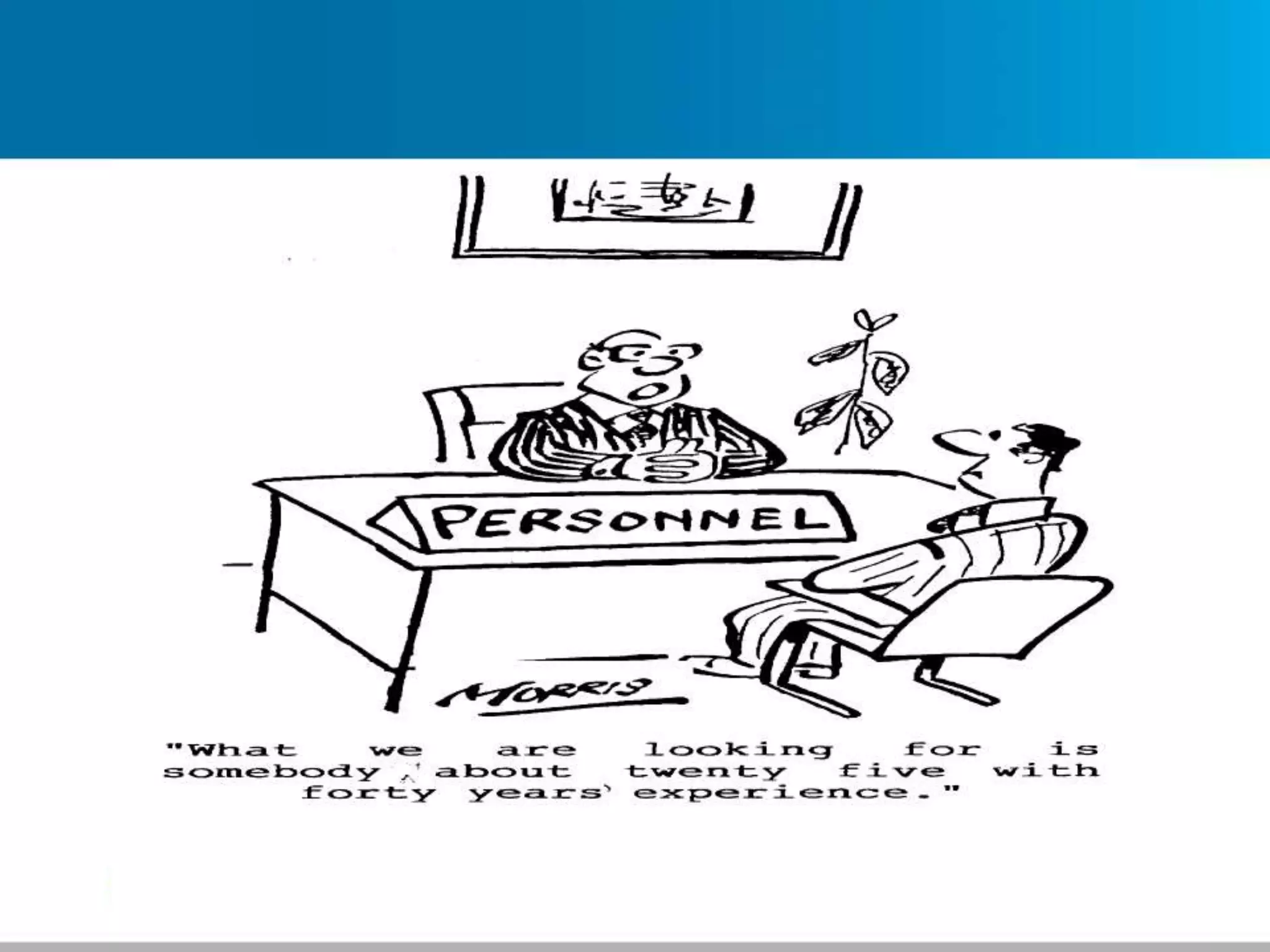
This is not your grandfather’s job market where one could work and retire from one company after 40
years. Your father and your company have probably not fared that well either. The fast pace of
technology change and productivity improvements, in an increasingly competitive market, have
forced companies to change their strategy, frequently upgrade and improve their products or
services, and adjust their workforce. Downsizing, outsourcing, automation, financial pressures,
short-term demands, and failed strategy all contribute to the challenges.
The pace of technology innovation is increasing so fast that many have a hard time choosing where
to focus and how to discover what is new. Most delay action and then miss the window to innovate.
The growth of complex systems and a global infrastructure has changed the decision and education
process. The ability to adapt to real-time and continuous learning will provide an advantage for
professionals of the future. A future focus and focused innovation will drive the next generations of
products and services.
This talk explores the future of work and how it impacts companies and you.
David Smith
Technology, Jobs and the Future
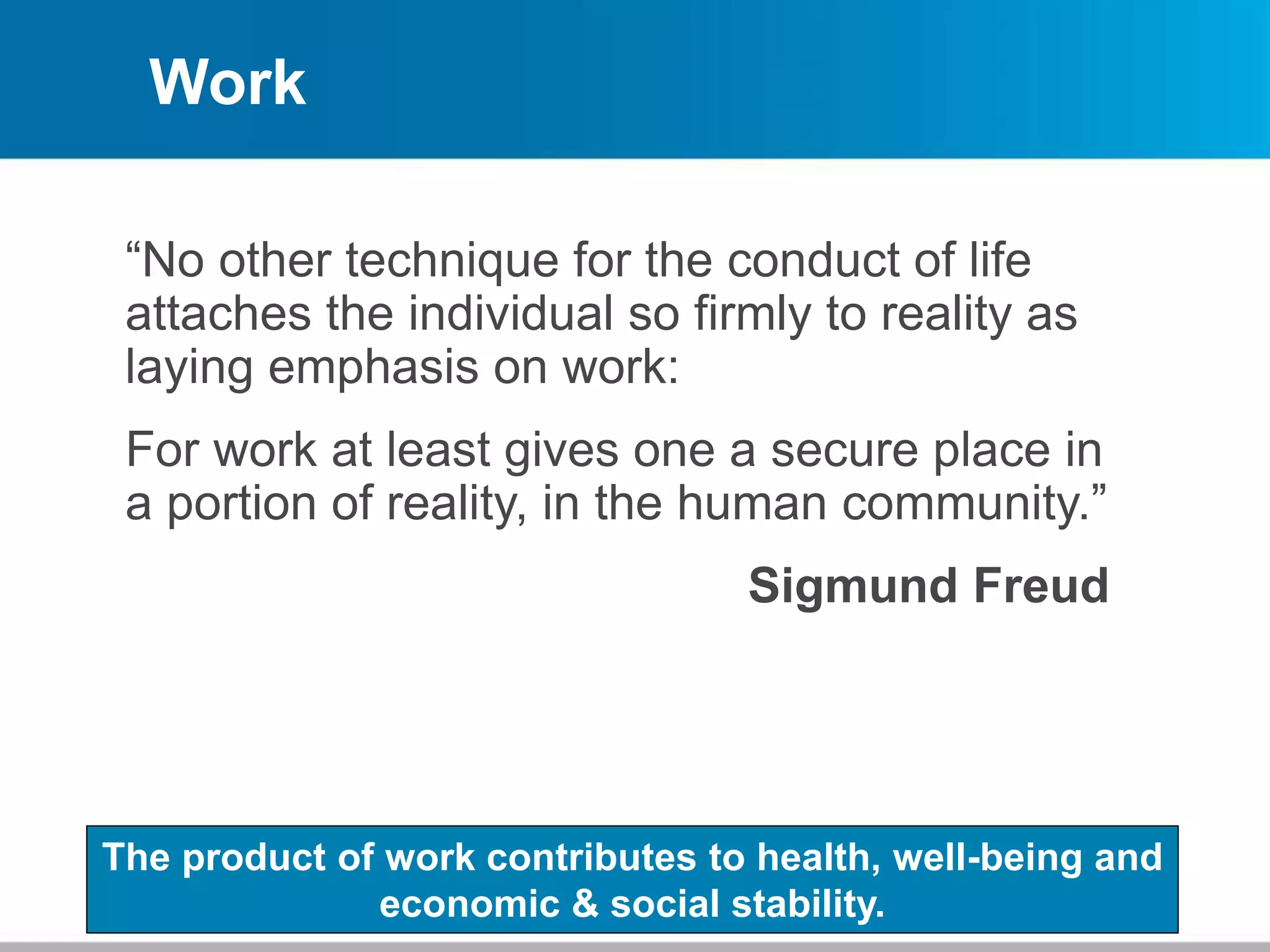
Work
“No other technique for the conduct of life
attaches the individual so firmly to reality as
laying emphasis on work:
For work at least gives one a secure place in
a portion of reality, in the human community.”
Sigmund Freud
The product of work contributes to health, well-being and
economic & social stability.
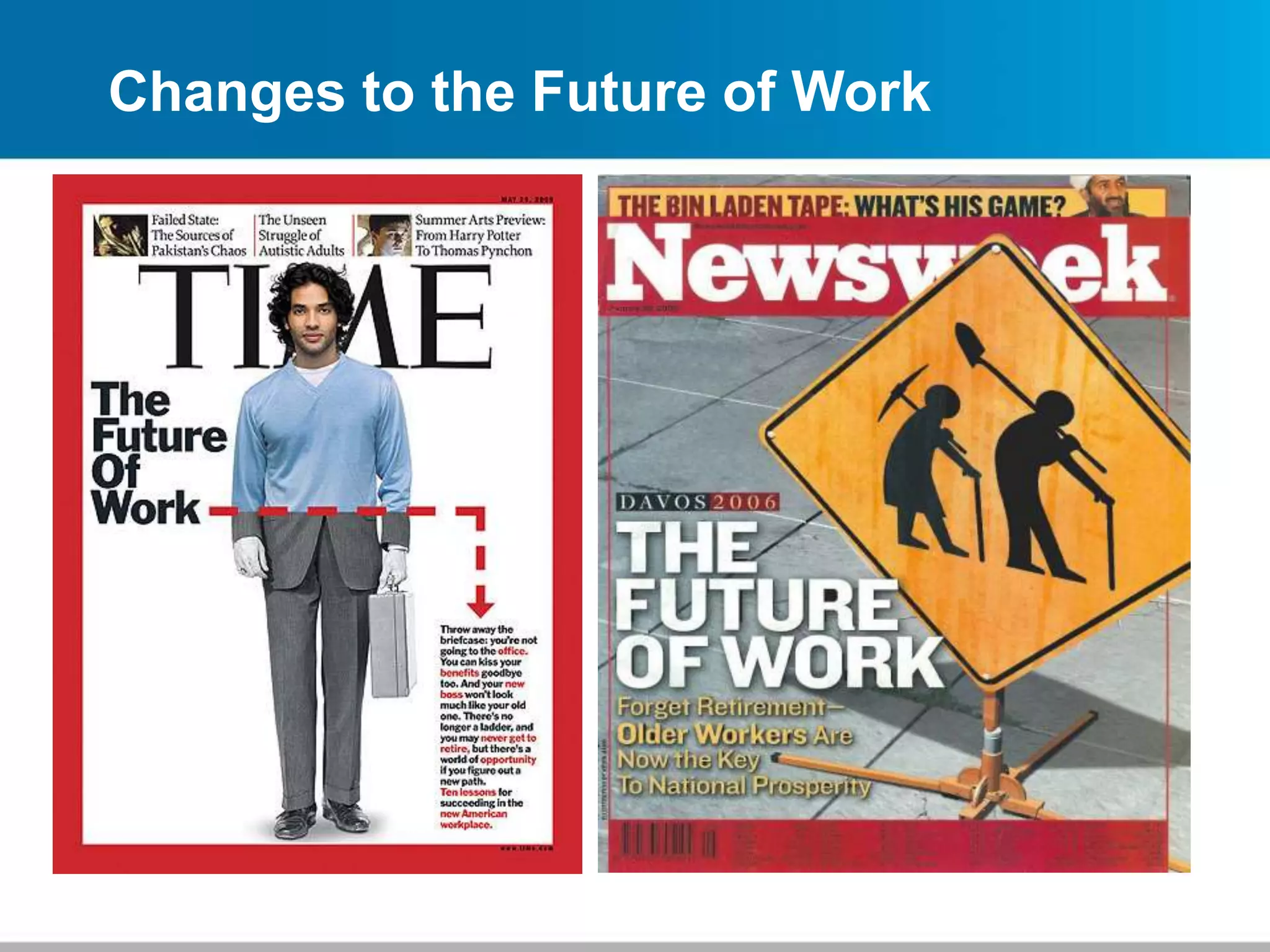
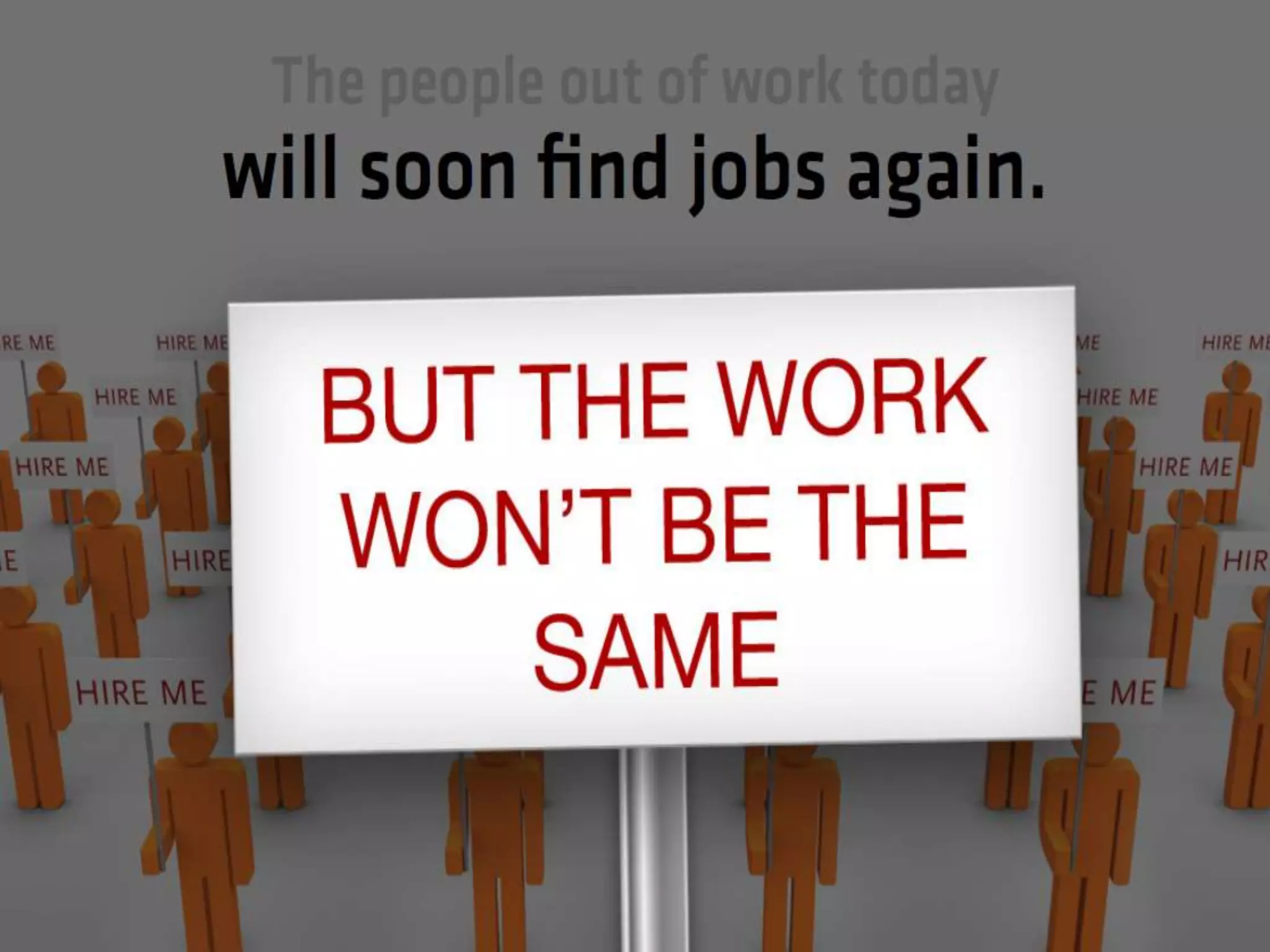
Changes to the Future of Work
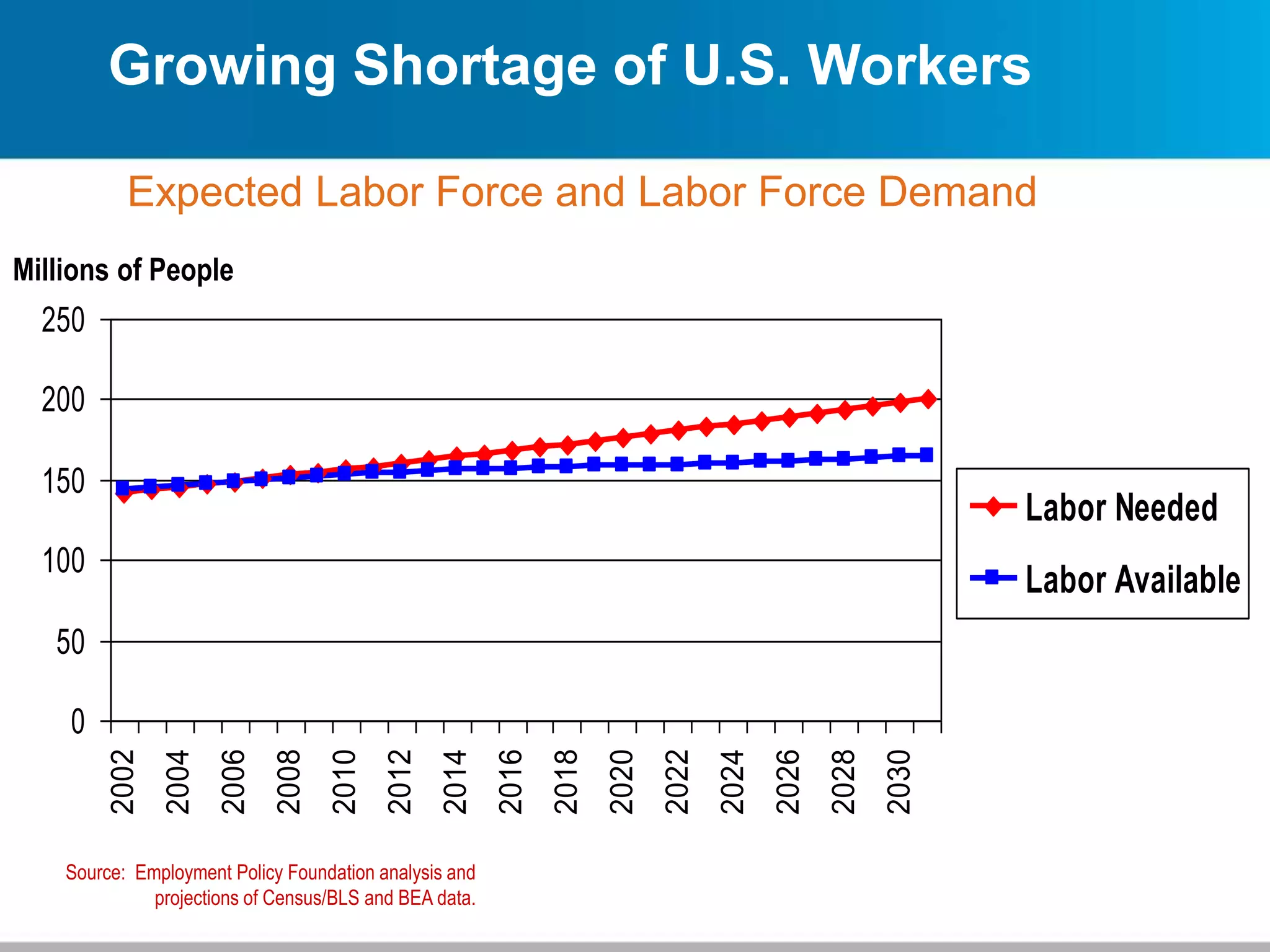
Source: Employment Policy Foundation analysis and
projections of Census/BLS and BEA data.
Millions of People
Expected Labor Force and Labor Force Demand
Growing Shortage of U.S. Workers
0
50
100
150
200
250
2002
2004
2006
2008
2010
2012
2014
2016
2018
2020
2022
2024
2026
2028
2030
Labor Needed
Labor Available
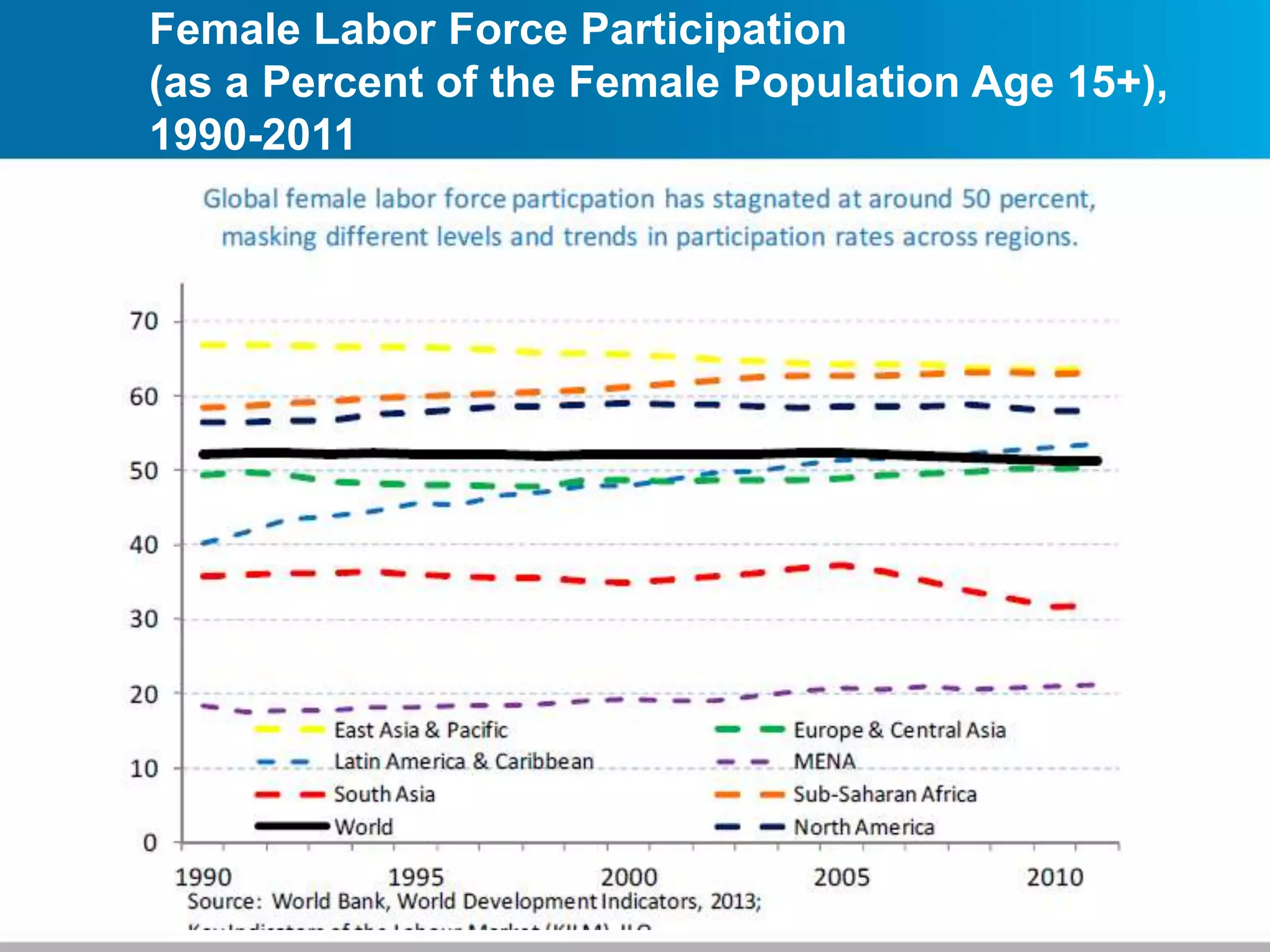
Female Labor Force Participation
(as a Percent of the Female Population Age 15+),
1990-2011
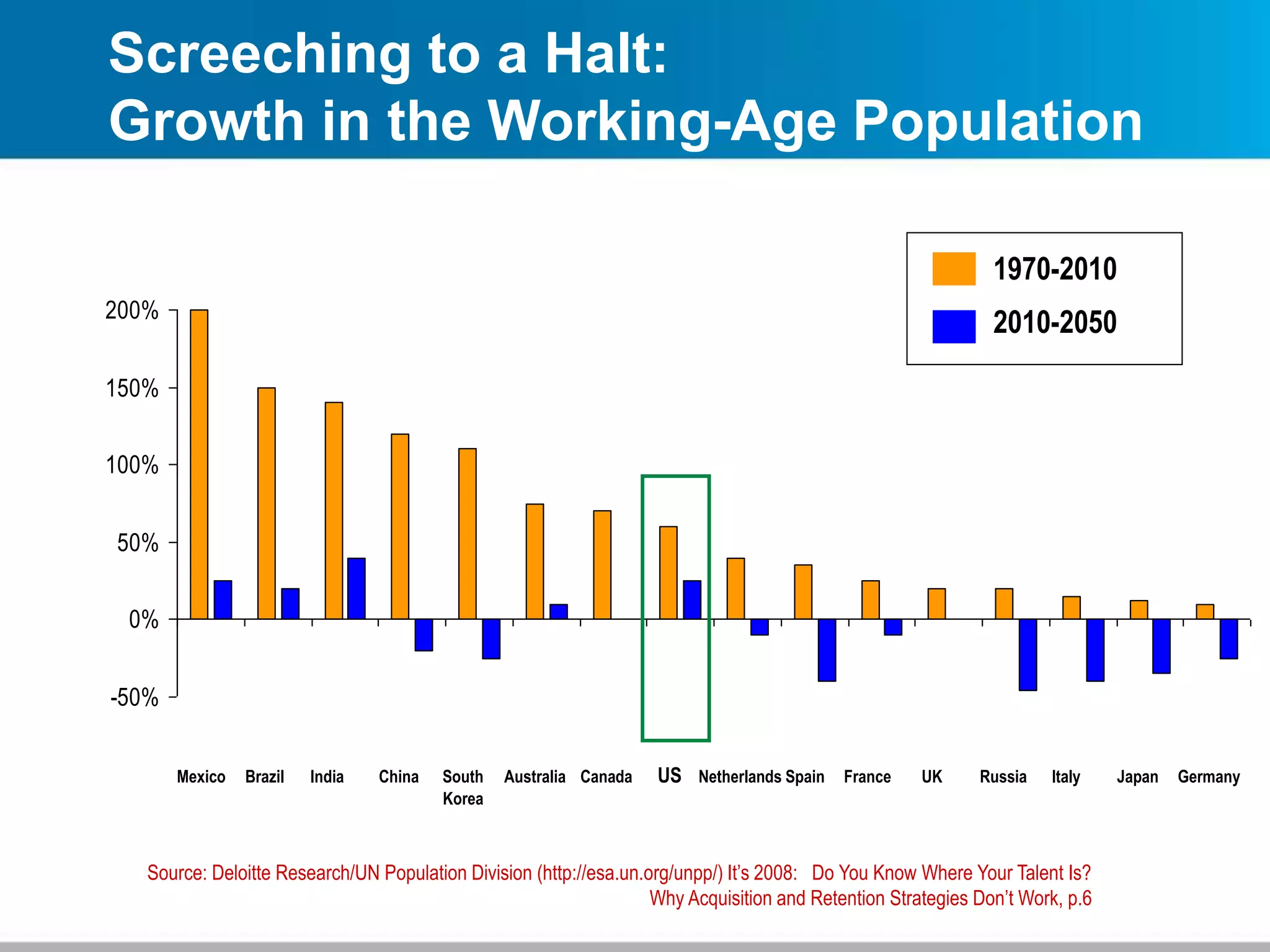
Screeching to a Halt:
Growth in the Working-Age Population
Source: Deloitte Research/UN Population Division (http://esa.un.org/unpp/) It’s 2008: Do You Know Where Your Talent Is?
Why Acquisition and Retention Strategies Don’t Work, p.6
-50%
0%
50%
100%
150%
200%
Mexico Brazil India China South Australia Canada US Netherlands Spain France UK Russia Italy Japan Germany
Korea
1970-2010
2010-2050
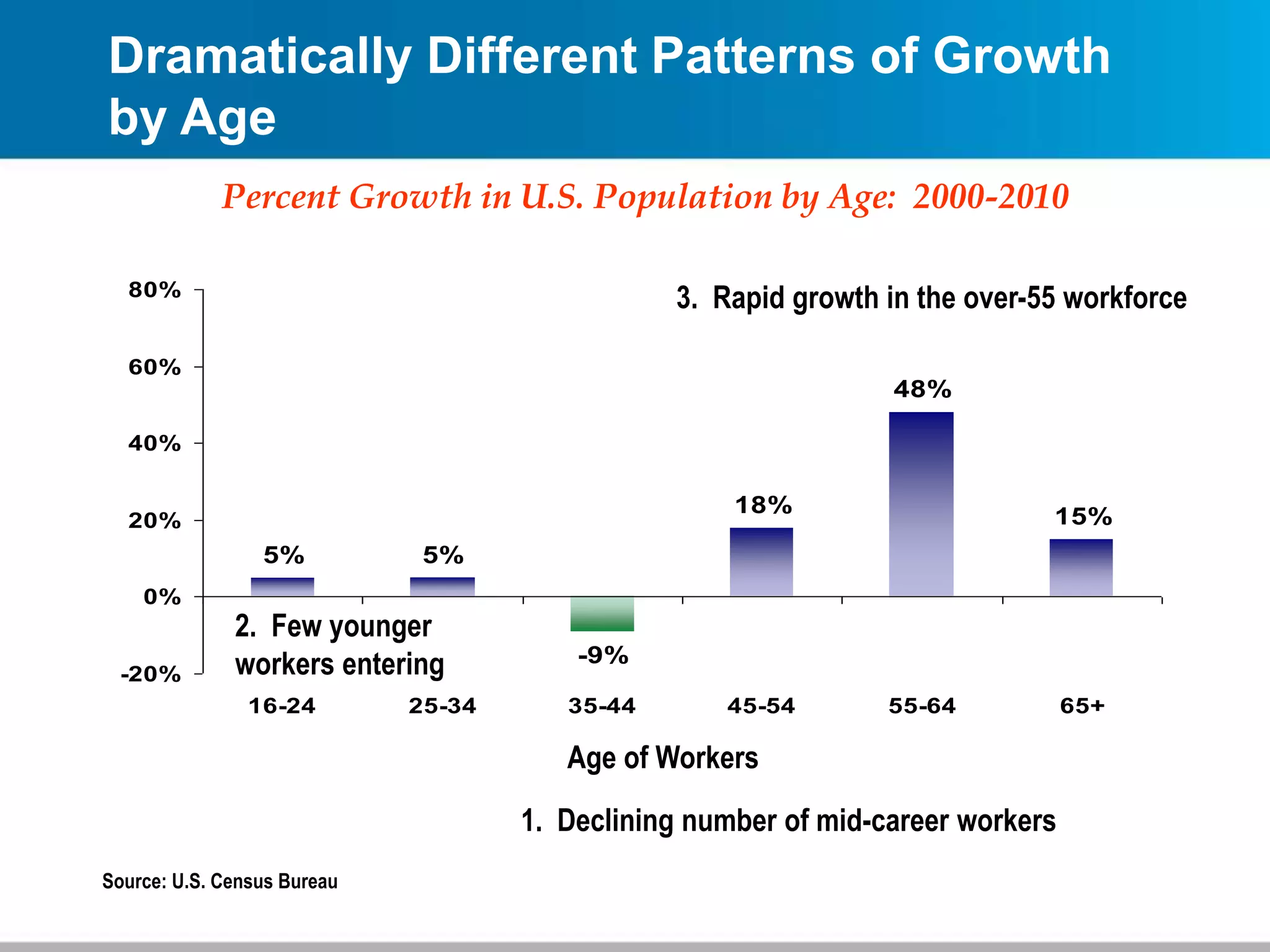
5% 5%
-9%
18%
48%
15%
-20%
0%
20%
40%
60%
80%
16-24 25-34 35-44 45-54 55-64 65+
Age of Workers
Percent Growth in U.S. Population by Age: 2000-2010
Dramatically Different Patterns of Growth
by Age
1. Declining number of mid-career workers
2. Few younger
workers entering
3. Rapid growth in the over-55 workforce
Source: U.S. Census Bureau
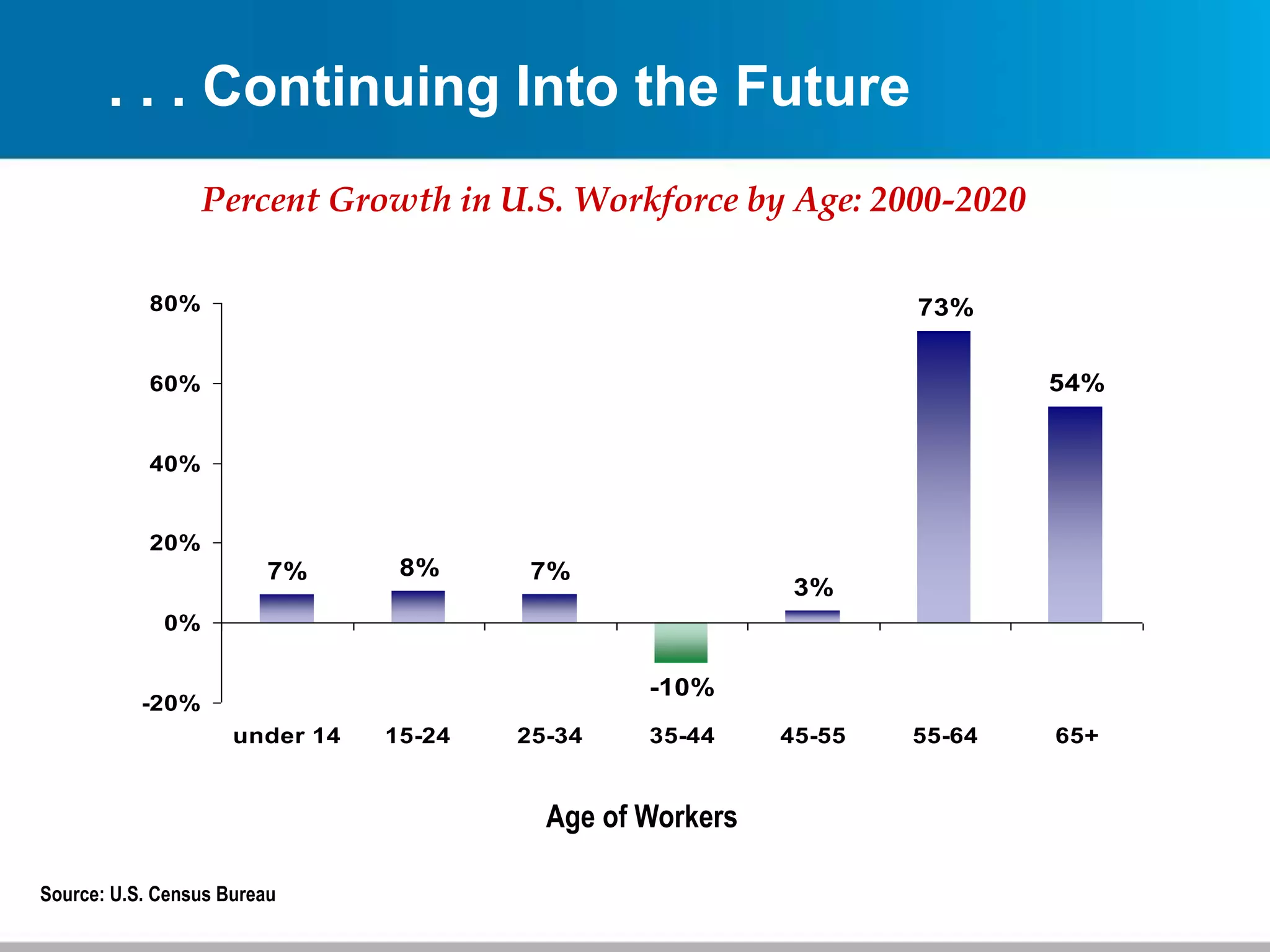
. . . Continuing Into the Future
Age of Workers
Percent Growth in U.S. Workforce by Age: 2000-2020
7% 8% 7%
-10%
3%
73%
54%
-20%
0%
20%
40%
60%
80%
under 14 15-24 25-34 35-44 45-55 55-64 65+
Source: U.S. Census Bureau
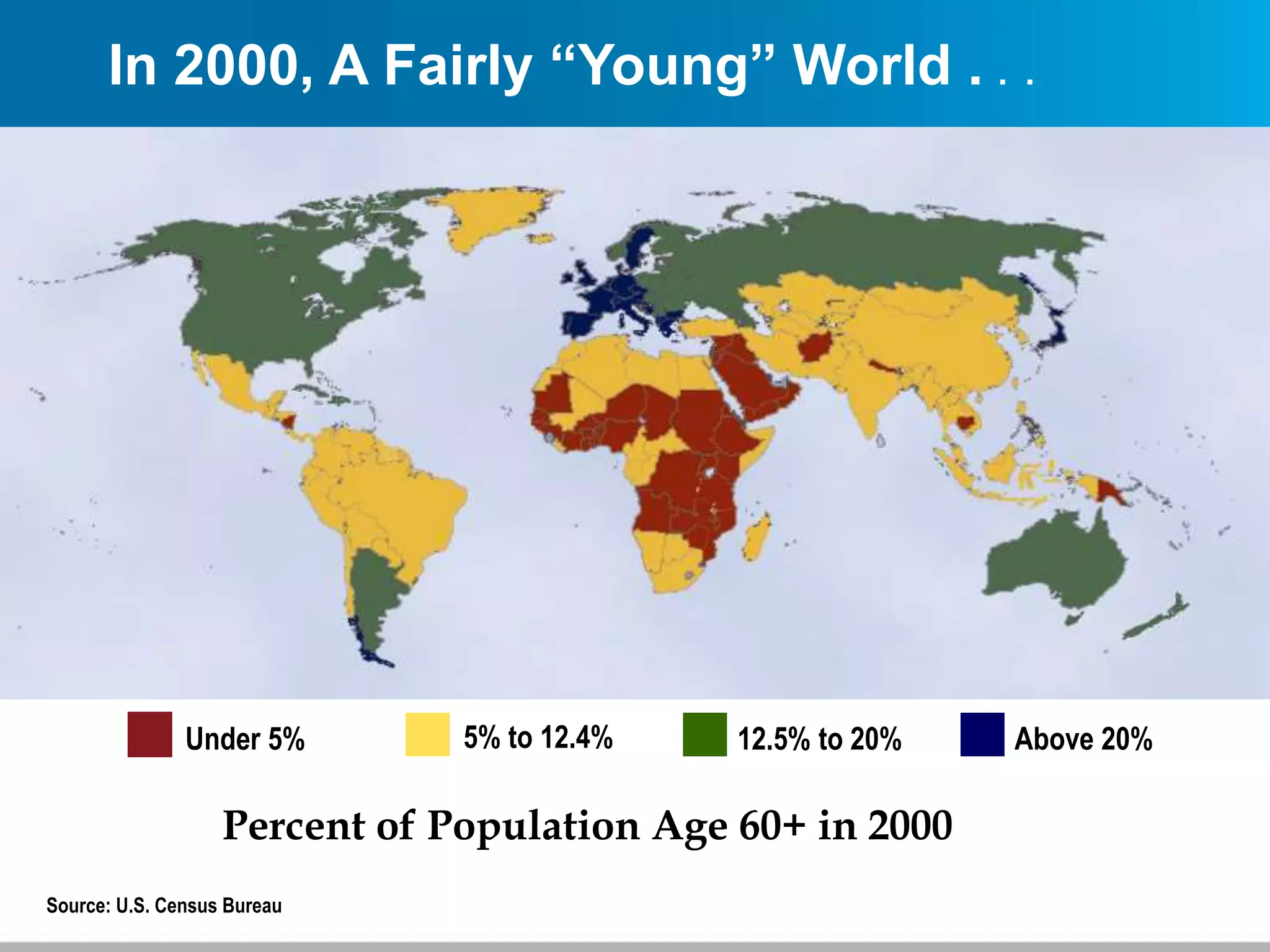
In 2000, A Fairly “Young” World . . .
Under 5% 5% to 12.4% 12.5% to 20% Above 20%
Source: U.S. Census Bureau
Percent of Population Age 60+ in 2000
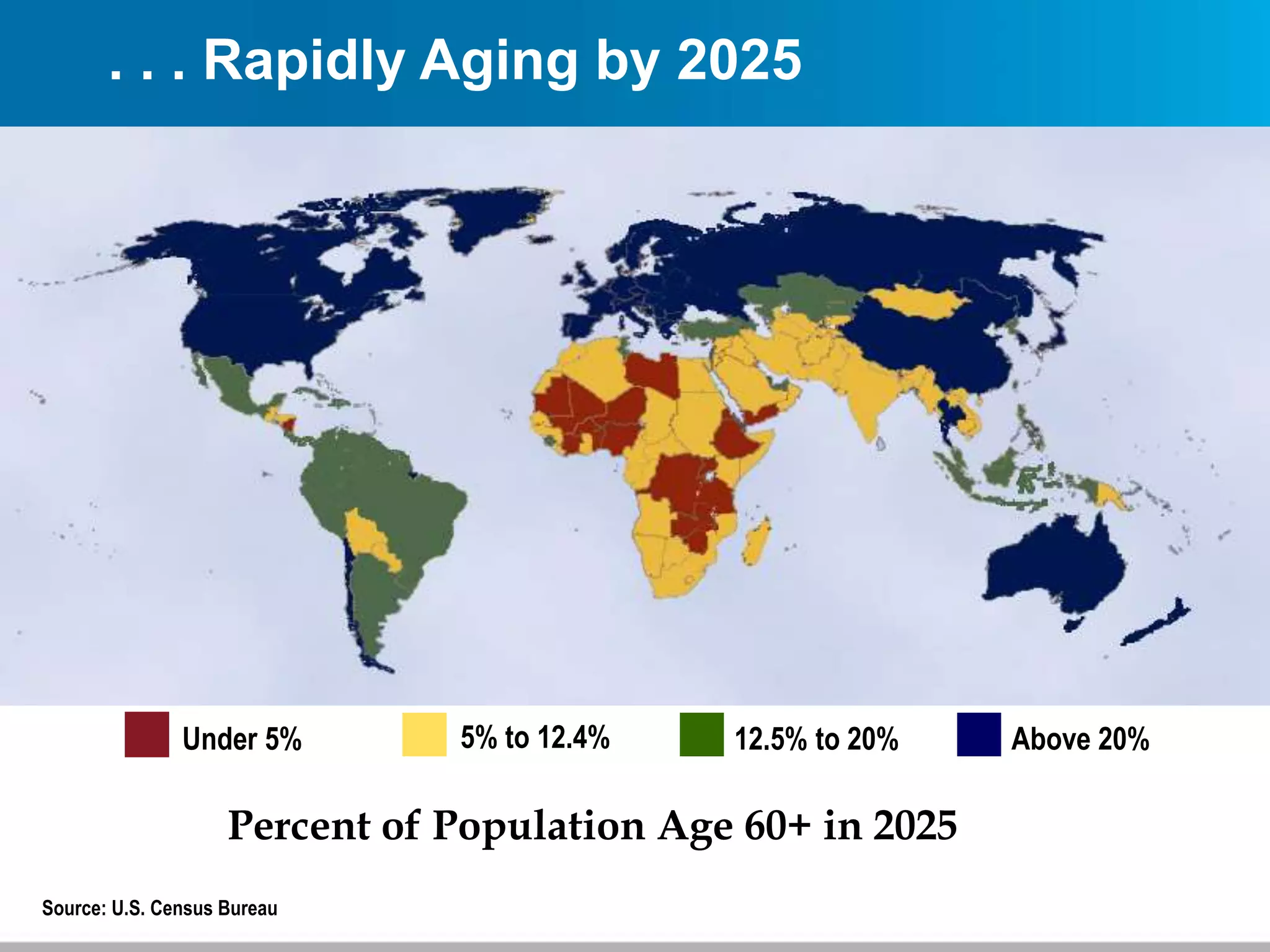
. . . Rapidly Aging by 2025
Source: U.S. Census Bureau
Under 5% 5% to 12.4% 12.5% to 20% Above 20%
Percent of Population Age 60+ in 2025
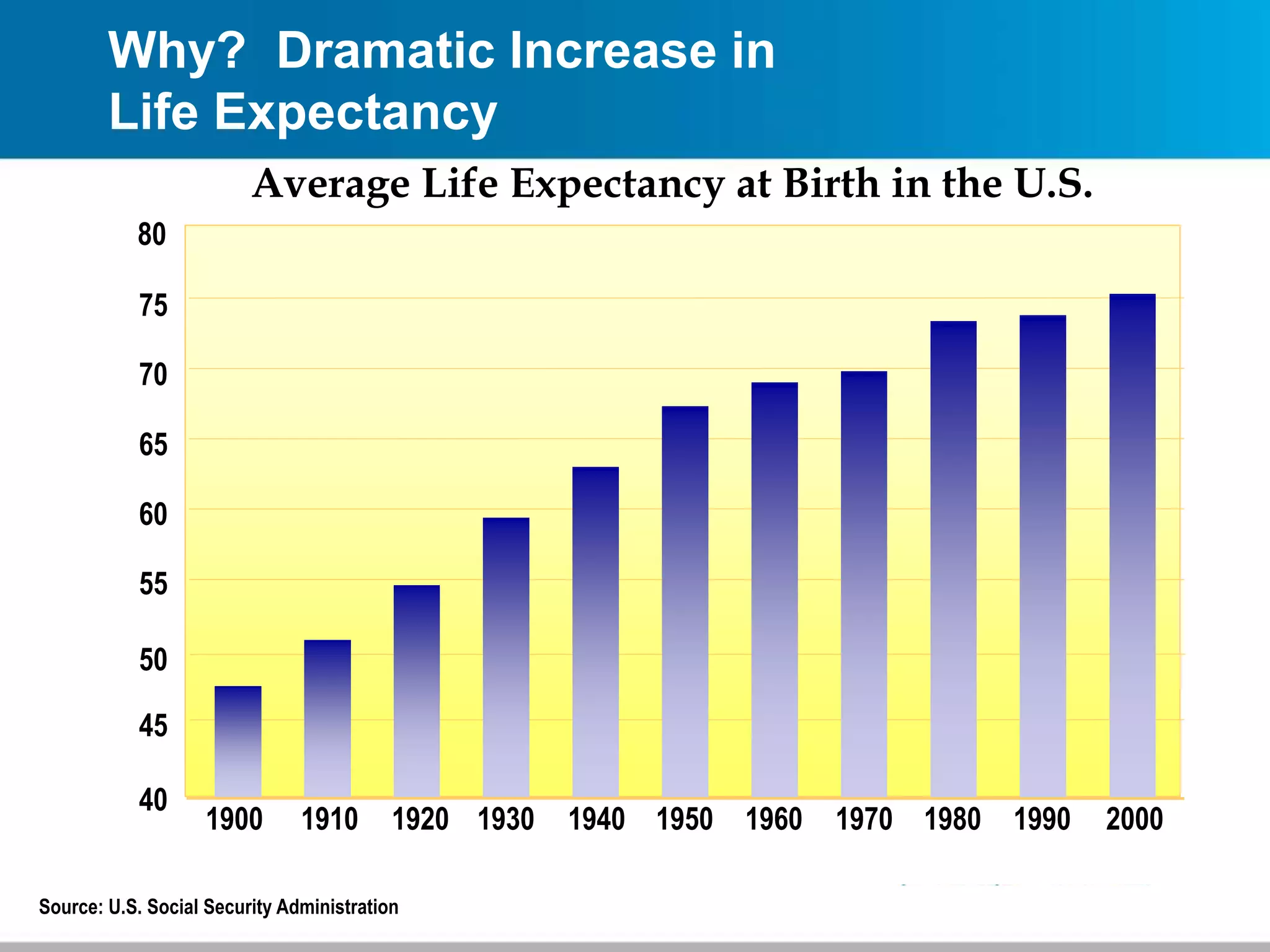
1900 1950 1970 1980 1990 20001910 1920 1930 1940 1960
75
70
65
60
55
50
45
40
80
Source: U.S. Social Security Administration
Average Life Expectancy at Birth in the U.S.
Why? Dramatic Increase in
Life Expectancy
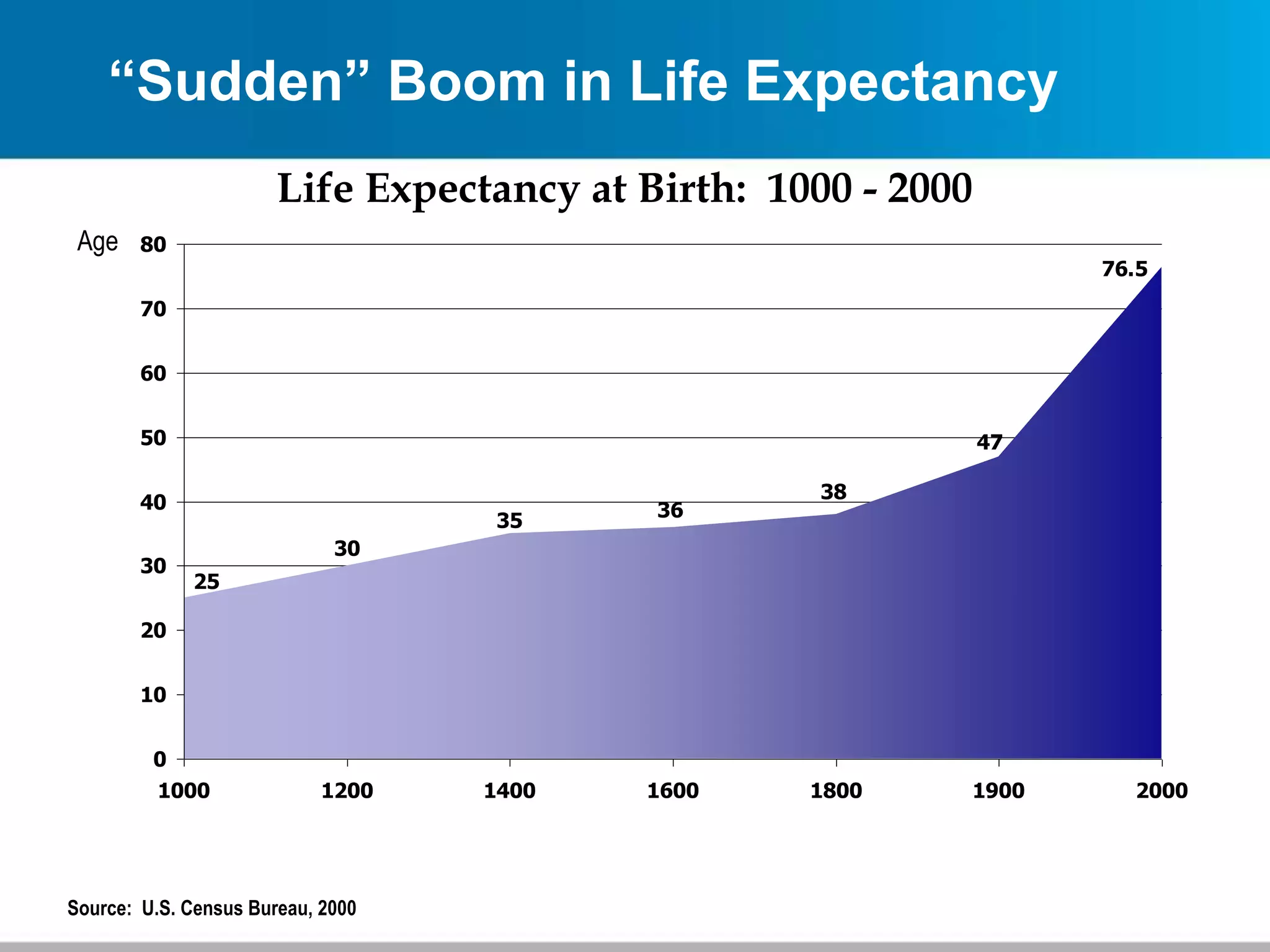
“Sudden” Boom in Life Expectancy
Source: U.S. Census Bureau, 2000
Life Expectancy at Birth: 1000 - 2000
Age
76.5
47
38
36
35
30
25
0
10
20
30
40
50
60
70
80
1000 1200 1400 1600 1800 1900 2000
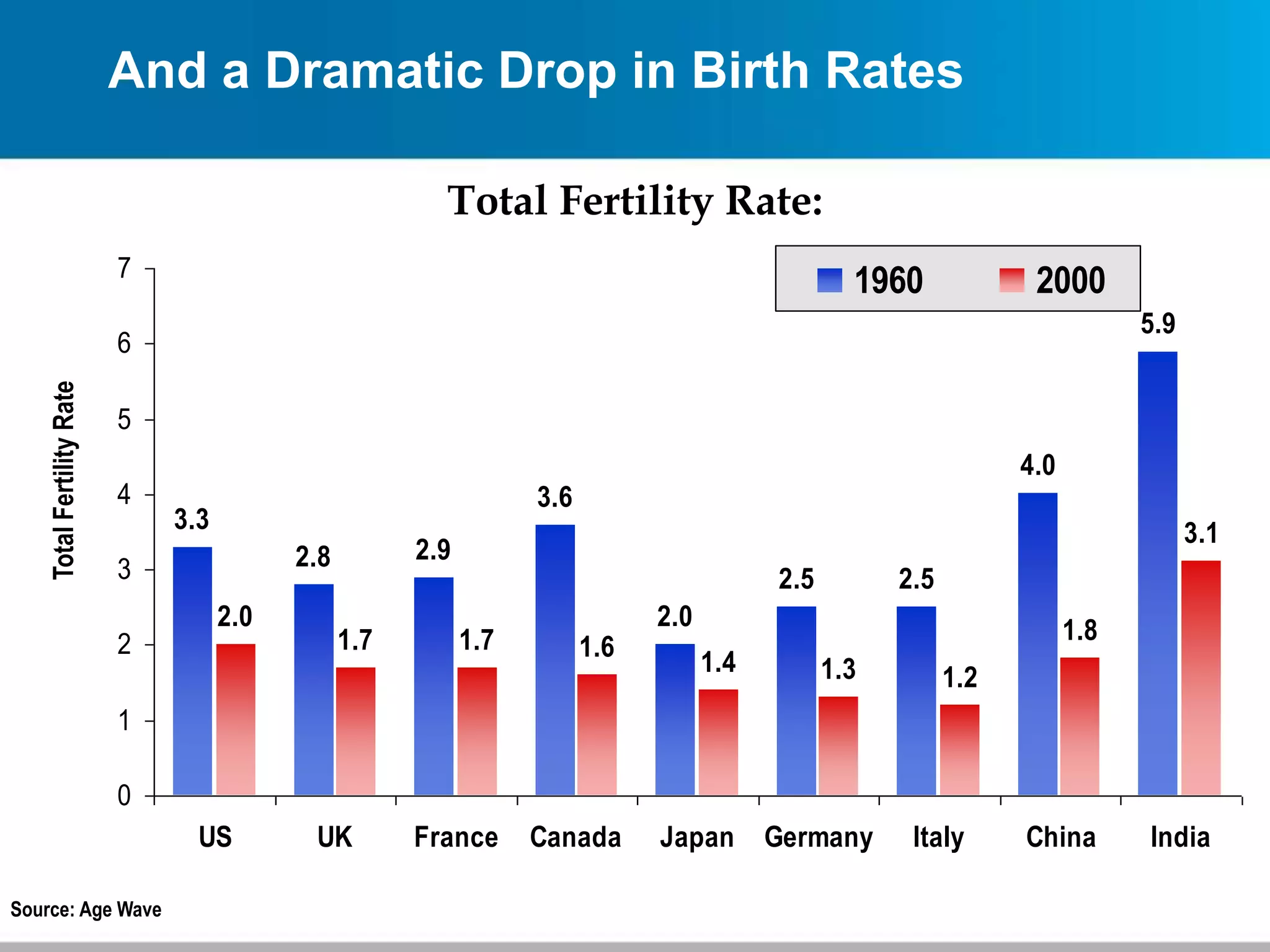
And a Dramatic Drop in Birth Rates
Source: Age Wave
TotalFertilityRate
Total Fertility Rate:
3.3
2.8 2.9
3.6
2.0
2.5 2.5
4.0
5.9
2.0
1.7 1.7 1.6
1.4 1.3 1.2
1.8
3.1
0
1
2
3
4
5
6
7
US UK France Canada Japan Germany Italy China India
1960 2000
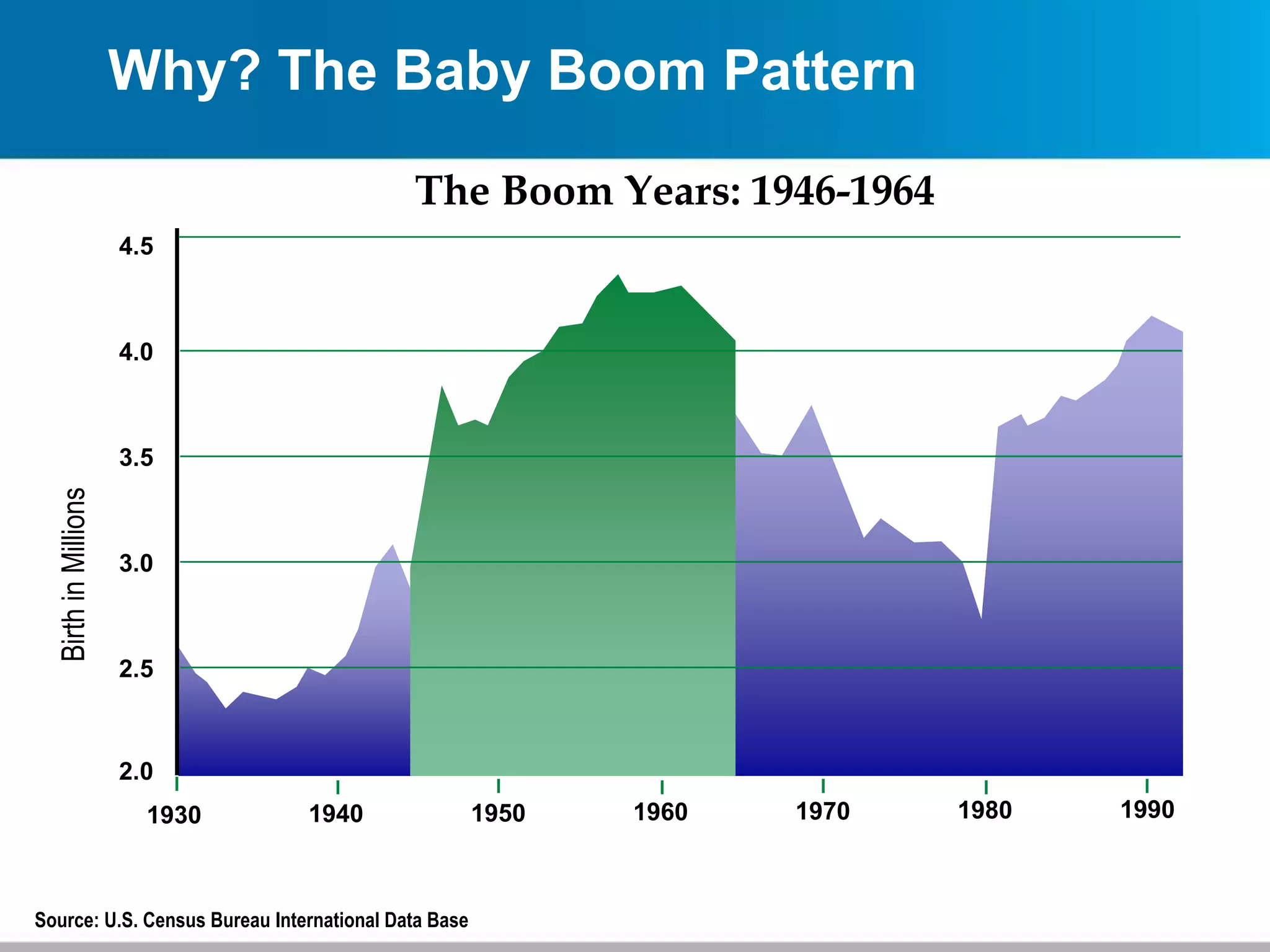
Why? The Baby Boom Pattern
Source: U.S. Census Bureau International Data Base
1930 1940 1950 1960 1970 1980 1990
4.5
4.0
3.5
3.0
2.5
2.0
BirthinMillions
The Boom Years: 1946-1964
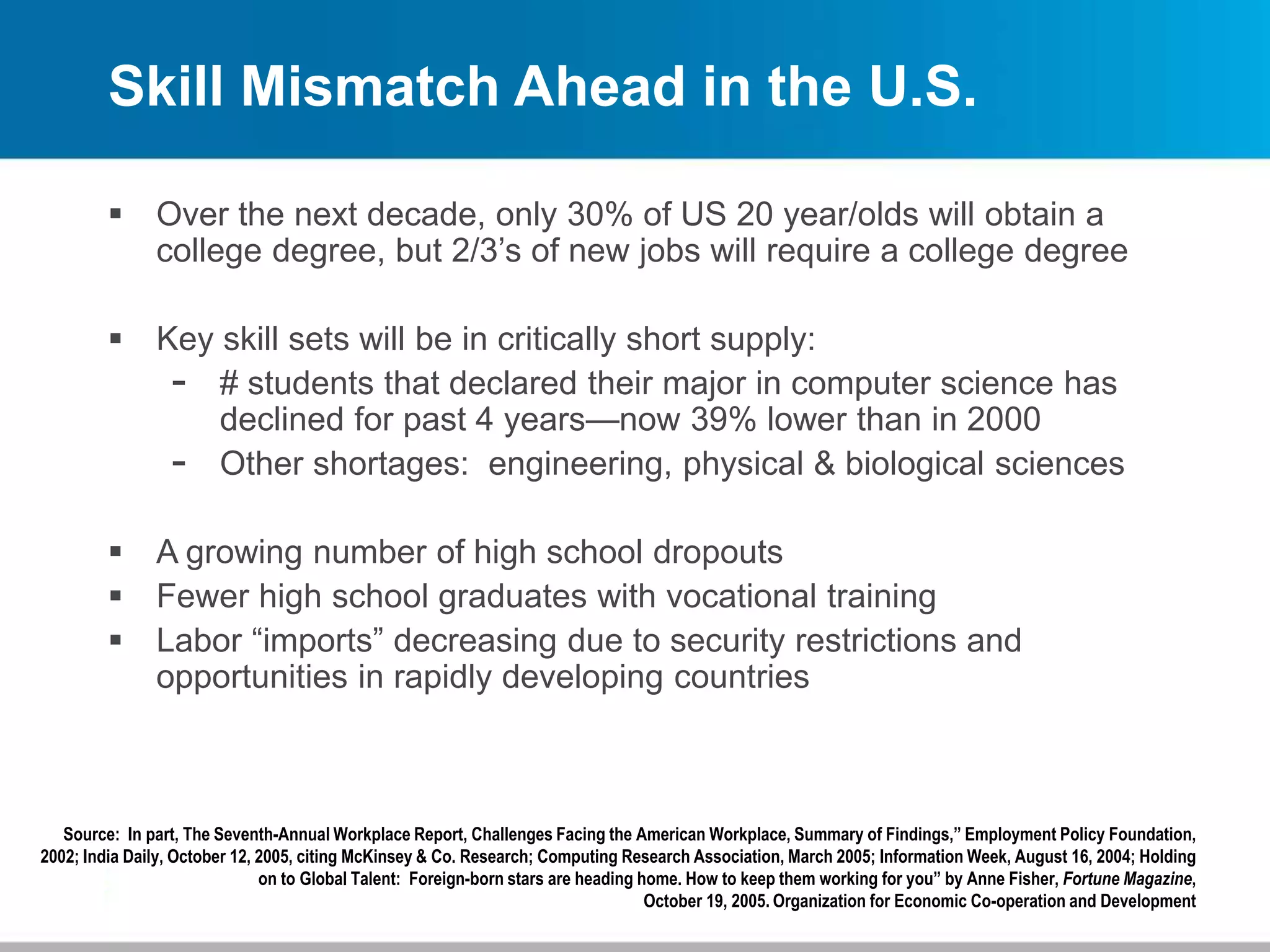
Skill Mismatch Ahead in the U.S.
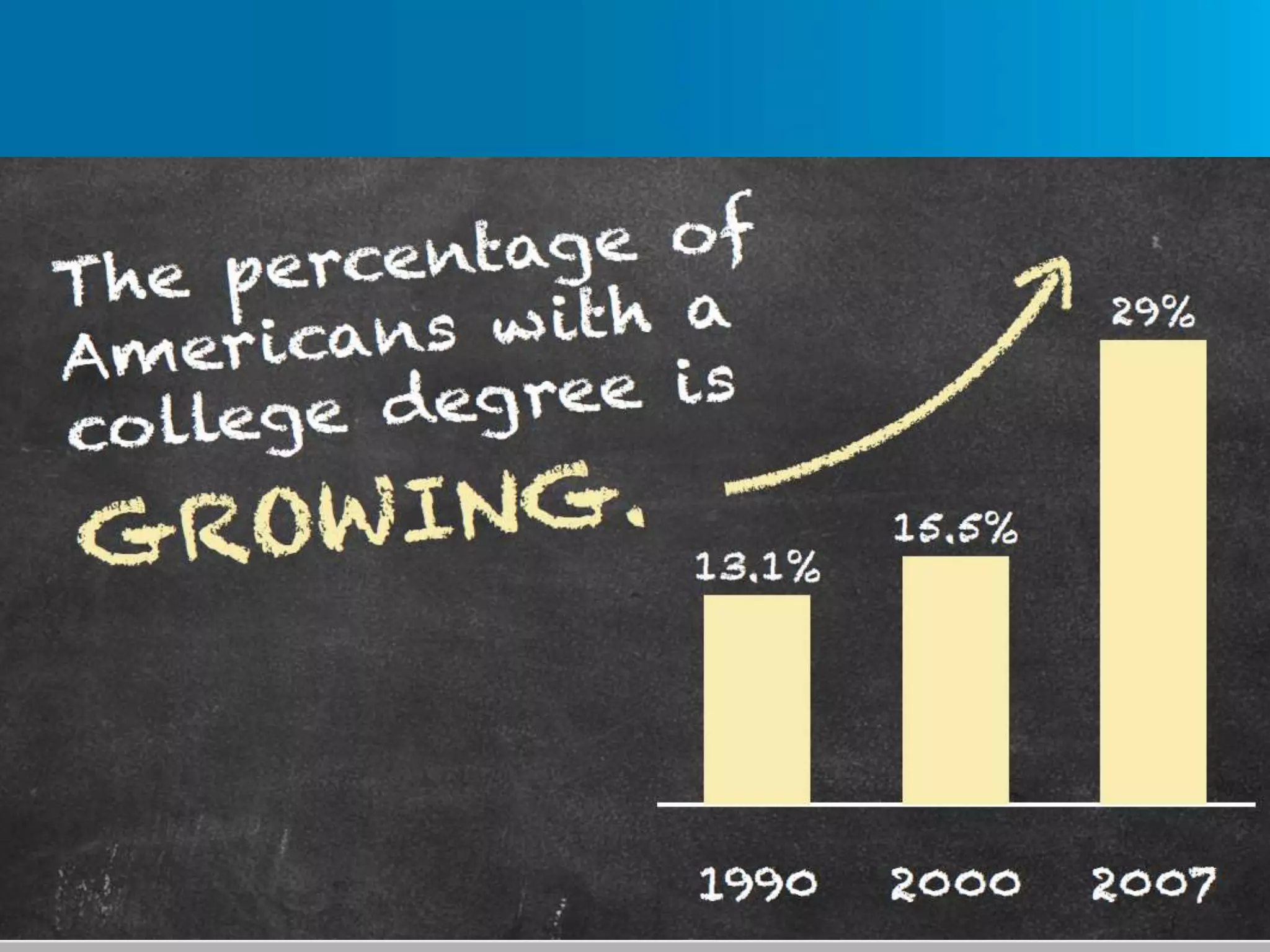
 Over the next decade, only 30% of US 20 year/olds will obtain a
college degree, but 2/3’s of new jobs will require a college degree
 Key skill sets will be in critically short supply:
- # students that declared their major in computer science has
declined for past 4 years—now 39% lower than in 2000
- Other shortages: engineering, physical & biological sciences
 A growing number of high school dropouts
 Fewer high school graduates with vocational training
 Labor “imports” decreasing due to security restrictions and
opportunities in rapidly developing countries
Source: In part, The Seventh-Annual Workplace Report, Challenges Facing the American Workplace, Summary of Findings,” Employment Policy Foundation,
2002; India Daily, October 12, 2005, citing McKinsey & Co. Research; Computing Research Association, March 2005; Information Week, August 16, 2004; Holding
on to Global Talent: Foreign-born stars are heading home. How to keep them working for you” by Anne Fisher, Fortune Magazine,
October 19, 2005. Organization for Economic Co-operation and Development
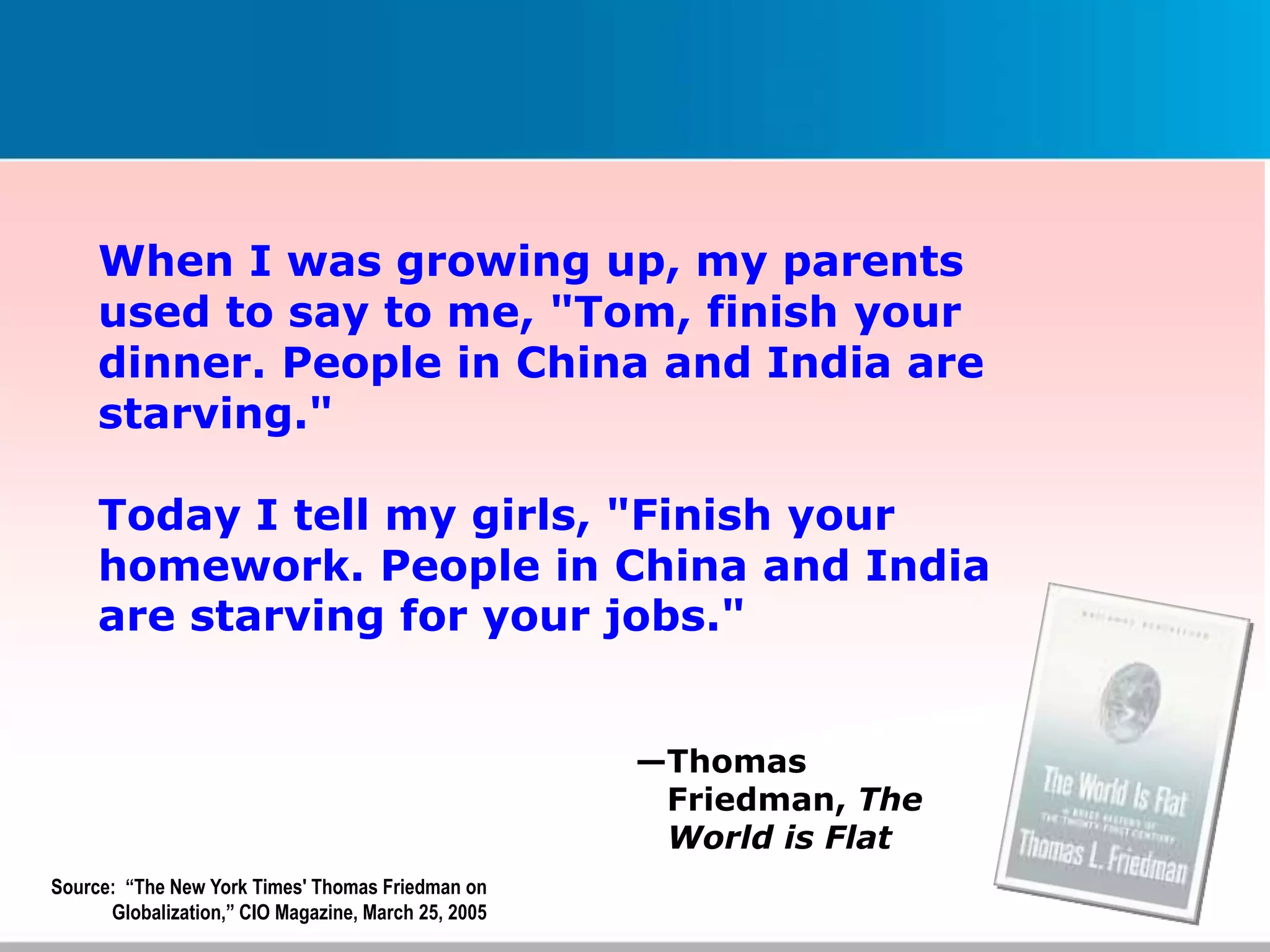
When I was growing up, my parents
used to say to me, "Tom, finish your
dinner. People in China and India are
starving."
Today I tell my girls, "Finish your
homework. People in China and India
are starving for your jobs."
Source: “The New York Times' Thomas Friedman on
Globalization,” CIO Magazine, March 25, 2005
—Thomas
Friedman, The
World is Flat
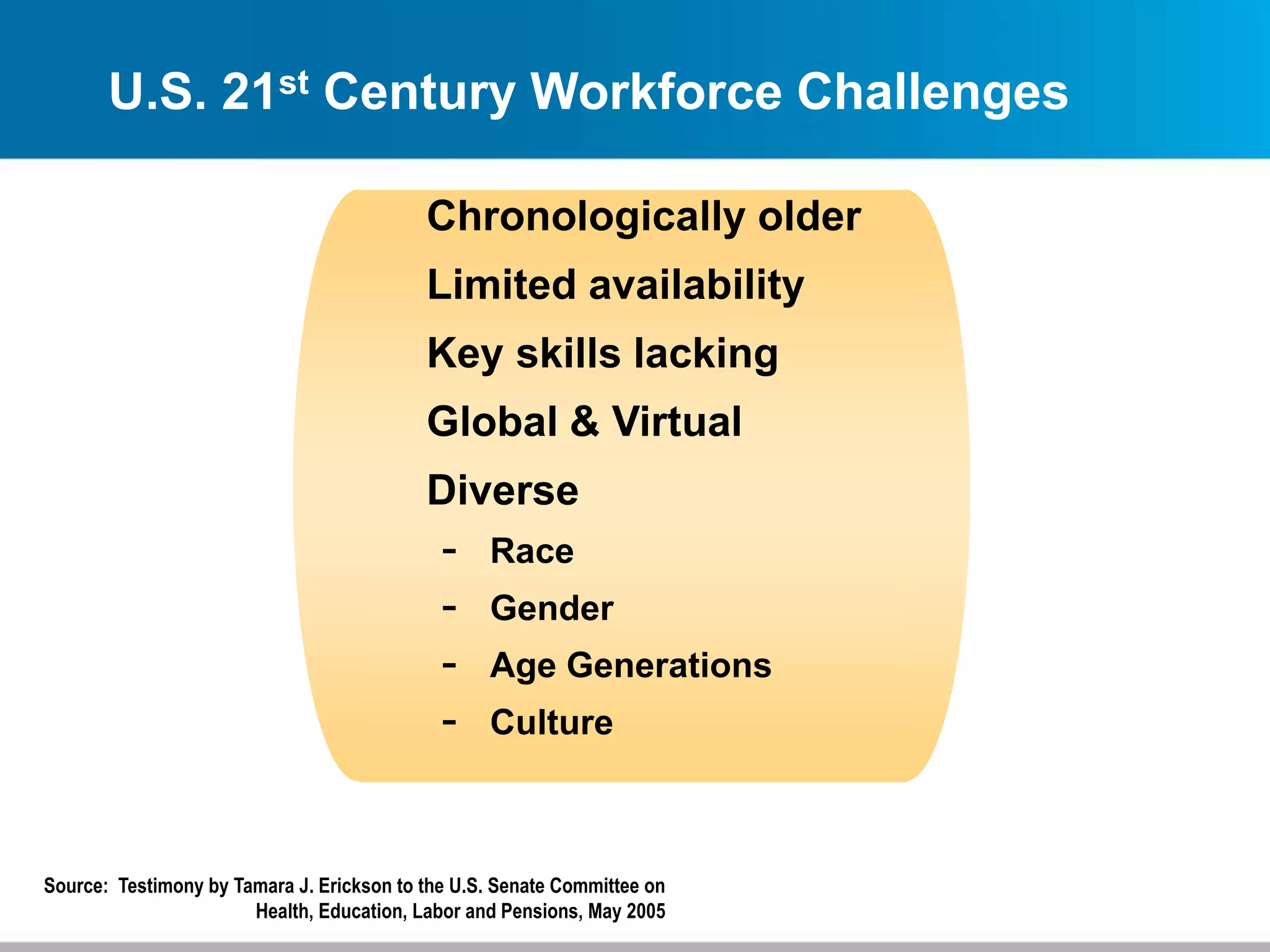
U.S. 21st Century Workforce Challenges
Chronologically older
Limited availability
Key skills lacking
Global & Virtual
Diverse
- Race
- Gender
- Age Generations
- Culture
Source: Testimony by Tamara J. Erickson to the U.S. Senate Committee on
Health, Education, Labor and Pensions, May 2005
Source: Based in part on “Meeting the Challenges of
Tomorrow's Workplace,” CEO Magazine, 2005
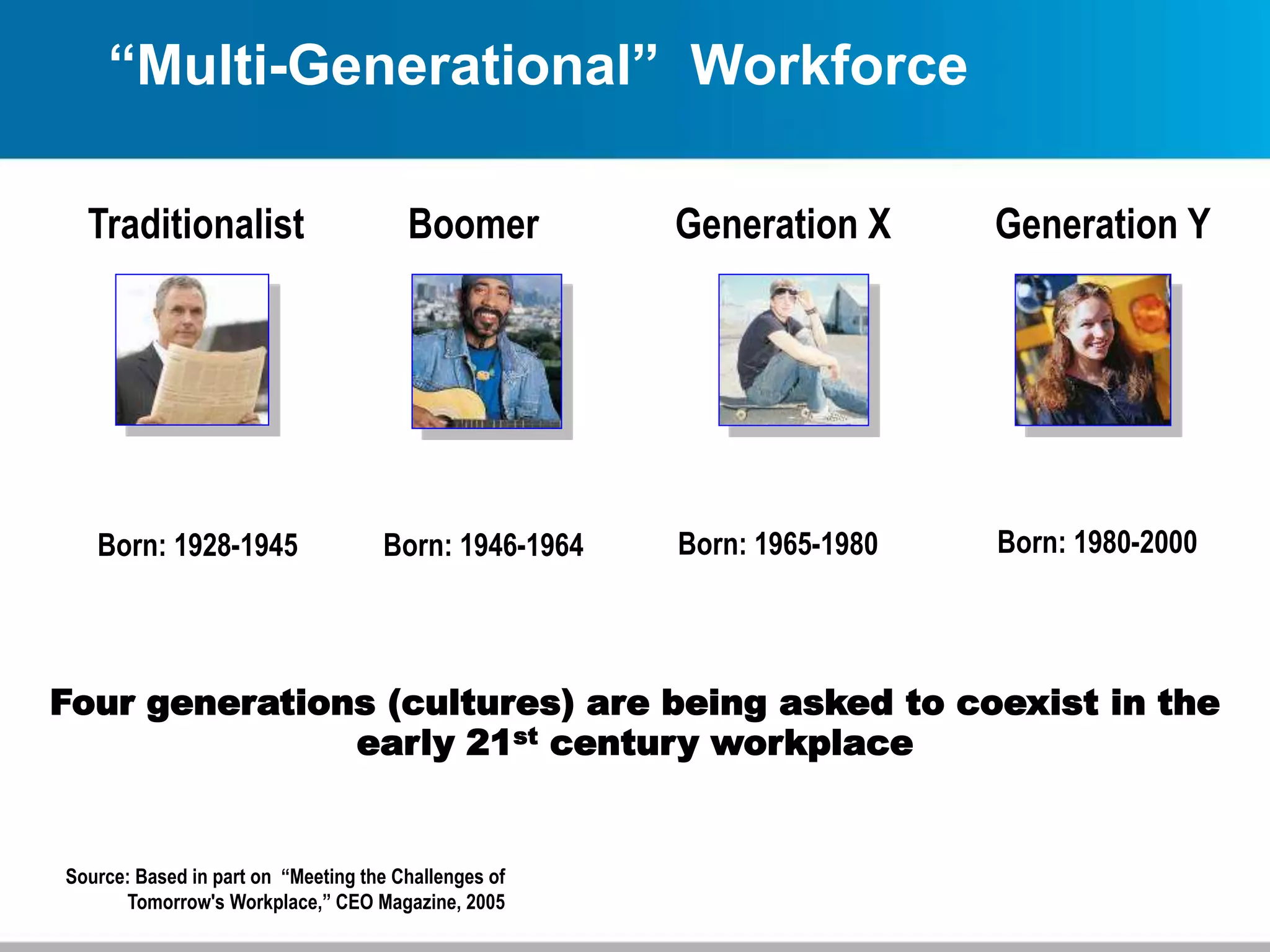
Four generations (cultures) are being asked to coexist in the
early 21st century workplace
“Multi-Generational” Workforce
Traditionalist Boomer Generation X Generation Y
Born: 1928-1945 Born: 1946-1964 Born: 1965-1980 Born: 1980-2000
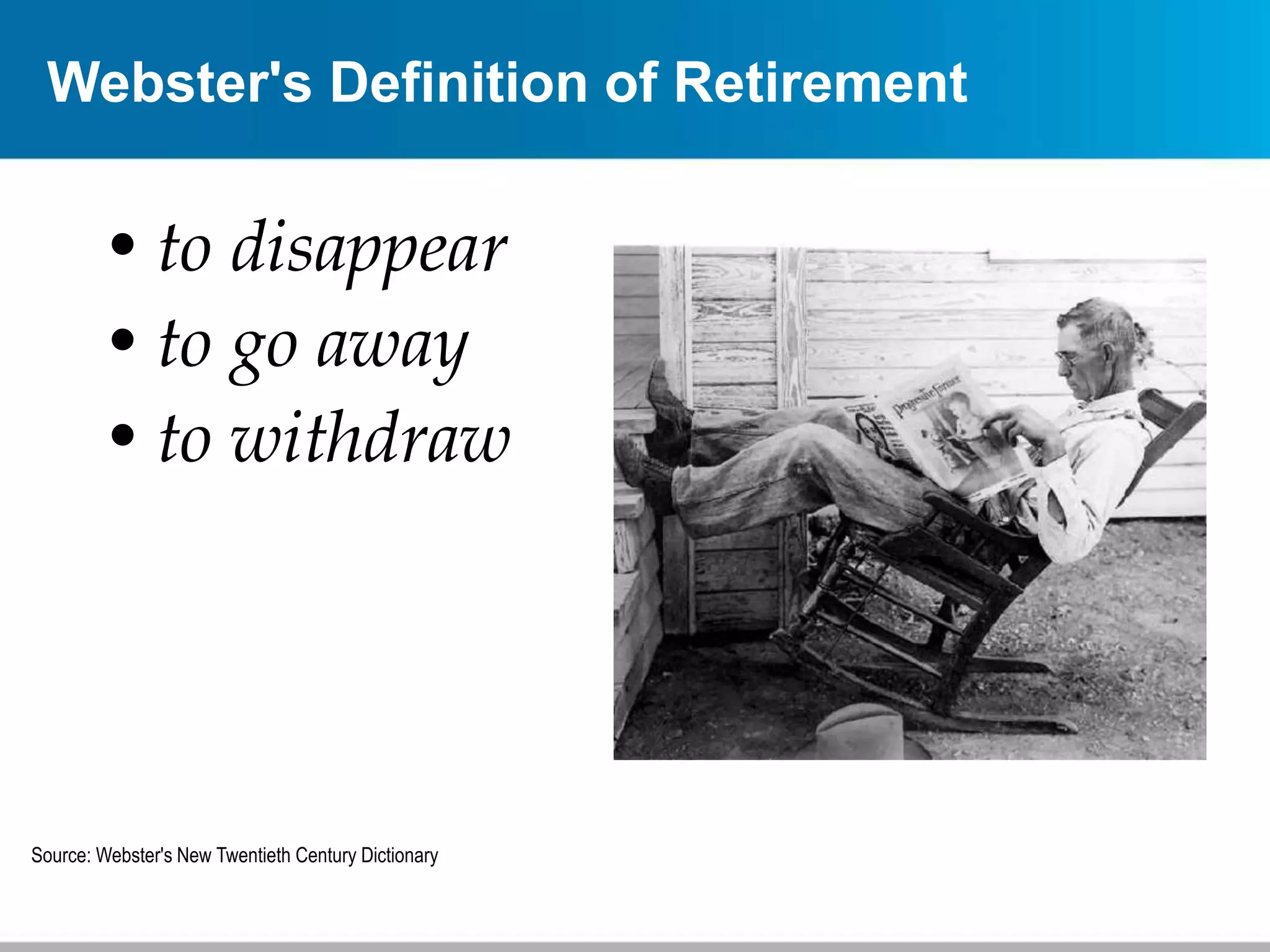
• to disappear
• to go away
• to withdraw
Source: Webster's New Twentieth Century Dictionary
Webster's Definition of Retirement
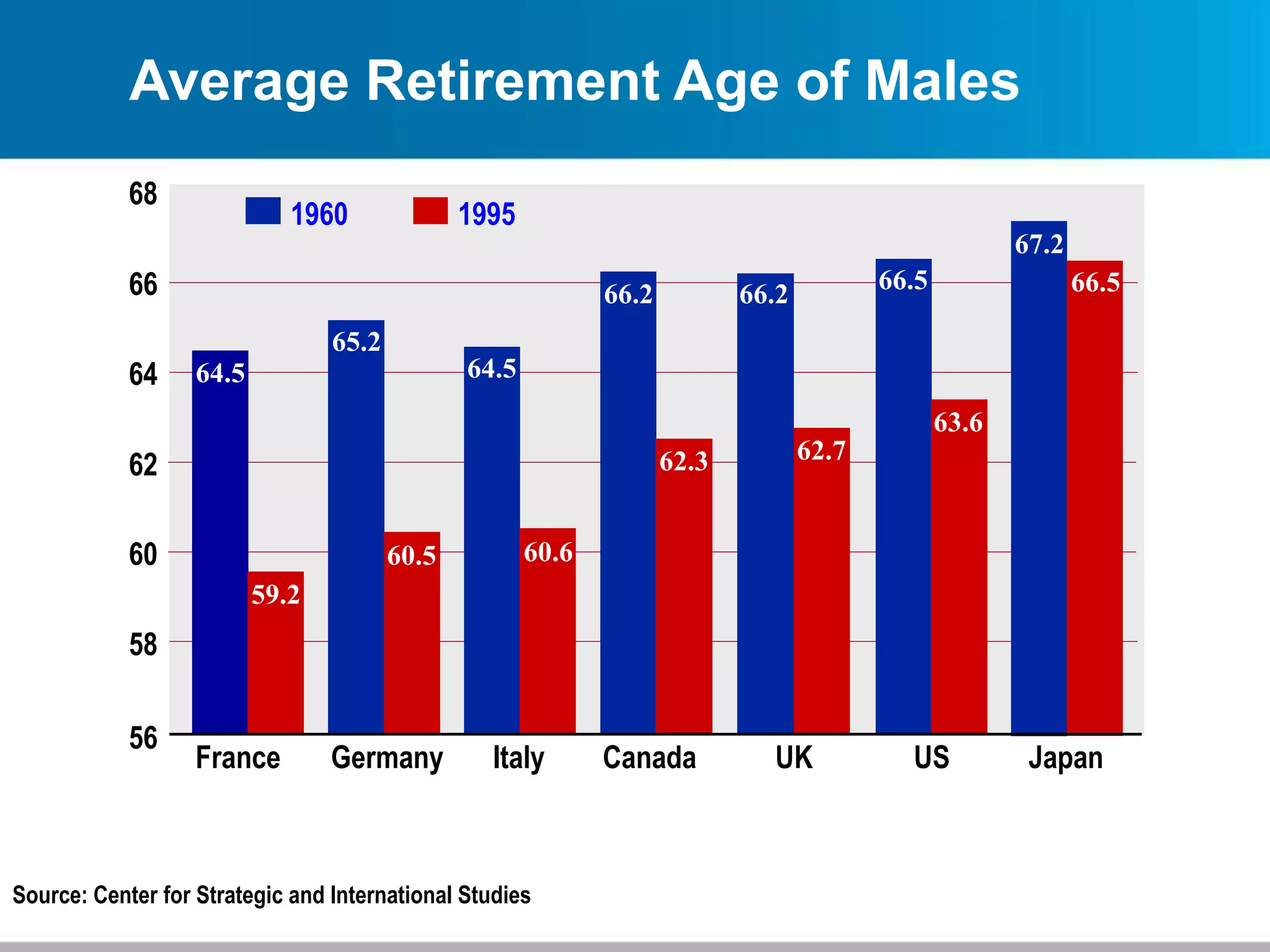
Average Retirement Age of Males
Source: Center for Strategic and International Studies
France
64.5
59.2
65.2
60.5
64.5
60.6
66.2
62.3
66.2
62.7
66.5
63.6
67.2
Germany Italy Canada UK US Japan
19951960
68
66
64
62
60
58
56
66.5
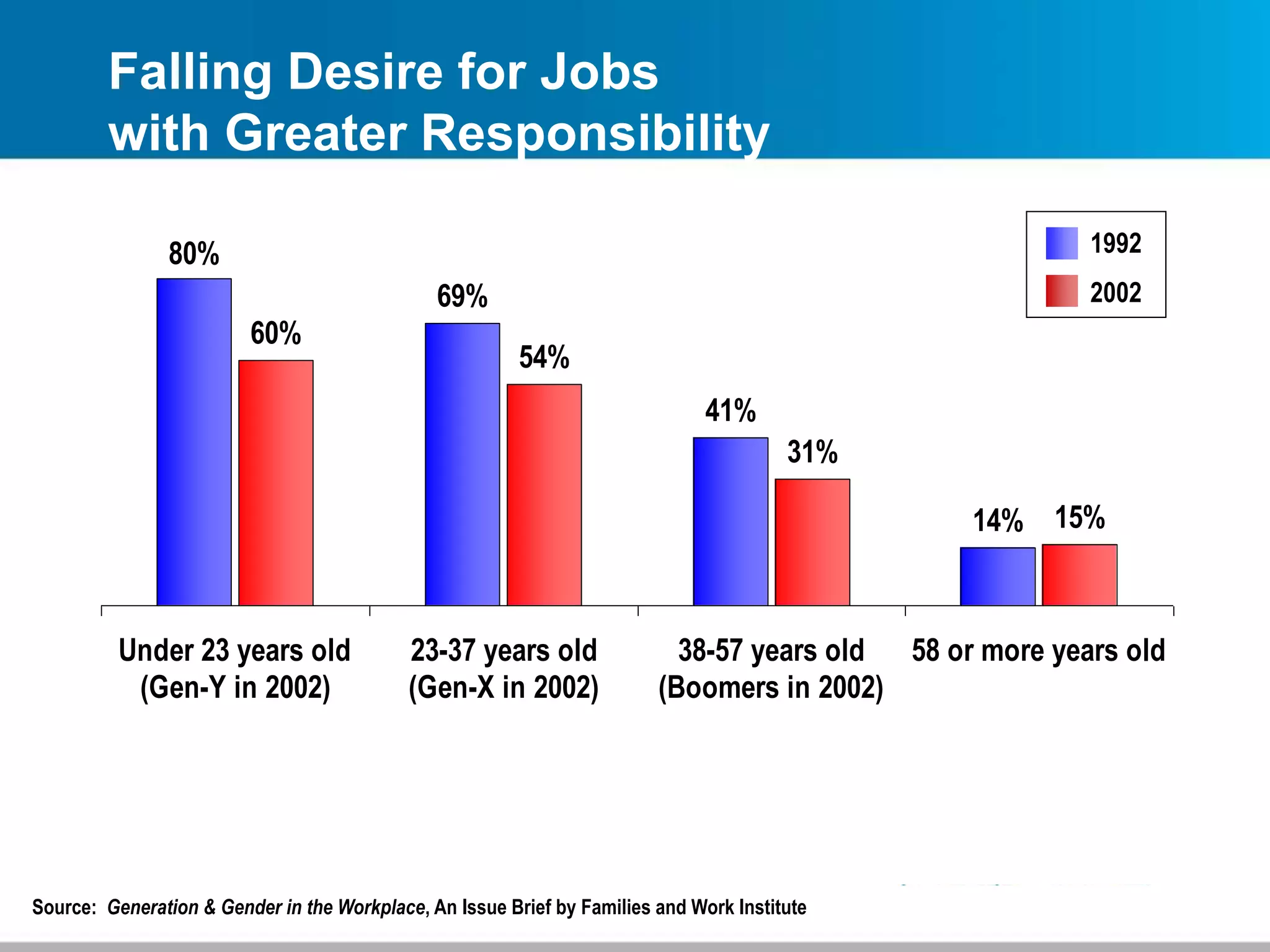
Falling Desire for Jobs
with Greater Responsibility
Source: Generation & Gender in the Workplace, An Issue Brief by Families and Work Institute
69%
41%
14%
60%
54%
31%
15%
80%
Under 23 years old
(Gen-Y in 2002)
23-37 years old
(Gen-X in 2002)
38-57 years old
(Boomers in 2002)
58 or more years old
1992
2002
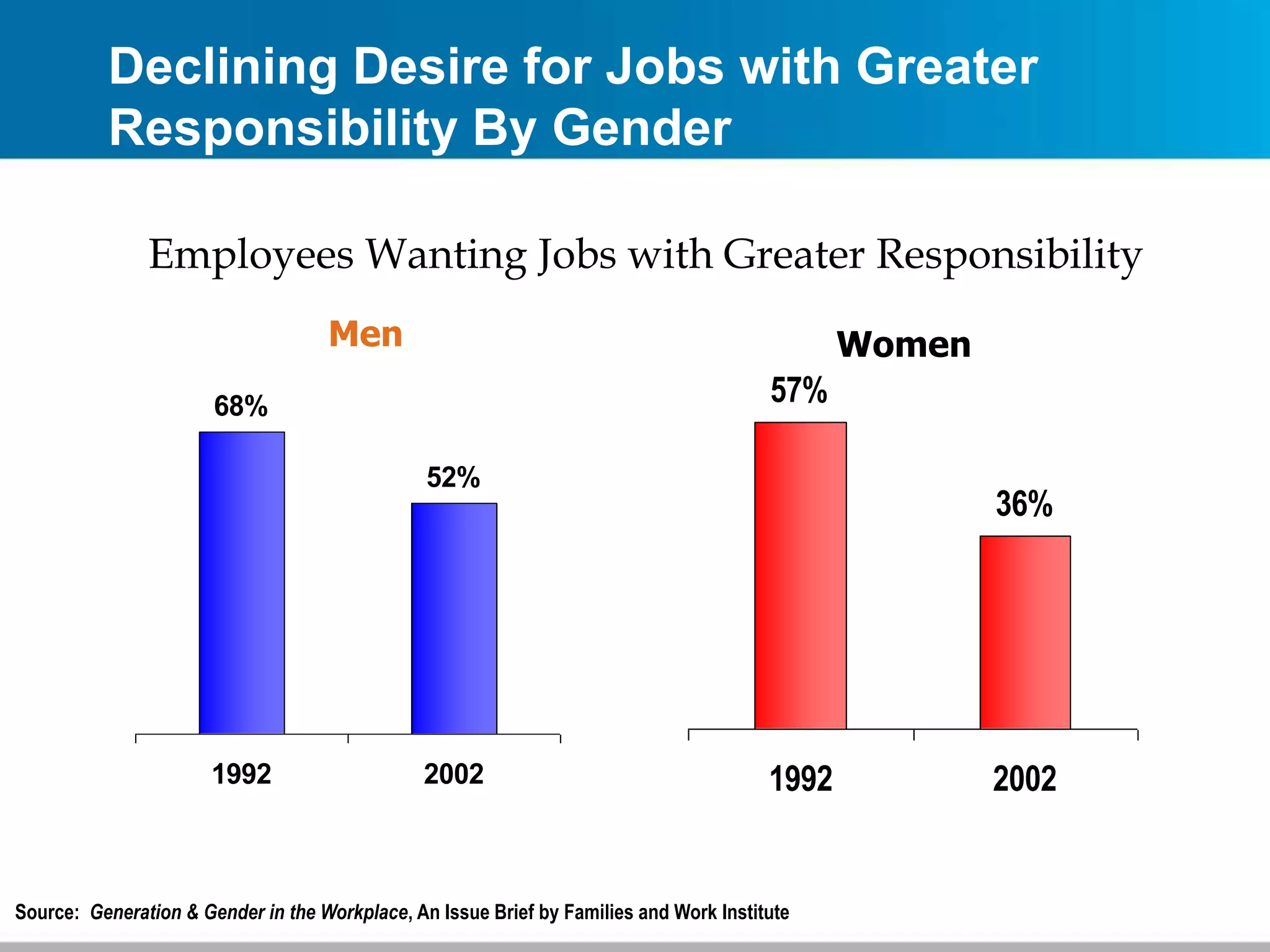
Declining Desire for Jobs with Greater
Responsibility By Gender
Source: Generation & Gender in the Workplace, An Issue Brief by Families and Work Institute
52%
68%
1992 2002
Men
36%
57%
1992 2002
Women
Employees Wanting Jobs with Greater Responsibility
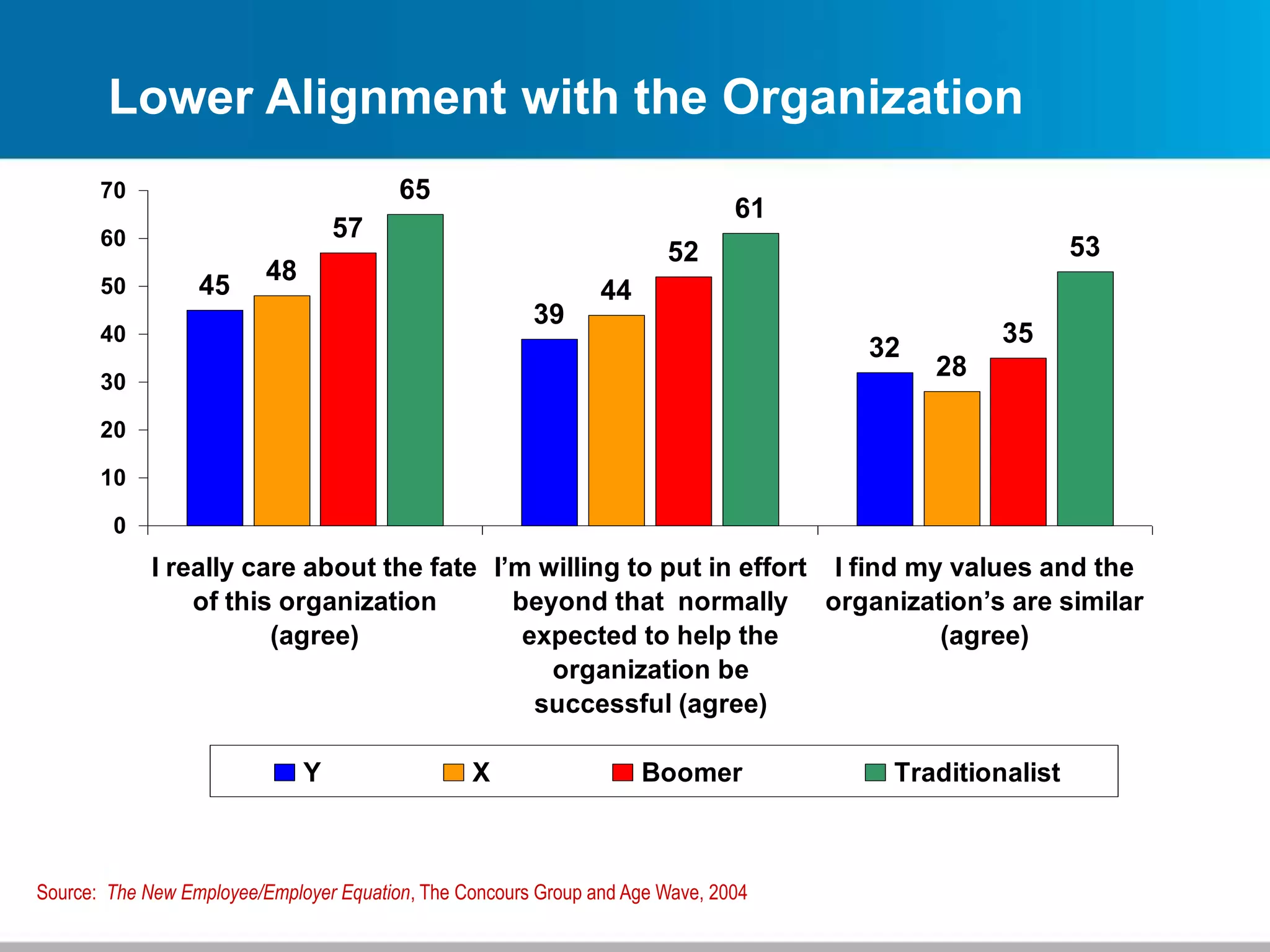
Lower Alignment with the Organization
45
39
32
48
44
28
57
52
35
65
61
53
0
10
20
30
40
50
60
70
I really care about the fate
of this organization
(agree)
I’m willing to put in effort
beyond that normally
expected to help the
organization be
successful (agree)
I find my values and the
organization’s are similar
(agree)
Y X Boomer Traditionalist
Source: The New Employee/Employer Equation, The Concours Group and Age Wave, 2004
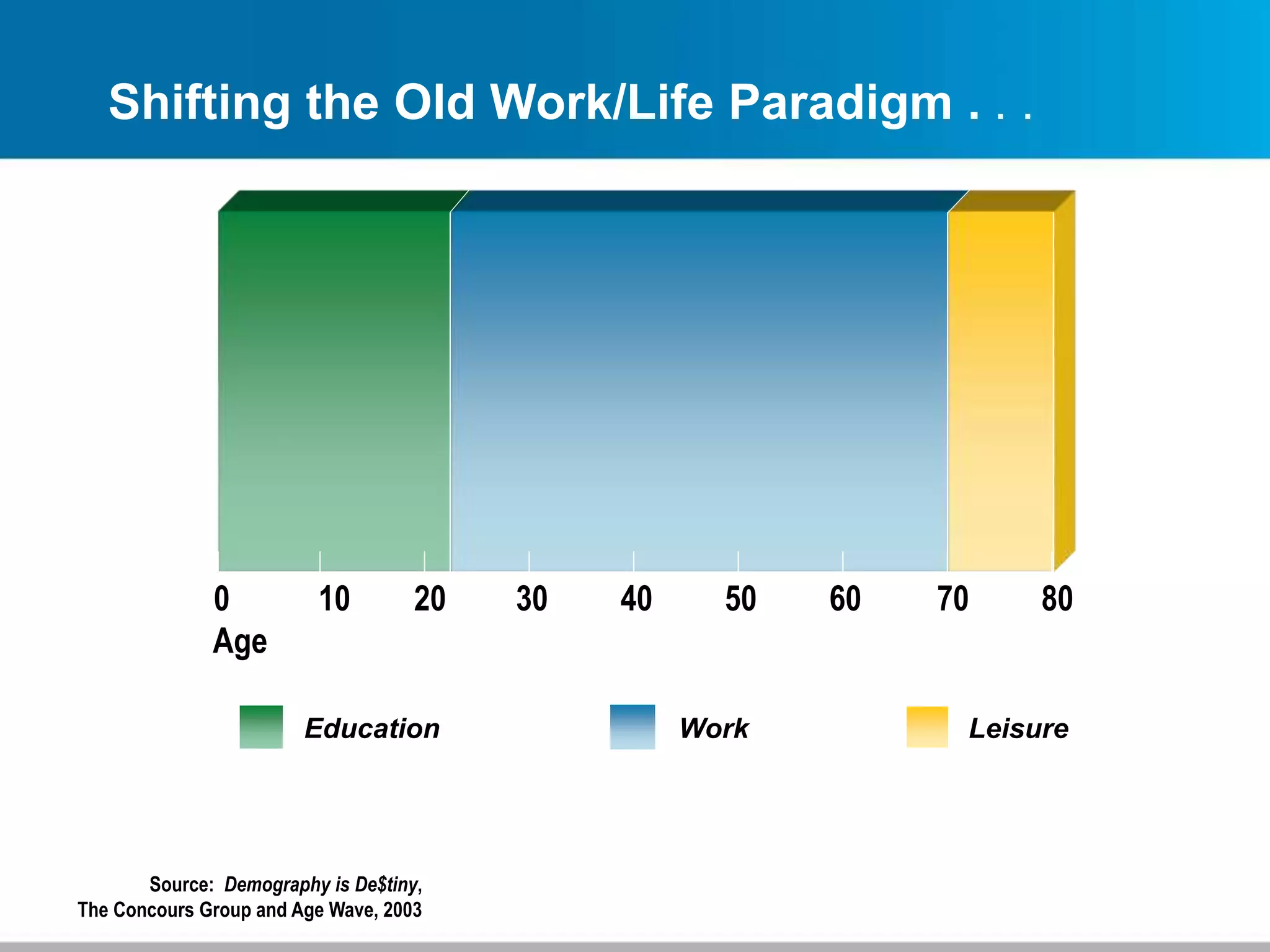
Education Work Leisure
0 10 20 30 40 50 60 70 80
Shifting the Old Work/Life Paradigm . . .
Age
Source: Demography is De$tiny,
The Concours Group and Age Wave, 2003
Education Work Leisure
0 10 20 30 40 50 60 70
Age
80
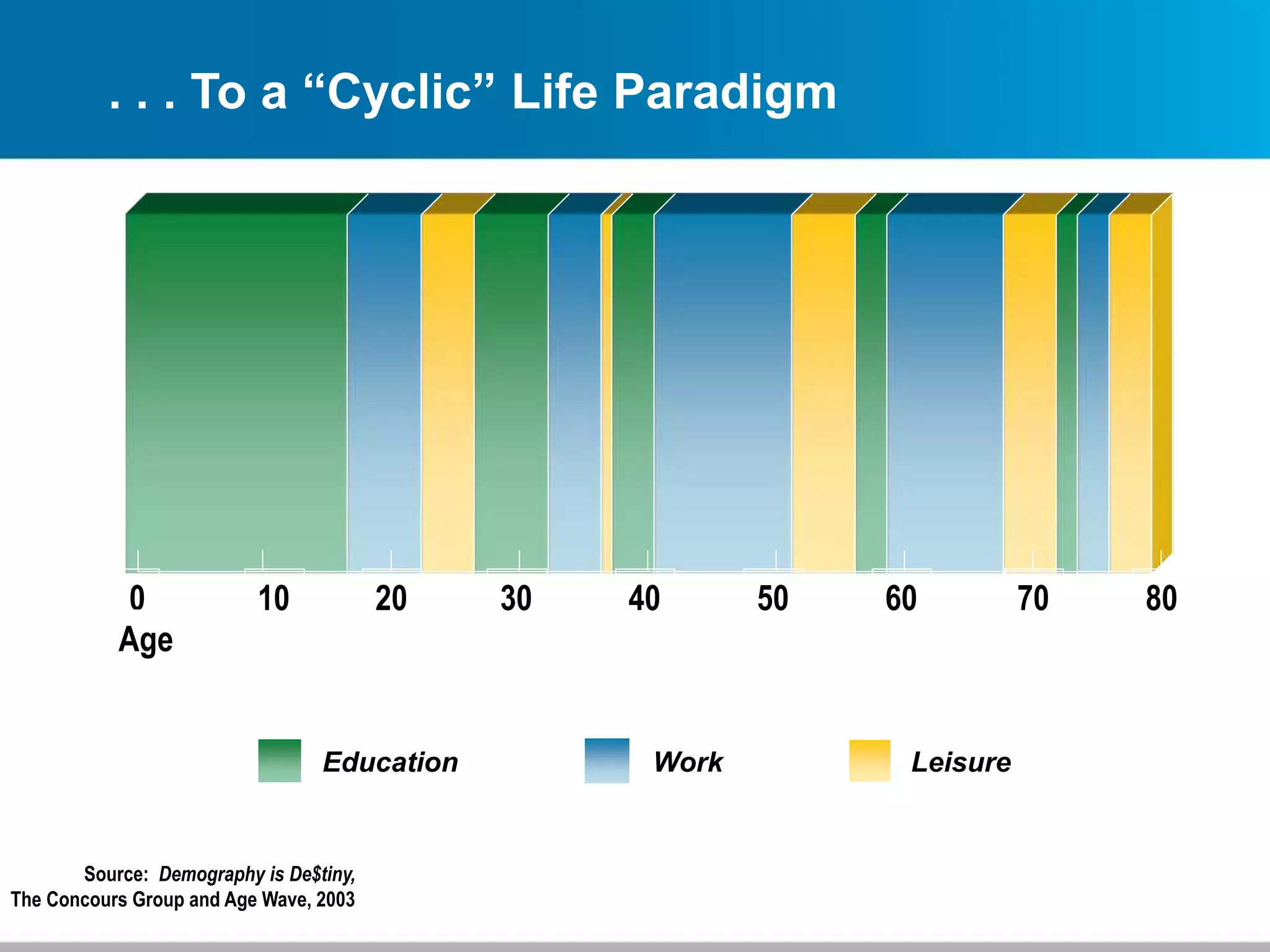
. . . To a “Cyclic” Life Paradigm
Source: Demography is De$tiny,
The Concours Group and Age Wave, 2003
Education Work Leisure
0 10 20 30 40 50 60 70
Age
80
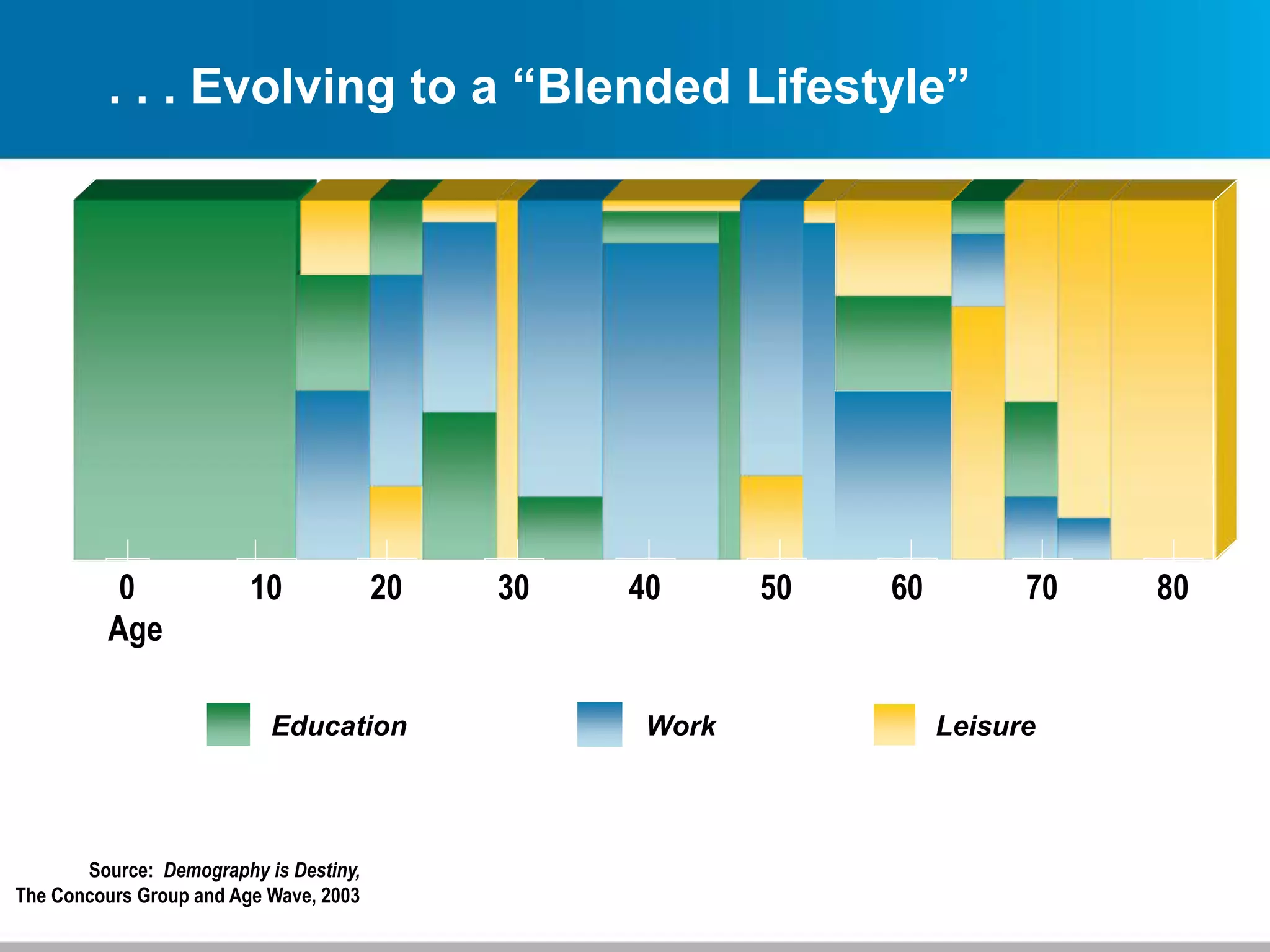
. . . Evolving to a “Blended Lifestyle”
Source: Demography is Destiny,
The Concours Group and Age Wave, 2003
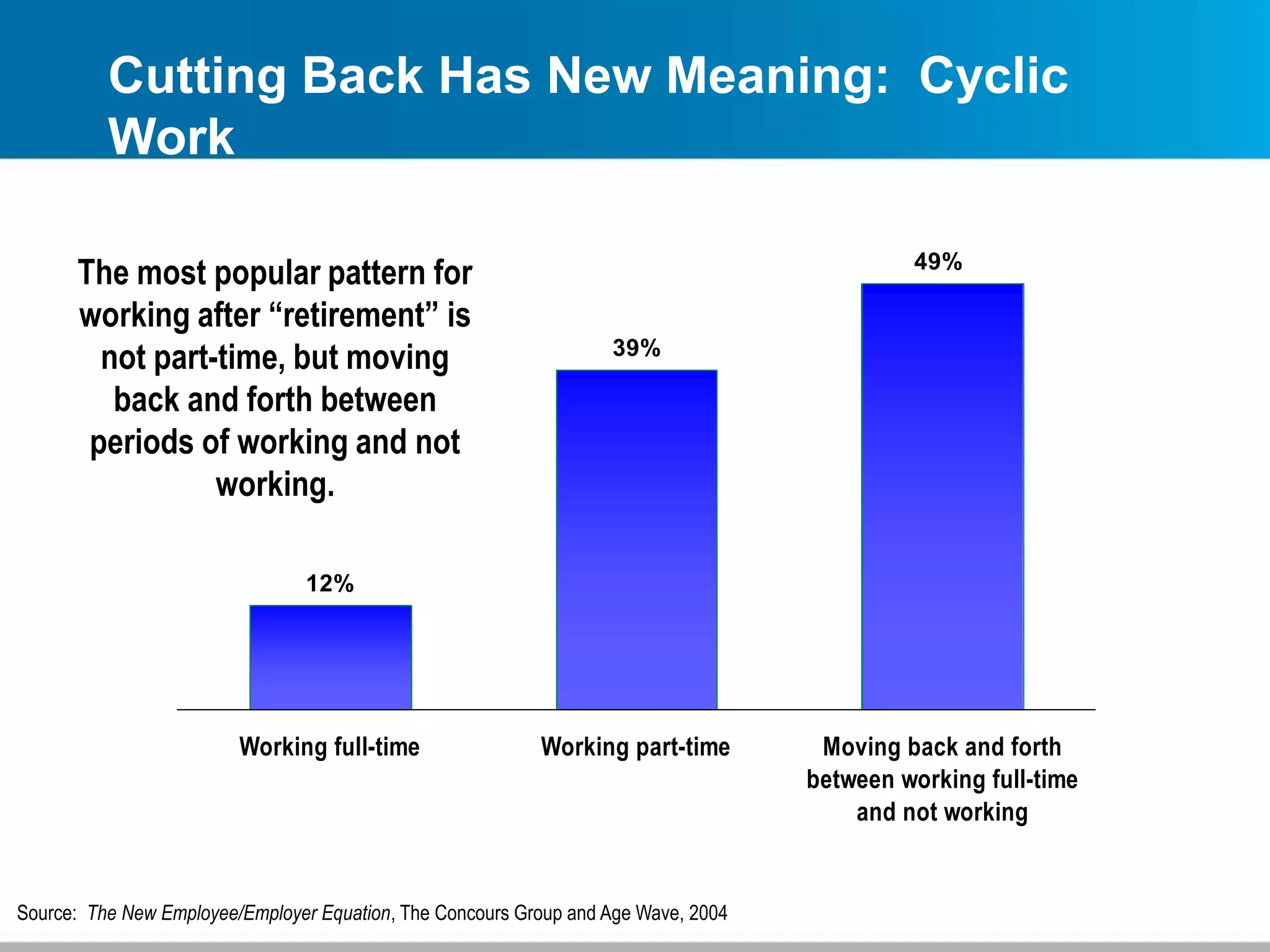
Cutting Back Has New Meaning: Cyclic
Work
12%
39%
49%
Working full-time Working part-time Moving back and forth
between working full-time
and not working
The most popular pattern for
working after “retirement” is
not part-time, but moving
back and forth between
periods of working and not
working.
Source: The New Employee/Employer Equation, The Concours Group and Age Wave, 2004
Cutting Back Has New Meaning: Cyclic
Work
12%
39%
49%
Working full-time Working part-time Moving back and forth
between working full-time
and not working
The most popular pattern for
working after “retirement” is
not part-time, but moving
back and forth between
periods of working and not
working.
Source: The New Employee/Employer Equation, The Concours Group and Age Wave, 2004
Copyright, 2011 © HBMG, Inc.
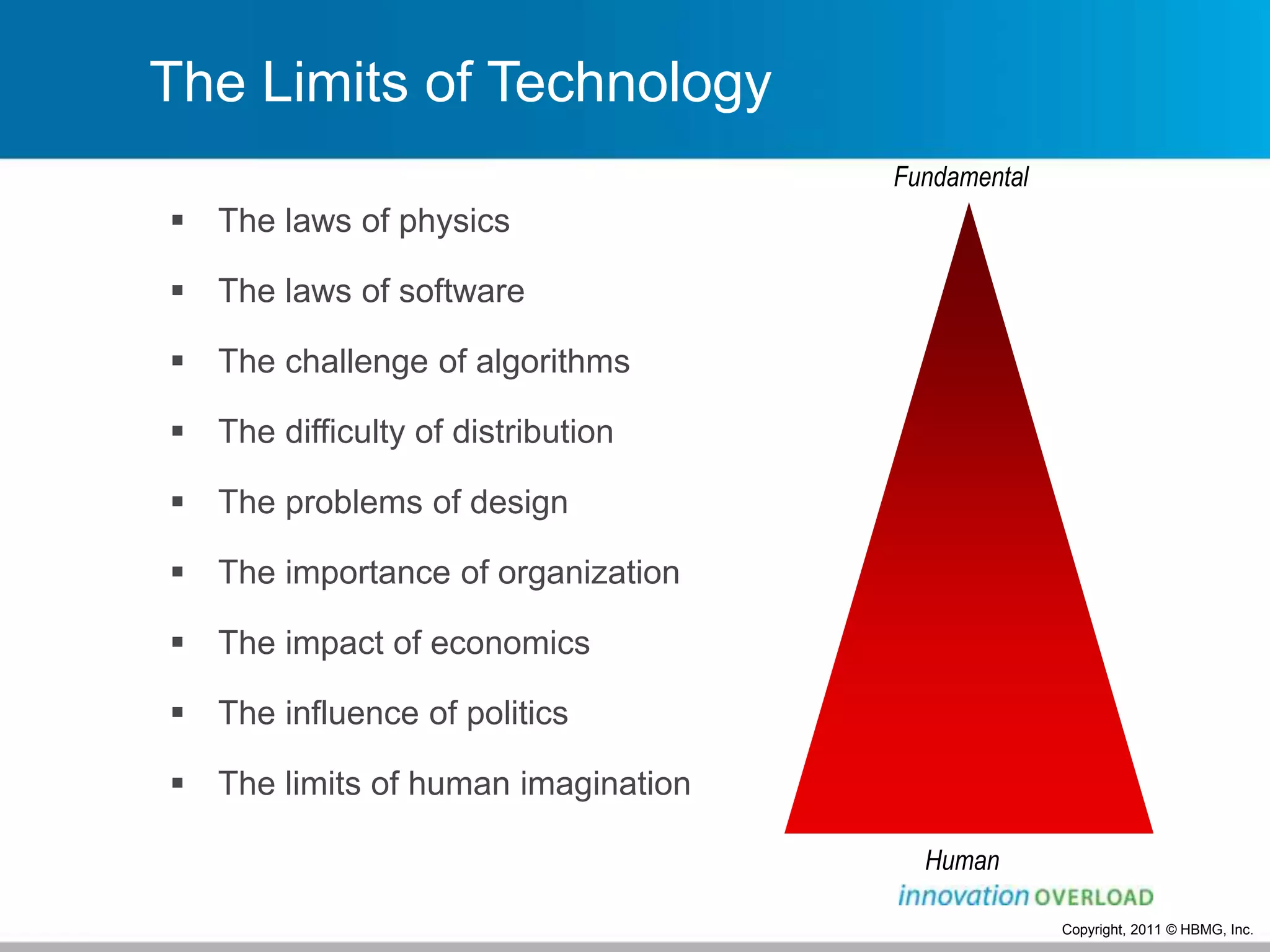
The Limits of Technology
 The laws of physics
 The laws of software
 The challenge of algorithms
 The difficulty of distribution
 The problems of design
 The importance of organization
 The impact of economics
 The influence of politics
 The limits of human imagination
Fundamental
Human
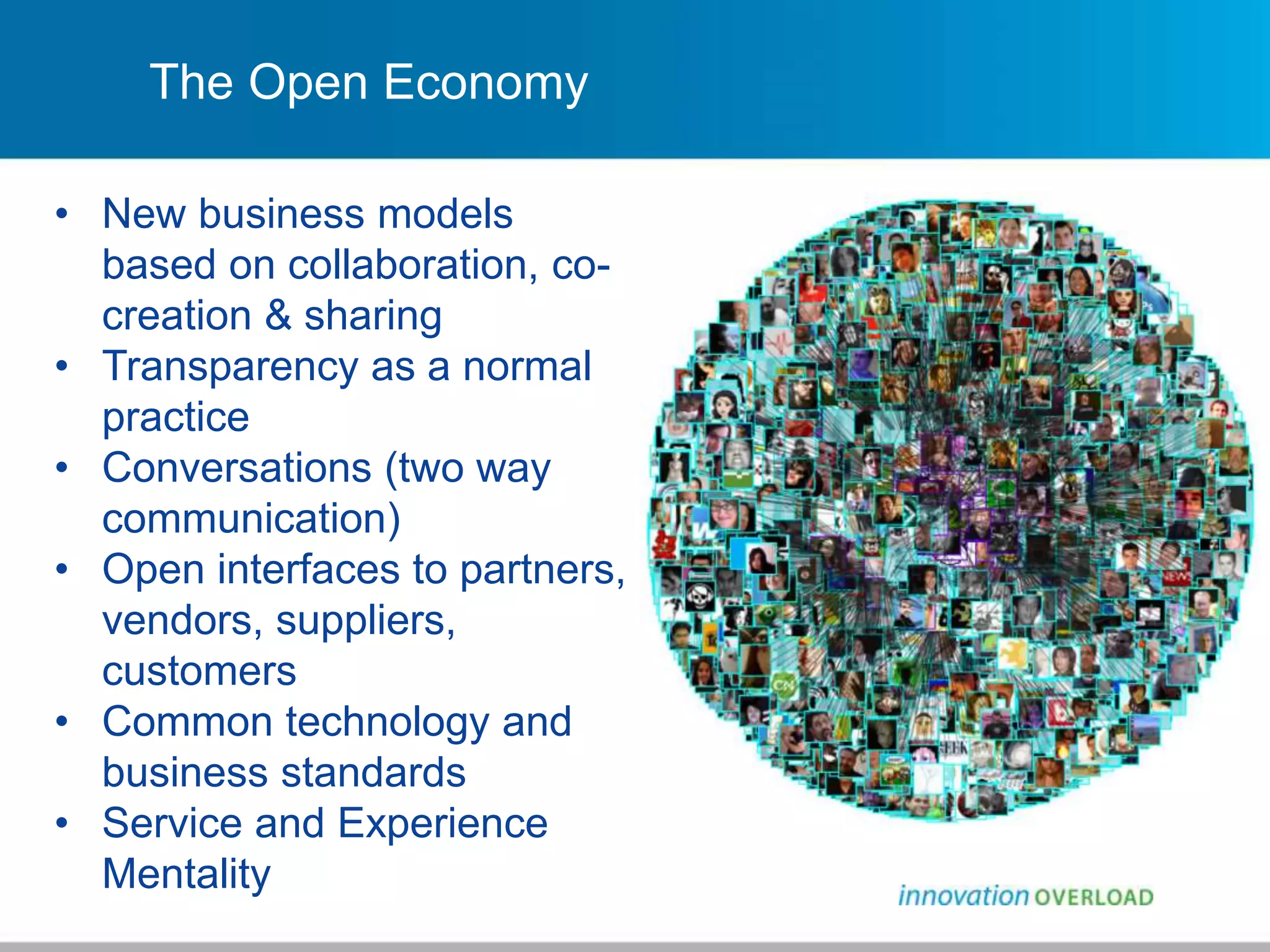
The Open Economy
• New business models
based on collaboration, co-
creation & sharing
• Transparency as a normal
practice
• Conversations (two way
communication)
• Open interfaces to partners,
vendors, suppliers,
customers
• Common technology and
business standards
• Service and Experience
Mentality
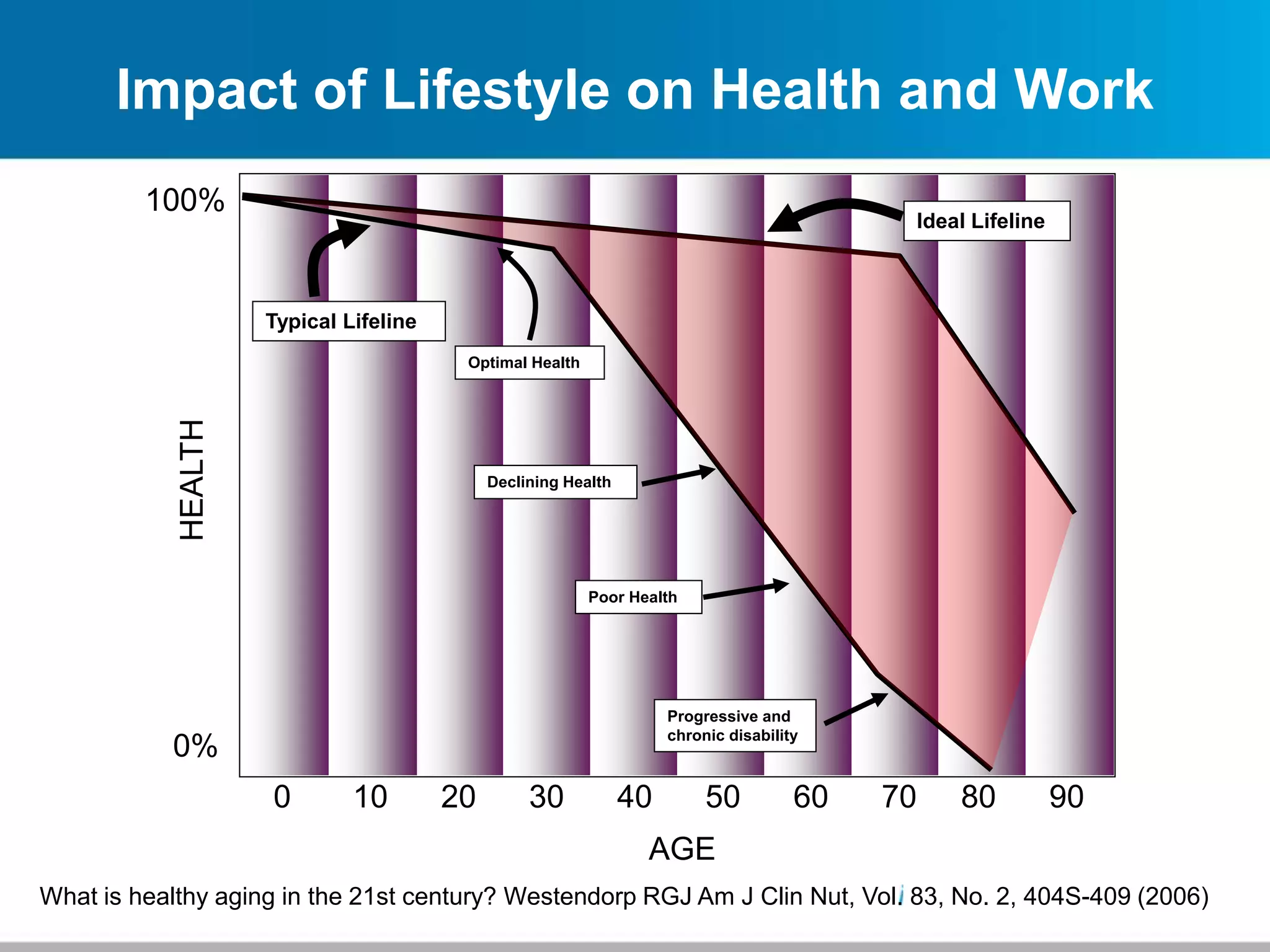
Impact of Lifestyle on Health and Work
100%
0%
HEALTH
0 10 20 30 40 50 60 70 80 90
AGE
Ideal Lifeline
Typical Lifeline
Optimal Health
Declining Health
Poor Health
Progressive and
chronic disability
What is healthy aging in the 21st century? Westendorp RGJ Am J Clin Nut, Vol. 83, No. 2, 404S-409 (2006)
Copyright 2012@ HBMG Inc.
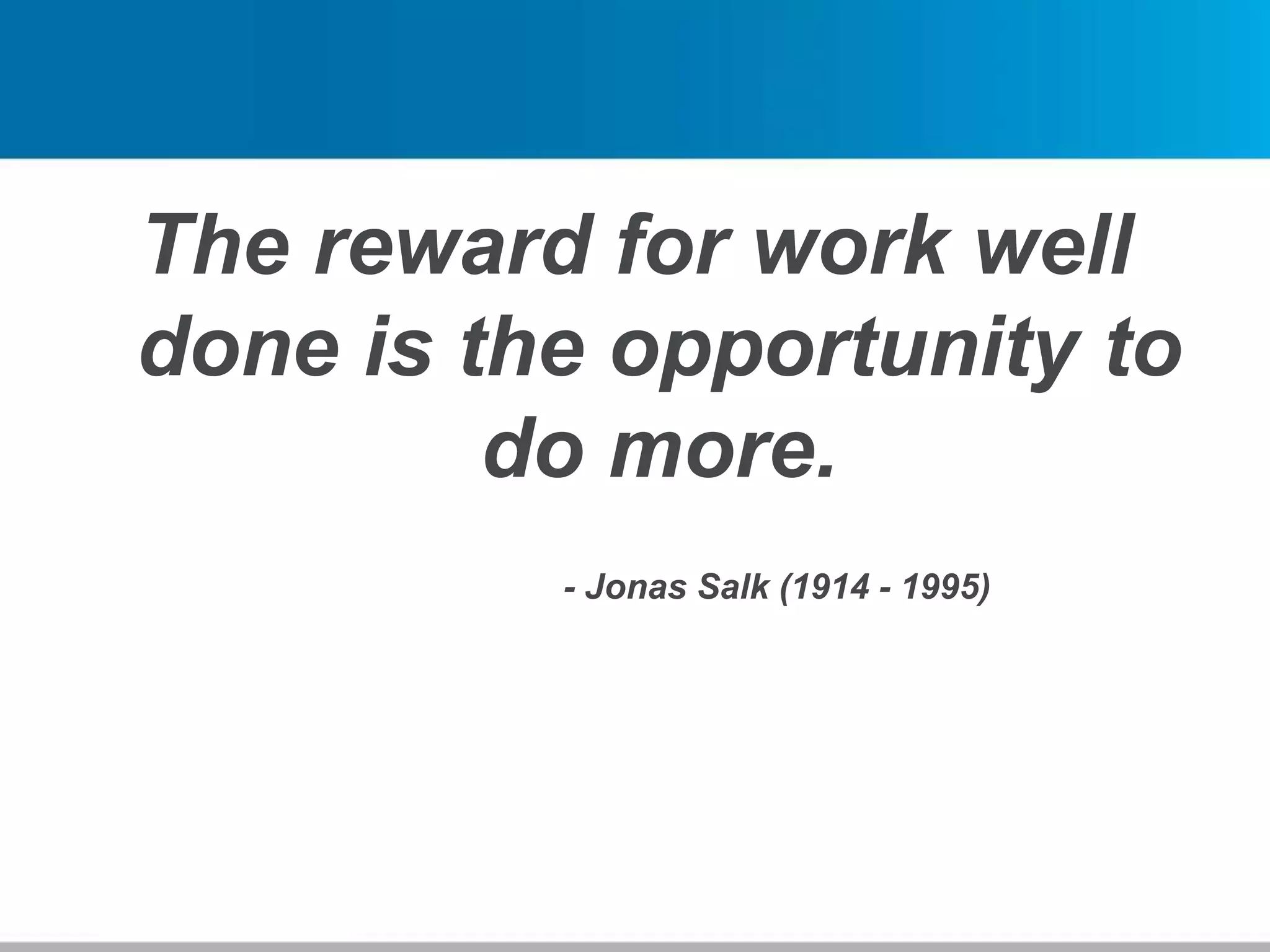
The reward for work well
done is the opportunity to
do more.
- Jonas Salk (1914 - 1995)
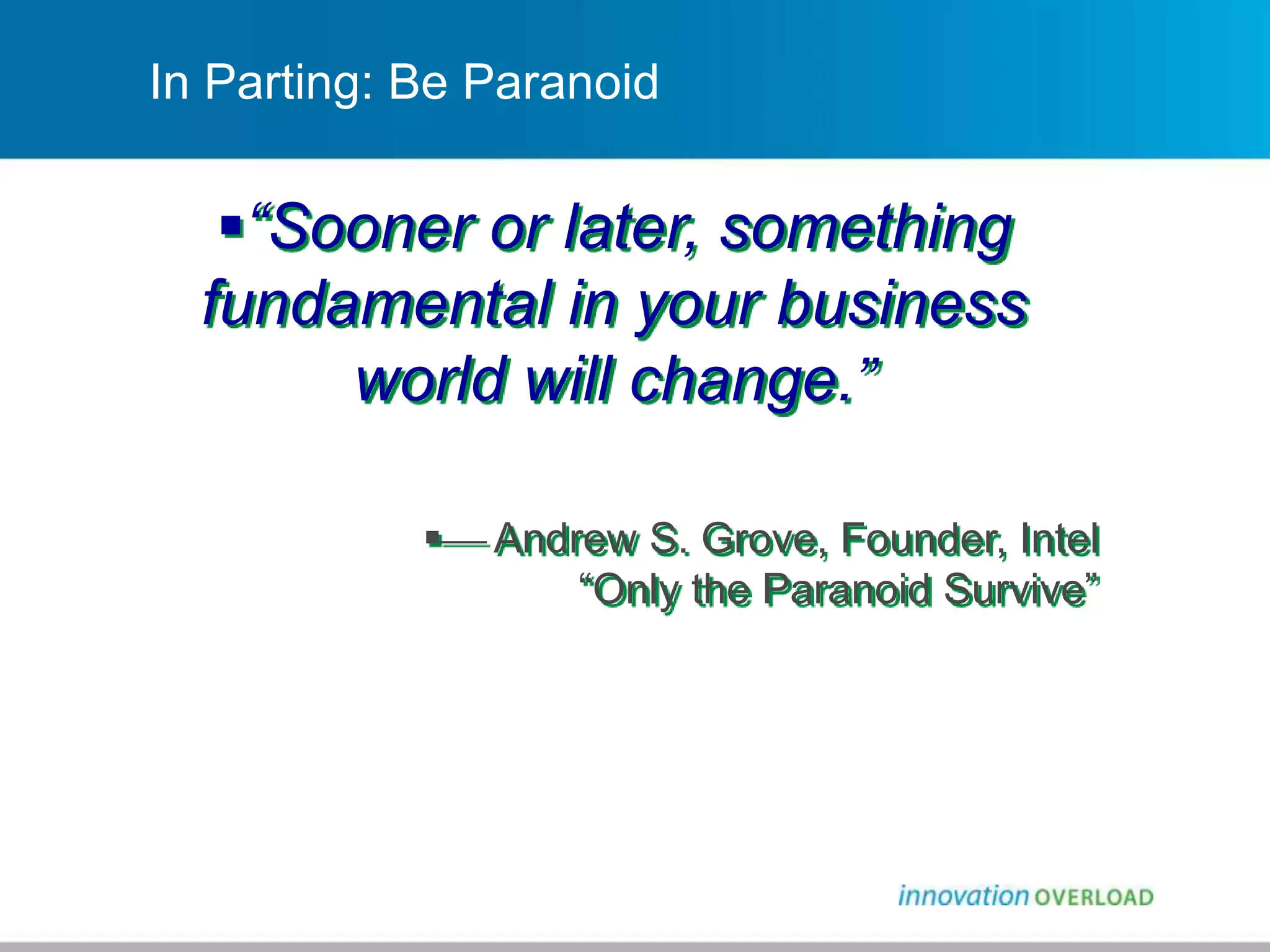
In Parting: Be Paranoid
“Sooner or later, something
fundamental in your business
world will change.”
 Andrew S. Grove, Founder, Intel
“Only the Paranoid Survive”

Innovation Overload – Technology, Jobs and the Future

  • 1.
    9:00 AM -10:00 AM Innovation Overload – Technology, Jobs and the Future Room: Meeting Room 202A Speaker: David Smith This is not your grandfather’s job market where one could work and retire from one company after 40 years. Your father and your company have probably not fared that well either. The fast pace of technology change and productivity improvements, in an increasingly competitive market, have forced companies to change their strategy, frequently upgrade and improve their products or services, and adjust their workforce. Downsizing, outsourcing, automation, financial pressures, short-term demands, and failed strategy all contribute to the challenges. The pace of technology innovation is increasing so fast that many have a hard time choosing where to focus and how to discover what is new. Most delay action and then miss the window to innovate. The growth of complex systems and a global infrastructure has changed the decision and education process. The ability to adapt to real-time and continuous learning will provide an advantage for professionals of the future. A future focus and focused innovation will drive the next generations of products and services. This talk explores the future of work and how it impacts companies and you.
  • 2.
  • 3.
    Work “No other techniquefor the conduct of life attaches the individual so firmly to reality as laying emphasis on work: For work at least gives one a secure place in a portion of reality, in the human community.” Sigmund Freud The product of work contributes to health, well-being and economic & social stability.
  • 4.
    Changes to theFuture of Work
  • 13.
    Source: Employment PolicyFoundation analysis and projections of Census/BLS and BEA data. Millions of People Expected Labor Force and Labor Force Demand Growing Shortage of U.S. Workers 0 50 100 150 200 250 2002 2004 2006 2008 2010 2012 2014 2016 2018 2020 2022 2024 2026 2028 2030 Labor Needed Labor Available
  • 14.
    Female Labor ForceParticipation (as a Percent of the Female Population Age 15+), 1990-2011
  • 16.
    Screeching to aHalt: Growth in the Working-Age Population Source: Deloitte Research/UN Population Division (http://esa.un.org/unpp/) It’s 2008: Do You Know Where Your Talent Is? Why Acquisition and Retention Strategies Don’t Work, p.6 -50% 0% 50% 100% 150% 200% Mexico Brazil India China South Australia Canada US Netherlands Spain France UK Russia Italy Japan Germany Korea 1970-2010 2010-2050
  • 17.
    5% 5% -9% 18% 48% 15% -20% 0% 20% 40% 60% 80% 16-24 25-3435-44 45-54 55-64 65+ Age of Workers Percent Growth in U.S. Population by Age: 2000-2010 Dramatically Different Patterns of Growth by Age 1. Declining number of mid-career workers 2. Few younger workers entering 3. Rapid growth in the over-55 workforce Source: U.S. Census Bureau
  • 18.
    . . .Continuing Into the Future Age of Workers Percent Growth in U.S. Workforce by Age: 2000-2020 7% 8% 7% -10% 3% 73% 54% -20% 0% 20% 40% 60% 80% under 14 15-24 25-34 35-44 45-55 55-64 65+ Source: U.S. Census Bureau
  • 19.
    In 2000, AFairly “Young” World . . . Under 5% 5% to 12.4% 12.5% to 20% Above 20% Source: U.S. Census Bureau Percent of Population Age 60+ in 2000
  • 20.
    . . .Rapidly Aging by 2025 Source: U.S. Census Bureau Under 5% 5% to 12.4% 12.5% to 20% Above 20% Percent of Population Age 60+ in 2025
  • 21.
    1900 1950 19701980 1990 20001910 1920 1930 1940 1960 75 70 65 60 55 50 45 40 80 Source: U.S. Social Security Administration Average Life Expectancy at Birth in the U.S. Why? Dramatic Increase in Life Expectancy
  • 22.
    “Sudden” Boom inLife Expectancy Source: U.S. Census Bureau, 2000 Life Expectancy at Birth: 1000 - 2000 Age 76.5 47 38 36 35 30 25 0 10 20 30 40 50 60 70 80 1000 1200 1400 1600 1800 1900 2000
  • 23.
    And a DramaticDrop in Birth Rates Source: Age Wave TotalFertilityRate Total Fertility Rate: 3.3 2.8 2.9 3.6 2.0 2.5 2.5 4.0 5.9 2.0 1.7 1.7 1.6 1.4 1.3 1.2 1.8 3.1 0 1 2 3 4 5 6 7 US UK France Canada Japan Germany Italy China India 1960 2000
  • 24.
    Why? The BabyBoom Pattern Source: U.S. Census Bureau International Data Base 1930 1940 1950 1960 1970 1980 1990 4.5 4.0 3.5 3.0 2.5 2.0 BirthinMillions The Boom Years: 1946-1964
  • 25.
    Skill Mismatch Aheadin the U.S.  Over the next decade, only 30% of US 20 year/olds will obtain a college degree, but 2/3’s of new jobs will require a college degree  Key skill sets will be in critically short supply: - # students that declared their major in computer science has declined for past 4 years—now 39% lower than in 2000 - Other shortages: engineering, physical & biological sciences  A growing number of high school dropouts  Fewer high school graduates with vocational training  Labor “imports” decreasing due to security restrictions and opportunities in rapidly developing countries Source: In part, The Seventh-Annual Workplace Report, Challenges Facing the American Workplace, Summary of Findings,” Employment Policy Foundation, 2002; India Daily, October 12, 2005, citing McKinsey & Co. Research; Computing Research Association, March 2005; Information Week, August 16, 2004; Holding on to Global Talent: Foreign-born stars are heading home. How to keep them working for you” by Anne Fisher, Fortune Magazine, October 19, 2005. Organization for Economic Co-operation and Development
  • 26.
    When I wasgrowing up, my parents used to say to me, "Tom, finish your dinner. People in China and India are starving." Today I tell my girls, "Finish your homework. People in China and India are starving for your jobs." Source: “The New York Times' Thomas Friedman on Globalization,” CIO Magazine, March 25, 2005 —Thomas Friedman, The World is Flat
  • 27.
    U.S. 21st CenturyWorkforce Challenges Chronologically older Limited availability Key skills lacking Global & Virtual Diverse - Race - Gender - Age Generations - Culture Source: Testimony by Tamara J. Erickson to the U.S. Senate Committee on Health, Education, Labor and Pensions, May 2005
  • 28.
    Source: Based inpart on “Meeting the Challenges of Tomorrow's Workplace,” CEO Magazine, 2005 Four generations (cultures) are being asked to coexist in the early 21st century workplace “Multi-Generational” Workforce Traditionalist Boomer Generation X Generation Y Born: 1928-1945 Born: 1946-1964 Born: 1965-1980 Born: 1980-2000
  • 29.
    • to disappear •to go away • to withdraw Source: Webster's New Twentieth Century Dictionary Webster's Definition of Retirement
  • 30.
    Average Retirement Ageof Males Source: Center for Strategic and International Studies France 64.5 59.2 65.2 60.5 64.5 60.6 66.2 62.3 66.2 62.7 66.5 63.6 67.2 Germany Italy Canada UK US Japan 19951960 68 66 64 62 60 58 56 66.5
  • 31.
    Falling Desire forJobs with Greater Responsibility Source: Generation & Gender in the Workplace, An Issue Brief by Families and Work Institute 69% 41% 14% 60% 54% 31% 15% 80% Under 23 years old (Gen-Y in 2002) 23-37 years old (Gen-X in 2002) 38-57 years old (Boomers in 2002) 58 or more years old 1992 2002
  • 32.
    Declining Desire forJobs with Greater Responsibility By Gender Source: Generation & Gender in the Workplace, An Issue Brief by Families and Work Institute 52% 68% 1992 2002 Men 36% 57% 1992 2002 Women Employees Wanting Jobs with Greater Responsibility
  • 33.
    Lower Alignment withthe Organization 45 39 32 48 44 28 57 52 35 65 61 53 0 10 20 30 40 50 60 70 I really care about the fate of this organization (agree) I’m willing to put in effort beyond that normally expected to help the organization be successful (agree) I find my values and the organization’s are similar (agree) Y X Boomer Traditionalist Source: The New Employee/Employer Equation, The Concours Group and Age Wave, 2004
  • 35.
    Education Work Leisure 010 20 30 40 50 60 70 80 Shifting the Old Work/Life Paradigm . . . Age Source: Demography is De$tiny, The Concours Group and Age Wave, 2003
  • 36.
    Education Work Leisure 010 20 30 40 50 60 70 Age 80 . . . To a “Cyclic” Life Paradigm Source: Demography is De$tiny, The Concours Group and Age Wave, 2003
  • 37.
    Education Work Leisure 010 20 30 40 50 60 70 Age 80 . . . Evolving to a “Blended Lifestyle” Source: Demography is Destiny, The Concours Group and Age Wave, 2003
  • 38.
    Cutting Back HasNew Meaning: Cyclic Work 12% 39% 49% Working full-time Working part-time Moving back and forth between working full-time and not working The most popular pattern for working after “retirement” is not part-time, but moving back and forth between periods of working and not working. Source: The New Employee/Employer Equation, The Concours Group and Age Wave, 2004
  • 39.
    Cutting Back HasNew Meaning: Cyclic Work 12% 39% 49% Working full-time Working part-time Moving back and forth between working full-time and not working The most popular pattern for working after “retirement” is not part-time, but moving back and forth between periods of working and not working. Source: The New Employee/Employer Equation, The Concours Group and Age Wave, 2004
  • 43.
    Copyright, 2011 ©HBMG, Inc. The Limits of Technology  The laws of physics  The laws of software  The challenge of algorithms  The difficulty of distribution  The problems of design  The importance of organization  The impact of economics  The influence of politics  The limits of human imagination Fundamental Human
  • 44.
    The Open Economy •New business models based on collaboration, co- creation & sharing • Transparency as a normal practice • Conversations (two way communication) • Open interfaces to partners, vendors, suppliers, customers • Common technology and business standards • Service and Experience Mentality
  • 46.
    Impact of Lifestyleon Health and Work 100% 0% HEALTH 0 10 20 30 40 50 60 70 80 90 AGE Ideal Lifeline Typical Lifeline Optimal Health Declining Health Poor Health Progressive and chronic disability What is healthy aging in the 21st century? Westendorp RGJ Am J Clin Nut, Vol. 83, No. 2, 404S-409 (2006)
  • 47.
  • 48.
  • 67.
    The reward forwork well done is the opportunity to do more. - Jonas Salk (1914 - 1995)
  • 68.
    In Parting: BeParanoid “Sooner or later, something fundamental in your business world will change.”  Andrew S. Grove, Founder, Intel “Only the Paranoid Survive”