Week 8 – The Transformation of Work in the Information Age Manuel Castells. 2000. (2 nd  ed.).  The Rise of the Network Society.  Volume 1 of  The Information Age: Economy, Society and Culture.  Blackwell. pp. 216-354 Frank Levy and Richard Murnane. 2004.  The New Division of Labor: How Computers are Creating the Next Job Market.  Princeton University Press. pp. 1-54
Introduction This presentation is on Transformation of work and employment 1920-70, 1970 and beyond All analysis based on data of Advanced Capitalist Countries: the G7 Evaluation period is 1920-2007
The Transformation of Work and Employment Manuel Castells, tries to address following: Secular transformation of employment structure Emergence of Global Labor Impact of IT, widespread fear of jobless society Impact on social structure with emergence of the Information paradigm.
The Transformation of Work and Employment Classical theory of post-industrialism Source of productivity and growth lies in generation of knowledge Demise of agricultural and manufacturing employment New social structure based on importance of managerial, professional and technical occupations
The Transformation of Work and Employment Proposed criterion for post-industrialism Distinction not to be done on base of source, rather should be on form of knowledge based production. Services sector increased, however manufacturing sector did not decline as predicted. Growth may be small, however low end or unskilled jobs continue to represent a significant number in post-industrial occupational structure.
The Transformation of Work and Employment The transformation of employment structure  1920-70, 1970-90 Post-agricultural (1920-70) – Increase in employment in transformative activities. True for all G7. Post-industrial (1970-90) – Decrease in manufacturing employment, however depression was  uneven .  De-industrialization rate: rapid in US, UK and Italy. Moderate in Japan and Germany. Intermediate in France and Canada.
The Transformation of Work and Employment The transformation of employment structure  1920-70, 1970-90 Agriculture    {Manufacturing and Services}
The Transformation of Work and Employment Services industry Types Producer services –  information provider, support productivity Social services –  health, hospitals Distributive services –  transporation, communication Personal services –  eating and drinking places Findings Increased for all G7 countries US: Pioneered Japan: Increased, however rate was moderate
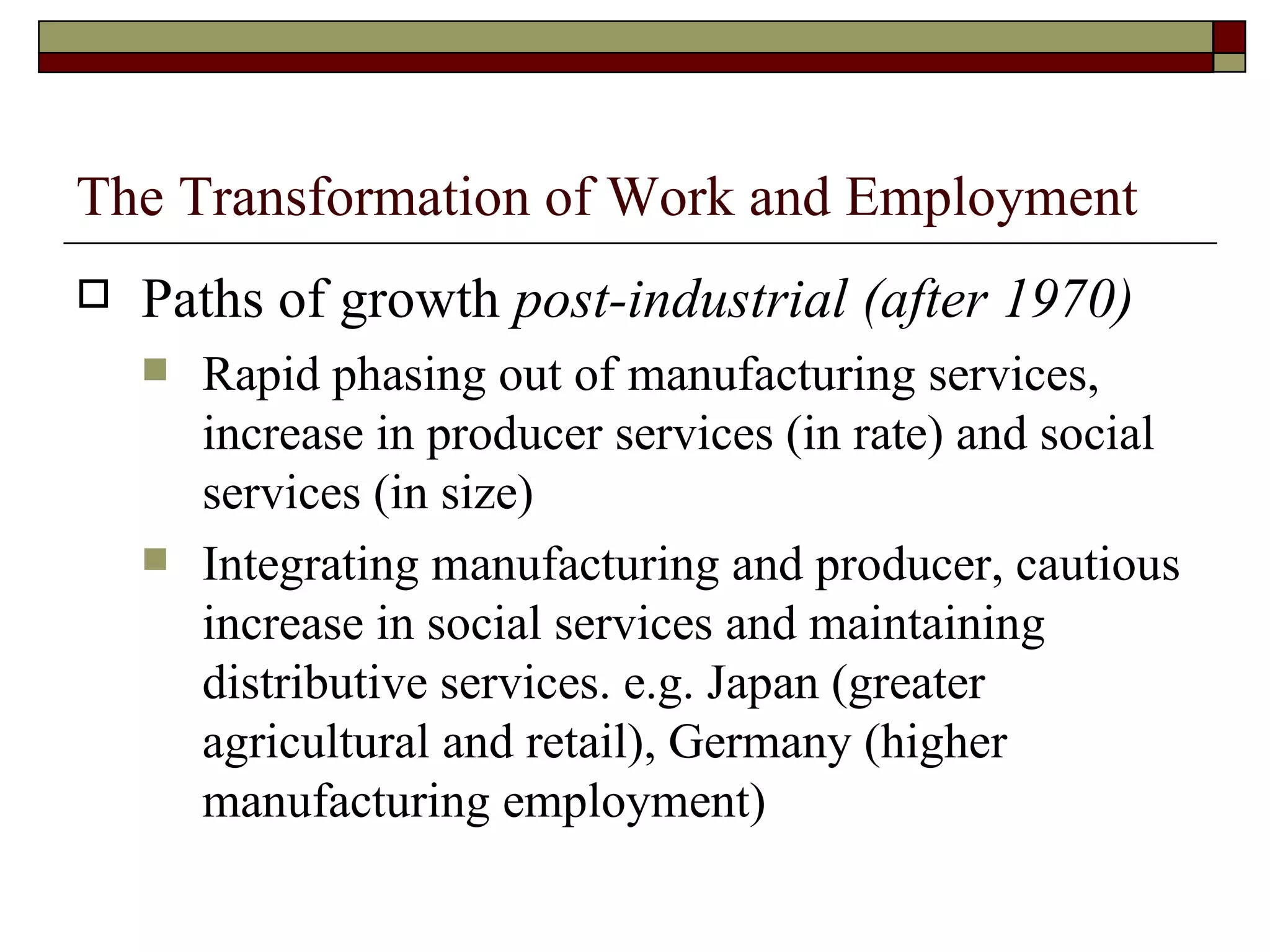
The Transformation of Work and Employment Paths of growth  post-industrial (after 1970) Rapid phasing out of manufacturing services, increase in producer services (in rate) and social services (in size) Integrating manufacturing and producer, cautious increase in social services and maintaining distributive services. e.g. Japan (greater agricultural and retail), Germany (higher manufacturing employment)
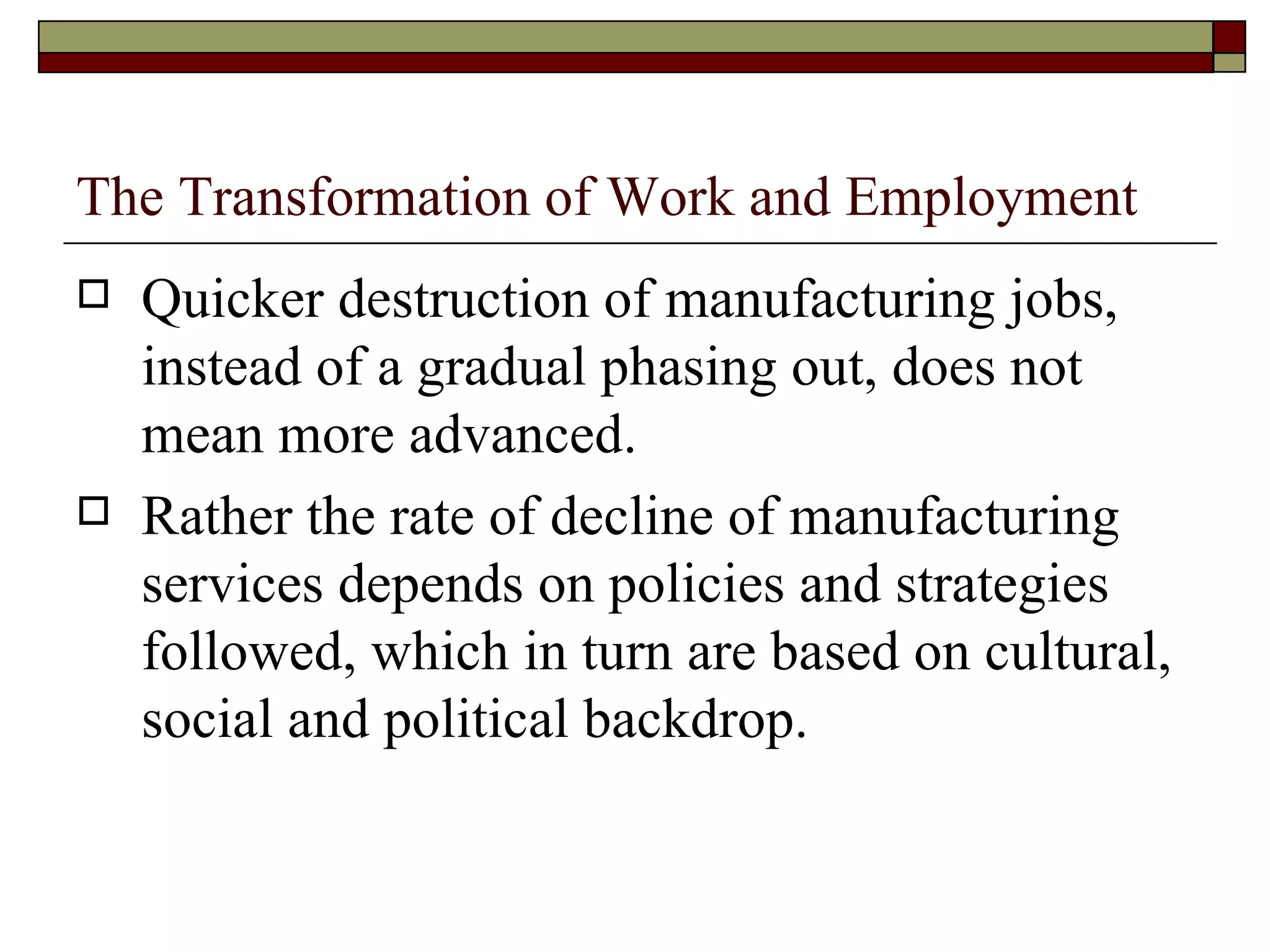
The Transformation of Work and Employment Quicker destruction of manufacturing jobs, instead of a gradual phasing out, does not mean more advanced. Rather the rate of decline of manufacturing services depends on policies and strategies followed, which in turn are based on cultural, social and political backdrop.
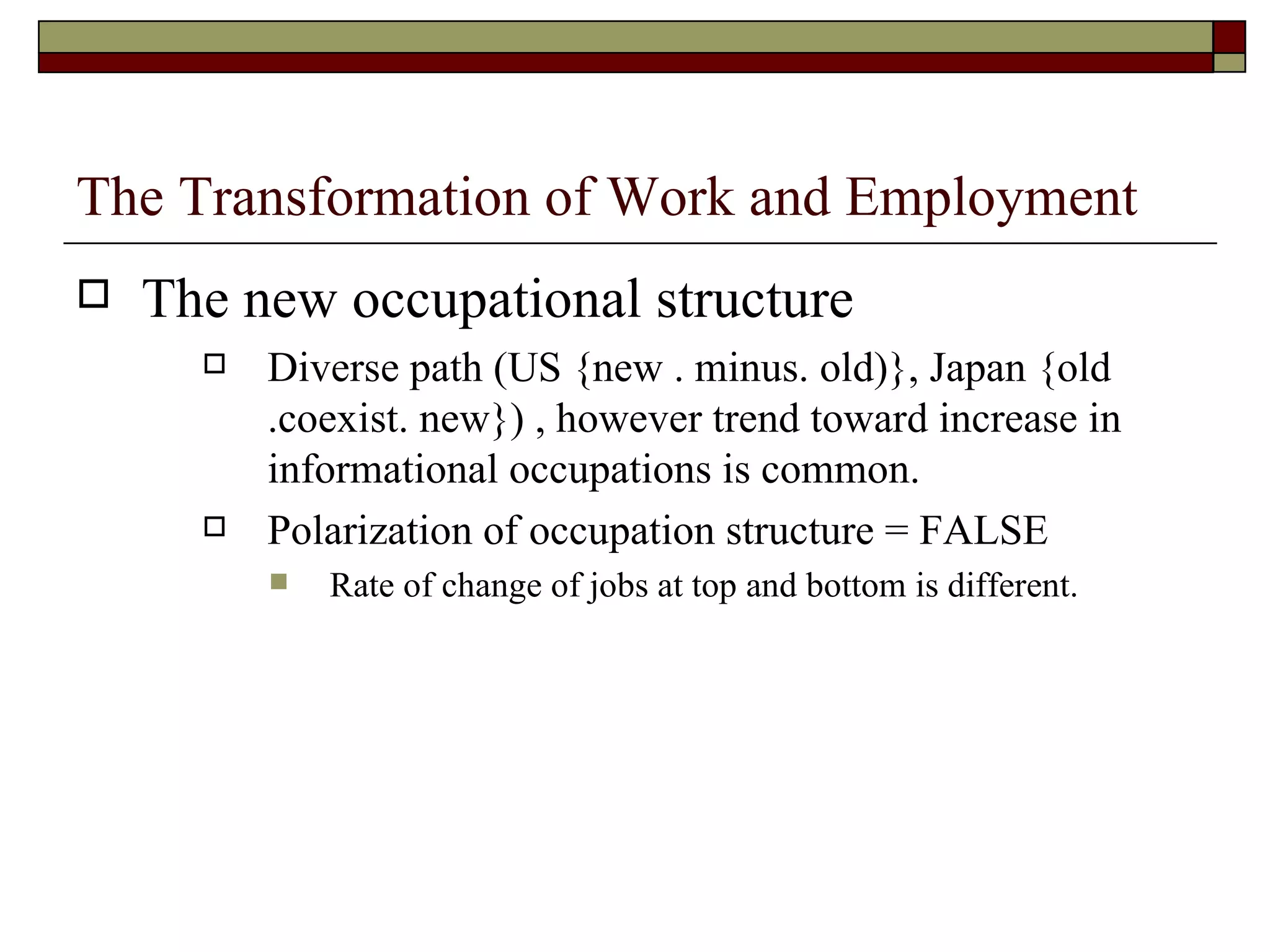
The Transformation of Work and Employment The new occupational structure Diverse path (US {new . minus. old)}, Japan {old .coexist. new}) , however trend toward increase in informational occupations is common. Polarization of occupation structure = FALSE Rate of change of jobs at top and bottom is different.
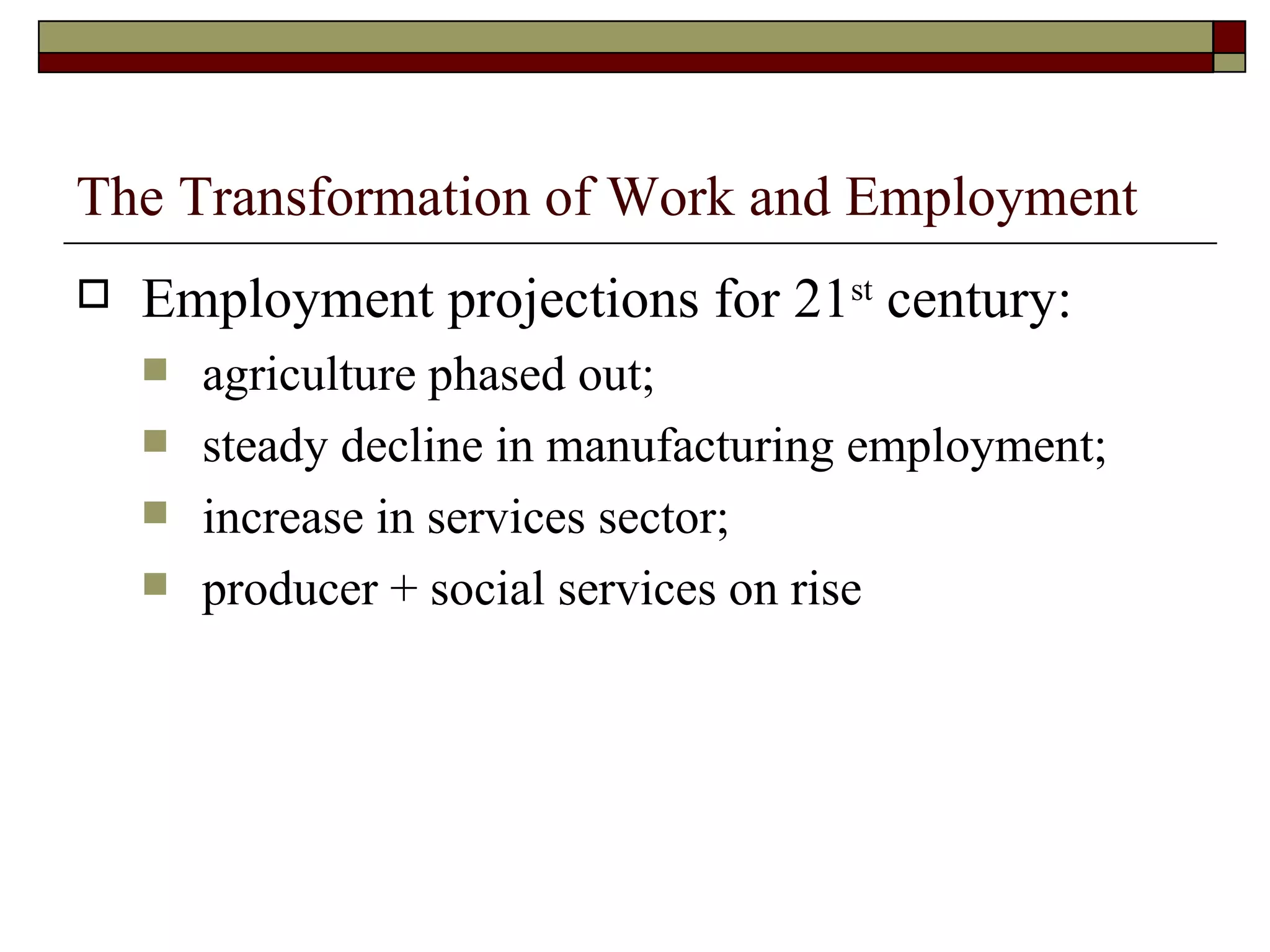
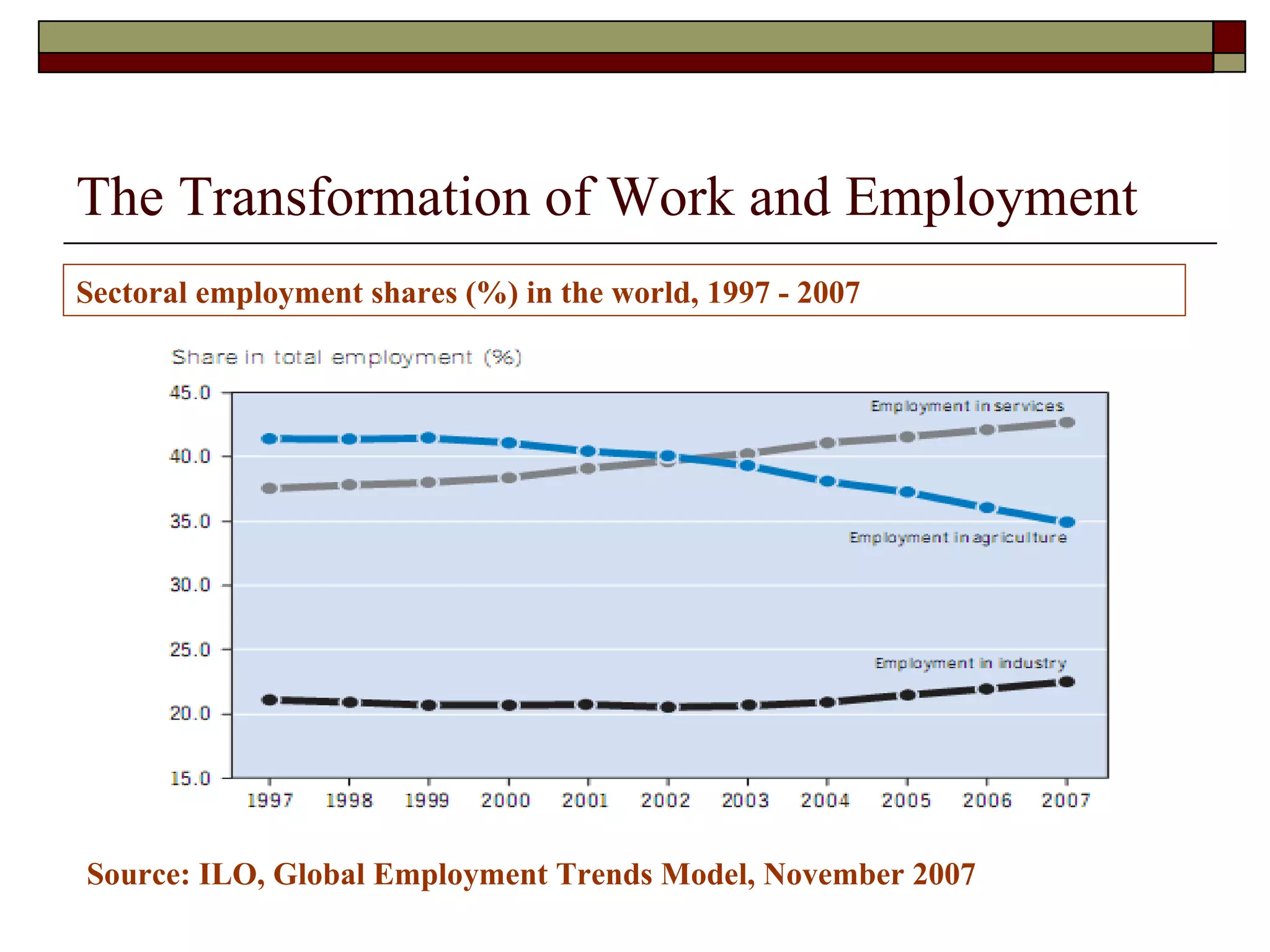
The Transformation of Work and Employment Employment projections for 21 st  century: agriculture phased out; steady decline in manufacturing employment; increase in services sector; producer + social services on rise
The Transformation of Work and Employment Sectoral employment shares (%) in the world, 1997 - 2007 Source: ILO, Global Employment Trends Model, November 2007
The Transformation of Work and Employment Is there a Global Labor Force? Yes, individuals in innovative R&D, research scholars, cutting technology, financial management and services form global labor force. Indicators: keep high profile / non-repetitive, innovative task, outsource others for cheaper labor , sub-contracting, temporary labor, automate,… (downsize firm size)
The Transformation of Work and Employment Source : US Bureau of the Census. ( http://www.census.gov/population/www/socdemo/foreign/STP-159-2000tl.html ) Foreign Born US Population (before 1970 and 1970:2000)
The Transformation of Work and Employment The Work Process in the Informational Paradigm work and labor model is messy, not a neat  (technological change + industrial relations policy + social action) e.g. Automation demands human brain in work process, however later computers turn human into second order robots.
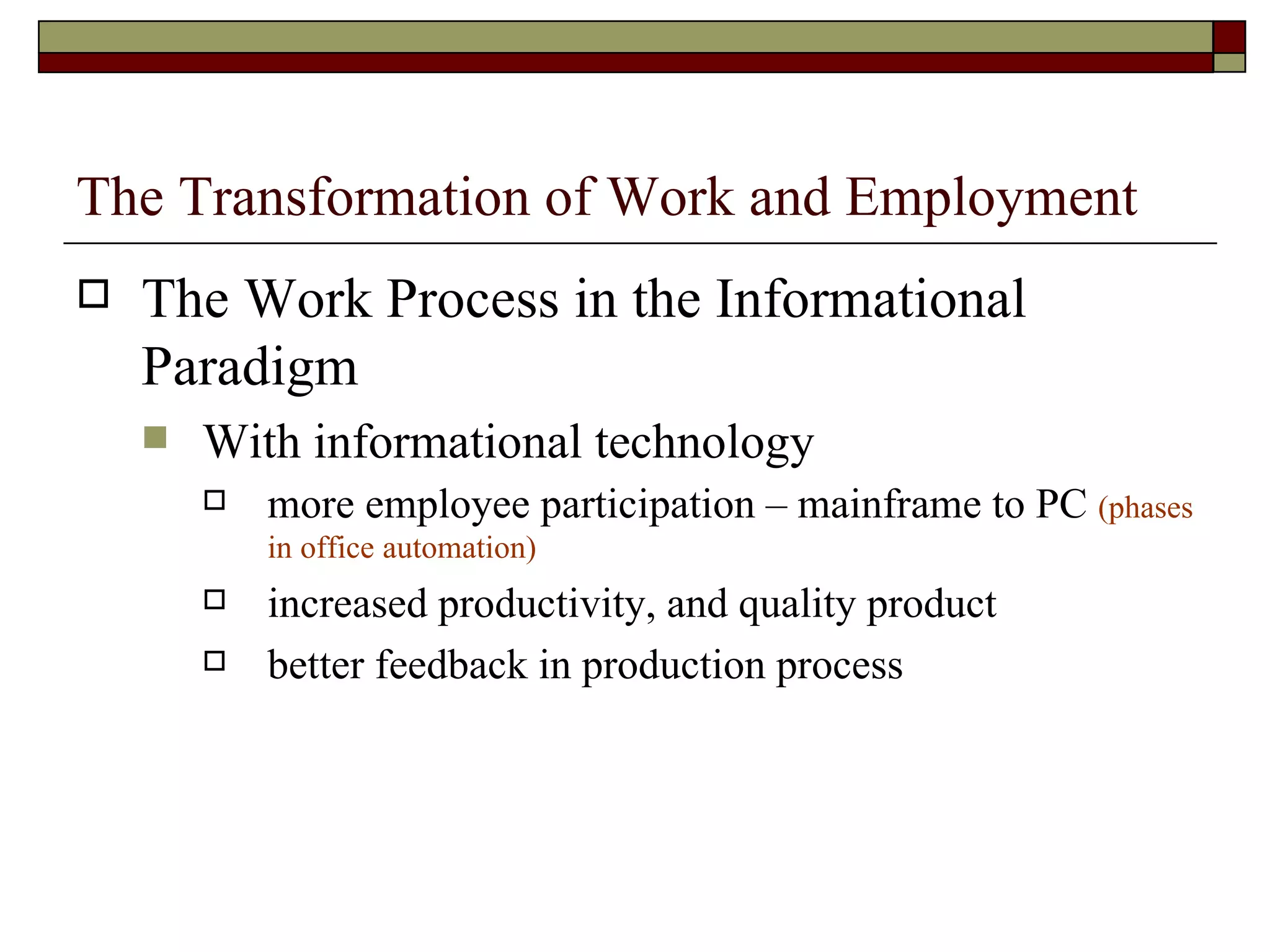
The Transformation of Work and Employment The Work Process in the Informational Paradigm With informational technology more employee participation – mainframe to PC  (phases in office automation) increased productivity, and quality product better feedback in production process
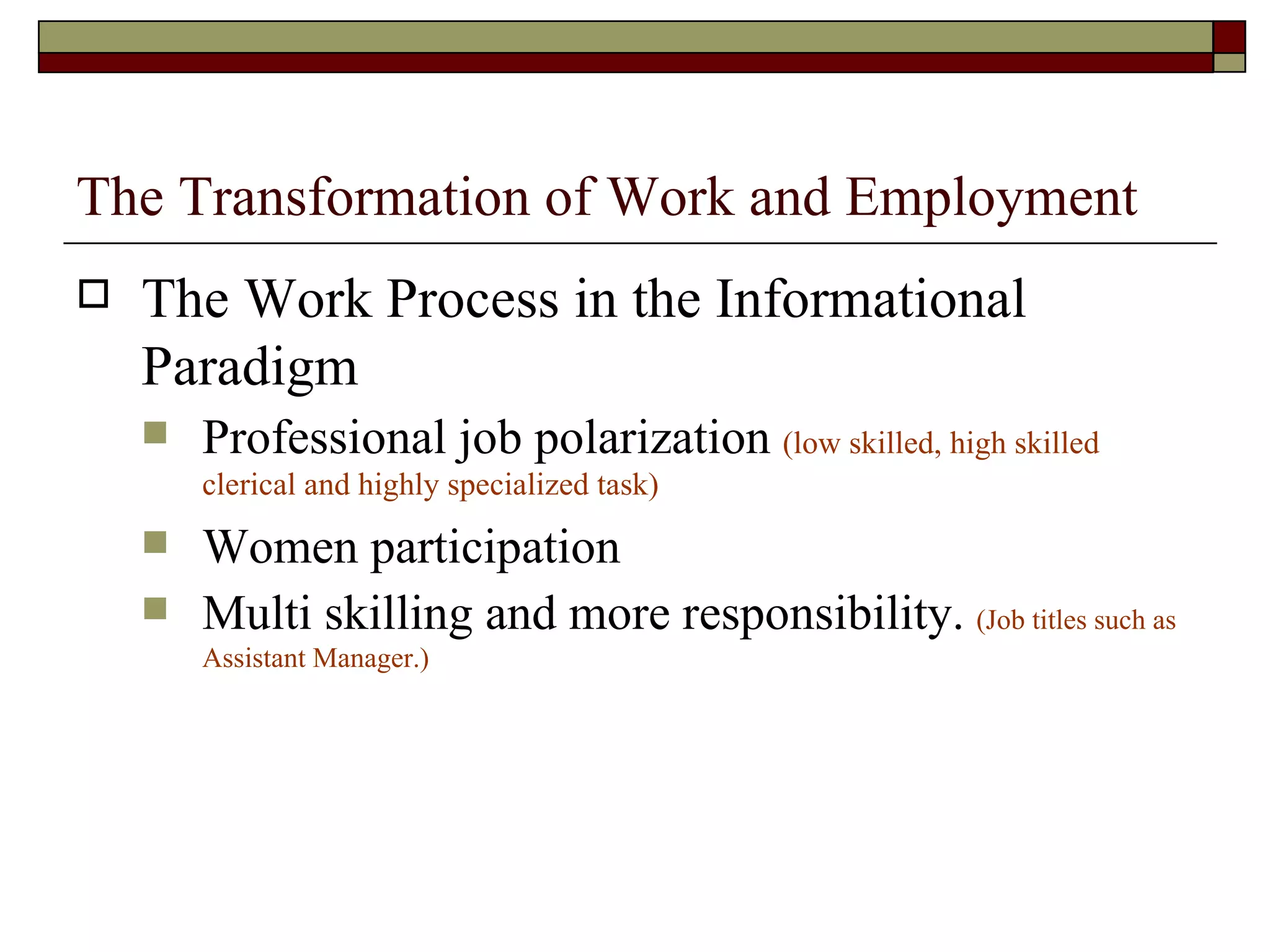
The Transformation of Work and Employment The Work Process in the Informational Paradigm Professional job polarization  (low skilled, high skilled clerical and highly specialized task) Women participation Multi skilling and more responsibility.  (Job titles such as Assistant Manager.)
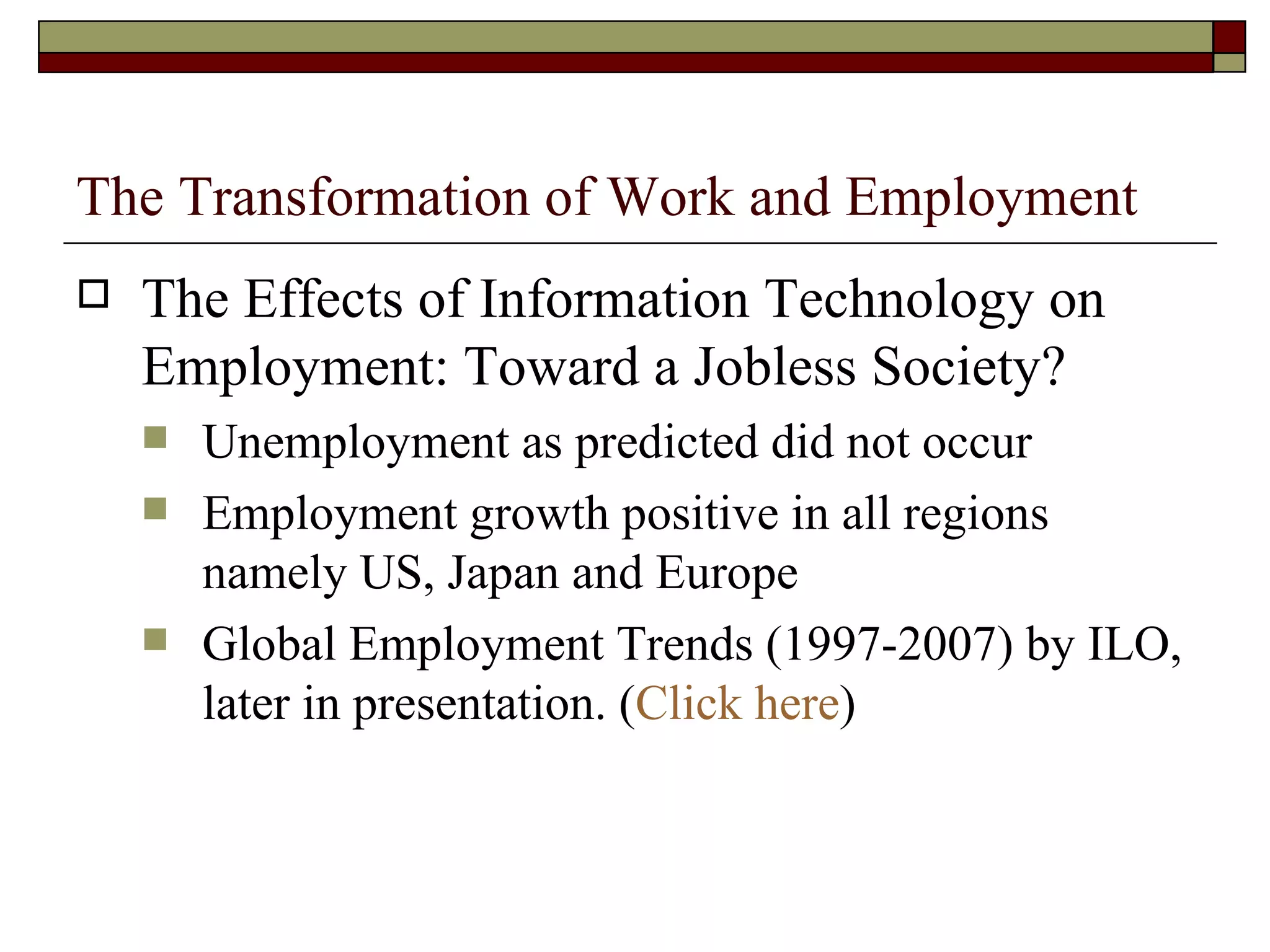
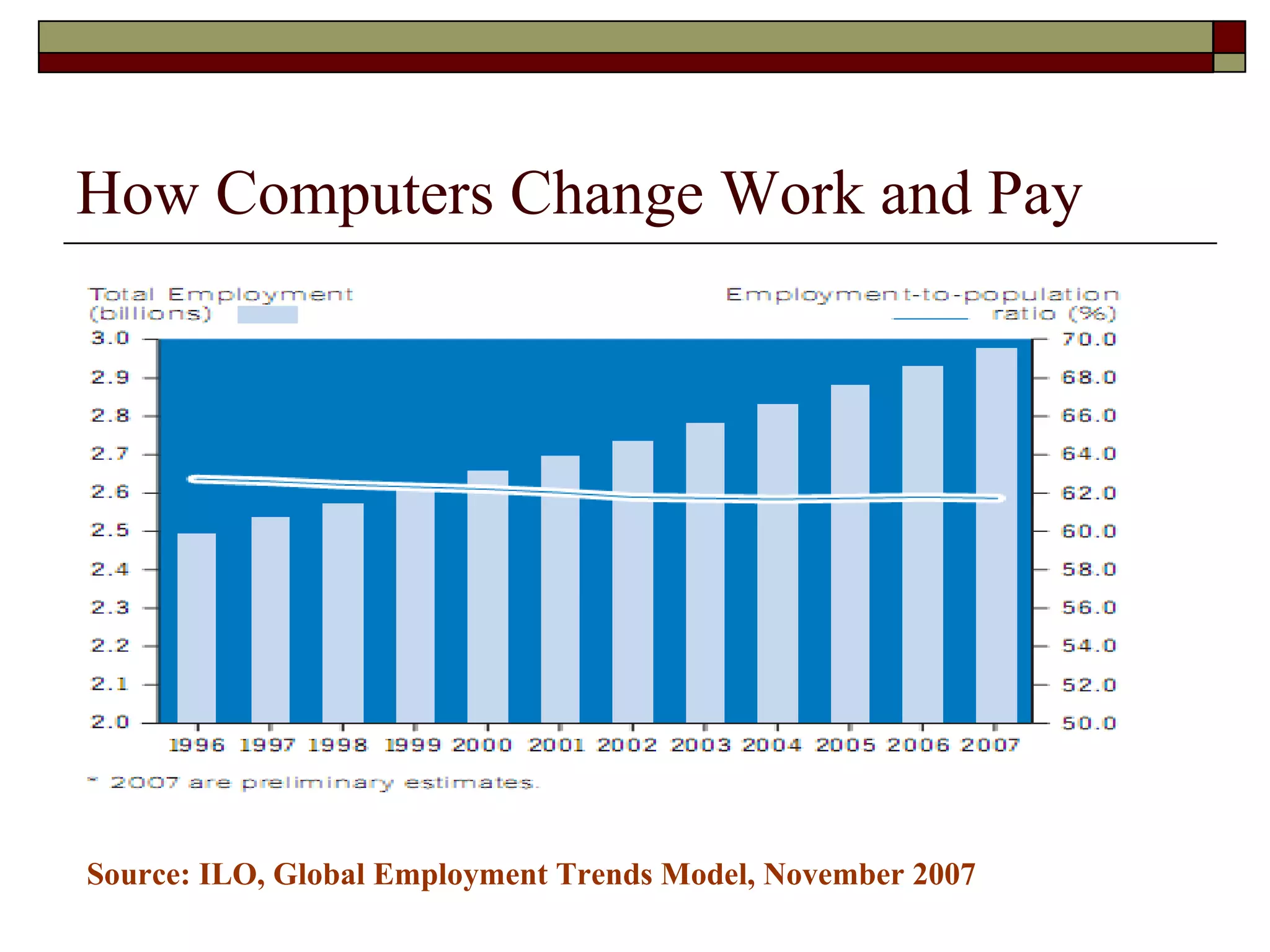
The Transformation of Work and Employment The Effects of Information Technology on Employment: Toward a Jobless Society? Unemployment as predicted did not occur Employment growth positive in all regions namely US, Japan and Europe Global Employment Trends (1997-2007) by ILO, later in presentation. ( Click here )
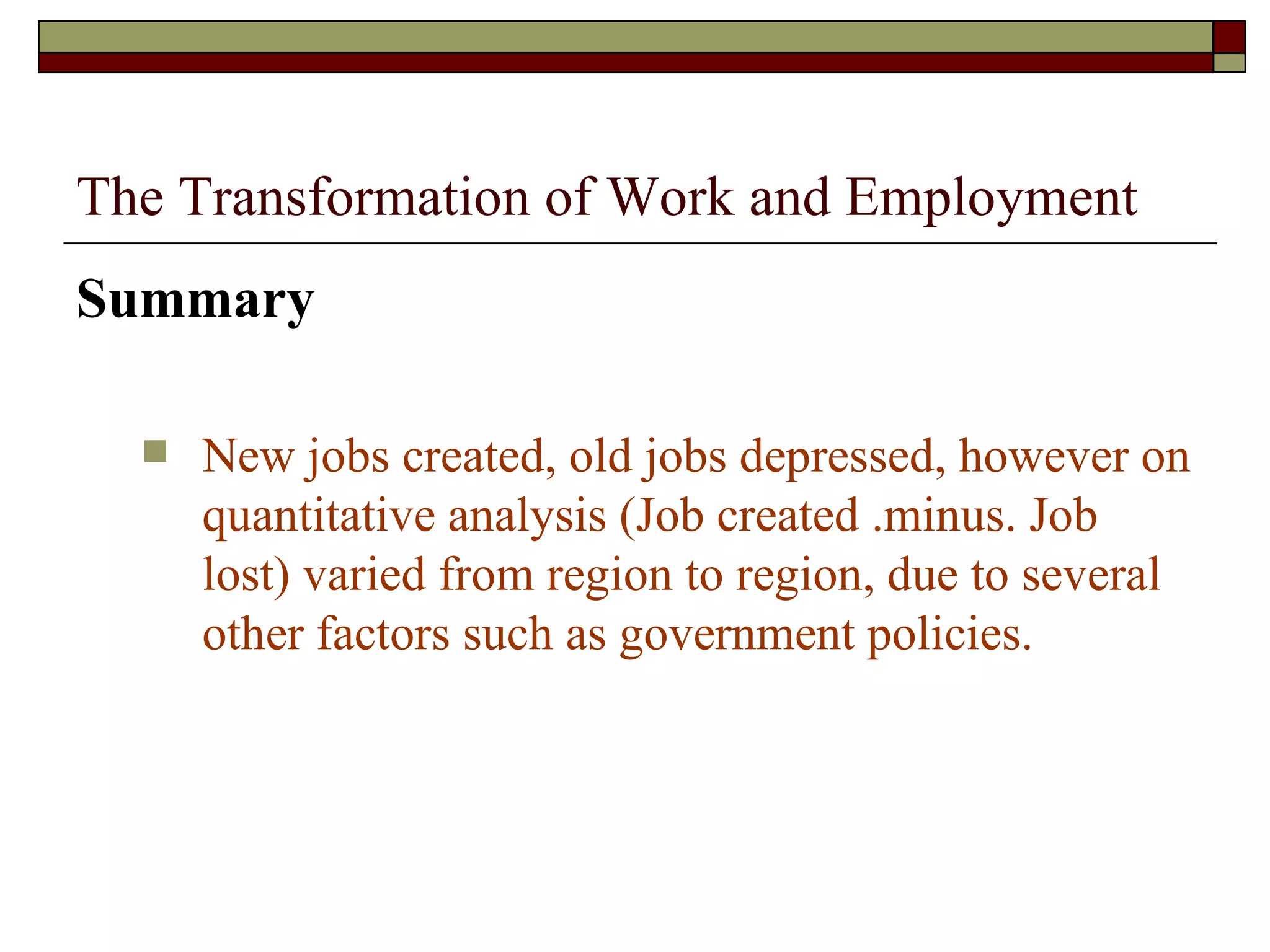
The Transformation of Work and Employment Summary   New jobs created, old jobs depressed, however on quantitative analysis (Job created .minus. Job lost) varied from region to region, due to several other factors such as government policies.
The Transformation of Work and Employment Work and Information Divide: Flex-timers Working time:  flex, means unconstrained by tradition 35-40 hours per week Job stability:  no commitment to future employment Location:  large concentration at work place, however increase in proportion of outside workplace Employer and employee contracts:  less commitment than traditional contract.  Trends:  More freedom, self employment, and temporary help on the rise.
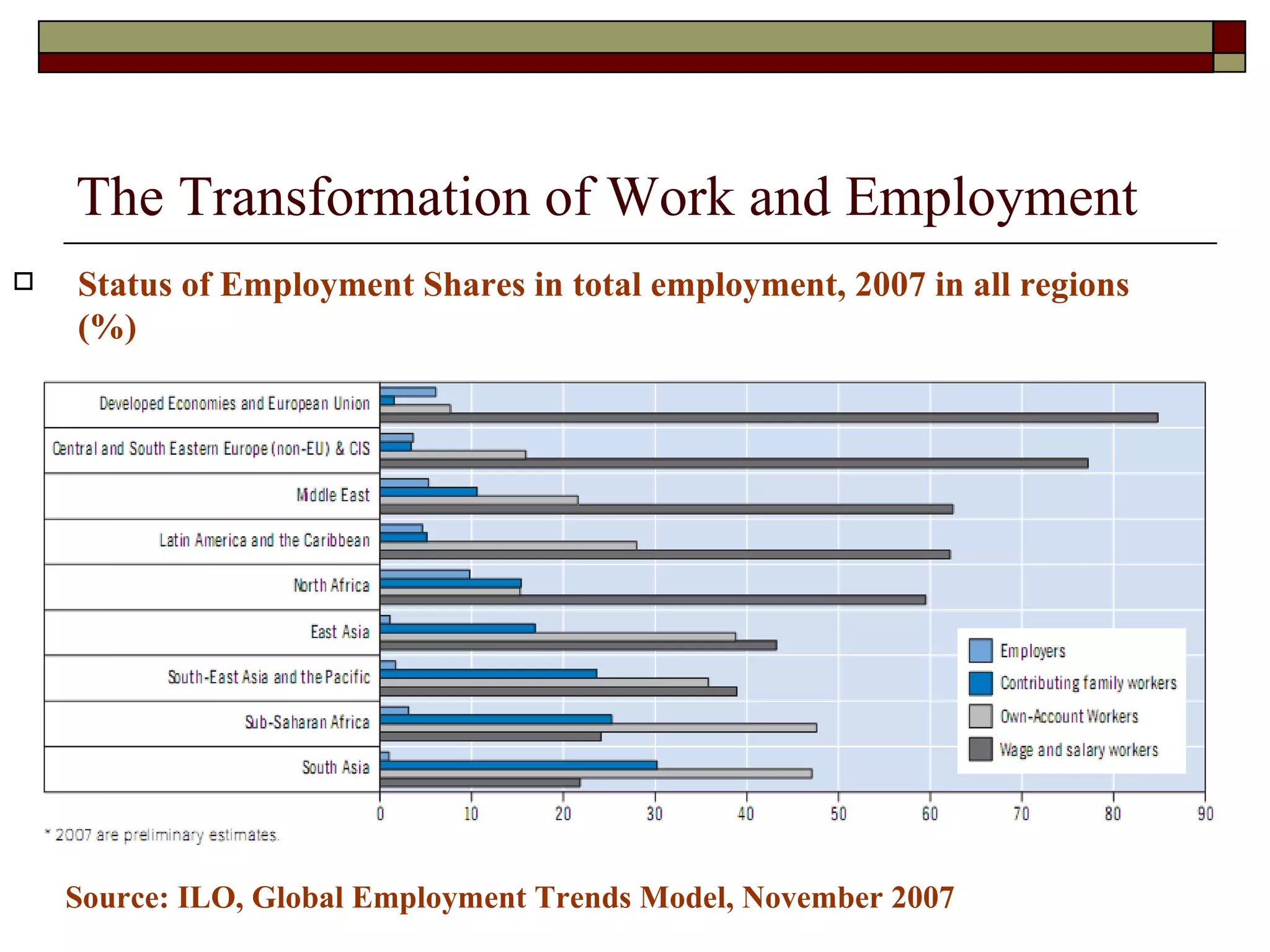
The Transformation of Work and Employment Status of Employment Shares in total employment, 2007 in all regions (%) Source: ILO, Global Employment Trends Model, November 2007
The Transformation of Work and Employment Work and Information Divide: Flex-timers US model to deal with labor shortage Non-traditional incentive such as stock options. Use of immigrant labor in both highly skilled and unskilled occupations Temporary of JIT labor. What model Europe practiced Dutch model: moderate wage increase however preserve core jobs in the industry. Expansion to temporary, part-time and other flexible forms of employment.
The Transformation of Work and Employment Information Technology and the Restructuring of Capital-Labor Relation: Social Dualism or Fragmented Societies? Productivity and profitability ( ↑ ) Labor protection ( ↓ )
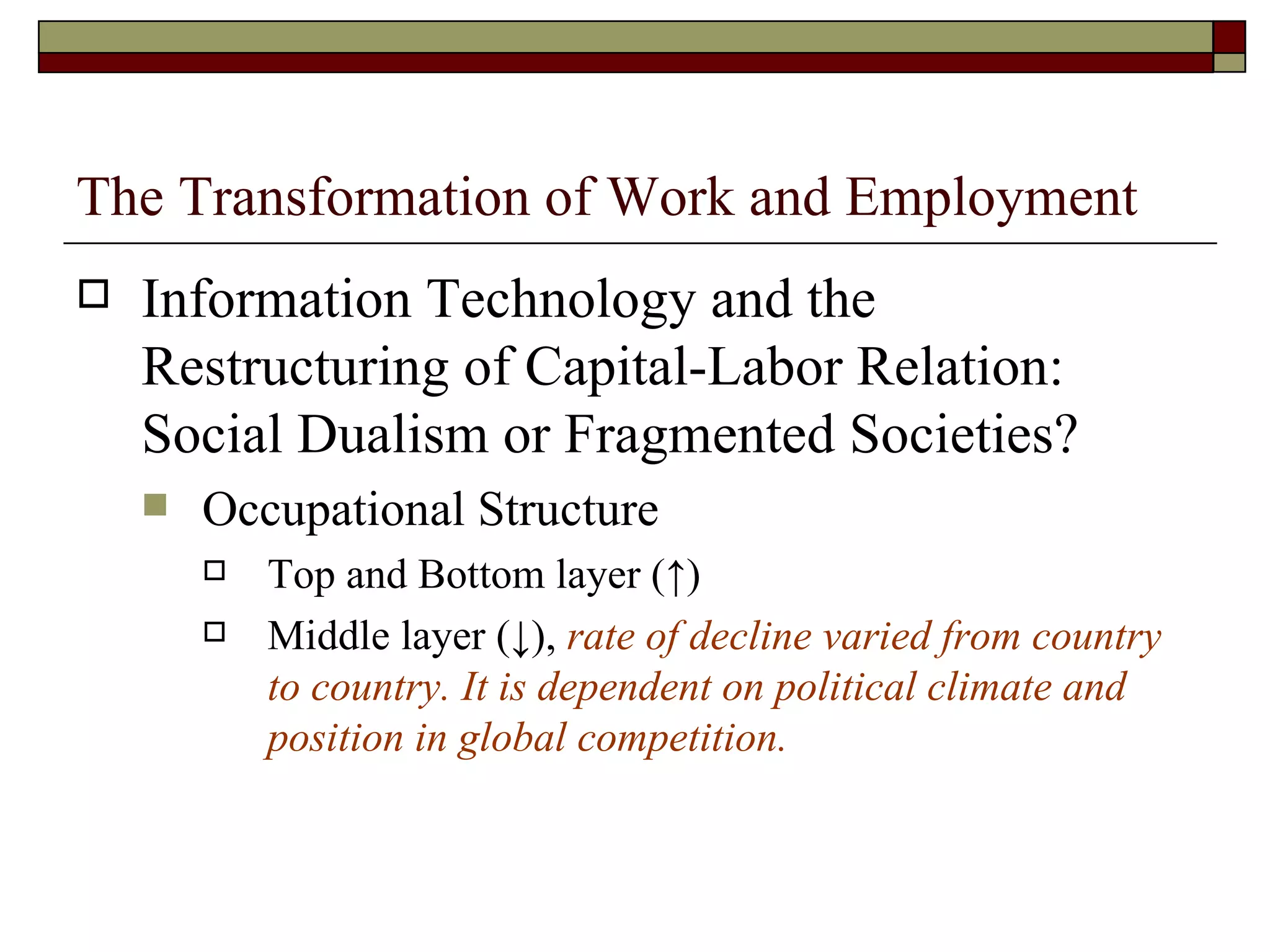
The Transformation of Work and Employment Information Technology and the Restructuring of Capital-Labor Relation: Social Dualism or Fragmented Societies? Occupational Structure Top and Bottom layer ( ↑ ) Middle layer ( ↓ ),  rate of decline varied from country to country. It is dependent on political climate and position in global competition.
The Transformation of Work and Employment Summary New social structure Disjoint labor Rise of individualism Showing up of network society
New Divisions of Labor Adhoc committee miscalculation. Expectation : computers will replicate all models by which human process information.  { Statement was partly correct } Fact: Major upheaval in nature of work, not mass unemployment.
New Divisions of Labor “divisions of labor” words by Adam Smith, new meaning in computer age Division of labor between computers and humans Growing division within human labor Can or cannot do valued work in computers world The two above has created the divide.
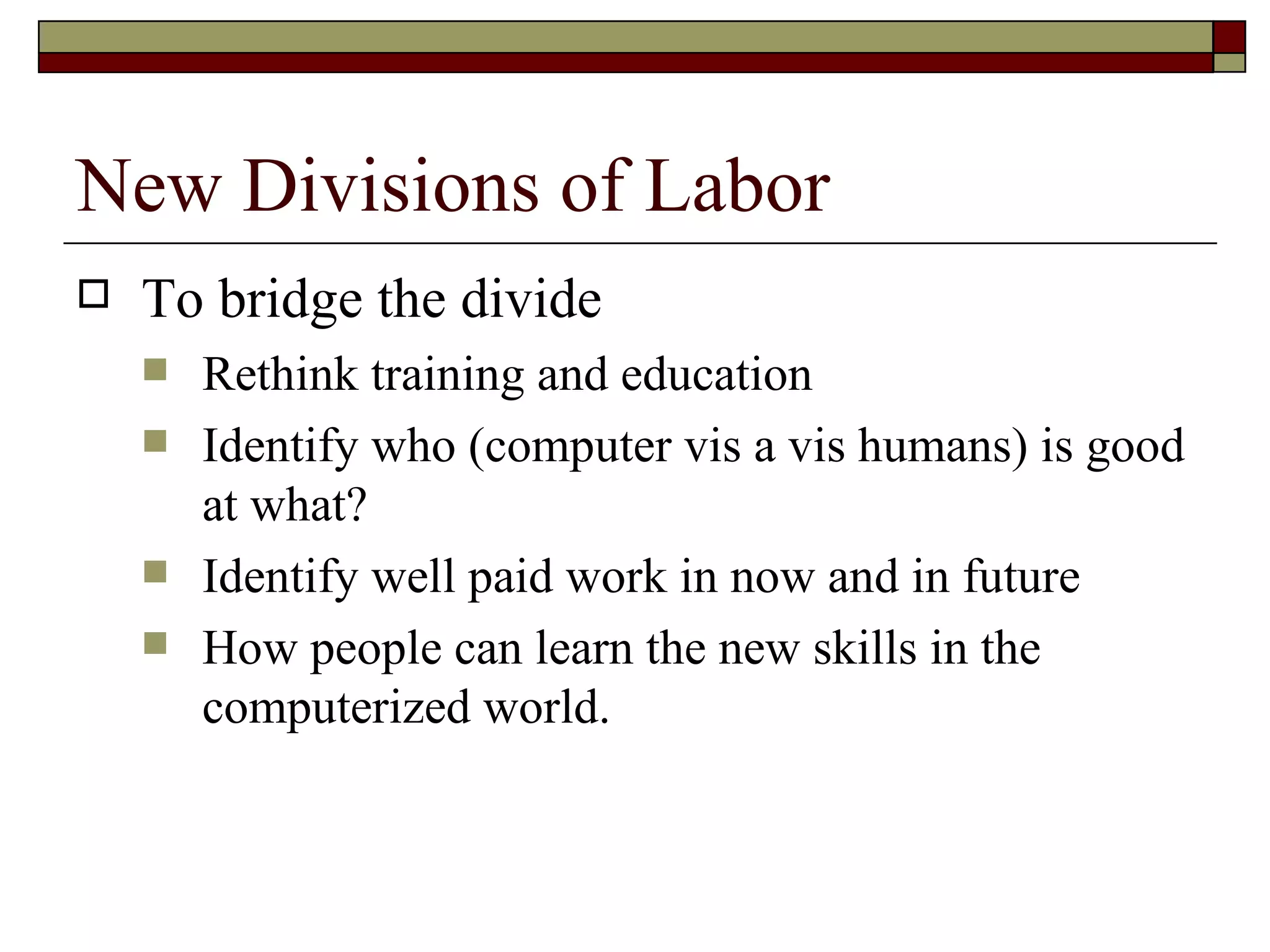
New Divisions of Labor To bridge the divide Rethink training and education Identify who (computer vis a vis humans) is good at what? Identify well paid work in now and in future How people can learn the new skills in the  computerized world.
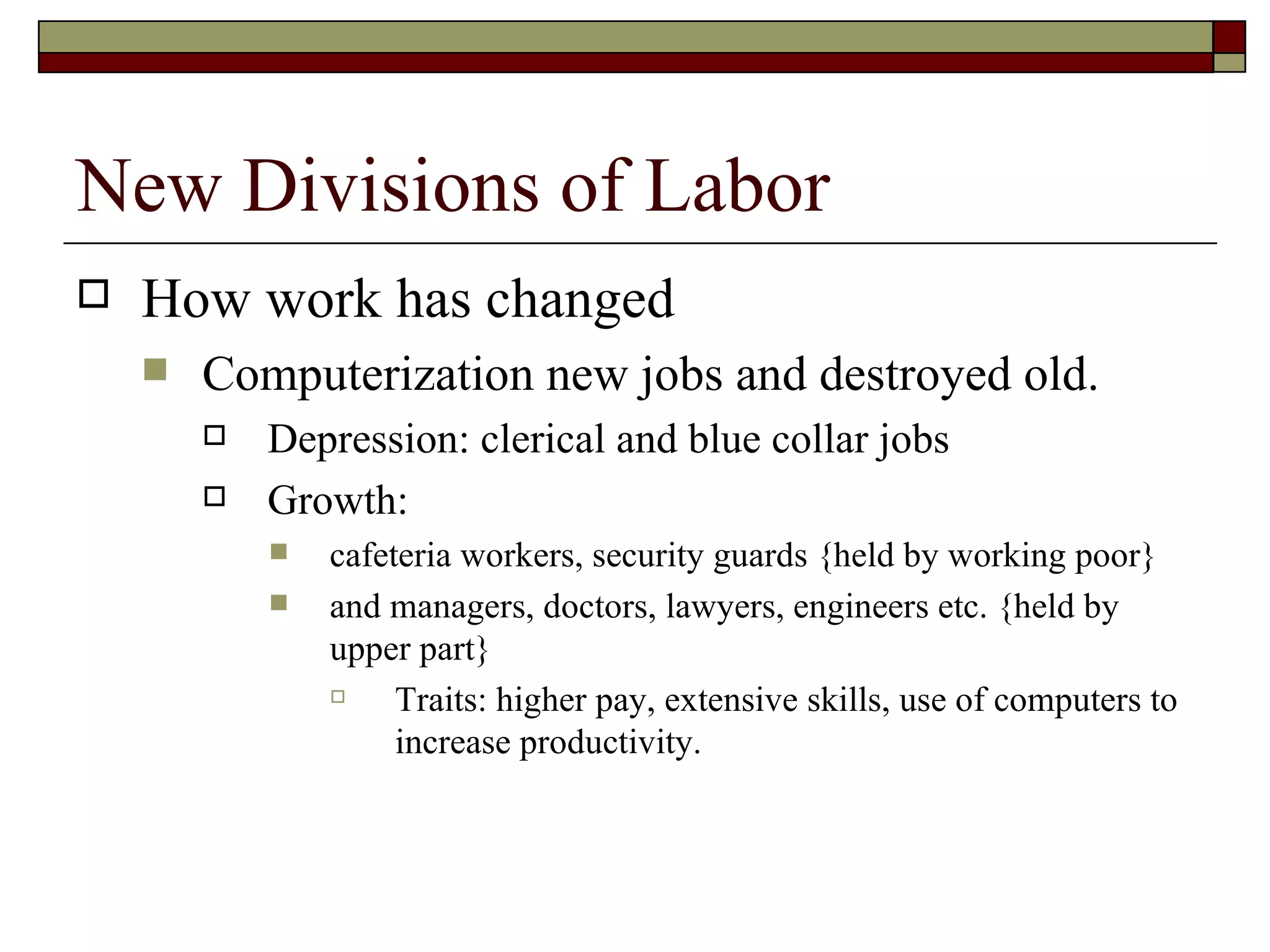
New Divisions of Labor How work has changed Computerization new jobs and destroyed old. Depression: clerical and blue collar jobs Growth:  cafeteria workers, security guards {held by working poor}  and managers, doctors, lawyers, engineers etc. {held by upper part} Traits: higher pay, extensive skills, use of computers to increase productivity.
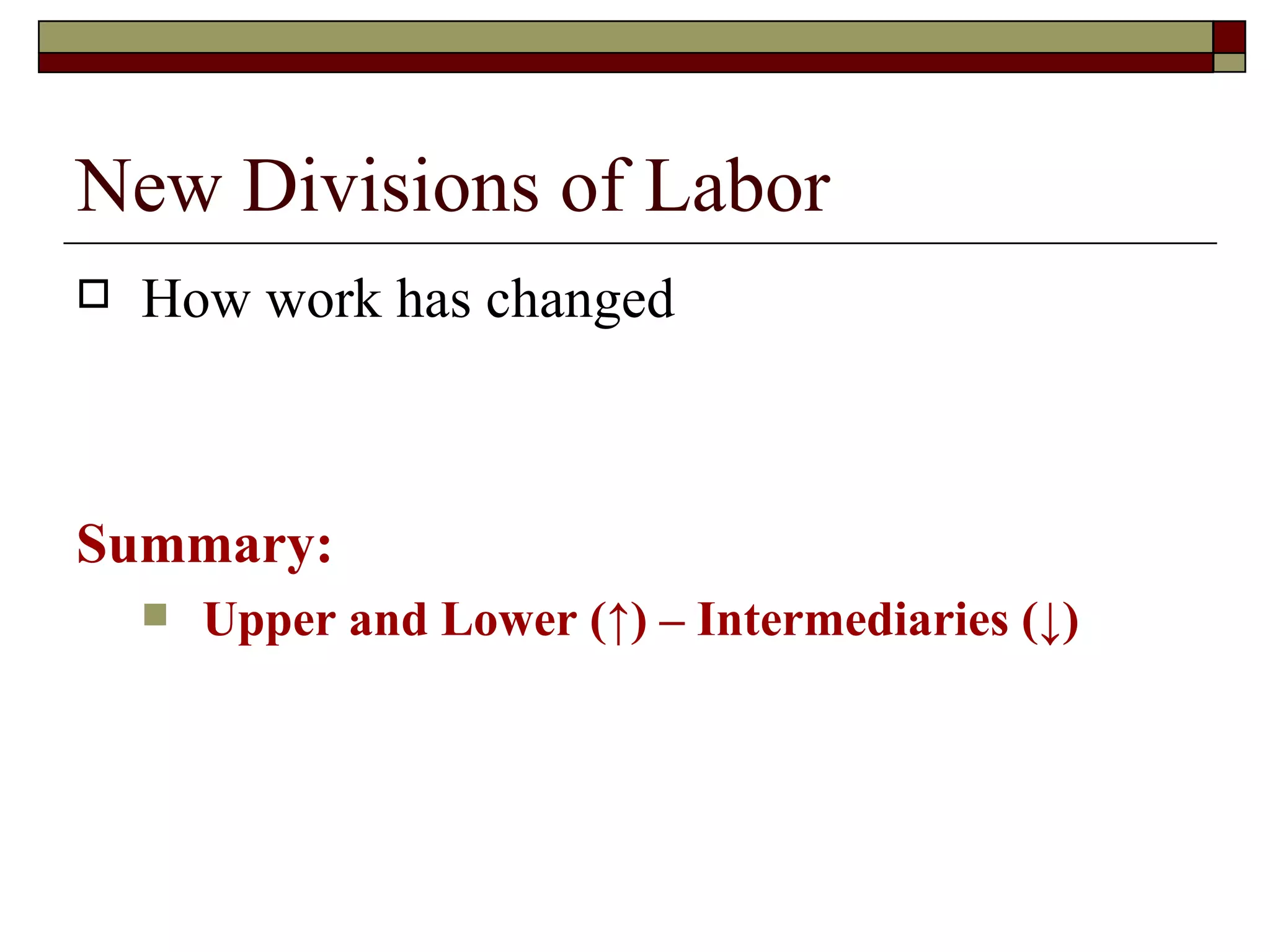
New Divisions of Labor How work has changed Summary:  Upper and Lower ( ↑ ) – Intermediaries ( ↓)
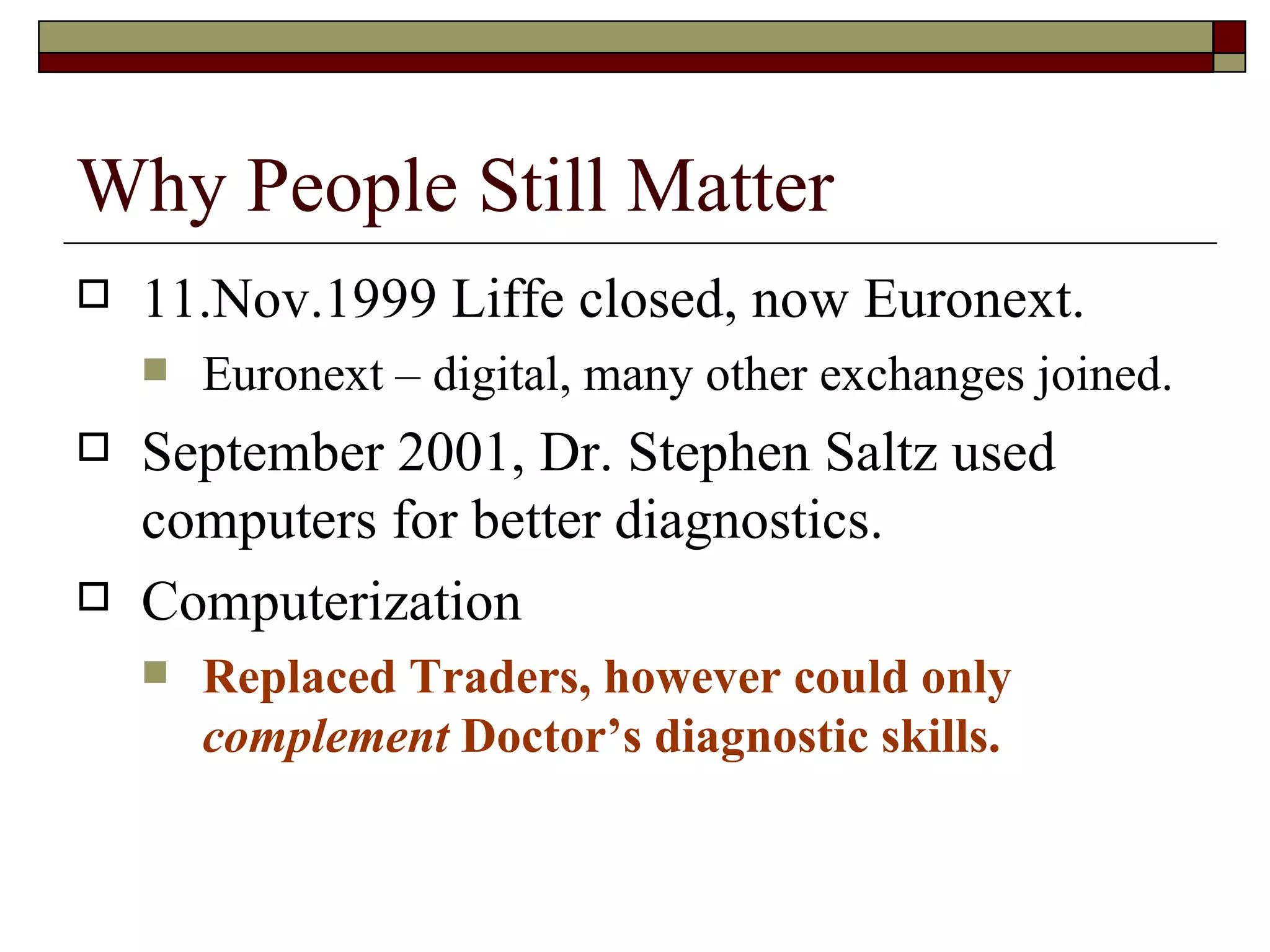
Why People Still Matter 11.Nov.1999 Liffe closed, now Euronext. Euronext – digital, many other exchanges joined. September 2001, Dr. Stephen Saltz used computers for better diagnostics. Computerization Replaced Traders, however could only  complement  Doctor’s diagnostic skills.
Why People Still Matter Rules – step by step : computerized e.g. Rail Ticketing, Flight enquiry  Pattern – solving new problem referring an old existing pattern : not computerized. Perception : difficult to program Interpreting what is perceived: even human differs
Why People Still Matter Can computers substitute humans in all jobs No, its not easy. However computers can complement humans by providing large information at low cost. Example:  echocardiograph
How Computers Change Work and Pay Boeing – Use of CATIA, CNC Dispersed manufacturing, low cost production and new foreign customers
How Computers Change Work and Pay What characterizes use of a new computer application Adopt computer, gain a particular competitive advantage Recognize computer potential, reorganize work Create new jobs and destroy old jobs
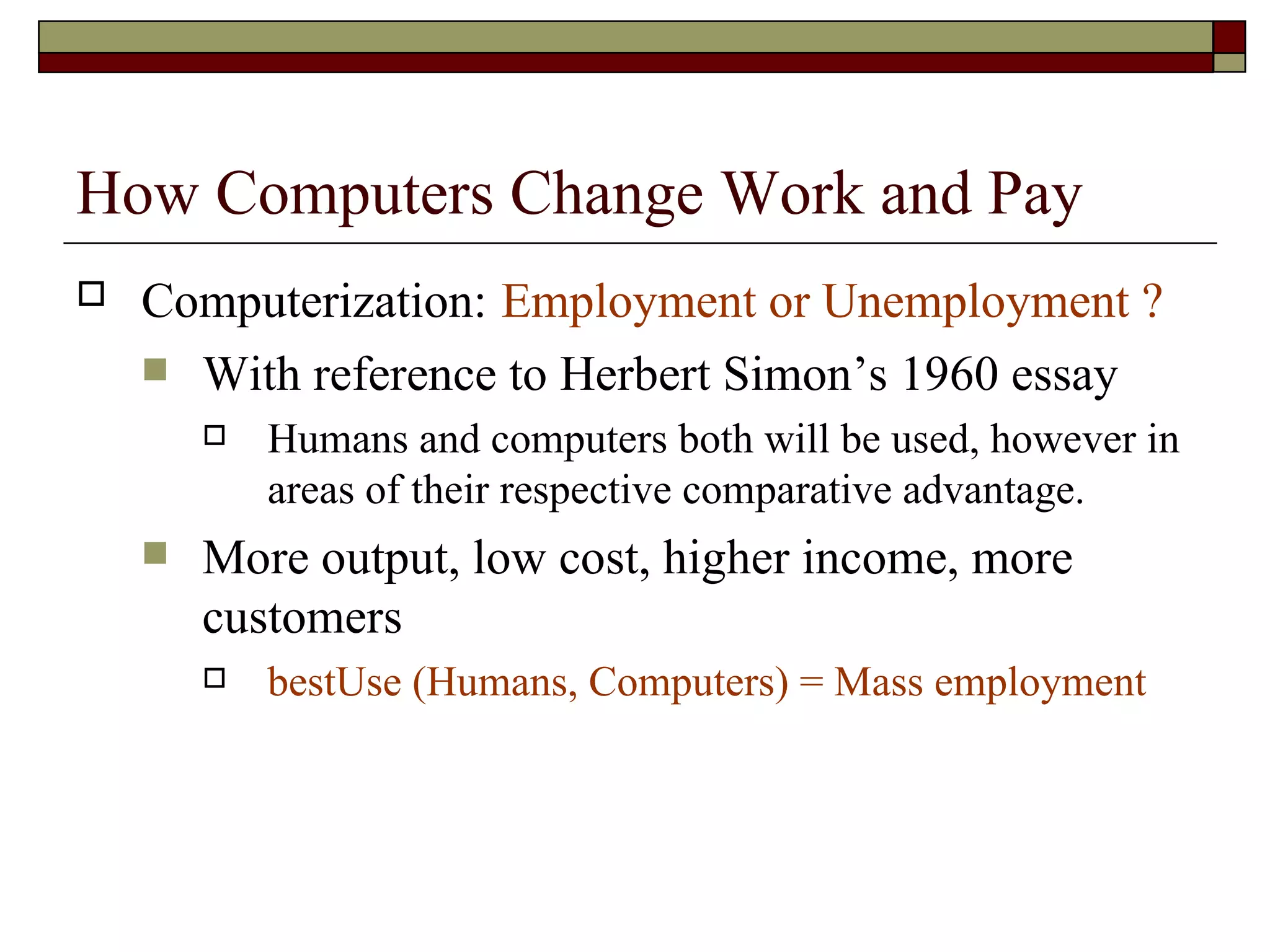
How Computers Change Work and Pay Computerization:   Employment or Unemployment ? With reference to Herbert Simon’s 1960 essay Humans and computers both will be used, however in areas of their respective comparative advantage. More output, low cost, higher income, more customers bestUse (Humans, Computers) = Mass employment
How Computers Change Work and Pay Source: ILO, Global Employment Trends Model, November 2007
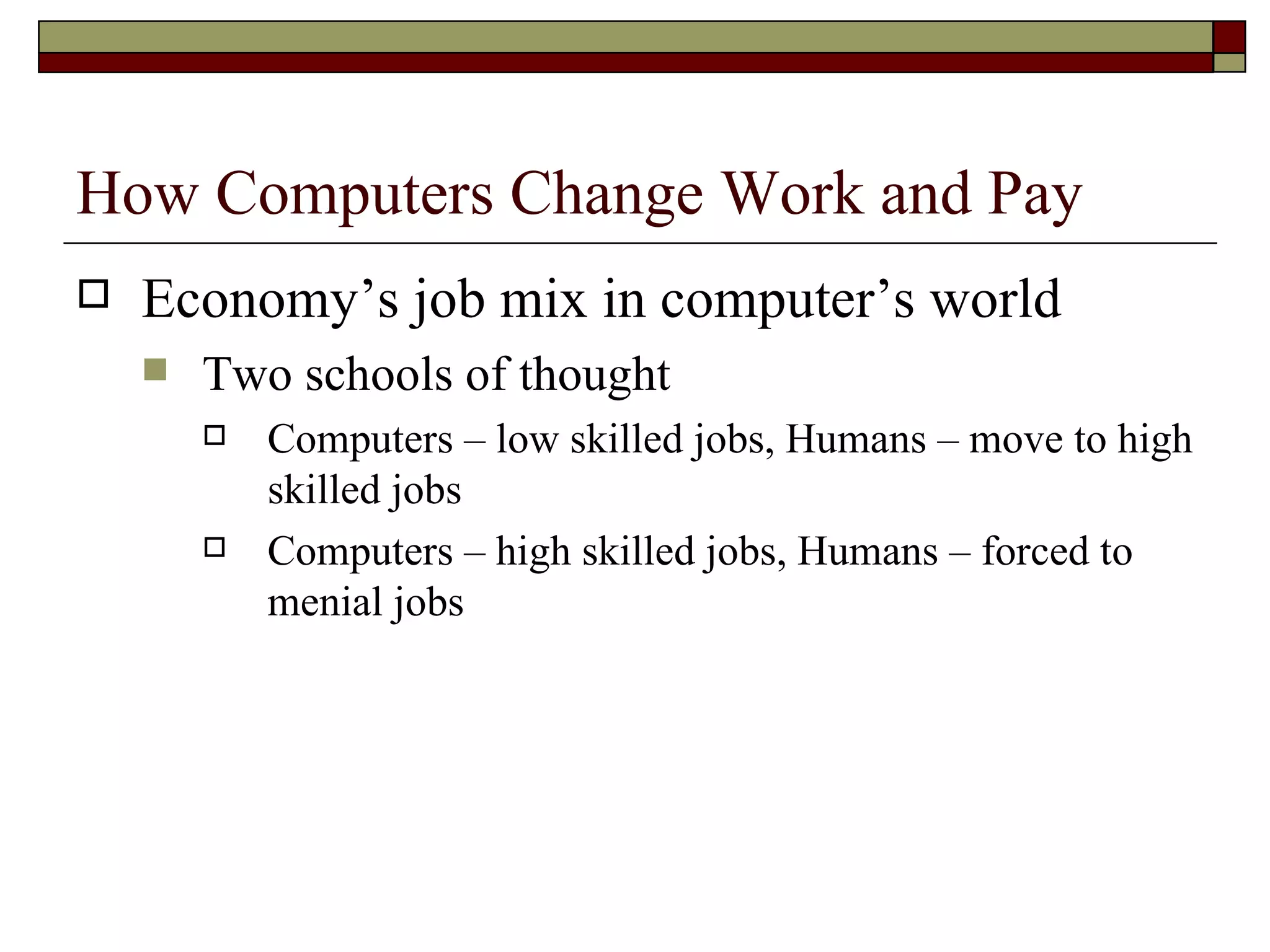
How Computers Change Work and Pay Economy’s job mix in computer’s world Two schools of thought Computers – low skilled jobs, Humans – move to high skilled jobs Computers – high skilled jobs, Humans – forced to menial jobs
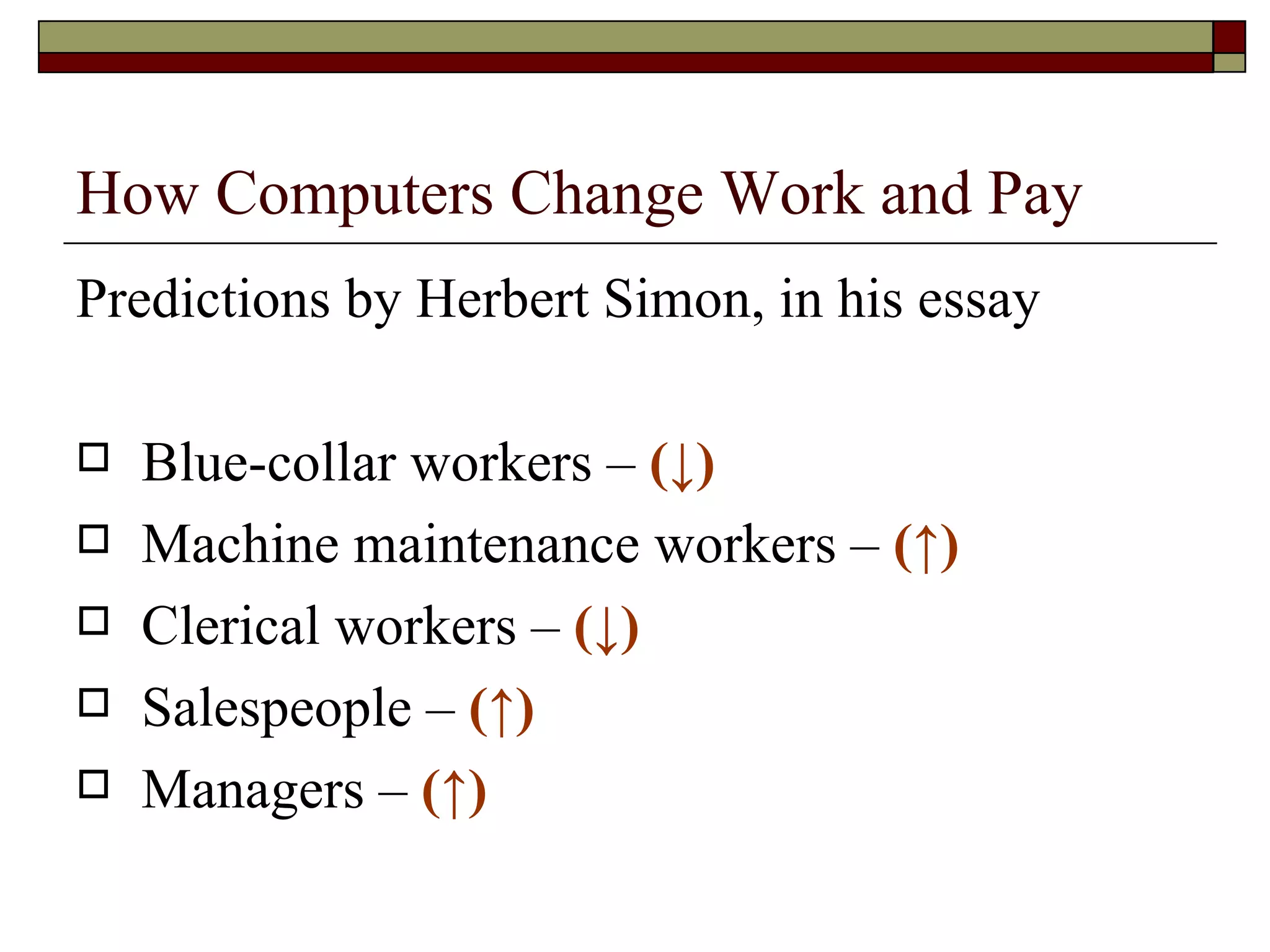
How Computers Change Work and Pay Predictions by Herbert Simon, in his essay Blue-collar workers –  ( ↓ ) Machine maintenance workers –  ( ↑)   Clerical workers –  ( ↓) Salespeople –  ( ↑) Managers –  ( ↑)
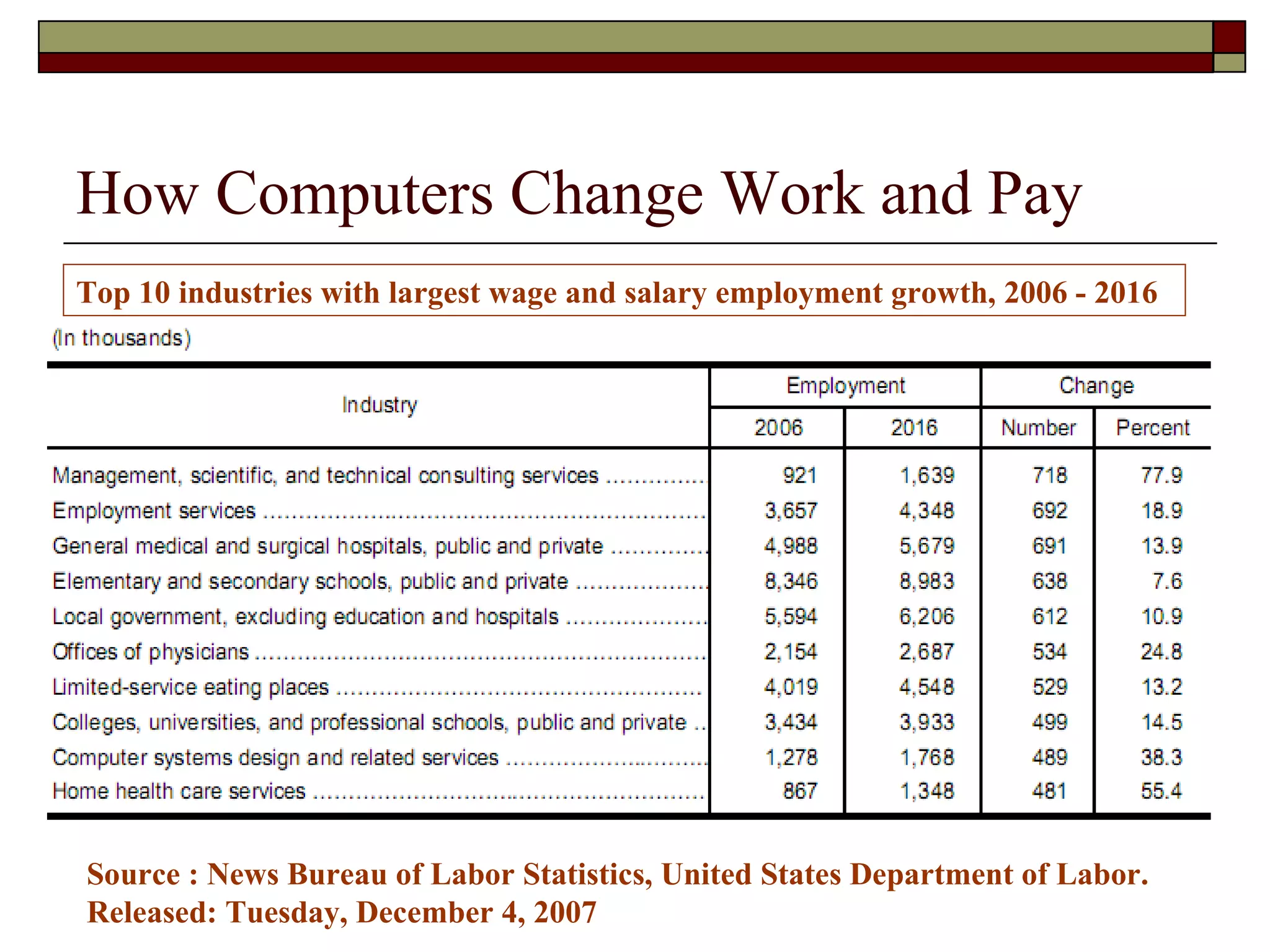
How Computers Change Work and Pay Source : News Bureau of Labor Statistics, United States Department of Labor. Released: Tuesday, December 4, 2007 Top 10 industries with largest wage and salary employment growth, 2006 - 2016
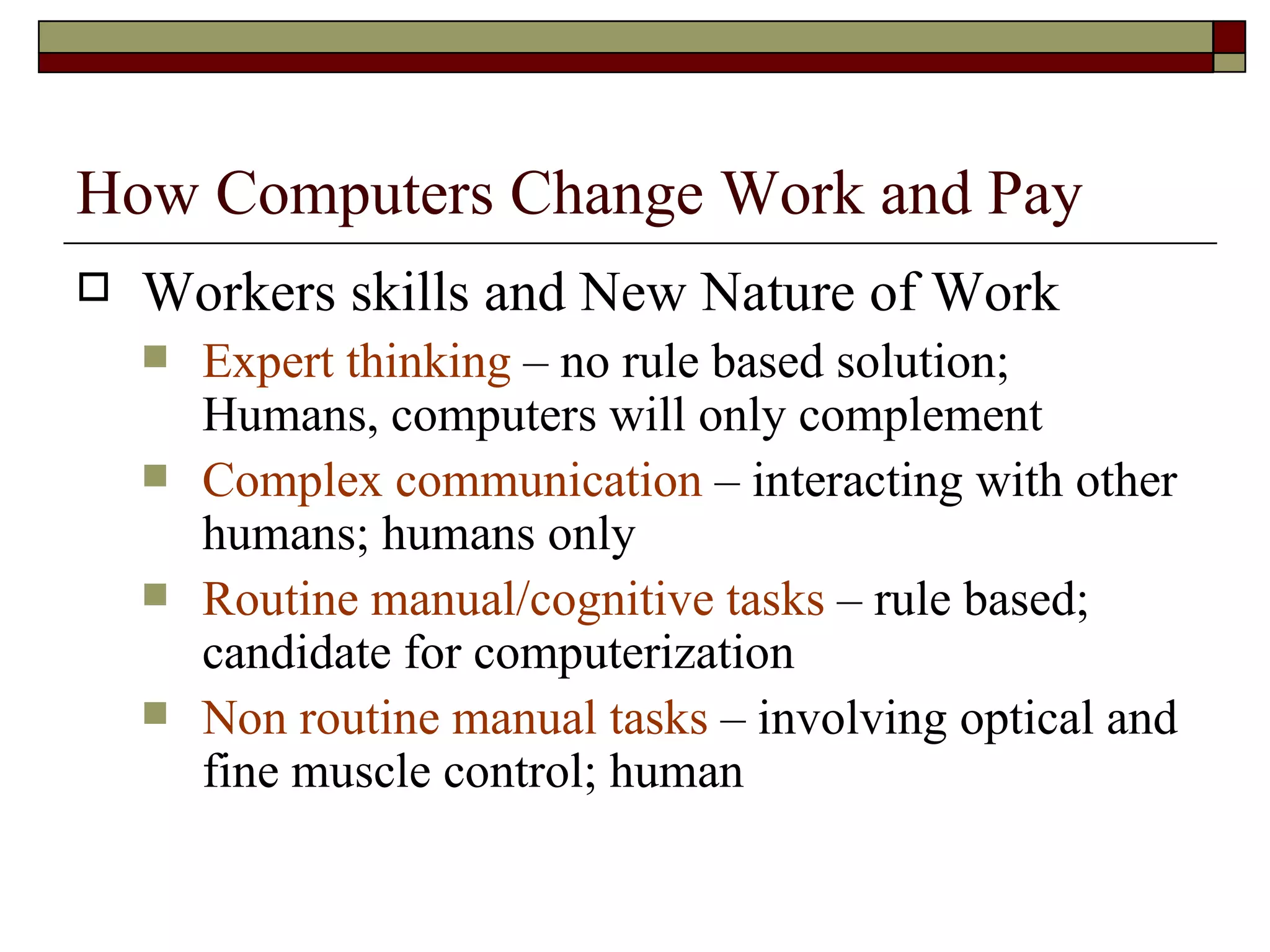
How Computers Change Work and Pay Workers skills and New Nature of Work Expert thinking  – no rule based solution; Humans, computers will only complement Complex communication  – interacting with other humans; humans only Routine manual/cognitive tasks  – rule based; candidate for computerization Non routine manual tasks  – involving optical and fine muscle control; human
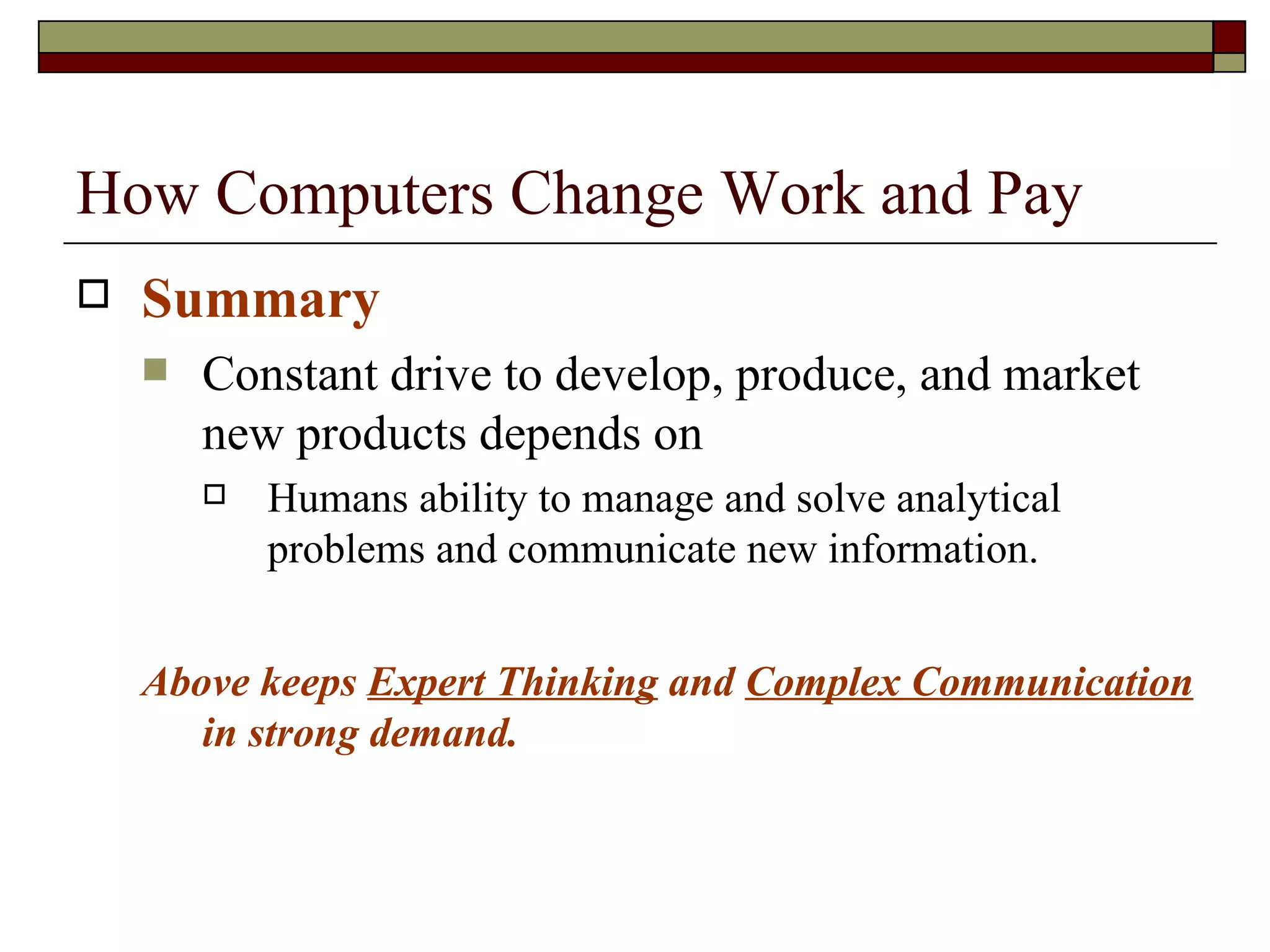
How Computers Change Work and Pay Summary Constant drive to develop, produce, and market new products depends on Humans ability to manage and solve analytical problems and communicate new information. Above keeps  Expert Thinking  and  Complex Communication  in strong demand.
References ILO,  Global employment trends :  January 2008.  Home page: ( http://www.ilo.org/global/lang--en/index.htm ) Bureau of Labor Statistics, United States Department of Labor. Home page: ( http:// www.bls.gov / ) US Bureau of the Census Home page: ( http:// www.census.gov / )

The Transformation of Work in the Information Age

  • 1.
    Week 8 –The Transformation of Work in the Information Age Manuel Castells. 2000. (2 nd ed.). The Rise of the Network Society. Volume 1 of The Information Age: Economy, Society and Culture. Blackwell. pp. 216-354 Frank Levy and Richard Murnane. 2004. The New Division of Labor: How Computers are Creating the Next Job Market. Princeton University Press. pp. 1-54
  • 2.
    Introduction This presentationis on Transformation of work and employment 1920-70, 1970 and beyond All analysis based on data of Advanced Capitalist Countries: the G7 Evaluation period is 1920-2007
  • 3.
    The Transformation ofWork and Employment Manuel Castells, tries to address following: Secular transformation of employment structure Emergence of Global Labor Impact of IT, widespread fear of jobless society Impact on social structure with emergence of the Information paradigm.
  • 4.
    The Transformation ofWork and Employment Classical theory of post-industrialism Source of productivity and growth lies in generation of knowledge Demise of agricultural and manufacturing employment New social structure based on importance of managerial, professional and technical occupations
  • 5.
    The Transformation ofWork and Employment Proposed criterion for post-industrialism Distinction not to be done on base of source, rather should be on form of knowledge based production. Services sector increased, however manufacturing sector did not decline as predicted. Growth may be small, however low end or unskilled jobs continue to represent a significant number in post-industrial occupational structure.
  • 6.
    The Transformation ofWork and Employment The transformation of employment structure 1920-70, 1970-90 Post-agricultural (1920-70) – Increase in employment in transformative activities. True for all G7. Post-industrial (1970-90) – Decrease in manufacturing employment, however depression was uneven . De-industrialization rate: rapid in US, UK and Italy. Moderate in Japan and Germany. Intermediate in France and Canada.
  • 7.
    The Transformation ofWork and Employment The transformation of employment structure 1920-70, 1970-90 Agriculture  {Manufacturing and Services}
  • 8.
    The Transformation ofWork and Employment Services industry Types Producer services – information provider, support productivity Social services – health, hospitals Distributive services – transporation, communication Personal services – eating and drinking places Findings Increased for all G7 countries US: Pioneered Japan: Increased, however rate was moderate
  • 9.
    The Transformation ofWork and Employment Paths of growth post-industrial (after 1970) Rapid phasing out of manufacturing services, increase in producer services (in rate) and social services (in size) Integrating manufacturing and producer, cautious increase in social services and maintaining distributive services. e.g. Japan (greater agricultural and retail), Germany (higher manufacturing employment)
  • 10.
    The Transformation ofWork and Employment Quicker destruction of manufacturing jobs, instead of a gradual phasing out, does not mean more advanced. Rather the rate of decline of manufacturing services depends on policies and strategies followed, which in turn are based on cultural, social and political backdrop.
  • 11.
    The Transformation ofWork and Employment The new occupational structure Diverse path (US {new . minus. old)}, Japan {old .coexist. new}) , however trend toward increase in informational occupations is common. Polarization of occupation structure = FALSE Rate of change of jobs at top and bottom is different.
  • 12.
    The Transformation ofWork and Employment Employment projections for 21 st century: agriculture phased out; steady decline in manufacturing employment; increase in services sector; producer + social services on rise
  • 13.
    The Transformation ofWork and Employment Sectoral employment shares (%) in the world, 1997 - 2007 Source: ILO, Global Employment Trends Model, November 2007
  • 14.
    The Transformation ofWork and Employment Is there a Global Labor Force? Yes, individuals in innovative R&D, research scholars, cutting technology, financial management and services form global labor force. Indicators: keep high profile / non-repetitive, innovative task, outsource others for cheaper labor , sub-contracting, temporary labor, automate,… (downsize firm size)
  • 15.
    The Transformation ofWork and Employment Source : US Bureau of the Census. ( http://www.census.gov/population/www/socdemo/foreign/STP-159-2000tl.html ) Foreign Born US Population (before 1970 and 1970:2000)
  • 16.
    The Transformation ofWork and Employment The Work Process in the Informational Paradigm work and labor model is messy, not a neat (technological change + industrial relations policy + social action) e.g. Automation demands human brain in work process, however later computers turn human into second order robots.
  • 17.
    The Transformation ofWork and Employment The Work Process in the Informational Paradigm With informational technology more employee participation – mainframe to PC (phases in office automation) increased productivity, and quality product better feedback in production process
  • 18.
    The Transformation ofWork and Employment The Work Process in the Informational Paradigm Professional job polarization (low skilled, high skilled clerical and highly specialized task) Women participation Multi skilling and more responsibility. (Job titles such as Assistant Manager.)
  • 19.
    The Transformation ofWork and Employment The Effects of Information Technology on Employment: Toward a Jobless Society? Unemployment as predicted did not occur Employment growth positive in all regions namely US, Japan and Europe Global Employment Trends (1997-2007) by ILO, later in presentation. ( Click here )
  • 20.
    The Transformation ofWork and Employment Summary New jobs created, old jobs depressed, however on quantitative analysis (Job created .minus. Job lost) varied from region to region, due to several other factors such as government policies.
  • 21.
    The Transformation ofWork and Employment Work and Information Divide: Flex-timers Working time: flex, means unconstrained by tradition 35-40 hours per week Job stability: no commitment to future employment Location: large concentration at work place, however increase in proportion of outside workplace Employer and employee contracts: less commitment than traditional contract. Trends: More freedom, self employment, and temporary help on the rise.
  • 22.
    The Transformation ofWork and Employment Status of Employment Shares in total employment, 2007 in all regions (%) Source: ILO, Global Employment Trends Model, November 2007
  • 23.
    The Transformation ofWork and Employment Work and Information Divide: Flex-timers US model to deal with labor shortage Non-traditional incentive such as stock options. Use of immigrant labor in both highly skilled and unskilled occupations Temporary of JIT labor. What model Europe practiced Dutch model: moderate wage increase however preserve core jobs in the industry. Expansion to temporary, part-time and other flexible forms of employment.
  • 24.
    The Transformation ofWork and Employment Information Technology and the Restructuring of Capital-Labor Relation: Social Dualism or Fragmented Societies? Productivity and profitability ( ↑ ) Labor protection ( ↓ )
  • 25.
    The Transformation ofWork and Employment Information Technology and the Restructuring of Capital-Labor Relation: Social Dualism or Fragmented Societies? Occupational Structure Top and Bottom layer ( ↑ ) Middle layer ( ↓ ), rate of decline varied from country to country. It is dependent on political climate and position in global competition.
  • 26.
    The Transformation ofWork and Employment Summary New social structure Disjoint labor Rise of individualism Showing up of network society
  • 27.
    New Divisions ofLabor Adhoc committee miscalculation. Expectation : computers will replicate all models by which human process information. { Statement was partly correct } Fact: Major upheaval in nature of work, not mass unemployment.
  • 28.
    New Divisions ofLabor “divisions of labor” words by Adam Smith, new meaning in computer age Division of labor between computers and humans Growing division within human labor Can or cannot do valued work in computers world The two above has created the divide.
  • 29.
    New Divisions ofLabor To bridge the divide Rethink training and education Identify who (computer vis a vis humans) is good at what? Identify well paid work in now and in future How people can learn the new skills in the computerized world.
  • 30.
    New Divisions ofLabor How work has changed Computerization new jobs and destroyed old. Depression: clerical and blue collar jobs Growth: cafeteria workers, security guards {held by working poor} and managers, doctors, lawyers, engineers etc. {held by upper part} Traits: higher pay, extensive skills, use of computers to increase productivity.
  • 31.
    New Divisions ofLabor How work has changed Summary: Upper and Lower ( ↑ ) – Intermediaries ( ↓)
  • 32.
    Why People StillMatter 11.Nov.1999 Liffe closed, now Euronext. Euronext – digital, many other exchanges joined. September 2001, Dr. Stephen Saltz used computers for better diagnostics. Computerization Replaced Traders, however could only complement Doctor’s diagnostic skills.
  • 33.
    Why People StillMatter Rules – step by step : computerized e.g. Rail Ticketing, Flight enquiry Pattern – solving new problem referring an old existing pattern : not computerized. Perception : difficult to program Interpreting what is perceived: even human differs
  • 34.
    Why People StillMatter Can computers substitute humans in all jobs No, its not easy. However computers can complement humans by providing large information at low cost. Example: echocardiograph
  • 35.
    How Computers ChangeWork and Pay Boeing – Use of CATIA, CNC Dispersed manufacturing, low cost production and new foreign customers
  • 36.
    How Computers ChangeWork and Pay What characterizes use of a new computer application Adopt computer, gain a particular competitive advantage Recognize computer potential, reorganize work Create new jobs and destroy old jobs
  • 37.
    How Computers ChangeWork and Pay Computerization: Employment or Unemployment ? With reference to Herbert Simon’s 1960 essay Humans and computers both will be used, however in areas of their respective comparative advantage. More output, low cost, higher income, more customers bestUse (Humans, Computers) = Mass employment
  • 38.
    How Computers ChangeWork and Pay Source: ILO, Global Employment Trends Model, November 2007
  • 39.
    How Computers ChangeWork and Pay Economy’s job mix in computer’s world Two schools of thought Computers – low skilled jobs, Humans – move to high skilled jobs Computers – high skilled jobs, Humans – forced to menial jobs
  • 40.
    How Computers ChangeWork and Pay Predictions by Herbert Simon, in his essay Blue-collar workers – ( ↓ ) Machine maintenance workers – ( ↑) Clerical workers – ( ↓) Salespeople – ( ↑) Managers – ( ↑)
  • 41.
    How Computers ChangeWork and Pay Source : News Bureau of Labor Statistics, United States Department of Labor. Released: Tuesday, December 4, 2007 Top 10 industries with largest wage and salary employment growth, 2006 - 2016
  • 42.
    How Computers ChangeWork and Pay Workers skills and New Nature of Work Expert thinking – no rule based solution; Humans, computers will only complement Complex communication – interacting with other humans; humans only Routine manual/cognitive tasks – rule based; candidate for computerization Non routine manual tasks – involving optical and fine muscle control; human
  • 43.
    How Computers ChangeWork and Pay Summary Constant drive to develop, produce, and market new products depends on Humans ability to manage and solve analytical problems and communicate new information. Above keeps Expert Thinking and Complex Communication in strong demand.
  • 44.
    References ILO, Global employment trends : January 2008. Home page: ( http://www.ilo.org/global/lang--en/index.htm ) Bureau of Labor Statistics, United States Department of Labor. Home page: ( http:// www.bls.gov / ) US Bureau of the Census Home page: ( http:// www.census.gov / )