DATABASE NORMALIZATION
Fahmida Afrin
What is Normalization ?
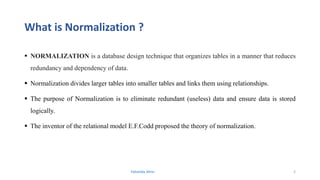
 NORMALIZATION is a database design technique that organizes tables in a manner that reduces
redundancy and dependency of data.
 Normalization divides larger tables into smaller tables and links them using relationships.
 The purpose of Normalization is to eliminate redundant (useless) data and ensure data is stored
logically.
 The inventor of the relational model E.F.Codd proposed the theory of normalization.
Fahmida Afrin 2
Redundancy
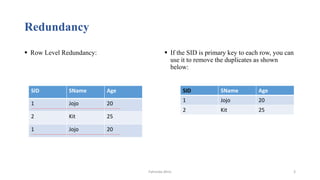
 If the SID is primary key to each row, you can
use it to remove the duplicates as shown
below:
 Row Level Redundancy:
SID SName Age
1 Jojo 20
2 Kit 25
1 Jojo 20
SID SName Age
1 Jojo 20
2 Kit 25
Fahmida Afrin 3
Redundancy (Cont..)
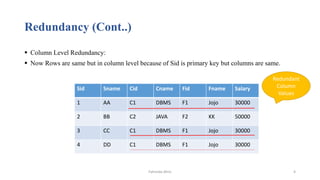
 Column Level Redundancy:
 Now Rows are same but in column level because of Sid is primary key but columns are same.
Sid Sname Cid Cname Fid Fname Salary
1 AA C1 DBMS F1 Jojo 30000
2 BB C2 JAVA F2 KK 50000
3 CC C1 DBMS F1 Jojo 30000
4 DD C1 DBMS F1 Jojo 30000
Redundant
Column
Values
Fahmida Afrin 4
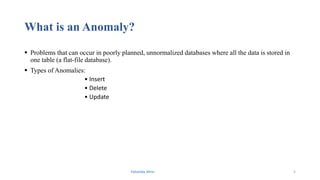
What is an Anomaly?
 Problems that can occur in poorly planned, unnormalized databases where all the data is stored in
one table (a flat-file database).
 Types of Anomalies:
• Insert
• Delete
• Update
Fahmida Afrin 5
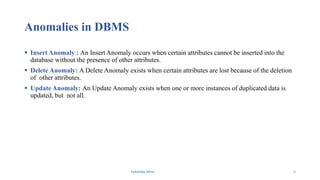
Anomalies in DBMS
 Insert Anomaly : An Insert Anomaly occurs when certain attributes cannot be inserted into the
database without the presence of other attributes.
 Delete Anomaly: A Delete Anomaly exists when certain attributes are lost because of the deletion
of other attributes.
 Update Anomaly: An Update Anomaly exists when one or more instances of duplicated data is
updated, but not all.
Fahmida Afrin 6
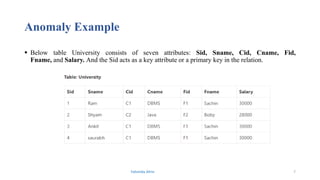
Anomaly Example
 Below table University consists of seven attributes: Sid, Sname, Cid, Cname, Fid,
Fname, and Salary. And the Sid acts as a key attribute or a primary key in the relation.
Fahmida Afrin 7
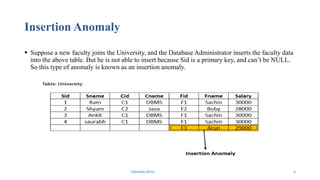
Insertion Anomaly
 Suppose a new faculty joins the University, and the Database Administrator inserts the faculty data
into the above table. But he is not able to insert because Sid is a primary key, and can’t be NULL.
So this type of anomaly is known as an insertion anomaly.
Fahmida Afrin 8
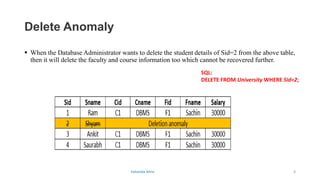
Delete Anomaly
 When the Database Administrator wants to delete the student details of Sid=2 from the above table,
then it will delete the faculty and course information too which cannot be recovered further.
SQL:
DELETE FROM University WHERE Sid=2;
Fahmida Afrin 9
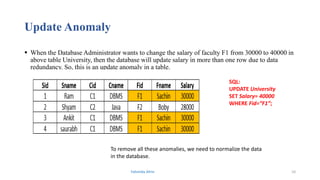
Update Anomaly
 When the Database Administrator wants to change the salary of faculty F1 from 30000 to 40000 in
above table University, then the database will update salary in more than one row due to data
redundancy. So, this is an update anomaly in a table.
SQL:
UPDATE University
SET Salary= 40000
WHERE Fid=“F1”;
To remove all these anomalies, we need to normalize the data
in the database.
Fahmida Afrin 10
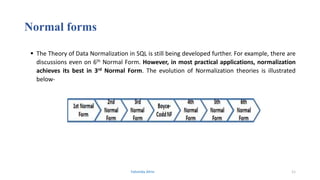
Normal forms
 The Theory of Data Normalization in SQL is still being developed further. For example, there are
discussions even on 6th Normal Form. However, in most practical applications, normalization
achieves its best in 3rd Normal Form. The evolution of Normalization theories is illustrated
below-
Fahmida Afrin 11
First Normal Form (1NF)
 According to the E.F. Codd, a relation will be in 1NF, if each cell of a relation contains only an
atomic value.
Fahmida Afrin 12
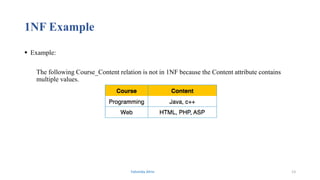
1NF Example
 Example:
The following Course_Content relation is not in 1NF because the Content attribute contains
multiple values.
Fahmida Afrin 13
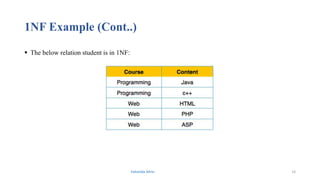
1NF Example (Cont..)
 The below relation student is in 1NF:
Fahmida Afrin 14
Rules of 1NF
The official qualifications for 1NF are:
1. Each attribute name must be unique.
2. Each attribute value must be single.
3. Each row must be unique.
 Additional:
 Choose a primary key.
 Reminder:
A primary key is unique, not null, unchanged. A primary key can be either an attribute or combined
attributes.
Fahmida Afrin 15
Second Normal Form (2NF)
 According to the E.F. Codd, a relation is in 2NF, if it satisfies the following conditions:
 The table should be in the First Normal Form.
 There should be no Partial Dependency.
Fahmida Afrin 16
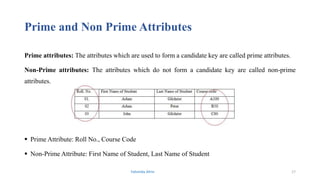
Prime and Non Prime Attributes
Prime attributes: The attributes which are used to form a candidate key are called prime attributes.
Non-Prime attributes: The attributes which do not form a candidate key are called non-prime
attributes.
 Prime Attribute: Roll No., Course Code
 Non-Prime Attribute: First Name of Student, Last Name of Student
Fahmida Afrin 17
Functional Dependency
 A dependency FD: X → Y means that the values of Y are determined by the values of X. Two
tuples sharing the same values of X will necessarily have the same values of Y.
 We illustrate this as:
 X Y (read as: X determines Y or Y depends on X)
Fahmida Afrin 18
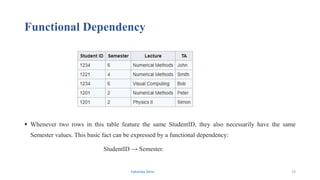
Functional Dependency
 Whenever two rows in this table feature the same StudentID, they also necessarily have the same
Semester values. This basic fact can be expressed by a functional dependency:
StudentID → Semester.
Fahmida Afrin 19
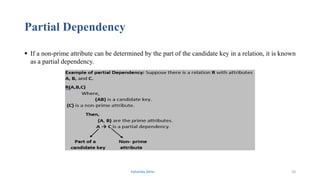
Partial Dependency
 If a non-prime attribute can be determined by the part of the candidate key in a relation, it is known
as a partial dependency.
Fahmida Afrin 20
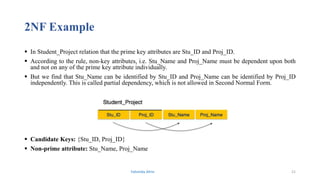
2NF Example
 In Student_Project relation that the prime key attributes are Stu_ID and Proj_ID.
 According to the rule, non-key attributes, i.e. Stu_Name and Proj_Name must be dependent upon both
and not on any of the prime key attribute individually.
 But we find that Stu_Name can be identified by Stu_ID and Proj_Name can be identified by Proj_ID
independently. This is called partial dependency, which is not allowed in Second Normal Form.
 Candidate Keys: {Stu_ID, Proj_ID}
 Non-prime attribute: Stu_Name, Proj_Name
Fahmida Afrin 21
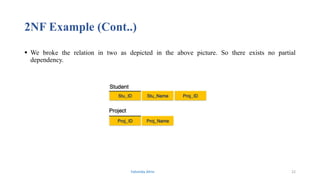
2NF Example (Cont..)
 We broke the relation in two as depicted in the above picture. So there exists no partial
dependency.
Fahmida Afrin 22
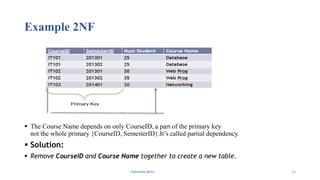
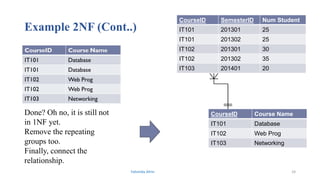
Example 2NF
 The Course Name depends on only CourseID, a part of the primary key
not the whole primary {CourseID, SemesterID}.It’s called partial dependency.
 Solution:
 Remove CourseID and Course Name together to create a new table.
Fahmida Afrin 23
Example 2NF (Cont..)
CourseID SemesterID Num Student
IT101 201301 25
IT101 201302 25
IT102 201301 30
IT102 201302 35
IT103 201401 20
CourseID Course Name
IT101 Database
IT102 Web Prog
IT103 Networking
Done? Oh no, it is still not
in 1NF yet.
Remove the repeating
groups too.
Finally, connect the
relationship.
Fahmida Afrin 24
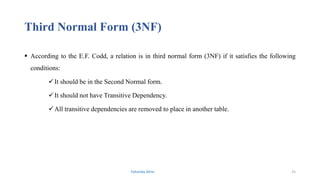
Third Normal Form (3NF)
 According to the E.F. Codd, a relation is in third normal form (3NF) if it satisfies the following
conditions:
It should be in the Second Normal form.
It should not have Transitive Dependency.
All transitive dependencies are removed to place in another table.
Fahmida Afrin 25
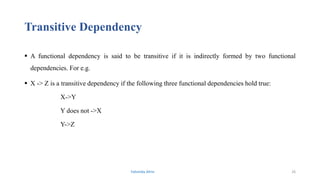
Transitive Dependency
 A functional dependency is said to be transitive if it is indirectly formed by two functional
dependencies. For e.g.
 X -> Z is a transitive dependency if the following three functional dependencies hold true:
X->Y
Y does not ->X
Y->Z
Fahmida Afrin 26
Transitive Dependency(Cont..)
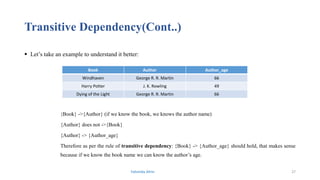
 Let’s take an example to understand it better:
{Book} ->{Author} (if we know the book, we knows the author name)
{Author} does not ->{Book}
{Author} -> {Author_age}
Therefore as per the rule of transitive dependency: {Book} -> {Author_age} should hold, that makes sense
because if we know the book name we can know the author’s age.
Book Author Author_age
Windhaven George R. R. Martin 66
Harry Potter J. K. Rowling 49
Dying of the Light George R. R. Martin 66
Fahmida Afrin 27
3NF Example
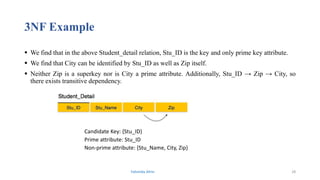
 We find that in the above Student_detail relation, Stu_ID is the key and only prime key attribute.
 We find that City can be identified by Stu_ID as well as Zip itself.
 Neither Zip is a superkey nor is City a prime attribute. Additionally, Stu_ID → Zip → City, so
there exists transitive dependency.
Candidate Key: {Stu_ID}
Prime attribute: Stu_ID
Non-prime attribute: {Stu_Name, City, Zip}
Fahmida Afrin 28
3NF Example (Cont..)
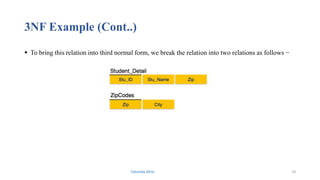
 To bring this relation into third normal form, we break the relation into two relations as follows −
Fahmida Afrin 29
Example 3NF
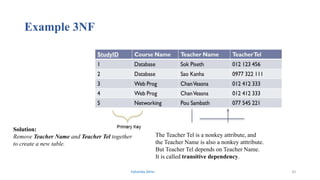
The Teacher Tel is a nonkey attribute, and
the Teacher Name is also a nonkey atttribute.
But Teacher Tel depends on Teacher Name.
It is called transitive dependency.
Solution:
Remove Teacher Name and Teacher Tel together
to create a new table.
Fahmida Afrin 30
Example 3NF
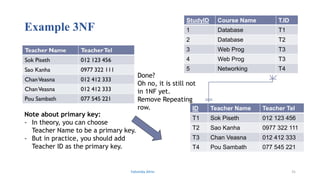
StudyID Course Name T.ID
1 Database T1
2 Database T2
3 Web Prog T3
4 Web Prog T3
5 Networking T4
ID Teacher Name Teacher Tel
T1 Sok Piseth 012 123 456
T2 Sao Kanha 0977 322 111
T3 Chan Veasna 012 412 333
T4 Pou Sambath 077 545 221
Note about primary key:
- In theory, you can choose
Teacher Name to be a primary key.
- But in practice, you should add
Teacher ID as the primary key.
Done?
Oh no, it is still not
in 1NF yet.
Remove Repeating
row.
Fahmida Afrin 31
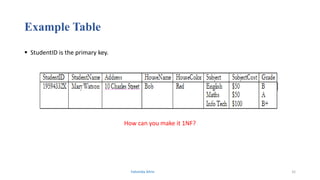
Example Table
 StudentID is the primary key.
Is it 1NF?
How can you make it 1NF?
Fahmida Afrin 32
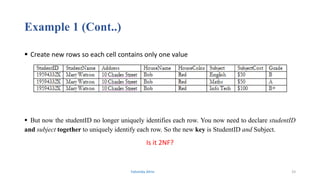
Example 1 (Cont..)
 Create new rows so each cell contains only one value
 But now the studentID no longer uniquely identifies each row. You now need to declare studentID
and subject together to uniquely identify each row. So the new key is StudentID and Subject.
Is it 2NF?
Fahmida Afrin 33
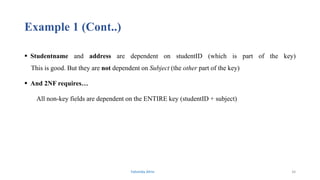
Example 1 (Cont..)
 Studentname and address are dependent on studentID (which is part of the key)
This is good. But they are not dependent on Subject (the other part of the key)
 And 2NF requires…
All non-key fields are dependent on the ENTIRE key (studentID + subject)
Fahmida Afrin 34
Example 1 (Cont..)
 Make new tables
 Make a new table for each primary key field
 Give each new table its own primary key
 Move columns from the original table to the new table that matches their primary key…
Fahmida Afrin 35
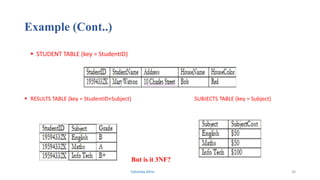
Example (Cont..)
 STUDENT TABLE (key = StudentID)
 RESULTS TABLE (key = StudentID+Subject) SUBJECTS TABLE (key = Subject)
But is it 3NF?
Fahmida Afrin 36
Example 1 (Cont..)
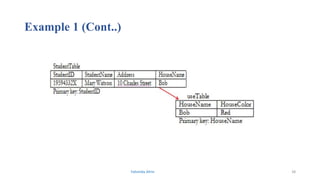
 HouseName is dependent on both StudentID + HouseColour
Or
 HouseColour is dependent on both StudentID + HouseName
 But either way, non-key fields are dependent on MORE THAN THE PRIMARY KEY (studentID).
And 3NF says that non-key fields must depend on nothing but the key
Fahmida Afrin 37
Example 1 (Cont..)
Fahmida Afrin 38
Example 1 (Cont..)
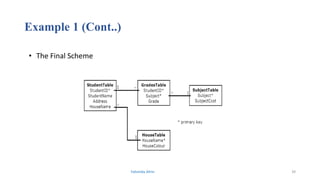
• The Final Scheme
Fahmida Afrin 39
Example 2
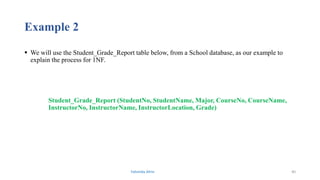
 We will use the Student_Grade_Report table below, from a School database, as our example to
explain the process for 1NF.
Student_Grade_Report (StudentNo, StudentName, Major, CourseNo, CourseName,
InstructorNo, InstructorName, InstructorLocation, Grade)
Fahmida Afrin 40
Process for 1NF
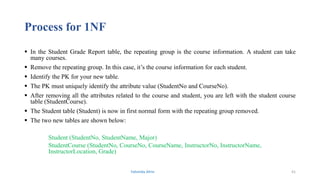
 In the Student Grade Report table, the repeating group is the course information. A student can take
many courses.
 Remove the repeating group. In this case, it’s the course information for each student.
 Identify the PK for your new table.
 The PK must uniquely identify the attribute value (StudentNo and CourseNo).
 After removing all the attributes related to the course and student, you are left with the student course
table (StudentCourse).
 The Student table (Student) is now in first normal form with the repeating group removed.
 The two new tables are shown below:
Student (StudentNo, StudentName, Major)
StudentCourse (StudentNo, CourseNo, CourseName, InstructorNo, InstructorName,
InstructorLocation, Grade)
Fahmida Afrin 41
Example 2 (Cont..)
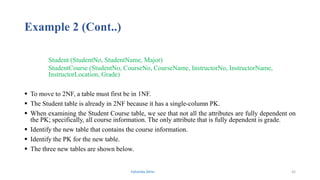
Student (StudentNo, StudentName, Major)
StudentCourse (StudentNo, CourseNo, CourseName, InstructorNo, InstructorName,
InstructorLocation, Grade)
 To move to 2NF, a table must first be in 1NF.
 The Student table is already in 2NF because it has a single-column PK.
 When examining the Student Course table, we see that not all the attributes are fully dependent on
the PK; specifically, all course information. The only attribute that is fully dependent is grade.
 Identify the new table that contains the course information.
 Identify the PK for the new table.
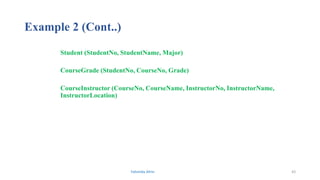
 The three new tables are shown below.
Fahmida Afrin 42
Example 2 (Cont..)
Student (StudentNo, StudentName, Major)
CourseGrade (StudentNo, CourseNo, Grade)
CourseInstructor (CourseNo, CourseName, InstructorNo, InstructorName,
InstructorLocation)
Fahmida Afrin 43
Process for 3NF
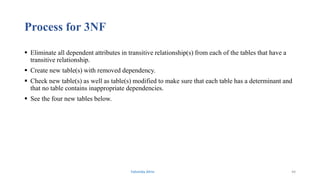
 Eliminate all dependent attributes in transitive relationship(s) from each of the tables that have a
transitive relationship.
 Create new table(s) with removed dependency.
 Check new table(s) as well as table(s) modified to make sure that each table has a determinant and
that no table contains inappropriate dependencies.
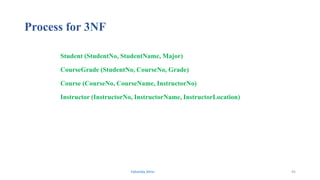
 See the four new tables below.
Fahmida Afrin 44
Process for 3NF
Student (StudentNo, StudentName, Major)
CourseGrade (StudentNo, CourseNo, Grade)
Course (CourseNo, CourseName, InstructorNo)
Instructor (InstructorNo, InstructorName, InstructorLocation)
Fahmida Afrin 45
Process for 3NF
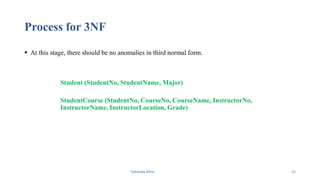
 At this stage, there should be no anomalies in third normal form.
Student (StudentNo, StudentName, Major)
StudentCourse (StudentNo, CourseNo, CourseName, InstructorNo,
InstructorName, InstructorLocation, Grade)
Fahmida Afrin 46
Fahmida Afrin 47

Database normalaization with examples.pptx

  • 1.
  • 2.
    What is Normalization?  NORMALIZATION is a database design technique that organizes tables in a manner that reduces redundancy and dependency of data.  Normalization divides larger tables into smaller tables and links them using relationships.  The purpose of Normalization is to eliminate redundant (useless) data and ensure data is stored logically.  The inventor of the relational model E.F.Codd proposed the theory of normalization. Fahmida Afrin 2
  • 3.
    Redundancy  If theSID is primary key to each row, you can use it to remove the duplicates as shown below:  Row Level Redundancy: SID SName Age 1 Jojo 20 2 Kit 25 1 Jojo 20 SID SName Age 1 Jojo 20 2 Kit 25 Fahmida Afrin 3
  • 4.
    Redundancy (Cont..)  ColumnLevel Redundancy:  Now Rows are same but in column level because of Sid is primary key but columns are same. Sid Sname Cid Cname Fid Fname Salary 1 AA C1 DBMS F1 Jojo 30000 2 BB C2 JAVA F2 KK 50000 3 CC C1 DBMS F1 Jojo 30000 4 DD C1 DBMS F1 Jojo 30000 Redundant Column Values Fahmida Afrin 4
  • 5.
    What is anAnomaly?  Problems that can occur in poorly planned, unnormalized databases where all the data is stored in one table (a flat-file database).  Types of Anomalies: • Insert • Delete • Update Fahmida Afrin 5
  • 6.
    Anomalies in DBMS Insert Anomaly : An Insert Anomaly occurs when certain attributes cannot be inserted into the database without the presence of other attributes.  Delete Anomaly: A Delete Anomaly exists when certain attributes are lost because of the deletion of other attributes.  Update Anomaly: An Update Anomaly exists when one or more instances of duplicated data is updated, but not all. Fahmida Afrin 6
  • 7.
    Anomaly Example  Belowtable University consists of seven attributes: Sid, Sname, Cid, Cname, Fid, Fname, and Salary. And the Sid acts as a key attribute or a primary key in the relation. Fahmida Afrin 7
  • 8.
    Insertion Anomaly  Supposea new faculty joins the University, and the Database Administrator inserts the faculty data into the above table. But he is not able to insert because Sid is a primary key, and can’t be NULL. So this type of anomaly is known as an insertion anomaly. Fahmida Afrin 8
  • 9.
    Delete Anomaly  Whenthe Database Administrator wants to delete the student details of Sid=2 from the above table, then it will delete the faculty and course information too which cannot be recovered further. SQL: DELETE FROM University WHERE Sid=2; Fahmida Afrin 9
  • 10.
    Update Anomaly  Whenthe Database Administrator wants to change the salary of faculty F1 from 30000 to 40000 in above table University, then the database will update salary in more than one row due to data redundancy. So, this is an update anomaly in a table. SQL: UPDATE University SET Salary= 40000 WHERE Fid=“F1”; To remove all these anomalies, we need to normalize the data in the database. Fahmida Afrin 10
  • 11.
    Normal forms  TheTheory of Data Normalization in SQL is still being developed further. For example, there are discussions even on 6th Normal Form. However, in most practical applications, normalization achieves its best in 3rd Normal Form. The evolution of Normalization theories is illustrated below- Fahmida Afrin 11
  • 12.
    First Normal Form(1NF)  According to the E.F. Codd, a relation will be in 1NF, if each cell of a relation contains only an atomic value. Fahmida Afrin 12
  • 13.
    1NF Example  Example: Thefollowing Course_Content relation is not in 1NF because the Content attribute contains multiple values. Fahmida Afrin 13
  • 14.
    1NF Example (Cont..) The below relation student is in 1NF: Fahmida Afrin 14
  • 15.
    Rules of 1NF Theofficial qualifications for 1NF are: 1. Each attribute name must be unique. 2. Each attribute value must be single. 3. Each row must be unique.  Additional:  Choose a primary key.  Reminder: A primary key is unique, not null, unchanged. A primary key can be either an attribute or combined attributes. Fahmida Afrin 15
  • 16.
    Second Normal Form(2NF)  According to the E.F. Codd, a relation is in 2NF, if it satisfies the following conditions:  The table should be in the First Normal Form.  There should be no Partial Dependency. Fahmida Afrin 16
  • 17.
    Prime and NonPrime Attributes Prime attributes: The attributes which are used to form a candidate key are called prime attributes. Non-Prime attributes: The attributes which do not form a candidate key are called non-prime attributes.  Prime Attribute: Roll No., Course Code  Non-Prime Attribute: First Name of Student, Last Name of Student Fahmida Afrin 17
  • 18.
    Functional Dependency  Adependency FD: X → Y means that the values of Y are determined by the values of X. Two tuples sharing the same values of X will necessarily have the same values of Y.  We illustrate this as:  X Y (read as: X determines Y or Y depends on X) Fahmida Afrin 18
  • 19.
    Functional Dependency  Whenevertwo rows in this table feature the same StudentID, they also necessarily have the same Semester values. This basic fact can be expressed by a functional dependency: StudentID → Semester. Fahmida Afrin 19
  • 20.
    Partial Dependency  Ifa non-prime attribute can be determined by the part of the candidate key in a relation, it is known as a partial dependency. Fahmida Afrin 20
  • 21.
    2NF Example  InStudent_Project relation that the prime key attributes are Stu_ID and Proj_ID.  According to the rule, non-key attributes, i.e. Stu_Name and Proj_Name must be dependent upon both and not on any of the prime key attribute individually.  But we find that Stu_Name can be identified by Stu_ID and Proj_Name can be identified by Proj_ID independently. This is called partial dependency, which is not allowed in Second Normal Form.  Candidate Keys: {Stu_ID, Proj_ID}  Non-prime attribute: Stu_Name, Proj_Name Fahmida Afrin 21
  • 22.
    2NF Example (Cont..) We broke the relation in two as depicted in the above picture. So there exists no partial dependency. Fahmida Afrin 22
  • 23.
    Example 2NF  TheCourse Name depends on only CourseID, a part of the primary key not the whole primary {CourseID, SemesterID}.It’s called partial dependency.  Solution:  Remove CourseID and Course Name together to create a new table. Fahmida Afrin 23
  • 24.
    Example 2NF (Cont..) CourseIDSemesterID Num Student IT101 201301 25 IT101 201302 25 IT102 201301 30 IT102 201302 35 IT103 201401 20 CourseID Course Name IT101 Database IT102 Web Prog IT103 Networking Done? Oh no, it is still not in 1NF yet. Remove the repeating groups too. Finally, connect the relationship. Fahmida Afrin 24
  • 25.
    Third Normal Form(3NF)  According to the E.F. Codd, a relation is in third normal form (3NF) if it satisfies the following conditions: It should be in the Second Normal form. It should not have Transitive Dependency. All transitive dependencies are removed to place in another table. Fahmida Afrin 25
  • 26.
    Transitive Dependency  Afunctional dependency is said to be transitive if it is indirectly formed by two functional dependencies. For e.g.  X -> Z is a transitive dependency if the following three functional dependencies hold true: X->Y Y does not ->X Y->Z Fahmida Afrin 26
  • 27.
    Transitive Dependency(Cont..)  Let’stake an example to understand it better: {Book} ->{Author} (if we know the book, we knows the author name) {Author} does not ->{Book} {Author} -> {Author_age} Therefore as per the rule of transitive dependency: {Book} -> {Author_age} should hold, that makes sense because if we know the book name we can know the author’s age. Book Author Author_age Windhaven George R. R. Martin 66 Harry Potter J. K. Rowling 49 Dying of the Light George R. R. Martin 66 Fahmida Afrin 27
  • 28.
    3NF Example  Wefind that in the above Student_detail relation, Stu_ID is the key and only prime key attribute.  We find that City can be identified by Stu_ID as well as Zip itself.  Neither Zip is a superkey nor is City a prime attribute. Additionally, Stu_ID → Zip → City, so there exists transitive dependency. Candidate Key: {Stu_ID} Prime attribute: Stu_ID Non-prime attribute: {Stu_Name, City, Zip} Fahmida Afrin 28
  • 29.
    3NF Example (Cont..) To bring this relation into third normal form, we break the relation into two relations as follows − Fahmida Afrin 29
  • 30.
    Example 3NF The TeacherTel is a nonkey attribute, and the Teacher Name is also a nonkey atttribute. But Teacher Tel depends on Teacher Name. It is called transitive dependency. Solution: Remove Teacher Name and Teacher Tel together to create a new table. Fahmida Afrin 30
  • 31.
    Example 3NF StudyID CourseName T.ID 1 Database T1 2 Database T2 3 Web Prog T3 4 Web Prog T3 5 Networking T4 ID Teacher Name Teacher Tel T1 Sok Piseth 012 123 456 T2 Sao Kanha 0977 322 111 T3 Chan Veasna 012 412 333 T4 Pou Sambath 077 545 221 Note about primary key: - In theory, you can choose Teacher Name to be a primary key. - But in practice, you should add Teacher ID as the primary key. Done? Oh no, it is still not in 1NF yet. Remove Repeating row. Fahmida Afrin 31
  • 32.
    Example Table  StudentIDis the primary key. Is it 1NF? How can you make it 1NF? Fahmida Afrin 32
  • 33.
    Example 1 (Cont..) Create new rows so each cell contains only one value  But now the studentID no longer uniquely identifies each row. You now need to declare studentID and subject together to uniquely identify each row. So the new key is StudentID and Subject. Is it 2NF? Fahmida Afrin 33
  • 34.
    Example 1 (Cont..) Studentname and address are dependent on studentID (which is part of the key) This is good. But they are not dependent on Subject (the other part of the key)  And 2NF requires… All non-key fields are dependent on the ENTIRE key (studentID + subject) Fahmida Afrin 34
  • 35.
    Example 1 (Cont..) Make new tables  Make a new table for each primary key field  Give each new table its own primary key  Move columns from the original table to the new table that matches their primary key… Fahmida Afrin 35
  • 36.
    Example (Cont..)  STUDENTTABLE (key = StudentID)  RESULTS TABLE (key = StudentID+Subject) SUBJECTS TABLE (key = Subject) But is it 3NF? Fahmida Afrin 36
  • 37.
    Example 1 (Cont..) HouseName is dependent on both StudentID + HouseColour Or  HouseColour is dependent on both StudentID + HouseName  But either way, non-key fields are dependent on MORE THAN THE PRIMARY KEY (studentID). And 3NF says that non-key fields must depend on nothing but the key Fahmida Afrin 37
  • 38.
  • 39.
    Example 1 (Cont..) •The Final Scheme Fahmida Afrin 39
  • 40.
    Example 2  Wewill use the Student_Grade_Report table below, from a School database, as our example to explain the process for 1NF. Student_Grade_Report (StudentNo, StudentName, Major, CourseNo, CourseName, InstructorNo, InstructorName, InstructorLocation, Grade) Fahmida Afrin 40
  • 41.
    Process for 1NF In the Student Grade Report table, the repeating group is the course information. A student can take many courses.  Remove the repeating group. In this case, it’s the course information for each student.  Identify the PK for your new table.  The PK must uniquely identify the attribute value (StudentNo and CourseNo).  After removing all the attributes related to the course and student, you are left with the student course table (StudentCourse).  The Student table (Student) is now in first normal form with the repeating group removed.  The two new tables are shown below: Student (StudentNo, StudentName, Major) StudentCourse (StudentNo, CourseNo, CourseName, InstructorNo, InstructorName, InstructorLocation, Grade) Fahmida Afrin 41
  • 42.
    Example 2 (Cont..) Student(StudentNo, StudentName, Major) StudentCourse (StudentNo, CourseNo, CourseName, InstructorNo, InstructorName, InstructorLocation, Grade)  To move to 2NF, a table must first be in 1NF.  The Student table is already in 2NF because it has a single-column PK.  When examining the Student Course table, we see that not all the attributes are fully dependent on the PK; specifically, all course information. The only attribute that is fully dependent is grade.  Identify the new table that contains the course information.  Identify the PK for the new table.  The three new tables are shown below. Fahmida Afrin 42
  • 43.
    Example 2 (Cont..) Student(StudentNo, StudentName, Major) CourseGrade (StudentNo, CourseNo, Grade) CourseInstructor (CourseNo, CourseName, InstructorNo, InstructorName, InstructorLocation) Fahmida Afrin 43
  • 44.
    Process for 3NF Eliminate all dependent attributes in transitive relationship(s) from each of the tables that have a transitive relationship.  Create new table(s) with removed dependency.  Check new table(s) as well as table(s) modified to make sure that each table has a determinant and that no table contains inappropriate dependencies.  See the four new tables below. Fahmida Afrin 44
  • 45.
    Process for 3NF Student(StudentNo, StudentName, Major) CourseGrade (StudentNo, CourseNo, Grade) Course (CourseNo, CourseName, InstructorNo) Instructor (InstructorNo, InstructorName, InstructorLocation) Fahmida Afrin 45
  • 46.
    Process for 3NF At this stage, there should be no anomalies in third normal form. Student (StudentNo, StudentName, Major) StudentCourse (StudentNo, CourseNo, CourseName, InstructorNo, InstructorName, InstructorLocation, Grade) Fahmida Afrin 46
  • 47.