Process and CPU
Process and CPU
Scheduling
Scheduling
Unit_II
Chap_3
Contents
Contents
 Process Concept
 Process Scheduling
 Operations on Processes
 Interprocess Communication
 Examples of IPC Systems
 Communication in Client-Server Systems
Objectives
Objectives
To introduce the notion of a process -- a
program in execution, which forms the basis
of all computation
To describe the various features of
processes, including scheduling, creation and
termination, and communication
To explore interprocess communication
using shared memory and message passing
To describe communication in client-server
systems
Process Concept
Process Concept
An operating system executes a variety
of programs:
◦ Batch system – jobs
◦ Time-shared systems – user programs or
tasks
Process – a program in execution;
process execution must progress in
sequential fashion
Process Concept (Cont.)
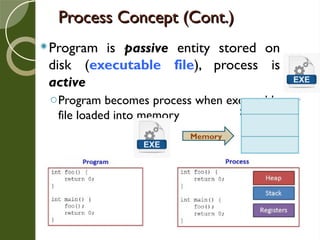
Program is passive entity stored on
disk (executable file), process is
active
oProgram becomes process when executable
file loaded into memory
Memory
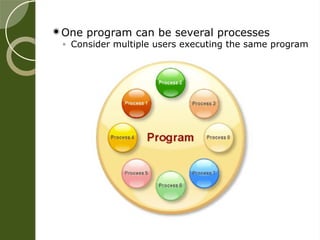
One program can be several processes
◦ Consider multiple users executing the same program
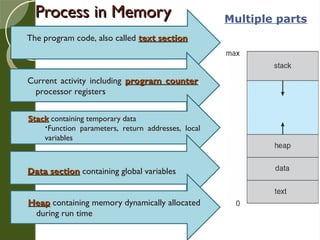
The program code, also called text section
text section
Current activity including program counter
program counter,
processor registers
Stack
Stack containing temporary data
Function parameters, return addresses, local
variables
Data section
Data section containing global variables
Heap
Heap containing memory dynamically allocated
during run time
Multiple parts
Process in Memory
Process in Memory
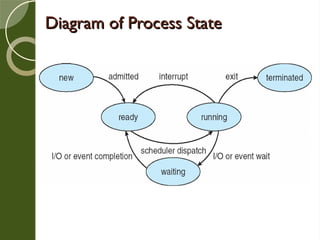
Process States
Process States
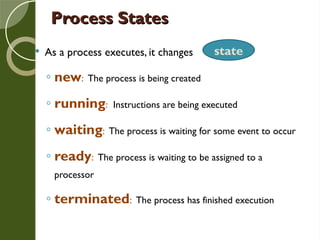
 As a process executes, it changes
◦ new: The process is being created
◦ running: Instructions are being executed
◦ waiting: The process is waiting for some event to occur
◦ ready: The process is waiting to be assigned to a
processor
◦ terminated: The process has finished execution
state
Diagram of Process State
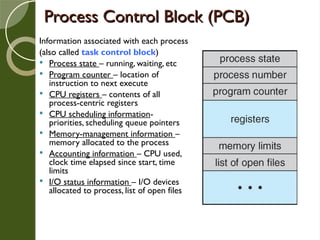
Process Control Block (PCB)
Information associated with each process
(also called task control block)
 Process state – running, waiting, etc
 Program counter – location of
instruction to next execute
 CPU registers – contents of all
process-centric registers
 CPU scheduling information-
priorities, scheduling queue pointers
 Memory-management information –
memory allocated to the process
 Accounting information – CPU used,
clock time elapsed since start, time
limits
 I/O status information – I/O devices
allocated to process, list of open files
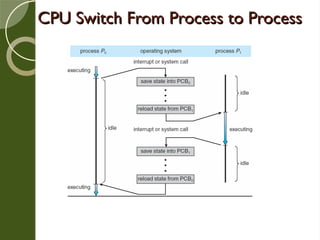
CPU Switch From Process to Process
Threads
Threads
 So far, process has a single thread of
execution
 Consider having multiple program
counters per process
◦ Multiple locations can execute at once
 Multiple threads of control → threads
 Must then have storage for thread details,
multiple program counters in PCB
Process Scheduling
Process Scheduling
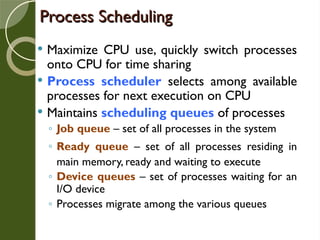
 Maximize CPU use, quickly switch processes
onto CPU for time sharing
 Process scheduler selects among available
processes for next execution on CPU
 Maintains scheduling queues of processes
◦ Job queue – set of all processes in the system
◦ Ready queue – set of all processes residing in
main memory, ready and waiting to execute
◦ Device queues – set of processes waiting for an
I/O device
◦ Processes migrate among the various queues
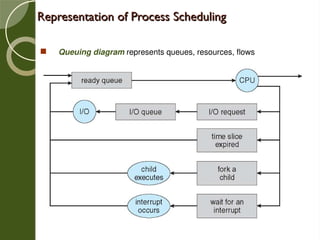
Representation of Process Scheduling
 Queuing diagram represents queues, resources, flows
Schedulers
Schedulers
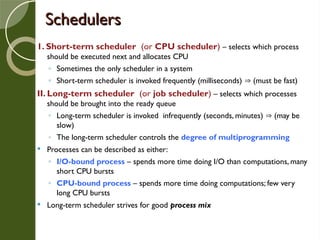
1. Short-term scheduler (or CPU scheduler) – selects which process
should be executed next and allocates CPU
◦ Sometimes the only scheduler in a system
◦ Short-term scheduler is invoked frequently (milliseconds)  (must be fast)
II. Long-term scheduler (or job scheduler) – selects which processes
should be brought into the ready queue
◦ Long-term scheduler is invoked infrequently (seconds, minutes)  (may be
slow)
◦ The long-term scheduler controls the degree of multiprogramming
 Processes can be described as either:
◦ I/O-bound process – spends more time doing I/O than computations, many
short CPU bursts
◦ CPU-bound process – spends more time doing computations; few very
long CPU bursts
 Long-term scheduler strives for good process mix
Addition of Medium Term Scheduling
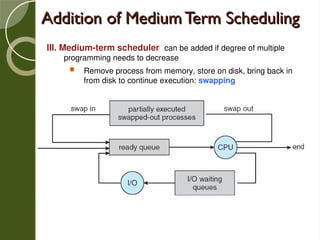
III. Medium-term scheduler can be added if degree of multiple
programming needs to decrease
 Remove process from memory, store on disk, bring back in
from disk to continue execution: swapping
Multitasking in Mobile Systems
 Some mobile systems (e.g., early version of iOS) allow only one
process to run, others suspended
 Due to screen real estate, user interface limits iOS provides for
a
◦ Single foreground process- controlled via user interface
◦ Multiple background processes– in memory, running, but not on
the display, and with limits
◦ Limits include single, short task, receiving notification of events,
specific long-running tasks like audio playback
 Android runs foreground and background, with fewer limits
◦ Background process uses a service to perform tasks
◦ Service can keep running even if background process is suspended
◦ Service has no user interface, small memory use
Context Switch
Context Switch
 When CPU switches to another process, the system
must save the state of the old process and load the
saved state for the new process via a context
switch
 Context of a process represented in the PCB
 Context-switch time is overhead; the system does no
useful work while switching
◦ The more complex the OS and the PCB  the longer the
context switch
 Time dependent on hardware support
◦ Some hardware provides multiple sets of registers per
CPU  multiple contexts loaded at once
The process of saving the status of an
interrupted process and loading the status of
the scheduled process is known as
Context Switching.
When a running process is interrupted and the
OS assigns another process and transfers
control to it, it is known as
Process Switching.
Contents
Contents
 Process Concept
 Process Scheduling
Operations on Processes
 Interprocess Communication
 Examples of IPC Systems
 Communication in Client-Server Systems
Operations on Processes
System must provide mechanisms for:
 process creation,
 process termination,
 and so on as detailed next
Process Creation
Process Creation
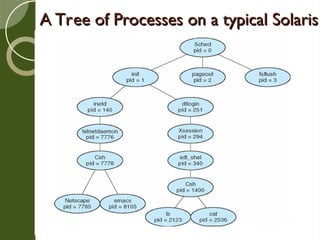
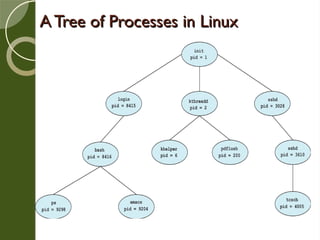
 Parent process create children processes, which, in
turn create other processes, forming a tree of
processes
 Generally, process identified and managed via a
process identifier (pid)
 Resource sharing options
Parent and children share all resources
Children share subset of parent’s resources
Parent and child share no resources
 Execution options
Parent and children execute concurrently
Parent waits until children terminate
A Tree of Processes on a typical Solaris
A Tree of Processes in Linux
Process Creation (Cont.)
 Address space
◦ Child duplicate of parent
◦ Child has a program loaded into it
 UNIX examples
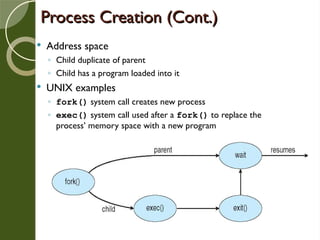
◦ fork() system call creates new process
◦ exec() system call used after a fork() to replace the
process’ memory space with a new program
Process Termination
Process Termination
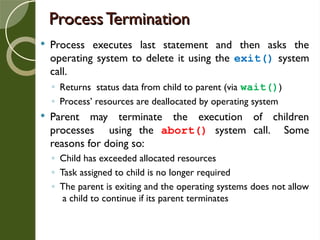
 Process executes last statement and then asks the
operating system to delete it using the exit() system
call.
◦ Returns status data from child to parent (via wait())
◦ Process’ resources are deallocated by operating system
 Parent may terminate the execution of children
processes using the abort() system call. Some
reasons for doing so:
◦ Child has exceeded allocated resources
◦ Task assigned to child is no longer required
◦ The parent is exiting and the operating systems does not allow
a child to continue if its parent terminates
Process Termination cont..
 Some operating systems do not allow child to exists if its parent has
terminated. If a process terminates, then all its children must also be
terminated.
◦ cascading termination. All children, grandchildren, etc. are terminated.
◦ The termination is initiated by the operating system.
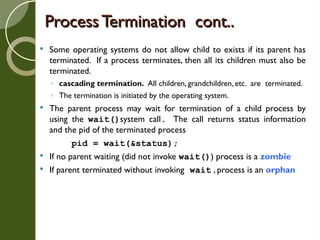
 The parent process may wait for termination of a child process by
using the wait()system call. The call returns status information
and the pid of the terminated process
pid = wait(&status);
 If no parent waiting (did not invoke wait()) process is a zombie
 If parent terminated without invoking wait , process is an orphan
A Zombie process or defunct process is a process that has
completed execution(via exit system call) but still has an entry in
the process table. It is a process in the “Terminated state”.
This occurs for child processes, where the process table entry is
still needed to allow the parent process to read its child’s exit
status: once the exit status is read via wait system call by the
parent process.
An Orphan process is a process that is still executing, but
whose parent has died. When the parent dies, the orphaned
child process is adopted by init or systemd (process ID)
Interprocess Communication
 Processes within a system may be independent or
cooperating
 Cooperating process can affect or be affected by other
processes, including sharing data
 Reasons for cooperating processes:
◦ Information sharing
◦ Computation speedup
◦ Modularity
◦ Convenience
 Cooperating processes need interprocess
communication (IPC)
 Two models of IPC
◦ Shared memory
◦ Message passing
Cooperating Processes
 Independent process cannot affect or be
affected by the execution of another process
 Cooperating process can affect or be
affected by the execution of another process
 Advantages of process cooperation
◦ Information sharing
◦ Computation speed-up
◦ Modularity
◦ Convenience
Producer-Consumer Problem
 Paradigm for cooperating processes,
producer process produces information that
is consumed by a consumer process
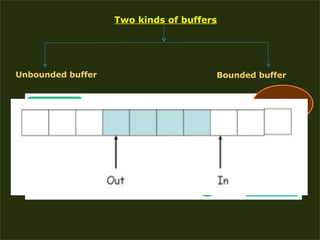
◦ unbounded-buffer places no practical limit on
the size of the buffer
◦ bounded-buffer assumes that there is a fixed
buffer size
Bounded-Buffer – Shared-Memory Solution
 Shared data
#define BUFFER_SIZE 10
typedef struct {
. . .
} item;
item buffer[BUFFER_SIZE];
int in = 0;
int out = 0;
Bounded-Buffer
Bounded-Buffer
item next_produced;
while (true) {
/* produce an item in
next produced */
while (((in + 1) %
BUFFER_SIZE) == out);
/* do nothing */
buffer[in] =
next_produced;
in = (in + 1) %
BUFFER_SIZE;
}
item next_consumed;
while (true) {
while (in == out);
/* do nothing */
next_consumed =
buffer[out];
out = (out + 1) %
BUFFER_SIZE;
/* consume the item in
next consumed */
}
Producer Consumer
 This scheme allows at most BUFFER_SIZE -1 items
in the buffer at the same time.
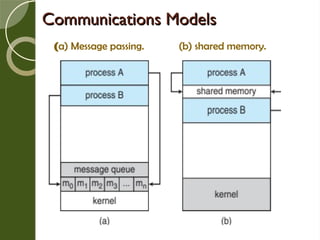
Communications Models
(a) Message passing. (b) shared memory.
Interprocess Communication
Interprocess Communication –
– Shared Memory
Shared Memory
 An area of memory shared among the processes that
wish to communicate
 The communication is under the control of the users
processes not the operating system.
 Major issues is to provide mechanism that will allow the
user processes to synchronize their actions when they
access shared memory.
 Synchronization is discussed in great details in Chapter
5.
Two kinds of buffers
Unbounded buffer Bounded buffer
FULL
WAIT
Interprocess Communication
Interprocess Communication –
– Message Passing
Message Passing
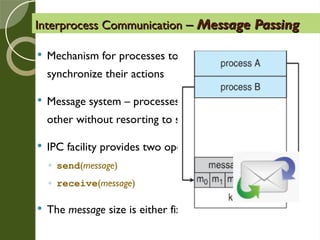
 Mechanism for processes to communicate and to
synchronize their actions
 Message system – processes communicate with each
other without resorting to shared variables
 IPC facility provides two operations:
◦ send(message)
◦ receive(message)
 The message size is either fixed or variable
Message Passing (Cont.)
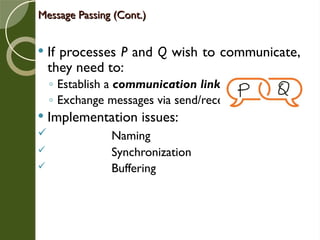
 If processes P and Q wish to communicate,
they need to:
◦ Establish a communication link between them
◦ Exchange messages via send/receive
 Implementation issues:
 Naming
 Synchronization
 Buffering
Message Passing (Cont.)
 Implementation of communication link
◦ Physical:
 Shared memory
 Hardware bus
 Network
◦ Logical:
 Direct or indirect
 Synchronous or asynchronous
 Automatic or explicit buffering
Direct Communication
 Processes must name each other explicitly:
◦ send (P, message) – send a message to process P
◦ receive(Q, message) – receive a message from
process Q
 Properties of communication link
◦ Links are established automatically
◦ A link is associated with exactly one pair of
communicating processes
◦ Between each pair there exists exactly one link
◦ The link may be unidirectional, but is usually bi-
directional
Indirect Communication
 Messages are directed and received from mailboxes 8 (also
referred to as ports)
◦ Each mailbox has a unique id
◦ Processes can communicate only if they share a mailbox
 Properties of communication link
◦ Link established only if processes share a common mailbox
◦ A link may be associated with many processes
◦ Each pair of processes may share several communication links
◦ Link may be unidirectional or bi-directional
Indirect Communication cont…
 Primitives are defined as:
send(A, message) – send a message to
mailbox A
receive(A, message) – receive a message
from mailbox A
 Operations
◦ create a new mailbox (port)
◦ send and receive messages through mailbox
◦ destroy a mailbox
Synchronization
Synchronization
 Message passing may be either blocking or non-blocking
 Blocking is considered synchronous
◦ Blocking send -- the sender is blocked until the message
is received
◦ Blocking receive -- the receiver is blocked until a
message is available
 Non-blocking is considered asynchronous
◦ Non-blocking send -- the sender sends the message and
continue
◦ Non-blocking receive -- the receiver receives:
 A valid message, or
 Null message
 Different combinations possible
 If both send and receive are blocking, we have a
rendezvous
Buffering
Buffering
 Queue of messages attached to the link.
 implemented in one of three ways
1. Zero capacity – no messages are queued on
a link.
Sender must wait for receiver (rendezvous)
2. Bounded capacity – finite length of n
messages
Sender must wait if link full
3. Unbounded capacity – infinite length
Sender never waits
Examples of IPC Systems - POSIX
 POSIX Shared Memory
Process first creates shared memory segment
segment_id =
shmget(IPC_PRIVATE,size,S_IRUSR |
S_IWUSR);
Process must attach address space
shared_memory = (char *)
shmat(id, NULL, 0);
Now the process could write to the shared
memory
sprintf(shared memory, "Writing
to shared memory");
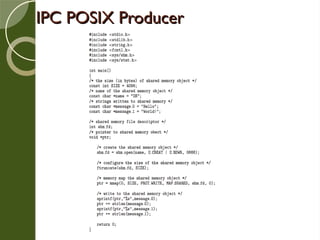
IPC POSIX Producer
IPC POSIX Producer
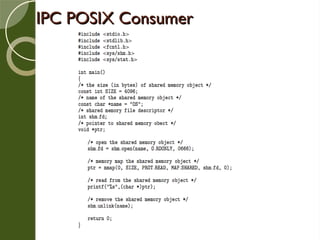
IPC POSIX Consumer
IPC POSIX Consumer
Examples of IPC Systems - Mach
 Mach communication is message based
◦ Even system calls are messages
◦ Each task gets two mailboxes at creation- Kernel and Notify
◦ Only three system calls needed for message transfer
msg_send(), msg_receive(), msg_rpc()
◦ Mailboxes needed for commuication, created via
port_allocate()
◦ Send and receive are flexible, for example four options if
mailbox full:
 Wait indefinitely
 Wait at most n milliseconds
 Return immediately
 Temporarily cache a message
Examples of IPC Systems –Windows
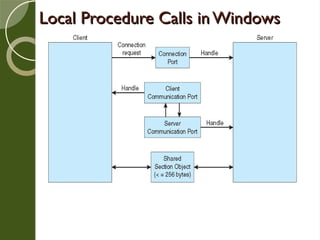
 Message-passing centric via advanced local
procedure call (LPC) facility
◦ Only works between processes on the same
system
◦ Uses ports (like mailboxes) to establish and
maintain communication channels
◦ Communication works as follows:
 The client opens a handle to the subsystem’s connection
port object.
 The client sends a connection request.
 The server creates two private communication ports
and returns the handle to one of them to the client.
 The client and server use the corresponding port handle
to send messages or callbacks and to listen for replies.
Local Procedure Calls in Windows

Process and CPU Scheduling algorithms and IPC

  • 1.
    Process and CPU Processand CPU Scheduling Scheduling Unit_II Chap_3
  • 2.
    Contents Contents  Process Concept Process Scheduling  Operations on Processes  Interprocess Communication  Examples of IPC Systems  Communication in Client-Server Systems
  • 3.
    Objectives Objectives To introduce thenotion of a process -- a program in execution, which forms the basis of all computation To describe the various features of processes, including scheduling, creation and termination, and communication To explore interprocess communication using shared memory and message passing To describe communication in client-server systems
  • 4.
    Process Concept Process Concept Anoperating system executes a variety of programs: ◦ Batch system – jobs ◦ Time-shared systems – user programs or tasks Process – a program in execution; process execution must progress in sequential fashion
  • 5.
    Process Concept (Cont.) ProcessConcept (Cont.) Program is passive entity stored on disk (executable file), process is active oProgram becomes process when executable file loaded into memory Memory
  • 6.
    One program canbe several processes ◦ Consider multiple users executing the same program
  • 7.
    The program code,also called text section text section Current activity including program counter program counter, processor registers Stack Stack containing temporary data Function parameters, return addresses, local variables Data section Data section containing global variables Heap Heap containing memory dynamically allocated during run time Multiple parts Process in Memory Process in Memory
  • 8.
    Process States Process States As a process executes, it changes ◦ new: The process is being created ◦ running: Instructions are being executed ◦ waiting: The process is waiting for some event to occur ◦ ready: The process is waiting to be assigned to a processor ◦ terminated: The process has finished execution state
  • 9.
    Diagram of ProcessState Diagram of Process State
  • 11.
    Process Control Block(PCB) Process Control Block (PCB) Information associated with each process (also called task control block)  Process state – running, waiting, etc  Program counter – location of instruction to next execute  CPU registers – contents of all process-centric registers  CPU scheduling information- priorities, scheduling queue pointers  Memory-management information – memory allocated to the process  Accounting information – CPU used, clock time elapsed since start, time limits  I/O status information – I/O devices allocated to process, list of open files
  • 12.
    CPU Switch FromProcess to Process CPU Switch From Process to Process
  • 13.
    Threads Threads  So far,process has a single thread of execution  Consider having multiple program counters per process ◦ Multiple locations can execute at once  Multiple threads of control → threads  Must then have storage for thread details, multiple program counters in PCB
  • 14.
    Process Scheduling Process Scheduling Maximize CPU use, quickly switch processes onto CPU for time sharing  Process scheduler selects among available processes for next execution on CPU  Maintains scheduling queues of processes ◦ Job queue – set of all processes in the system ◦ Ready queue – set of all processes residing in main memory, ready and waiting to execute ◦ Device queues – set of processes waiting for an I/O device ◦ Processes migrate among the various queues
  • 15.
    Representation of ProcessScheduling Representation of Process Scheduling  Queuing diagram represents queues, resources, flows
  • 16.
    Schedulers Schedulers 1. Short-term scheduler(or CPU scheduler) – selects which process should be executed next and allocates CPU ◦ Sometimes the only scheduler in a system ◦ Short-term scheduler is invoked frequently (milliseconds)  (must be fast) II. Long-term scheduler (or job scheduler) – selects which processes should be brought into the ready queue ◦ Long-term scheduler is invoked infrequently (seconds, minutes)  (may be slow) ◦ The long-term scheduler controls the degree of multiprogramming  Processes can be described as either: ◦ I/O-bound process – spends more time doing I/O than computations, many short CPU bursts ◦ CPU-bound process – spends more time doing computations; few very long CPU bursts  Long-term scheduler strives for good process mix
  • 17.
    Addition of MediumTerm Scheduling Addition of Medium Term Scheduling III. Medium-term scheduler can be added if degree of multiple programming needs to decrease  Remove process from memory, store on disk, bring back in from disk to continue execution: swapping
  • 18.
    Multitasking in MobileSystems Multitasking in Mobile Systems  Some mobile systems (e.g., early version of iOS) allow only one process to run, others suspended  Due to screen real estate, user interface limits iOS provides for a ◦ Single foreground process- controlled via user interface ◦ Multiple background processes– in memory, running, but not on the display, and with limits ◦ Limits include single, short task, receiving notification of events, specific long-running tasks like audio playback  Android runs foreground and background, with fewer limits ◦ Background process uses a service to perform tasks ◦ Service can keep running even if background process is suspended ◦ Service has no user interface, small memory use
  • 19.
    Context Switch Context Switch When CPU switches to another process, the system must save the state of the old process and load the saved state for the new process via a context switch  Context of a process represented in the PCB  Context-switch time is overhead; the system does no useful work while switching ◦ The more complex the OS and the PCB  the longer the context switch  Time dependent on hardware support ◦ Some hardware provides multiple sets of registers per CPU  multiple contexts loaded at once
  • 20.
    The process ofsaving the status of an interrupted process and loading the status of the scheduled process is known as Context Switching. When a running process is interrupted and the OS assigns another process and transfers control to it, it is known as Process Switching.
  • 21.
    Contents Contents  Process Concept Process Scheduling Operations on Processes  Interprocess Communication  Examples of IPC Systems  Communication in Client-Server Systems
  • 22.
    Operations on Processes Operationson Processes System must provide mechanisms for:  process creation,  process termination,  and so on as detailed next
  • 23.
    Process Creation Process Creation Parent process create children processes, which, in turn create other processes, forming a tree of processes  Generally, process identified and managed via a process identifier (pid)  Resource sharing options Parent and children share all resources Children share subset of parent’s resources Parent and child share no resources  Execution options Parent and children execute concurrently Parent waits until children terminate
  • 24.
    A Tree ofProcesses on a typical Solaris A Tree of Processes on a typical Solaris
  • 25.
    A Tree ofProcesses in Linux A Tree of Processes in Linux
  • 26.
    Process Creation (Cont.) ProcessCreation (Cont.)  Address space ◦ Child duplicate of parent ◦ Child has a program loaded into it  UNIX examples ◦ fork() system call creates new process ◦ exec() system call used after a fork() to replace the process’ memory space with a new program
  • 27.
    Process Termination Process Termination Process executes last statement and then asks the operating system to delete it using the exit() system call. ◦ Returns status data from child to parent (via wait()) ◦ Process’ resources are deallocated by operating system  Parent may terminate the execution of children processes using the abort() system call. Some reasons for doing so: ◦ Child has exceeded allocated resources ◦ Task assigned to child is no longer required ◦ The parent is exiting and the operating systems does not allow a child to continue if its parent terminates
  • 28.
    Process Termination cont.. ProcessTermination cont..  Some operating systems do not allow child to exists if its parent has terminated. If a process terminates, then all its children must also be terminated. ◦ cascading termination. All children, grandchildren, etc. are terminated. ◦ The termination is initiated by the operating system.  The parent process may wait for termination of a child process by using the wait()system call. The call returns status information and the pid of the terminated process pid = wait(&status);  If no parent waiting (did not invoke wait()) process is a zombie  If parent terminated without invoking wait , process is an orphan
  • 29.
    A Zombie processor defunct process is a process that has completed execution(via exit system call) but still has an entry in the process table. It is a process in the “Terminated state”. This occurs for child processes, where the process table entry is still needed to allow the parent process to read its child’s exit status: once the exit status is read via wait system call by the parent process. An Orphan process is a process that is still executing, but whose parent has died. When the parent dies, the orphaned child process is adopted by init or systemd (process ID)
  • 30.
    Interprocess Communication Interprocess Communication Processes within a system may be independent or cooperating  Cooperating process can affect or be affected by other processes, including sharing data  Reasons for cooperating processes: ◦ Information sharing ◦ Computation speedup ◦ Modularity ◦ Convenience  Cooperating processes need interprocess communication (IPC)  Two models of IPC ◦ Shared memory ◦ Message passing
  • 31.
    Cooperating Processes Cooperating Processes Independent process cannot affect or be affected by the execution of another process  Cooperating process can affect or be affected by the execution of another process  Advantages of process cooperation ◦ Information sharing ◦ Computation speed-up ◦ Modularity ◦ Convenience
  • 32.
    Producer-Consumer Problem Producer-Consumer Problem Paradigm for cooperating processes, producer process produces information that is consumed by a consumer process ◦ unbounded-buffer places no practical limit on the size of the buffer ◦ bounded-buffer assumes that there is a fixed buffer size
  • 33.
    Bounded-Buffer – Shared-MemorySolution Bounded-Buffer – Shared-Memory Solution  Shared data #define BUFFER_SIZE 10 typedef struct { . . . } item; item buffer[BUFFER_SIZE]; int in = 0; int out = 0;
  • 34.
    Bounded-Buffer Bounded-Buffer item next_produced; while (true){ /* produce an item in next produced */ while (((in + 1) % BUFFER_SIZE) == out); /* do nothing */ buffer[in] = next_produced; in = (in + 1) % BUFFER_SIZE; } item next_consumed; while (true) { while (in == out); /* do nothing */ next_consumed = buffer[out]; out = (out + 1) % BUFFER_SIZE; /* consume the item in next consumed */ } Producer Consumer  This scheme allows at most BUFFER_SIZE -1 items in the buffer at the same time.
  • 35.
    Communications Models Communications Models (a)Message passing. (b) shared memory.
  • 36.
    Interprocess Communication Interprocess Communication– – Shared Memory Shared Memory  An area of memory shared among the processes that wish to communicate  The communication is under the control of the users processes not the operating system.  Major issues is to provide mechanism that will allow the user processes to synchronize their actions when they access shared memory.  Synchronization is discussed in great details in Chapter 5.
  • 37.
    Two kinds ofbuffers Unbounded buffer Bounded buffer FULL WAIT
  • 38.
    Interprocess Communication Interprocess Communication– – Message Passing Message Passing  Mechanism for processes to communicate and to synchronize their actions  Message system – processes communicate with each other without resorting to shared variables  IPC facility provides two operations: ◦ send(message) ◦ receive(message)  The message size is either fixed or variable
  • 39.
    Message Passing (Cont.) MessagePassing (Cont.)  If processes P and Q wish to communicate, they need to: ◦ Establish a communication link between them ◦ Exchange messages via send/receive  Implementation issues:  Naming  Synchronization  Buffering
  • 40.
    Message Passing (Cont.) MessagePassing (Cont.)  Implementation of communication link ◦ Physical:  Shared memory  Hardware bus  Network ◦ Logical:  Direct or indirect  Synchronous or asynchronous  Automatic or explicit buffering
  • 41.
    Direct Communication Direct Communication Processes must name each other explicitly: ◦ send (P, message) – send a message to process P ◦ receive(Q, message) – receive a message from process Q  Properties of communication link ◦ Links are established automatically ◦ A link is associated with exactly one pair of communicating processes ◦ Between each pair there exists exactly one link ◦ The link may be unidirectional, but is usually bi- directional
  • 42.
    Indirect Communication Indirect Communication Messages are directed and received from mailboxes 8 (also referred to as ports) ◦ Each mailbox has a unique id ◦ Processes can communicate only if they share a mailbox  Properties of communication link ◦ Link established only if processes share a common mailbox ◦ A link may be associated with many processes ◦ Each pair of processes may share several communication links ◦ Link may be unidirectional or bi-directional
  • 43.
    Indirect Communication cont… IndirectCommunication cont…  Primitives are defined as: send(A, message) – send a message to mailbox A receive(A, message) – receive a message from mailbox A  Operations ◦ create a new mailbox (port) ◦ send and receive messages through mailbox ◦ destroy a mailbox
  • 44.
    Synchronization Synchronization  Message passingmay be either blocking or non-blocking  Blocking is considered synchronous ◦ Blocking send -- the sender is blocked until the message is received ◦ Blocking receive -- the receiver is blocked until a message is available  Non-blocking is considered asynchronous ◦ Non-blocking send -- the sender sends the message and continue ◦ Non-blocking receive -- the receiver receives:  A valid message, or  Null message  Different combinations possible  If both send and receive are blocking, we have a rendezvous
  • 45.
    Buffering Buffering  Queue ofmessages attached to the link.  implemented in one of three ways 1. Zero capacity – no messages are queued on a link. Sender must wait for receiver (rendezvous) 2. Bounded capacity – finite length of n messages Sender must wait if link full 3. Unbounded capacity – infinite length Sender never waits
  • 46.
    Examples of IPCSystems - POSIX Examples of IPC Systems - POSIX  POSIX Shared Memory Process first creates shared memory segment segment_id = shmget(IPC_PRIVATE,size,S_IRUSR | S_IWUSR); Process must attach address space shared_memory = (char *) shmat(id, NULL, 0); Now the process could write to the shared memory sprintf(shared memory, "Writing to shared memory");
  • 48.
    IPC POSIX Producer IPCPOSIX Producer
  • 49.
    IPC POSIX Consumer IPCPOSIX Consumer
  • 50.
    Examples of IPCSystems - Mach Examples of IPC Systems - Mach  Mach communication is message based ◦ Even system calls are messages ◦ Each task gets two mailboxes at creation- Kernel and Notify ◦ Only three system calls needed for message transfer msg_send(), msg_receive(), msg_rpc() ◦ Mailboxes needed for commuication, created via port_allocate() ◦ Send and receive are flexible, for example four options if mailbox full:  Wait indefinitely  Wait at most n milliseconds  Return immediately  Temporarily cache a message
  • 51.
    Examples of IPCSystems –Windows Examples of IPC Systems –Windows  Message-passing centric via advanced local procedure call (LPC) facility ◦ Only works between processes on the same system ◦ Uses ports (like mailboxes) to establish and maintain communication channels ◦ Communication works as follows:  The client opens a handle to the subsystem’s connection port object.  The client sends a connection request.  The server creates two private communication ports and returns the handle to one of them to the client.  The client and server use the corresponding port handle to send messages or callbacks and to listen for replies.
  • 52.
    Local Procedure Callsin Windows Local Procedure Calls in Windows