Database Systems
Introduction to Databases and Data Warehouses
(Solutions to end-of-chapter exercises E8.1, E8.2, E8.3)
E8.1 ZAGI Retail Company
Consider the following, slightly modified, ZAGI Retail Company
scenario. The ZAGI Retail Company wants to create analytical database
to analyze sales.
The three available data sources are:
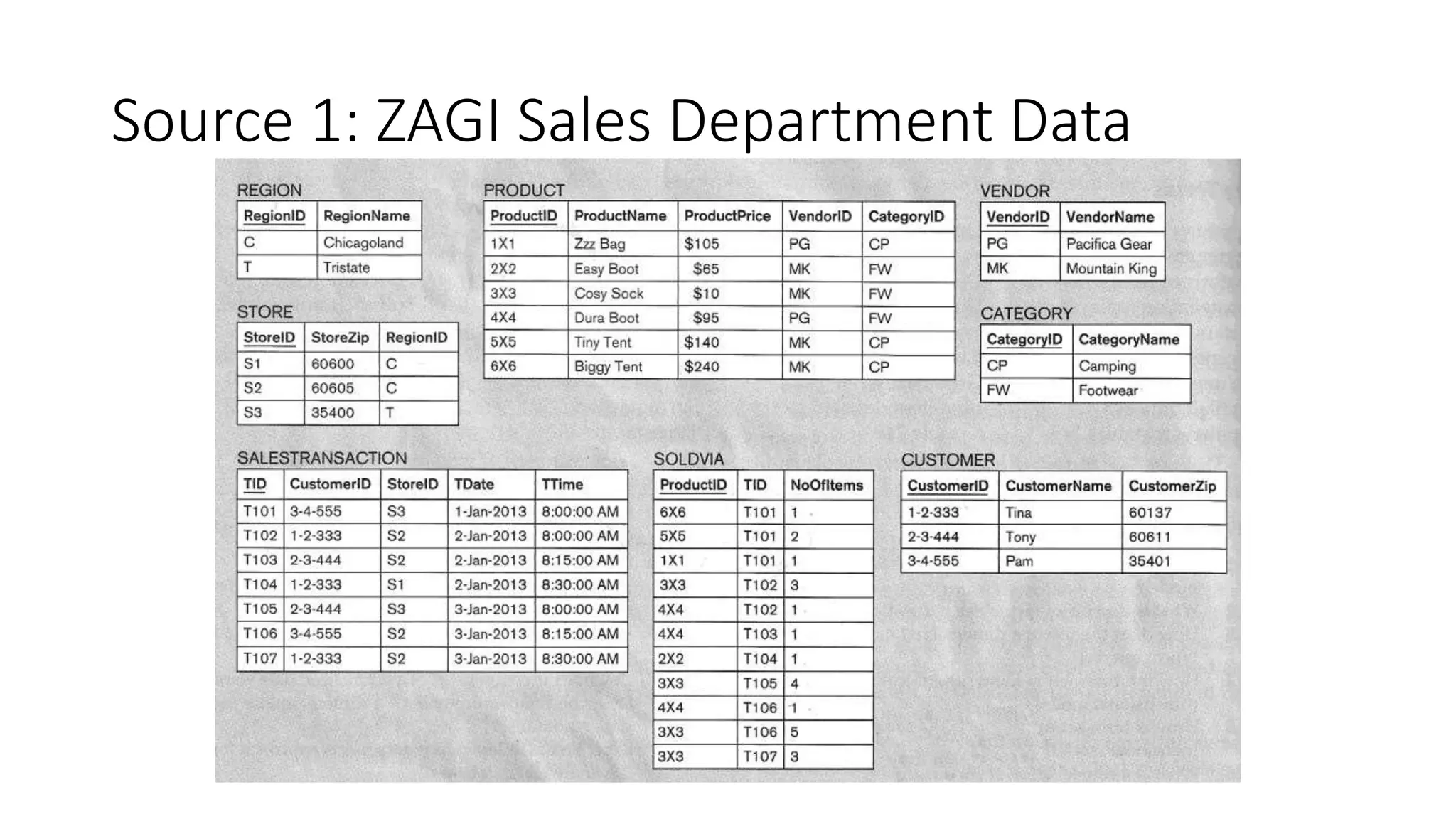
• Source 1 The ZAGI Retail Company Sales Department Database, as
shown below)
• Source 2 The ZAGI Retail Company Facilities Department Database
shown below
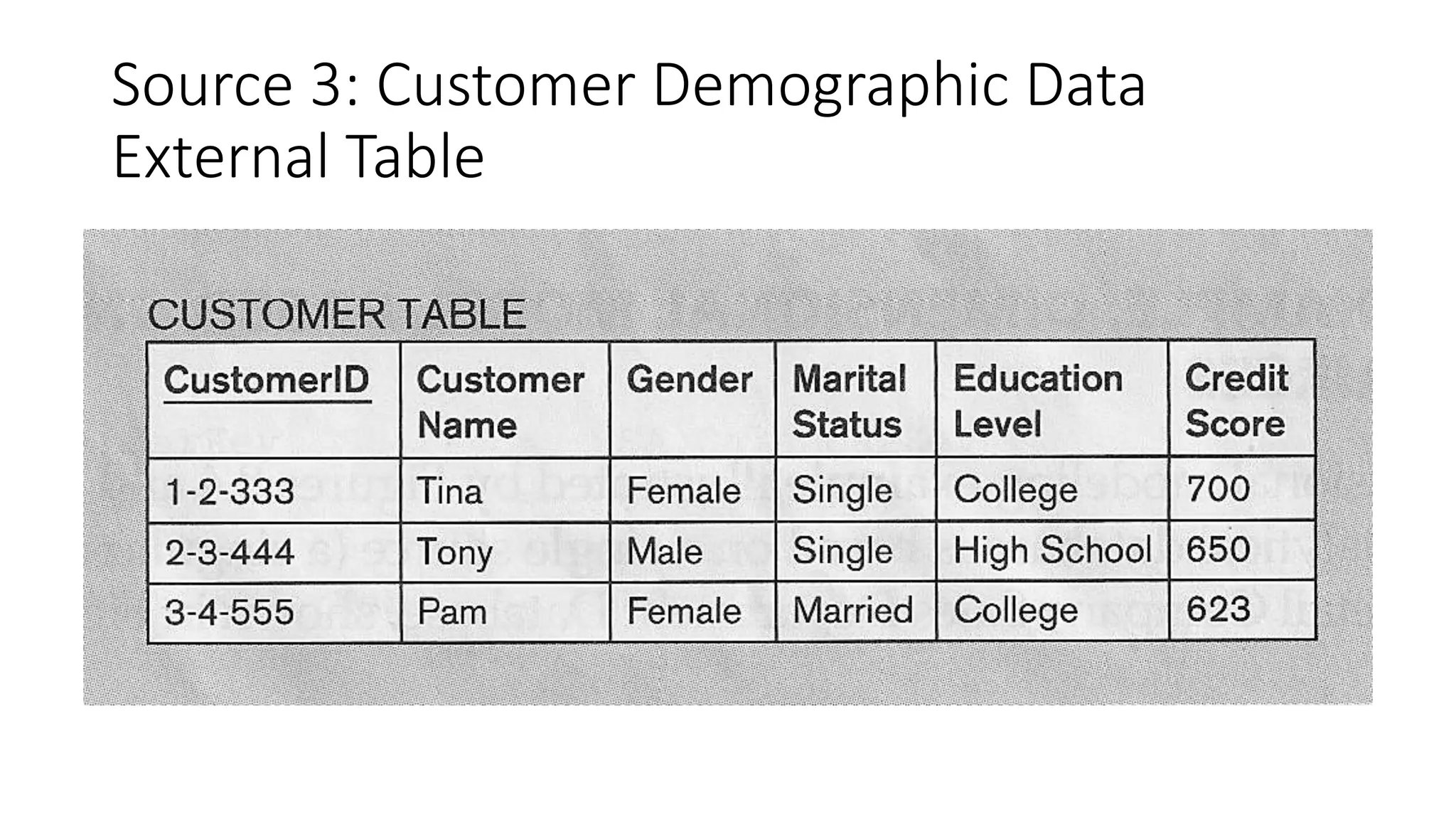
• Source 3 A Customer Demographic Data external table shown below.
Source 1: ZAGI Sales Department
Source 2: ZAGI Facilities Department
Source 3: Customer Demographic external
table
E8.1 ZAGI Retail Company data warehouse
The data warehouse has to enable an analysis of sales dollar amounts and
quantities by
• date, including: full date, day of week, day of month, month quarter, year
• time
• product, including: product name and price, product category, product
vendor
• customer, including: customer name, zip, gender, marital status, education
level, credit score
• store, including: individual store, store size and store zip, store checkout
system, store layout, store region.
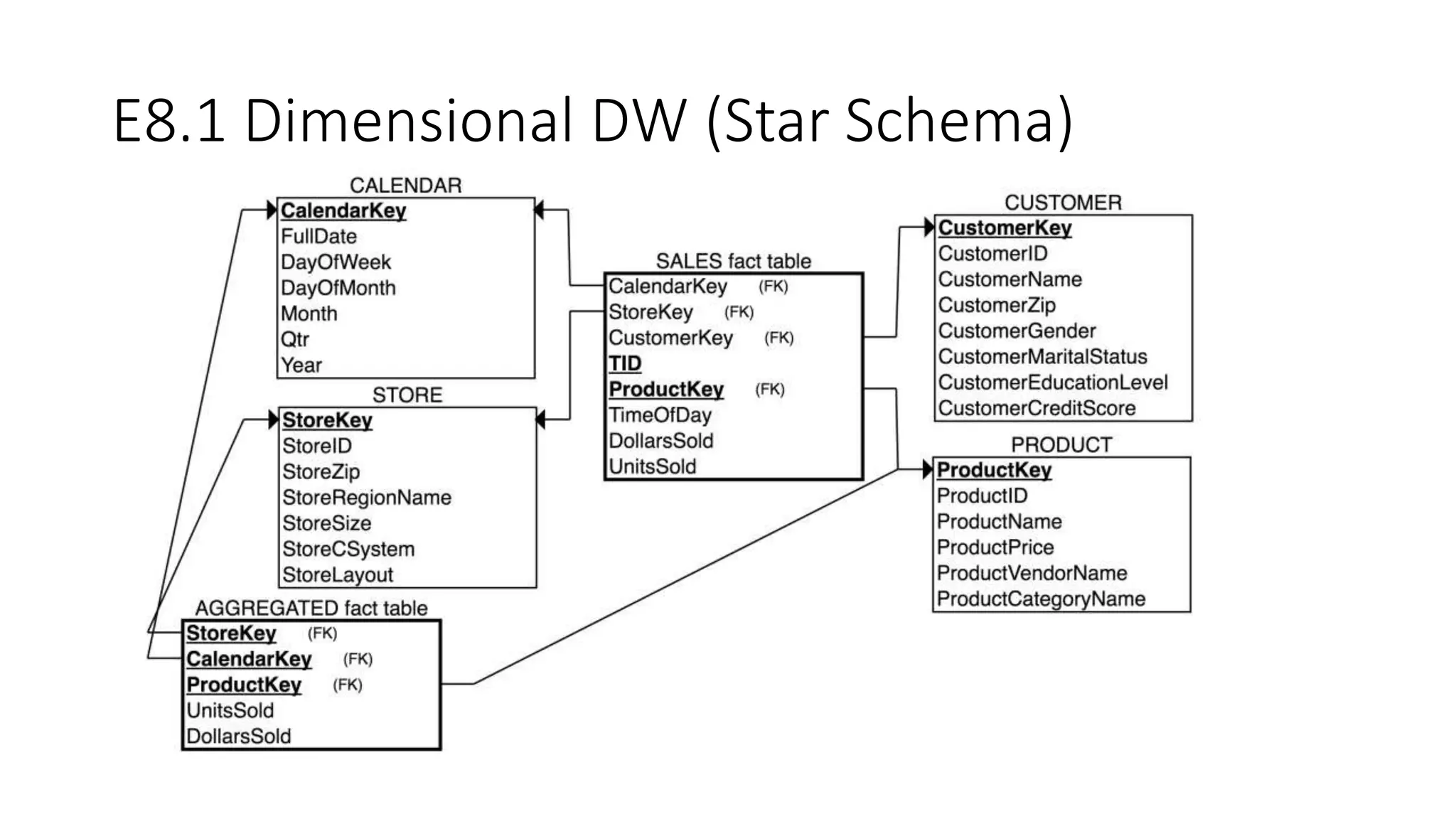
ZAGI Sales Dimensional DW model
(star schema)
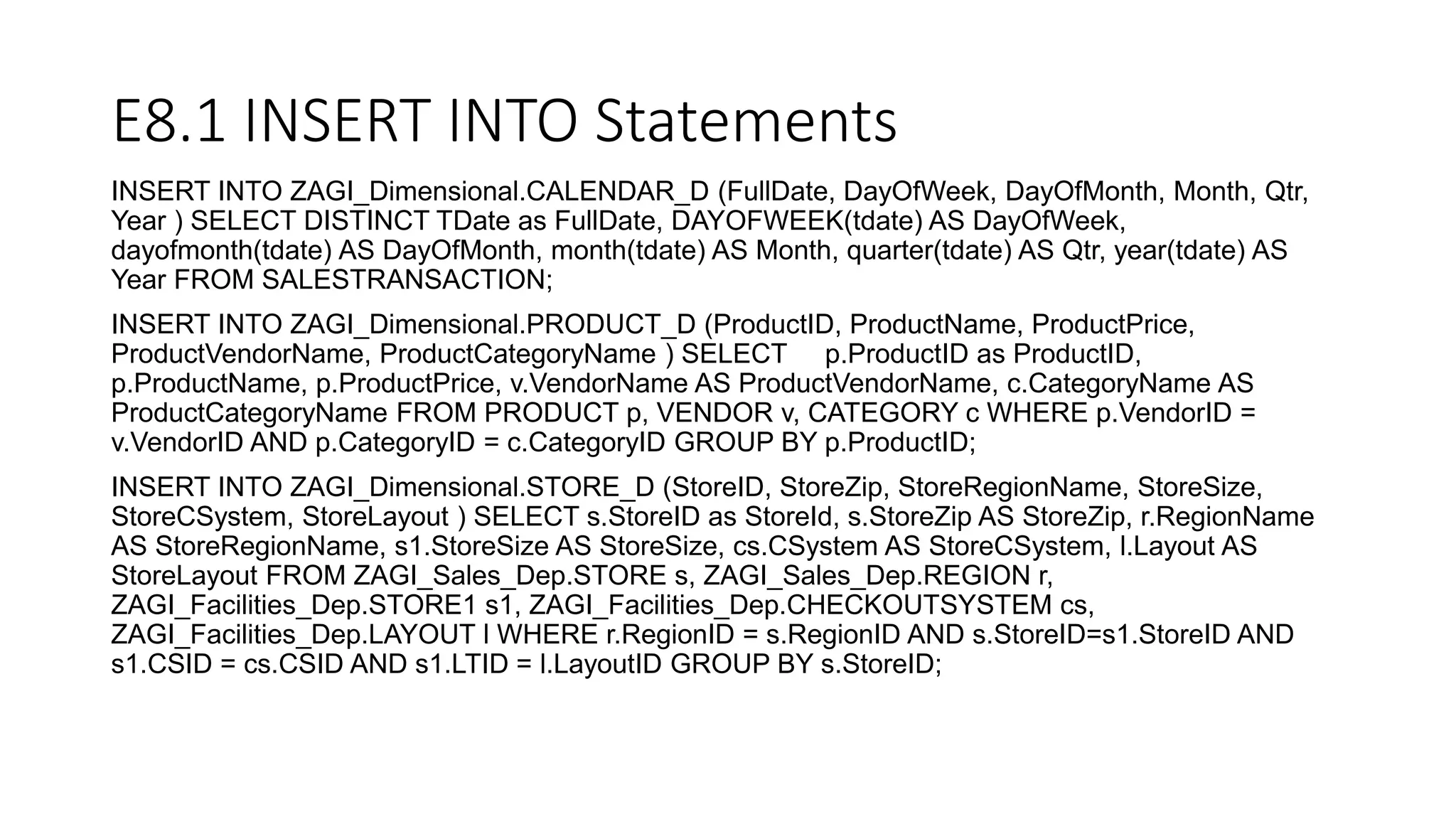
INSERT INTO Statements
INSERT INTO ZAGI_Dimensional.CALENDAR_D (FullDate, DayOfWeek, DayOfMonth, Month, Qtr,
Year ) SELECT DISTINCT TDate as FullDate, DAYOFWEEK(tdate) AS DayOfWeek,
dayofmonth(tdate) AS DayOfMonth, month(tdate) AS Month, quarter(tdate) AS Qtr, year(tdate) AS
Year FROM SALESTRANSACTION;
INSERT INTO ZAGI_Dimensional.PRODUCT_D (ProductID, ProductName, ProductPrice,
ProductVendorName, ProductCategoryName ) SELECT p.ProductID as ProductID,
p.ProductName, p.ProductPrice, v.VendorName AS ProductVendorName, c.CategoryName AS
ProductCategoryName FROM PRODUCT p, VENDOR v, CATEGORY c WHERE p.VendorID =
v.VendorID AND p.CategoryID = c.CategoryID GROUP BY p.ProductID;
INSERT INTO ZAGI_Dimensional.STORE_D (StoreID, StoreZip, StoreRegionName, StoreSize,
StoreCSystem, StoreLayout ) SELECT s.StoreID as StoreId, s.StoreZip AS StoreZip, r.RegionName
AS StoreRegionName, s1.StoreSize AS StoreSize, cs.CSystem AS StoreCSystem, l.Layout AS
StoreLayout FROM ZAGI_Sales_Dep.STORE s, ZAGI_Sales_Dep.REGION r,
ZAGI_Facilities_Dep.STORE1 s1, ZAGI_Facilities_Dep.CHECKOUTSYSTEM cs,
ZAGI_Facilities_Dep.LAYOUT l WHERE r.RegionID = s.RegionID AND s.StoreID=s1.StoreID AND
s1.CSID = cs.CSID AND s1.LTID = l.LayoutID GROUP BY s.StoreID;
INSERT INTO ZAGI_Dimensional.CUSTOMER_D(CustomerID, CustomerName, CustomerZip,
CustomerGender, CustomerMaritalStatus, CustomerEducationLevel, CustomerCreditScore )SELECT
t1.customerid as CustomerId, t1.customername AS CustomerName, t1.customerzip AS CustomerZip,
t2.gender AS CustomerGender, t2.maritalstatus AS CustomerMaritalStatus, t2.educationlevel AS
CustomerEducationLevel, t2.creditscore AS CustomerCreditScore FROM
ZAGI_Sales_Dep.CUSTOMER AS t1, ZAGI_Customer_Table.CUSTOMER_TABLE AS t2 WHERE
t1.CustomerID = t2.CustomerID;
CREATE VIEW `SALES_FACT_VIEW` AS SELECT st.TDate, st.StoreID, sv.ProductID,
st.CustomerID, sv.TID AS TID, st.TTime AS TimeOfDay, p.ProductPrice*sv.NoOfItems AS DollarsSold,
sv.NoOfItems AS UnitsSold FROM ZAGI_Sales_Dep.SOLDVIA AS sv, ZAGI_Sales_Dep.PRODUCT
AS p, ZAGI_Sales_Dep.SALESTRANSACTION AS st WHERE sv.ProductID = p.ProductID AND
sv.TID = st.TID;
INSERT INTO ZAGI_Dimensional.SALES_FACT (CalendarKey, StoreKey, ProductKey, CustomerKey,
TID, TimeOfDay, DollarsSold, UnitsSold ) SELECT CA.CalendarKey, S.StoreKey, P.ProductKey,
CU.CustomerKey, SFV.TID, SFV.TimeOfDay, SFV.DollarsSold, SFV.UnitsSold FROM
ZAGI_Sales_Dep.SALES_FACT_VIEW AS SFV, ZAGI_Dimensional.CALENDAR_D AS CA,
ZAGI_Dimensional.PRODUCT_D AS P, ZAGI_Dimensional.STORE_D as S,
ZAGI_Dimensional.CUSTOMER_D AS CU WHERE CA.FullDate = SFV.TDate AND S.StoreID =
SFV.StoreID AND P.ProductID = SFV.ProductID AND CU.CustomerID = SFV.CustomerID;
E8.1b, E8.1c Aggregated Fact Table
A dimensional model above contains an aggregated fact table, which
shows a summary of units sold and dollars sold for daily purchases of
each product in each store. It is populated as shown below.
INSERT INTO ZAGI_Dimensional.AGGREGATED_FACT (CalendarKey, StoreKey,
ProductKey, DollarsSold, UnitsSold)
SELECT SF.CalendarKey, SF.StoreKey, SF.ProductKey, SUM(DollarsSold),
SUM(UnitsSold)
FROM ZAGI_Dimensional.SALES_FACT SF
GROUP BY CalendarKey, StoreKey, ProductKey;
Source 1: ZAGI Sales Department data
Source 2: ZAGI Facilities Department data
Source 3: Customer Demographic data
external table
ZAGI Sales Dimensional DW: fact tables
populated with data, Calendar dimension
ZAGI Sales Dimensional DW: Store, Product and
Customer Dimensions Populated with data
E8.2 City Police Department
Consider the following scenario involving the City Police Department.
The City Police Department wants to create an analytical database to
analyze its ticket revenue.
The two available data sources, Source 1 and Source 2, are described
below.
• Source 1 The City Police Department maintains the Ticketed
Violations Database, shown in Figure below.
• Source 2 The Department of Motor Vehicles (DMV) maintains the
Vehicle Registration Table, shown in Figure below
Source 1: CPD Ticketed Violations
Source 2: DMV Vehicle Registration Table
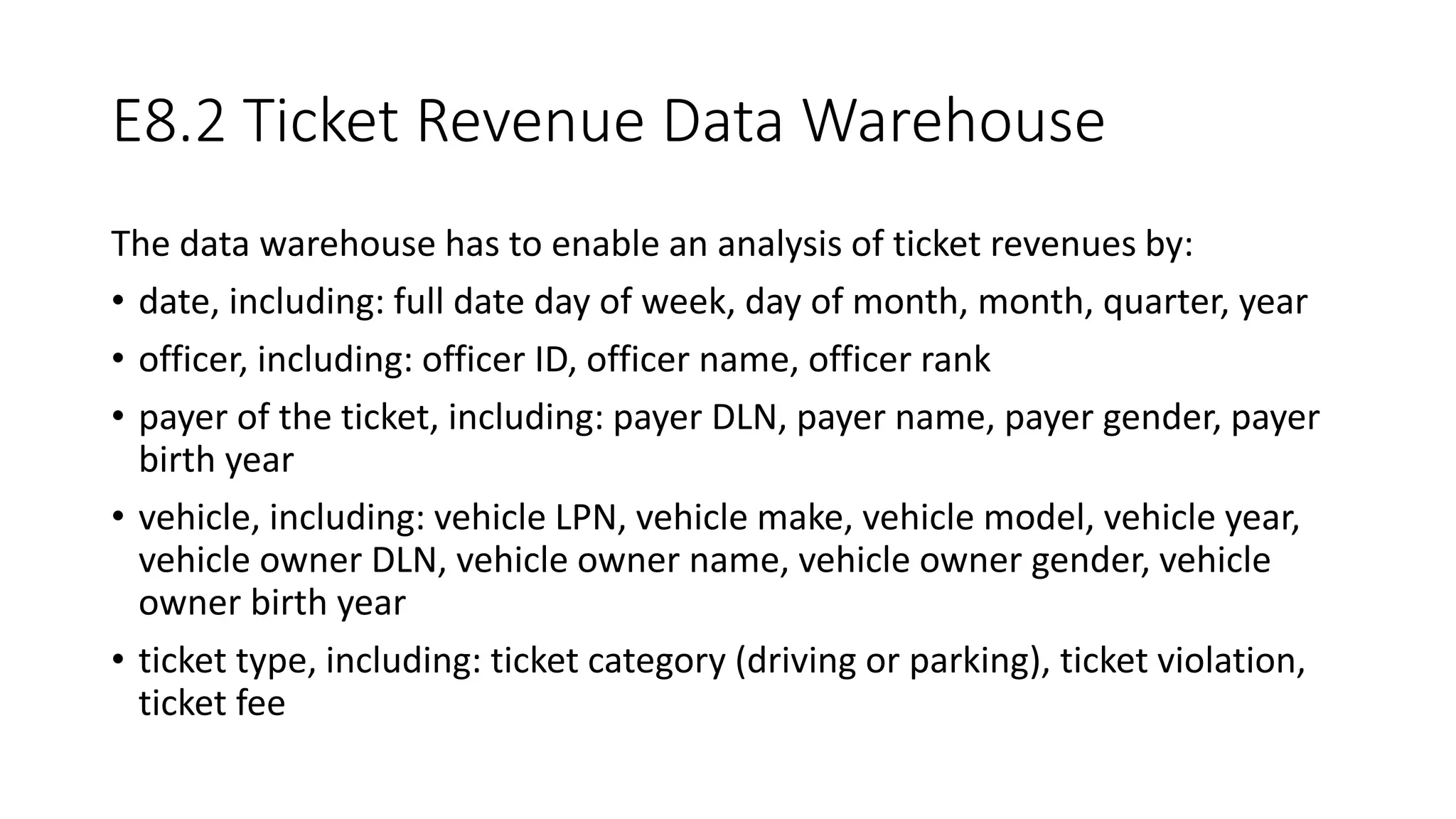
E8.2 Ticket Revenue Data Warehouse
The data warehouse has to enable an analysis of ticket revenues by:
• date, including: full date day of week, day of month, month, quarter, year
• officer, including: officer ID, officer name, officer rank
• payer of the ticket, including: payer DLN, payer name, payer gender, payer
birth year
• vehicle, including: vehicle LPN, vehicle make, vehicle model, vehicle year,
vehicle owner DLN, vehicle owner name, vehicle owner gender, vehicle
owner birth year
• ticket type, including: ticket category (driving or parking), ticket violation,
ticket fee
Ticket Revenue Dimensional DW model
(star schema)
INSERT INTO statements
INSERT INTO CPD_Ticket_Revenue.CALENDAR (FullDate, DayOfWeek, DayOfMonth, Month, Quarter, Year )
SELECT DISTINCT DTDate as FullDate, DAYOFWEEK(DTDate) AS DayOfWeek, dayofmonth(DTDate) AS
DayOfMonth, month(DTDate) AS Month, quarter(DTDate) AS Qtr, year(DTDate) AS Year FROM
CPD_Ticketed_Violations.DRIVINGTICKET UNION SELECT DISTINCT PTDate as FullDate,
DAYOFWEEK(PTDate) AS DayOfWeek, dayofmonth(PTDate) AS DayOfMonth, month(PTDate) AS Month,
quarter(PTDate) AS Quarter, year(PTDate) AS Year FROM CPD_Ticketed_Violations.PARKINGTICKET;
INSERT INTO CPD_Ticket_Revenue.OFFICER (OfficerID, OfficerName, OfficerRank) SELECT OfficerID,
OfficerName, OfficerRank FROM CPD_Ticketed_Violations.OFFICER;
INSERT INTO CPD_Ticket_Revenue.TICKETTYPE (TicketCategory, TicketViolation, TicketFee) SELECT * FROM
CPD_Ticketed_Violations.DTICKETTYPE UNION SELECT * FROM CPD_Ticketed_Violations.PTICKETTYPE;
INSERT INTO CPD_Ticket_Revenue.PAYER (PayerDLN, PayerName, PayerGender, PayerBirthYear)SELECT *
FROM CPD_Ticketed_Violations.DRIVER;
INSERT INTO CPD_Ticket_Revenue.VEHICLE (VehicleLPN, VehicleMake, VehicleModel, VehicleYear,
VehicleOwnerDLN, VehicleOwnerName, VehicleOwnerGender, VehicleOwnerBirthYear) SELECT v1.VehicleLPN,
v2.VehicleMake, v2.VehicleModel, v2.VehicleYear, v2.OwnerDLN, v2.OwnerName, v2.OwnerGender,
OwnerBirthYear FROM CPD_Ticketed_Violations.VEHICLE AS v1, CPD_Vehicle_Registration_Table.VRT AS v2
WHERE v1.VehicleLPN = v2.VehicleLPN;
INSERT INTO CPD_Ticket_Revenue.REVENUE_FACT (CalendarKey, OfficerKey, PayerKey,
VehicleKey, TicketTypeKey, TicketID, Amount)SELECT C.CalendarKey, O.OfficerKey, P.PayerKey,
V.VehicleKey, TT.TicketTypeKey, dt.DTID AS TID, dtt.DTFee AS Amount FROM
CPD_Ticketed_Violations.DRIVINGTICKET dt, CPD_Ticketed_Violations.DTICKETTYPE dtt,
CPD_Ticket_Revenue.CALENDAR as C, CPD_Ticket_Revenue.PAYER as P,
CPD_Ticket_Revenue.VEHICLE as V, CPD_Ticket_Revenue.OFFICER as O,
CPD_Ticket_Revenue.TICKETTYPE AS TT WHERE dt.DTTypeID = dtt.DTTypeID and dt.OfficerID =
O.OfficerID and dt.DLN = P.PayerDLN and dt.VehicleLPN = V.VehicleLPN and dt.DTTypeID =
TT.TicketCategory and C.FullDate = dt.DTDateGROUP BY TID UNION SELECT C.CalendarKey,
O.OfficerKey, P.PayerKey, V.VehicleKey, TT.TicketTypeKey, pt.PTID AS TID, ptt.DTFee AS Amount
FROM CPD_Ticketed_Violations.PARKINGTICKET pt, CPD_Vehicle_Registration_Table.VRT vr,
CPD_Ticketed_Violations.PTICKETTYPE ptt, CPD_Ticket_Revenue.CALENDAR as C,
CPD_Ticket_Revenue.PAYER as P, CPD_Ticket_Revenue.VEHICLE as V,
CPD_Ticket_Revenue.OFFICER as O, CPD_Ticket_Revenue.TICKETTYPE AS TT WHERE
pt.PTTypeID = ptt.PTTypeID and pt.OfficerID = O.OfficerID and vr.OwnerDLN = P.PayerDLN and
pt.VehicleLPN = V.VehicleLPN and pt.PTTypeID = TT.TicketCategory and C.FullDate =
pt.PTDateGROUP BY TID;
E8.2b,c Aggregated fact table
A dimensional model above contains an aggregated fact table, which
shows a summary of daily revenue amount for each officer. It is
populated as shown below.
INSERT INTO CPD_Ticket_Revenue.REV_OFFICER_BY_DAY (CalendarKey,
OfficerKey, Revenue)
SELECT CalendarKey, OfficerKey, SUM(Amount)
FROM CPD_Ticket_Revenue.REVENUE_FACT
GROUP BY CalendarKey, OfficerKey;
Sources 1: CPD Ticketed Violations data
Source 2: DMV Vehicle Registration table
Ticket Revenue DW: Fact Tables populated
with data, Calendar dimension
Ticket Revenue DW: Payer, Vehicle, Officer and
TicketType Dimensions Populated with Data
E8.3 Big Z Inc. Automotive Products
Consider the following scenario involving Big Z Inc., an automotive
products wholesaler analytical database Big Z Inc. wants to create the
(data warehouse) to analyze its order quantities. The two available data
sources, Source 1 and Source 2, are described below.
The three available data sources are:
• Source 1 The Big Z Inc. Human Resources Department Table, shown
below.
• Source 2 The Big Z Inc. Orders Database, shown in Figure bellow.
Source 1: HR Department table
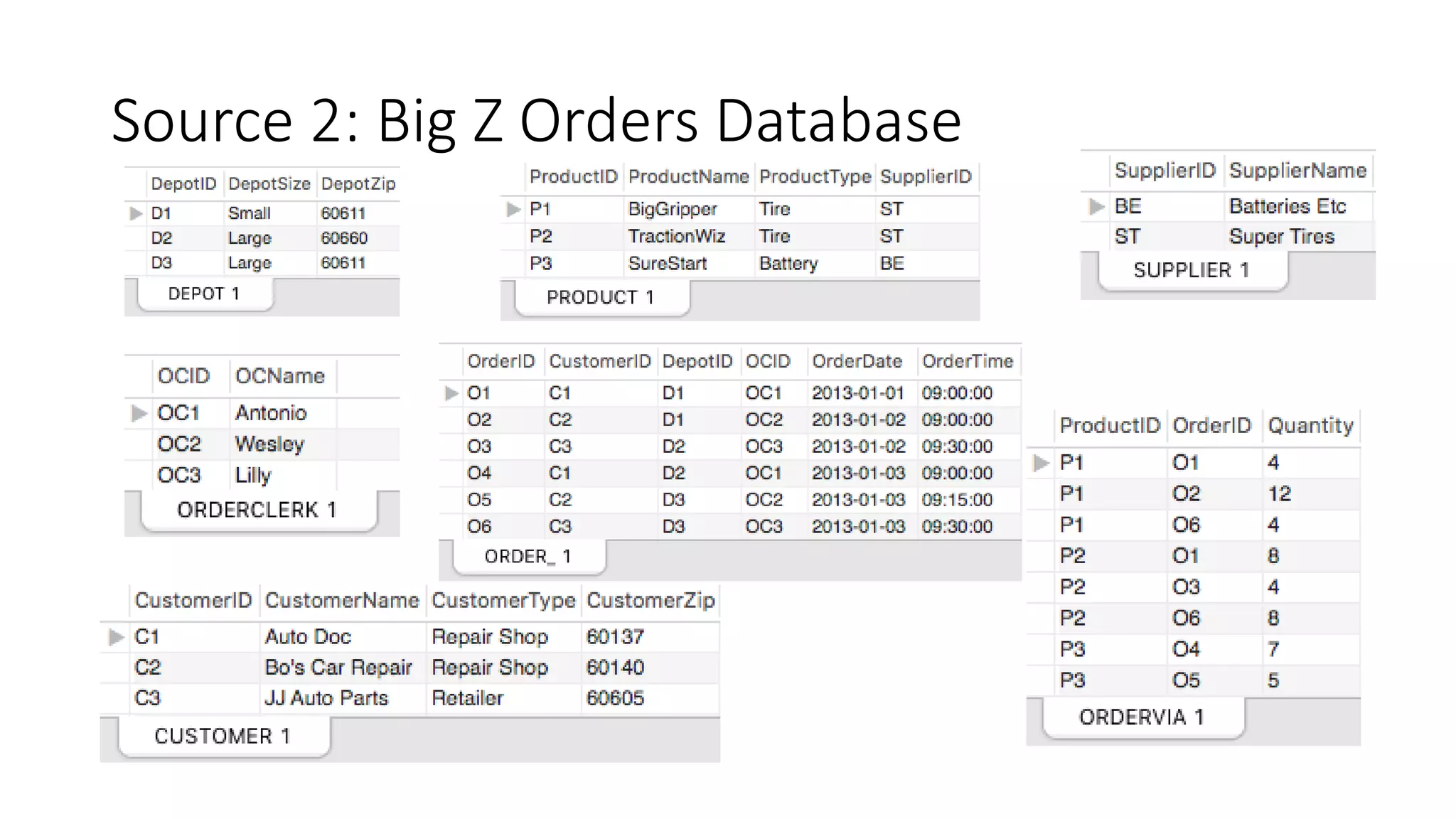
Source 2: Big Z Orders database
E8.3 Dimensional Warehouse
The data warehouse has to enable an analysis of order quantities by:
• date, including: full date, day of week, day of month, month, quarter, year
• time
• product, including product ID, product name, product type, product supplier
name
• customer, including: customer ID, customer name, customer type, customer zip
• depot, including depot ID, depot size, depot zip
• order clerk, including: order clerk id, order clerk name, order clerk title, order
clerk education level, order clerk year of hire
Based on the sources and requirements listed above, create a dimensional model
that will be used for the dimensionally modeled data warehouse for Big Z Inc.
Big Z Order Quantities Dimensional DW model
(star schema)
Big Z Orders Quantities Normalized schema
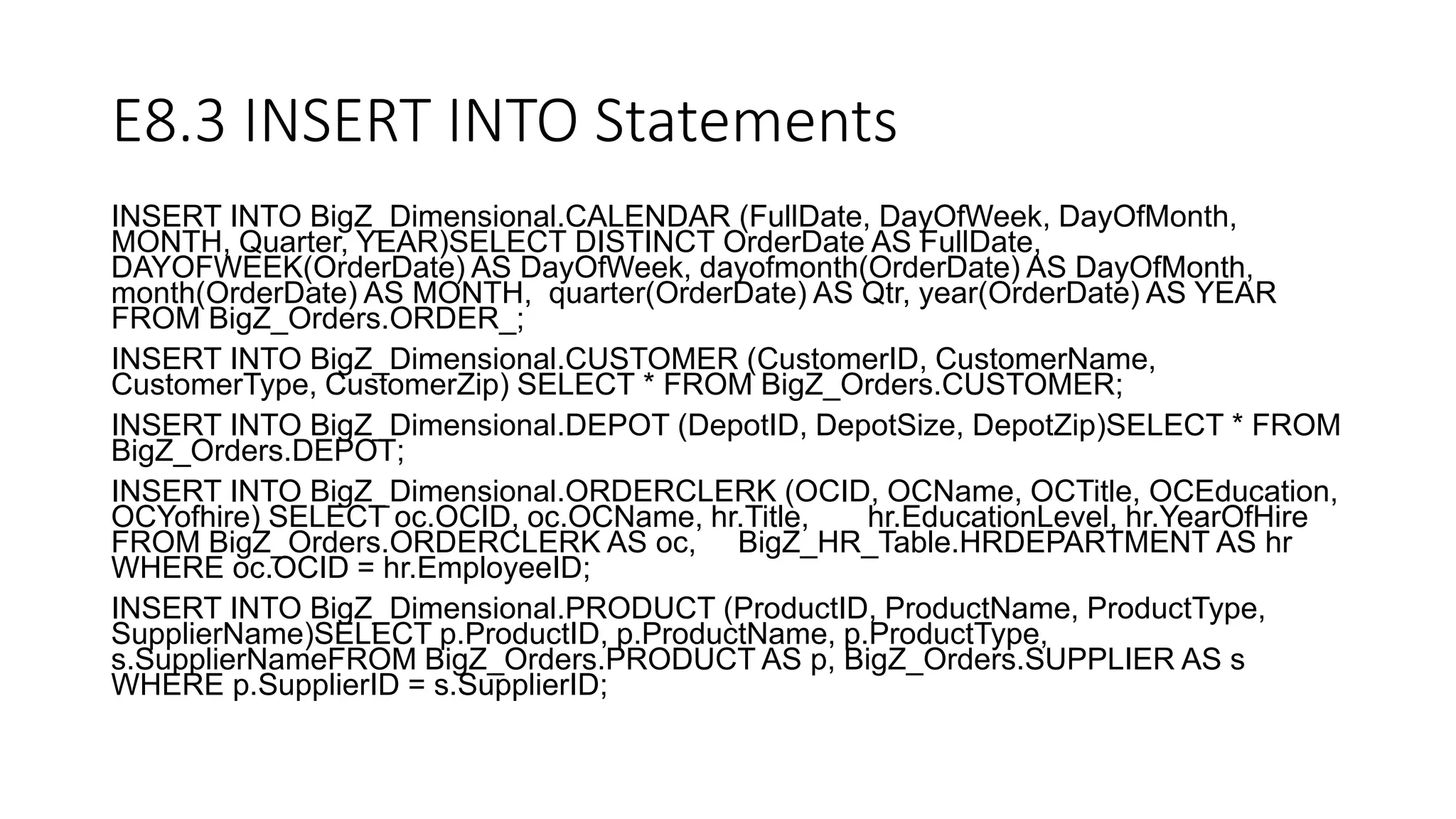
E8.3 INSERT INTO Statements
INSERT INTO BigZ_Dimensional.CALENDAR (FullDate, DayOfWeek, DayOfMonth,
MONTH, Quarter, YEAR)SELECT DISTINCT OrderDate AS FullDate,
DAYOFWEEK(OrderDate) AS DayOfWeek, dayofmonth(OrderDate) AS DayOfMonth,
month(OrderDate) AS MONTH, quarter(OrderDate) AS Qtr, year(OrderDate) AS YEAR
FROM BigZ_Orders.ORDER_;
INSERT INTO BigZ_Dimensional.CUSTOMER (CustomerID, CustomerName,
CustomerType, CustomerZip) SELECT * FROM BigZ_Orders.CUSTOMER;
INSERT INTO BigZ_Dimensional.DEPOT (DepotID, DepotSize, DepotZip)SELECT * FROM
BigZ_Orders.DEPOT;
INSERT INTO BigZ_Dimensional.ORDERCLERK (OCID, OCName, OCTitle, OCEducation,
OCYofhire) SELECT oc.OCID, oc.OCName, hr.Title, hr.EducationLevel, hr.YearOfHire
FROM BigZ_Orders.ORDERCLERK AS oc, BigZ_HR_Table.HRDEPARTMENT AS hr
WHERE oc.OCID = hr.EmployeeID;
INSERT INTO BigZ_Dimensional.PRODUCT (ProductID, ProductName, ProductType,
SupplierName)SELECT p.ProductID, p.ProductName, p.ProductType,
s.SupplierNameFROM BigZ_Orders.PRODUCT AS p, BigZ_Orders.SUPPLIER AS s
WHERE p.SupplierID = s.SupplierID;
INSERT INTO BigZ_Dimensional.ORDER_QUANTITY_FACT (CalendarKey, CustomerKey, DepotKey,
OrderClerkKey, ProductKey, OrderID, TIME, Quantity) SELECT C.CalendarKey, CU.CustomerKey,
D.DepotKey, OC.OCKey, P.ProductKey, OV.OrderID, O.OrderTime, sum(OV.Quantity) FROM
BigZ_Dimensional.CALENDAR AS C, BigZ_Dimensional.CUSTOMER AS CU,
BigZ_Dimensional.Depot AS D, BigZ_Dimensional.ORDERCLERK AS OC,
BigZ_Dimensional.PRODUCT AS P, BigZ_Orders.ORDER_ AS O, BigZ_Orders.ORDERVIA AS OV
WHERE O.OrderDate = C.FullDate AND O.CustomerID = CU.CustomerID AND O.DepotID =
D.DepotID AND O.OCID = OC.OCID AND OV.ProductID = P.ProductID AND OV.OrderID =
O.OrderIDGROUP BY OV.OrderID, OV.ProductID;
INSERT INTO BigZ_Normalized.ORDERCLERK (OCID, OCName, Title, EducationLevel, YearOfHire)
SELECT HR.EmployeeID as OCID, HR.Name as OCName, HR.Title, HR.EducationLevel,
HR.YearOfHire FROM BigZ_HR_Table.HRDEPARTMENT HR, BigZ_Orders.ORDERCLERK OC
WHERE HR.EmployeeID = OC.OCID;
INSERT INTO BigZ_Normalized.CUSTOMER SELECT *FROM BigZ_Orders.CUSTOMER;
INSERT INTO BigZ_Normalized.DEPOT SELECT *FROM BigZ_Orders.DEPOT;
INSERT INTO BigZ_Normalized.PRODUCT SELECT p.ProductID, p.ProductName, p.ProductType,
s.SupplierName FROM BigZ_Orders.PRODUCT AS p, BigZ_Orders.SUPPLIER AS s WHERE
p.SupplierID = s.SupplierID;
INSERT INTO BigZ_Normalized.ORDER_SELECT * FROM BigZ_Orders.ORDER_;
INSERT INTO BigZ_Normalized.ORDERVIA SELECT * FROM BigZ_Orders.ORDERVIA;
Source 1: HR Department table
Source 2: Big Z Orders Database
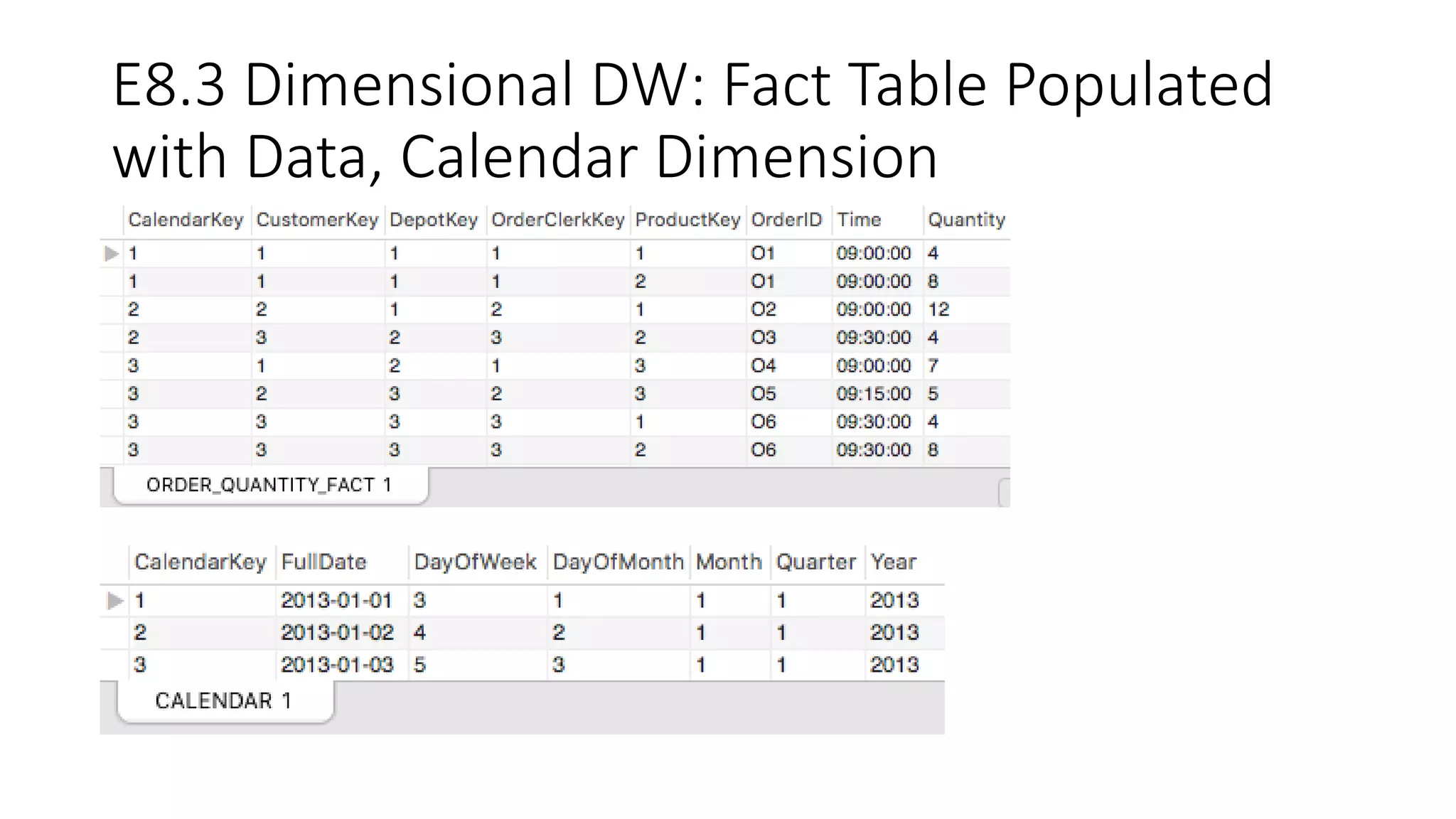
E8.3 Dimensional DW: Fact Table populated
with data, Calendar dimension
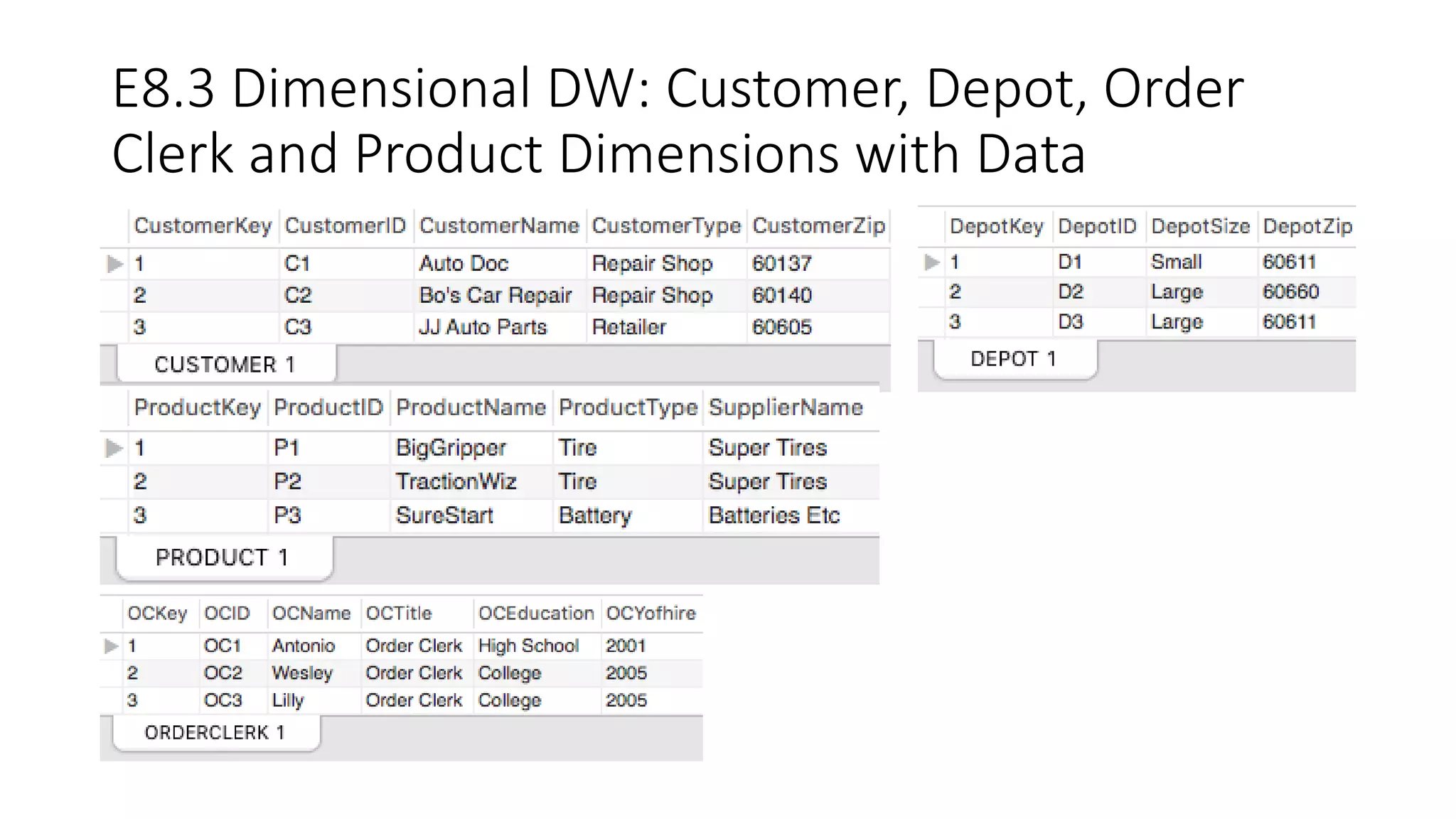
E8.3 Dimensional DW: Customer, Depot, Order
Clerk and Product dimensions with data
References:
Jukic N., Vrbsky S., Nestorov S. “Database Systems. Introduction to
Databases and Data Warehouses”. Pearson Education Inc., 2014.

Data Warehouse Project

  • 1.
    Database Systems Introduction toDatabases and Data Warehouses (Solutions to end-of-chapter exercises E8.1, E8.2, E8.3)
  • 2.
    E8.1 ZAGI RetailCompany Consider the following, slightly modified, ZAGI Retail Company scenario. The ZAGI Retail Company wants to create analytical database to analyze sales. The three available data sources are: • Source 1 The ZAGI Retail Company Sales Department Database, as shown below) • Source 2 The ZAGI Retail Company Facilities Department Database shown below • Source 3 A Customer Demographic Data external table shown below.
  • 3.
    Source 1: ZAGISales Department
  • 4.
    Source 2: ZAGIFacilities Department
  • 5.
    Source 3: CustomerDemographic external table
  • 6.
    E8.1 ZAGI RetailCompany data warehouse The data warehouse has to enable an analysis of sales dollar amounts and quantities by • date, including: full date, day of week, day of month, month quarter, year • time • product, including: product name and price, product category, product vendor • customer, including: customer name, zip, gender, marital status, education level, credit score • store, including: individual store, store size and store zip, store checkout system, store layout, store region.
  • 7.
    ZAGI Sales DimensionalDW model (star schema)
  • 8.
    INSERT INTO Statements INSERTINTO ZAGI_Dimensional.CALENDAR_D (FullDate, DayOfWeek, DayOfMonth, Month, Qtr, Year ) SELECT DISTINCT TDate as FullDate, DAYOFWEEK(tdate) AS DayOfWeek, dayofmonth(tdate) AS DayOfMonth, month(tdate) AS Month, quarter(tdate) AS Qtr, year(tdate) AS Year FROM SALESTRANSACTION; INSERT INTO ZAGI_Dimensional.PRODUCT_D (ProductID, ProductName, ProductPrice, ProductVendorName, ProductCategoryName ) SELECT p.ProductID as ProductID, p.ProductName, p.ProductPrice, v.VendorName AS ProductVendorName, c.CategoryName AS ProductCategoryName FROM PRODUCT p, VENDOR v, CATEGORY c WHERE p.VendorID = v.VendorID AND p.CategoryID = c.CategoryID GROUP BY p.ProductID; INSERT INTO ZAGI_Dimensional.STORE_D (StoreID, StoreZip, StoreRegionName, StoreSize, StoreCSystem, StoreLayout ) SELECT s.StoreID as StoreId, s.StoreZip AS StoreZip, r.RegionName AS StoreRegionName, s1.StoreSize AS StoreSize, cs.CSystem AS StoreCSystem, l.Layout AS StoreLayout FROM ZAGI_Sales_Dep.STORE s, ZAGI_Sales_Dep.REGION r, ZAGI_Facilities_Dep.STORE1 s1, ZAGI_Facilities_Dep.CHECKOUTSYSTEM cs, ZAGI_Facilities_Dep.LAYOUT l WHERE r.RegionID = s.RegionID AND s.StoreID=s1.StoreID AND s1.CSID = cs.CSID AND s1.LTID = l.LayoutID GROUP BY s.StoreID;
  • 9.
    INSERT INTO ZAGI_Dimensional.CUSTOMER_D(CustomerID,CustomerName, CustomerZip, CustomerGender, CustomerMaritalStatus, CustomerEducationLevel, CustomerCreditScore )SELECT t1.customerid as CustomerId, t1.customername AS CustomerName, t1.customerzip AS CustomerZip, t2.gender AS CustomerGender, t2.maritalstatus AS CustomerMaritalStatus, t2.educationlevel AS CustomerEducationLevel, t2.creditscore AS CustomerCreditScore FROM ZAGI_Sales_Dep.CUSTOMER AS t1, ZAGI_Customer_Table.CUSTOMER_TABLE AS t2 WHERE t1.CustomerID = t2.CustomerID; CREATE VIEW `SALES_FACT_VIEW` AS SELECT st.TDate, st.StoreID, sv.ProductID, st.CustomerID, sv.TID AS TID, st.TTime AS TimeOfDay, p.ProductPrice*sv.NoOfItems AS DollarsSold, sv.NoOfItems AS UnitsSold FROM ZAGI_Sales_Dep.SOLDVIA AS sv, ZAGI_Sales_Dep.PRODUCT AS p, ZAGI_Sales_Dep.SALESTRANSACTION AS st WHERE sv.ProductID = p.ProductID AND sv.TID = st.TID; INSERT INTO ZAGI_Dimensional.SALES_FACT (CalendarKey, StoreKey, ProductKey, CustomerKey, TID, TimeOfDay, DollarsSold, UnitsSold ) SELECT CA.CalendarKey, S.StoreKey, P.ProductKey, CU.CustomerKey, SFV.TID, SFV.TimeOfDay, SFV.DollarsSold, SFV.UnitsSold FROM ZAGI_Sales_Dep.SALES_FACT_VIEW AS SFV, ZAGI_Dimensional.CALENDAR_D AS CA, ZAGI_Dimensional.PRODUCT_D AS P, ZAGI_Dimensional.STORE_D as S, ZAGI_Dimensional.CUSTOMER_D AS CU WHERE CA.FullDate = SFV.TDate AND S.StoreID = SFV.StoreID AND P.ProductID = SFV.ProductID AND CU.CustomerID = SFV.CustomerID;
  • 10.
    E8.1b, E8.1c AggregatedFact Table A dimensional model above contains an aggregated fact table, which shows a summary of units sold and dollars sold for daily purchases of each product in each store. It is populated as shown below. INSERT INTO ZAGI_Dimensional.AGGREGATED_FACT (CalendarKey, StoreKey, ProductKey, DollarsSold, UnitsSold) SELECT SF.CalendarKey, SF.StoreKey, SF.ProductKey, SUM(DollarsSold), SUM(UnitsSold) FROM ZAGI_Dimensional.SALES_FACT SF GROUP BY CalendarKey, StoreKey, ProductKey;
  • 11.
    Source 1: ZAGISales Department data
  • 12.
    Source 2: ZAGIFacilities Department data
  • 13.
    Source 3: CustomerDemographic data external table
  • 14.
    ZAGI Sales DimensionalDW: fact tables populated with data, Calendar dimension
  • 15.
    ZAGI Sales DimensionalDW: Store, Product and Customer Dimensions Populated with data
  • 16.
    E8.2 City PoliceDepartment Consider the following scenario involving the City Police Department. The City Police Department wants to create an analytical database to analyze its ticket revenue. The two available data sources, Source 1 and Source 2, are described below. • Source 1 The City Police Department maintains the Ticketed Violations Database, shown in Figure below. • Source 2 The Department of Motor Vehicles (DMV) maintains the Vehicle Registration Table, shown in Figure below
  • 17.
    Source 1: CPDTicketed Violations
  • 18.
    Source 1: CPDTicketed Violations
  • 19.
    Source 2: DMVVehicle Registration Table
  • 20.
    E8.2 Ticket RevenueData Warehouse The data warehouse has to enable an analysis of ticket revenues by: • date, including: full date day of week, day of month, month, quarter, year • officer, including: officer ID, officer name, officer rank • payer of the ticket, including: payer DLN, payer name, payer gender, payer birth year • vehicle, including: vehicle LPN, vehicle make, vehicle model, vehicle year, vehicle owner DLN, vehicle owner name, vehicle owner gender, vehicle owner birth year • ticket type, including: ticket category (driving or parking), ticket violation, ticket fee
  • 21.
    Ticket Revenue DimensionalDW model (star schema)
  • 22.
    INSERT INTO statements INSERTINTO CPD_Ticket_Revenue.CALENDAR (FullDate, DayOfWeek, DayOfMonth, Month, Quarter, Year ) SELECT DISTINCT DTDate as FullDate, DAYOFWEEK(DTDate) AS DayOfWeek, dayofmonth(DTDate) AS DayOfMonth, month(DTDate) AS Month, quarter(DTDate) AS Qtr, year(DTDate) AS Year FROM CPD_Ticketed_Violations.DRIVINGTICKET UNION SELECT DISTINCT PTDate as FullDate, DAYOFWEEK(PTDate) AS DayOfWeek, dayofmonth(PTDate) AS DayOfMonth, month(PTDate) AS Month, quarter(PTDate) AS Quarter, year(PTDate) AS Year FROM CPD_Ticketed_Violations.PARKINGTICKET; INSERT INTO CPD_Ticket_Revenue.OFFICER (OfficerID, OfficerName, OfficerRank) SELECT OfficerID, OfficerName, OfficerRank FROM CPD_Ticketed_Violations.OFFICER; INSERT INTO CPD_Ticket_Revenue.TICKETTYPE (TicketCategory, TicketViolation, TicketFee) SELECT * FROM CPD_Ticketed_Violations.DTICKETTYPE UNION SELECT * FROM CPD_Ticketed_Violations.PTICKETTYPE; INSERT INTO CPD_Ticket_Revenue.PAYER (PayerDLN, PayerName, PayerGender, PayerBirthYear)SELECT * FROM CPD_Ticketed_Violations.DRIVER; INSERT INTO CPD_Ticket_Revenue.VEHICLE (VehicleLPN, VehicleMake, VehicleModel, VehicleYear, VehicleOwnerDLN, VehicleOwnerName, VehicleOwnerGender, VehicleOwnerBirthYear) SELECT v1.VehicleLPN, v2.VehicleMake, v2.VehicleModel, v2.VehicleYear, v2.OwnerDLN, v2.OwnerName, v2.OwnerGender, OwnerBirthYear FROM CPD_Ticketed_Violations.VEHICLE AS v1, CPD_Vehicle_Registration_Table.VRT AS v2 WHERE v1.VehicleLPN = v2.VehicleLPN;
  • 23.
    INSERT INTO CPD_Ticket_Revenue.REVENUE_FACT(CalendarKey, OfficerKey, PayerKey, VehicleKey, TicketTypeKey, TicketID, Amount)SELECT C.CalendarKey, O.OfficerKey, P.PayerKey, V.VehicleKey, TT.TicketTypeKey, dt.DTID AS TID, dtt.DTFee AS Amount FROM CPD_Ticketed_Violations.DRIVINGTICKET dt, CPD_Ticketed_Violations.DTICKETTYPE dtt, CPD_Ticket_Revenue.CALENDAR as C, CPD_Ticket_Revenue.PAYER as P, CPD_Ticket_Revenue.VEHICLE as V, CPD_Ticket_Revenue.OFFICER as O, CPD_Ticket_Revenue.TICKETTYPE AS TT WHERE dt.DTTypeID = dtt.DTTypeID and dt.OfficerID = O.OfficerID and dt.DLN = P.PayerDLN and dt.VehicleLPN = V.VehicleLPN and dt.DTTypeID = TT.TicketCategory and C.FullDate = dt.DTDateGROUP BY TID UNION SELECT C.CalendarKey, O.OfficerKey, P.PayerKey, V.VehicleKey, TT.TicketTypeKey, pt.PTID AS TID, ptt.DTFee AS Amount FROM CPD_Ticketed_Violations.PARKINGTICKET pt, CPD_Vehicle_Registration_Table.VRT vr, CPD_Ticketed_Violations.PTICKETTYPE ptt, CPD_Ticket_Revenue.CALENDAR as C, CPD_Ticket_Revenue.PAYER as P, CPD_Ticket_Revenue.VEHICLE as V, CPD_Ticket_Revenue.OFFICER as O, CPD_Ticket_Revenue.TICKETTYPE AS TT WHERE pt.PTTypeID = ptt.PTTypeID and pt.OfficerID = O.OfficerID and vr.OwnerDLN = P.PayerDLN and pt.VehicleLPN = V.VehicleLPN and pt.PTTypeID = TT.TicketCategory and C.FullDate = pt.PTDateGROUP BY TID;
  • 24.
    E8.2b,c Aggregated facttable A dimensional model above contains an aggregated fact table, which shows a summary of daily revenue amount for each officer. It is populated as shown below. INSERT INTO CPD_Ticket_Revenue.REV_OFFICER_BY_DAY (CalendarKey, OfficerKey, Revenue) SELECT CalendarKey, OfficerKey, SUM(Amount) FROM CPD_Ticket_Revenue.REVENUE_FACT GROUP BY CalendarKey, OfficerKey;
  • 25.
    Sources 1: CPDTicketed Violations data
  • 26.
    Source 2: DMVVehicle Registration table
  • 27.
    Ticket Revenue DW:Fact Tables populated with data, Calendar dimension
  • 28.
    Ticket Revenue DW:Payer, Vehicle, Officer and TicketType Dimensions Populated with Data
  • 29.
    E8.3 Big ZInc. Automotive Products Consider the following scenario involving Big Z Inc., an automotive products wholesaler analytical database Big Z Inc. wants to create the (data warehouse) to analyze its order quantities. The two available data sources, Source 1 and Source 2, are described below. The three available data sources are: • Source 1 The Big Z Inc. Human Resources Department Table, shown below. • Source 2 The Big Z Inc. Orders Database, shown in Figure bellow.
  • 30.
    Source 1: HRDepartment table
  • 31.
    Source 2: BigZ Orders database
  • 32.
    E8.3 Dimensional Warehouse Thedata warehouse has to enable an analysis of order quantities by: • date, including: full date, day of week, day of month, month, quarter, year • time • product, including product ID, product name, product type, product supplier name • customer, including: customer ID, customer name, customer type, customer zip • depot, including depot ID, depot size, depot zip • order clerk, including: order clerk id, order clerk name, order clerk title, order clerk education level, order clerk year of hire Based on the sources and requirements listed above, create a dimensional model that will be used for the dimensionally modeled data warehouse for Big Z Inc.
  • 33.
    Big Z OrderQuantities Dimensional DW model (star schema)
  • 34.
    Big Z OrdersQuantities Normalized schema
  • 35.
    E8.3 INSERT INTOStatements INSERT INTO BigZ_Dimensional.CALENDAR (FullDate, DayOfWeek, DayOfMonth, MONTH, Quarter, YEAR)SELECT DISTINCT OrderDate AS FullDate, DAYOFWEEK(OrderDate) AS DayOfWeek, dayofmonth(OrderDate) AS DayOfMonth, month(OrderDate) AS MONTH, quarter(OrderDate) AS Qtr, year(OrderDate) AS YEAR FROM BigZ_Orders.ORDER_; INSERT INTO BigZ_Dimensional.CUSTOMER (CustomerID, CustomerName, CustomerType, CustomerZip) SELECT * FROM BigZ_Orders.CUSTOMER; INSERT INTO BigZ_Dimensional.DEPOT (DepotID, DepotSize, DepotZip)SELECT * FROM BigZ_Orders.DEPOT; INSERT INTO BigZ_Dimensional.ORDERCLERK (OCID, OCName, OCTitle, OCEducation, OCYofhire) SELECT oc.OCID, oc.OCName, hr.Title, hr.EducationLevel, hr.YearOfHire FROM BigZ_Orders.ORDERCLERK AS oc, BigZ_HR_Table.HRDEPARTMENT AS hr WHERE oc.OCID = hr.EmployeeID; INSERT INTO BigZ_Dimensional.PRODUCT (ProductID, ProductName, ProductType, SupplierName)SELECT p.ProductID, p.ProductName, p.ProductType, s.SupplierNameFROM BigZ_Orders.PRODUCT AS p, BigZ_Orders.SUPPLIER AS s WHERE p.SupplierID = s.SupplierID;
  • 36.
    INSERT INTO BigZ_Dimensional.ORDER_QUANTITY_FACT(CalendarKey, CustomerKey, DepotKey, OrderClerkKey, ProductKey, OrderID, TIME, Quantity) SELECT C.CalendarKey, CU.CustomerKey, D.DepotKey, OC.OCKey, P.ProductKey, OV.OrderID, O.OrderTime, sum(OV.Quantity) FROM BigZ_Dimensional.CALENDAR AS C, BigZ_Dimensional.CUSTOMER AS CU, BigZ_Dimensional.Depot AS D, BigZ_Dimensional.ORDERCLERK AS OC, BigZ_Dimensional.PRODUCT AS P, BigZ_Orders.ORDER_ AS O, BigZ_Orders.ORDERVIA AS OV WHERE O.OrderDate = C.FullDate AND O.CustomerID = CU.CustomerID AND O.DepotID = D.DepotID AND O.OCID = OC.OCID AND OV.ProductID = P.ProductID AND OV.OrderID = O.OrderIDGROUP BY OV.OrderID, OV.ProductID; INSERT INTO BigZ_Normalized.ORDERCLERK (OCID, OCName, Title, EducationLevel, YearOfHire) SELECT HR.EmployeeID as OCID, HR.Name as OCName, HR.Title, HR.EducationLevel, HR.YearOfHire FROM BigZ_HR_Table.HRDEPARTMENT HR, BigZ_Orders.ORDERCLERK OC WHERE HR.EmployeeID = OC.OCID; INSERT INTO BigZ_Normalized.CUSTOMER SELECT *FROM BigZ_Orders.CUSTOMER; INSERT INTO BigZ_Normalized.DEPOT SELECT *FROM BigZ_Orders.DEPOT; INSERT INTO BigZ_Normalized.PRODUCT SELECT p.ProductID, p.ProductName, p.ProductType, s.SupplierName FROM BigZ_Orders.PRODUCT AS p, BigZ_Orders.SUPPLIER AS s WHERE p.SupplierID = s.SupplierID; INSERT INTO BigZ_Normalized.ORDER_SELECT * FROM BigZ_Orders.ORDER_; INSERT INTO BigZ_Normalized.ORDERVIA SELECT * FROM BigZ_Orders.ORDERVIA;
  • 37.
    Source 1: HRDepartment table
  • 38.
    Source 2: BigZ Orders Database
  • 39.
    E8.3 Dimensional DW:Fact Table populated with data, Calendar dimension
  • 40.
    E8.3 Dimensional DW:Customer, Depot, Order Clerk and Product dimensions with data
  • 41.
    References: Jukic N., VrbskyS., Nestorov S. “Database Systems. Introduction to Databases and Data Warehouses”. Pearson Education Inc., 2014.