Data Types in C
What is a Data Type?
• A data type is an attribute of a variable that determines the types of
data it can store and the operation that can be performed on it.
• Each programming language provides different data types to support
different types of data and operation.
• C is a strongly typed language which means all variable must have a
data type associated with them
• In C programming language, there are built-in data types that can be
used to define variable, as well as user-defined data types that can be
created using the struct keyword.
Built-in Data Types
• C language provide built-in data types to define variable.
• The following are the built-in data types in C:
Character
Integer
Floating Point
Double
Character
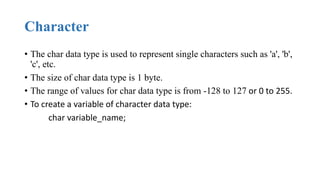
• The char data type is used to represent single characters such as 'a', 'b',
'c', etc.
• The size of char data type is 1 byte.
• The range of values for char data type is from -128 to 127 or 0 to 255.
• To create a variable of character data type:
char variable_name;
Integer
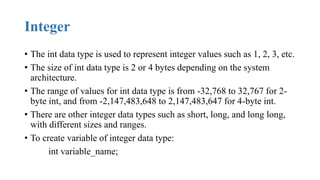
• The int data type is used to represent integer values such as 1, 2, 3, etc.
• The size of int data type is 2 or 4 bytes depending on the system
architecture.
• The range of values for int data type is from -32,768 to 32,767 for 2-
byte int, and from -2,147,483,648 to 2,147,483,647 for 4-byte int.
• There are other integer data types such as short, long, and long long,
with different sizes and ranges.
• To create variable of integer data type:
int variable_name;
Floating Point
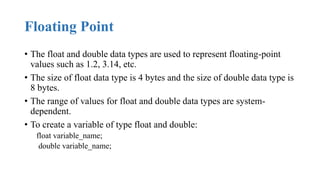
• The float and double data types are used to represent floating-point
values such as 1.2, 3.14, etc.
• The size of float data type is 4 bytes and the size of double data type is
8 bytes.
• The range of values for float and double data types are system-
dependent.
• To create a variable of type float and double:
float variable_name;
double variable_name;
Void Data Type
• The void data type represents the absence of a value.
• It is used to specify that a function returns no value or that a pointer
points to no specific data type.
User Defined Data Type
• C language allows users to define their own data types using the struct
keyword.
• A struct is a collection of variables of different data types.
• A struct can be used to group related variables and make the code
more readable.

Data Types in C language

  • 1.
  • 2.
    What is aData Type? • A data type is an attribute of a variable that determines the types of data it can store and the operation that can be performed on it. • Each programming language provides different data types to support different types of data and operation. • C is a strongly typed language which means all variable must have a data type associated with them • In C programming language, there are built-in data types that can be used to define variable, as well as user-defined data types that can be created using the struct keyword.
  • 3.
    Built-in Data Types •C language provide built-in data types to define variable. • The following are the built-in data types in C: Character Integer Floating Point Double
  • 4.
    Character • The chardata type is used to represent single characters such as 'a', 'b', 'c', etc. • The size of char data type is 1 byte. • The range of values for char data type is from -128 to 127 or 0 to 255. • To create a variable of character data type: char variable_name;
  • 5.
    Integer • The intdata type is used to represent integer values such as 1, 2, 3, etc. • The size of int data type is 2 or 4 bytes depending on the system architecture. • The range of values for int data type is from -32,768 to 32,767 for 2- byte int, and from -2,147,483,648 to 2,147,483,647 for 4-byte int. • There are other integer data types such as short, long, and long long, with different sizes and ranges. • To create variable of integer data type: int variable_name;
  • 6.
    Floating Point • Thefloat and double data types are used to represent floating-point values such as 1.2, 3.14, etc. • The size of float data type is 4 bytes and the size of double data type is 8 bytes. • The range of values for float and double data types are system- dependent. • To create a variable of type float and double: float variable_name; double variable_name;
  • 7.
    Void Data Type •The void data type represents the absence of a value. • It is used to specify that a function returns no value or that a pointer points to no specific data type.
  • 8.
    User Defined DataType • C language allows users to define their own data types using the struct keyword. • A struct is a collection of variables of different data types. • A struct can be used to group related variables and make the code more readable.