Prepared By:
Savani Nirali
Sanghani Monika
Patel Pooja
How and Where C datatypes are
stored in Memory
C Data types:
 Basic Types:
They are arithmetic types and consists of the two
types: (a) integer types and (b) floating-point types.
 Enumerated types:
They are again arithmetic types and they are
used to define variables that can only be assigned
certain discrete integer values throughout the
program.
 The type void:
The type specifier void indicates that no value is
available.
 Derived types:
They include (a) Pointer types, (b) Array types,
(c) Structure types, (d) Union types and (e) Function
Integer Types:
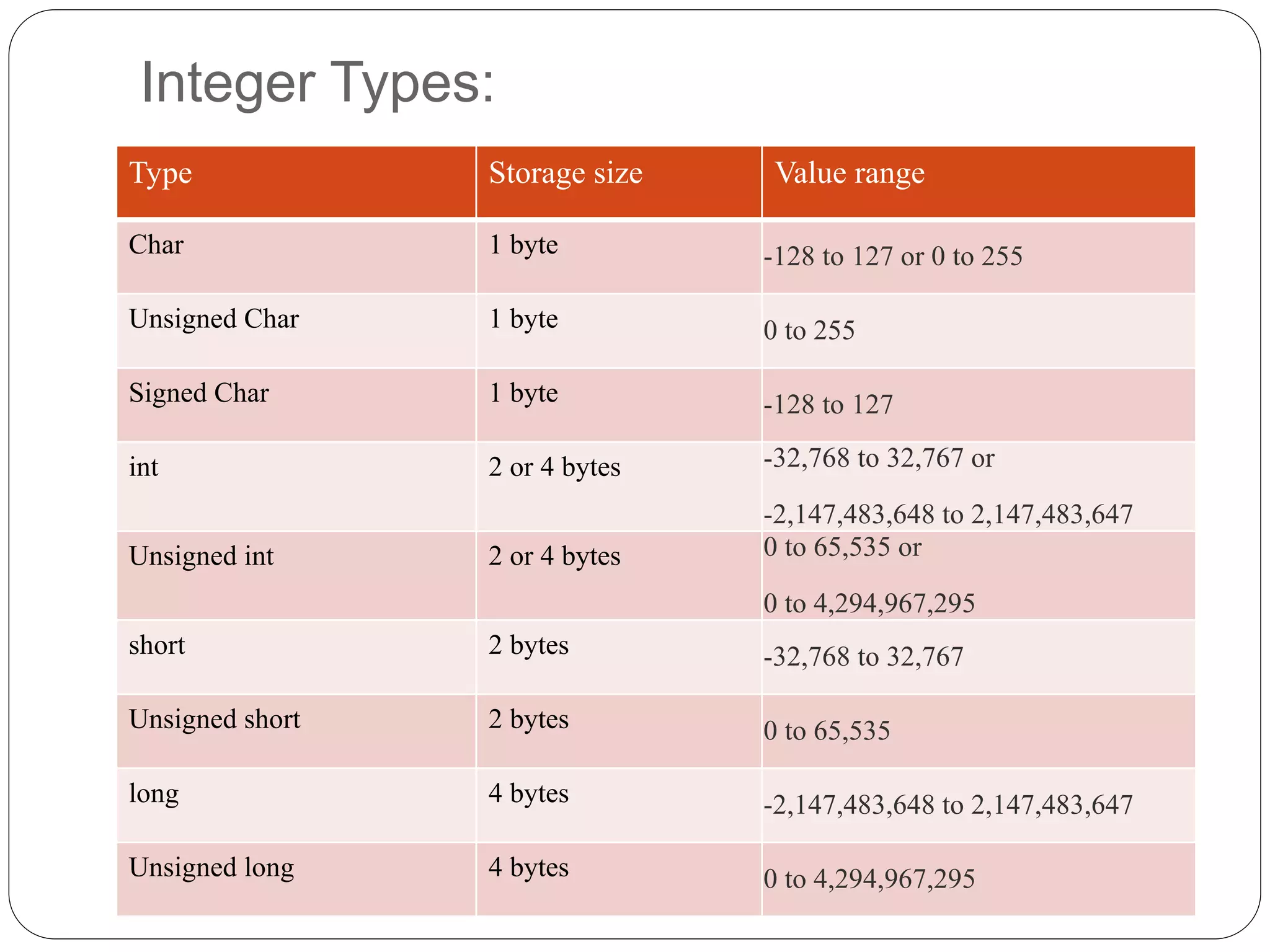
Type Storage size Value range
Char 1 byte -128 to 127 or 0 to 255
Unsigned Char 1 byte 0 to 255
Signed Char 1 byte -128 to 127
int 2 or 4 bytes -32,768 to 32,767 or
-2,147,483,648 to 2,147,483,647
Unsigned int 2 or 4 bytes 0 to 65,535 or
0 to 4,294,967,295
short 2 bytes -32,768 to 32,767
Unsigned short 2 bytes 0 to 65,535
long 4 bytes -2,147,483,648 to 2,147,483,647
Unsigned long 4 bytes 0 to 4,294,967,295
 Memory representation of char data type in C
Char data types may be signed or unsigned. Size of char data
type is 8 bit. Both signed and unsigned have different memory
representation.
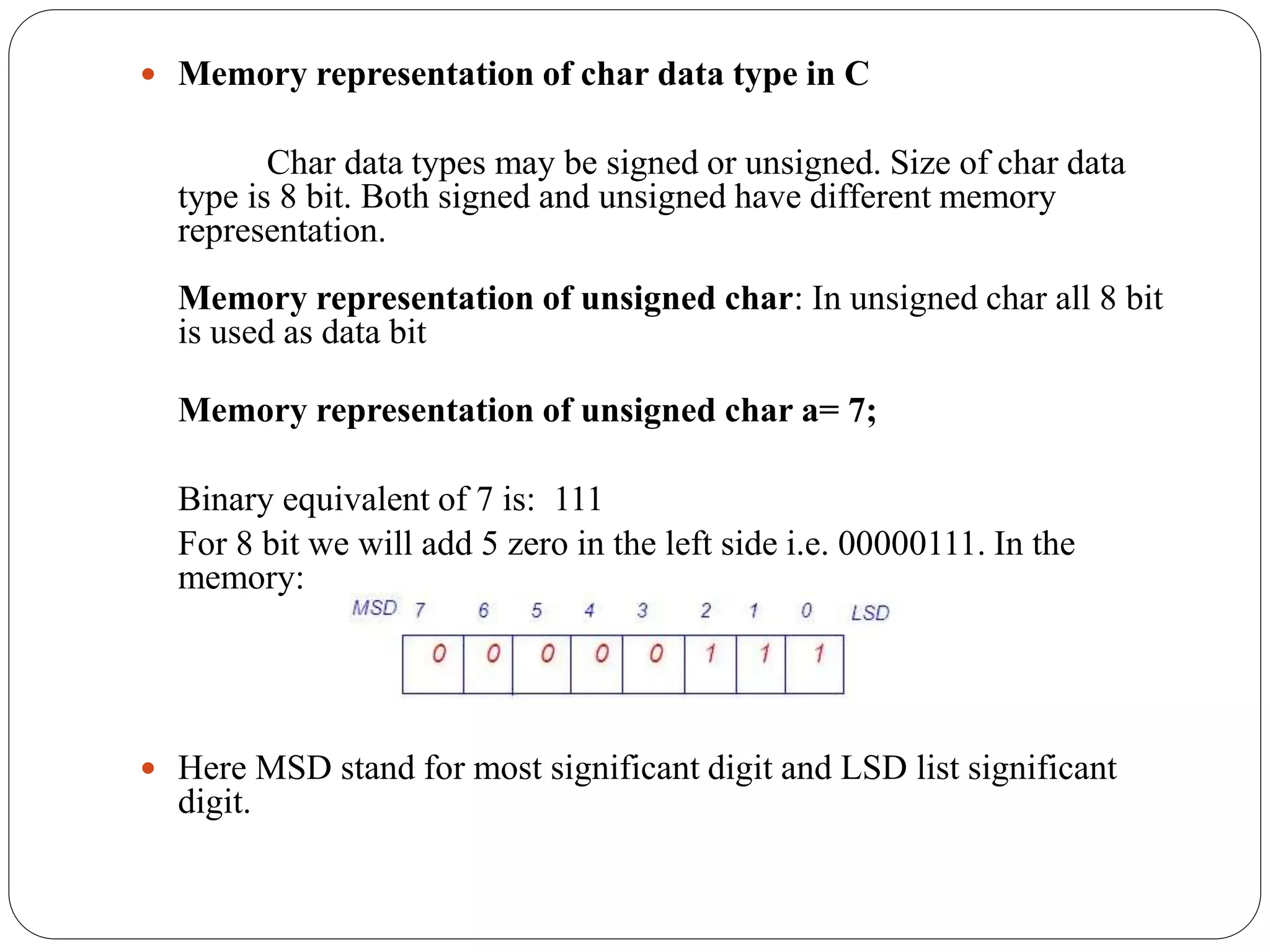
Memory representation of unsigned char: In unsigned char all 8 bit
is used as data bit
Memory representation of unsigned char a= 7;
Binary equivalent of 7 is: 111
For 8 bit we will add 5 zero in the left side i.e. 00000111. In the
memory:
 Here MSD stand for most significant digit and LSD list significant
digit.
 Memory representation of signed char:
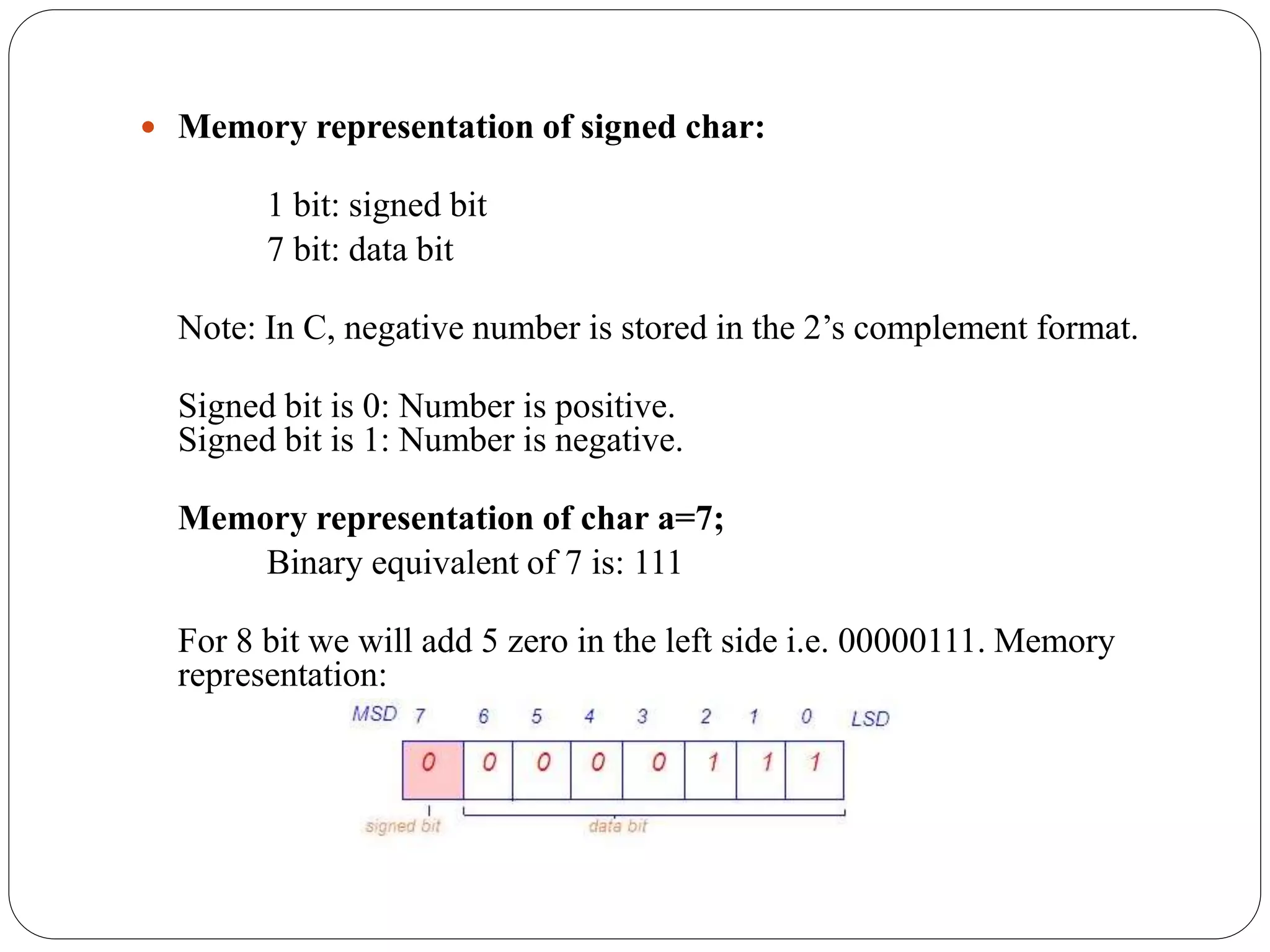
1 bit: signed bit
7 bit: data bit
Note: In C, negative number is stored in the 2’s complement format.
Signed bit is 0: Number is positive.
Signed bit is 1: Number is negative.
Memory representation of char a=7;
Binary equivalent of 7 is: 111
For 8 bit we will add 5 zero in the left side i.e. 00000111. Memory
representation:
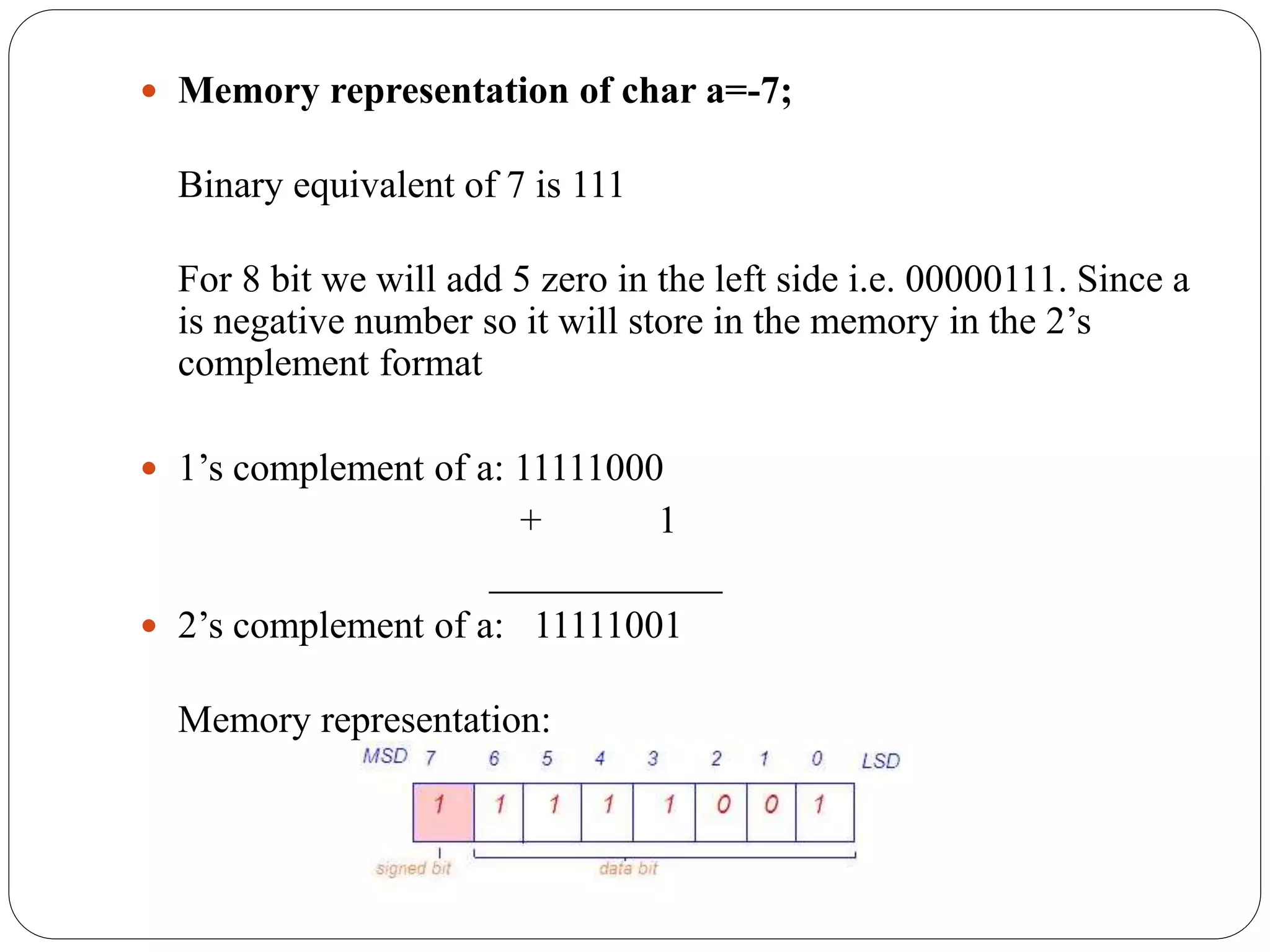
 Memory representation of char a=-7;
Binary equivalent of 7 is 111
For 8 bit we will add 5 zero in the left side i.e. 00000111. Since a
is negative number so it will store in the memory in the 2’s
complement format
 1’s complement of a: 11111000
+ 1
____________
 2’s complement of a: 11111001
Memory representation:
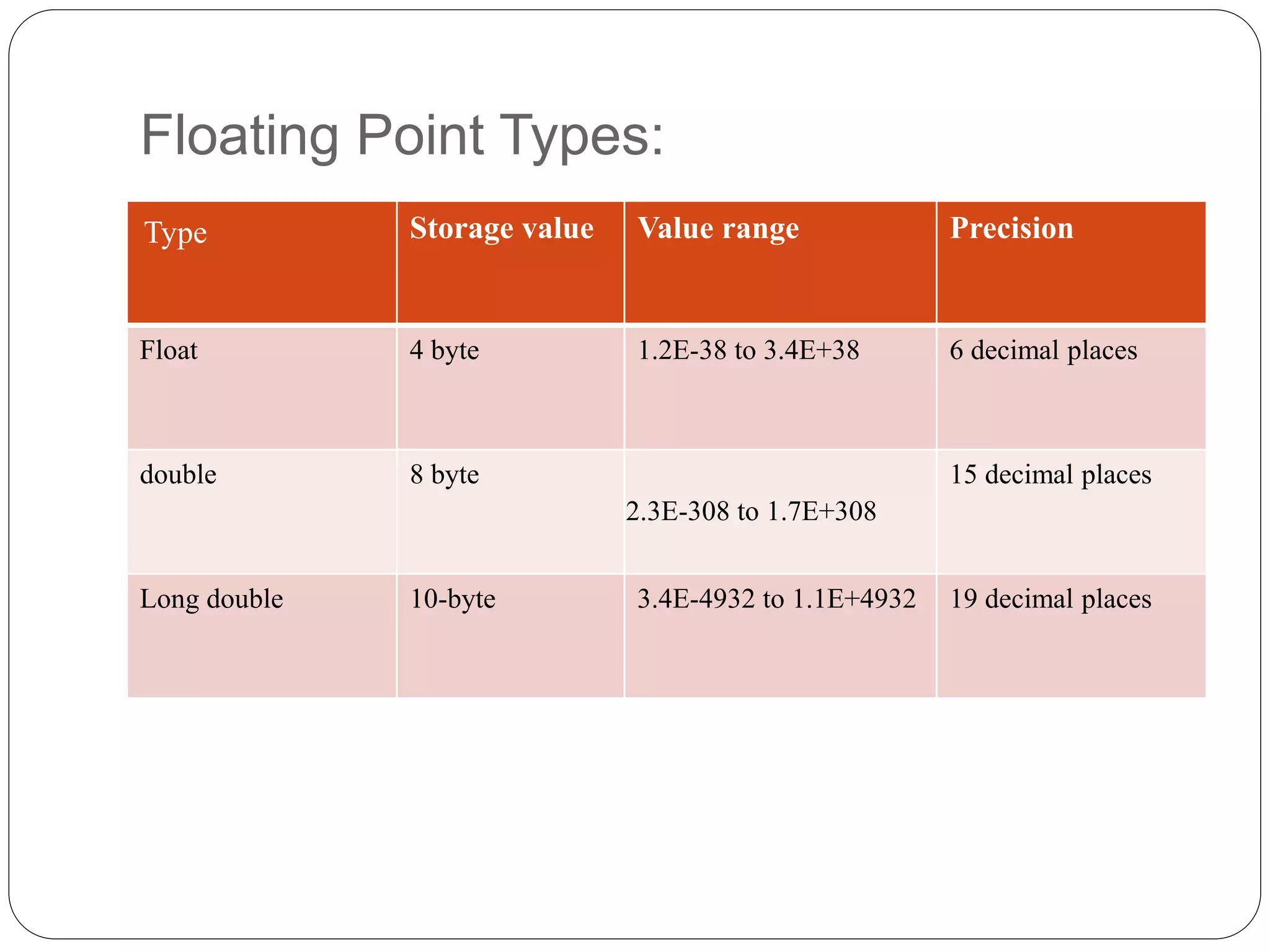
Floating Point Types:
Type Storage value Value range Precision
Float 4 byte 1.2E-38 to 3.4E+38 6 decimal places
double 8 byte
2.3E-308 to 1.7E+308
15 decimal places
Long double 10-byte 3.4E-4932 to 1.1E+4932 19 decimal places
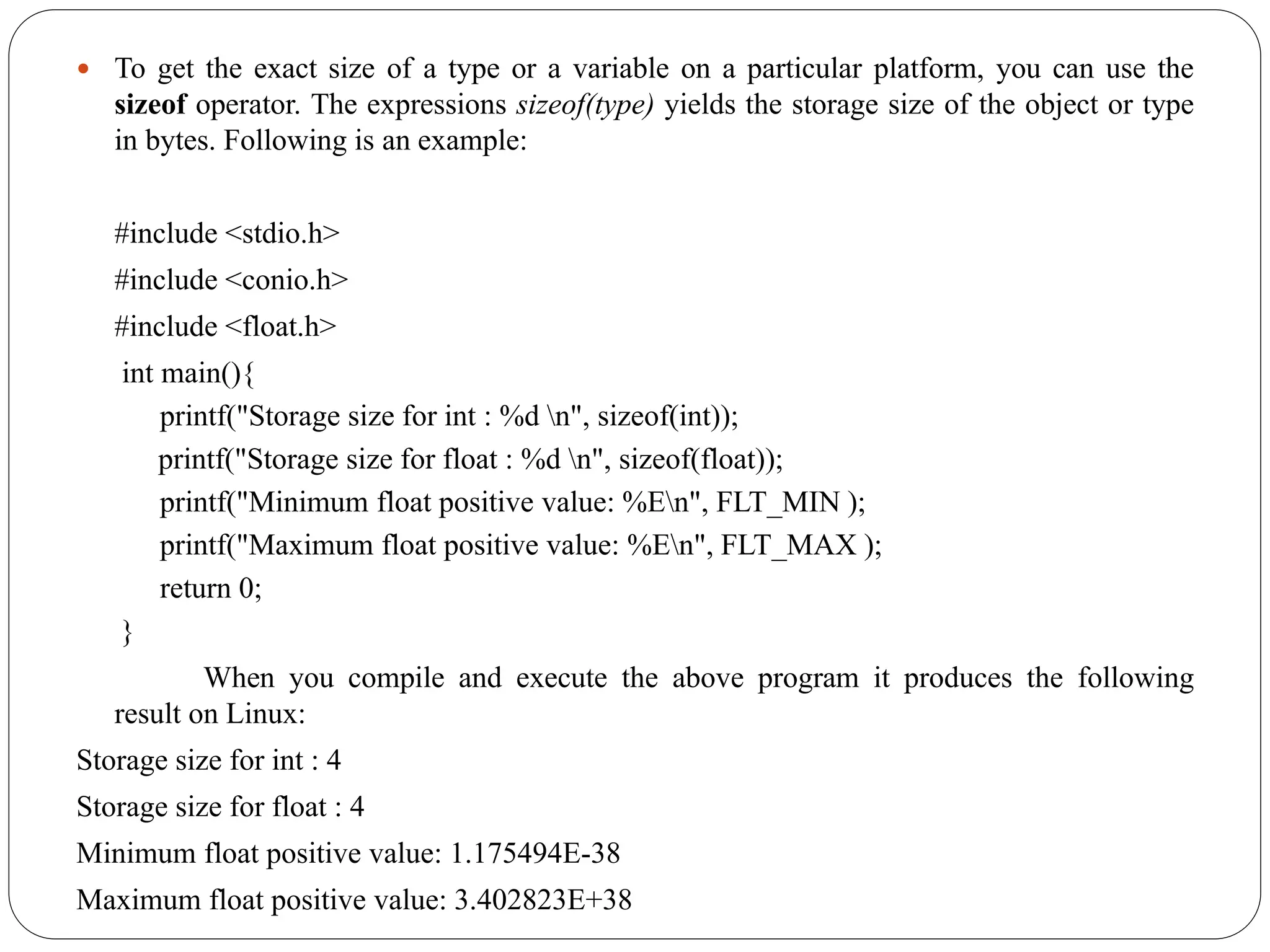
 To get the exact size of a type or a variable on a particular platform, you can use the
sizeof operator. The expressions sizeof(type) yields the storage size of the object or type
in bytes. Following is an example:
#include <stdio.h>
#include <conio.h>
#include <float.h>
int main(){
printf("Storage size for int : %d n", sizeof(int));
printf("Storage size for float : %d n", sizeof(float));
printf("Minimum float positive value: %En", FLT_MIN );
printf("Maximum float positive value: %En", FLT_MAX );
return 0;
}
When you compile and execute the above program it produces the following
result on Linux:
Storage size for int : 4
Storage size for float : 4
Minimum float positive value: 1.175494E-38
Maximum float positive value: 3.402823E+38
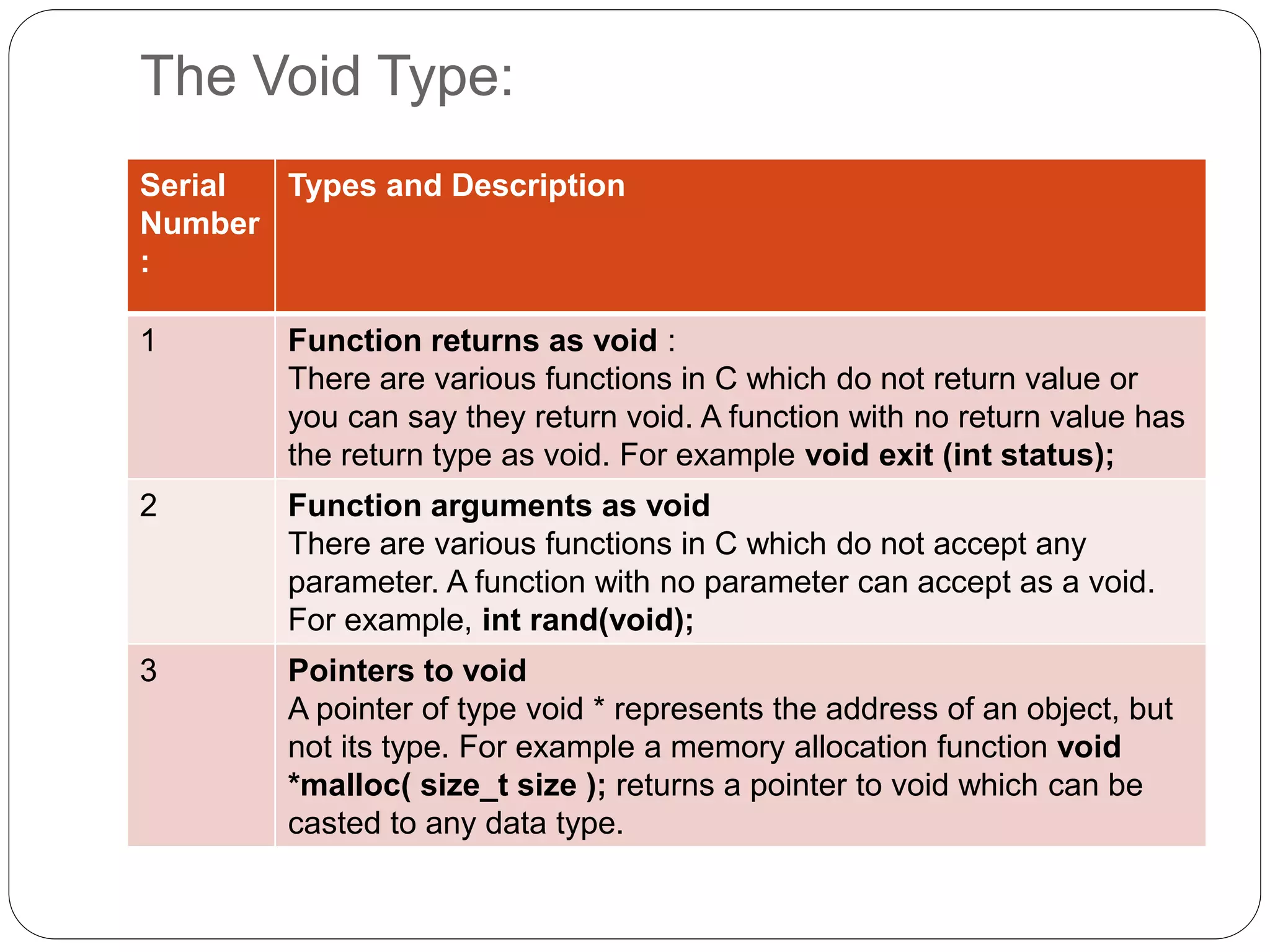
The Void Type:
Serial
Number
:
Types and Description
1 Function returns as void :
There are various functions in C which do not return value or
you can say they return void. A function with no return value has
the return type as void. For example void exit (int status);
2 Function arguments as void
There are various functions in C which do not accept any
parameter. A function with no parameter can accept as a void.
For example, int rand(void);
3 Pointers to void
A pointer of type void * represents the address of an object, but
not its type. For example a memory allocation function void
*malloc( size_t size ); returns a pointer to void which can be
casted to any data type.
Enum [Enumerated] data types:
 Syntax:
enum identifier {value1, value2,.... Value n};
 enum is ” Enumerated Data Type “.
 enum is user defined data type
 In the above example “identifier” is nothing but the user defined data
type .
 Value1,Value2,Value3….. etc creates one set of enum values.
 Using “identifier” we are creating our variables.
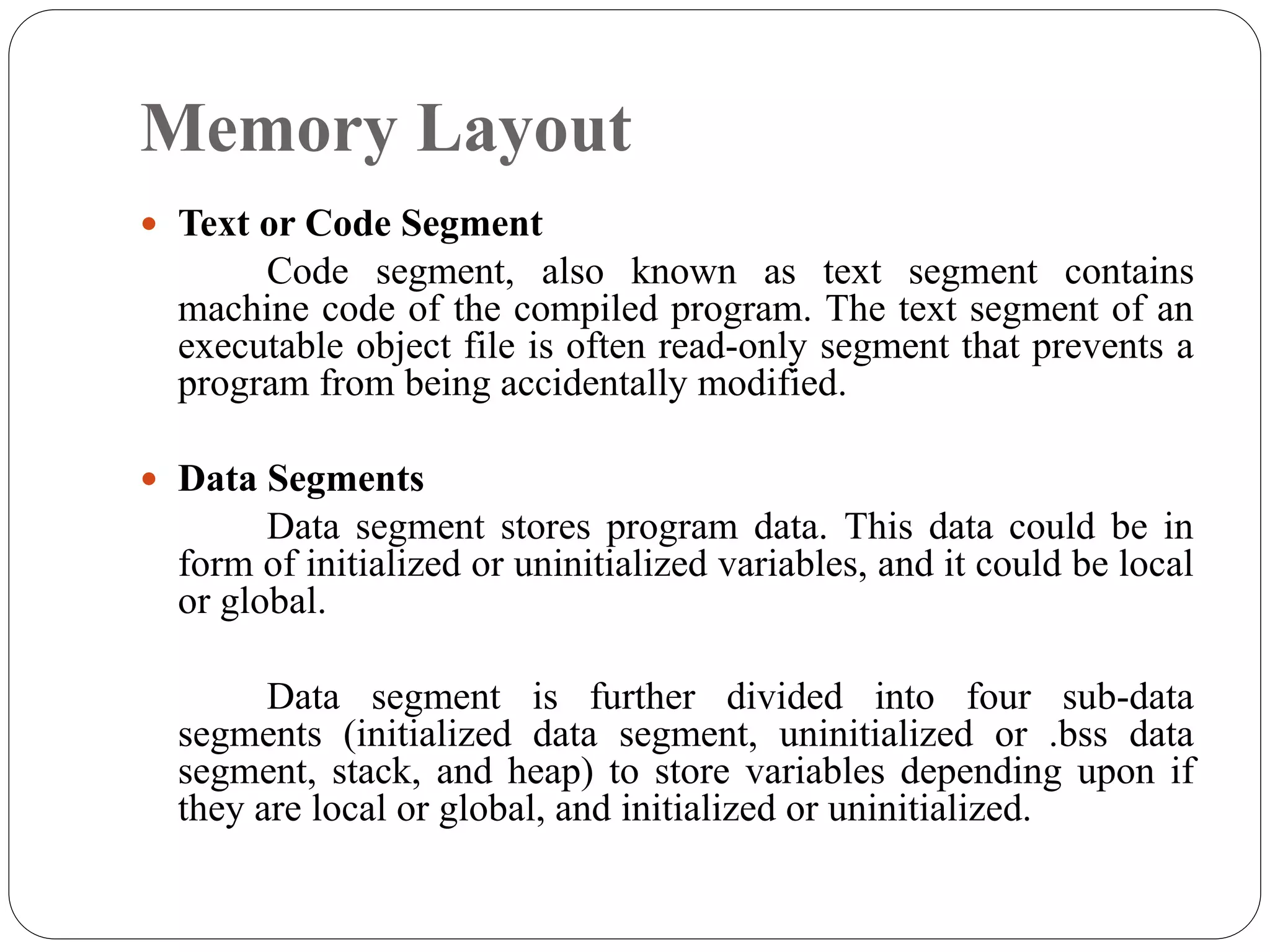
Memory Layout
 Text or Code Segment
Code segment, also known as text segment contains
machine code of the compiled program. The text segment of an
executable object file is often read-only segment that prevents a
program from being accidentally modified.
 Data Segments
Data segment stores program data. This data could be in
form of initialized or uninitialized variables, and it could be local
or global.
Data segment is further divided into four sub-data
segments (initialized data segment, uninitialized or .bss data
segment, stack, and heap) to store variables depending upon if
they are local or global, and initialized or uninitialized.
Memory Layout (Cont.)
 Initialized Data or Data Segment
Initialized data or simply data segment stores all global,
static, constant, and external variables (declared
with extern keyword) that are initialized beforehand.
 Uninitialized Data or .bss Segment
Contrary to initialized data segment, uninitialized
data or .bss segment stores all uninitialized global, static, and
external variables (declared with extern keyword). Global,
external, and static variable are by default initialized to zero.
Object file formats distinguish between initialized and
uninitialized variables for space efficiency; uninitialized
variables do not have to occupy any actual disk space in the
object file.
Memory Layout (Cont.)
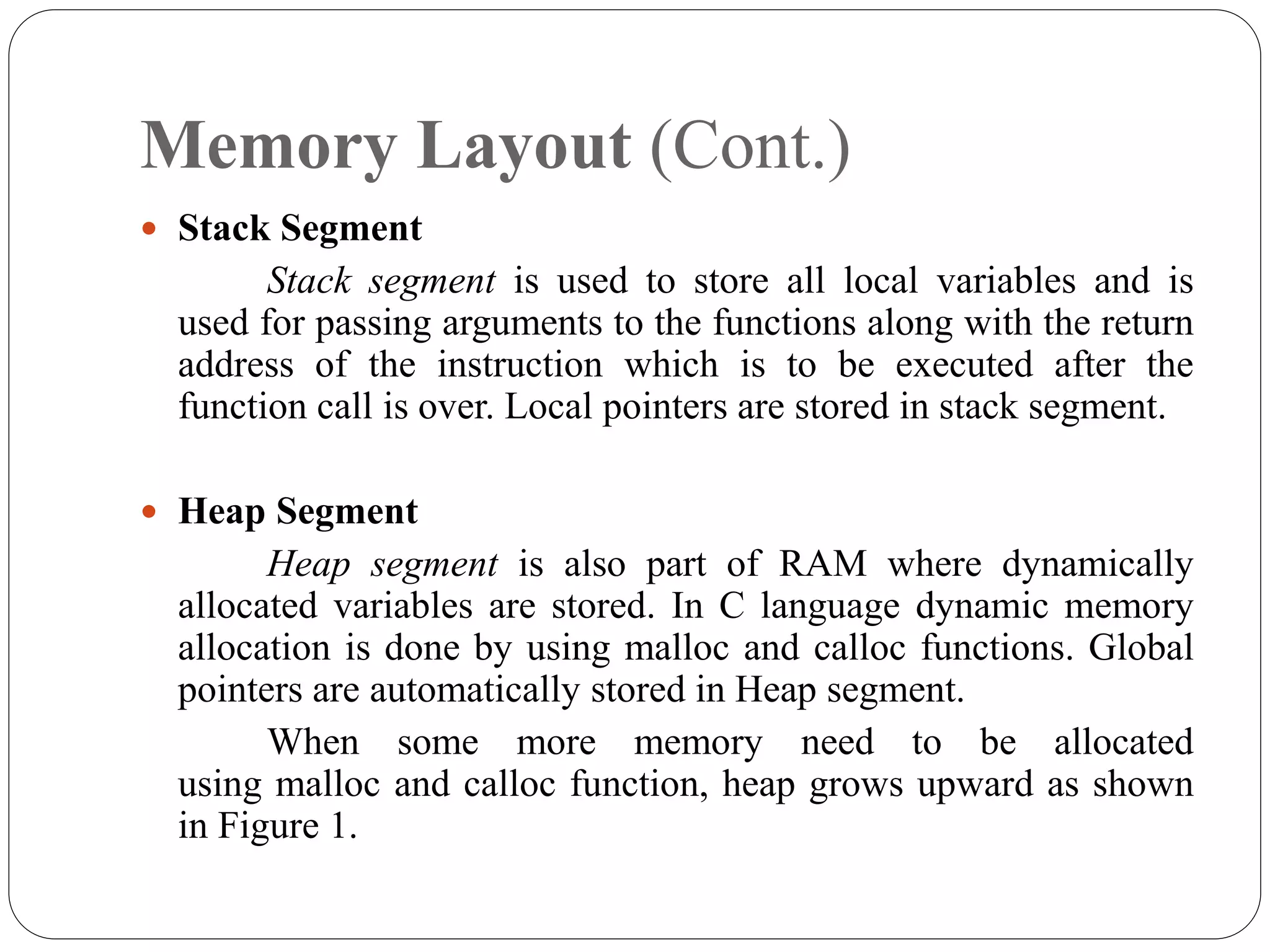
Figure 1 : Memory Layout of C Program
Memory Layout (Cont.)
 Stack Segment
Stack segment is used to store all local variables and is
used for passing arguments to the functions along with the return
address of the instruction which is to be executed after the
function call is over. Local pointers are stored in stack segment.
 Heap Segment
Heap segment is also part of RAM where dynamically
allocated variables are stored. In C language dynamic memory
allocation is done by using malloc and calloc functions. Global
pointers are automatically stored in Heap segment.
When some more memory need to be allocated
using malloc and calloc function, heap grows upward as shown
in Figure 1.
Big and Little Endian
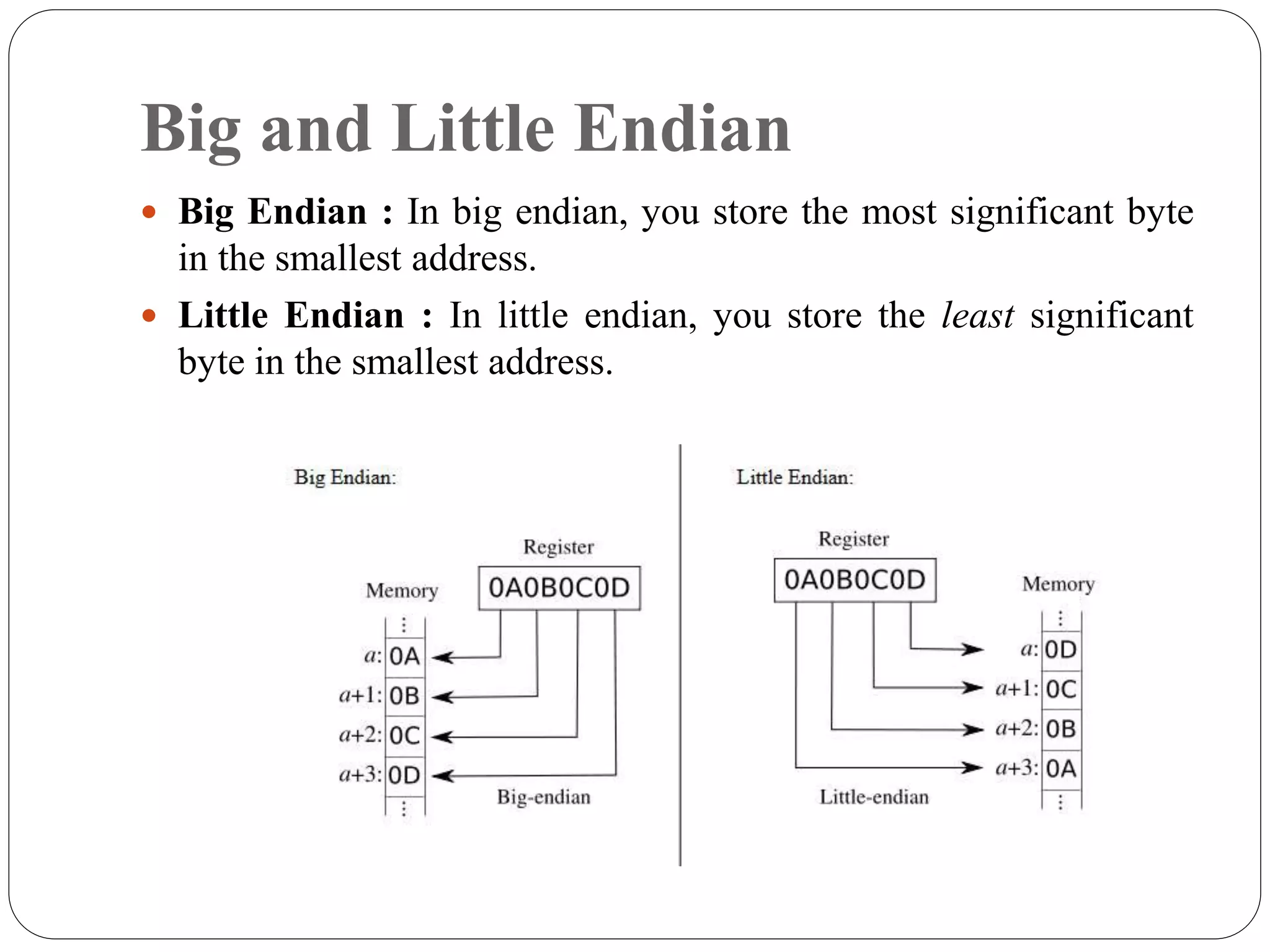
 Big Endian : In big endian, you store the most significant byte
in the smallest address.
 Little Endian : In little endian, you store the least significant
byte in the smallest address.
THANK YOU

Memory management of datatypes

  • 1.
    Prepared By: Savani Nirali SanghaniMonika Patel Pooja How and Where C datatypes are stored in Memory
  • 2.
    C Data types: Basic Types: They are arithmetic types and consists of the two types: (a) integer types and (b) floating-point types.  Enumerated types: They are again arithmetic types and they are used to define variables that can only be assigned certain discrete integer values throughout the program.  The type void: The type specifier void indicates that no value is available.  Derived types: They include (a) Pointer types, (b) Array types, (c) Structure types, (d) Union types and (e) Function
  • 3.
    Integer Types: Type Storagesize Value range Char 1 byte -128 to 127 or 0 to 255 Unsigned Char 1 byte 0 to 255 Signed Char 1 byte -128 to 127 int 2 or 4 bytes -32,768 to 32,767 or -2,147,483,648 to 2,147,483,647 Unsigned int 2 or 4 bytes 0 to 65,535 or 0 to 4,294,967,295 short 2 bytes -32,768 to 32,767 Unsigned short 2 bytes 0 to 65,535 long 4 bytes -2,147,483,648 to 2,147,483,647 Unsigned long 4 bytes 0 to 4,294,967,295
  • 4.
     Memory representationof char data type in C Char data types may be signed or unsigned. Size of char data type is 8 bit. Both signed and unsigned have different memory representation. Memory representation of unsigned char: In unsigned char all 8 bit is used as data bit Memory representation of unsigned char a= 7; Binary equivalent of 7 is: 111 For 8 bit we will add 5 zero in the left side i.e. 00000111. In the memory:  Here MSD stand for most significant digit and LSD list significant digit.
  • 5.
     Memory representationof signed char: 1 bit: signed bit 7 bit: data bit Note: In C, negative number is stored in the 2’s complement format. Signed bit is 0: Number is positive. Signed bit is 1: Number is negative. Memory representation of char a=7; Binary equivalent of 7 is: 111 For 8 bit we will add 5 zero in the left side i.e. 00000111. Memory representation:
  • 6.
     Memory representationof char a=-7; Binary equivalent of 7 is 111 For 8 bit we will add 5 zero in the left side i.e. 00000111. Since a is negative number so it will store in the memory in the 2’s complement format  1’s complement of a: 11111000 + 1 ____________  2’s complement of a: 11111001 Memory representation:
  • 7.
    Floating Point Types: TypeStorage value Value range Precision Float 4 byte 1.2E-38 to 3.4E+38 6 decimal places double 8 byte 2.3E-308 to 1.7E+308 15 decimal places Long double 10-byte 3.4E-4932 to 1.1E+4932 19 decimal places
  • 8.
     To getthe exact size of a type or a variable on a particular platform, you can use the sizeof operator. The expressions sizeof(type) yields the storage size of the object or type in bytes. Following is an example: #include <stdio.h> #include <conio.h> #include <float.h> int main(){ printf("Storage size for int : %d n", sizeof(int)); printf("Storage size for float : %d n", sizeof(float)); printf("Minimum float positive value: %En", FLT_MIN ); printf("Maximum float positive value: %En", FLT_MAX ); return 0; } When you compile and execute the above program it produces the following result on Linux: Storage size for int : 4 Storage size for float : 4 Minimum float positive value: 1.175494E-38 Maximum float positive value: 3.402823E+38
  • 9.
    The Void Type: Serial Number : Typesand Description 1 Function returns as void : There are various functions in C which do not return value or you can say they return void. A function with no return value has the return type as void. For example void exit (int status); 2 Function arguments as void There are various functions in C which do not accept any parameter. A function with no parameter can accept as a void. For example, int rand(void); 3 Pointers to void A pointer of type void * represents the address of an object, but not its type. For example a memory allocation function void *malloc( size_t size ); returns a pointer to void which can be casted to any data type.
  • 10.
    Enum [Enumerated] datatypes:  Syntax: enum identifier {value1, value2,.... Value n};  enum is ” Enumerated Data Type “.  enum is user defined data type  In the above example “identifier” is nothing but the user defined data type .  Value1,Value2,Value3….. etc creates one set of enum values.  Using “identifier” we are creating our variables.
  • 11.
    Memory Layout  Textor Code Segment Code segment, also known as text segment contains machine code of the compiled program. The text segment of an executable object file is often read-only segment that prevents a program from being accidentally modified.  Data Segments Data segment stores program data. This data could be in form of initialized or uninitialized variables, and it could be local or global. Data segment is further divided into four sub-data segments (initialized data segment, uninitialized or .bss data segment, stack, and heap) to store variables depending upon if they are local or global, and initialized or uninitialized.
  • 12.
    Memory Layout (Cont.) Initialized Data or Data Segment Initialized data or simply data segment stores all global, static, constant, and external variables (declared with extern keyword) that are initialized beforehand.  Uninitialized Data or .bss Segment Contrary to initialized data segment, uninitialized data or .bss segment stores all uninitialized global, static, and external variables (declared with extern keyword). Global, external, and static variable are by default initialized to zero. Object file formats distinguish between initialized and uninitialized variables for space efficiency; uninitialized variables do not have to occupy any actual disk space in the object file.
  • 13.
    Memory Layout (Cont.) Figure1 : Memory Layout of C Program
  • 14.
    Memory Layout (Cont.) Stack Segment Stack segment is used to store all local variables and is used for passing arguments to the functions along with the return address of the instruction which is to be executed after the function call is over. Local pointers are stored in stack segment.  Heap Segment Heap segment is also part of RAM where dynamically allocated variables are stored. In C language dynamic memory allocation is done by using malloc and calloc functions. Global pointers are automatically stored in Heap segment. When some more memory need to be allocated using malloc and calloc function, heap grows upward as shown in Figure 1.
  • 15.
    Big and LittleEndian  Big Endian : In big endian, you store the most significant byte in the smallest address.  Little Endian : In little endian, you store the least significant byte in the smallest address.
  • 16.