ِ‫ن‬َ‫م‬ْ‫ح‬‫ه‬‫الر‬ ِ ‫ه‬
‫اَّلل‬ ِ‫م‬ْ‫س‬ِ‫ب‬
‫يم‬ ِ‫ح‬‫ه‬‫الر‬
DATA STRUCTURES
& ALGORITHM
LECTURE NO. 4
BY: AZHAR IQBAL
ALGORITHM
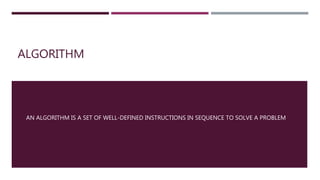
AN ALGORITHM IS A SET OF WELL-DEFINED INSTRUCTIONS IN SEQUENCE TO SOLVE A PROBLEM
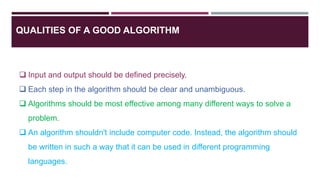
QUALITIES OF A GOOD ALGORITHM
 Input and output should be defined precisely.
 Each step in the algorithm should be clear and unambiguous.
 Algorithms should be most effective among many different ways to solve a
problem.
 An algorithm shouldn't include computer code. Instead, the algorithm should
be written in such a way that it can be used in different programming
languages.
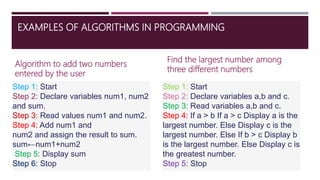
EXAMPLES OF ALGORITHMS IN PROGRAMMING
Algorithm to add two numbers
entered by the user
Find the largest number among
three different numbers
Step 1: Start
Step 2: Declare variables num1, num2
and sum.
Step 3: Read values num1 and num2.
Step 4: Add num1 and
num2 and assign the result to sum.
sum←num1+num2
Step 5: Display sum
Step 6: Stop
Step 1: Start
Step 2: Declare variables a,b and c.
Step 3: Read variables a,b and c.
Step 4: If a > b If a > c Display a is the
largest number. Else Display c is the
largest number. Else If b > c Display b
is the largest number. Else Display c is
the greatest number.
Step 5: Stop
WHY LEARN DATA STRUCTURES AND ALGORITHMS?
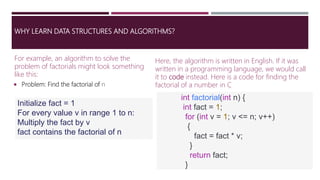
For example, an algorithm to solve the
problem of factorials might look something
like this:
 Problem: Find the factorial of n
Here, the algorithm is written in English. If it was
written in a programming language, we would call
it to code instead. Here is a code for finding the
factorial of a number in C
Initialize fact = 1
For every value v in range 1 to n:
Multiply the fact by v
fact contains the factorial of n
int factorial(int n) {
int fact = 1;
for (int v = 1; v <= n; v++)
{
fact = fact * v;
}
return fact;
}
THANK YOU….
Any Question…?

Data structures Lecture no. 4

  • 1.
    ِ‫ن‬َ‫م‬ْ‫ح‬‫ه‬‫الر‬ ِ ‫ه‬ ‫اَّلل‬ِ‫م‬ْ‫س‬ِ‫ب‬ ‫يم‬ ِ‫ح‬‫ه‬‫الر‬
  • 2.
  • 3.
    ALGORITHM AN ALGORITHM ISA SET OF WELL-DEFINED INSTRUCTIONS IN SEQUENCE TO SOLVE A PROBLEM
  • 4.
    QUALITIES OF AGOOD ALGORITHM  Input and output should be defined precisely.  Each step in the algorithm should be clear and unambiguous.  Algorithms should be most effective among many different ways to solve a problem.  An algorithm shouldn't include computer code. Instead, the algorithm should be written in such a way that it can be used in different programming languages.
  • 5.
    EXAMPLES OF ALGORITHMSIN PROGRAMMING Algorithm to add two numbers entered by the user Find the largest number among three different numbers Step 1: Start Step 2: Declare variables num1, num2 and sum. Step 3: Read values num1 and num2. Step 4: Add num1 and num2 and assign the result to sum. sum←num1+num2 Step 5: Display sum Step 6: Stop Step 1: Start Step 2: Declare variables a,b and c. Step 3: Read variables a,b and c. Step 4: If a > b If a > c Display a is the largest number. Else Display c is the largest number. Else If b > c Display b is the largest number. Else Display c is the greatest number. Step 5: Stop
  • 6.
    WHY LEARN DATASTRUCTURES AND ALGORITHMS? For example, an algorithm to solve the problem of factorials might look something like this:  Problem: Find the factorial of n Here, the algorithm is written in English. If it was written in a programming language, we would call it to code instead. Here is a code for finding the factorial of a number in C Initialize fact = 1 For every value v in range 1 to n: Multiply the fact by v fact contains the factorial of n int factorial(int n) { int fact = 1; for (int v = 1; v <= n; v++) { fact = fact * v; } return fact; }
  • 7.