NADARSARASWATHI COLLEGE OF ARTS
AND SCIENCE
DATA STRUCTURE ALOGIRTHM
TECHNIQUES FOR BINARY TREES
TECHNIQUES FOR GRAPHS
PRESENTED BY:
S.SABTHAMI
I.M.Sc(IT)
Binary Tree Traversal
Traversal is the process of visiting every node
once visiting a node entails doing some processing
at that node, but when describing a traversal
strategy
Binary Tree Traversal
Techniques
 Three recursive techniques for binary
tree traversal
 In each technique, the left subtree is
traversed recursively, the right subtree
is traversed recursively, and the root is
visited
 What distinguishes the techniques from
one another is the order of those 3
tasks
Preoder, Inorder, Postorder
 In Preorder, the root
is visited before (pre)
the subtrees traversals
 In Inorder, the root is
visited in-between left
and right subtree
traversal
 In Preorder, the root
is visited after (pre)
the subtrees traversals
 Preorder Traversal:
1. Visit the root
2. Traverse left subtree
3. Traverse right subtree
 Inorder Traversal:
1. Traverse left subtree
2. Visit the root
3. Traverse right subtree
 Postorder Traversal:
1. Traverse left subtree
2. Traverse right subtree
3. Visit the root
Illustrations for Traversals
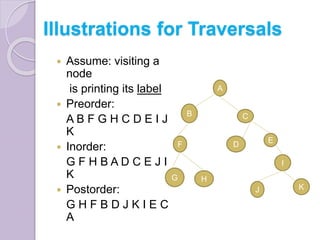
 Assume: visiting a
node
is printing its label
 Preorder:
A B F G H C D E I J
K
 Inorder:
G F H B A D C E J I
K
 Postorder:
G H F B D J K I E C
A
A
B C
D
E
I
J K
F
G H
Code for the Traversal
Techniques
 The code for visitis up to you to provide,
depending
on the application
 A typical example for visit(…) is to print
out the data
part of its input node
ALGORITHM FOR PREORDER
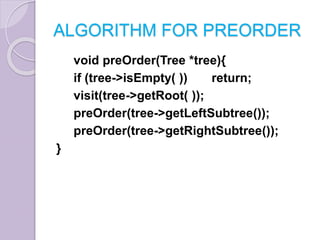
void preOrder(Tree *tree){
if (tree->isEmpty( )) return;
visit(tree->getRoot( ));
preOrder(tree->getLeftSubtree());
preOrder(tree->getRightSubtree());
}
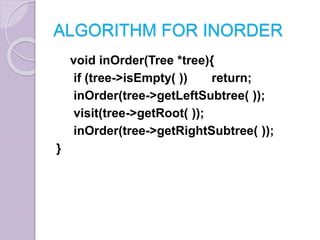
ALGORITHM FOR INORDER
void inOrder(Tree *tree){
if (tree->isEmpty( )) return;
inOrder(tree->getLeftSubtree( ));
visit(tree->getRoot( ));
inOrder(tree->getRightSubtree( ));
}
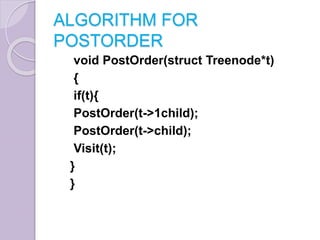
ALGORITHM FOR
POSTORDER
void PostOrder(struct Treenode*t)
{
if(t){
PostOrder(t->1child);
PostOrder(t->child);
Visit(t);
}
}
Graph Traversal
Depth-First Traversal
Breadth-First Traversal
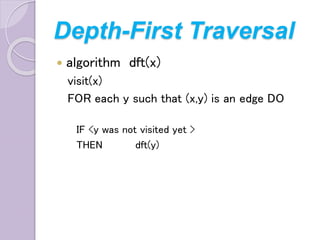
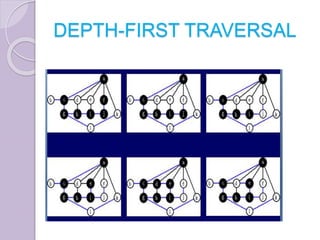
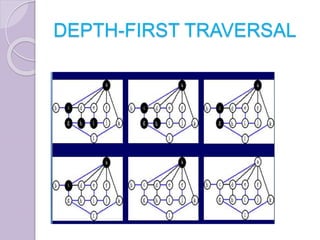
Depth-First Traversal
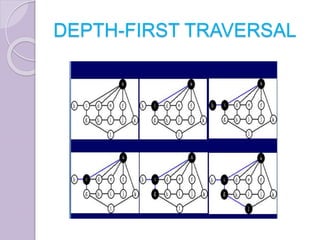
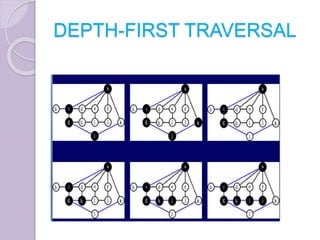
 algorithm dft(x)
visit(x)
FOR each y such that (x,y) is an edge DO
IF <y was not visited yet >
THEN dft(y)
Depth-First Traversal
 A recursive algorithm implicitly
recording a “backtracking” path from
the root to the node currently under
consideration
DEPTH-FIRST TRAVERSAL
• Depth first search is another way
of traversing graphs, which is
closely related to preorder
traversal of a tree.
• the Breath-first search tree is typically
"short and bushy", the DFS tree is
typically "long and stringy".
DEPTH-FIRST TRAVERSAL
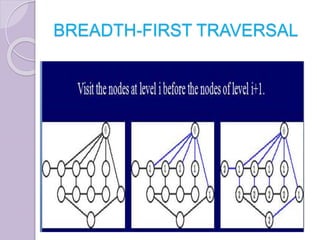
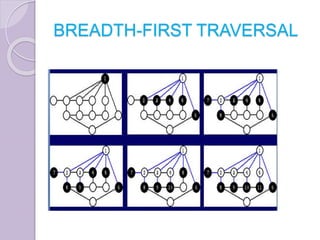
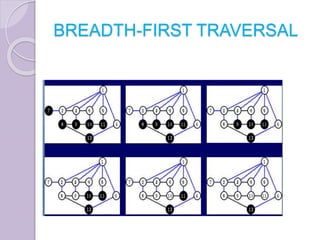
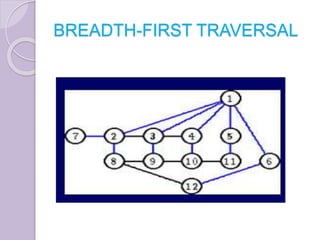
BREADTH-FIRST TRAVERSAL
• Each vertex is clearly
• marked at most once,
• added to the list at most once (since that happens only
when it's marked), and
• removed from the list at most once.
◦ Since the time to process a vertex is proportional to the
length of its adjacency list, the total time for the whole
algorithm is O(m).
• A tree T constructed by the algorithm is called a breadth
first search tree.
• The traversal goes a level at a time, left to right within a
level (where a level is defined simply in terms of distance
from the root of the tree).
BREADTH-FIRST TRAVERSAL
• Every edge of G can be classified into one of three
groups.
• Some edges are in T themselves.
• Some connect two vertices at the same level of T.
• The remaining ones connect two vertices on two
adjacent levels. It is not possible for an edge to skip
a level.
• Breadth-first search tree really is a shortest path tree
starting from its root.
BREADTH-FIRST TRAVERSAL
Relation between BFS and
DFS
 Both of these search algorithms now keep a list
of edges to explore; the only difference
between the two is
 while both algorithms adds items to the end of L,
• BFS removes them from the beginning, which
results in maintaining the list as a queue
• DFS removes them from the end, maintaining
the list as a stack.
BFS and DFS in directed
graphs
 The same search routines work essentially
unmodified for directed graphs.
◦ The only difference is that when exploring a
vertex v, we only want to look at edges (v,w)
going out of v; we ignore the other edges
coming into v.
BFS AND DFS IN DIRECTED
GRAPHS
 For BFS in directed graphs each edge of the
graph either
• connects two vertices at the same level
• goes down exactly one level
• goes up any number of levels.
 For DFS, each edge either connects an ancestor
to
• a descendant
• a descendant to an ancestor
• one node to a node in a previously visited
subtree.
Data structure and algorithm

Data structure and algorithm

  • 1.
    NADARSARASWATHI COLLEGE OFARTS AND SCIENCE DATA STRUCTURE ALOGIRTHM TECHNIQUES FOR BINARY TREES TECHNIQUES FOR GRAPHS PRESENTED BY: S.SABTHAMI I.M.Sc(IT)
  • 2.
    Binary Tree Traversal Traversalis the process of visiting every node once visiting a node entails doing some processing at that node, but when describing a traversal strategy
  • 3.
    Binary Tree Traversal Techniques Three recursive techniques for binary tree traversal  In each technique, the left subtree is traversed recursively, the right subtree is traversed recursively, and the root is visited  What distinguishes the techniques from one another is the order of those 3 tasks
  • 4.
    Preoder, Inorder, Postorder In Preorder, the root is visited before (pre) the subtrees traversals  In Inorder, the root is visited in-between left and right subtree traversal  In Preorder, the root is visited after (pre) the subtrees traversals  Preorder Traversal: 1. Visit the root 2. Traverse left subtree 3. Traverse right subtree  Inorder Traversal: 1. Traverse left subtree 2. Visit the root 3. Traverse right subtree  Postorder Traversal: 1. Traverse left subtree 2. Traverse right subtree 3. Visit the root
  • 5.
    Illustrations for Traversals Assume: visiting a node is printing its label  Preorder: A B F G H C D E I J K  Inorder: G F H B A D C E J I K  Postorder: G H F B D J K I E C A A B C D E I J K F G H
  • 6.
    Code for theTraversal Techniques  The code for visitis up to you to provide, depending on the application  A typical example for visit(…) is to print out the data part of its input node
  • 7.
    ALGORITHM FOR PREORDER voidpreOrder(Tree *tree){ if (tree->isEmpty( )) return; visit(tree->getRoot( )); preOrder(tree->getLeftSubtree()); preOrder(tree->getRightSubtree()); }
  • 8.
    ALGORITHM FOR INORDER voidinOrder(Tree *tree){ if (tree->isEmpty( )) return; inOrder(tree->getLeftSubtree( )); visit(tree->getRoot( )); inOrder(tree->getRightSubtree( )); }
  • 9.
    ALGORITHM FOR POSTORDER void PostOrder(structTreenode*t) { if(t){ PostOrder(t->1child); PostOrder(t->child); Visit(t); } }
  • 10.
  • 11.
    Depth-First Traversal  algorithmdft(x) visit(x) FOR each y such that (x,y) is an edge DO IF <y was not visited yet > THEN dft(y)
  • 12.
    Depth-First Traversal  Arecursive algorithm implicitly recording a “backtracking” path from the root to the node currently under consideration
  • 13.
    DEPTH-FIRST TRAVERSAL • Depthfirst search is another way of traversing graphs, which is closely related to preorder traversal of a tree. • the Breath-first search tree is typically "short and bushy", the DFS tree is typically "long and stringy".
  • 14.
  • 15.
  • 16.
  • 17.
  • 18.
    BREADTH-FIRST TRAVERSAL • Eachvertex is clearly • marked at most once, • added to the list at most once (since that happens only when it's marked), and • removed from the list at most once. ◦ Since the time to process a vertex is proportional to the length of its adjacency list, the total time for the whole algorithm is O(m). • A tree T constructed by the algorithm is called a breadth first search tree. • The traversal goes a level at a time, left to right within a level (where a level is defined simply in terms of distance from the root of the tree).
  • 19.
    BREADTH-FIRST TRAVERSAL • Everyedge of G can be classified into one of three groups. • Some edges are in T themselves. • Some connect two vertices at the same level of T. • The remaining ones connect two vertices on two adjacent levels. It is not possible for an edge to skip a level. • Breadth-first search tree really is a shortest path tree starting from its root.
  • 20.
  • 21.
  • 22.
  • 23.
  • 24.
    Relation between BFSand DFS  Both of these search algorithms now keep a list of edges to explore; the only difference between the two is  while both algorithms adds items to the end of L, • BFS removes them from the beginning, which results in maintaining the list as a queue • DFS removes them from the end, maintaining the list as a stack.
  • 25.
    BFS and DFSin directed graphs  The same search routines work essentially unmodified for directed graphs. ◦ The only difference is that when exploring a vertex v, we only want to look at edges (v,w) going out of v; we ignore the other edges coming into v.
  • 26.
    BFS AND DFSIN DIRECTED GRAPHS  For BFS in directed graphs each edge of the graph either • connects two vertices at the same level • goes down exactly one level • goes up any number of levels.  For DFS, each edge either connects an ancestor to • a descendant • a descendant to an ancestor • one node to a node in a previously visited subtree.