DEPARTMENT OF CS &IT
SUN NETWORK FILE SYSTEM
CODA FILE SYSTEM
PRESENTED BY:
S.SABTHAMI
I.MSC(IT)
NADAR SARASWATHI COLLEGE
OF ARTS AND SCIENCE
NFS
 Network File System
 Sun Microsystems, 1980s
 Used widely even today
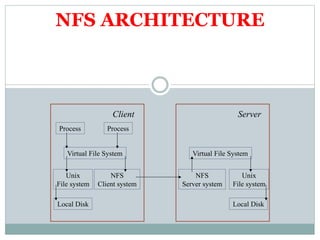
NFS ARCHITECTURE
Process Process
Virtual File System
Unix
File system
NFS
Client system
Local Disk
Client
Virtual File System
Unix
File system
NFS
Server system
Local Disk
Server
NFS CLIENT SYSTEM
Similar to our “Client service” in our Vanilla DFS
Integrated with kernel (OS)
Performs RPCs to NFS Server system for DFS
operations
NFS
 NFS Server system
 Plays the role of both Flat file service + Directory service from
our Vanilla DFS
 Allows mounting of files and directories
 Mount /usr/tesla/inventions into /usr/edison/my_competitors
 => Now, /usr/edison/my_competitors/foo refers to
/usr/tesla/inventions/foo
 Mount: Doesn’t clone (copy) files, just point to that directory
now
NFS
 Allows processes to access files via file
descriptors
 Just like local Unix files! So, local and remote files are
indistinguishable (i.e., gives transparency)
 For a given file access, decides whether to route to
local file system or to NFS client system
NFS
 Names all files (local or remote) uniquely using
“NFS file handles”
 Keeps a data structure for each mounted file
system
 Keeps a data structure called v-node for all open
files
 If local file, v-node points to local disk block
(called i-node)
 If remote, v-node contains address of remote
NFS server
NFS
 Server caching is one of the big reasons NFS
is so fast with reads
 Server Caching = Store, in memory, some of the
recently-accessed blocks (of files and directories)
 Most programs (written by humans) tend to have
locality of access
Blocks accessed recently will be accessed
soon in the future
NFS
 Writes: two flavors
 Delayed write: write in memory, flush to disk
every 30 s (e.g., via Unix sync operation)
Fast but not consistent
 Write-through: Write to disk immediately before
ack-ing client
 Consistent but may be slowTc: the time when the
cache entry was last validated.
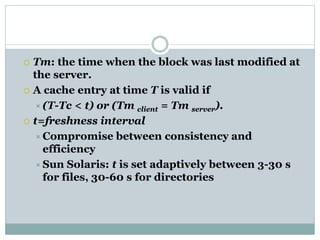
 Tm: the time when the block was last modified at
the server.
 A cache entry at time T is valid if
(T-Tc < t) or (Tm client = Tm server).
 t=freshness interval
Compromise between consistency and
efficiency
Sun Solaris: t is set adaptively between 3-30 s
for files, 30-60 s for directories
AFS
 Designed at CMU
Named after Andrew Carnegie and Andrew
Mellon, the “C” and “M” in CMU
 In use today in some clusters (especially University
clusters)
INSTERESTING DESIGN DECISIONS IN AFS
Two unusual design
principles:
Whole file serving
Not in blocks
Whole file caching
Permanent cache, survives reboots
INSTERESTING DESIGN DECISIONS IN AFS
 Based on (validated) assumptions
that
Most file accesses are by a single user
Most files are small
Even a client cache as “large” as
100MB is supportable (e.g., in RAM)
File reads are much more often that
file writes, and typically sequential
AFS
 Clients system = Venus service
 Server system = Vice service
 Reads and writes are optimistic
 Done on local copy of file at client (Venus)
 When file closed, writes propagated to Vice
 When a client (Venus) opens a file, Vice:
 Sends it entire file
 Gives client a callback promise
AFS
Callback promise
Promise that if another client
modifies then closes the file, a
callback will be sent from Vice to
Venus
Callback state at Venus only binary:
valid or canceled
distributed computing.pptx

distributed computing.pptx

  • 1.
    DEPARTMENT OF CS&IT SUN NETWORK FILE SYSTEM CODA FILE SYSTEM PRESENTED BY: S.SABTHAMI I.MSC(IT) NADAR SARASWATHI COLLEGE OF ARTS AND SCIENCE
  • 2.
    NFS  Network FileSystem  Sun Microsystems, 1980s  Used widely even today
  • 3.
    NFS ARCHITECTURE Process Process VirtualFile System Unix File system NFS Client system Local Disk Client Virtual File System Unix File system NFS Server system Local Disk Server
  • 4.
    NFS CLIENT SYSTEM Similarto our “Client service” in our Vanilla DFS Integrated with kernel (OS) Performs RPCs to NFS Server system for DFS operations
  • 5.
    NFS  NFS Serversystem  Plays the role of both Flat file service + Directory service from our Vanilla DFS  Allows mounting of files and directories  Mount /usr/tesla/inventions into /usr/edison/my_competitors  => Now, /usr/edison/my_competitors/foo refers to /usr/tesla/inventions/foo  Mount: Doesn’t clone (copy) files, just point to that directory now
  • 6.
    NFS  Allows processesto access files via file descriptors  Just like local Unix files! So, local and remote files are indistinguishable (i.e., gives transparency)  For a given file access, decides whether to route to local file system or to NFS client system
  • 7.
    NFS  Names allfiles (local or remote) uniquely using “NFS file handles”  Keeps a data structure for each mounted file system  Keeps a data structure called v-node for all open files  If local file, v-node points to local disk block (called i-node)  If remote, v-node contains address of remote NFS server
  • 8.
    NFS  Server cachingis one of the big reasons NFS is so fast with reads  Server Caching = Store, in memory, some of the recently-accessed blocks (of files and directories)  Most programs (written by humans) tend to have locality of access Blocks accessed recently will be accessed soon in the future
  • 9.
    NFS  Writes: twoflavors  Delayed write: write in memory, flush to disk every 30 s (e.g., via Unix sync operation) Fast but not consistent  Write-through: Write to disk immediately before ack-ing client  Consistent but may be slowTc: the time when the cache entry was last validated.
  • 10.
     Tm: thetime when the block was last modified at the server.  A cache entry at time T is valid if (T-Tc < t) or (Tm client = Tm server).  t=freshness interval Compromise between consistency and efficiency Sun Solaris: t is set adaptively between 3-30 s for files, 30-60 s for directories
  • 11.
    AFS  Designed atCMU Named after Andrew Carnegie and Andrew Mellon, the “C” and “M” in CMU  In use today in some clusters (especially University clusters)
  • 12.
    INSTERESTING DESIGN DECISIONSIN AFS Two unusual design principles: Whole file serving Not in blocks Whole file caching Permanent cache, survives reboots
  • 13.
    INSTERESTING DESIGN DECISIONSIN AFS  Based on (validated) assumptions that Most file accesses are by a single user Most files are small Even a client cache as “large” as 100MB is supportable (e.g., in RAM) File reads are much more often that file writes, and typically sequential
  • 14.
    AFS  Clients system= Venus service  Server system = Vice service  Reads and writes are optimistic  Done on local copy of file at client (Venus)  When file closed, writes propagated to Vice  When a client (Venus) opens a file, Vice:  Sends it entire file  Gives client a callback promise
  • 15.
    AFS Callback promise Promise thatif another client modifies then closes the file, a callback will be sent from Vice to Venus Callback state at Venus only binary: valid or canceled