Lists, Stacks, Queues, Trees, Hash Tables Basic Data Structures
Contents Abstract Data Types (ADT) Lists –  ArrayList  Class Stacks –  Stack  Class Queues –  Queue  Class Trees – Terminology and Types Dictionaries –  HashMap  Class
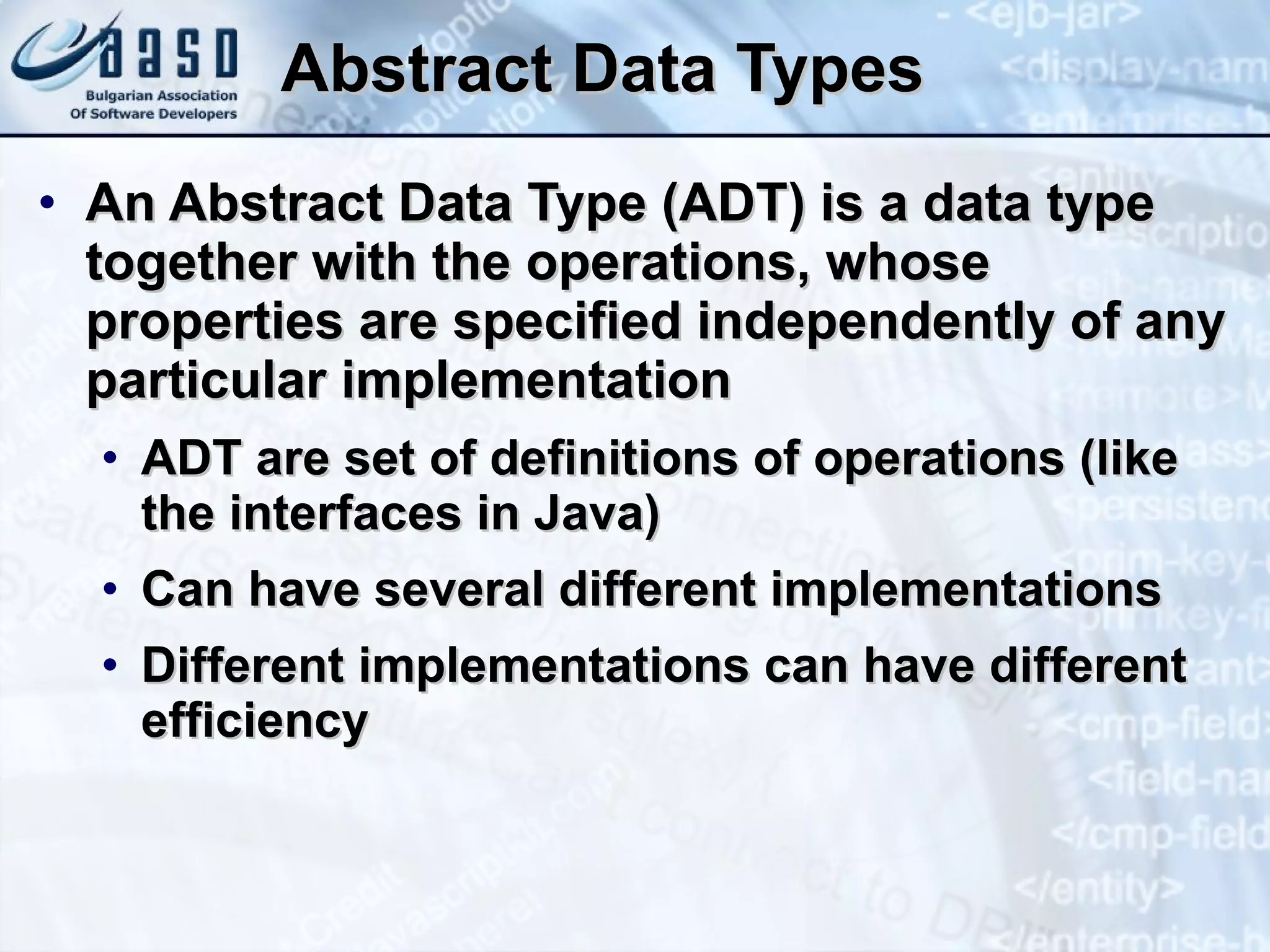
Abstract Data Types An Abstract Data Type (ADT) is a data type together with the operations, whose properties are specified independently of any particular implementation ADT are set of definitions of operations (like the interfaces in Java) Can have several different implementations Different implementations can have different efficiency
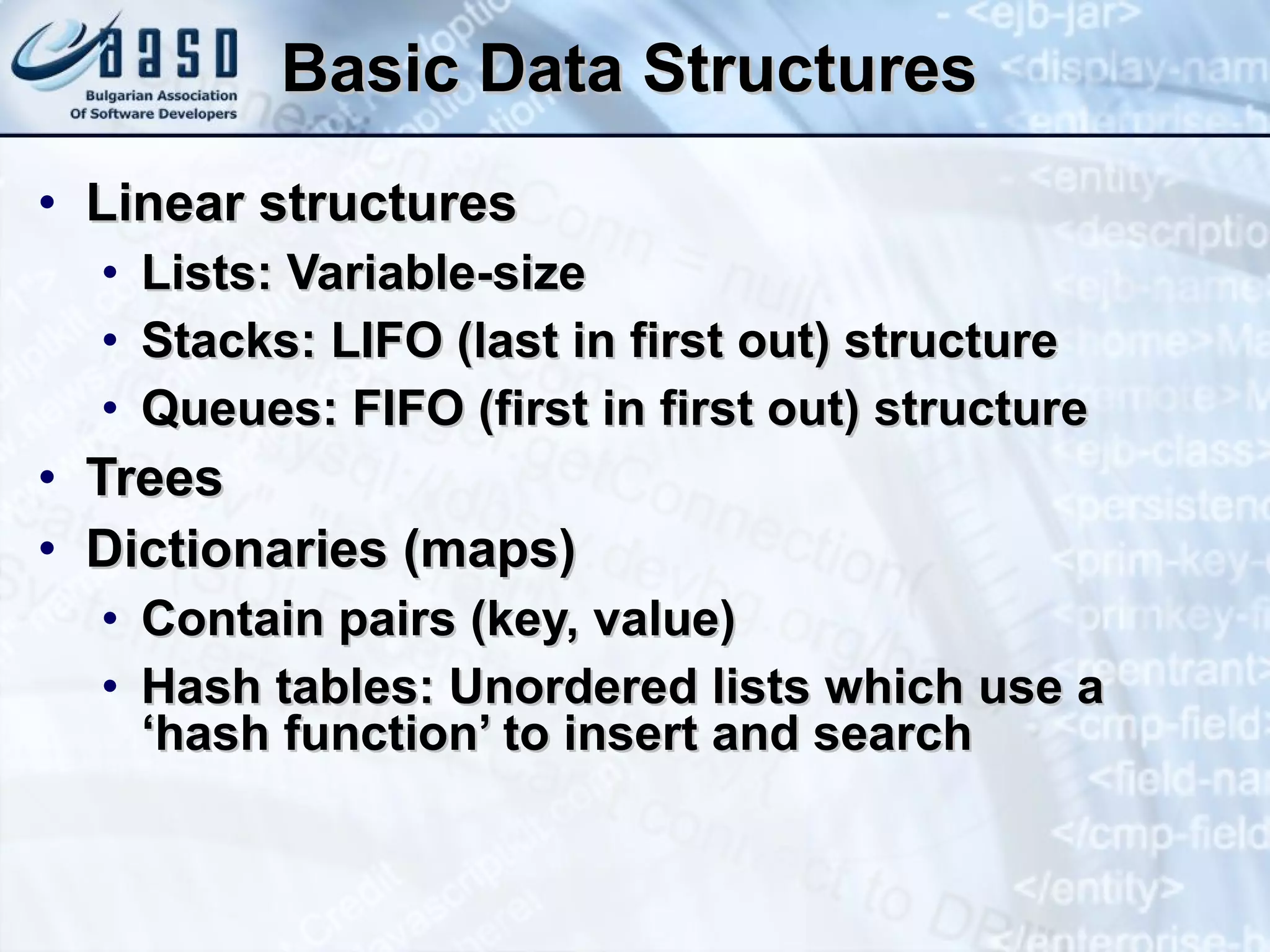
Basic Data Structures Linear structures Lists: Variable-size Stacks: LIFO (last in first out) structure Queues: FIFO (first in first out) structure Trees Dictionaries (maps) Contain pairs (key, value) Hash tables: Unordered lists which use a ‘hash function’ to insert and search
What Is a List?
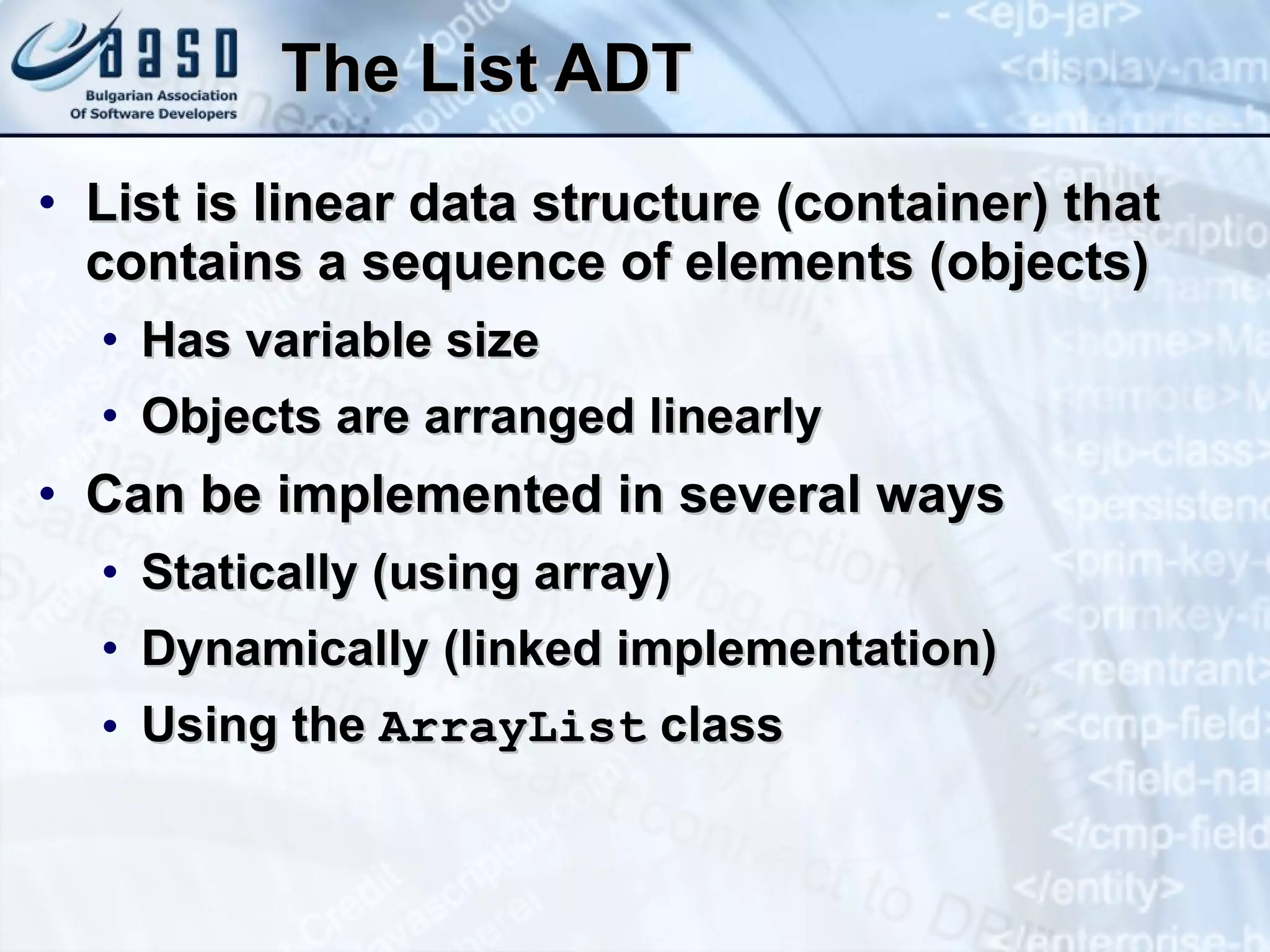
The List ADT List is linear data structure (container) that contains a sequence of elements (objects) Has variable size Objects are arranged linearly Can be implemented in several ways Statically (using array) Dynamically (linked implementation) Using the  ArrayList  class
Static and Linked Lists
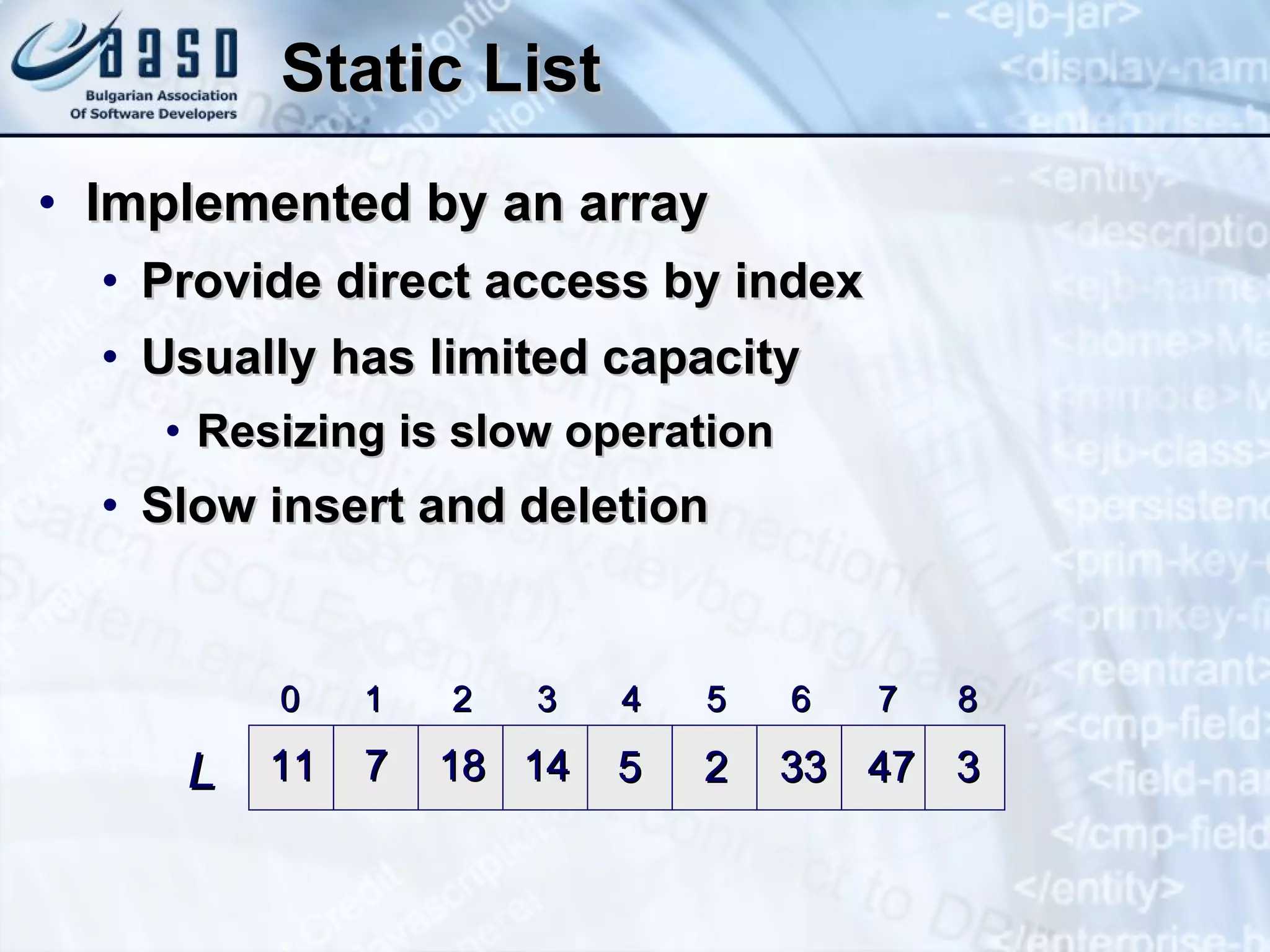
Static List Implemented by an array Provide direct access by index Usually has limited capacity Resizing is slow operation Slow insert and deletion 0 1 2 3 4 5 6 7 8 11 7 18 14 L 5 2 33 47 3
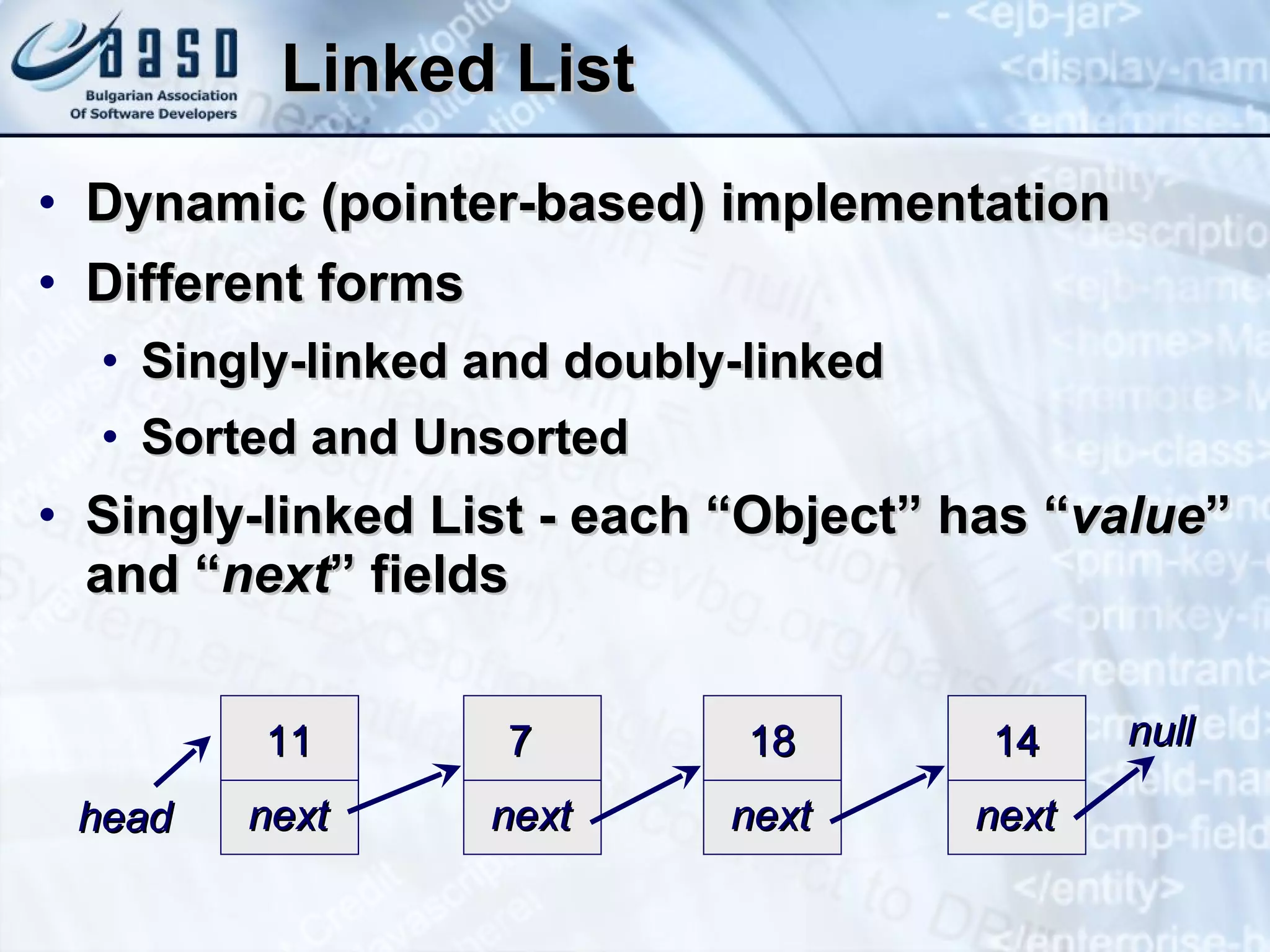
Linked List Dynamic (pointer-based) implementation Different forms Singly-linked and doubly-linked Sorted and Unsorted Singly-linked List - each “Object” has “ value ” and “ next ” fields 11 next 7 next 18 next 14 next head null
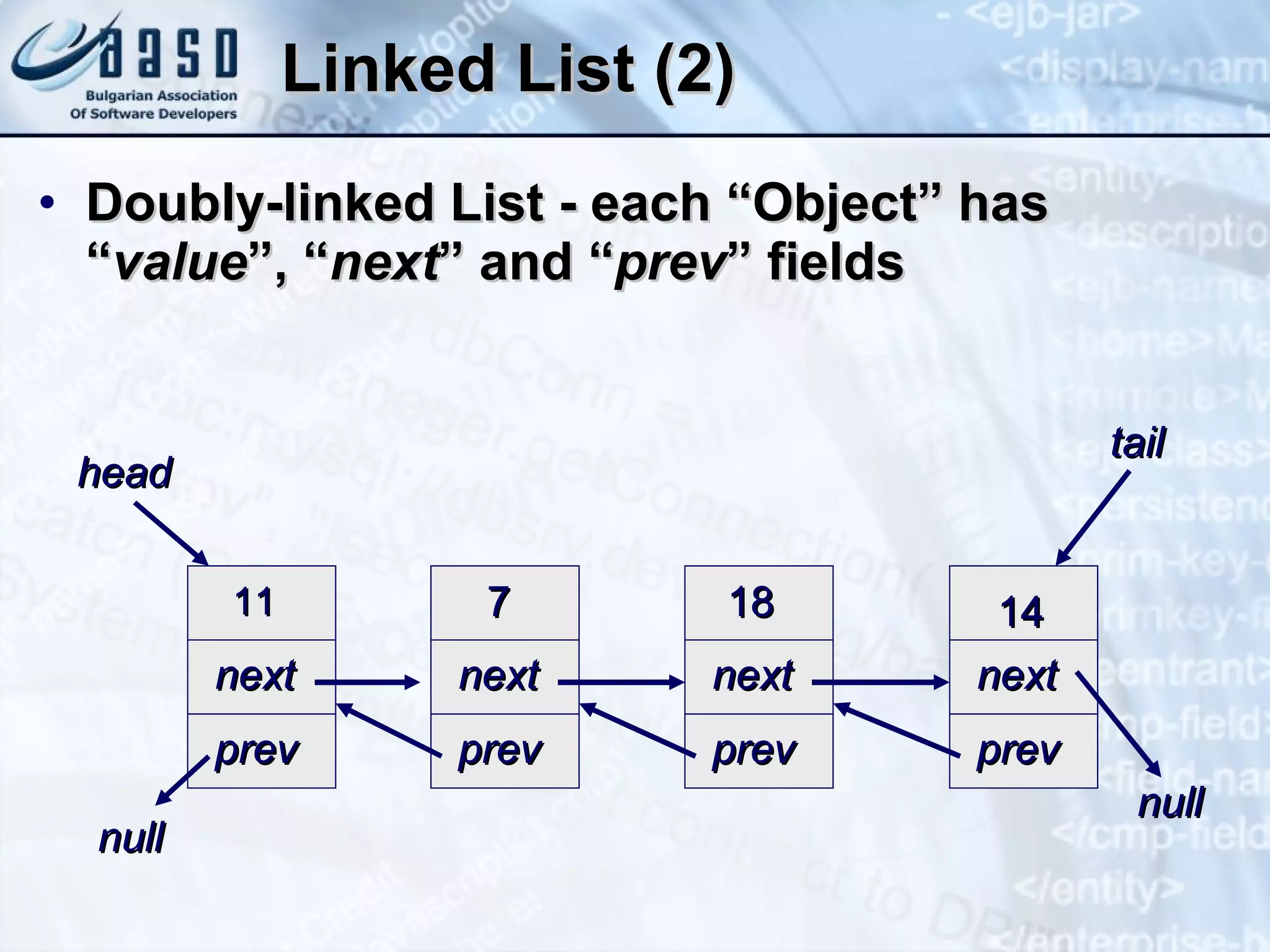
Linked List (2) Doubly-linked List - each “Object” has “ value ”, “ next ” and “ prev ” fields 11 next prev head tail 7 next prev 18 next prev 14 next prev null null
Using the ArrayList   class
The  java.util.ArrayList  Class Implements the list data structure using an array whose size is dynamically increased as needed Allocates in advance buffer space for new elements (for better performance) Insertion methods: add(Object)  – adds an object at the end add (index ,   Object)  – inserts an object to the list at a specified position size()  – returns the number of elements
The  ArrayList  Class Deletion methods: remove(Object)  – removes the first occurrence of a specific object remove( index)  – removes the element at the specified position clear()  – removes all elements Other supported methods: c ontains() ,   t oArray()
The  ArrayList  Class(2) ArrayList  can contain any data type Elements are added directly Typecasting is required when extracting elements unless we use Generics Converting to array List list = new ArrayList(); list. a dd(5); // Add integer value list. a dd("some string"); // Add string value int firstElement = ((Integer)(list.get(0))).intValue(); String secondElement = (String)list.get(1);  Integer[] arr = list.toArray(new Integer[list.size()]);
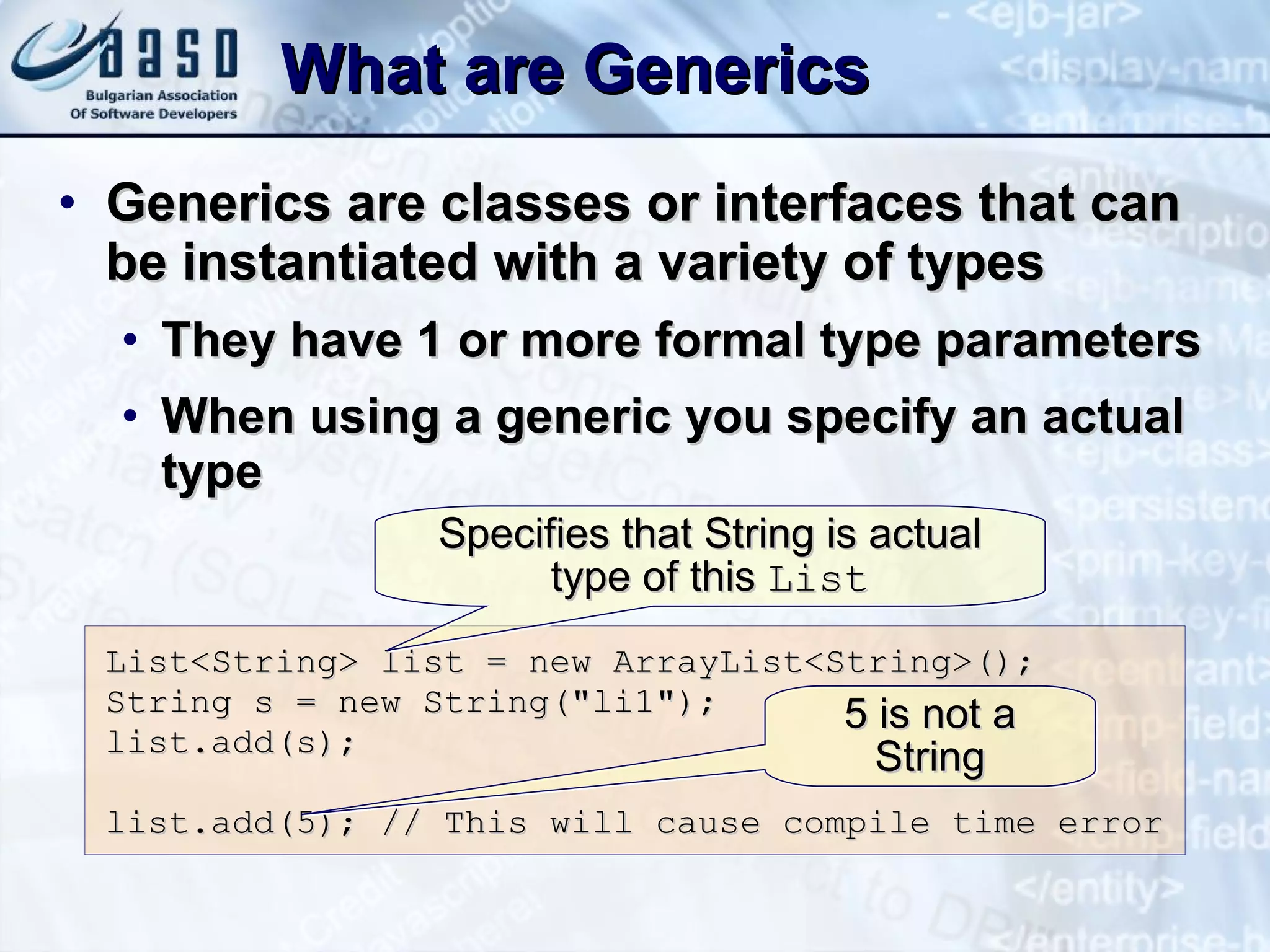
What are Generics Generics are classes or interfaces that can be instantiated with a variety of types They have 1 or more formal type parameters When using a generic you specify an actual type List<String> list = new ArrayList<String>(); String s = new String(&quot; li1 &quot;); list.add(s); list.add(5); // This will cause compile time error Specifies that String is actual type of this  List 5 is not a String
Primes[n..m] – Example Find all prime numbers in a specified interval public static ArrayList<Integer>   getPrimes(int start, int end) { List<Integer> primesList =    new ArrayList<Integer>(); for (int num = start; num <= end; num++) { boolean prime = true; for (int div = 2; div <= Math.sqrt(num); div++) { if (num % div == 0) { prime = false; break; } } if (prime) { primesList.add(num); } } return primesList; }
Primes[n..m] Live Demo
Union and Intersection of Lists – Example public static Integer[] union(Integer[] firstArr, Integer[] secondArr) { List<Integer> union = new ArrayList<Integer>(); for (Integer item : firstArr) { union.add(item); } for (Integer item : secondArr) { if (!union.contains(item)) { union.add(item); } } return union.toArray(new Integer[union.size()]); } //Example continues...
Union and Intersection of Lists – Example(2) public static Integer[] intersect(Integer[] firstArr, Integer[] secondArr) { List<Integer> intersect = new ArrayList<Integer>(); for (Integer item : firstArr) { if (Arrays.binarySearch(secondArr, item) >= 0) { intersect.add(item); } } return intersect.toArray( new Integer[intersect.size()]); }
Union and Intersection Live Demo
What is a Stack?
The Stack ADT LIFO (last in first out) structure Elements inserted (push) at “top” Elements removed (pop) from “top” Can be implemented in several ways Statically (using array) Dynamically (linked implementation) Using the  Stack  class
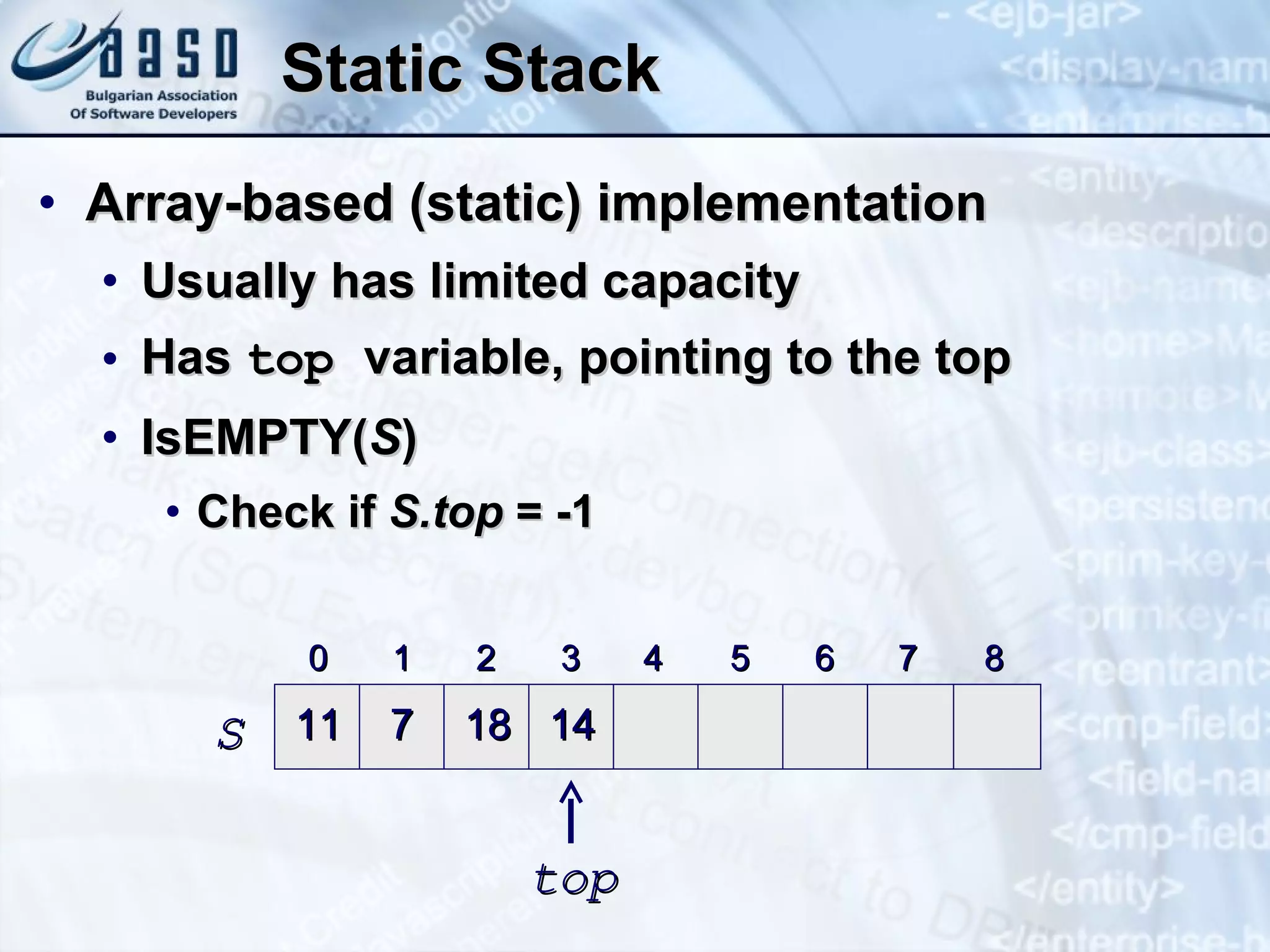
Static Stack Array-based (static) implementation Usually has limited capacity Has  top  variable, pointing to the top IsEMPTY( S ) Check if  S.top  = -1 0 1 2 3 4 5 6 7 8 11 7 18 14 S top
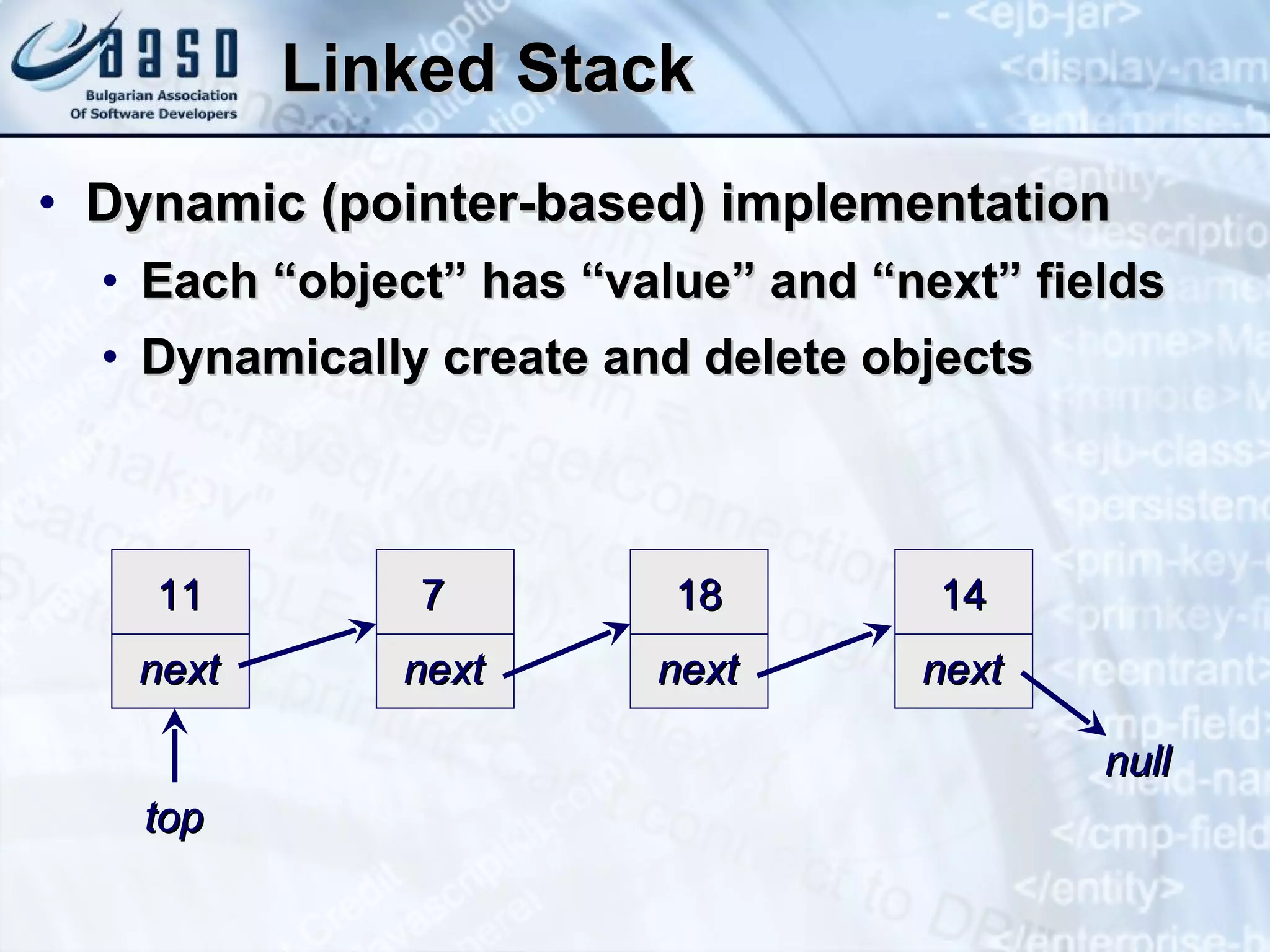
Linked Stack Dynamic (pointer-based) implementation Each “object” has “value” and “next” fields Dynamically create and delete objects 11 next 7 next 18 next 14 next top null
Using the  Stack  class
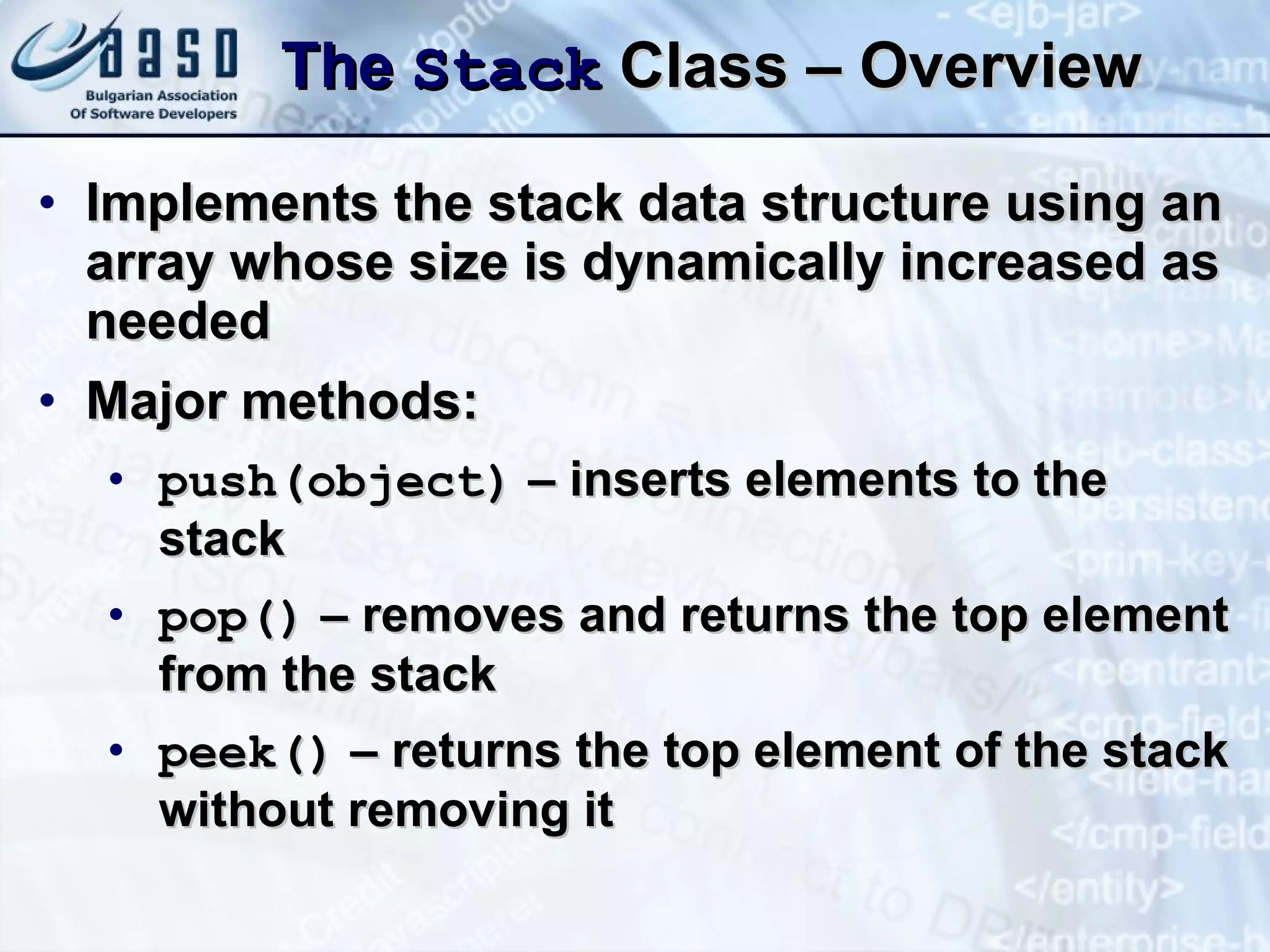
The  Stack  Class – Overview Implements the stack data structure using an array whose size is dynamically increased as needed Major methods: push(object)  – inserts elements to the stack pop()  – removes and returns the top element from the stack peek()  – returns the top element of the stack without removing it
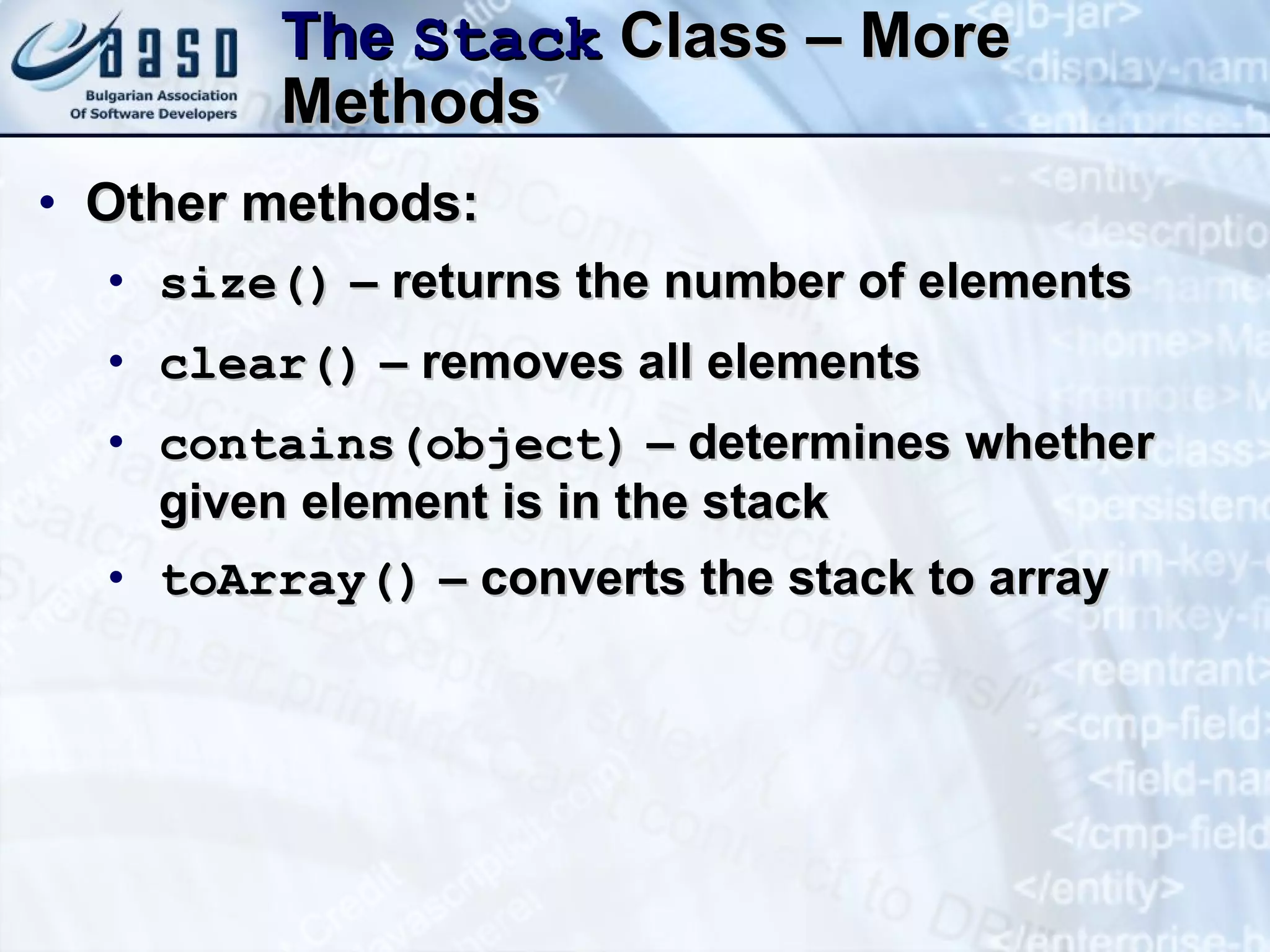
The  Stack  Class – More Methods Other methods: size()  – returns the number of elements clear()  – removes all elements contains(object)  – determines whether given element is in the stack toArray()  – converts the stack to array
Examples Using the  Stack  class
Stack  – Example Using  push() ,  pop()  and  peek()  methods public static void main(String[] args) { Stack<String> stack = new Stack<String>(); stack.push(&quot;1. Ivan&quot;); stack.push(&quot;2. Nikolay&quot;); stack.push(&quot;3. Maria&quot;); stack.push(&quot;4. George&quot;); System.out.println(&quot;Top = &quot; + stack.peek()); while (stack.size() > 0)   { String personName = stack.pop(); System.out.println(personName); } }
Live Demo Using the  Stack  class
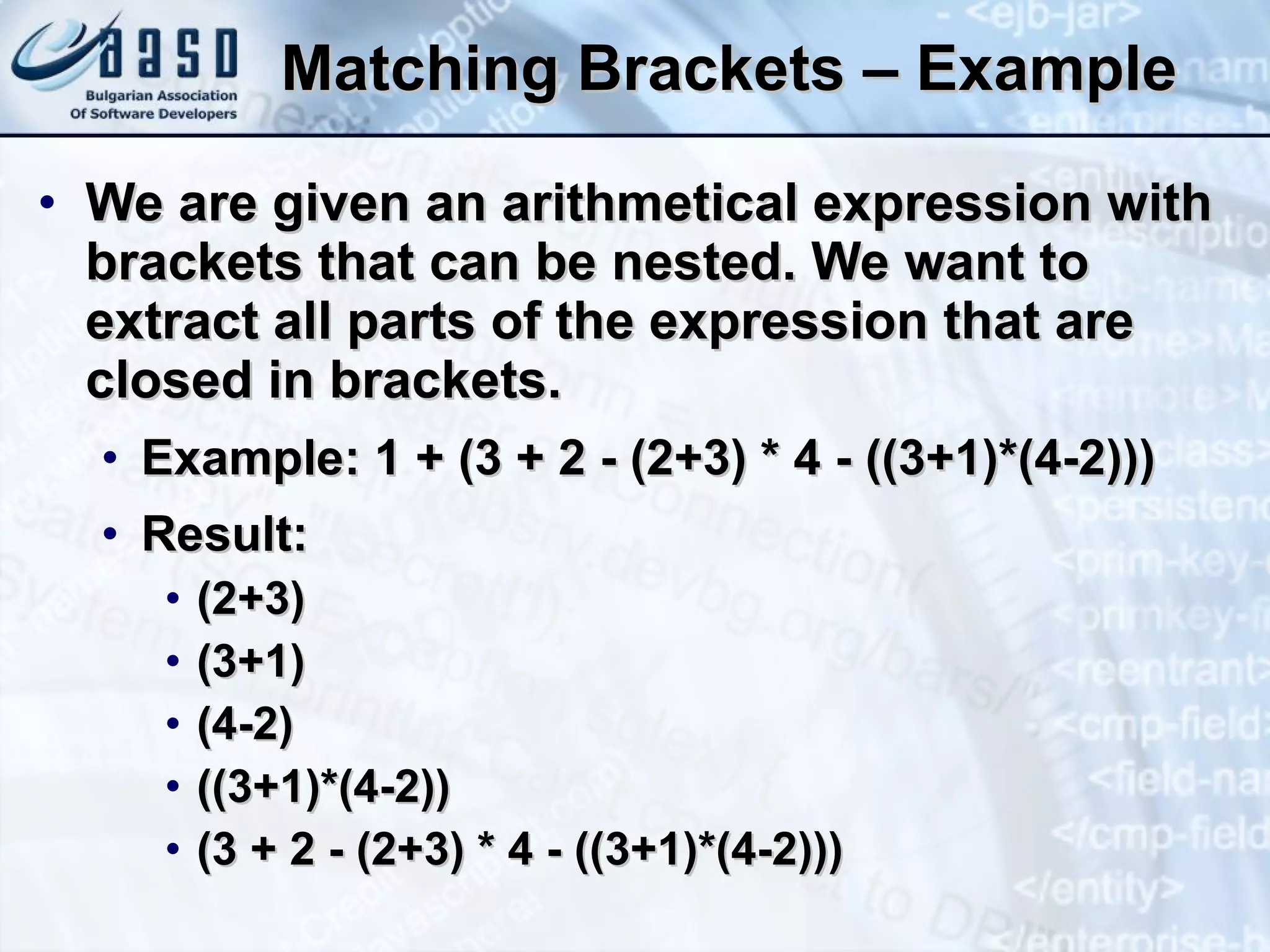
Matching Brackets – Example We are given an arithmetical expression with brackets that can be nested. We want to extract all parts of the expression that are closed in brackets. Example: 1 + (3 + 2 - (2+3) * 4 - ((3+1)*(4-2))) Result: (2+3) (3+1) (4-2) ((3+1)*(4-2)) (3 + 2 - (2+3) * 4 - ((3+1)*(4-2)))
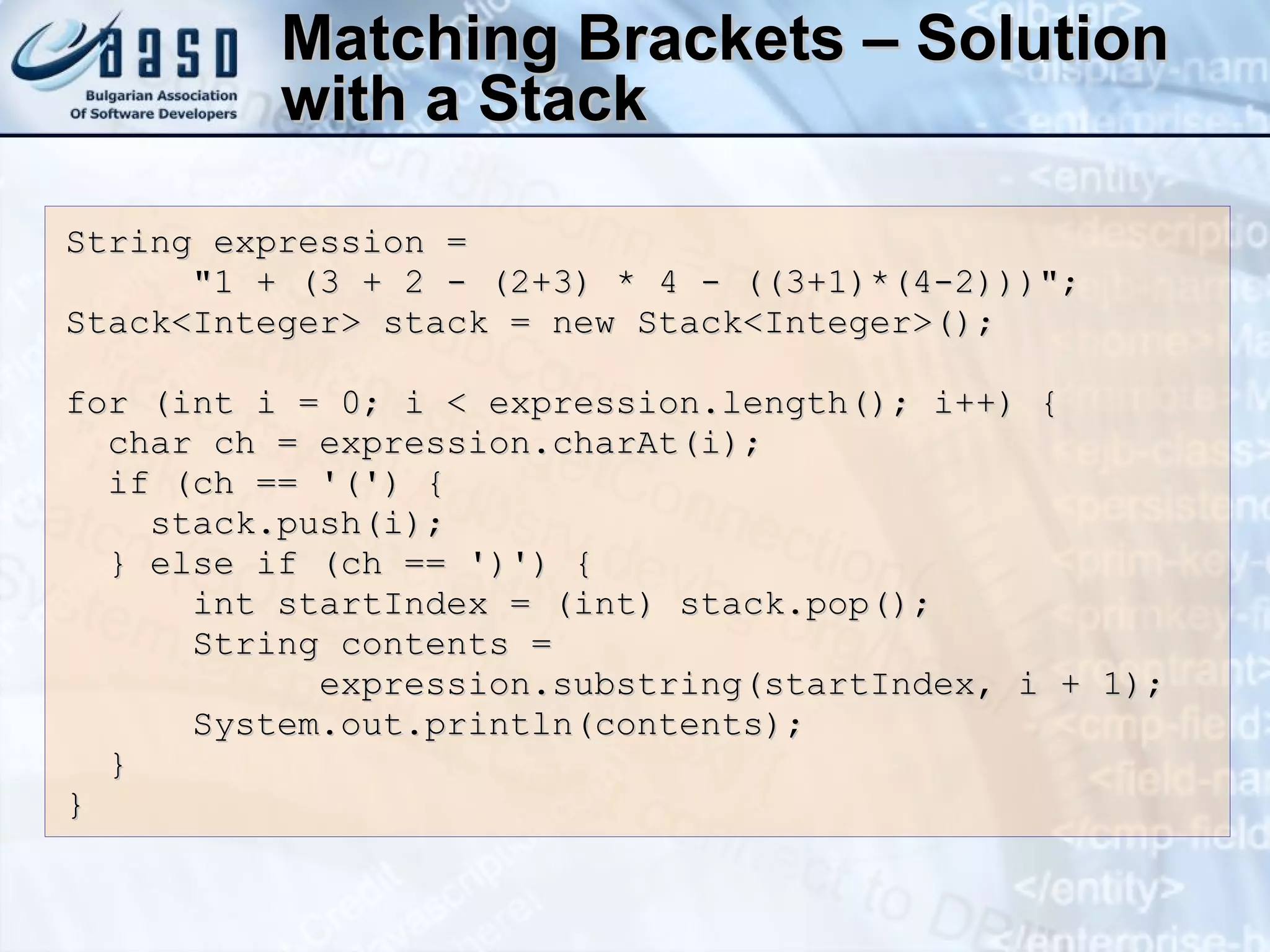
Matching Brackets – Solution with a Stack String expression = &quot;1 + (3 + 2 - (2+3) * 4 - ((3+1)*(4-2)))&quot;; Stack<Integer> stack = new Stack<Integer>(); for (int i = 0; i < expression.length(); i++) { char ch = expression.charAt(i); if (ch == '(') { stack.push(i); } else if (ch == ')') { int startIndex = (int) stack.pop(); String contents =  expression.substring(startIndex, i + 1); System.out.println(contents); } }
Live Demo Matching Brackets
What is a Queue?
The Queue ADT FIFO (first in first out) structure Elements inserted at tail (enqueue) Elements removed from head ( dequeue ) Useful in many situations Processing jobs, print queues, messages Can be implemented in several ways Statically (using array) Dynamically (using pointers) Using the  LinkedList  class
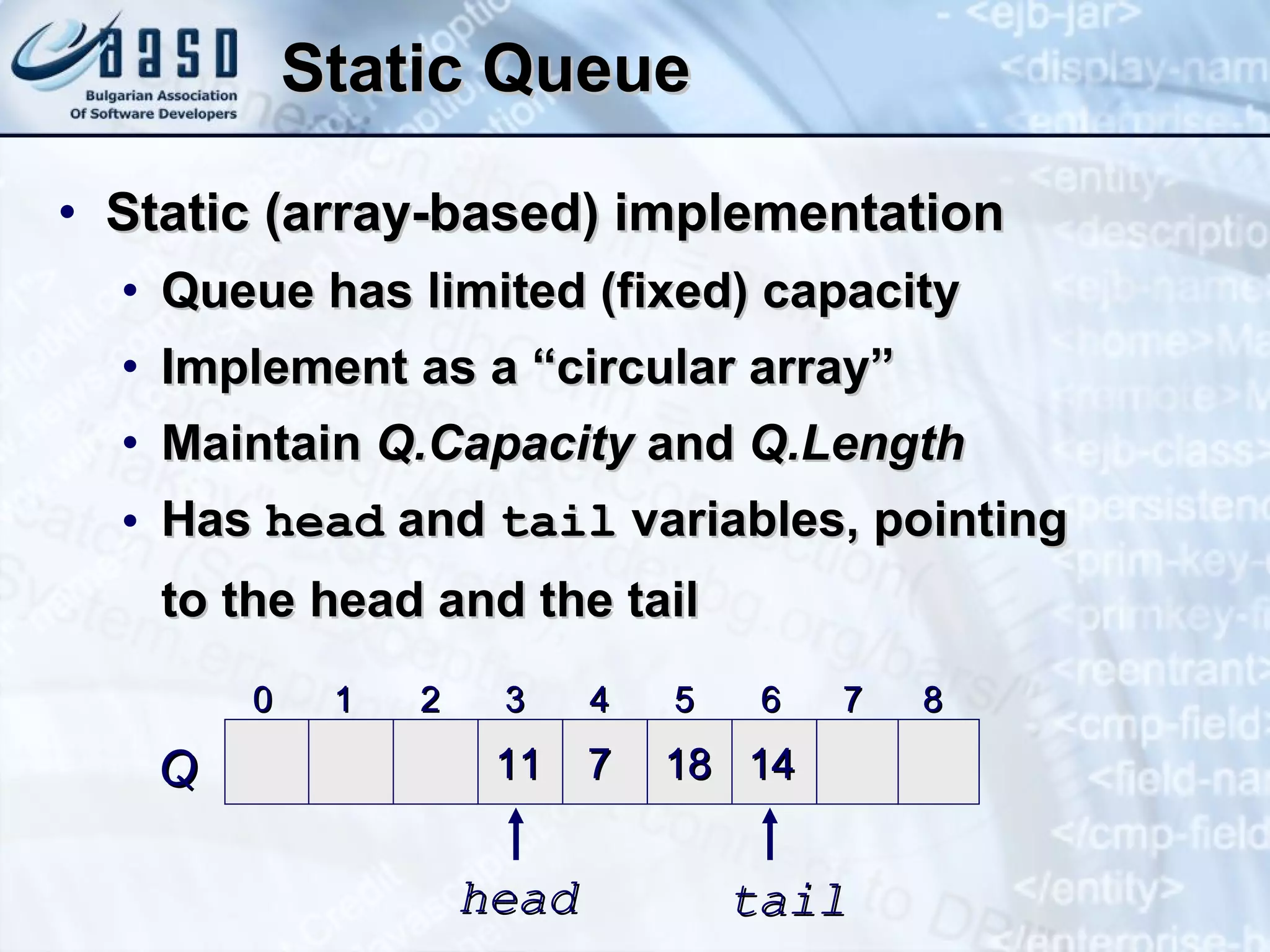
Static Queue Static (array-based) implementation Queue has limited (fixed) capacity Implement as a “circular array” Maintain  Q.Capacity  and  Q.Length Has  head  and  tail  variables, pointing to the head and the tail 0 1 2 3 4 5 6 7 8 11 7 18 14 Q head tail
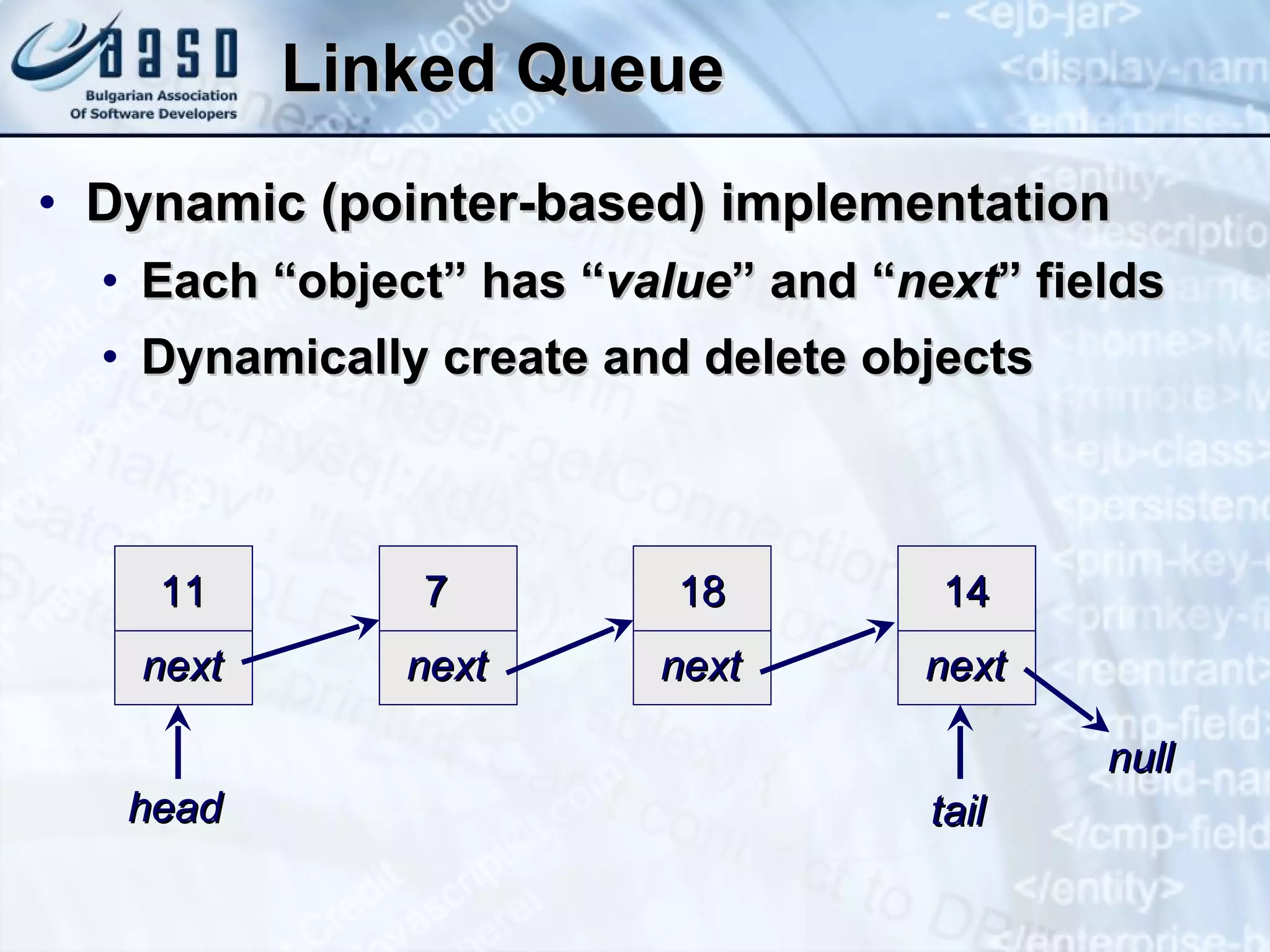
Linked Queue Dynamic (pointer-based) implementation Each “object” has “ value ” and “ next ” fields Dynamically create and delete objects 11 next 7 next 18 next 14 next head tail null
Using the  LinkedList  class
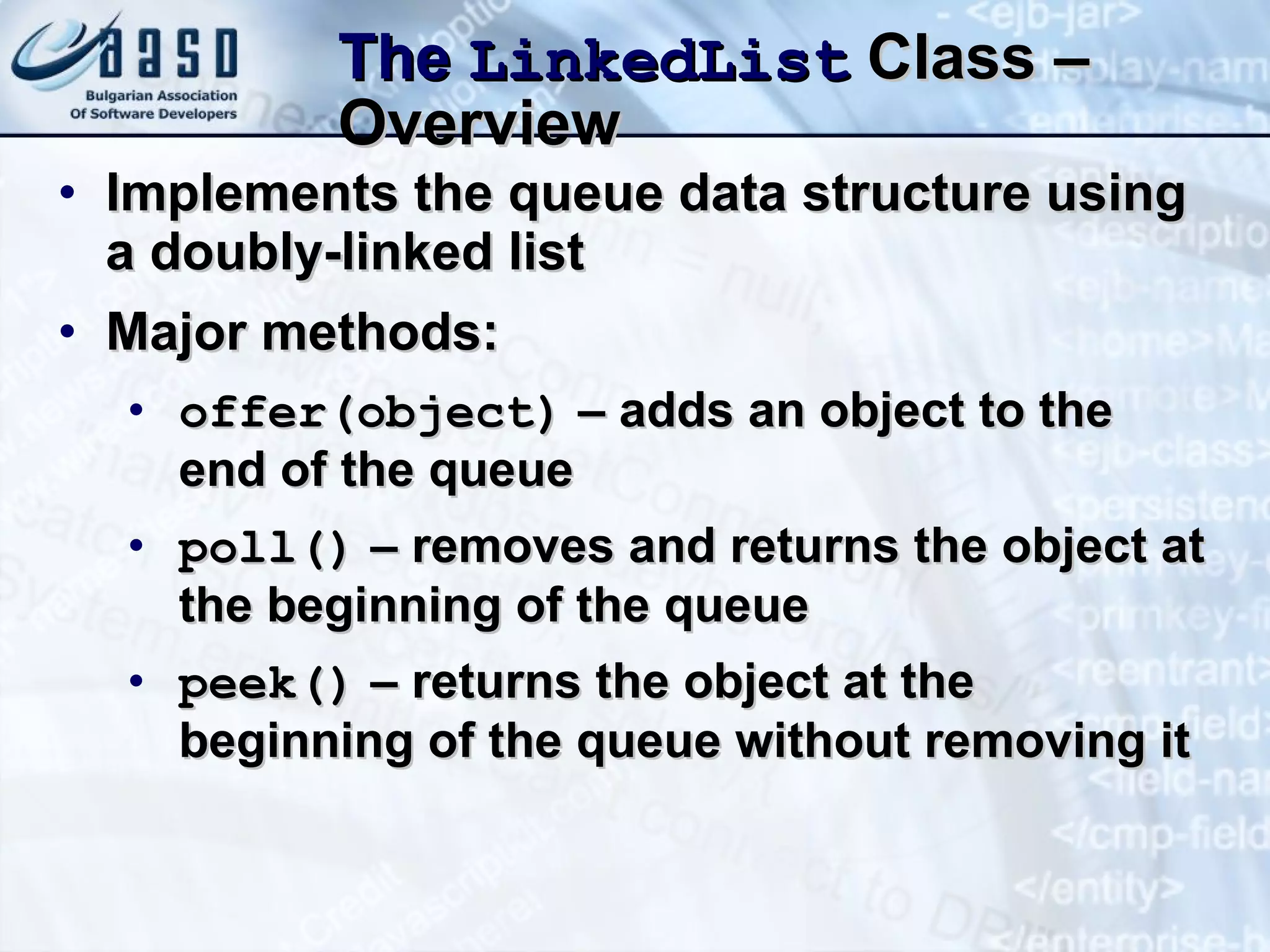
The  LinkedList  Class – Overview Implements the queue data structure using a doubly-linked list Major methods: offer(object)  – adds an object to the end of the queue poll()  – removes and returns the object at the beginning of the queue peek()  – returns the object at the beginning of the queue without removing it
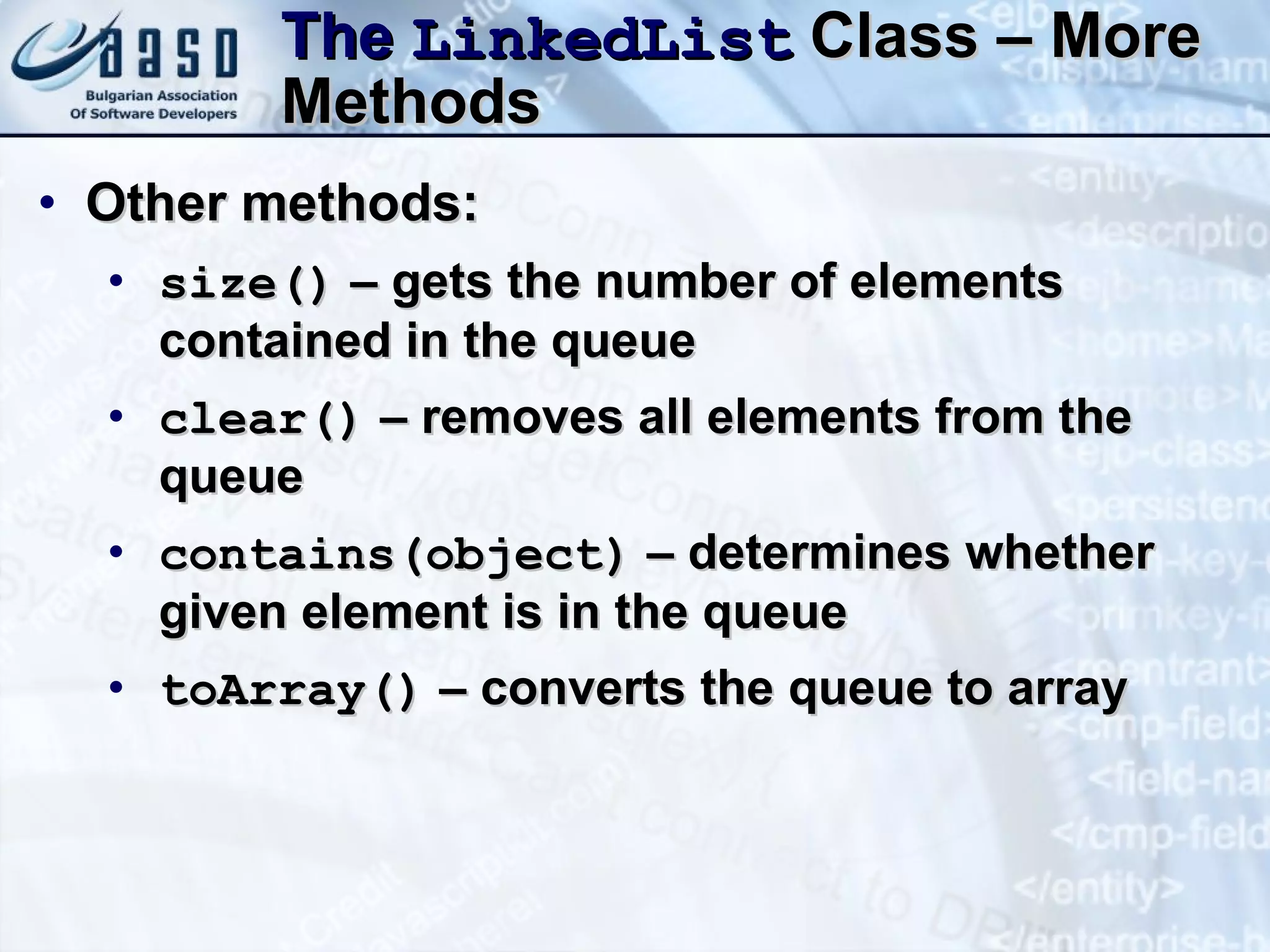
The  LinkedList  Class – More Methods Other methods: size()  – gets the number of elements contained in the queue clear()  – removes all elements from the queue contains(object)  – determines whether given element is in the queue toArray ()  – converts the queue to array
Examples Using the  LinkedList   class
Queue –   Example Using  offer ()  and  poll ()  methods public static void main(String[] args) { Queue<String> queue = new LinkedList<String>(); queue.offer(&quot;Message One&quot;); queue.offer(&quot;Message Two&quot;); queue.offer(&quot;Message Three&quot;); queue.offer(&quot;Message Four&quot;); queue.offer(&quot;Message Five&quot;); while (queue.size() > 0) { String msg = queue.poll(); System.out.println(msg); } }
Live Demo Using the  LinkedList   class
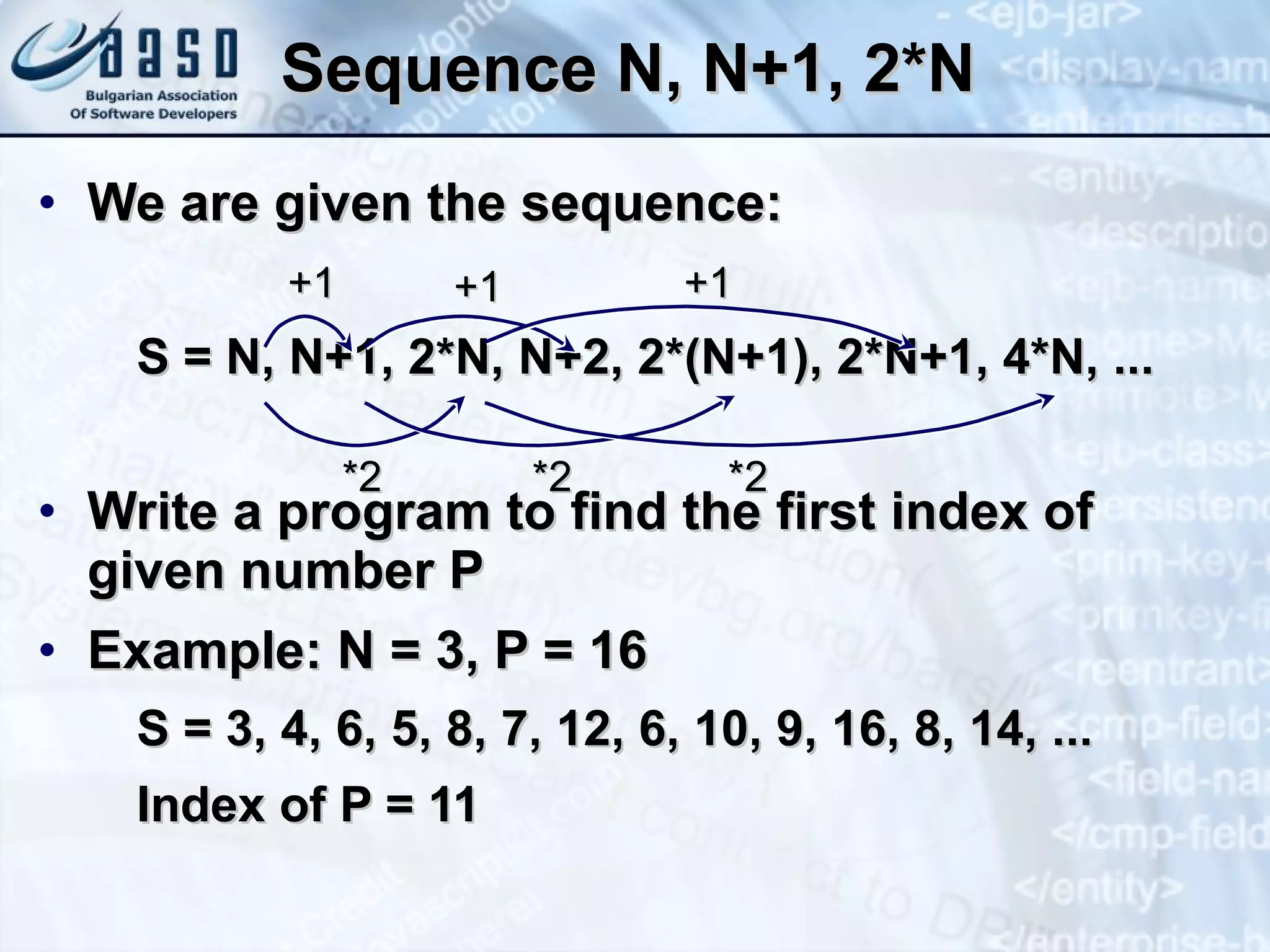
Sequence N, N+1, 2*N We are given the sequence: S = N, N+1, 2*N, N+2, 2*(N+1), 2*N+1, 4*N, ... Write a program to find the first index of given number P Example: N = 3, P = 16 S = 3, 4, 6, 5, 8, 7, 12, 6, 10, 9, 16, 8, 14, ... Index of P = 11 +1 *2 +1 *2 +1 *2
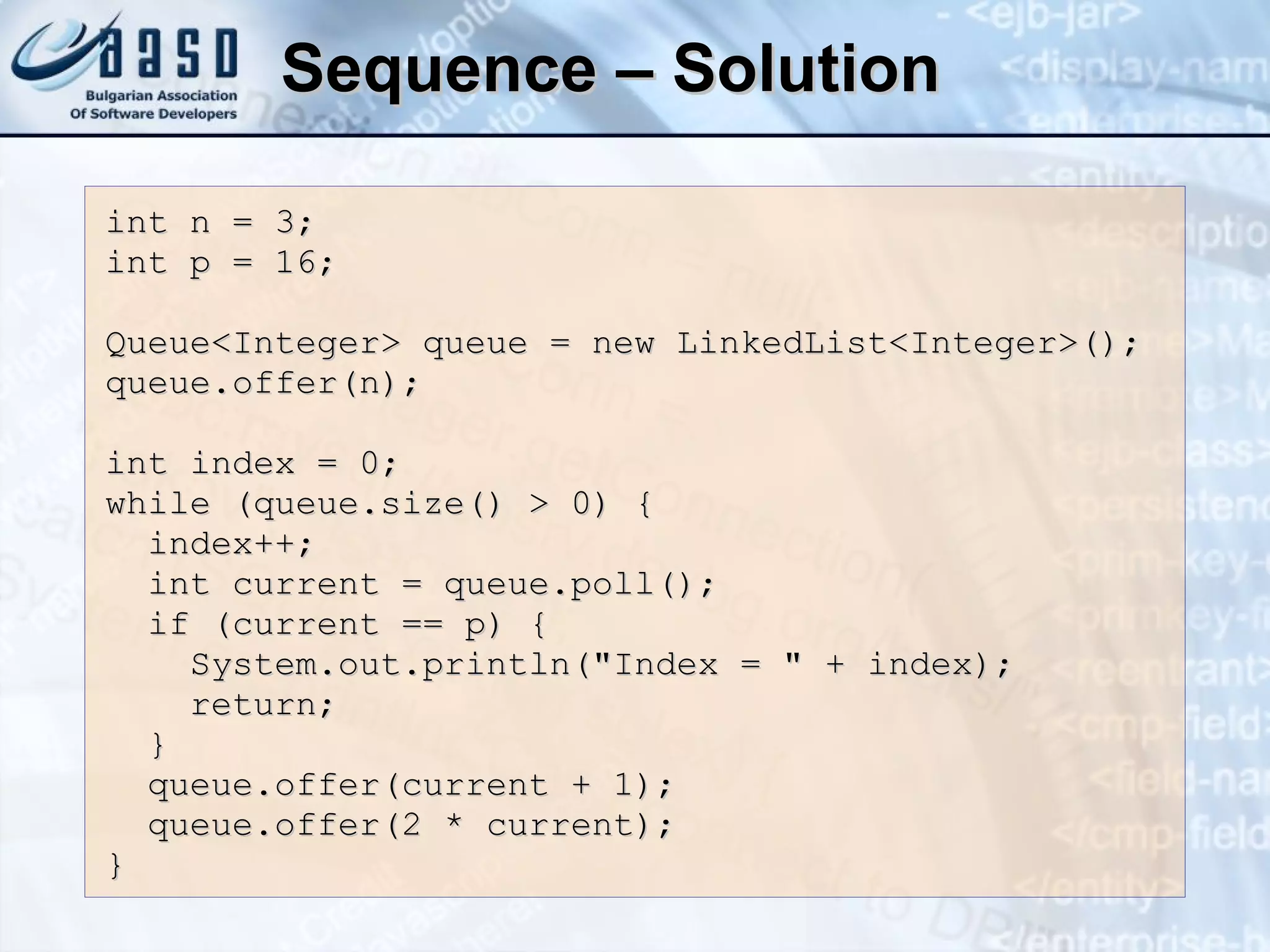
Sequence – Solution int n = 3; int p = 16; Queue<Integer> queue = new LinkedList<Integer>(); queue.offer(n); int index = 0; while (queue.size() > 0) { index++; int current = queue.poll(); if (current == p) { System.out.println(&quot;Index = &quot; + index); return; } queue.offer(current + 1); queue.offer(2 * current); }
Live Demo Sequence N, N+1, 2*N
Definition, Types of Trees What is Tree?
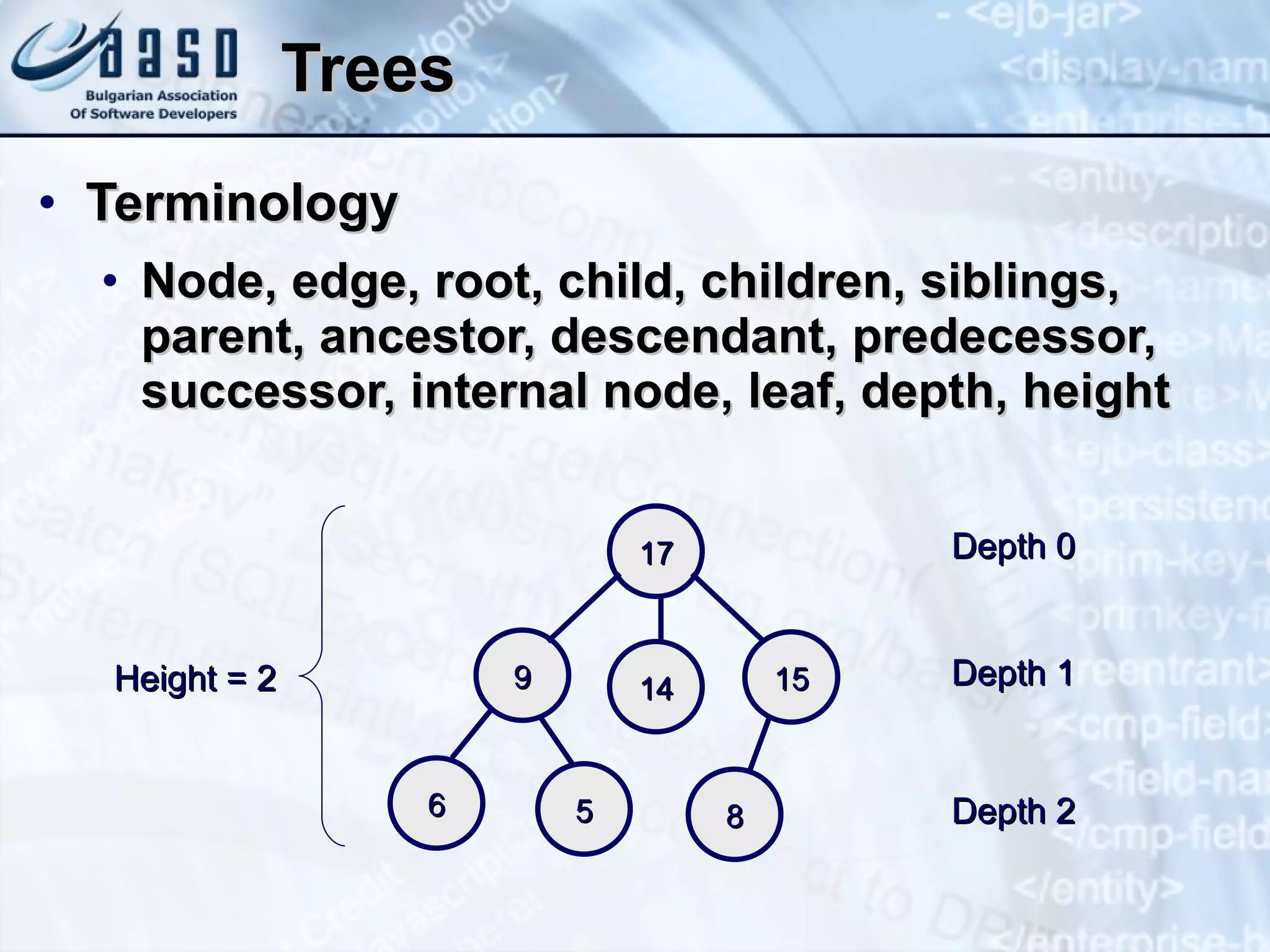
Trees Terminology Node, edge, root, child, children, siblings, parent, ancestor, descendant, predecessor, successor, internal node, leaf, depth, height 17 15 14 9 6 5 8 Height = 2 Depth 0 Depth 1 Depth 2
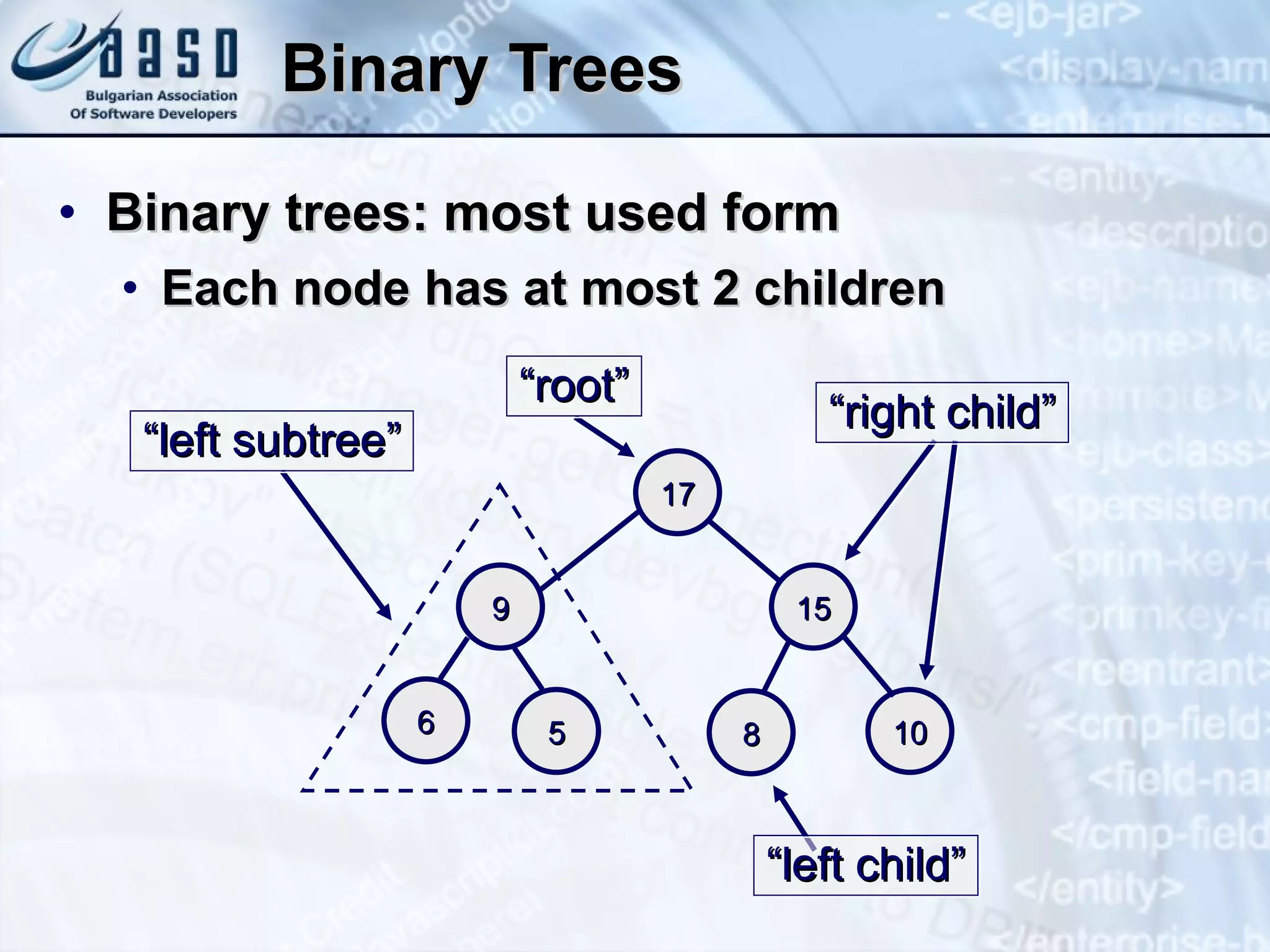
Binary Trees Binary trees: most used form Each node has at most 2 children 10 17 15 9 6 5 8 “ right child” “ left subtree” “ root” “ left child”
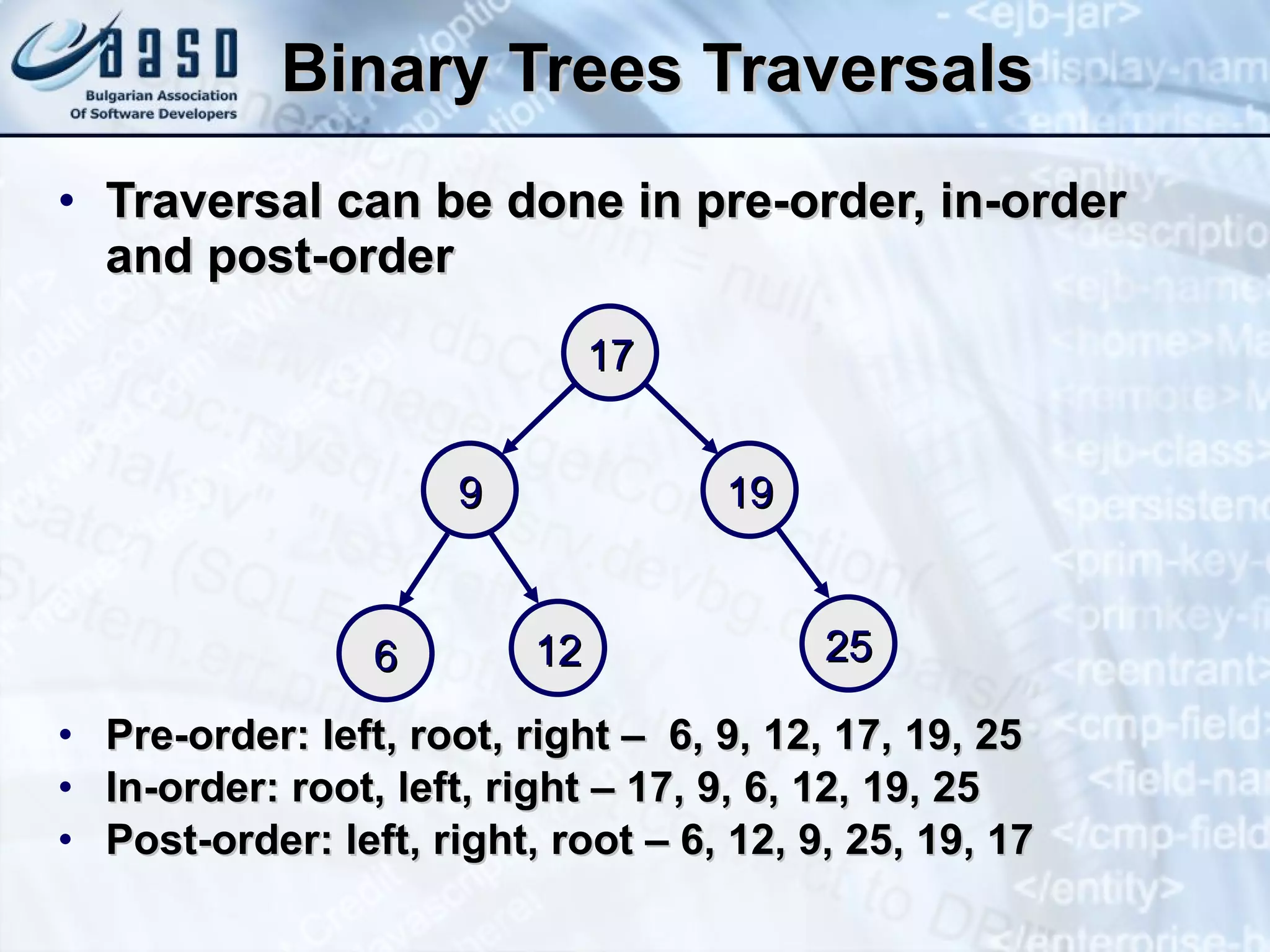
Binary Trees   Traversals Traversal can be done in pre-order, in-order and post-order Pre-order: left, root, right –  6, 9, 12, 17, 19, 25 In-order: root, left, right – 17, 9, 6, 12, 19, 25 Post-order: left, right, root – 6, 12, 9, 25, 19, 17 17 19 9 6 12 25
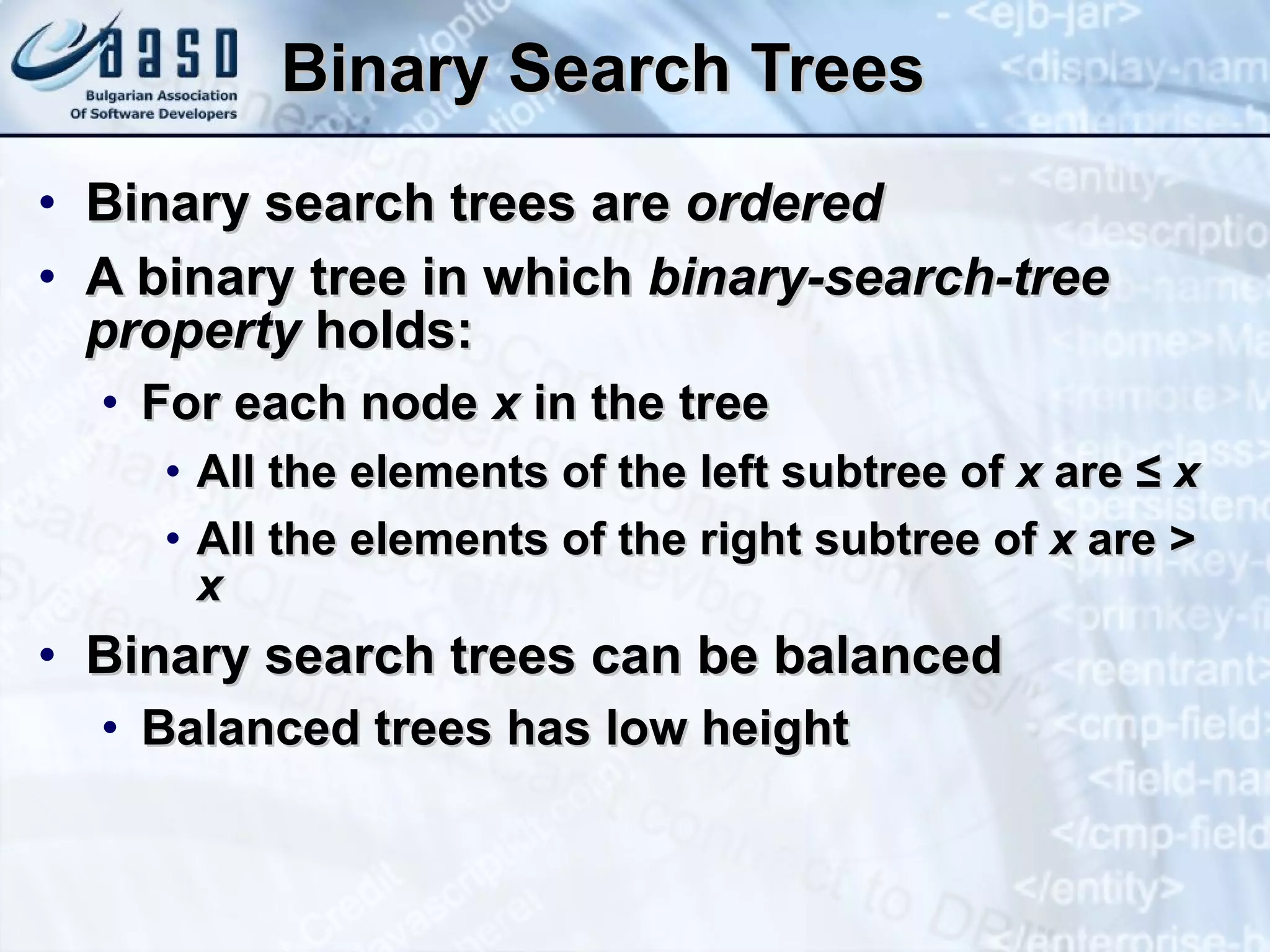
Binary Search Trees Binary search trees are  ordered A binary tree in which  binary-search-tree property  holds: For each node  x  in the tree All the elements of the left subtree of  x  are  ≤   x All the elements of the right subtree of  x  are >  x Binary search trees can be balanced Balanced trees has low height
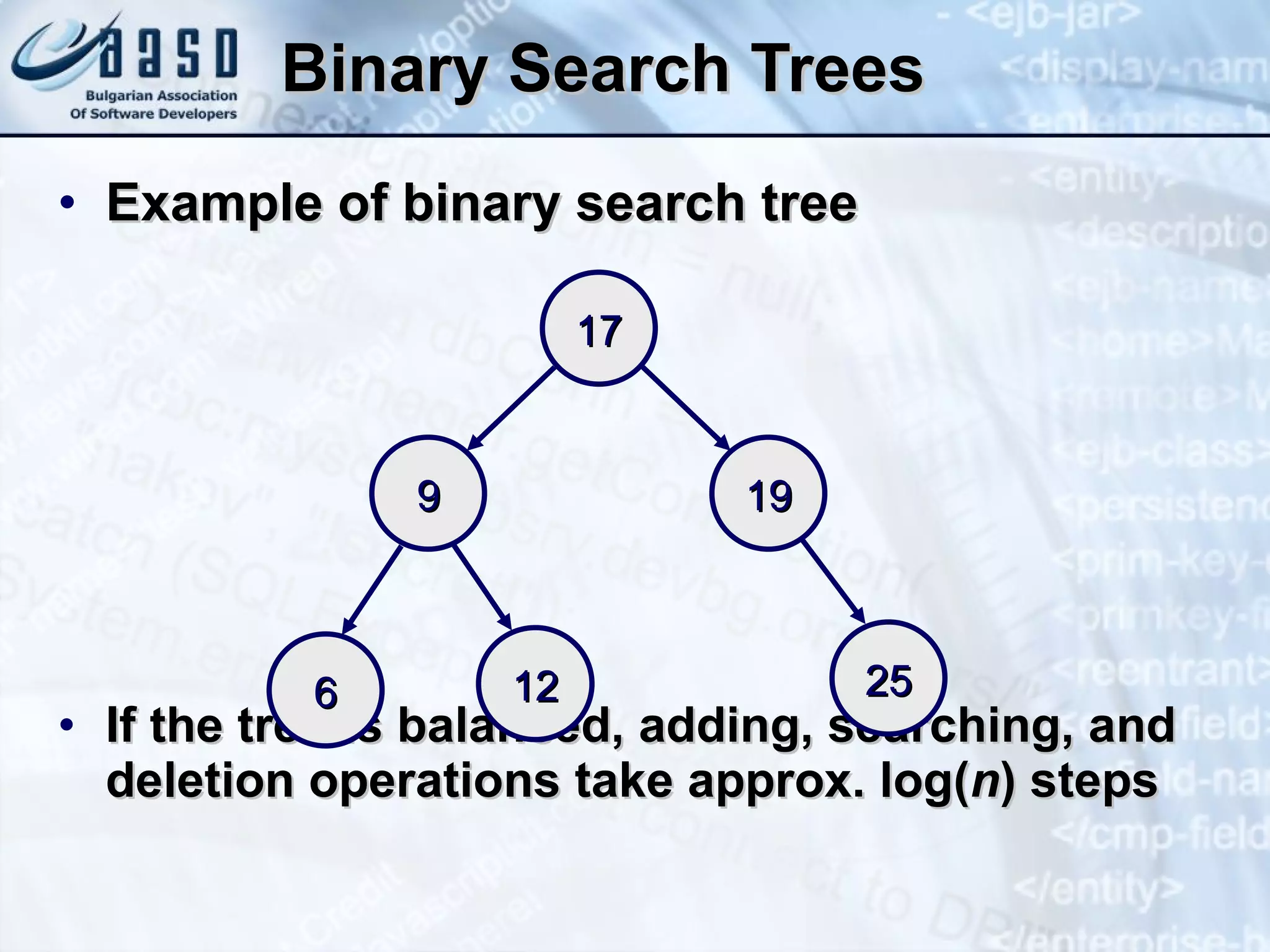
Binary Search Trees Example of binary search tree If the tree is balanced, adding, searching, and deletion operations take approx.  log( n ) steps 17 19 9 6 12 25
What is a Dictionary (Map)?
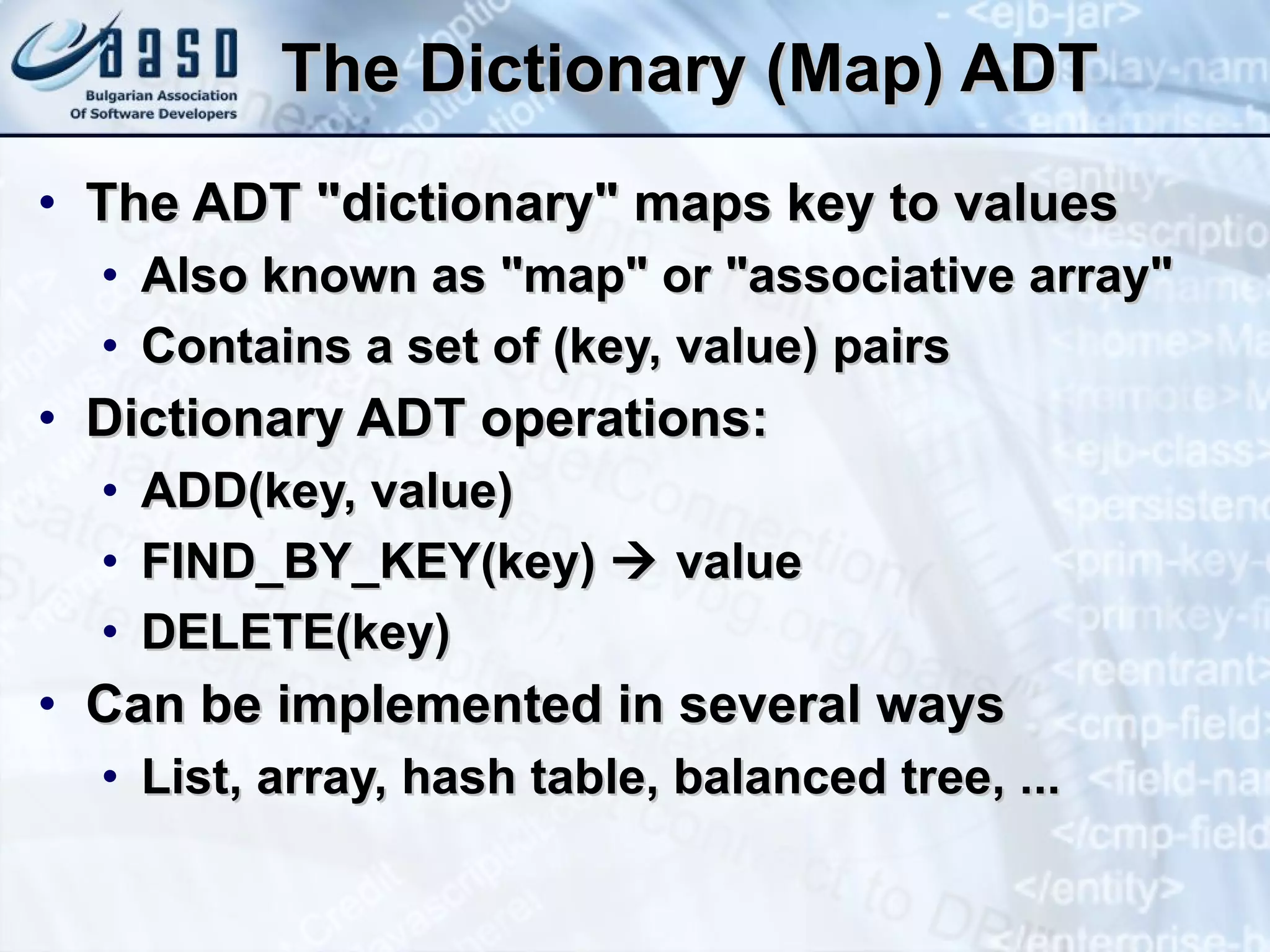
The Dictionary (Map) ADT The ADT &quot;dictionary&quot; maps key to values Also known as &quot;map&quot; or &quot;associative array&quot; Contains a set of (key, value) pairs Dictionary ADT operations: ADD(key, value) FIND_BY_KEY(key)    value DELETE(key) Can be implemented in several ways List, array, hash table, balanced tree, ...
What is a Hash Table?
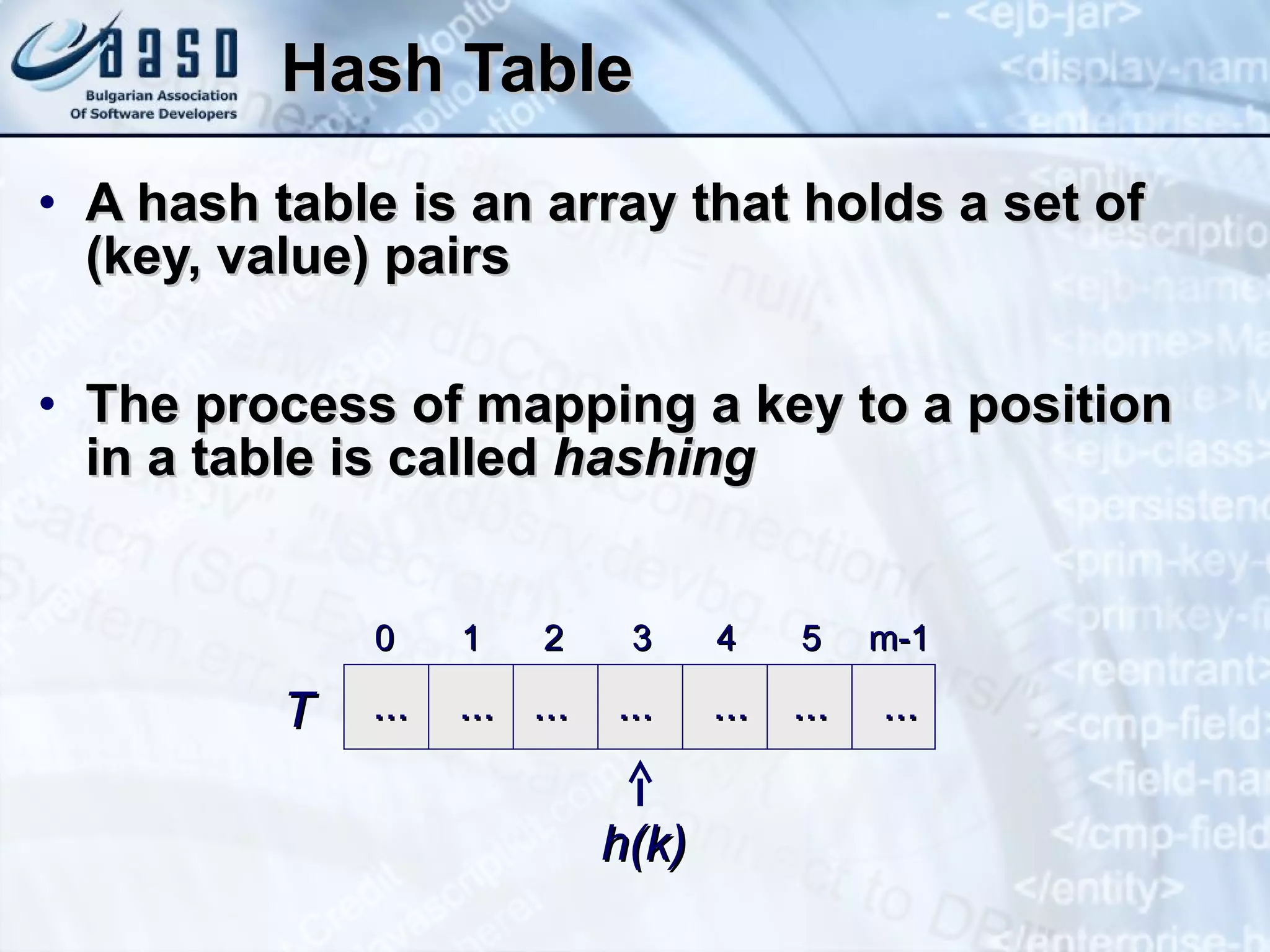
Hash Table A hash table is an array that holds a set of (key, value) pairs The process of mapping a key to a position in a table is called  hashing 0 1 2 3 4 5 m-1 ... ... ... ... T h( k ) ... ... ...
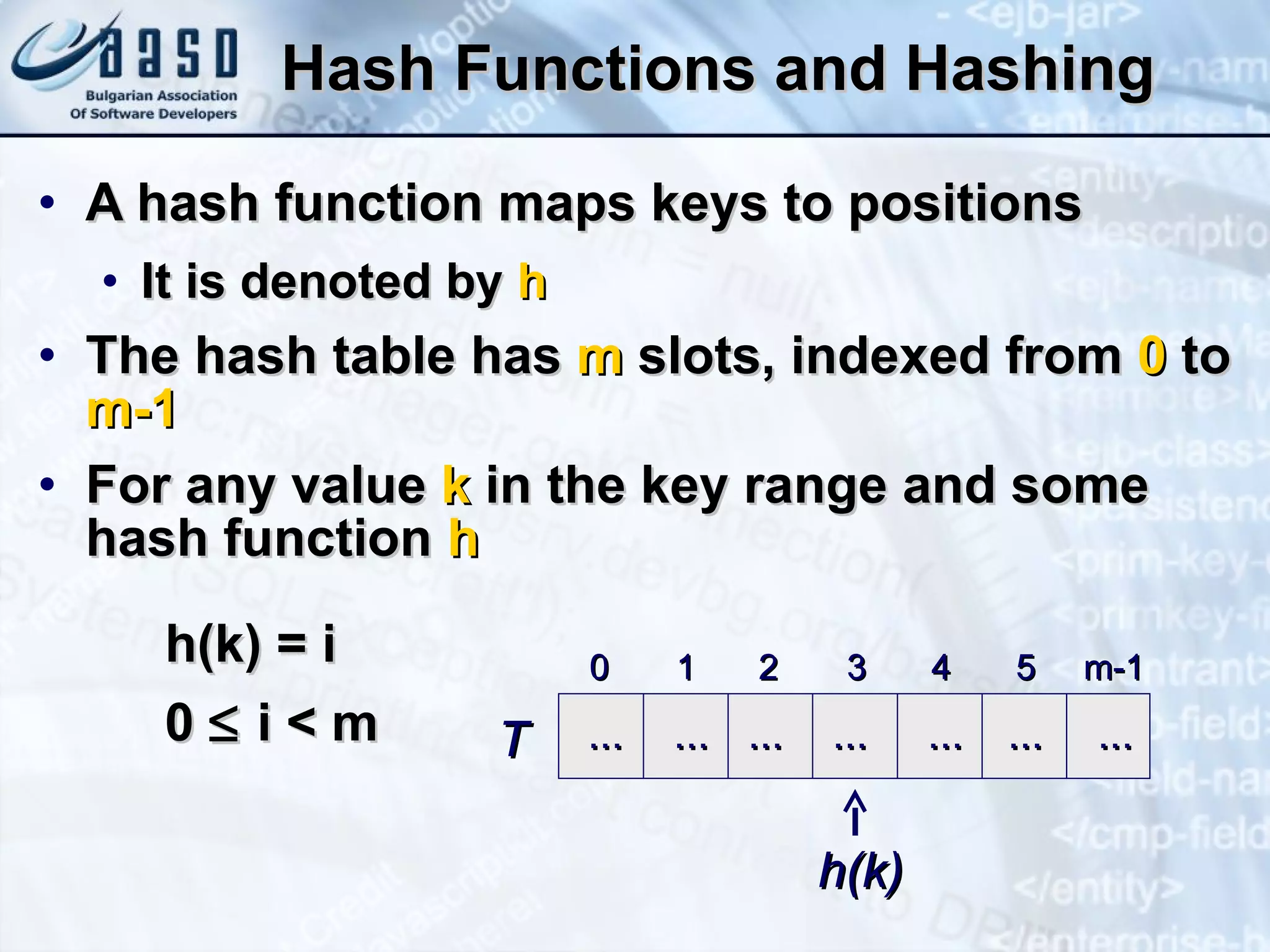
Hash Functions and Hashing A hash function maps keys to positions It is denoted by  h The hash table has  m  slots, indexed from  0  to  m-1 For any value  k  in the key range and some hash function  h h( k ) = i 0    i <  m 0 1 2 3 4 5 m-1 ... ... ... ... T h( k ) ... ... ...
Mapping Functions Perfect hashing function (PHF) h(k)  : one-to-one mapping from each key  k  to integers in [ 0 ,   m -1 ] The PHF maps each key to a distinct integer within some manageable range Finding a perfect hashing function is in most cases  impossible More realistically Hash functions  h(k)  map  most  of the keys onto unique integers, but  not all
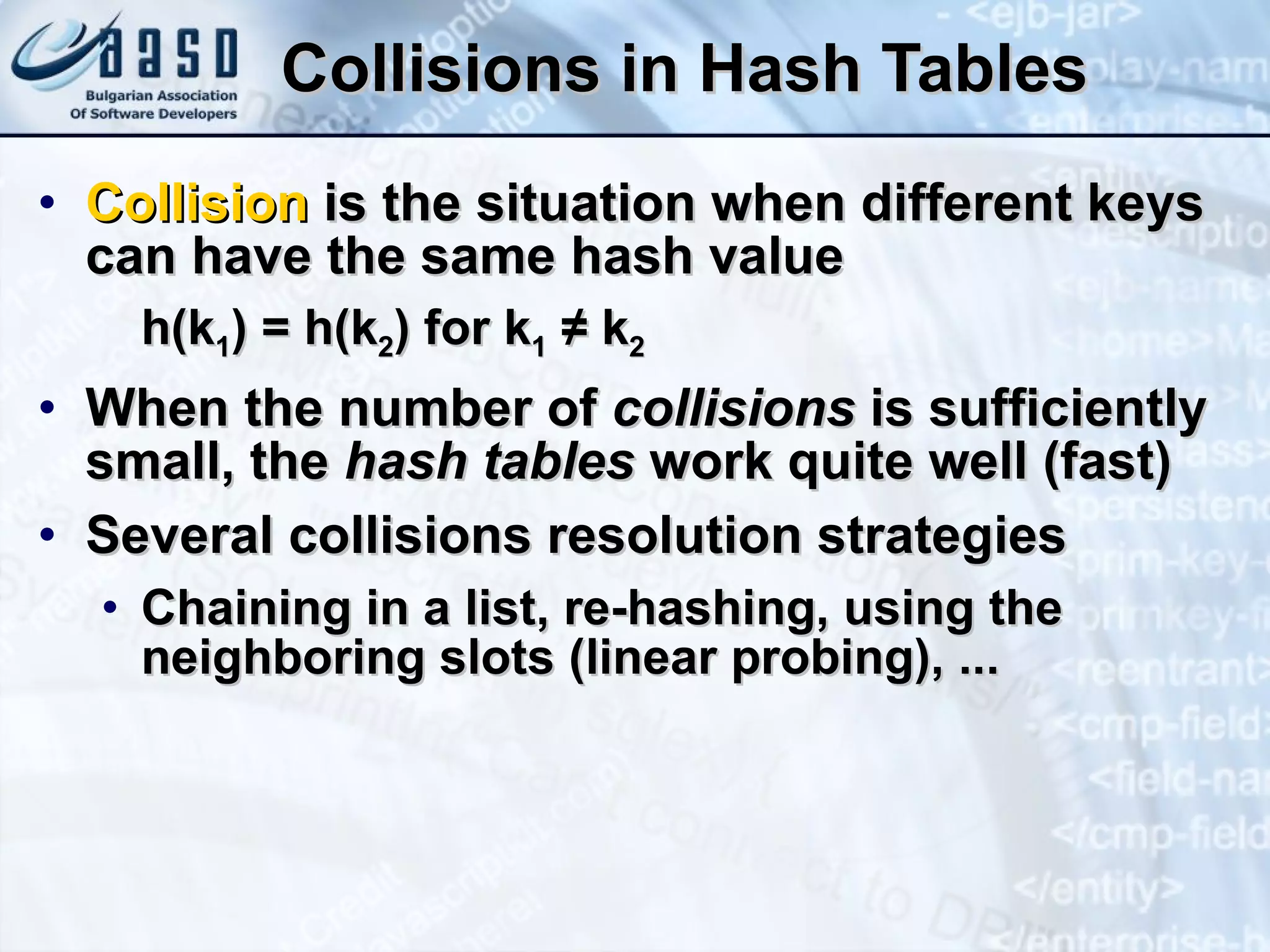
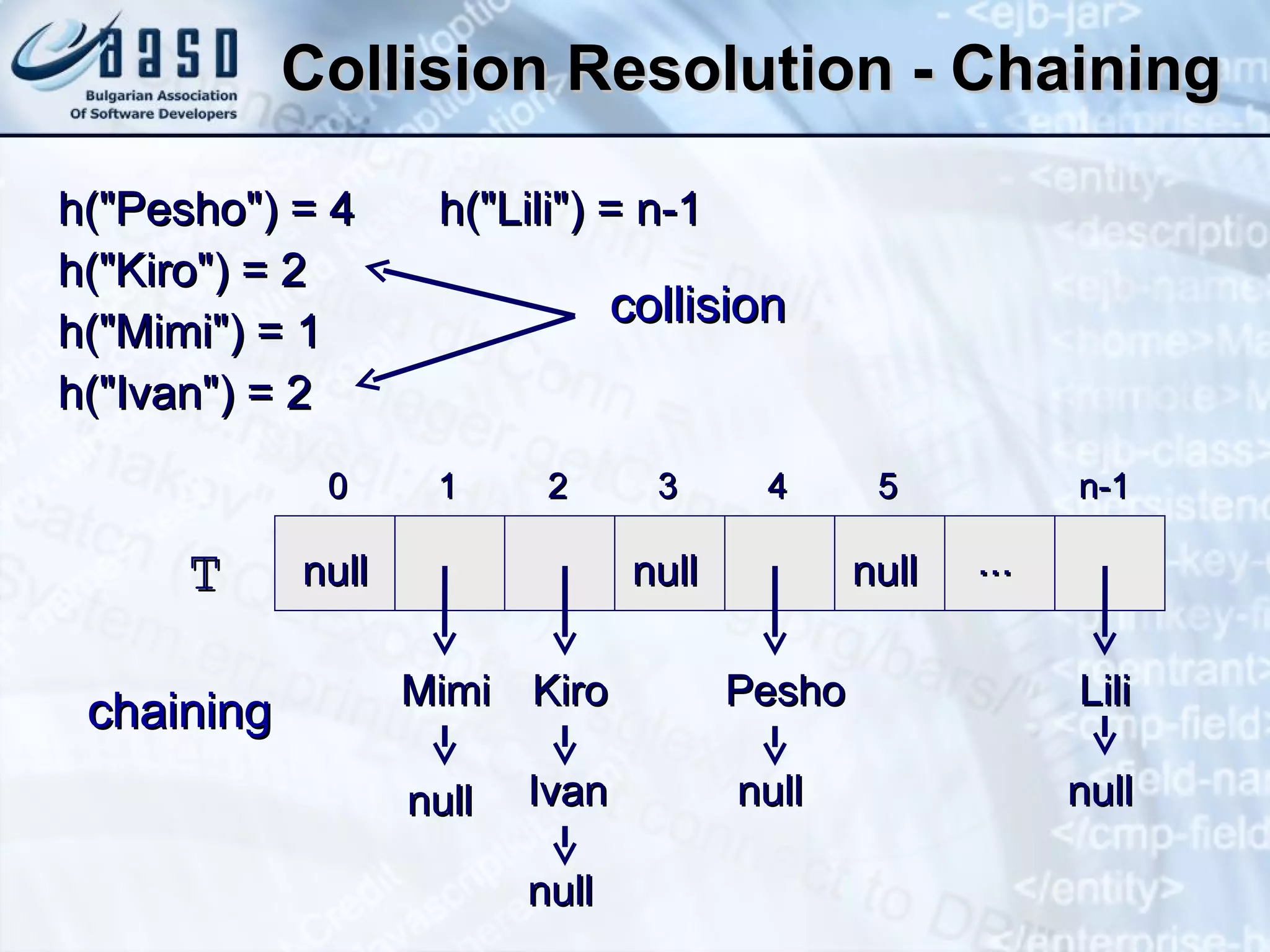
Collisions in Hash Tables Collision  is the situation when different keys can have the same hash value h(k 1 ) = h(k 2 ) for k 1   ≠ k 2 When the number of  collisions  is sufficiently small, the  hash tables  work quite well (fast) Several collisions resolution strategies Chaining in a list, re-hashing, using the neighboring slots (linear probing), ...
Collision Resolution - Chaining   h( &quot;Pesho&quot; ) =  4 h( &quot;Lili&quot; ) =  n-1 h( &quot;Kiro&quot; ) =  2   h(&quot;Mimi&quot;) = 1 h(&quot;Ivan&quot;) = 2    null T 0 1 2 3 4 5 n-1 null ... null chaining Kiro Ivan collision null Mimi null Lili null Pesho null
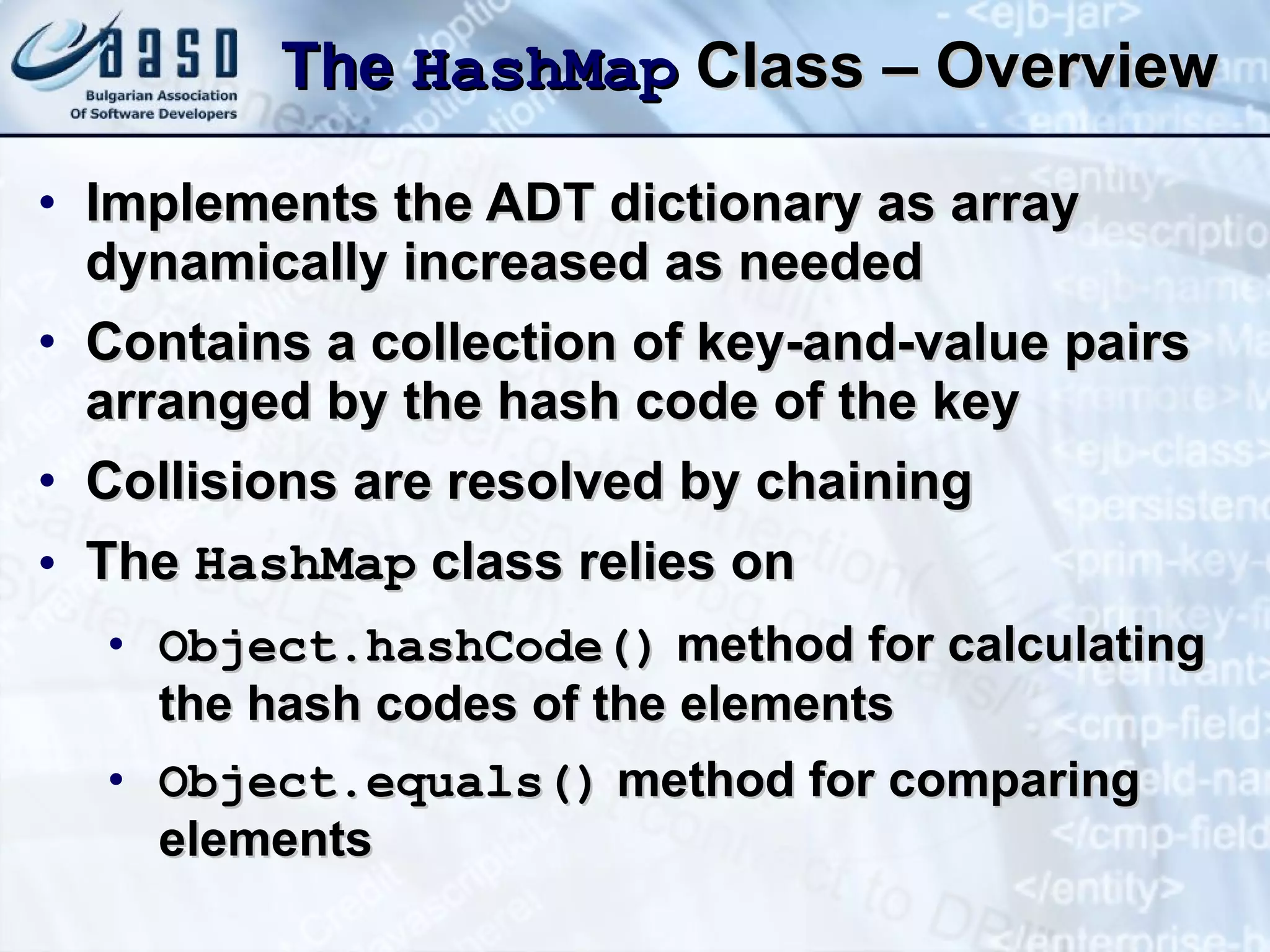
Using the Hash Map  class
The  Hash Map  Class – Overview Implements the ADT dictionary as array dynamically increased as needed Contains a collection of key-and-value pairs arranged by the hash code of the key Collisions are resolved by chaining The  Hash Map  class relies on Object. h ashCode()  method for calculating the hash codes of the elements Object. equals( )  method for comparing elements
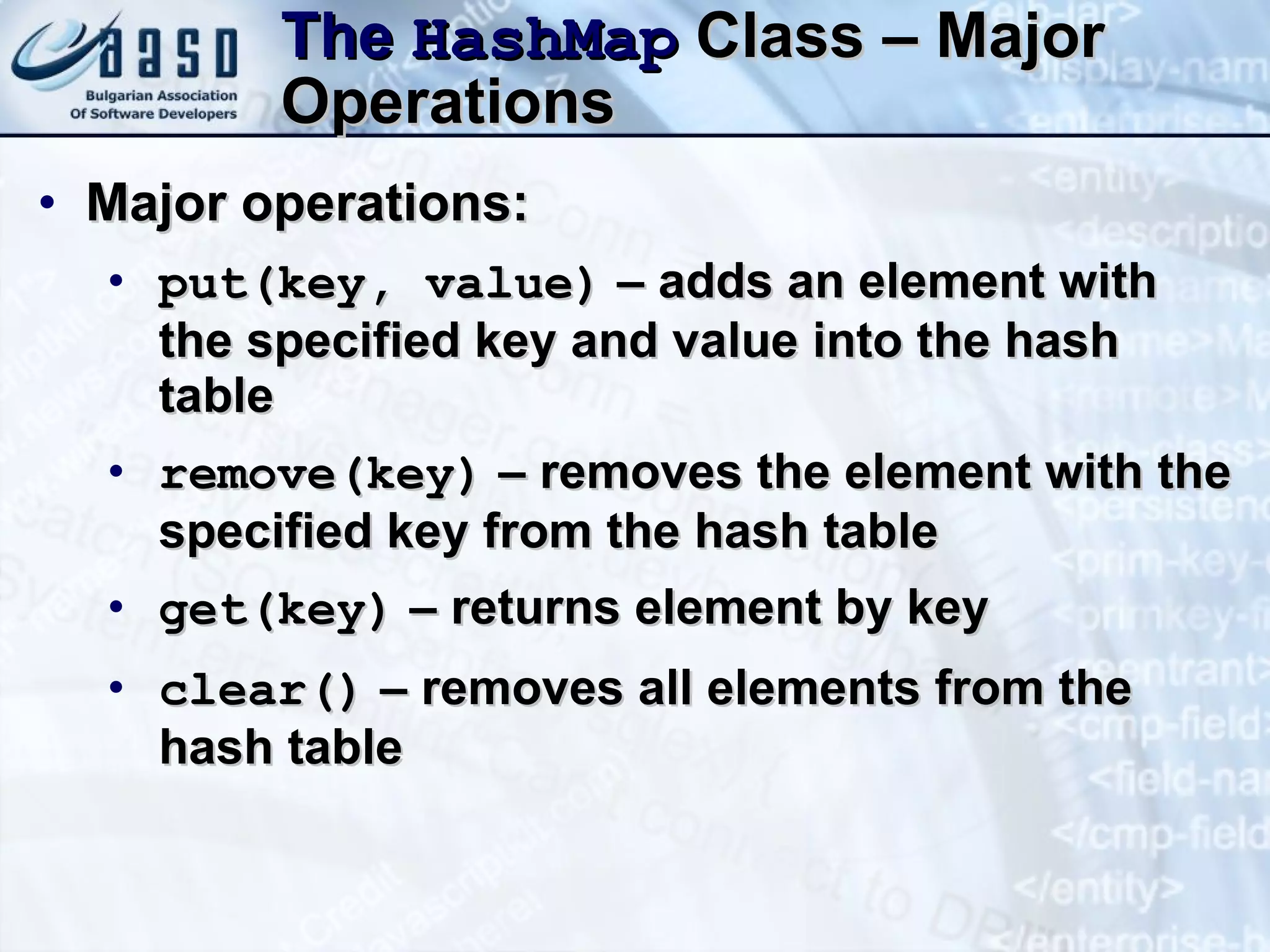
The  Hash Map  Class – Major Operations Major operations: put (key , value)  – adds an element with the specified key and value into the hash table remove(key )  – removes the element with the specified key from the hash table get(key )  – returns element by key clear()  – removes all elements from the hash table
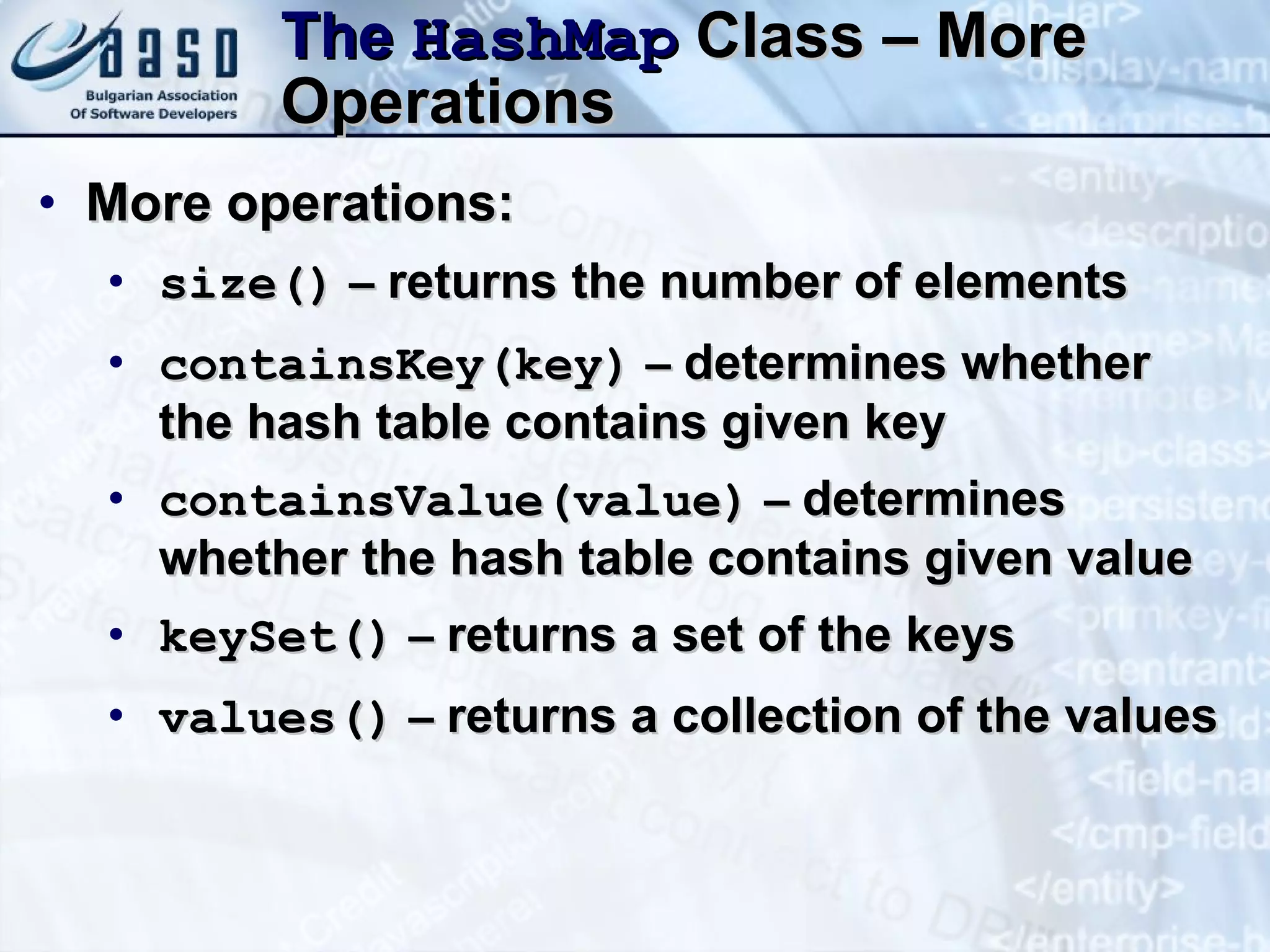
The  Hash Map  Class – More Operations More operations: size()  –  returns the number of elements c ontains Key (key )  –  determines whether the hash table contains given key c ontainsValue(value)  –  determines whether the hash table contains given value keySet( )  –  returns a set of the keys values()  –  returns a collection of the values
Examples Using the  HashMap  Class
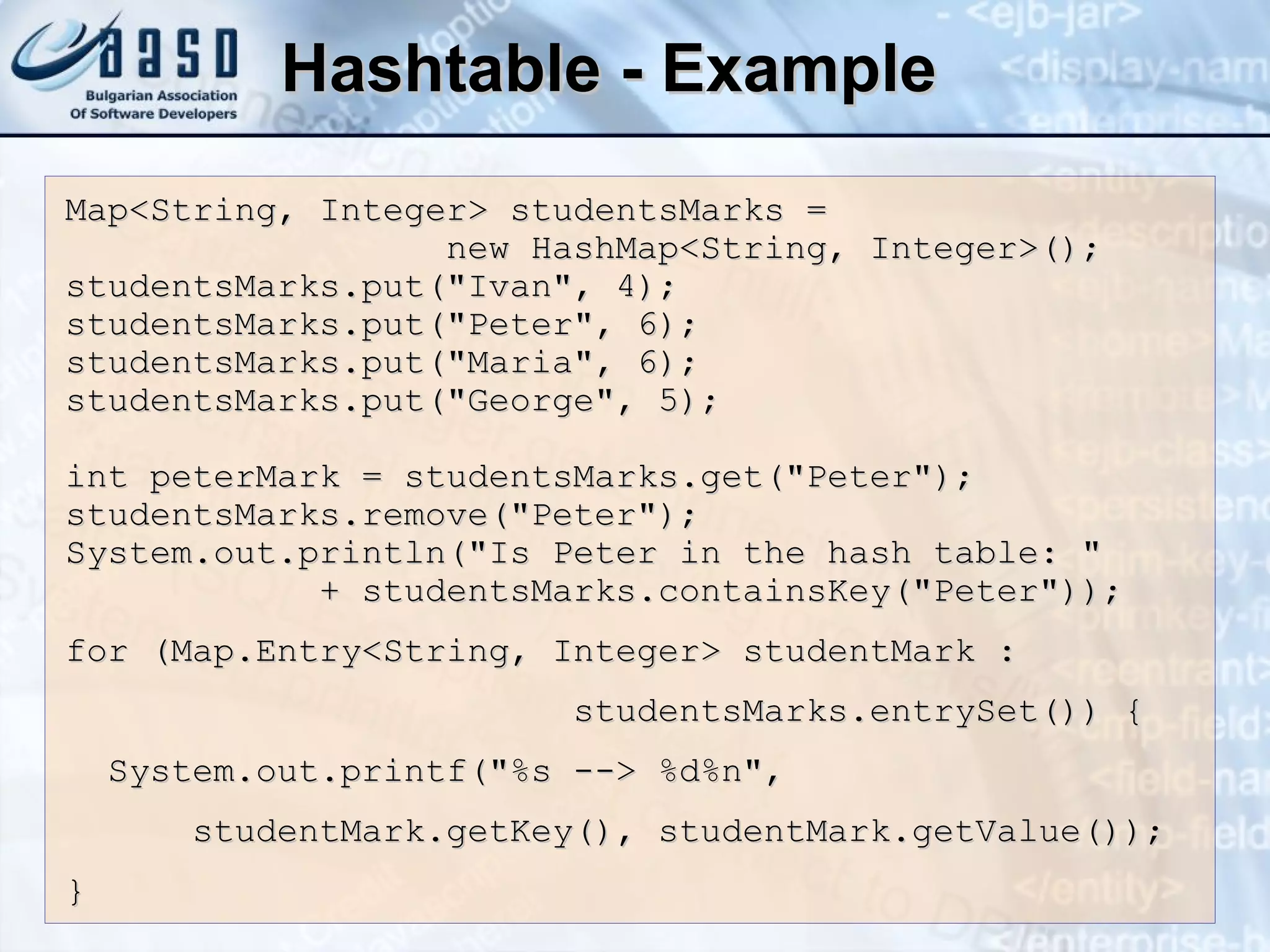
Hashtable - Example Map<String, Integer> studentsMarks = new HashMap<String, Integer>(); studentsMarks.put(&quot;Ivan&quot;, 4); studentsMarks.put(&quot;Peter&quot;, 6); studentsMarks.put(&quot;Maria&quot;, 6); studentsMarks.put(&quot;George&quot;, 5); int peterMark = studentsMarks.get(&quot;Peter&quot;); studentsMarks.remove(&quot;Peter&quot;); System.out.println(&quot;Is Peter in the hash table: &quot; + studentsMarks.containsKey(&quot;Peter&quot;)); for (Map.Entry<String, Integer> studentMark : studentsMarks.entrySet()) { System.out.printf(&quot;%s --> %d%n&quot;, studentMark.getKey(), studentMark.getValue()); }
Live Demo Using the  HashMap  Class
Counting Words in a Text String s = &quot;Welcome to our Java course. In this &quot; + &quot;course you will learn how to write simple &quot; + &quot;programs in Java&quot;; String[] words = s.split(&quot;[ ,.]&quot;); Map<String, Integer> wordsCount = new HashMap<String, Integer>(); for (String word : words)  if (!&quot;&quot;.equalsIgnoreCase(word)) { int count = 1; if (wordsCount.containsKey(word))  count += wordsCount.get(word); wordsCount.put(word, count); } for (String word : wordsCount.keySet()) System.out.printf(&quot;%s --> %d%n&quot;, word, wordsCount.get(word));
Live Demo Counting Words in a Text
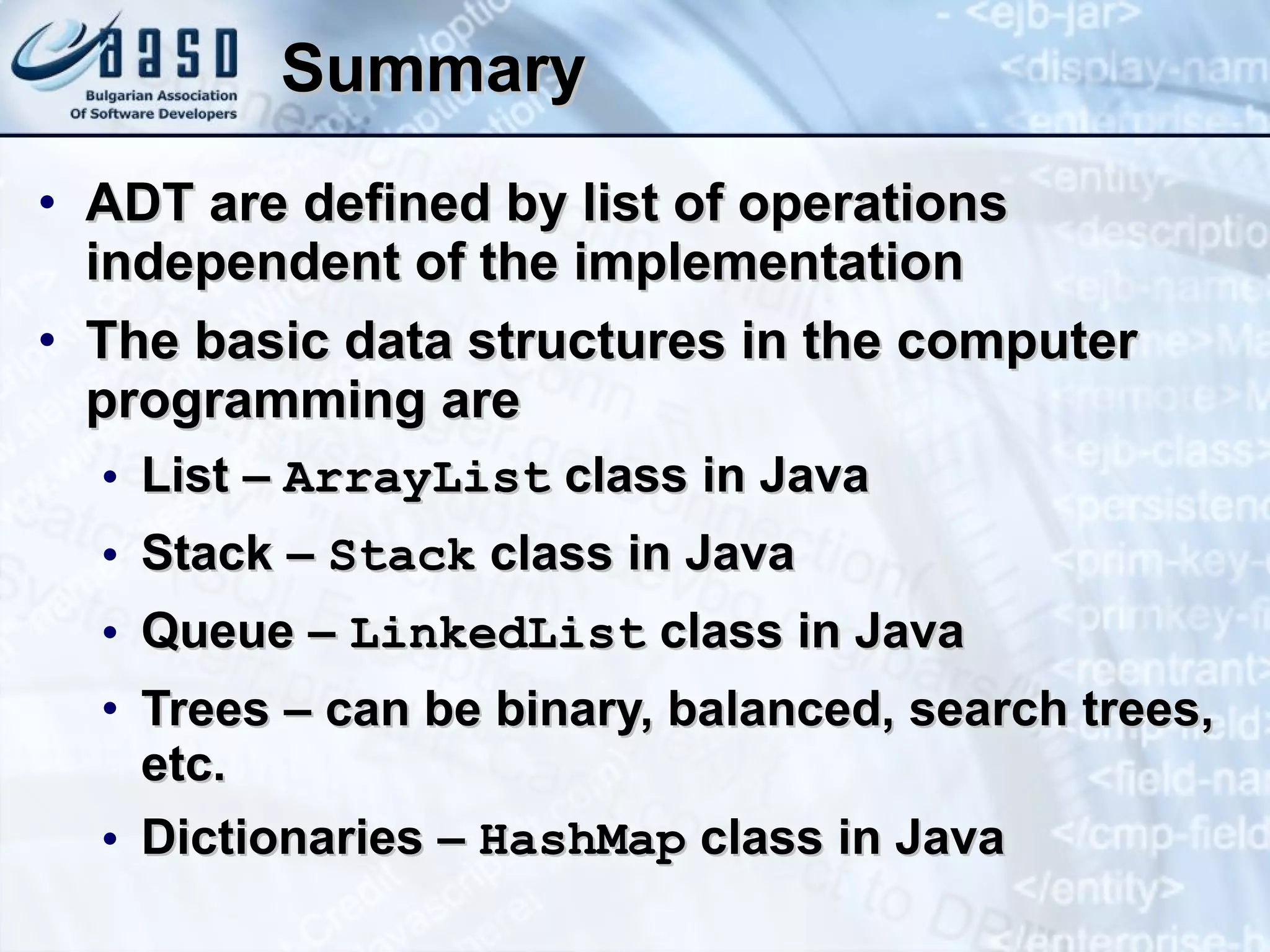
Summary ADT are defined by list of operations independent of the implementation The basic data structures in the computer programming are List –  ArrayList  class in Java Stack –  Stack  class in Java Queue –  LinkedList   class in Java Trees – can be binary, balanced, search trees, etc. Dictionaries –  Hash Map  class in Java
Basic Data Structures Questions?
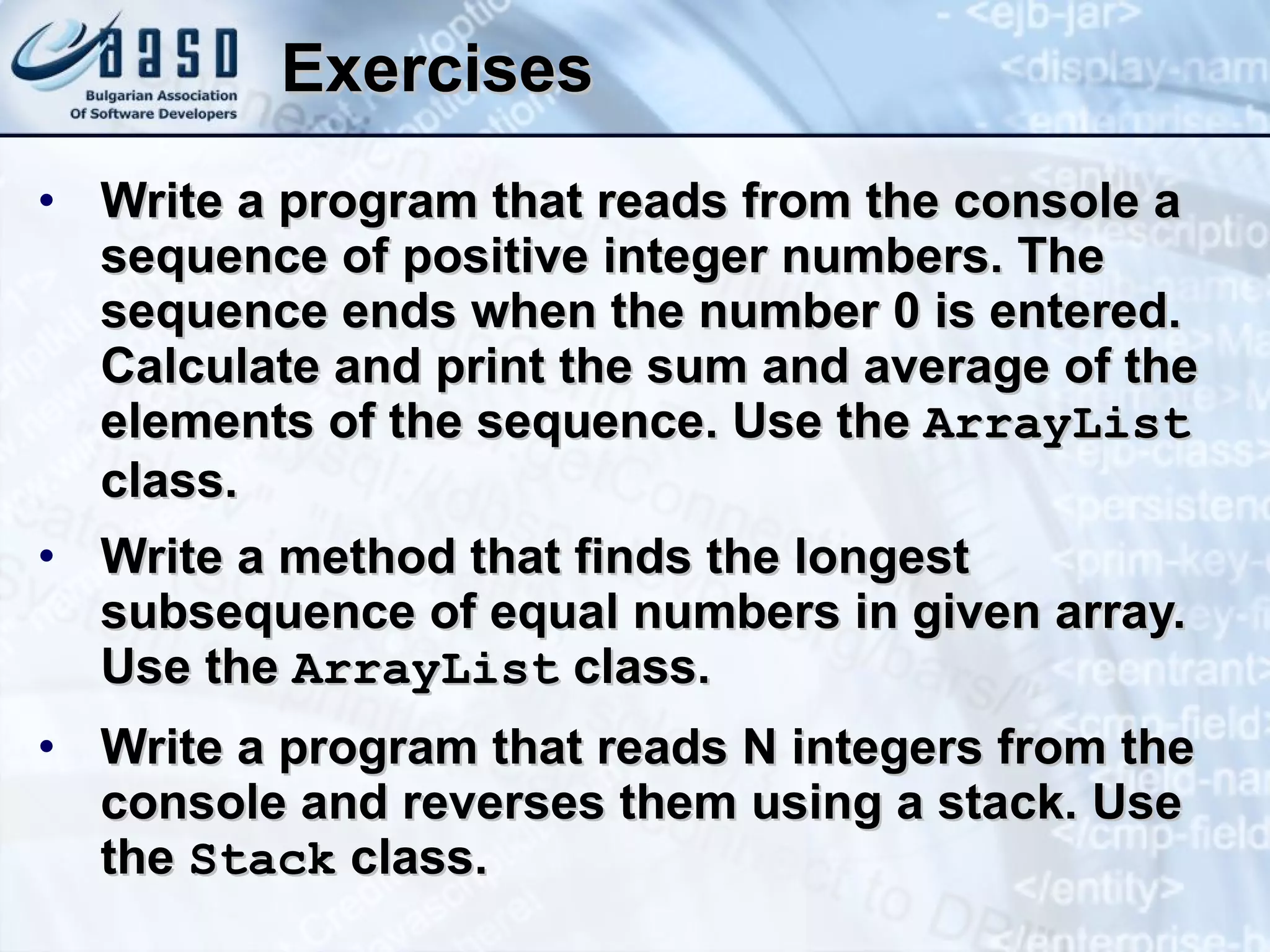
Exercises Write a program that reads from the console a sequence of positive integer numbers. The sequence ends when the number 0 is entered. Calculate and print the sum and average of the elements of the sequence. Use the  ArrayList  class. Write a method that finds the longest subsequence of equal numbers in given array. Use the  ArrayList  class. Write a program that reads N integers from the console and reverses them using a stack. Use the  Stack  class.
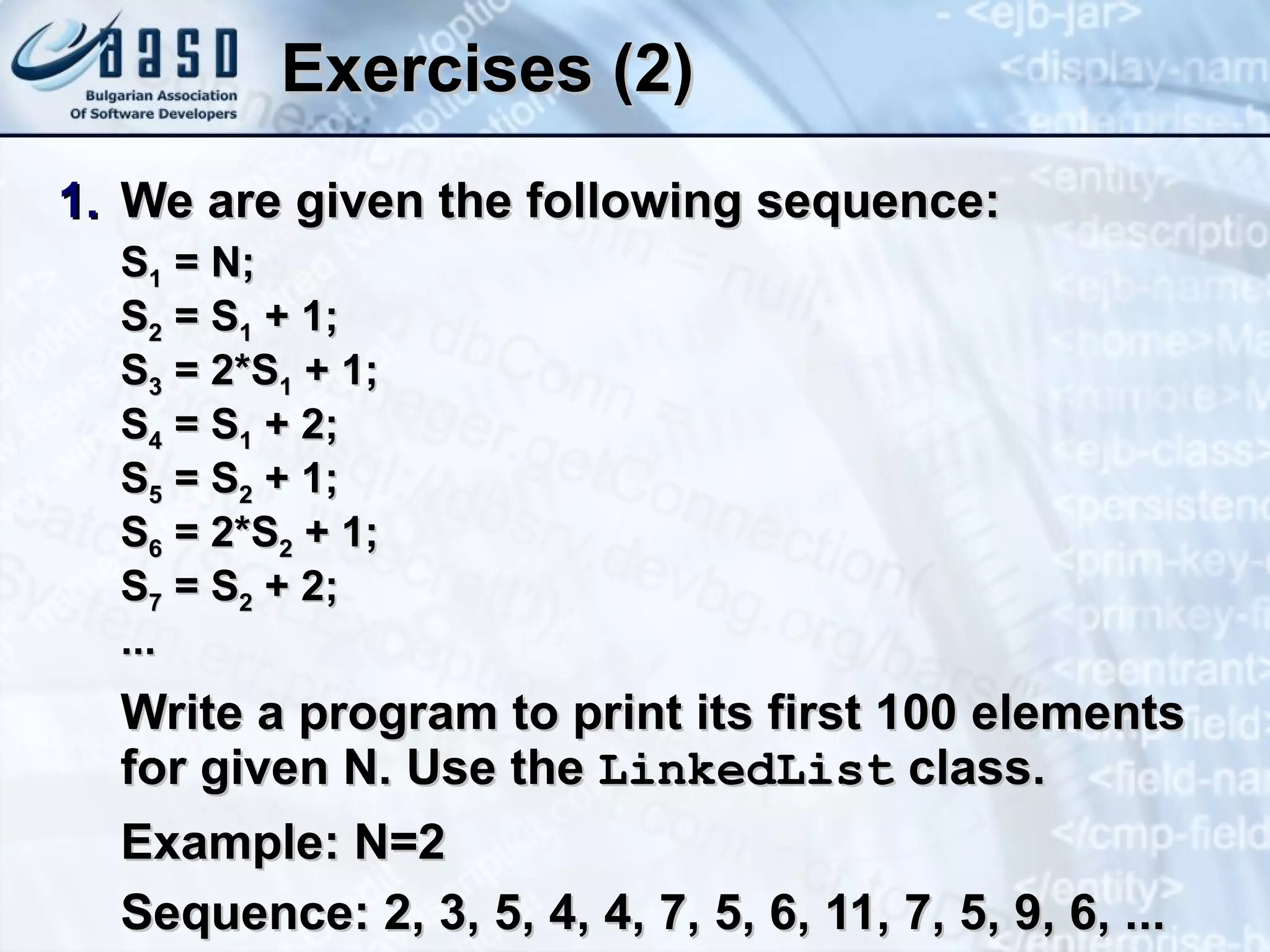
Exercises (2) We are given the following sequence: S 1  = N; S 2  = S 1  + 1; S 3  = 2*S 1  + 1; S 4  = S 1  + 2; S 5  = S 2  + 1; S 6  = 2*S 2  + 1; S 7  = S 2  + 2; ... Write a program to print its first 100 elements for given N. Use the  LinkedList  class. Example: N=2 Sequence: 2, 3, 5, 4, 4, 7, 5, 6, 11, 7, 5, 9, 6, ...
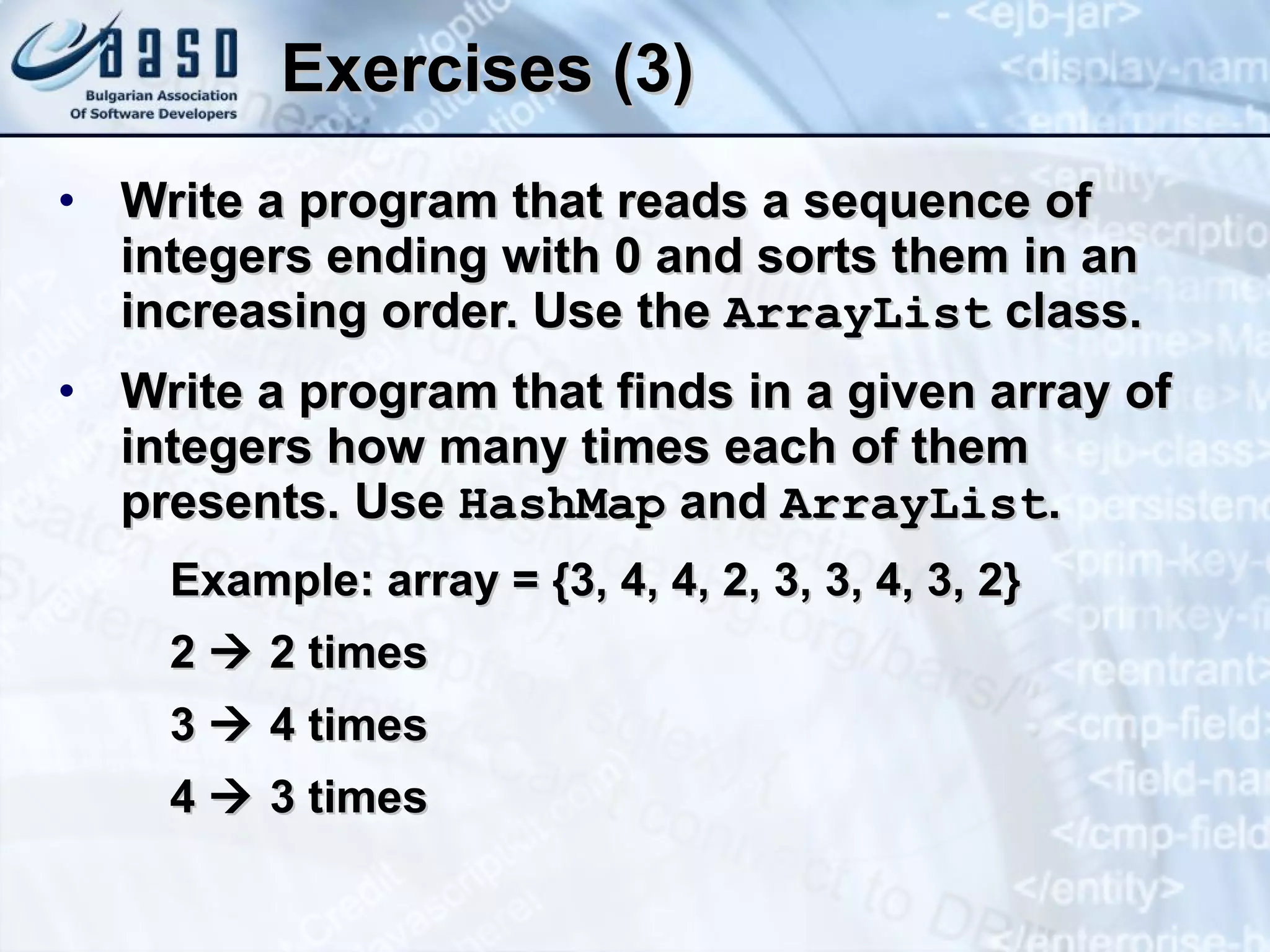
Exercises (3) Write a program that reads a sequence of integers ending with 0 and sorts them in an increasing order. Use the  ArrayList  class. Write a program that finds in a given array of integers how many times each of them presents. Use  Hash Map  and  ArrayList . Example: array = {3, 4, 4, 2, 3, 3, 4, 3, 2} 2    2 times 3    4 times 4    3 times
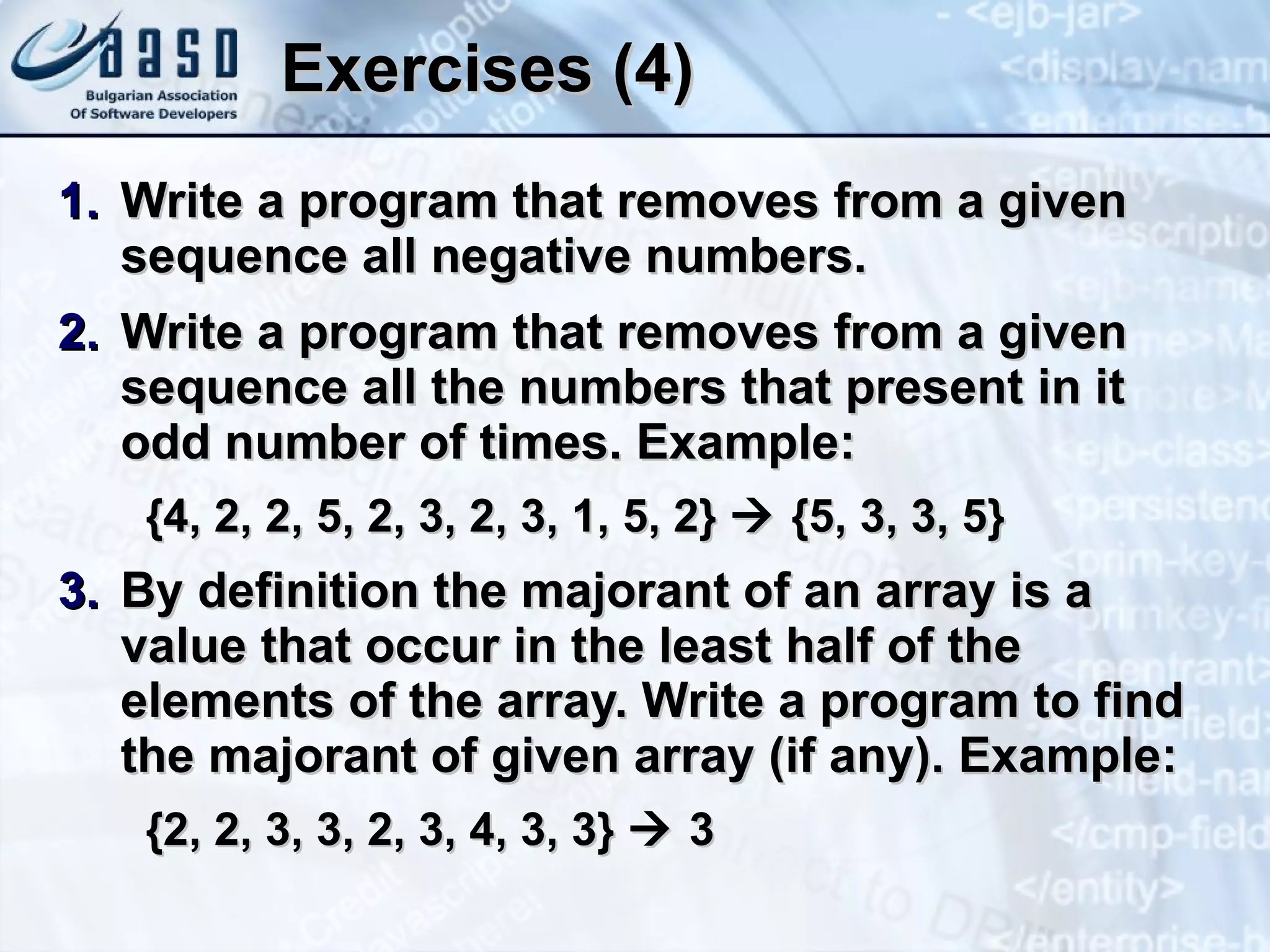
Exercises (4) Write a program that removes from a given sequence all negative numbers. Write a program that removes from a given sequence all the numbers that present in it odd number of times. Example: {4, 2, 2, 5, 2, 3, 2, 3, 1, 5, 2}    {5, 3, 3, 5} By definition the majorant of an array is a value that occur in the least half of the elements of the array. Write a program to find the majorant of given array (if any). Example: {2, 2, 3, 3, 2, 3, 4, 3, 3}    3
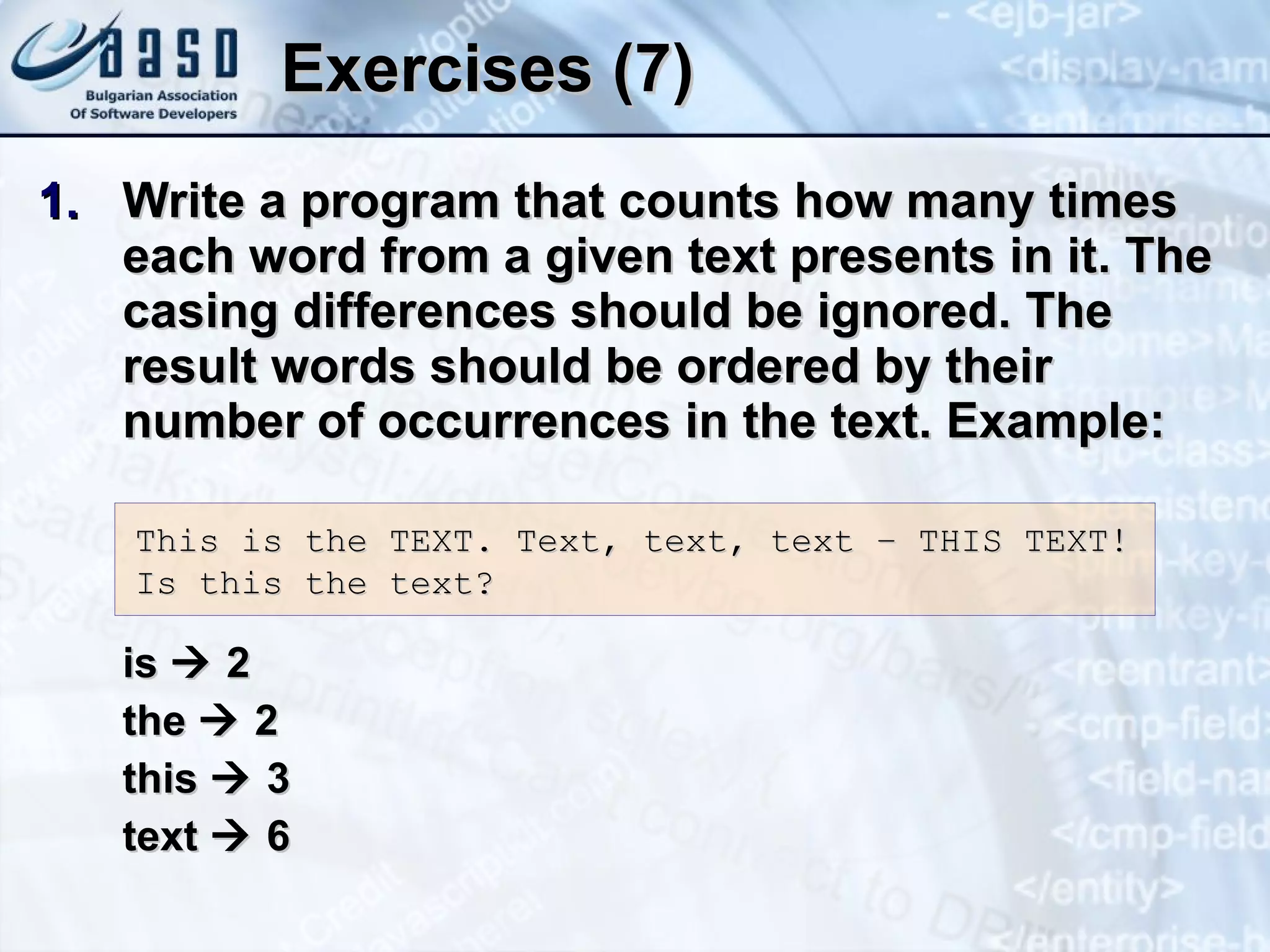
Exercises (7) Write a program that counts how many times each word from a given text presents in it. The casing differences should be ignored. The result words should be ordered by their number of occurrences in the text. Example: is    2 the    2 this    3 text    6 This is the TEXT. Text, text, text – THIS TEXT! Is this the text?
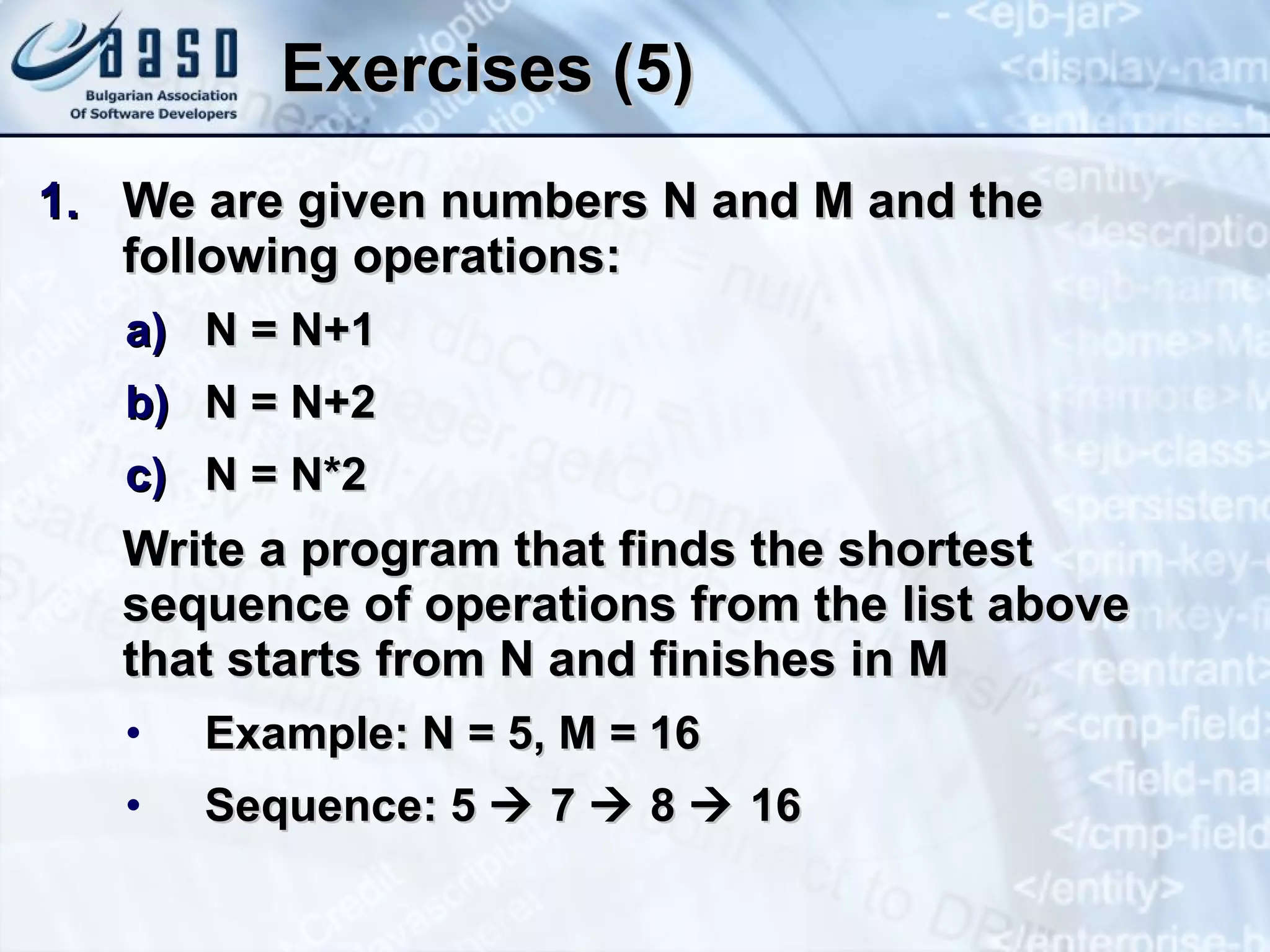
Exercises (5) We are given numbers N and M and the following operations: N = N+1 N = N+2 N = N*2 Write a program that finds the shortest sequence of operations from the list above that starts from N and finishes in M Example: N = 5, M = 16 Sequence: 5    7    8    16
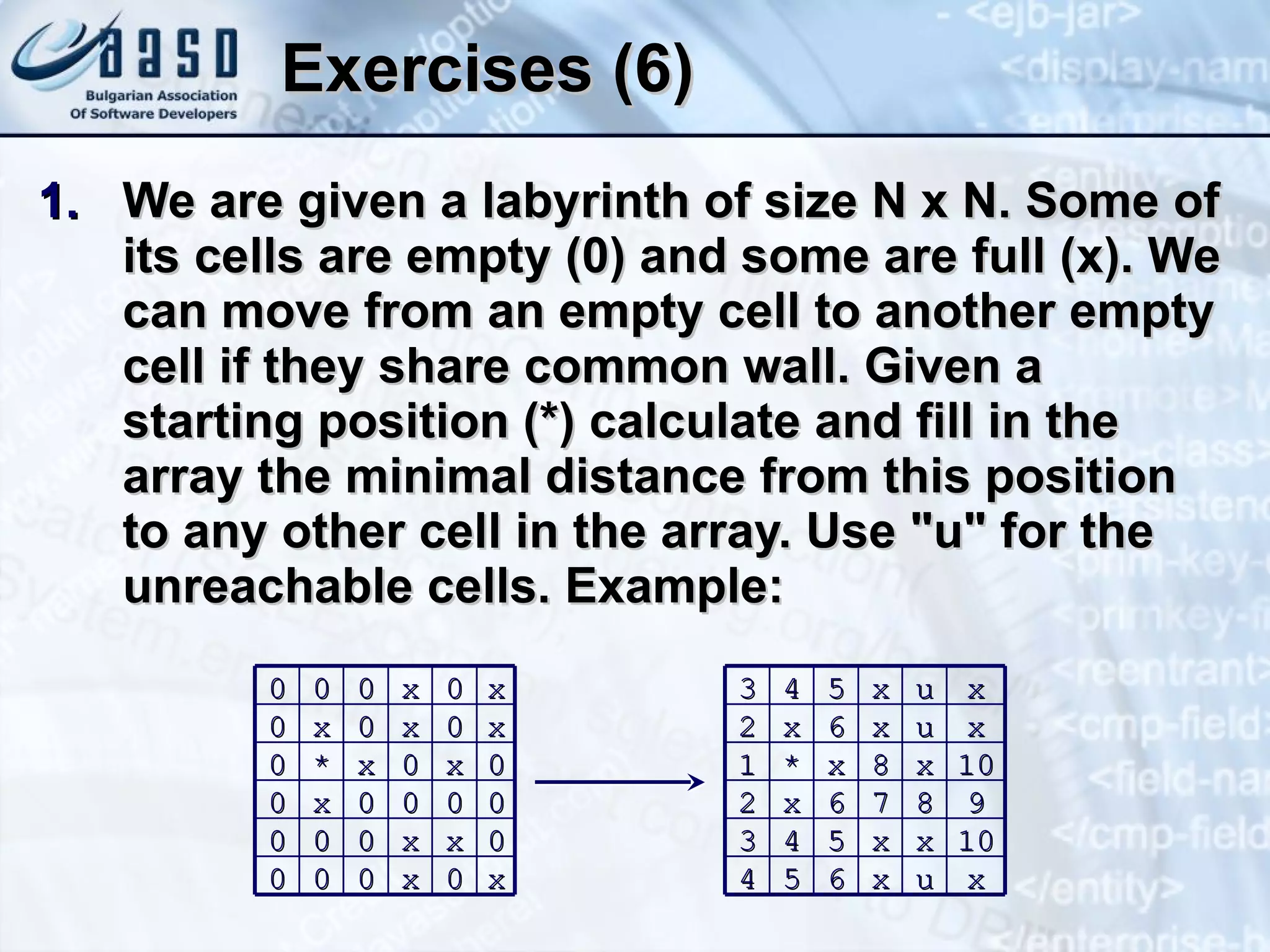
Exercises (6) We are given a labyrinth of size N x N. Some of its cells are empty (0) and some are full (x). We can move from an empty cell to another empty cell if they share common wall. Given a starting position (*) calculate and fill in the array the minimal distance from this position to any other cell in the array. Use &quot;u&quot; for the unreachable cells. Example: 0 0 0 x 0 x 0 x 0 x 0 x 0 * x 0 x 0 0 x 0 0 0 0 0 0 0 x x 0 0 0 0 x 0 x 3 4 5 x u x 2 x 6 x u x 1 * x 8 x 10 2 x 6 7 8 9 3 4 5 x x 10 4 5 6 x u x

Basic data-structures-v.1.1

  • 1.
    Lists, Stacks, Queues,Trees, Hash Tables Basic Data Structures
  • 2.
    Contents Abstract DataTypes (ADT) Lists – ArrayList Class Stacks – Stack Class Queues – Queue Class Trees – Terminology and Types Dictionaries – HashMap Class
  • 3.
    Abstract Data TypesAn Abstract Data Type (ADT) is a data type together with the operations, whose properties are specified independently of any particular implementation ADT are set of definitions of operations (like the interfaces in Java) Can have several different implementations Different implementations can have different efficiency
  • 4.
    Basic Data StructuresLinear structures Lists: Variable-size Stacks: LIFO (last in first out) structure Queues: FIFO (first in first out) structure Trees Dictionaries (maps) Contain pairs (key, value) Hash tables: Unordered lists which use a ‘hash function’ to insert and search
  • 5.
    What Is aList?
  • 6.
    The List ADTList is linear data structure (container) that contains a sequence of elements (objects) Has variable size Objects are arranged linearly Can be implemented in several ways Statically (using array) Dynamically (linked implementation) Using the ArrayList class
  • 7.
  • 8.
    Static List Implementedby an array Provide direct access by index Usually has limited capacity Resizing is slow operation Slow insert and deletion 0 1 2 3 4 5 6 7 8 11 7 18 14 L 5 2 33 47 3
  • 9.
    Linked List Dynamic(pointer-based) implementation Different forms Singly-linked and doubly-linked Sorted and Unsorted Singly-linked List - each “Object” has “ value ” and “ next ” fields 11 next 7 next 18 next 14 next head null
  • 10.
    Linked List (2)Doubly-linked List - each “Object” has “ value ”, “ next ” and “ prev ” fields 11 next prev head tail 7 next prev 18 next prev 14 next prev null null
  • 11.
  • 12.
    The java.util.ArrayList Class Implements the list data structure using an array whose size is dynamically increased as needed Allocates in advance buffer space for new elements (for better performance) Insertion methods: add(Object) – adds an object at the end add (index , Object) – inserts an object to the list at a specified position size() – returns the number of elements
  • 13.
    The ArrayList Class Deletion methods: remove(Object) – removes the first occurrence of a specific object remove( index) – removes the element at the specified position clear() – removes all elements Other supported methods: c ontains() , t oArray()
  • 14.
    The ArrayList Class(2) ArrayList can contain any data type Elements are added directly Typecasting is required when extracting elements unless we use Generics Converting to array List list = new ArrayList(); list. a dd(5); // Add integer value list. a dd(&quot;some string&quot;); // Add string value int firstElement = ((Integer)(list.get(0))).intValue(); String secondElement = (String)list.get(1); Integer[] arr = list.toArray(new Integer[list.size()]);
  • 15.
    What are GenericsGenerics are classes or interfaces that can be instantiated with a variety of types They have 1 or more formal type parameters When using a generic you specify an actual type List<String> list = new ArrayList<String>(); String s = new String(&quot; li1 &quot;); list.add(s); list.add(5); // This will cause compile time error Specifies that String is actual type of this List 5 is not a String
  • 16.
    Primes[n..m] – ExampleFind all prime numbers in a specified interval public static ArrayList<Integer> getPrimes(int start, int end) { List<Integer> primesList = new ArrayList<Integer>(); for (int num = start; num <= end; num++) { boolean prime = true; for (int div = 2; div <= Math.sqrt(num); div++) { if (num % div == 0) { prime = false; break; } } if (prime) { primesList.add(num); } } return primesList; }
  • 17.
  • 18.
    Union and Intersectionof Lists – Example public static Integer[] union(Integer[] firstArr, Integer[] secondArr) { List<Integer> union = new ArrayList<Integer>(); for (Integer item : firstArr) { union.add(item); } for (Integer item : secondArr) { if (!union.contains(item)) { union.add(item); } } return union.toArray(new Integer[union.size()]); } //Example continues...
  • 19.
    Union and Intersectionof Lists – Example(2) public static Integer[] intersect(Integer[] firstArr, Integer[] secondArr) { List<Integer> intersect = new ArrayList<Integer>(); for (Integer item : firstArr) { if (Arrays.binarySearch(secondArr, item) >= 0) { intersect.add(item); } } return intersect.toArray( new Integer[intersect.size()]); }
  • 20.
  • 21.
    What is aStack?
  • 22.
    The Stack ADTLIFO (last in first out) structure Elements inserted (push) at “top” Elements removed (pop) from “top” Can be implemented in several ways Statically (using array) Dynamically (linked implementation) Using the Stack class
  • 23.
    Static Stack Array-based(static) implementation Usually has limited capacity Has top variable, pointing to the top IsEMPTY( S ) Check if S.top = -1 0 1 2 3 4 5 6 7 8 11 7 18 14 S top
  • 24.
    Linked Stack Dynamic(pointer-based) implementation Each “object” has “value” and “next” fields Dynamically create and delete objects 11 next 7 next 18 next 14 next top null
  • 25.
    Using the Stack class
  • 26.
    The Stack Class – Overview Implements the stack data structure using an array whose size is dynamically increased as needed Major methods: push(object) – inserts elements to the stack pop() – removes and returns the top element from the stack peek() – returns the top element of the stack without removing it
  • 27.
    The Stack Class – More Methods Other methods: size() – returns the number of elements clear() – removes all elements contains(object) – determines whether given element is in the stack toArray() – converts the stack to array
  • 28.
    Examples Using the Stack class
  • 29.
    Stack –Example Using push() , pop() and peek() methods public static void main(String[] args) { Stack<String> stack = new Stack<String>(); stack.push(&quot;1. Ivan&quot;); stack.push(&quot;2. Nikolay&quot;); stack.push(&quot;3. Maria&quot;); stack.push(&quot;4. George&quot;); System.out.println(&quot;Top = &quot; + stack.peek()); while (stack.size() > 0) { String personName = stack.pop(); System.out.println(personName); } }
  • 30.
    Live Demo Usingthe Stack class
  • 31.
    Matching Brackets –Example We are given an arithmetical expression with brackets that can be nested. We want to extract all parts of the expression that are closed in brackets. Example: 1 + (3 + 2 - (2+3) * 4 - ((3+1)*(4-2))) Result: (2+3) (3+1) (4-2) ((3+1)*(4-2)) (3 + 2 - (2+3) * 4 - ((3+1)*(4-2)))
  • 32.
    Matching Brackets –Solution with a Stack String expression = &quot;1 + (3 + 2 - (2+3) * 4 - ((3+1)*(4-2)))&quot;; Stack<Integer> stack = new Stack<Integer>(); for (int i = 0; i < expression.length(); i++) { char ch = expression.charAt(i); if (ch == '(') { stack.push(i); } else if (ch == ')') { int startIndex = (int) stack.pop(); String contents = expression.substring(startIndex, i + 1); System.out.println(contents); } }
  • 33.
  • 34.
    What is aQueue?
  • 35.
    The Queue ADTFIFO (first in first out) structure Elements inserted at tail (enqueue) Elements removed from head ( dequeue ) Useful in many situations Processing jobs, print queues, messages Can be implemented in several ways Statically (using array) Dynamically (using pointers) Using the LinkedList class
  • 36.
    Static Queue Static(array-based) implementation Queue has limited (fixed) capacity Implement as a “circular array” Maintain Q.Capacity and Q.Length Has head and tail variables, pointing to the head and the tail 0 1 2 3 4 5 6 7 8 11 7 18 14 Q head tail
  • 37.
    Linked Queue Dynamic(pointer-based) implementation Each “object” has “ value ” and “ next ” fields Dynamically create and delete objects 11 next 7 next 18 next 14 next head tail null
  • 38.
    Using the LinkedList class
  • 39.
    The LinkedList Class – Overview Implements the queue data structure using a doubly-linked list Major methods: offer(object) – adds an object to the end of the queue poll() – removes and returns the object at the beginning of the queue peek() – returns the object at the beginning of the queue without removing it
  • 40.
    The LinkedList Class – More Methods Other methods: size() – gets the number of elements contained in the queue clear() – removes all elements from the queue contains(object) – determines whether given element is in the queue toArray () – converts the queue to array
  • 41.
    Examples Using the LinkedList class
  • 42.
    Queue – Example Using offer () and poll () methods public static void main(String[] args) { Queue<String> queue = new LinkedList<String>(); queue.offer(&quot;Message One&quot;); queue.offer(&quot;Message Two&quot;); queue.offer(&quot;Message Three&quot;); queue.offer(&quot;Message Four&quot;); queue.offer(&quot;Message Five&quot;); while (queue.size() > 0) { String msg = queue.poll(); System.out.println(msg); } }
  • 43.
    Live Demo Usingthe LinkedList class
  • 44.
    Sequence N, N+1,2*N We are given the sequence: S = N, N+1, 2*N, N+2, 2*(N+1), 2*N+1, 4*N, ... Write a program to find the first index of given number P Example: N = 3, P = 16 S = 3, 4, 6, 5, 8, 7, 12, 6, 10, 9, 16, 8, 14, ... Index of P = 11 +1 *2 +1 *2 +1 *2
  • 45.
    Sequence – Solutionint n = 3; int p = 16; Queue<Integer> queue = new LinkedList<Integer>(); queue.offer(n); int index = 0; while (queue.size() > 0) { index++; int current = queue.poll(); if (current == p) { System.out.println(&quot;Index = &quot; + index); return; } queue.offer(current + 1); queue.offer(2 * current); }
  • 46.
    Live Demo SequenceN, N+1, 2*N
  • 47.
    Definition, Types ofTrees What is Tree?
  • 48.
    Trees Terminology Node,edge, root, child, children, siblings, parent, ancestor, descendant, predecessor, successor, internal node, leaf, depth, height 17 15 14 9 6 5 8 Height = 2 Depth 0 Depth 1 Depth 2
  • 49.
    Binary Trees Binarytrees: most used form Each node has at most 2 children 10 17 15 9 6 5 8 “ right child” “ left subtree” “ root” “ left child”
  • 50.
    Binary Trees Traversals Traversal can be done in pre-order, in-order and post-order Pre-order: left, root, right – 6, 9, 12, 17, 19, 25 In-order: root, left, right – 17, 9, 6, 12, 19, 25 Post-order: left, right, root – 6, 12, 9, 25, 19, 17 17 19 9 6 12 25
  • 51.
    Binary Search TreesBinary search trees are ordered A binary tree in which binary-search-tree property holds: For each node x in the tree All the elements of the left subtree of x are ≤ x All the elements of the right subtree of x are > x Binary search trees can be balanced Balanced trees has low height
  • 52.
    Binary Search TreesExample of binary search tree If the tree is balanced, adding, searching, and deletion operations take approx. log( n ) steps 17 19 9 6 12 25
  • 53.
    What is aDictionary (Map)?
  • 54.
    The Dictionary (Map)ADT The ADT &quot;dictionary&quot; maps key to values Also known as &quot;map&quot; or &quot;associative array&quot; Contains a set of (key, value) pairs Dictionary ADT operations: ADD(key, value) FIND_BY_KEY(key)  value DELETE(key) Can be implemented in several ways List, array, hash table, balanced tree, ...
  • 55.
    What is aHash Table?
  • 56.
    Hash Table Ahash table is an array that holds a set of (key, value) pairs The process of mapping a key to a position in a table is called hashing 0 1 2 3 4 5 m-1 ... ... ... ... T h( k ) ... ... ...
  • 57.
    Hash Functions andHashing A hash function maps keys to positions It is denoted by h The hash table has m slots, indexed from 0 to m-1 For any value k in the key range and some hash function h h( k ) = i 0  i < m 0 1 2 3 4 5 m-1 ... ... ... ... T h( k ) ... ... ...
  • 58.
    Mapping Functions Perfecthashing function (PHF) h(k) : one-to-one mapping from each key k to integers in [ 0 , m -1 ] The PHF maps each key to a distinct integer within some manageable range Finding a perfect hashing function is in most cases impossible More realistically Hash functions h(k) map most of the keys onto unique integers, but not all
  • 59.
    Collisions in HashTables Collision is the situation when different keys can have the same hash value h(k 1 ) = h(k 2 ) for k 1 ≠ k 2 When the number of collisions is sufficiently small, the hash tables work quite well (fast) Several collisions resolution strategies Chaining in a list, re-hashing, using the neighboring slots (linear probing), ...
  • 60.
    Collision Resolution -Chaining h( &quot;Pesho&quot; ) = 4 h( &quot;Lili&quot; ) = n-1 h( &quot;Kiro&quot; ) = 2 h(&quot;Mimi&quot;) = 1 h(&quot;Ivan&quot;) = 2 null T 0 1 2 3 4 5 n-1 null ... null chaining Kiro Ivan collision null Mimi null Lili null Pesho null
  • 61.
    Using the HashMap class
  • 62.
    The HashMap Class – Overview Implements the ADT dictionary as array dynamically increased as needed Contains a collection of key-and-value pairs arranged by the hash code of the key Collisions are resolved by chaining The Hash Map class relies on Object. h ashCode() method for calculating the hash codes of the elements Object. equals( ) method for comparing elements
  • 63.
    The HashMap Class – Major Operations Major operations: put (key , value) – adds an element with the specified key and value into the hash table remove(key ) – removes the element with the specified key from the hash table get(key ) – returns element by key clear() – removes all elements from the hash table
  • 64.
    The HashMap Class – More Operations More operations: size() – returns the number of elements c ontains Key (key ) – determines whether the hash table contains given key c ontainsValue(value) – determines whether the hash table contains given value keySet( ) – returns a set of the keys values() – returns a collection of the values
  • 65.
    Examples Using the HashMap Class
  • 66.
    Hashtable - ExampleMap<String, Integer> studentsMarks = new HashMap<String, Integer>(); studentsMarks.put(&quot;Ivan&quot;, 4); studentsMarks.put(&quot;Peter&quot;, 6); studentsMarks.put(&quot;Maria&quot;, 6); studentsMarks.put(&quot;George&quot;, 5); int peterMark = studentsMarks.get(&quot;Peter&quot;); studentsMarks.remove(&quot;Peter&quot;); System.out.println(&quot;Is Peter in the hash table: &quot; + studentsMarks.containsKey(&quot;Peter&quot;)); for (Map.Entry<String, Integer> studentMark : studentsMarks.entrySet()) { System.out.printf(&quot;%s --> %d%n&quot;, studentMark.getKey(), studentMark.getValue()); }
  • 67.
    Live Demo Usingthe HashMap Class
  • 68.
    Counting Words ina Text String s = &quot;Welcome to our Java course. In this &quot; + &quot;course you will learn how to write simple &quot; + &quot;programs in Java&quot;; String[] words = s.split(&quot;[ ,.]&quot;); Map<String, Integer> wordsCount = new HashMap<String, Integer>(); for (String word : words) if (!&quot;&quot;.equalsIgnoreCase(word)) { int count = 1; if (wordsCount.containsKey(word)) count += wordsCount.get(word); wordsCount.put(word, count); } for (String word : wordsCount.keySet()) System.out.printf(&quot;%s --> %d%n&quot;, word, wordsCount.get(word));
  • 69.
    Live Demo CountingWords in a Text
  • 70.
    Summary ADT aredefined by list of operations independent of the implementation The basic data structures in the computer programming are List – ArrayList class in Java Stack – Stack class in Java Queue – LinkedList class in Java Trees – can be binary, balanced, search trees, etc. Dictionaries – Hash Map class in Java
  • 71.
  • 72.
    Exercises Write aprogram that reads from the console a sequence of positive integer numbers. The sequence ends when the number 0 is entered. Calculate and print the sum and average of the elements of the sequence. Use the ArrayList class. Write a method that finds the longest subsequence of equal numbers in given array. Use the ArrayList class. Write a program that reads N integers from the console and reverses them using a stack. Use the Stack class.
  • 73.
    Exercises (2) Weare given the following sequence: S 1 = N; S 2 = S 1 + 1; S 3 = 2*S 1 + 1; S 4 = S 1 + 2; S 5 = S 2 + 1; S 6 = 2*S 2 + 1; S 7 = S 2 + 2; ... Write a program to print its first 100 elements for given N. Use the LinkedList class. Example: N=2 Sequence: 2, 3, 5, 4, 4, 7, 5, 6, 11, 7, 5, 9, 6, ...
  • 74.
    Exercises (3) Writea program that reads a sequence of integers ending with 0 and sorts them in an increasing order. Use the ArrayList class. Write a program that finds in a given array of integers how many times each of them presents. Use Hash Map and ArrayList . Example: array = {3, 4, 4, 2, 3, 3, 4, 3, 2} 2  2 times 3  4 times 4  3 times
  • 75.
    Exercises (4) Writea program that removes from a given sequence all negative numbers. Write a program that removes from a given sequence all the numbers that present in it odd number of times. Example: {4, 2, 2, 5, 2, 3, 2, 3, 1, 5, 2}  {5, 3, 3, 5} By definition the majorant of an array is a value that occur in the least half of the elements of the array. Write a program to find the majorant of given array (if any). Example: {2, 2, 3, 3, 2, 3, 4, 3, 3}  3
  • 76.
    Exercises (7) Writea program that counts how many times each word from a given text presents in it. The casing differences should be ignored. The result words should be ordered by their number of occurrences in the text. Example: is  2 the  2 this  3 text  6 This is the TEXT. Text, text, text – THIS TEXT! Is this the text?
  • 77.
    Exercises (5) Weare given numbers N and M and the following operations: N = N+1 N = N+2 N = N*2 Write a program that finds the shortest sequence of operations from the list above that starts from N and finishes in M Example: N = 5, M = 16 Sequence: 5  7  8  16
  • 78.
    Exercises (6) Weare given a labyrinth of size N x N. Some of its cells are empty (0) and some are full (x). We can move from an empty cell to another empty cell if they share common wall. Given a starting position (*) calculate and fill in the array the minimal distance from this position to any other cell in the array. Use &quot;u&quot; for the unreachable cells. Example: 0 0 0 x 0 x 0 x 0 x 0 x 0 * x 0 x 0 0 x 0 0 0 0 0 0 0 x x 0 0 0 0 x 0 x 3 4 5 x u x 2 x 6 x u x 1 * x 8 x 10 2 x 6 7 8 9 3 4 5 x x 10 4 5 6 x u x

Editor's Notes

  • #2 * 12/04/10 07/16/96 (c) 2005 National Academy for Software Development - http://academy.devbg.org. All rights reserved. Unauthorized copying or re-distribution is strictly prohibited.* ##
  • #3 * 12/04/10 07/16/96 (c) 2005 National Academy for Software Development - http://academy.devbg.org. All rights reserved. Unauthorized copying or re-distribution is strictly prohibited.* ##
  • #6 * 12/04/10 07/16/96 (c) 2005 National Academy for Software Development - http://academy.devbg.org. All rights reserved. Unauthorized copying or re-distribution is strictly prohibited.* ##
  • #8 * 12/04/10 07/16/96 (c) 2005 National Academy for Software Development - http://academy.devbg.org. All rights reserved. Unauthorized copying or re-distribution is strictly prohibited.* ##
  • #11 * 12/04/10 07/16/96 (c) 2005 National Academy for Software Development - http://academy.devbg.org. All rights reserved. Unauthorized copying or re-distribution is strictly prohibited.* ##
  • #12 * 12/04/10 07/16/96 (c) 2005 National Academy for Software Development - http://academy.devbg.org. All rights reserved. Unauthorized copying or re-distribution is strictly prohibited.* ##
  • #18 * 12/04/10 07/16/96 (c) 2005 National Academy for Software Development - http://academy.devbg.org. All rights reserved. Unauthorized copying or re-distribution is strictly prohibited.* ##
  • #21 * 12/04/10 07/16/96 (c) 2005 National Academy for Software Development - http://academy.devbg.org. All rights reserved. Unauthorized copying or re-distribution is strictly prohibited.* ##
  • #22 * 12/04/10 07/16/96 (c) 2005 National Academy for Software Development - http://academy.devbg.org. All rights reserved. Unauthorized copying or re-distribution is strictly prohibited.* ##
  • #26 * 12/04/10 07/16/96 (c) 2005 National Academy for Software Development - http://academy.devbg.org. All rights reserved. Unauthorized copying or re-distribution is strictly prohibited.* ##
  • #29 * 12/04/10 07/16/96 (c) 2005 National Academy for Software Development - http://academy.devbg.org. All rights reserved. Unauthorized copying or re-distribution is strictly prohibited.* ##
  • #31 * 12/04/10 07/16/96 (c) 2005 National Academy for Software Development - http://academy.devbg.org. All rights reserved. Unauthorized copying or re-distribution is strictly prohibited.* ##
  • #34 * 12/04/10 07/16/96 (c) 2005 National Academy for Software Development - http://academy.devbg.org. All rights reserved. Unauthorized copying or re-distribution is strictly prohibited.* ##
  • #35 * 12/04/10 07/16/96 (c) 2005 National Academy for Software Development - http://academy.devbg.org. All rights reserved. Unauthorized copying or re-distribution is strictly prohibited.* ##
  • #39 * 12/04/10 07/16/96 (c) 2005 National Academy for Software Development - http://academy.devbg.org. All rights reserved. Unauthorized copying or re-distribution is strictly prohibited.* ##
  • #42 * 12/04/10 07/16/96 (c) 2005 National Academy for Software Development - http://academy.devbg.org. All rights reserved. Unauthorized copying or re-distribution is strictly prohibited.* ##
  • #44 * 12/04/10 07/16/96 (c) 2005 National Academy for Software Development - http://academy.devbg.org. All rights reserved. Unauthorized copying or re-distribution is strictly prohibited.* ##
  • #47 * 12/04/10 07/16/96 (c) 2005 National Academy for Software Development - http://academy.devbg.org. All rights reserved. Unauthorized copying or re-distribution is strictly prohibited.* ##
  • #48 * 12/04/10 07/16/96 (c) 2005 National Academy for Software Development - http://academy.devbg.org. All rights reserved. Unauthorized copying or re-distribution is strictly prohibited.* ##
  • #51 * 12/04/10 07/16/96 (c) 2005 National Academy for Software Development - http://academy.devbg.org. All rights reserved. Unauthorized copying or re-distribution is strictly prohibited.* ##
  • #52 * 12/04/10 07/16/96 (c) 2005 National Academy for Software Development - http://academy.devbg.org. All rights reserved. Unauthorized copying or re-distribution is strictly prohibited.* ##
  • #53 * 12/04/10 07/16/96 (c) 2005 National Academy for Software Development - http://academy.devbg.org. All rights reserved. Unauthorized copying or re-distribution is strictly prohibited.* ##
  • #54 * 12/04/10 07/16/96 (c) 2005 National Academy for Software Development - http://academy.devbg.org. All rights reserved. Unauthorized copying or re-distribution is strictly prohibited.* ##
  • #56 * 12/04/10 07/16/96 (c) 2005 National Academy for Software Development - http://academy.devbg.org. All rights reserved. Unauthorized copying or re-distribution is strictly prohibited.* ##
  • #57 * 12/04/10 07/16/96 (c) 2005 National Academy for Software Development - http://academy.devbg.org. All rights reserved. Unauthorized copying or re-distribution is strictly prohibited.* ##
  • #62 * 12/04/10 07/16/96 (c) 2005 National Academy for Software Development - http://academy.devbg.org. All rights reserved. Unauthorized copying or re-distribution is strictly prohibited.* ##
  • #66 * 12/04/10 07/16/96 (c) 2005 National Academy for Software Development - http://academy.devbg.org. All rights reserved. Unauthorized copying or re-distribution is strictly prohibited.* ##
  • #68 * 12/04/10 07/16/96 (c) 2005 National Academy for Software Development - http://academy.devbg.org. All rights reserved. Unauthorized copying or re-distribution is strictly prohibited.* ##
  • #70 * 12/04/10 07/16/96 (c) 2005 National Academy for Software Development - http://academy.devbg.org. All rights reserved. Unauthorized copying or re-distribution is strictly prohibited.* ##
  • #71 * 12/04/10 07/16/96 (c) 2005 National Academy for Software Development - http://academy.devbg.org. All rights reserved. Unauthorized copying or re-distribution is strictly prohibited.* ##
  • #73 * 12/04/10 07/16/96 (c) 2005 National Academy for Software Development - http://academy.devbg.org. All rights reserved. Unauthorized copying or re-distribution is strictly prohibited.* ##
  • #77 * 12/04/10 07/16/96 (c) 2005 National Academy for Software Development - http://academy.devbg.org. All rights reserved. Unauthorized copying or re-distribution is strictly prohibited.* ##
  • #78 * 12/04/10 07/16/96 (c) 2005 National Academy for Software Development - http://academy.devbg.org. All rights reserved. Unauthorized copying or re-distribution is strictly prohibited.* ##
  • #79 * 12/04/10 07/16/96 (c) 2005 National Academy for Software Development - http://academy.devbg.org. All rights reserved. Unauthorized copying or re-distribution is strictly prohibited.* ##