Data Storage & RepresentationHow data is stored in the Computer
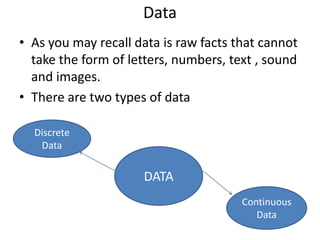
DataAs you may recall data is raw facts that cannot take the form of letters, numbers, text , sound and images.There are two types of dataDiscrete DataDATAContinuous Data
DECIMAL  NUMBER  SYSTEMBefore we explain the concept of the binary system, let us review the number system we are familiar with. Our decimal number system consists of ten digits: 0,1,2,3,4,5,6,7,8,9 and for this reason it is referred to as the base 10 number system or denary.The base of any number may be indicated as a subscript on the extreme right of the number e.g.45510
Types of numbers in the denary systemNatural numbers or whole numbers such as -1,2,3,10,108 etc.Integers are numbers that have no fractional parts and are either positive or negative. -19,88,-9etc.Real numbers are numbers with a decimal point or include a fractional part. 10.8, -8.9 etcThe magnitude of  a number refers to how large a number is. It does not depend on the sign of a number. E.gthe magnitude of -10 and 10 is 10.
Binary AdditionTo Lean 5 binary sumsOctal number systemHexadecimal number systemBinary subtraction
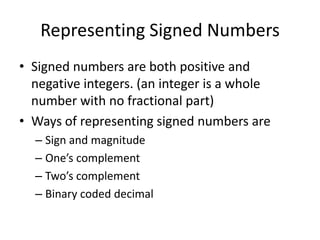
Representing Signed NumbersSigned numbers are both positive and negative integers. (an integer is a whole number with no fractional part)Ways of representing signed numbers areSign and magnitudeOne’s complementTwo’s complementBinary coded decimal
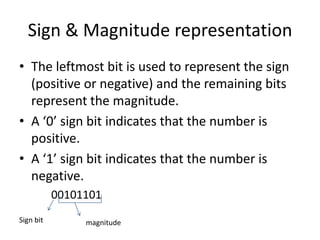
Sign & Magnitude representationThe leftmost bit is used to represent the sign (positive or negative) and the remaining bits represent the magnitude.A ‘0’ sign bit indicates that the number is positive.A ‘1’ sign bit indicates that the number is negative.		00101101Sign bitmagnitude
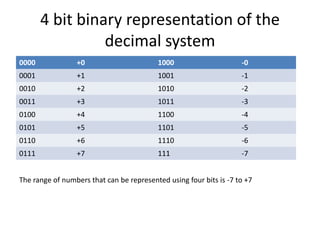
4 bit binary representation of the decimal systemThe range of numbers that can be represented using four bits is -7 to +7

Data storage & representation

  • 1.
    Data Storage &RepresentationHow data is stored in the Computer
  • 2.
    DataAs you mayrecall data is raw facts that cannot take the form of letters, numbers, text , sound and images.There are two types of dataDiscrete DataDATAContinuous Data
  • 6.
    DECIMAL NUMBER SYSTEMBefore we explain the concept of the binary system, let us review the number system we are familiar with. Our decimal number system consists of ten digits: 0,1,2,3,4,5,6,7,8,9 and for this reason it is referred to as the base 10 number system or denary.The base of any number may be indicated as a subscript on the extreme right of the number e.g.45510
  • 7.
    Types of numbersin the denary systemNatural numbers or whole numbers such as -1,2,3,10,108 etc.Integers are numbers that have no fractional parts and are either positive or negative. -19,88,-9etc.Real numbers are numbers with a decimal point or include a fractional part. 10.8, -8.9 etcThe magnitude of a number refers to how large a number is. It does not depend on the sign of a number. E.gthe magnitude of -10 and 10 is 10.
  • 8.
    Binary AdditionTo Lean5 binary sumsOctal number systemHexadecimal number systemBinary subtraction
  • 9.
    Representing Signed NumbersSignednumbers are both positive and negative integers. (an integer is a whole number with no fractional part)Ways of representing signed numbers areSign and magnitudeOne’s complementTwo’s complementBinary coded decimal
  • 10.
    Sign & MagnituderepresentationThe leftmost bit is used to represent the sign (positive or negative) and the remaining bits represent the magnitude.A ‘0’ sign bit indicates that the number is positive.A ‘1’ sign bit indicates that the number is negative. 00101101Sign bitmagnitude
  • 11.
    4 bit binaryrepresentation of the decimal systemThe range of numbers that can be represented using four bits is -7 to +7