By Dr Aijaz Ahmed Sohag
Prep by: Abdul Wasay Baloch
Amna Inayat Medical College
Data
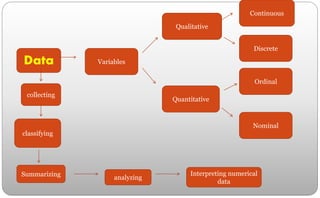
Data
collecting
classifying
Summarizing analyzing
Interpreting numerical
data
Variables
Qualitative
Quantitative
Discrete
Continuous
Ordinal
Nominal
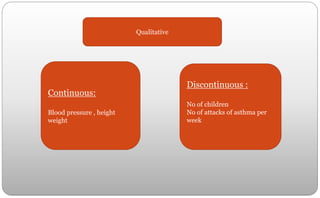
Continuous:
Blood pressure , height
weight
Discontinuous :
No of children
No of attacks of asthma per
week
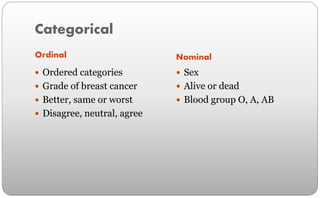
Qualitative
Categorical
Ordinal
 Ordered categories
 Grade of breast cancer
 Better, same or worst
 Disagree, neutral, agree
Nominal
 Sex
 Alive or dead
 Blood group O, A, AB
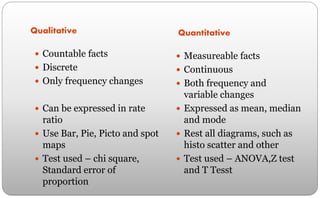
Qualitative
 Countable facts
 Discrete
 Only frequency changes
 Can be expressed in rate
ratio
 Use Bar, Pie, Picto and spot
maps
 Test used – chi square,
Standard error of
proportion
Quantitative
 Measureable facts
 Continuous
 Both frequency and
variable changes
 Expressed as mean, median
and mode
 Rest all diagrams, such as
histo scatter and other
 Test used – ANOVA,Z test
and T Tesst
Data Defines as
 ‘’ collection of observation in scientific way’’
Types
 It has two types
 Qualitative
 Quantitative
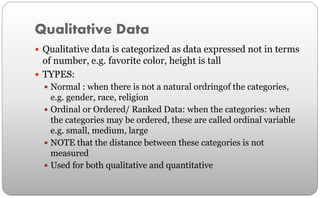
Qualitative Data
 Qualitative data is categorized as data expressed not in terms
of number, e.g. favorite color, height is tall
 TYPES:
 Normal : when there is not a natural ordringof the categories,
e.g. gender, race, religion
 Ordinal or Ordered/ Ranked Data: when the categories: when
the categories may be ordered, these are called ordinal variable
e.g. small, medium, large
 NOTE that the distance between these categories is not
measured
 Used for both qualitative and quantitative
Quantitative
Data
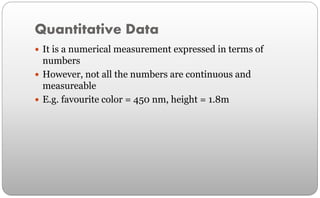
Quantitative Data
 It is a numerical measurement expressed in terms of
numbers
 However, not all the numbers are continuous and
measureable
 E.g. favourite color = 450 nm, height = 1.8m
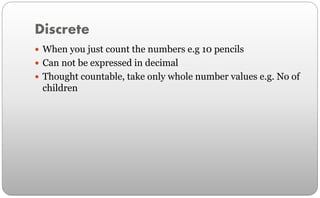
Discrete
 When you just count the numbers e.g 10 pencils
 Can not be expressed in decimal
 Thought countable, take only whole number values e.g. No of
children
Continuous
 This is measured on some scale
 It has no ends
 E.g. counting the pulse rate of class
 Measuring BP
 Can be measured in decimal
 May be measure as fractional values e.g. 17.4C, 162.5 cm etc)
Variables
 Characteristic :
 Any characteristic whose value is different from one individual
to another e.g. height of school boy
 A variable is any characteristic which is measured or observed
 It is denoted by X
 Variables are characteristics associated with the subjects of
study e.g. height weight, gender
 Variables so called because they tend to vary between subjects
 Broadly variables are grouped into quantitative and qualitative
variables
Quantitative Variables
 Data can be further classified beig qualitative or quantitative
 The STATISTICAL ANALYSIS that is appropriate depends
on whether the data for variable is qualitative or quantitative
 In general, there are more alternatives for statistical analysis
when the data are Quantitative
Quantitative Data
 Indicate either how many or how much
 Always numeric
 Ordinary arithmetic operation (e.g. +,- etc) are meaningful
only with QULITATIVE DATA

Data Statistics

  • 1.
    By Dr AijazAhmed Sohag Prep by: Abdul Wasay Baloch Amna Inayat Medical College Data
  • 2.
  • 3.
    Continuous: Blood pressure ,height weight Discontinuous : No of children No of attacks of asthma per week Qualitative
  • 4.
    Categorical Ordinal  Ordered categories Grade of breast cancer  Better, same or worst  Disagree, neutral, agree Nominal  Sex  Alive or dead  Blood group O, A, AB
  • 5.
    Qualitative  Countable facts Discrete  Only frequency changes  Can be expressed in rate ratio  Use Bar, Pie, Picto and spot maps  Test used – chi square, Standard error of proportion Quantitative  Measureable facts  Continuous  Both frequency and variable changes  Expressed as mean, median and mode  Rest all diagrams, such as histo scatter and other  Test used – ANOVA,Z test and T Tesst
  • 6.
    Data Defines as ‘’ collection of observation in scientific way’’
  • 7.
    Types  It hastwo types  Qualitative  Quantitative
  • 8.
    Qualitative Data  Qualitativedata is categorized as data expressed not in terms of number, e.g. favorite color, height is tall  TYPES:  Normal : when there is not a natural ordringof the categories, e.g. gender, race, religion  Ordinal or Ordered/ Ranked Data: when the categories: when the categories may be ordered, these are called ordinal variable e.g. small, medium, large  NOTE that the distance between these categories is not measured  Used for both qualitative and quantitative
  • 9.
  • 10.
    Quantitative Data  Itis a numerical measurement expressed in terms of numbers  However, not all the numbers are continuous and measureable  E.g. favourite color = 450 nm, height = 1.8m
  • 11.
    Discrete  When youjust count the numbers e.g 10 pencils  Can not be expressed in decimal  Thought countable, take only whole number values e.g. No of children
  • 12.
    Continuous  This ismeasured on some scale  It has no ends  E.g. counting the pulse rate of class  Measuring BP  Can be measured in decimal  May be measure as fractional values e.g. 17.4C, 162.5 cm etc)
  • 13.
    Variables  Characteristic : Any characteristic whose value is different from one individual to another e.g. height of school boy  A variable is any characteristic which is measured or observed  It is denoted by X  Variables are characteristics associated with the subjects of study e.g. height weight, gender  Variables so called because they tend to vary between subjects  Broadly variables are grouped into quantitative and qualitative variables
  • 14.
    Quantitative Variables  Datacan be further classified beig qualitative or quantitative  The STATISTICAL ANALYSIS that is appropriate depends on whether the data for variable is qualitative or quantitative  In general, there are more alternatives for statistical analysis when the data are Quantitative
  • 15.
    Quantitative Data  Indicateeither how many or how much  Always numeric  Ordinary arithmetic operation (e.g. +,- etc) are meaningful only with QULITATIVE DATA