Data representation‐ floatingpoints
C Minh Nguyen, email: mngu012@aucklanduni.ac.nz
C Tutorials:
C Office hours:
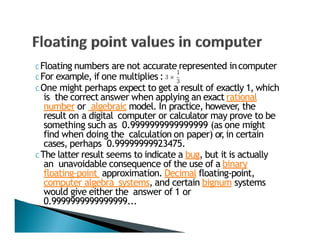
C Floating numbers are not accurate represented incomputer
C For example, if one multiplies :
C One might perhaps expect to get a result of exactly 1, which
is the correct answer when applying an exact rational
number or algebraic model. In practice, however, the
result on a digital computer or calculator may prove to be
something such as 0.9999999999999999 (as one might
find when doing the calculation on paper) or,in certain
cases, perhaps 0.99999999923475.
C The latter result seems to indicate a bug, but it is actually
an unavoidable consequence of the use of a binary
floating‐point approximation. Decimal floating‐point,
computer algebra systems, and certain bignum systems
would give either the answer of 1 or
0.9999999999999999...
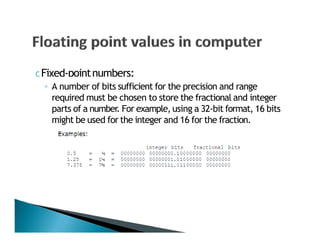
C Fixed‐pointnumbers:
◦ A number of bits sufficient for the precision and range
required must be chosen to store the fractional and integer
parts of a number. For example, using a 32‐bit format, 16 bits
might be used for the integer and 16 for the fraction.
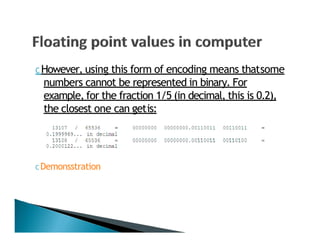
C However, using this form of encoding means thatsome
numbers cannot be represented in binary. For
example, for the fraction 1/5 (in decimal, this is 0.2),
the closest one can getis:
C Demonsstration
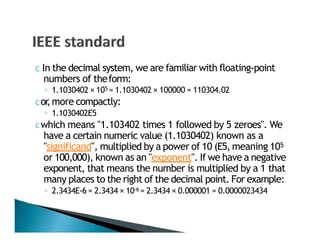
C In the decimal system, we are familiar with floating‐point
numbers of theform:
◦ 1.1030402 × 105 = 1.1030402 × 100000 = 110304.02
C or,more compactly:
◦ 1.1030402E5
C which means "1.103402 times 1 followed by 5 zeroes". We
have a certain numeric value (1.1030402) known as a
"significand", multiplied by a power of 10 (E5, meaning 105
or 100,000), known as an "exponent". If we have a negative
exponent, that means the number is multiplied by a 1 that
many places to the right of the decimal point. For example:
◦ 2.3434E‐6 = 2.3434 × 10‐6 = 2.3434 × 0.000001 = 0.0000023434
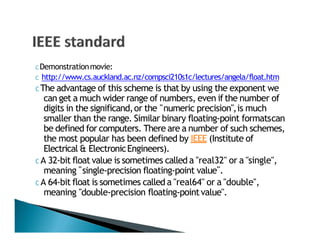
C Demonstrationmovie:
C http://www.cs.auckland.ac.nz/compsci210s1c/lectures/angela/float.htm
C The advantage of this scheme is that by using the exponent we
can get a much wider range of numbers, even if the number of
" "
" "
digits in the significand,or the numeric precision ,is much
smaller than the range. Similar binary floating‐point formatscan
be defined for computers. There are a number of such schemes,
the most popular has been defined by IEEE (Institute of
Electrical & ElectronicEngineers).
C A 32‐bit float value is sometimes called a "real32" or a "single",
meaning single‐precision floating‐point value .
C A 64‐bit float is sometimes called a "real64" or a "double",
meaning "double‐precision floating‐pointvalue".
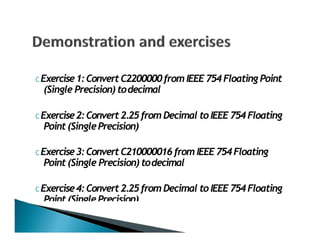
C Exercise1:ConvertC2200000from IEEE754Floating Point
(Single Precision) todecimal
C Exercise2:Convert2.25from Decimal to IEEE754Floating
Point (SinglePrecision)
C Exercise3:ConvertC210000016from IEEE754Floating
Point (Single Precision) todecimal
C Exercise4:Convert2.25from Decimal to IEEE754Floating
Point (SinglePrecision)

Data Representation - Floating Point

  • 1.
  • 2.
    C Minh Nguyen,email: mngu012@aucklanduni.ac.nz C Tutorials: C Office hours:
  • 3.
    C Floating numbersare not accurate represented incomputer C For example, if one multiplies : C One might perhaps expect to get a result of exactly 1, which is the correct answer when applying an exact rational number or algebraic model. In practice, however, the result on a digital computer or calculator may prove to be something such as 0.9999999999999999 (as one might find when doing the calculation on paper) or,in certain cases, perhaps 0.99999999923475. C The latter result seems to indicate a bug, but it is actually an unavoidable consequence of the use of a binary floating‐point approximation. Decimal floating‐point, computer algebra systems, and certain bignum systems would give either the answer of 1 or 0.9999999999999999...
  • 4.
    C Fixed‐pointnumbers: ◦ Anumber of bits sufficient for the precision and range required must be chosen to store the fractional and integer parts of a number. For example, using a 32‐bit format, 16 bits might be used for the integer and 16 for the fraction.
  • 5.
    C However, usingthis form of encoding means thatsome numbers cannot be represented in binary. For example, for the fraction 1/5 (in decimal, this is 0.2), the closest one can getis: C Demonsstration
  • 7.
    C In thedecimal system, we are familiar with floating‐point numbers of theform: ◦ 1.1030402 × 105 = 1.1030402 × 100000 = 110304.02 C or,more compactly: ◦ 1.1030402E5 C which means "1.103402 times 1 followed by 5 zeroes". We have a certain numeric value (1.1030402) known as a "significand", multiplied by a power of 10 (E5, meaning 105 or 100,000), known as an "exponent". If we have a negative exponent, that means the number is multiplied by a 1 that many places to the right of the decimal point. For example: ◦ 2.3434E‐6 = 2.3434 × 10‐6 = 2.3434 × 0.000001 = 0.0000023434
  • 8.
    C Demonstrationmovie: C http://www.cs.auckland.ac.nz/compsci210s1c/lectures/angela/float.htm CThe advantage of this scheme is that by using the exponent we can get a much wider range of numbers, even if the number of " " " " digits in the significand,or the numeric precision ,is much smaller than the range. Similar binary floating‐point formatscan be defined for computers. There are a number of such schemes, the most popular has been defined by IEEE (Institute of Electrical & ElectronicEngineers). C A 32‐bit float value is sometimes called a "real32" or a "single", meaning single‐precision floating‐point value . C A 64‐bit float is sometimes called a "real64" or a "double", meaning "double‐precision floating‐pointvalue".
  • 9.
    C Exercise1:ConvertC2200000from IEEE754FloatingPoint (Single Precision) todecimal C Exercise2:Convert2.25from Decimal to IEEE754Floating Point (SinglePrecision) C Exercise3:ConvertC210000016from IEEE754Floating Point (Single Precision) todecimal C Exercise4:Convert2.25from Decimal to IEEE754Floating Point (SinglePrecision)