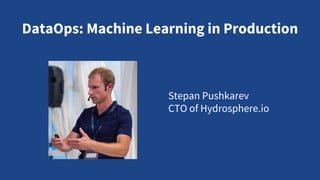
DataOps: Machine Learning in Production
Stepan Pushkarev
CTO of Hydrosphere.io
Mission: Accelerate Machine Learning to Production
Opensource Products:
- Mist: Serverless proxy for Spark
- ML Lambda: ML Function as a Service
- Sonar: Data and ML Monitoring
Business Model: Subscription services and hands-on consulting
About
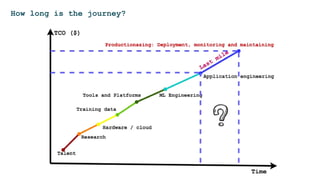
How long is the journey?
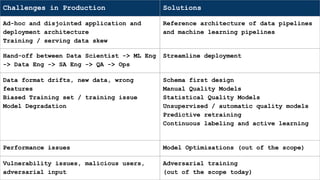
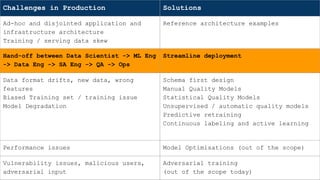
Challenges in Production Solutions
Ad-hoc and disjointed application and
deployment architecture
Training / serving data skew
Reference architecture of data pipelines
and machine learning pipelines
Hand-off between Data Scientist -> ML Eng
-> Data Eng -> SA Eng -> QA -> Ops
Streamline deployment
Data format drifts, new data, wrong
features
Biased Training set / training issue
Model Degradation
Schema first design
Manual Quality Models
Statistical Quality Models
Unsupervised / automatic quality models
Predictive retraining
Continuous labeling and active learning
Performance issues Model Optimisations (out of the scope)
Vulnerability issues, malicious users,
adversarial input
Adversarial training
(out of the scope today)
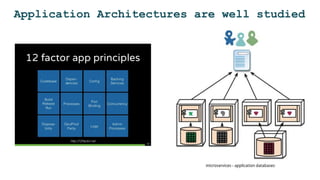
Application Architectures are well studied
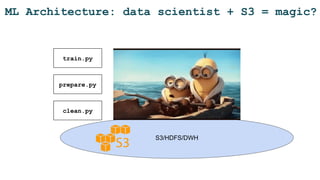
S3/HDFS/DWH
ML Architecture: data scientist + S3 = magic?
train.py
prepare.py
clean.py
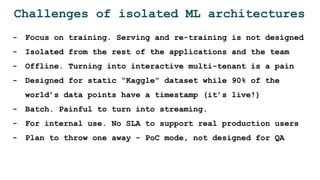
Challenges of isolated ML architectures
- Focus on training. Serving and re-training is not designed
- Isolated from the rest of the applications and the team
- Offline. Turning into interactive multi-tenant is a pain
- Designed for static “Kaggle” dataset while 90% of the
world’s data points have a timestamp (it’s live!)
- Batch. Painful to turn into streaming.
- For internal use. No SLA to support real production users
- Plan to throw one away - PoC mode, not designed for QA
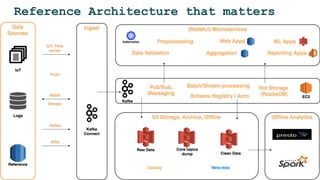
Reference Architecture that matters
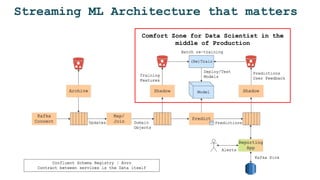
Streaming ML Architecture that matters
Comfort Zone for Data Scientist in the
middle of Production
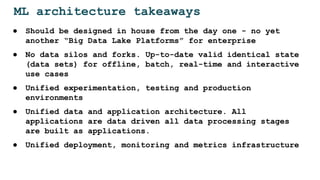
ML architecture takeaways
● Should be designed in house from the day one - no yet
another “Big Data Lake Platforms” for enterprise
● No data silos and forks. Up-to-date valid identical state
(data sets) for offline, batch, real-time and interactive
use cases
● Unified experimentation, testing and production
environments
● Unified data and application architecture. All
applications are data driven all data processing stages
are built as applications.
● Unified deployment, monitoring and metrics infrastructure
Challenges in Production Solutions
Ad-hoc and disjointed application and
infrastructure architecture
Training / serving data skew
Reference architecture examples
Hand-off between Data Scientist -> ML Eng
-> Data Eng -> SA Eng -> QA -> Ops
Streamline deployment
Data format drifts, new data, wrong
features
Biased Training set / training issue
Model Degradation
Schema first design
Manual Quality Models
Statistical Quality Models
Unsupervised / automatic quality models
Predictive retraining
Continuous labeling and active learning
Performance issues Model Optimisations (out of the scope)
Vulnerability issues, malicious users,
adversarial input
Adversarial training
(out of the scope today)
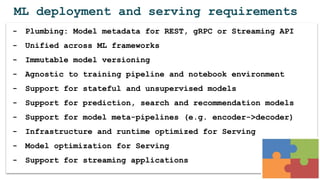
ML deployment and serving requirements
- Plumbing: Model metadata for REST, gRPC or Streaming API
- Unified across ML frameworks
- Immutable model versioning
- Agnostic to training pipeline and notebook environment
- Support for stateful and unsupervised models
- Support for prediction, search and recommendation models
- Support for model meta-pipelines (e.g. encoder->decoder)
- Infrastructure and runtime optimized for Serving
- Model optimization for Serving
- Support for streaming applications
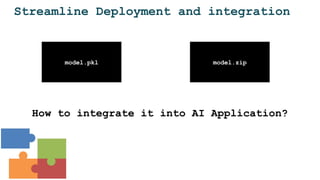
Streamline Deployment and integration
model.pkl model.zip
How to integrate it into AI Application?
Model server = Model Artifact + ...
matching_model v2
[
....
]
Build Docker and deploy to the cloud.
Now what?
It is still an anonymous black box.
Model server = Model Artifact +
Metadata + Runtime + Deps
/predict
input:
string text;
bytes image;
output:
string summary;
JVM DL4j
GPU
matching_model v2
[
....
]
gRPC HTTP server
Model server = Model Artifact +
Metadata + Runtime + Deps + Sidecar
/predict
input:
string text;
bytes image;
output:
string summary;
JVM DL4j
GPU
matching_model v2
[
....
]
gRPC HTTP server
routing, shadowing
pipelining
tracing
metrics
autoscaling
A/B, canary
sidecar
serving
requests
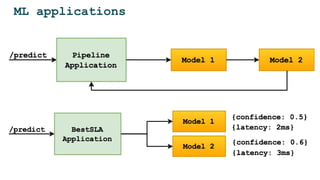
ML applications
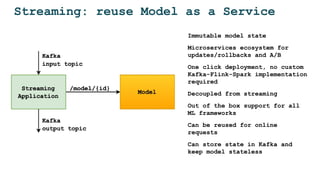
Streaming: reuse Model as a Service
Immutable model state
Microservices ecosystem for
updates/rollbacks and A/B
One click deployment, no custom
Kafka-Flink-Spark implementation
required
Decoupled from streaming
Out of the box support for all
ML frameworks
Can be reused for online
requests
Can store state in Kafka and
keep model stateless
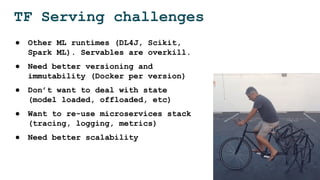
TF Serving challenges
● Other ML runtimes (DL4J, Scikit,
Spark ML). Servables are overkill.
● Need better versioning and
immutability (Docker per version)
● Don’t want to deal with state
(model loaded, offloaded, etc)
● Want to re-use microservices stack
(tracing, logging, metrics)
● Need better scalability
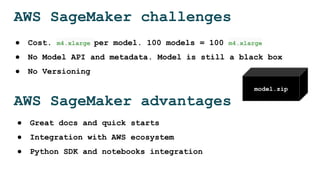
AWS SageMaker challenges
● Cost. m4.xlarge per model. 100 models = 100 m4.xlarge
● No Model API and metadata. Model is still a black box
● No Versioning
AWS SageMaker advantages
● Great docs and quick starts
● Integration with AWS ecosystem
● Python SDK and notebooks integration
model.zip
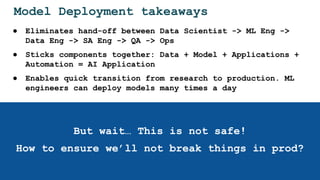
Model Deployment takeaways
● Eliminates hand-off between Data Scientist -> ML Eng ->
Data Eng -> SA Eng -> QA -> Ops
● Sticks components together: Data + Model + Applications +
Automation = AI Application
● Enables quick transition from research to production. ML
engineers can deploy models many times a day
But wait… This is not safe!
How to ensure we’ll not break things in prod?
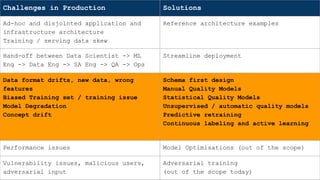
Challenges in Production Solutions
Ad-hoc and disjointed application and
infrastructure architecture
Training / serving data skew
Reference architecture examples
Hand-off between Data Scientist -> ML
Eng -> Data Eng -> SA Eng -> QA -> Ops
Streamline deployment
Data format drifts, new data, wrong
features
Biased Training set / training issue
Model Degradation
Concept drift
Schema first design
Manual Quality Models
Statistical Quality Models
Unsupervised / automatic quality models
Predictive retraining
Continuous labeling and active learning
Performance issues Model Optimisations (out of the scope)
Vulnerability issues, malicious users,
adversarial input
Adversarial training
(out of the scope today)
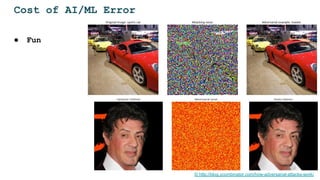
Cost of AI/ML Error
● Fun
© http://blog.ycombinator.com/how-adversarial-attacks-work/
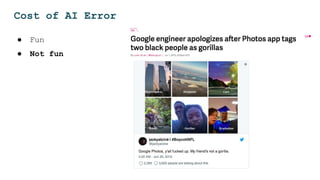
● Fun
● Not fun
Cost of AI Error
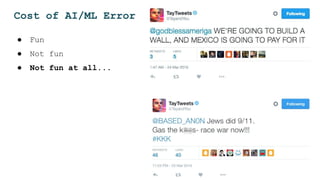
● Fun
● Not fun
● Not fun at all...
Cost of AI/ML Error
● Fun
● Not fun
● Not fun at all…
● People life
Cost of AI Error
● Fun
● Not fun
● Not fun at all…
● People life
● Money
Cost of AI/ML Error
● Fun
● Not fun
● Not fun at all…
● People life
● Money
● Business
Cost of ML Error
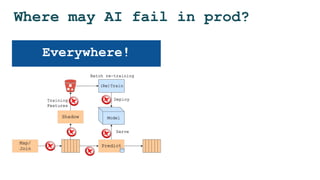
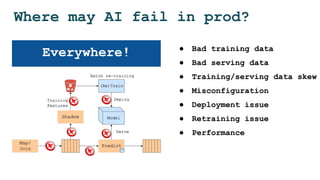
Where may AI fail in prod?
Everywhere!
Where may AI fail in prod?
● Bad training data
● Bad serving data
● Training/serving data skew
● Misconfiguration
● Deployment issue
● Retraining issue
● Performance
Everywhere!
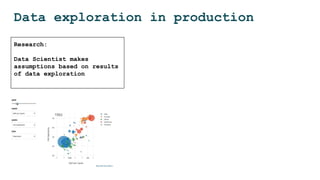
Data exploration in production
Research:
Data Scientist makes
assumptions based on results
of data exploration
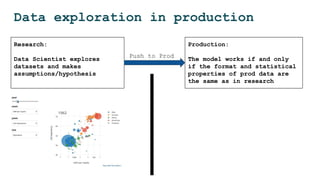
Data exploration in production
Research:
Data Scientist explores
datasets and makes
assumptions/hypothesis
Production:
The model works if and only
if the format and statistical
properties of prod data are
the same as in research
Push to Prod
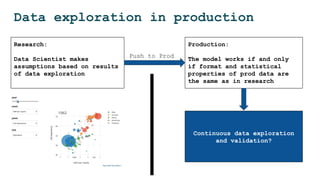
Data exploration in production
Research:
Data Scientist makes
assumptions based on results
of data exploration
Production:
The model works if and only
if format and statistical
properties of prod data are
the same as in research
Push to Prod
Continuous data exploration
and validation?
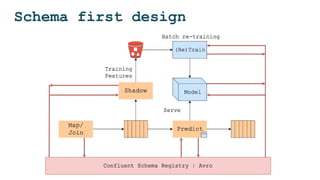
Step 1: Schema first design
● Data defines the contracts and API between components
● Avro/Protobuf for all data records
● Confluent Schema Registry to manage Avro schemas
● Not only for Kafka. Must be used for all the data
pipelines (batch, Spark, etc)
{"namespace": "example.avro",
"type": "record",
"name": "User",
"fields": [
{"name": "name", "type": "string"},
{"name": "number", "type": ["int", "null"]},
{"name": "color", "type": ["string", "null"]}
]
}
Schema first design
Step 2: Extend schema
● Avro/Protobuf can catch data format bugs
● How about data profile? Min, max, mean, etc?
● Describe a data profile, statistical properties and
validation rules in extended schema!
{"name": "User",
"fields": [
{"name": "name", "type": "string", "min_length": 2, "max_length": 128},
{"name": "age", "type": ["int", "null"], "range": "[10, 100]"},
{"name": "sex", "type": ["string", "null"], " enum": "[male, female, ...]"},
{"name": "wage", "type": ["int", "null"], "validator": "DSL here..."}
]
}
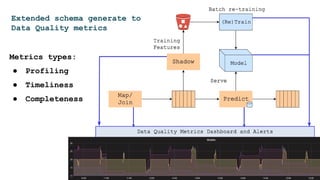
Extended schema generate to
Data Quality metrics
Metrics types:
● Profiling
● Timeliness
● Completeness
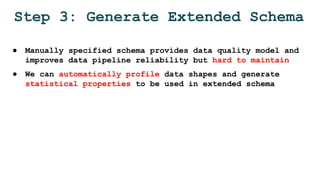
Step 3: Generate Extended Schema
● Manually specified schema provides data quality model and
improves data pipeline reliability but hard to maintain
● We can automatically profile data shapes and generate
statistical properties to be used in extended schema
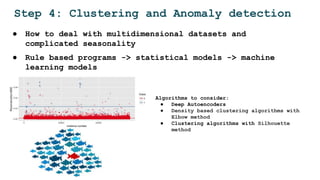
Step 4: Clustering and Anomaly detection
● How to deal with multidimensional datasets and
complicated seasonality
● Rule based programs -> statistical models -> machine
learning models
Algorithms to consider:
● Deep Autoencoders
● Density based clustering algorithms with
Elbow method
● Clustering algorithms with Silhouette
method
Model server = Metadata + Model Artifact +
Runtime + Deps + Sidecar + Training Metadata
/predict
input:
output:
JVM DL4j
GPU
matching_model v2
[
....
]
gRPC HTTP server
sidecar
serving
requests
training data stats:
- min
- max
- clusters
- autoencoder
compare with prod
data in runtime
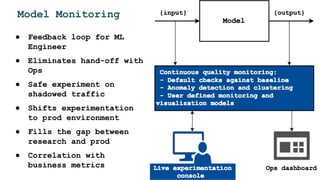
Model Monitoring
● Feedback loop for ML
Engineer
● Eliminates hand-off with
Ops
● Safe experiment on
shadowed traffic
● Shifts experimentation
to prod environment
● Fills the gap between
research and prod
● Correlation with
business metrics
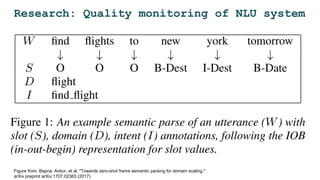
Research: Quality monitoring of NLU system
Figure from: Bapna, Ankur, et al. "Towards zero-shot frame semantic parsing for domain scaling."
arXiv preprint arXiv:1707.02363 (2017).
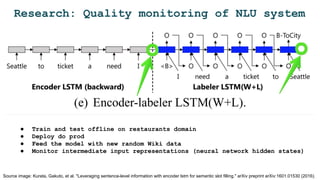
Research: Quality monitoring of NLU system
Source image: Kurata, Gakuto, et al. "Leveraging sentence-level information with encoder lstm for semantic slot filling." arXiv preprint arXiv:1601.01530 (2016).
● Train and test offline on restaurants domain
● Deploy do prod
● Feed the model with new random Wiki data
● Monitor intermediate input representations (neural network hidden states)
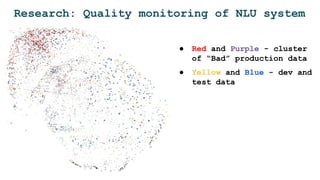
Research: Quality monitoring of NLU system
● Red and Purple - cluster
of “Bad” production data
● Yellow and Blue - dev and
test data
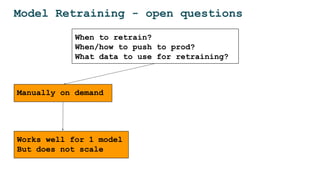
Model Retraining - open questions
When to retrain?
When/how to push to prod?
What data to use for retraining?
Manually on demand
Works well for 1 model
But does not scale
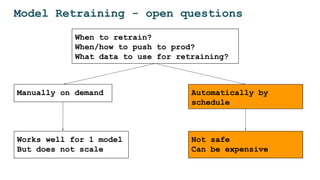
Model Retraining - open questions
When to retrain?
When/how to push to prod?
What data to use for retraining?
Manually on demand
Works well for 1 model
But does not scale
Automatically by
schedule
Not safe
Can be expensive
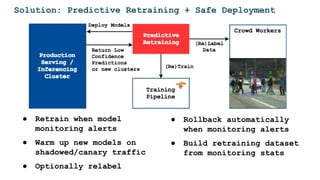
Solution: Predictive Retraining + Safe Deployment
● Retrain when model
monitoring alerts
● Warm up new models on
shadowed/canary traffic
● Optionally relabel
● Rollback automatically
when monitoring alerts
● Build retraining dataset
from monitoring stats
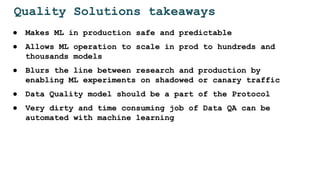
Quality Solutions takeaways
● Makes ML in production safe and predictable
● Allows ML operation to scale in prod to hundreds and
thousands models
● Blurs the line between research and production by
enabling ML experiments on shadowed or canary traffic
● Data Quality model should be a part of the Protocol
● Very dirty and time consuming job of Data QA can be
automated with machine learning
Webinar takeaway: Production-ready ML apps
with the speed of Prototyping
Thank you
- Stepan Pushkarev
- @hydrospheredata
- https://github.com/Hydrospheredata
- https://hydrosphere.io/
- spushkarev@hydrosphere.io

Data ops: Machine Learning in production

  • 1.
    DataOps: Machine Learningin Production Stepan Pushkarev CTO of Hydrosphere.io
  • 2.
    Mission: Accelerate MachineLearning to Production Opensource Products: - Mist: Serverless proxy for Spark - ML Lambda: ML Function as a Service - Sonar: Data and ML Monitoring Business Model: Subscription services and hands-on consulting About
  • 3.
    How long isthe journey?
  • 4.
    How long isthe journey?
  • 5.
    Challenges in ProductionSolutions Ad-hoc and disjointed application and deployment architecture Training / serving data skew Reference architecture of data pipelines and machine learning pipelines Hand-off between Data Scientist -> ML Eng -> Data Eng -> SA Eng -> QA -> Ops Streamline deployment Data format drifts, new data, wrong features Biased Training set / training issue Model Degradation Schema first design Manual Quality Models Statistical Quality Models Unsupervised / automatic quality models Predictive retraining Continuous labeling and active learning Performance issues Model Optimisations (out of the scope) Vulnerability issues, malicious users, adversarial input Adversarial training (out of the scope today)
  • 6.
  • 7.
    S3/HDFS/DWH ML Architecture: datascientist + S3 = magic? train.py prepare.py clean.py
  • 8.
    Challenges of isolatedML architectures - Focus on training. Serving and re-training is not designed - Isolated from the rest of the applications and the team - Offline. Turning into interactive multi-tenant is a pain - Designed for static “Kaggle” dataset while 90% of the world’s data points have a timestamp (it’s live!) - Batch. Painful to turn into streaming. - For internal use. No SLA to support real production users - Plan to throw one away - PoC mode, not designed for QA
  • 9.
  • 10.
    Streaming ML Architecturethat matters Comfort Zone for Data Scientist in the middle of Production
  • 11.
    ML architecture takeaways ●Should be designed in house from the day one - no yet another “Big Data Lake Platforms” for enterprise ● No data silos and forks. Up-to-date valid identical state (data sets) for offline, batch, real-time and interactive use cases ● Unified experimentation, testing and production environments ● Unified data and application architecture. All applications are data driven all data processing stages are built as applications. ● Unified deployment, monitoring and metrics infrastructure
  • 12.
    Challenges in ProductionSolutions Ad-hoc and disjointed application and infrastructure architecture Training / serving data skew Reference architecture examples Hand-off between Data Scientist -> ML Eng -> Data Eng -> SA Eng -> QA -> Ops Streamline deployment Data format drifts, new data, wrong features Biased Training set / training issue Model Degradation Schema first design Manual Quality Models Statistical Quality Models Unsupervised / automatic quality models Predictive retraining Continuous labeling and active learning Performance issues Model Optimisations (out of the scope) Vulnerability issues, malicious users, adversarial input Adversarial training (out of the scope today)
  • 13.
    ML deployment andserving requirements - Plumbing: Model metadata for REST, gRPC or Streaming API - Unified across ML frameworks - Immutable model versioning - Agnostic to training pipeline and notebook environment - Support for stateful and unsupervised models - Support for prediction, search and recommendation models - Support for model meta-pipelines (e.g. encoder->decoder) - Infrastructure and runtime optimized for Serving - Model optimization for Serving - Support for streaming applications
  • 14.
    Streamline Deployment andintegration model.pkl model.zip How to integrate it into AI Application?
  • 15.
    Model server =Model Artifact + ... matching_model v2 [ .... ] Build Docker and deploy to the cloud. Now what? It is still an anonymous black box.
  • 16.
    Model server =Model Artifact + Metadata + Runtime + Deps /predict input: string text; bytes image; output: string summary; JVM DL4j GPU matching_model v2 [ .... ] gRPC HTTP server
  • 17.
    Model server =Model Artifact + Metadata + Runtime + Deps + Sidecar /predict input: string text; bytes image; output: string summary; JVM DL4j GPU matching_model v2 [ .... ] gRPC HTTP server routing, shadowing pipelining tracing metrics autoscaling A/B, canary sidecar serving requests
  • 18.
  • 19.
    Streaming: reuse Modelas a Service Immutable model state Microservices ecosystem for updates/rollbacks and A/B One click deployment, no custom Kafka-Flink-Spark implementation required Decoupled from streaming Out of the box support for all ML frameworks Can be reused for online requests Can store state in Kafka and keep model stateless
  • 20.
    TF Serving challenges ●Other ML runtimes (DL4J, Scikit, Spark ML). Servables are overkill. ● Need better versioning and immutability (Docker per version) ● Don’t want to deal with state (model loaded, offloaded, etc) ● Want to re-use microservices stack (tracing, logging, metrics) ● Need better scalability
  • 21.
    AWS SageMaker challenges ●Cost. m4.xlarge per model. 100 models = 100 m4.xlarge ● No Model API and metadata. Model is still a black box ● No Versioning AWS SageMaker advantages ● Great docs and quick starts ● Integration with AWS ecosystem ● Python SDK and notebooks integration model.zip
  • 22.
    Model Deployment takeaways ●Eliminates hand-off between Data Scientist -> ML Eng -> Data Eng -> SA Eng -> QA -> Ops ● Sticks components together: Data + Model + Applications + Automation = AI Application ● Enables quick transition from research to production. ML engineers can deploy models many times a day But wait… This is not safe! How to ensure we’ll not break things in prod?
  • 23.
    Challenges in ProductionSolutions Ad-hoc and disjointed application and infrastructure architecture Training / serving data skew Reference architecture examples Hand-off between Data Scientist -> ML Eng -> Data Eng -> SA Eng -> QA -> Ops Streamline deployment Data format drifts, new data, wrong features Biased Training set / training issue Model Degradation Concept drift Schema first design Manual Quality Models Statistical Quality Models Unsupervised / automatic quality models Predictive retraining Continuous labeling and active learning Performance issues Model Optimisations (out of the scope) Vulnerability issues, malicious users, adversarial input Adversarial training (out of the scope today)
  • 24.
    Cost of AI/MLError ● Fun © http://blog.ycombinator.com/how-adversarial-attacks-work/
  • 25.
    ● Fun ● Notfun Cost of AI Error
  • 26.
    ● Fun ● Notfun ● Not fun at all... Cost of AI/ML Error
  • 27.
    ● Fun ● Notfun ● Not fun at all… ● People life Cost of AI Error
  • 28.
    ● Fun ● Notfun ● Not fun at all… ● People life ● Money Cost of AI/ML Error
  • 29.
    ● Fun ● Notfun ● Not fun at all… ● People life ● Money ● Business Cost of ML Error
  • 30.
    Where may AIfail in prod? Everywhere!
  • 31.
    Where may AIfail in prod? ● Bad training data ● Bad serving data ● Training/serving data skew ● Misconfiguration ● Deployment issue ● Retraining issue ● Performance Everywhere!
  • 32.
    Data exploration inproduction Research: Data Scientist makes assumptions based on results of data exploration
  • 33.
    Data exploration inproduction Research: Data Scientist explores datasets and makes assumptions/hypothesis Production: The model works if and only if the format and statistical properties of prod data are the same as in research Push to Prod
  • 34.
    Data exploration inproduction Research: Data Scientist makes assumptions based on results of data exploration Production: The model works if and only if format and statistical properties of prod data are the same as in research Push to Prod Continuous data exploration and validation?
  • 35.
    Step 1: Schemafirst design ● Data defines the contracts and API between components ● Avro/Protobuf for all data records ● Confluent Schema Registry to manage Avro schemas ● Not only for Kafka. Must be used for all the data pipelines (batch, Spark, etc) {"namespace": "example.avro", "type": "record", "name": "User", "fields": [ {"name": "name", "type": "string"}, {"name": "number", "type": ["int", "null"]}, {"name": "color", "type": ["string", "null"]} ] }
  • 36.
  • 37.
    Step 2: Extendschema ● Avro/Protobuf can catch data format bugs ● How about data profile? Min, max, mean, etc? ● Describe a data profile, statistical properties and validation rules in extended schema! {"name": "User", "fields": [ {"name": "name", "type": "string", "min_length": 2, "max_length": 128}, {"name": "age", "type": ["int", "null"], "range": "[10, 100]"}, {"name": "sex", "type": ["string", "null"], " enum": "[male, female, ...]"}, {"name": "wage", "type": ["int", "null"], "validator": "DSL here..."} ] }
  • 38.
    Extended schema generateto Data Quality metrics Metrics types: ● Profiling ● Timeliness ● Completeness
  • 39.
    Step 3: GenerateExtended Schema ● Manually specified schema provides data quality model and improves data pipeline reliability but hard to maintain ● We can automatically profile data shapes and generate statistical properties to be used in extended schema
  • 40.
    Step 4: Clusteringand Anomaly detection ● How to deal with multidimensional datasets and complicated seasonality ● Rule based programs -> statistical models -> machine learning models Algorithms to consider: ● Deep Autoencoders ● Density based clustering algorithms with Elbow method ● Clustering algorithms with Silhouette method
  • 41.
    Model server =Metadata + Model Artifact + Runtime + Deps + Sidecar + Training Metadata /predict input: output: JVM DL4j GPU matching_model v2 [ .... ] gRPC HTTP server sidecar serving requests training data stats: - min - max - clusters - autoencoder compare with prod data in runtime
  • 42.
    Model Monitoring ● Feedbackloop for ML Engineer ● Eliminates hand-off with Ops ● Safe experiment on shadowed traffic ● Shifts experimentation to prod environment ● Fills the gap between research and prod ● Correlation with business metrics
  • 43.
    Research: Quality monitoringof NLU system Figure from: Bapna, Ankur, et al. "Towards zero-shot frame semantic parsing for domain scaling." arXiv preprint arXiv:1707.02363 (2017).
  • 44.
    Research: Quality monitoringof NLU system Source image: Kurata, Gakuto, et al. "Leveraging sentence-level information with encoder lstm for semantic slot filling." arXiv preprint arXiv:1601.01530 (2016). ● Train and test offline on restaurants domain ● Deploy do prod ● Feed the model with new random Wiki data ● Monitor intermediate input representations (neural network hidden states)
  • 45.
    Research: Quality monitoringof NLU system ● Red and Purple - cluster of “Bad” production data ● Yellow and Blue - dev and test data
  • 46.
    Model Retraining -open questions When to retrain? When/how to push to prod? What data to use for retraining? Manually on demand Works well for 1 model But does not scale
  • 47.
    Model Retraining -open questions When to retrain? When/how to push to prod? What data to use for retraining? Manually on demand Works well for 1 model But does not scale Automatically by schedule Not safe Can be expensive
  • 48.
    Solution: Predictive Retraining+ Safe Deployment ● Retrain when model monitoring alerts ● Warm up new models on shadowed/canary traffic ● Optionally relabel ● Rollback automatically when monitoring alerts ● Build retraining dataset from monitoring stats
  • 49.
    Quality Solutions takeaways ●Makes ML in production safe and predictable ● Allows ML operation to scale in prod to hundreds and thousands models ● Blurs the line between research and production by enabling ML experiments on shadowed or canary traffic ● Data Quality model should be a part of the Protocol ● Very dirty and time consuming job of Data QA can be automated with machine learning
  • 50.
    Webinar takeaway: Production-readyML apps with the speed of Prototyping
  • 51.
    Thank you - StepanPushkarev - @hydrospheredata - https://github.com/Hydrospheredata - https://hydrosphere.io/ - spushkarev@hydrosphere.io