Pitfalls of Machine Learning in
production
Antoine Sauray - Nantes Machine Learning Meetup - 7/10/19
Who am I ?
Antoine Sauray 👋 @asauray
Software engineer, Scala dev
Founder of Hyperplan ML platform
We are hosted at the Halle 6 in Ile de Nantes
Previously worked at iAdvize as ML Engineer
4 years exp in mobile dev (Android and iOS native)
2
3
Software
engineering
Machine
LearningAND
4
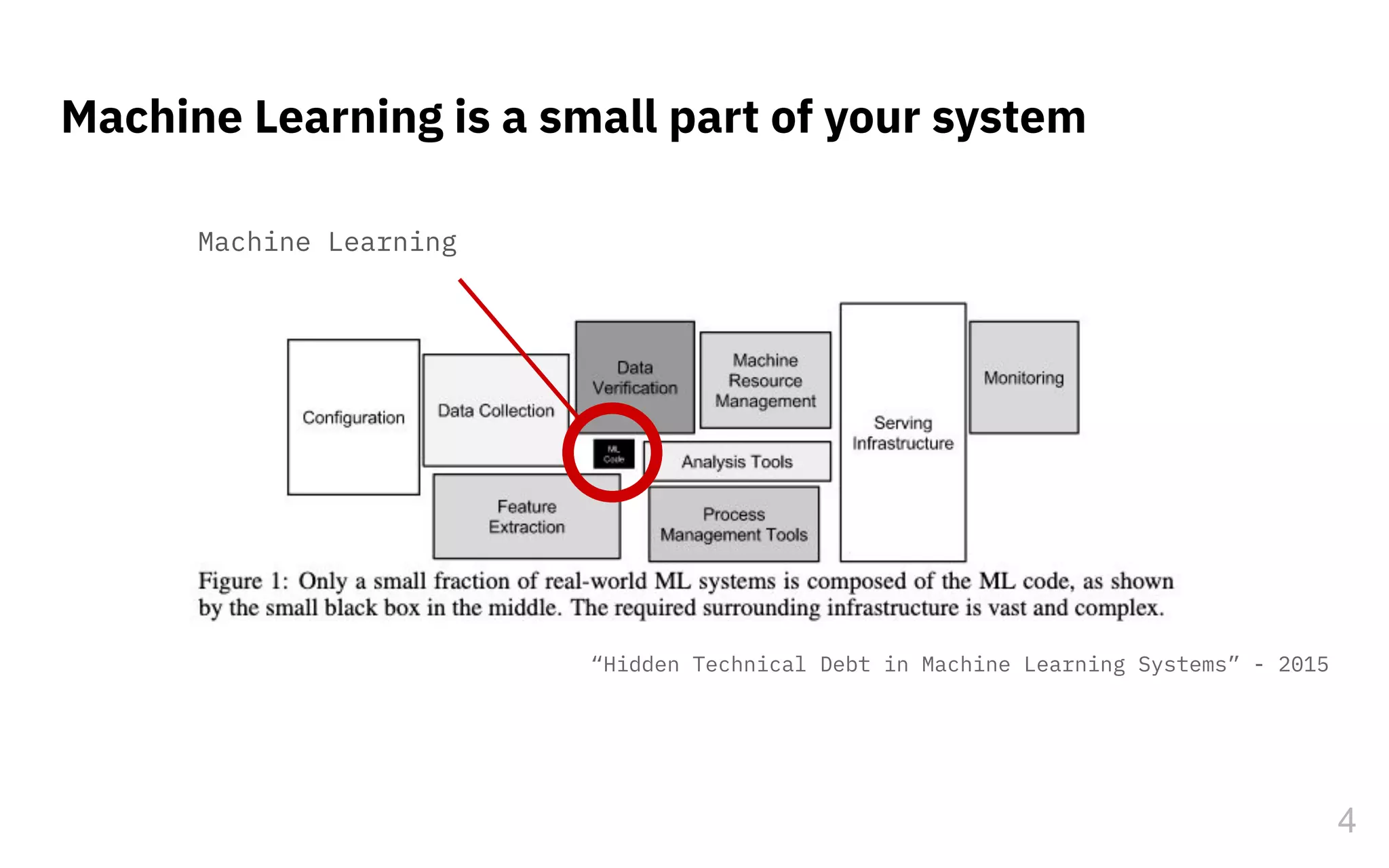
Machine Learning is a small part of your system
Machine Learning
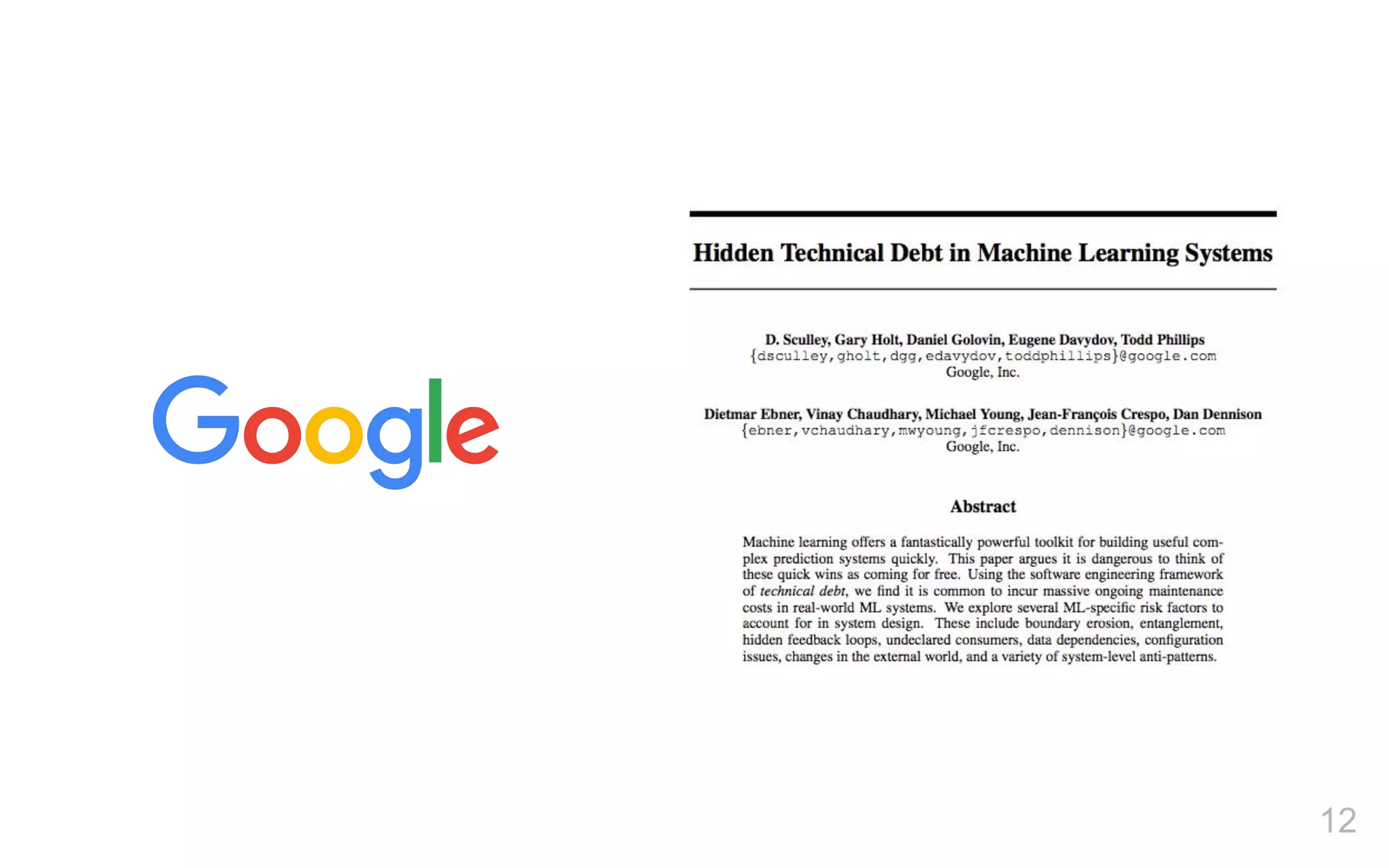
“Hidden Technical Debt in Machine Learning Systems” - 2015
5
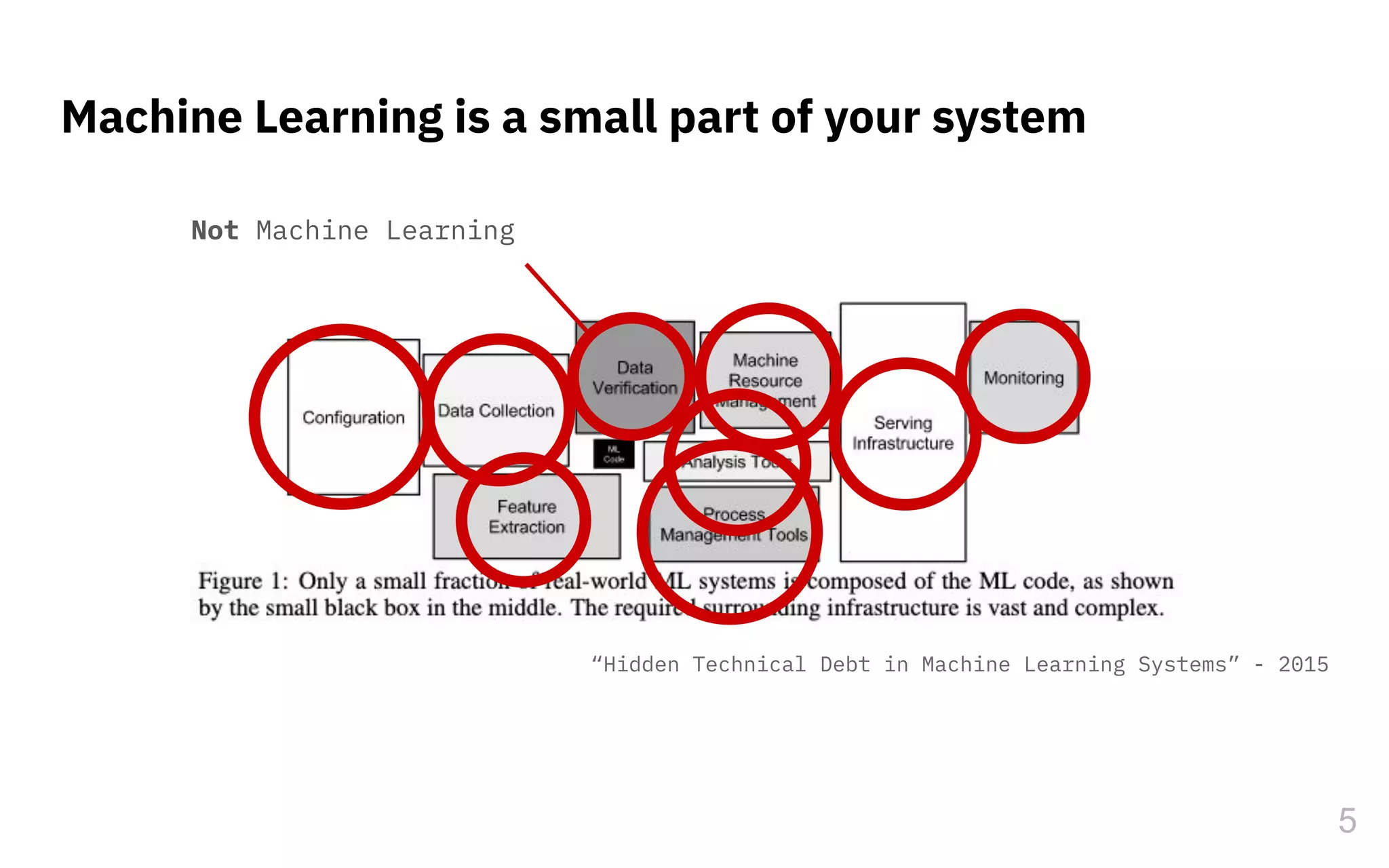
Machine Learning is a small part of your system
Not Machine Learning
“Hidden Technical Debt in Machine Learning Systems” - 2015
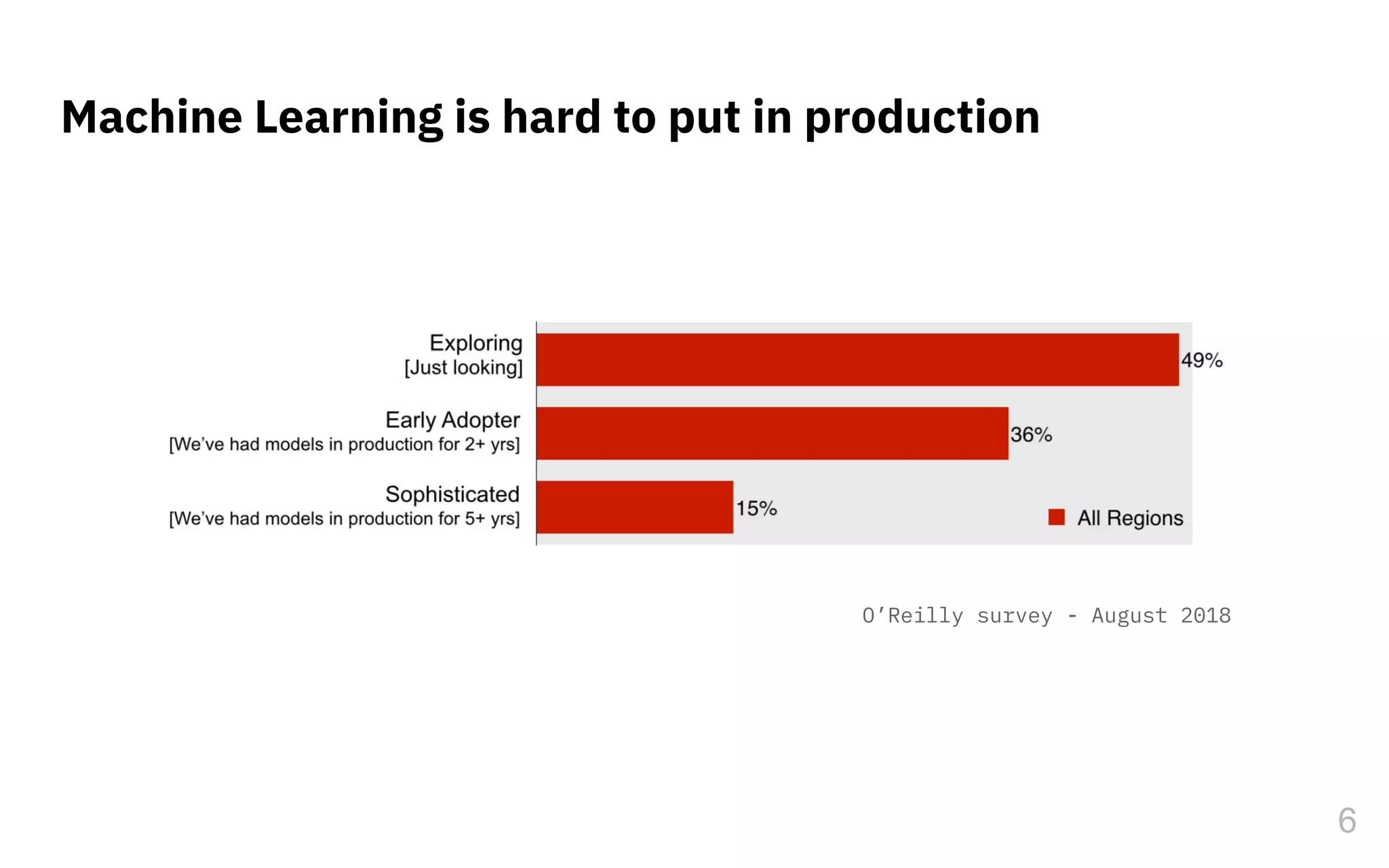
Machine Learning is hard to put in production
O’Reilly survey - August 2018
6
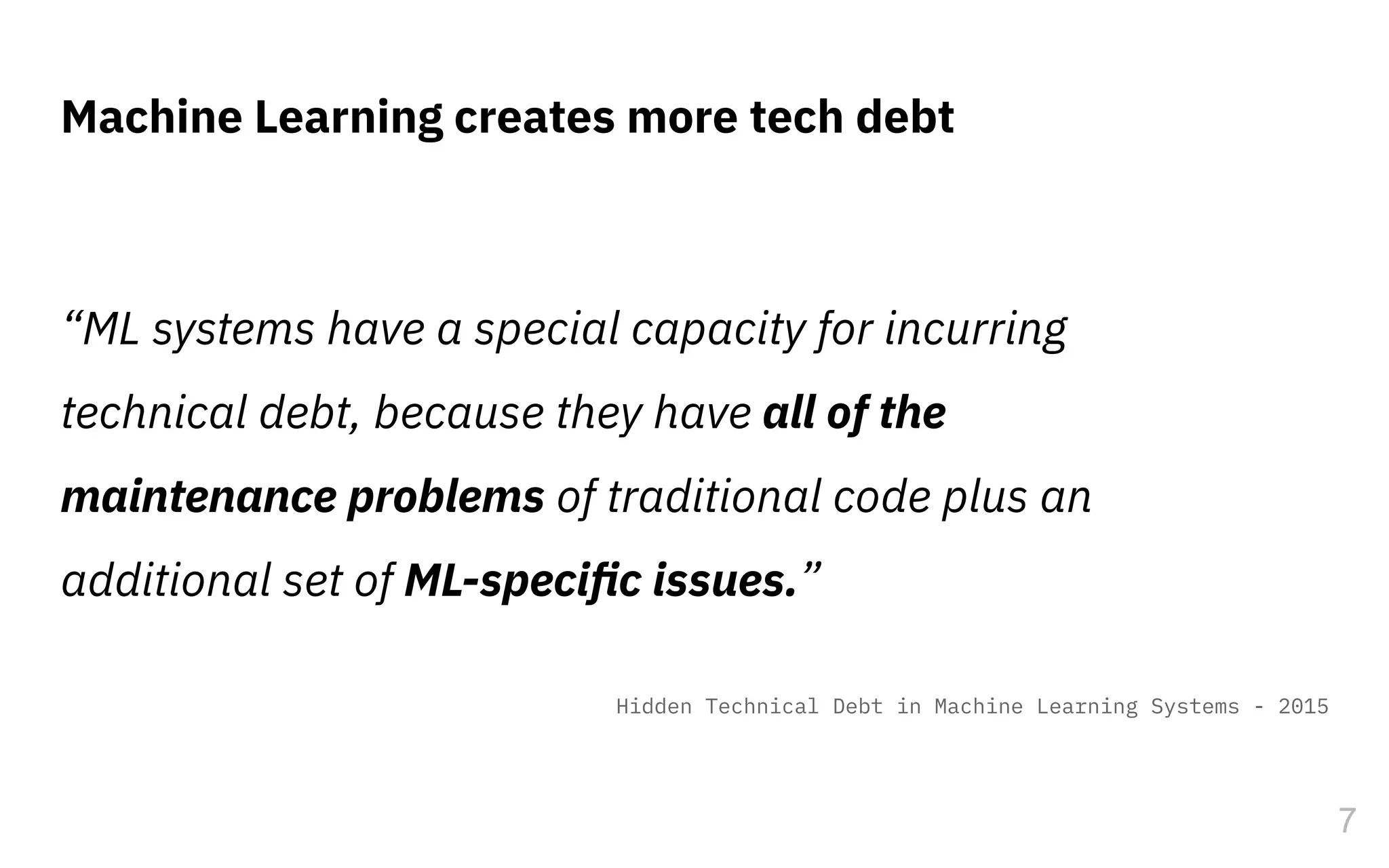
“ML systems have a special capacity for incurring
technical debt, because they have all of the
maintenance problems of traditional code plus an
additional set of ML-specific issues.”
Machine Learning creates more tech debt
7
Hidden Technical Debt in Machine Learning Systems - 2015
8
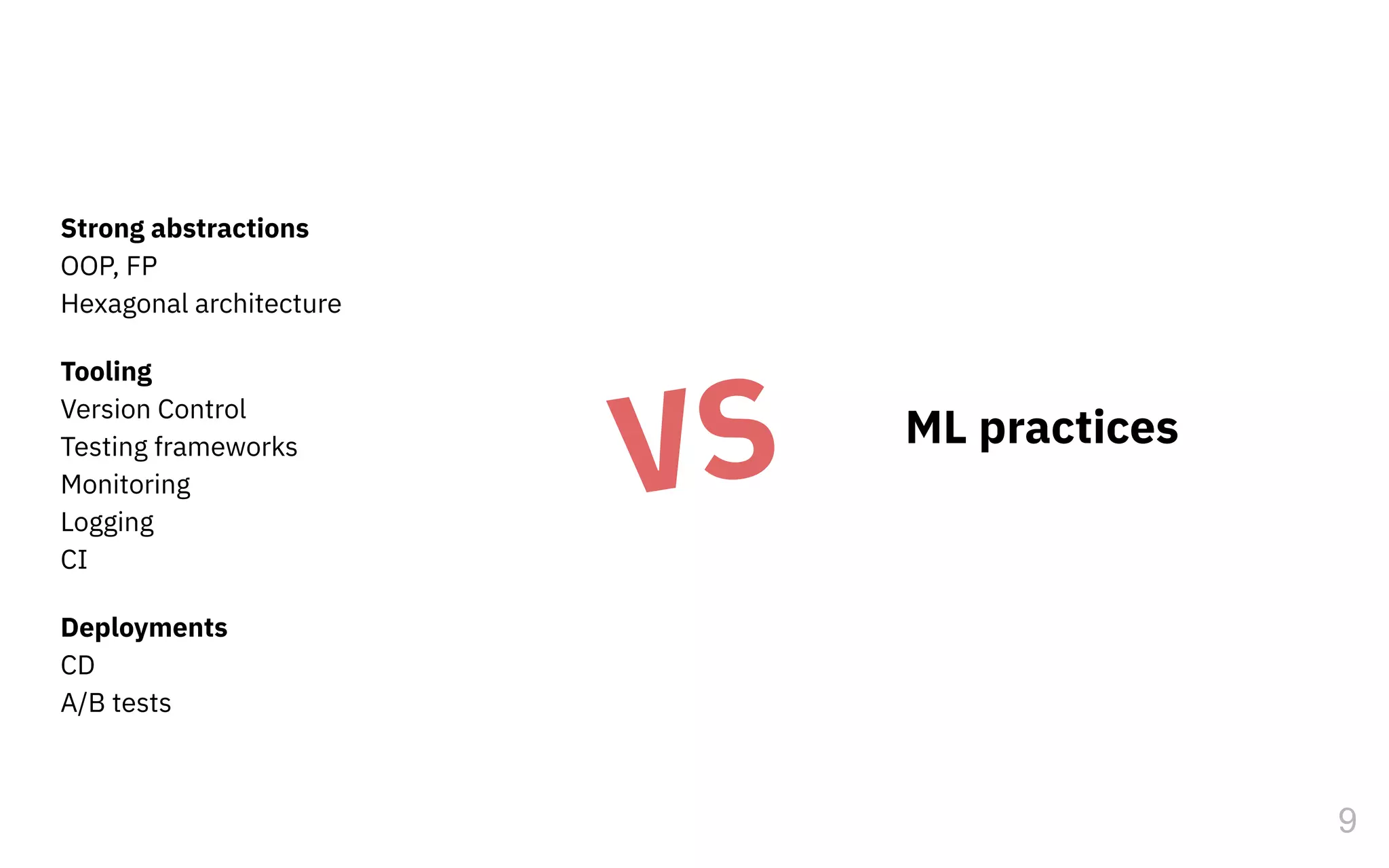
ML practices
VSSoftware practices
9
Strong abstractions
OOP, FP
Hexagonal architecture
Tooling
Version Control
Testing frameworks
Monitoring
Logging
CI
Deployments
CD
A/B tests
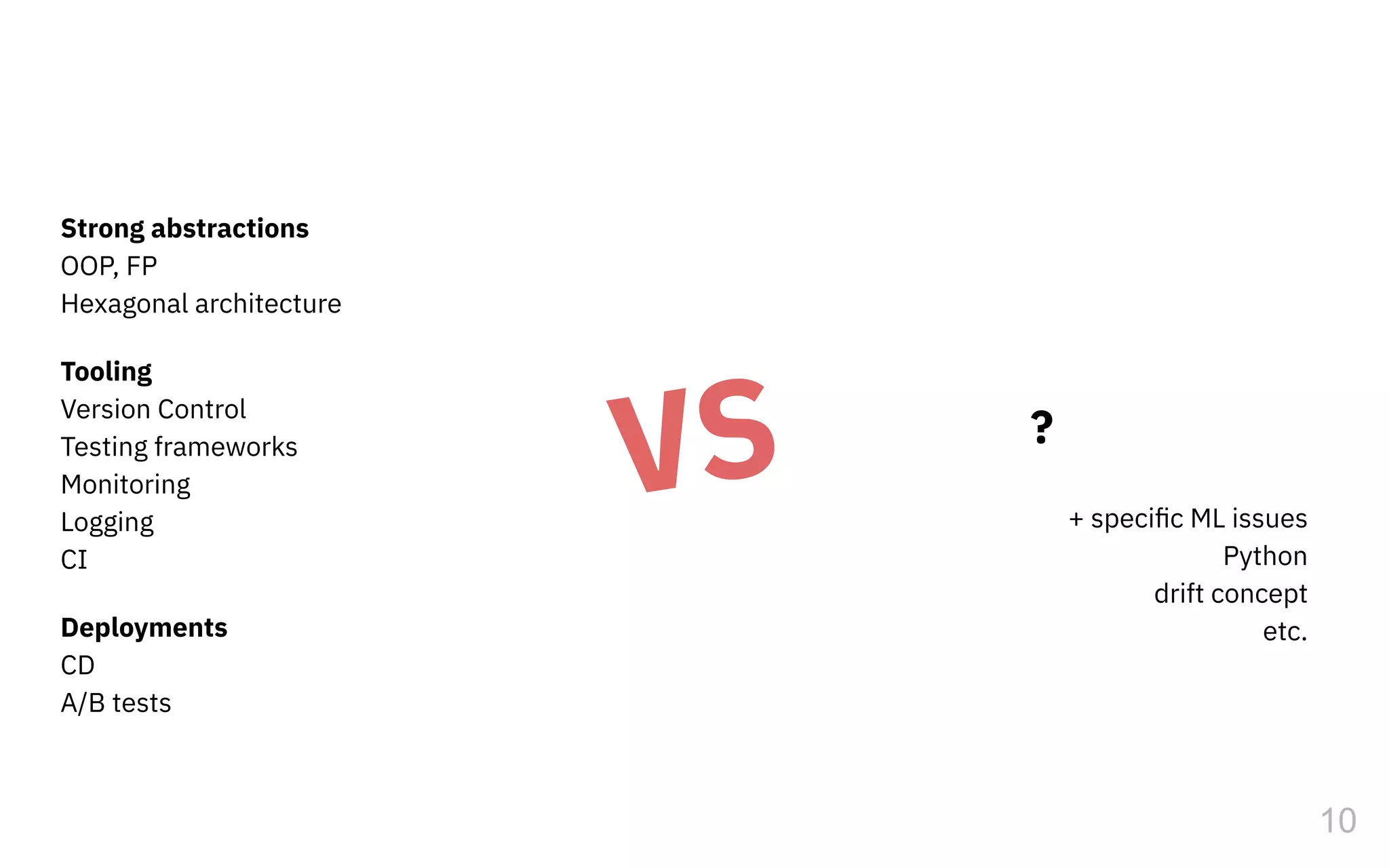
VS ML practices
Strong abstractions
OOP, FP
Hexagonal architecture
Tooling
Version Control
Testing frameworks
Monitoring
Logging
CI
Deployments
CD
A/B tests
10
+ specific ML issues
Python
drift concept
etc.
VS ?
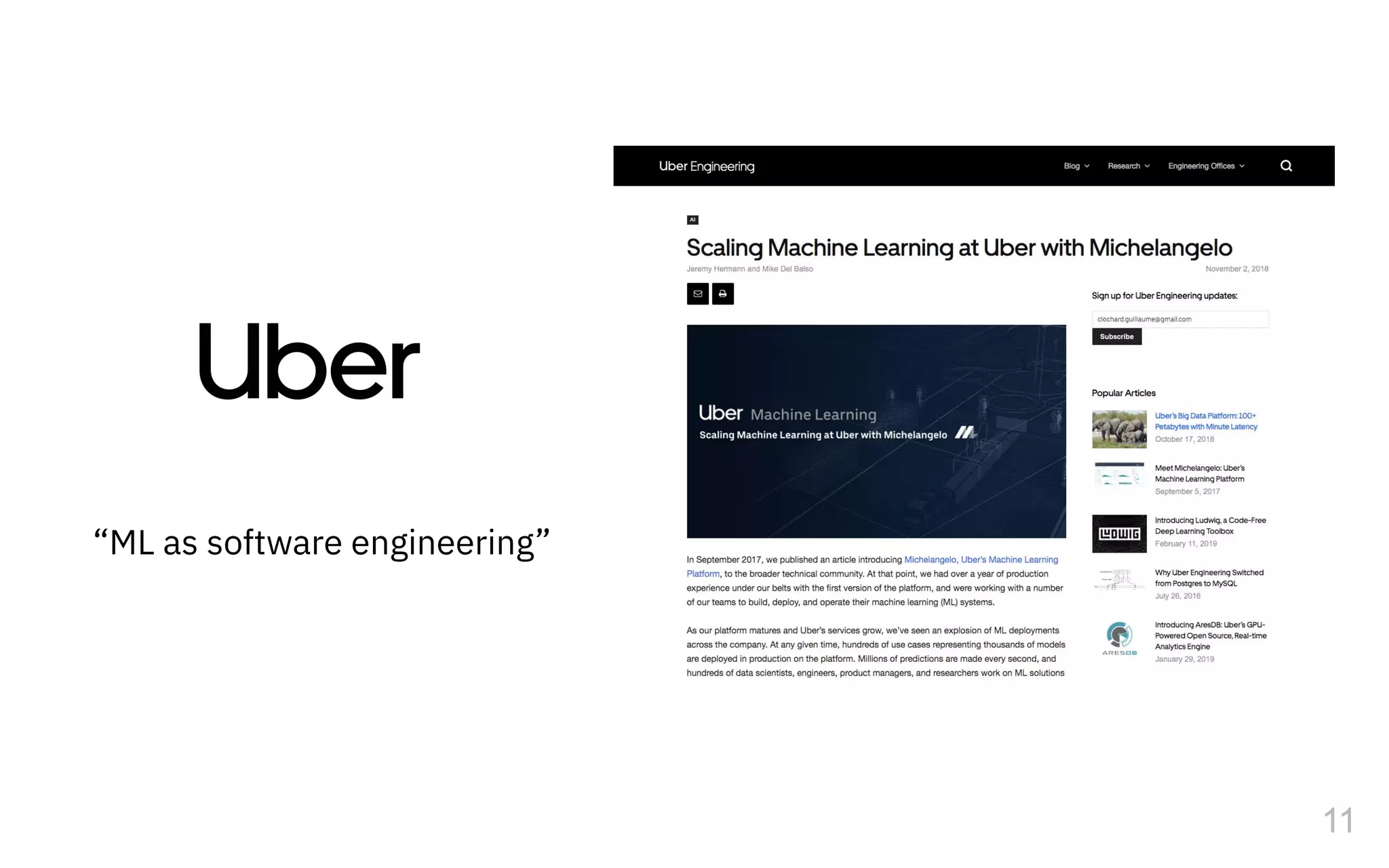
“ML as software engineering”
11
12
13
“Working
code is a
side effect”
Alberto Brandolini
Diving into issues
Collaboration
Data dependencies
Training and Serving Skews
Bad and good patterns
Diving into issues
15
Collaboration difficulties
16
Collaboration difficulties
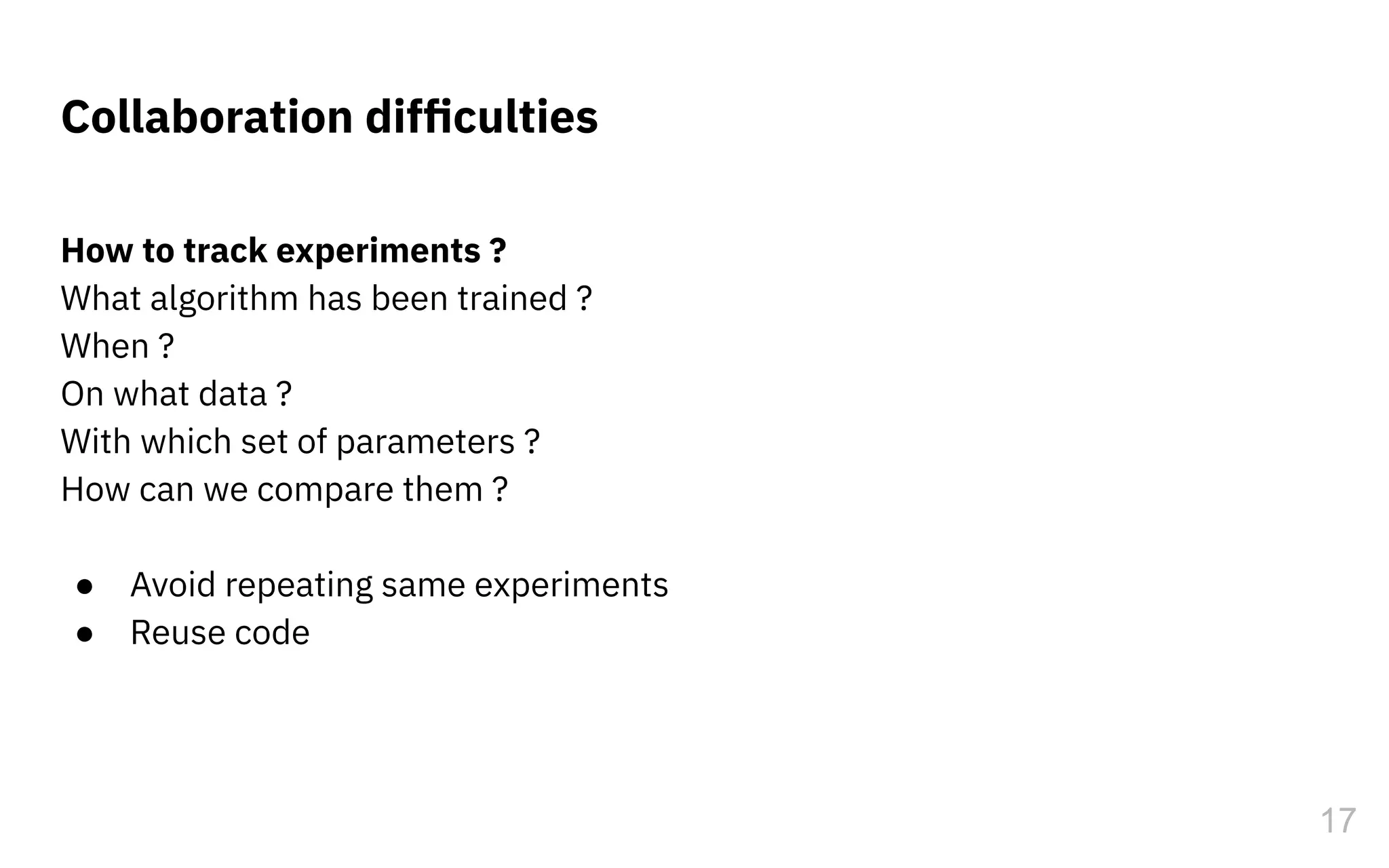
How to track experiments ?
What algorithm has been trained ?
When ?
On what data ?
With which set of parameters ?
How can we compare them ?
● Avoid repeating same experiments
● Reuse code
17
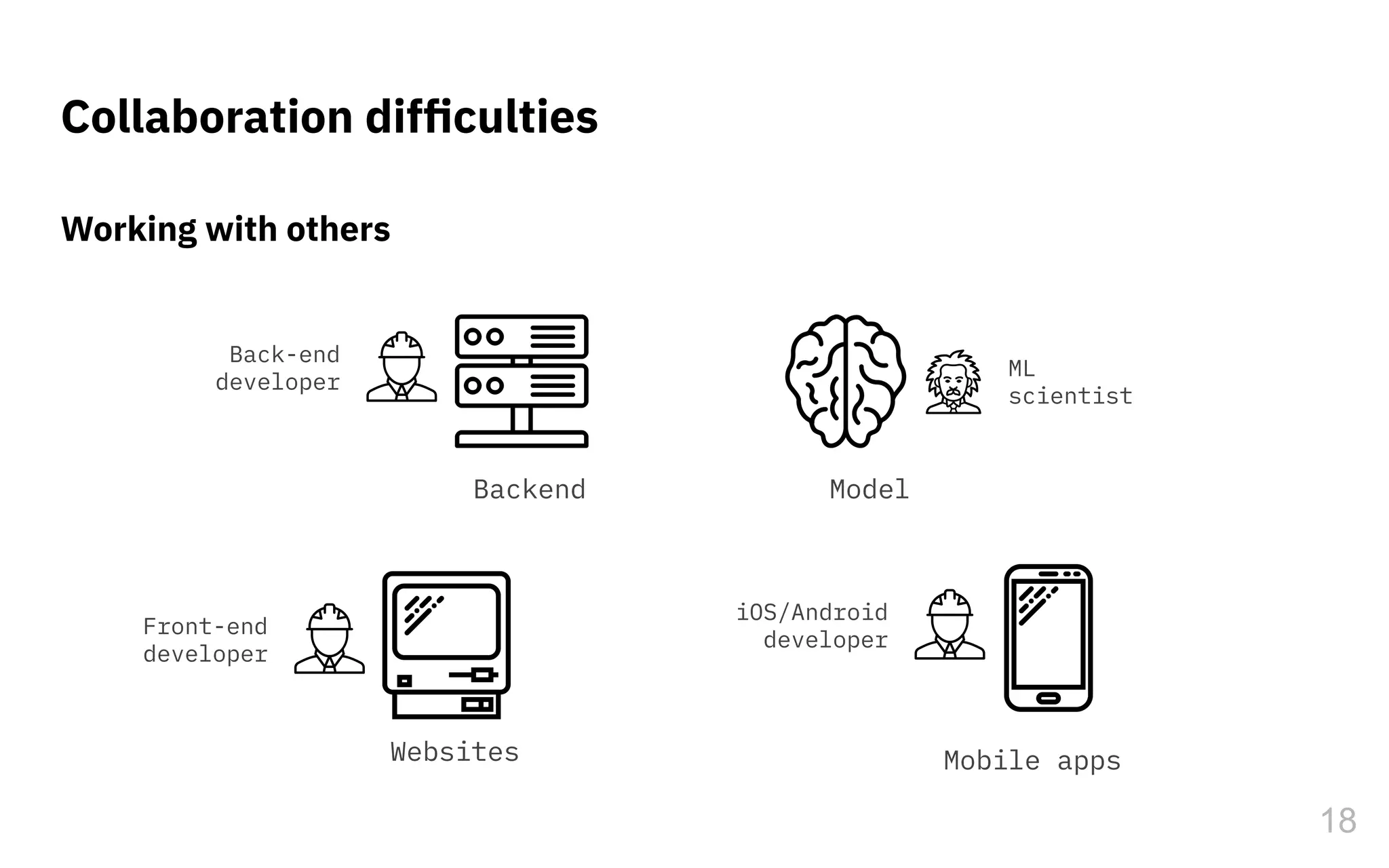
Working with others
Collaboration difficulties
18
Model
Websites
Front-end
developer
Backend
Back-end
developer
Mobile apps
iOS/Android
developer
ML
scientist
Working with others
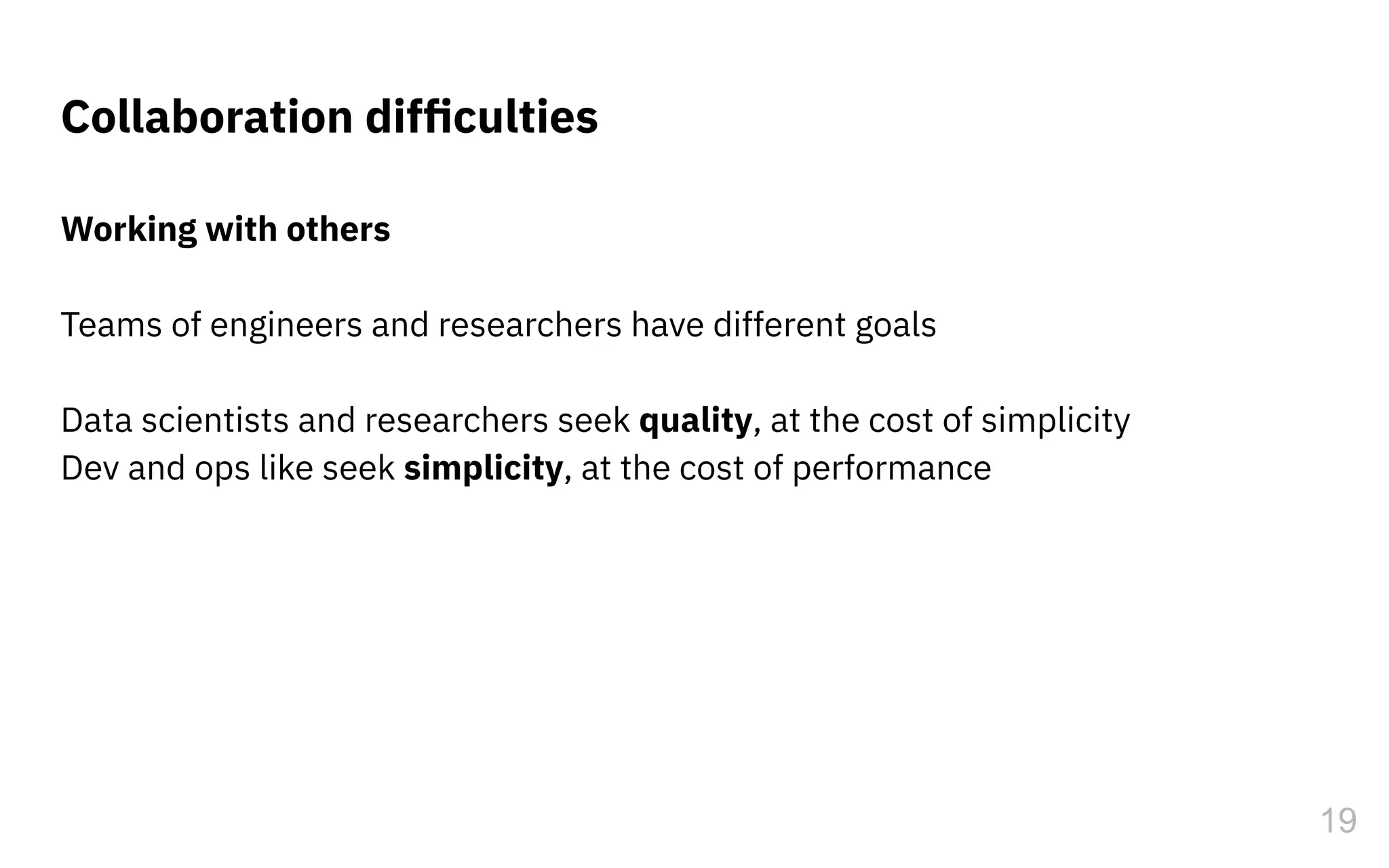
Teams of engineers and researchers have different goals
Data scientists and researchers seek quality, at the cost of simplicity
Dev and ops like seek simplicity, at the cost of performance
Collaboration difficulties
19
Data Dependencies
20
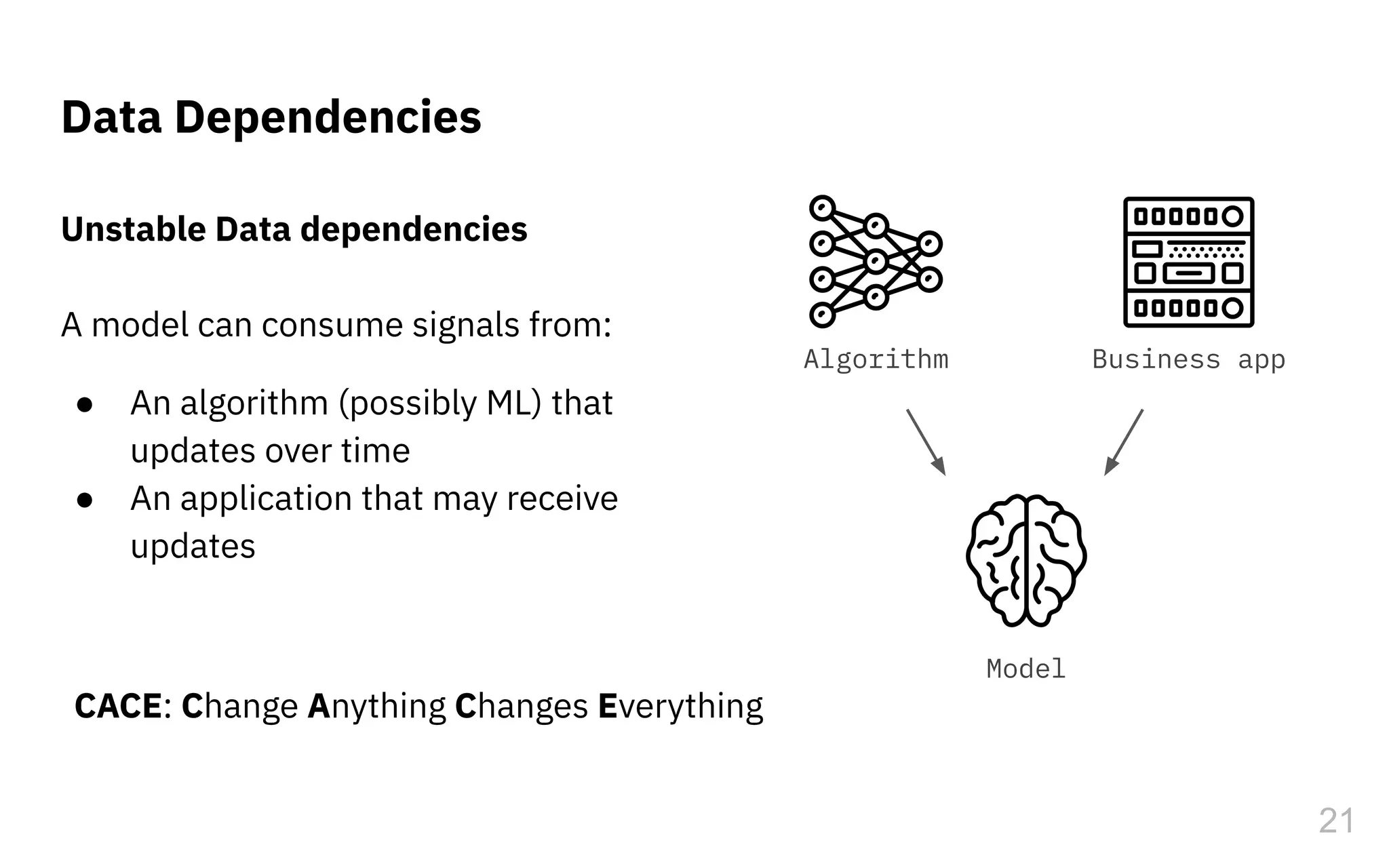
Unstable Data dependencies
A model can consume signals from:
● An algorithm (possibly ML) that
updates over time
● An application that may receive
updates
Data Dependencies
21
Model
Business appAlgorithm
CACE: Change Anything Changes Everything
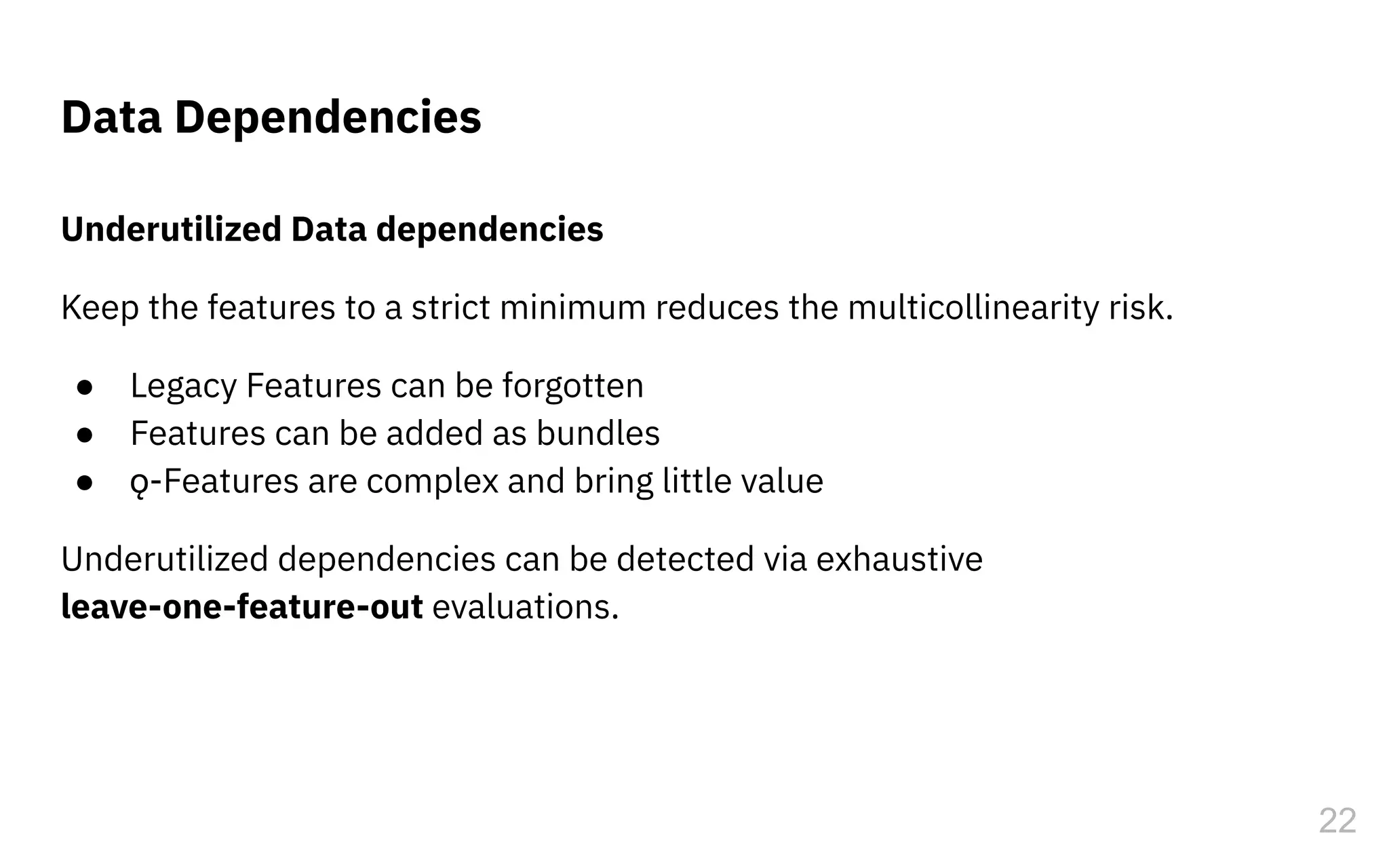
Underutilized Data dependencies
Keep the features to a strict minimum reduces the multicollinearity risk.
● Legacy Features can be forgotten
● Features can be added as bundles
● ǫ-Features are complex and bring little value
Underutilized dependencies can be detected via exhaustive
leave-one-feature-out evaluations.
Data Dependencies
22
According to the TensorFlow doc, 4 skews:
● Schema
● Feature
● Distribution
● Scoring and Serving
23
Training and Serving Skews
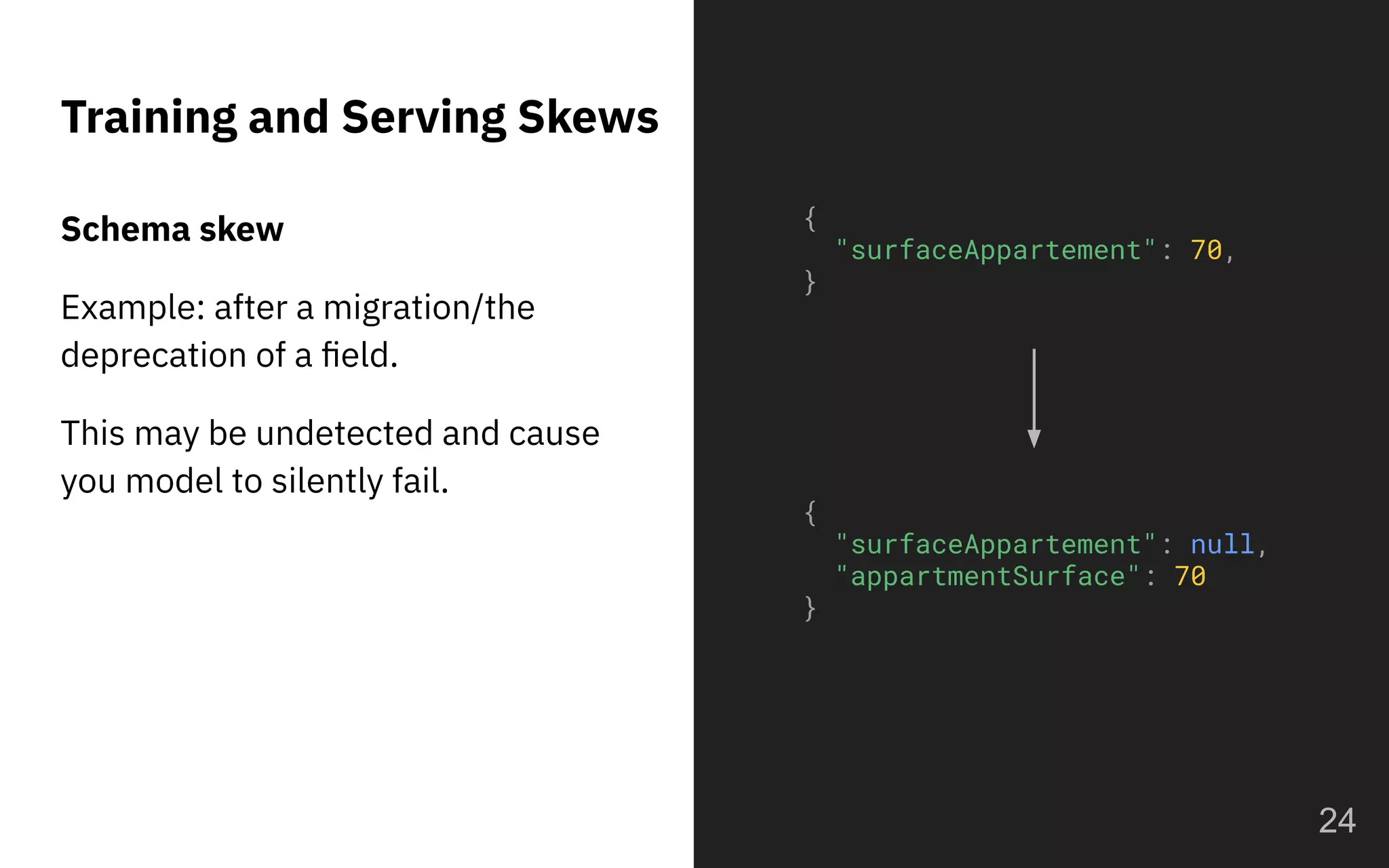
Schema skew
Example: after a migration/the
deprecation of a field.
This may be undetected and cause
you model to silently fail.
24
{
"surfaceAppartement": 70,
}
{
"surfaceAppartement": null,
"appartmentSurface": 70
}
Training and Serving Skews
25
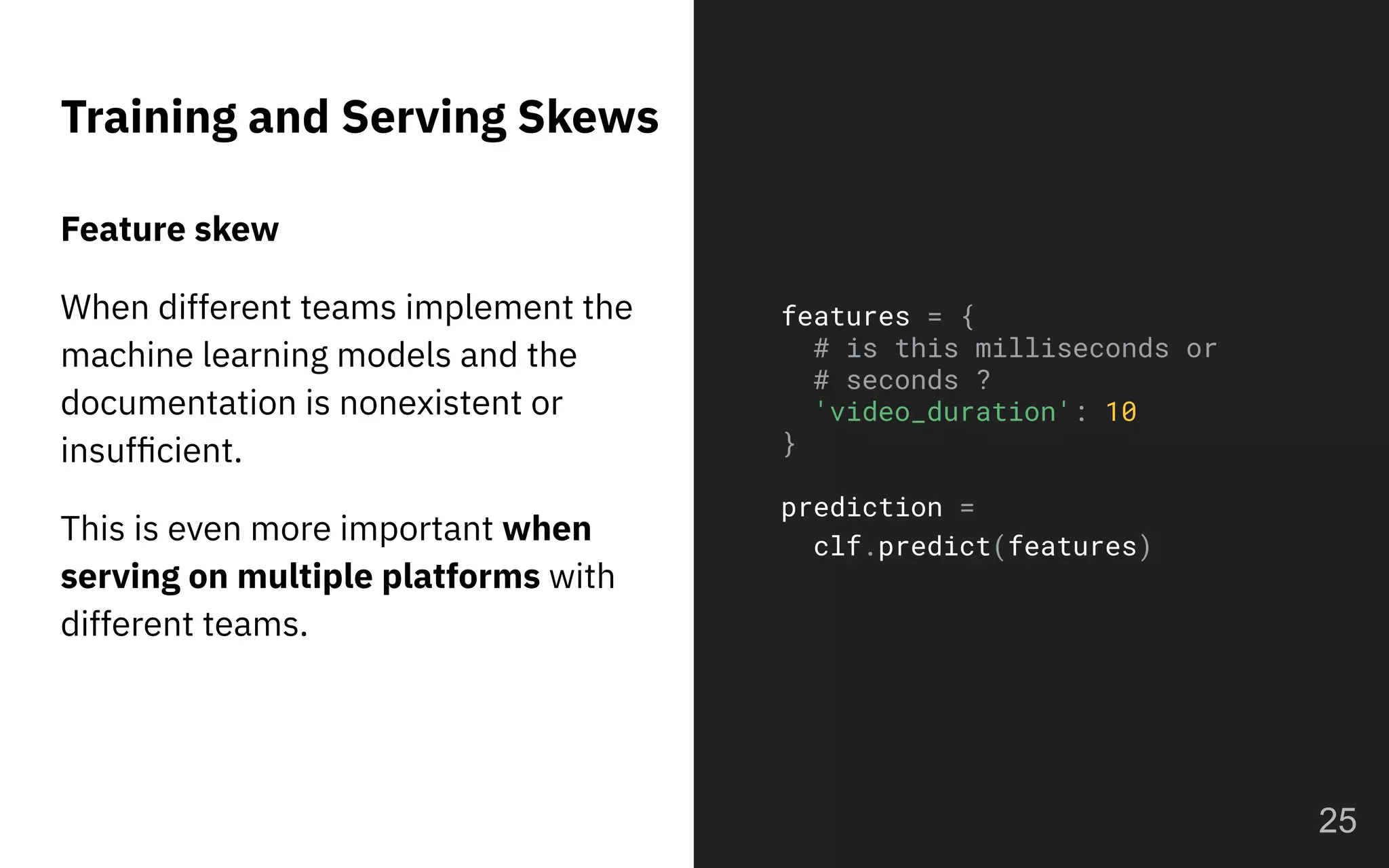
features = {
# is this milliseconds or
# seconds ?
'video_duration': 10
}
prediction =
clf.predict(features)
Feature skew
When different teams implement the
machine learning models and the
documentation is nonexistent or
insufficient.
This is even more important when
serving on multiple platforms with
different teams.
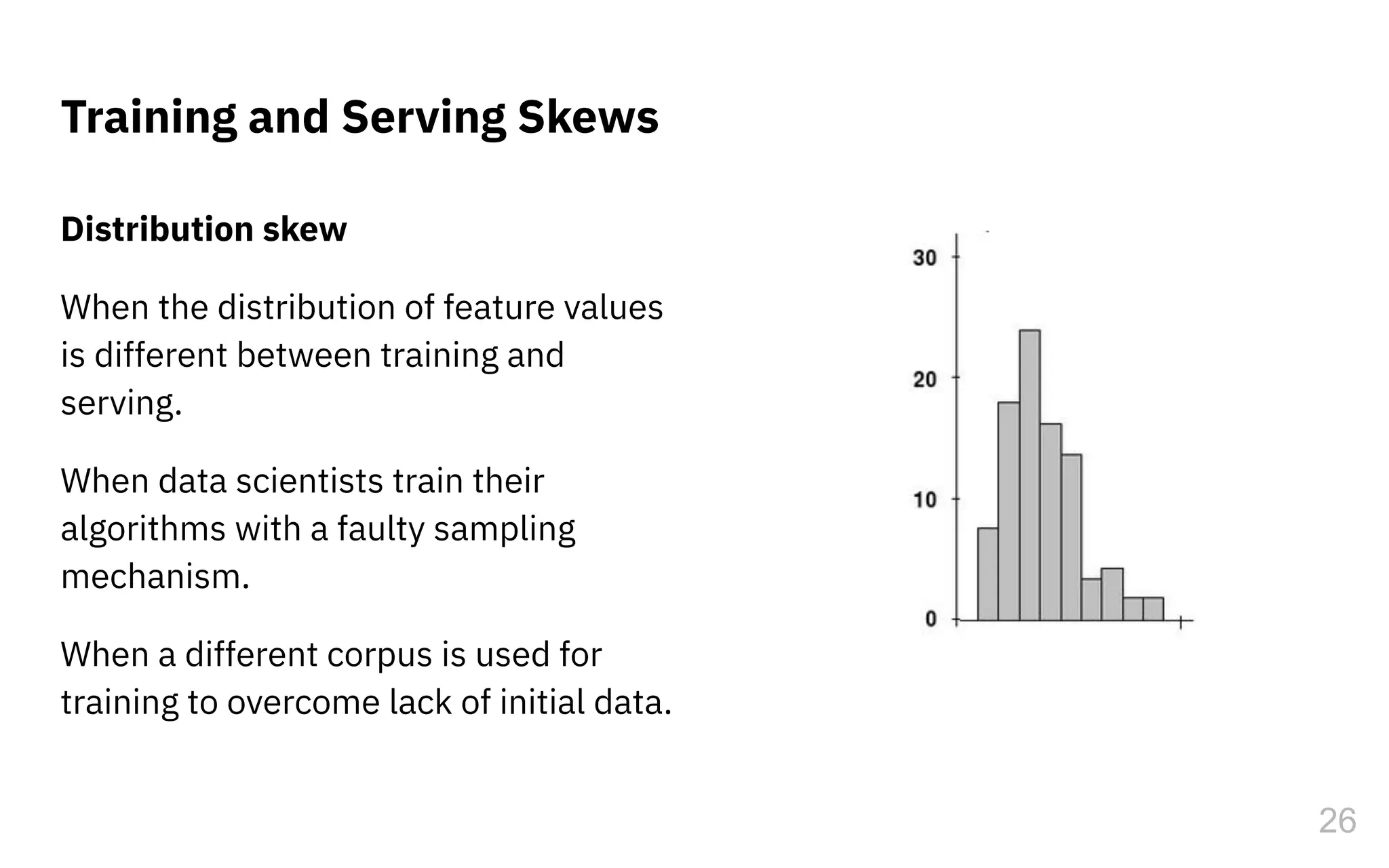
Distribution skew
When the distribution of feature values
is different between training and
serving.
When data scientists train their
algorithms with a faulty sampling
mechanism.
When a different corpus is used for
training to overcome lack of initial data.
Training and Serving Skews
26
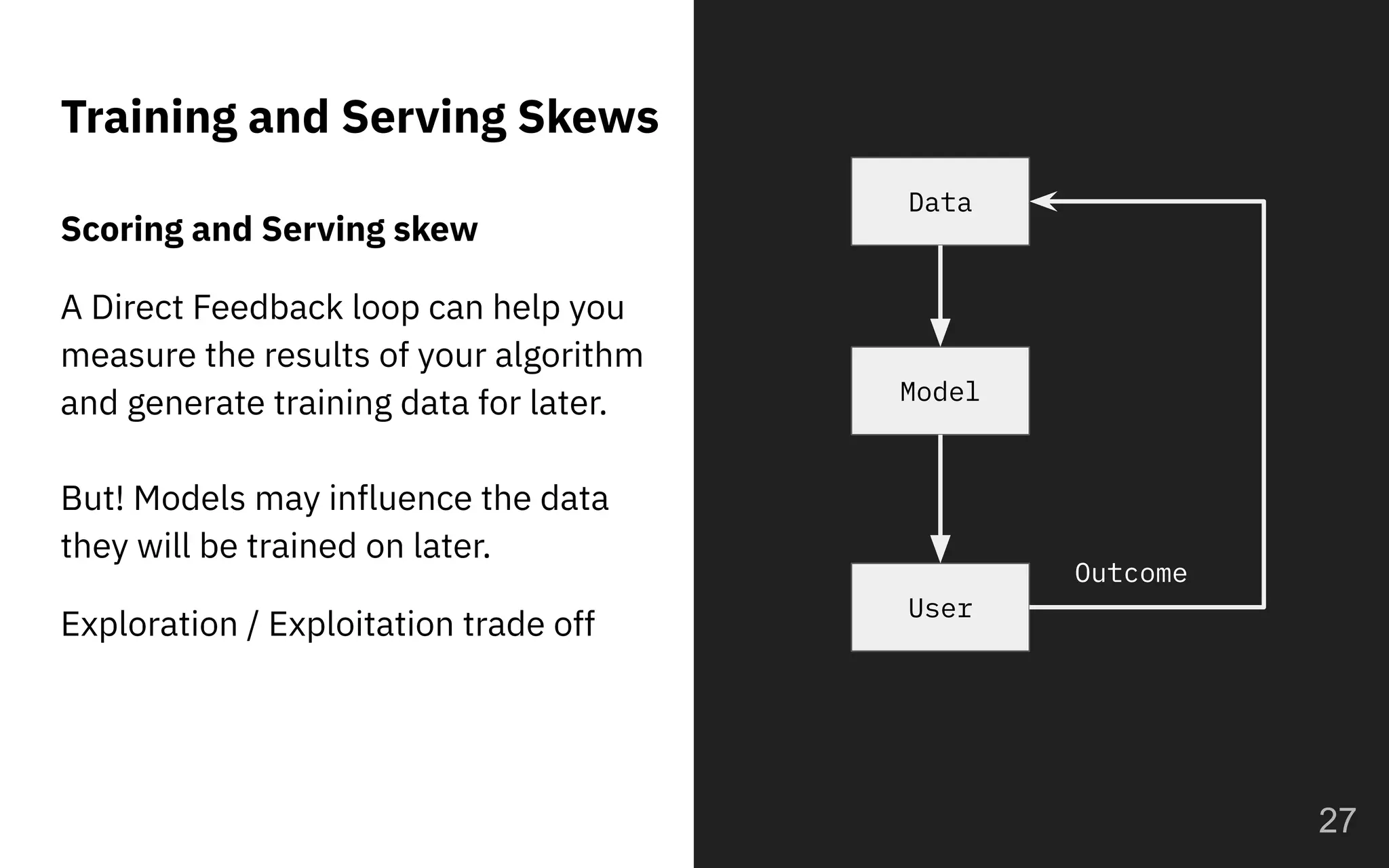
Training and Serving Skews
27
Model
User
Data
Outcome
Scoring and Serving skew
A Direct Feedback loop can help you
measure the results of your algorithm
and generate training data for later.
But! Models may influence the data
they will be trained on later.
Exploration / Exploitation trade off
Training and Serving Skews
28
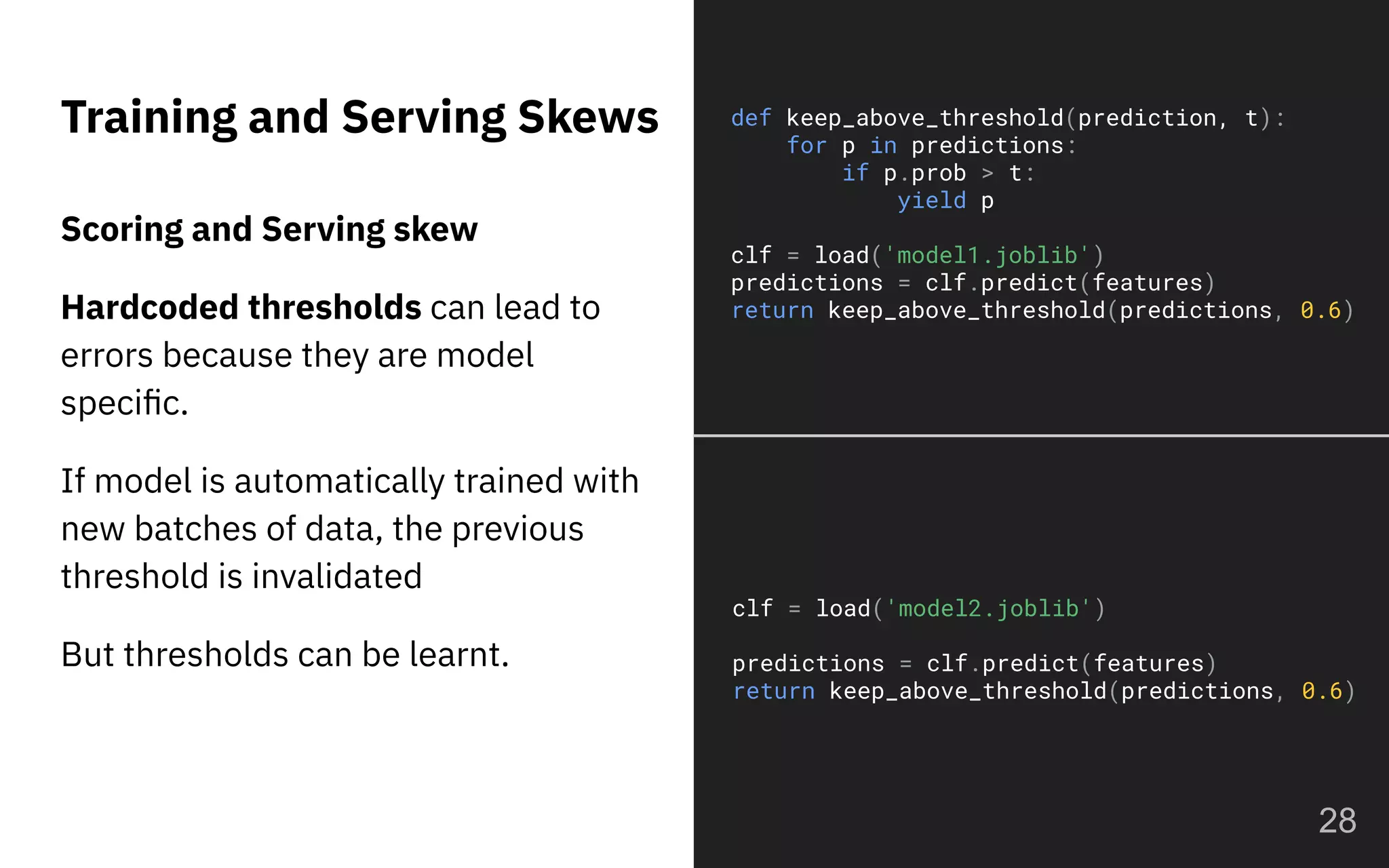
Scoring and Serving skew
Hardcoded thresholds can lead to
errors because they are model
specific.
If model is automatically trained with
new batches of data, the previous
threshold is invalidated
But thresholds can be learnt.
def keep_above_threshold(prediction, t):
for p in predictions:
if p.prob > t:
yield p
clf = load('model1.joblib')
predictions = clf.predict(features)
return keep_above_threshold(predictions, 0.6)
clf = load('model2.joblib')
predictions = clf.predict(features)
return keep_above_threshold(predictions, 0.6)
Bad and good patterns
29
Bad and good patterns
Bad: Glue code
Wikipedia: “... executable code that
serves solely to «adapt» different parts
of code that would otherwise be
incompatible”.
Problems
Maintenance is hard
Complexity is high
30
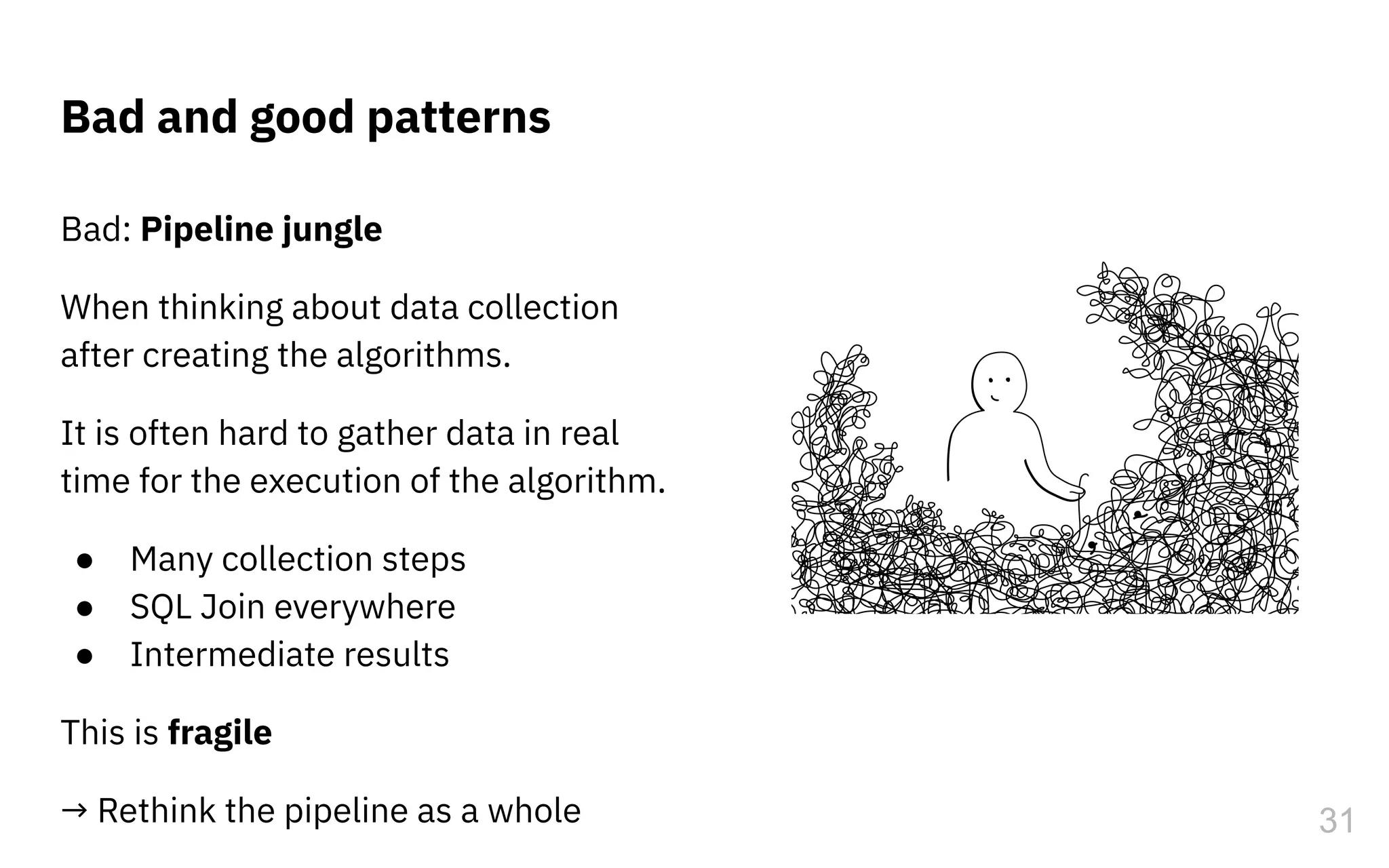
Bad: Pipeline jungle
When thinking about data collection
after creating the algorithms.
It is often hard to gather data in real
time for the execution of the algorithm.
● Many collection steps
● SQL Join everywhere
● Intermediate results
This is fragile
→ Rethink the pipeline as a whole
Bad and good patterns
31
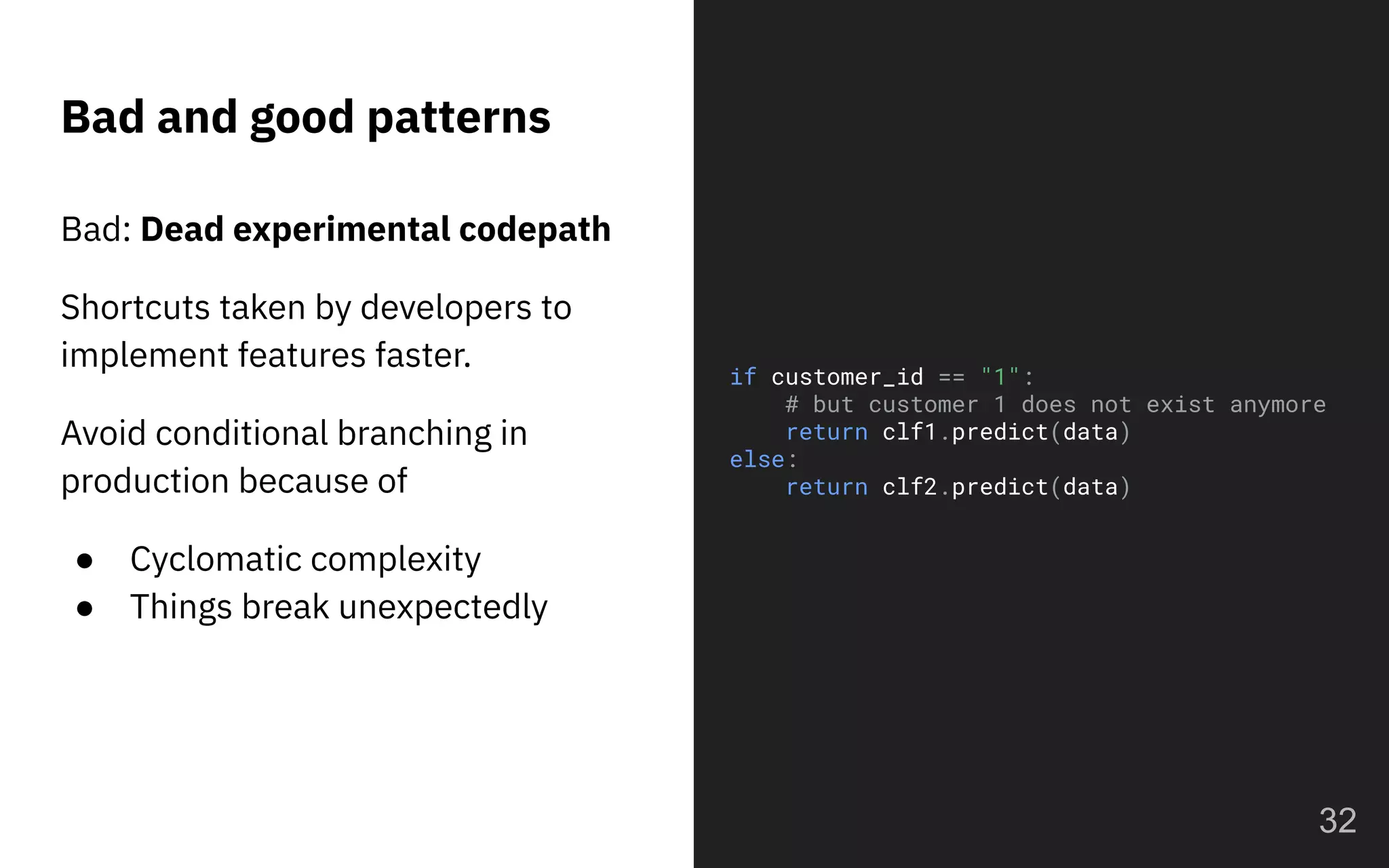
Bad: Dead experimental codepath
Shortcuts taken by developers to
implement features faster.
Avoid conditional branching in
production because of
● Cyclomatic complexity
● Things break unexpectedly
Bad and good patterns
32
if customer_id == "1":
# but customer 1 does not exist anymore
return clf1.predict(data)
else:
return clf2.predict(data)
Bad and good patterns
33
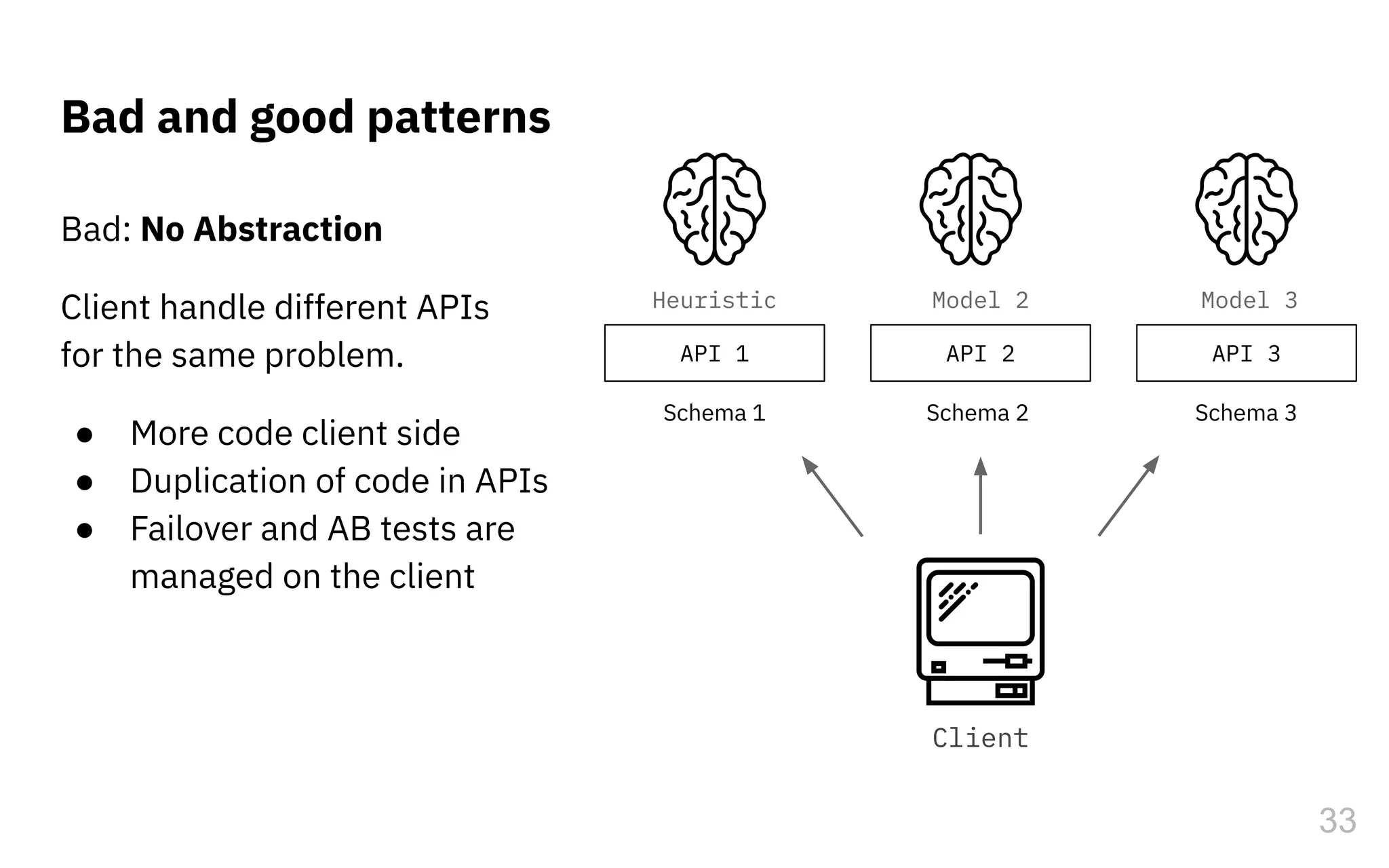
Client
API 1 API 2
Heuristic Model 2 Model 3
API 3
Schema 1 Schema 2 Schema 3
Bad: No Abstraction
Client handle different APIs
for the same problem.
● More code client side
● Duplication of code in APIs
● Failover and AB tests are
managed on the client
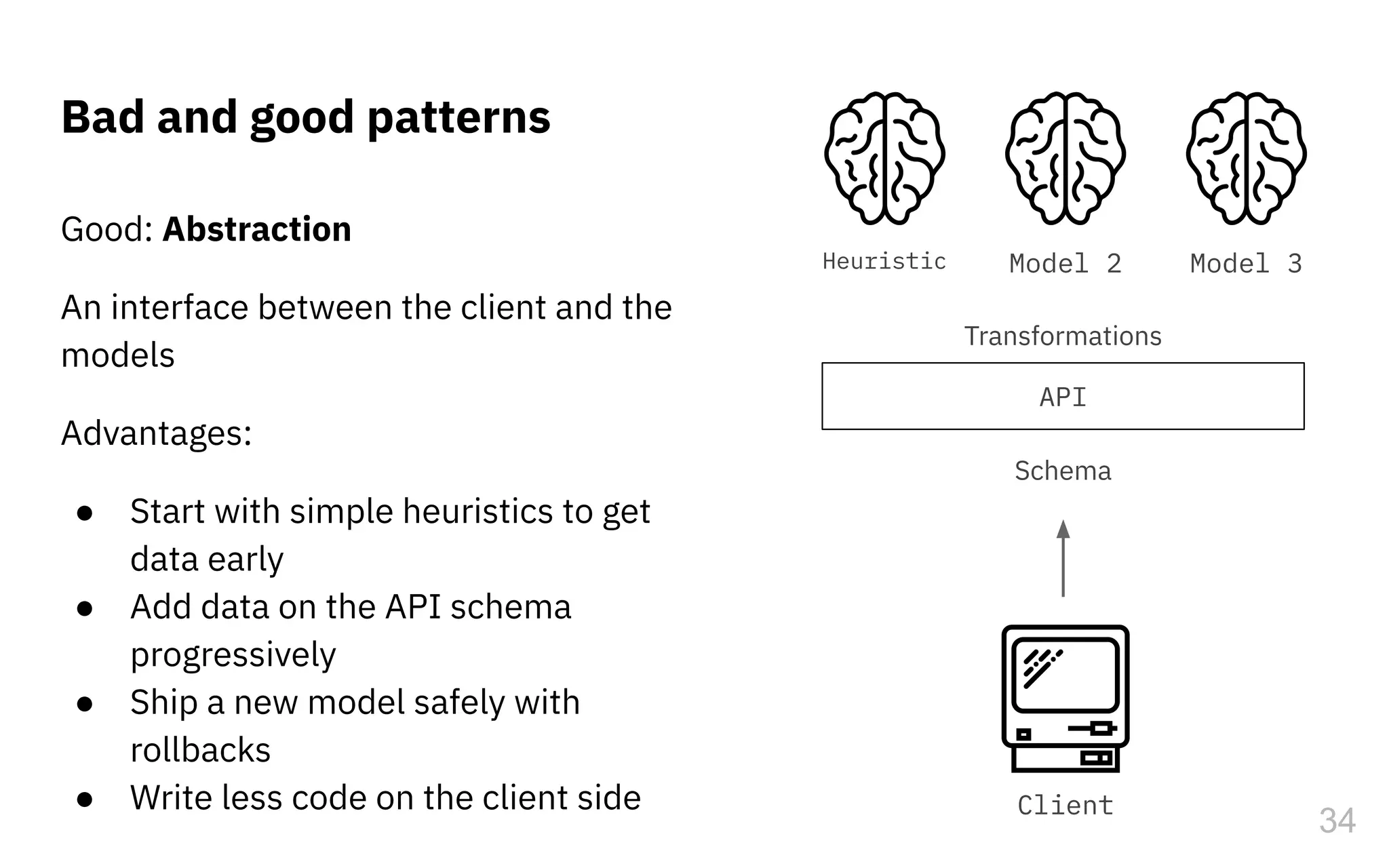
Good: Abstraction
An interface between the client and the
models
Advantages:
● Start with simple heuristics to get
data early
● Add data on the API schema
progressively
● Ship a new model safely with
rollbacks
● Write less code on the client side
Bad and good patterns
34
Heuristic
Client
API
Model 2 Model 3
Schema
Transformations
Platforms
The basics
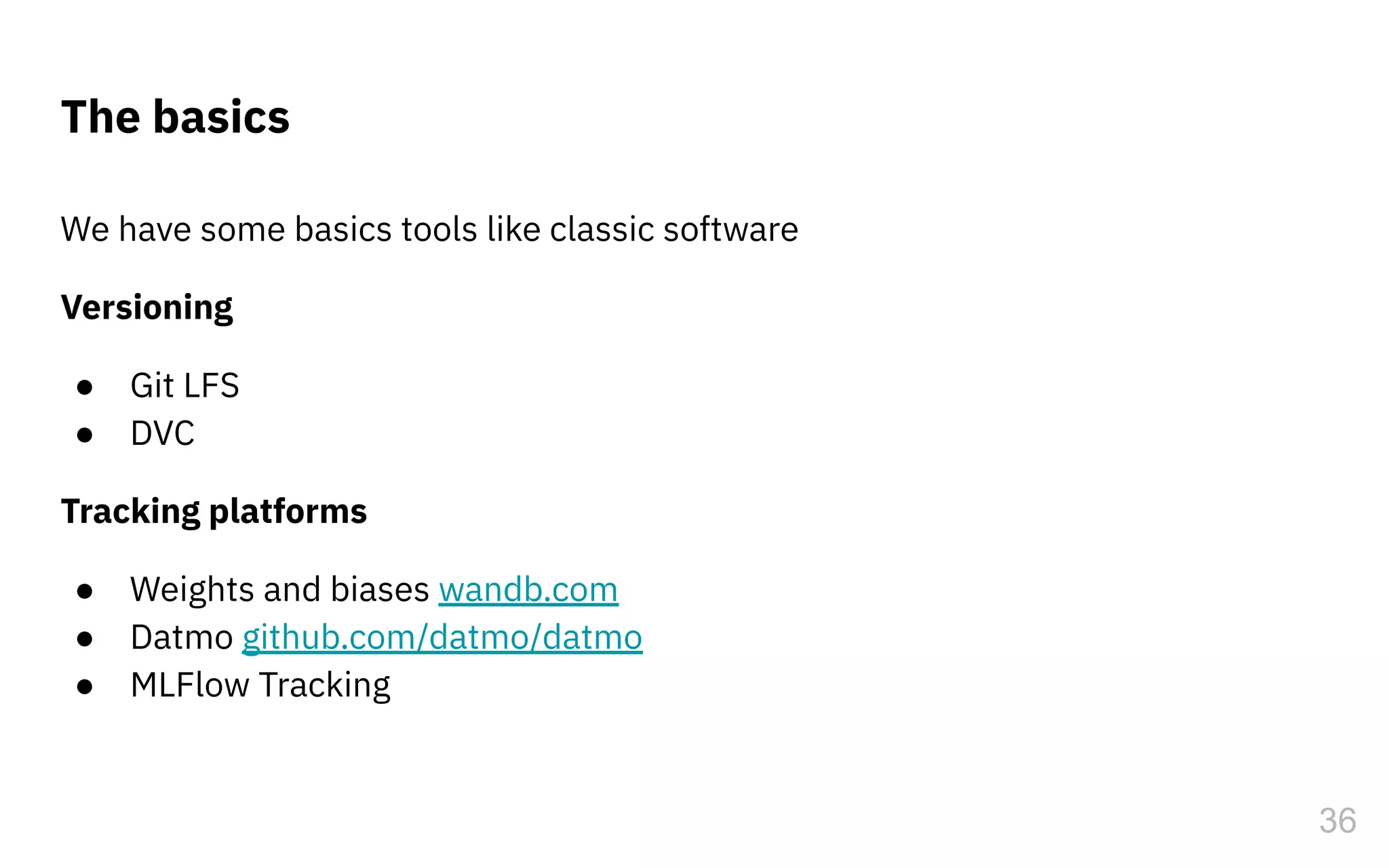
We have some basics tools like classic software
Versioning
● Git LFS
● DVC
Tracking platforms
● Weights and biases wandb.com
● Datmo github.com/datmo/datmo
● MLFlow Tracking
36
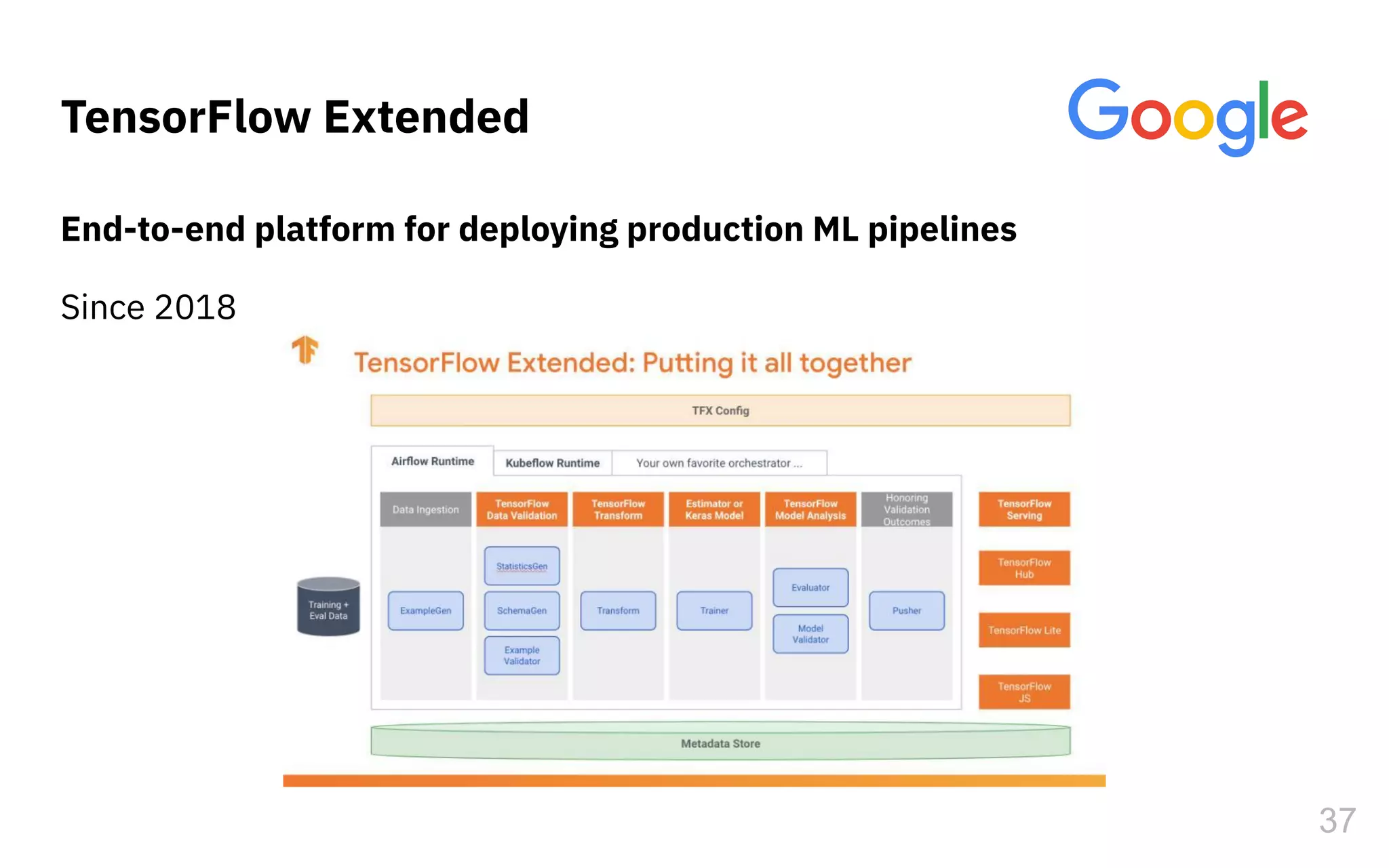
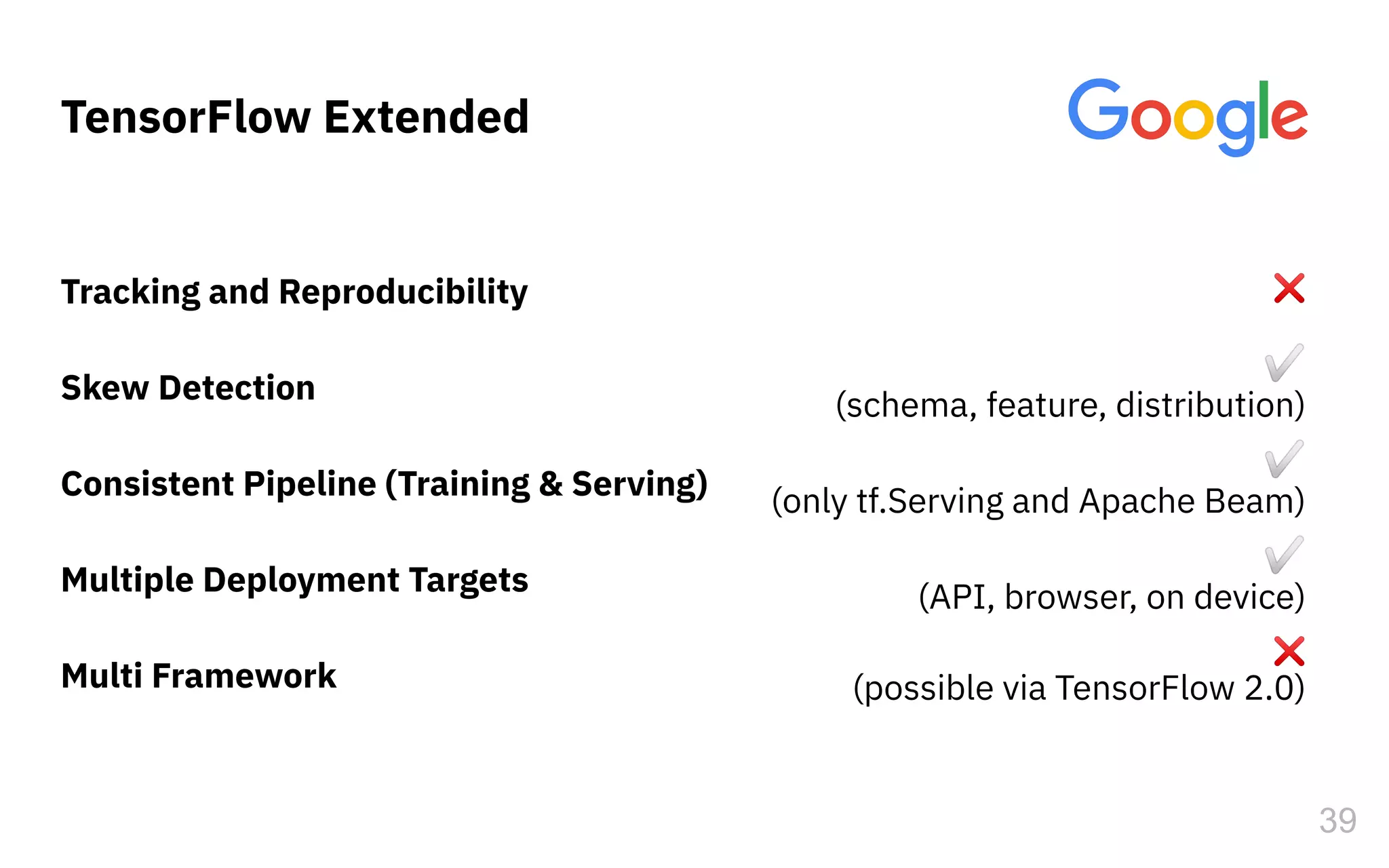
TensorFlow Extended
End-to-end platform for deploying production ML pipelines
Since 2018
37
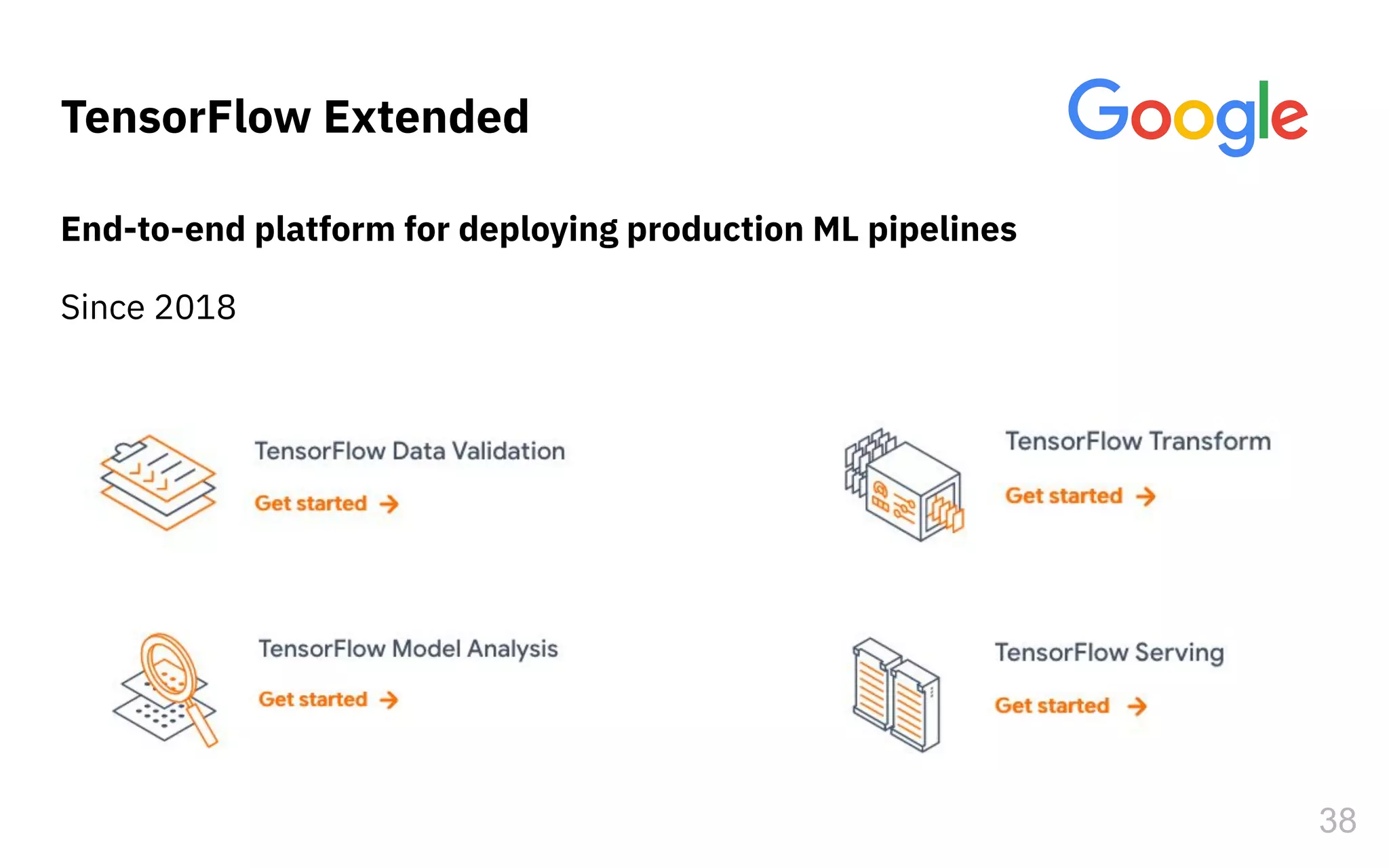
TensorFlow Extended
End-to-end platform for deploying production ML pipelines
Since 2018
38
TensorFlow Extended
39
Tracking and Reproducibility
Skew Detection
Consistent Pipeline (Training & Serving)
Multiple Deployment Targets
Multi Framework
❌
✅
(schema, feature, distribution)
✅
(only tf.Serving and Apache Beam)
✅
(API, browser, on device)
❌
(possible via TensorFlow 2.0)
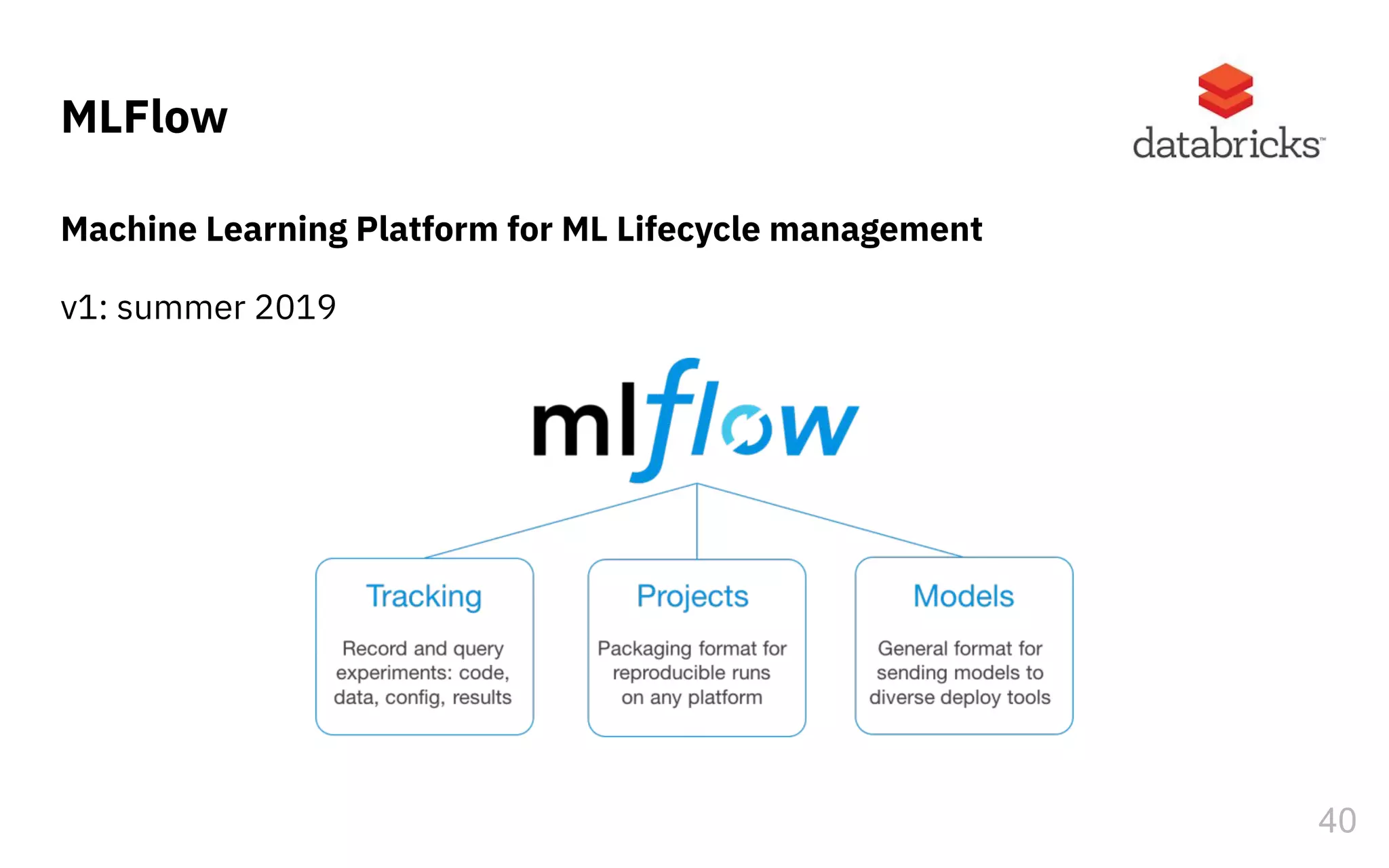
MLFlow
Machine Learning Platform for ML Lifecycle management
v1: summer 2019
40
✅
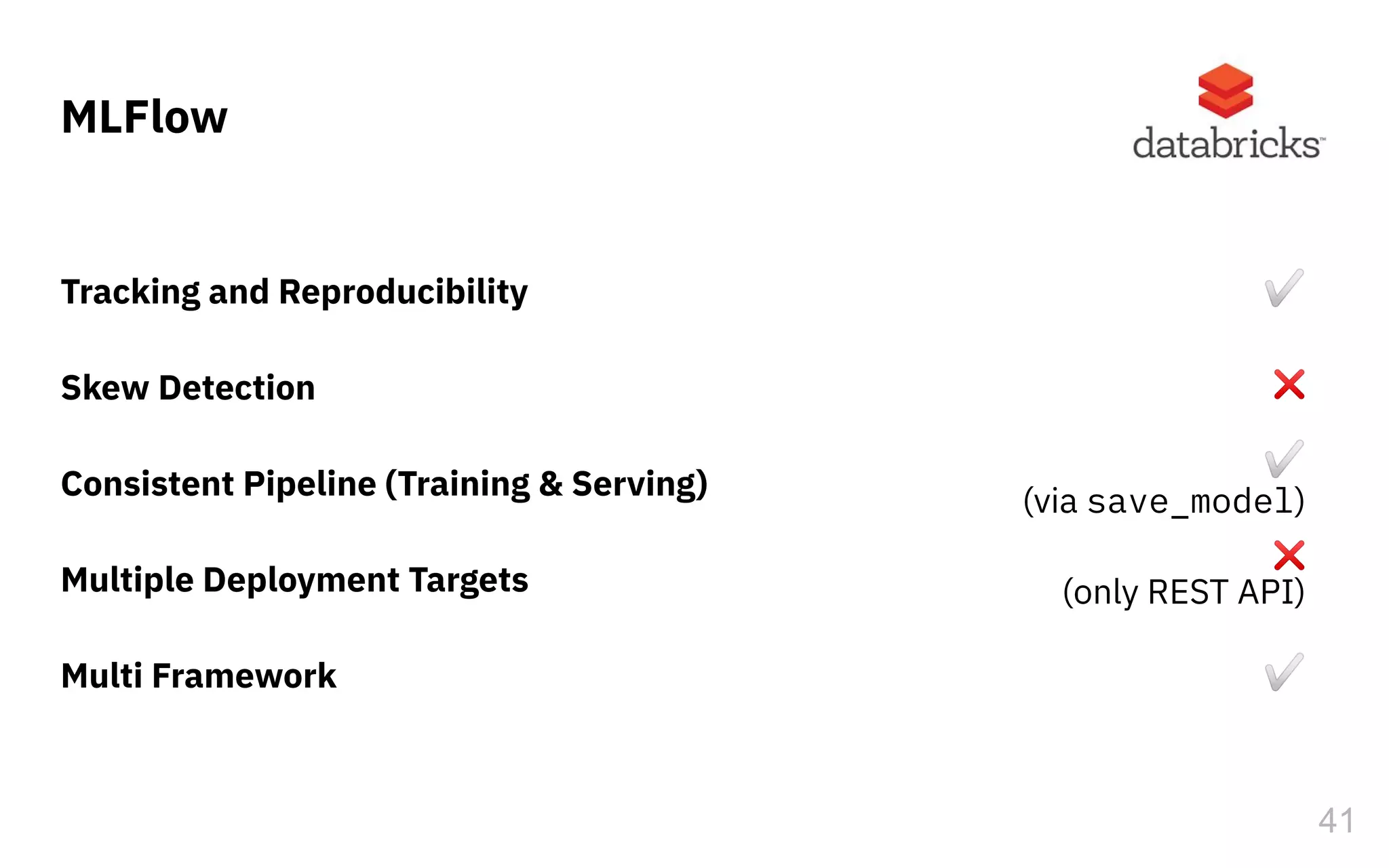
MLFlow
41
Tracking and Reproducibility
Skew Detection
Consistent Pipeline (Training & Serving)
Multiple Deployment Targets
Multi Framework
✅
❌
✅
(via save_model)
❌
(only REST API)
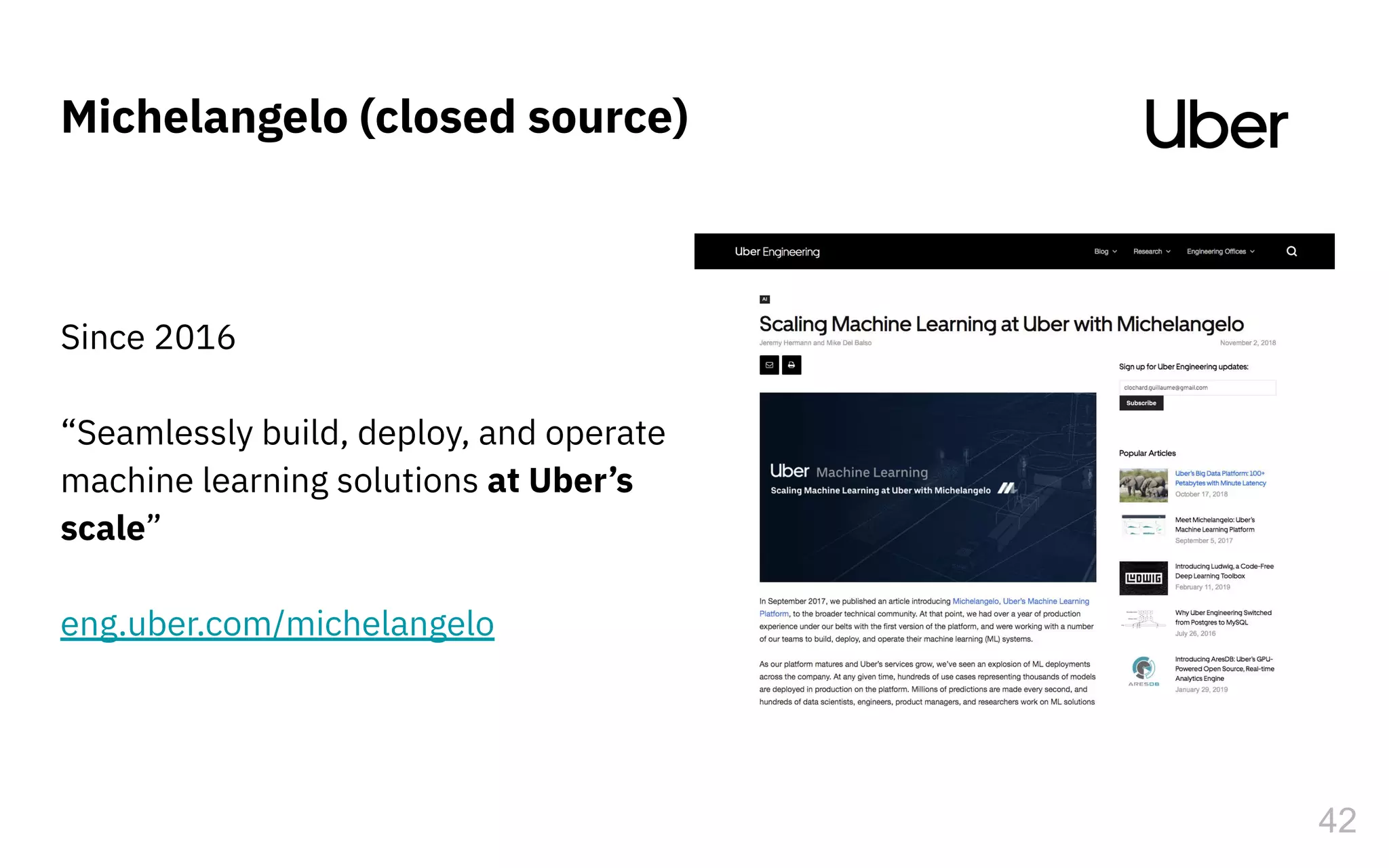
Since 2016
“Seamlessly build, deploy, and operate
machine learning solutions at Uber’s
scale”
eng.uber.com/michelangelo
Michelangelo (closed source)
42
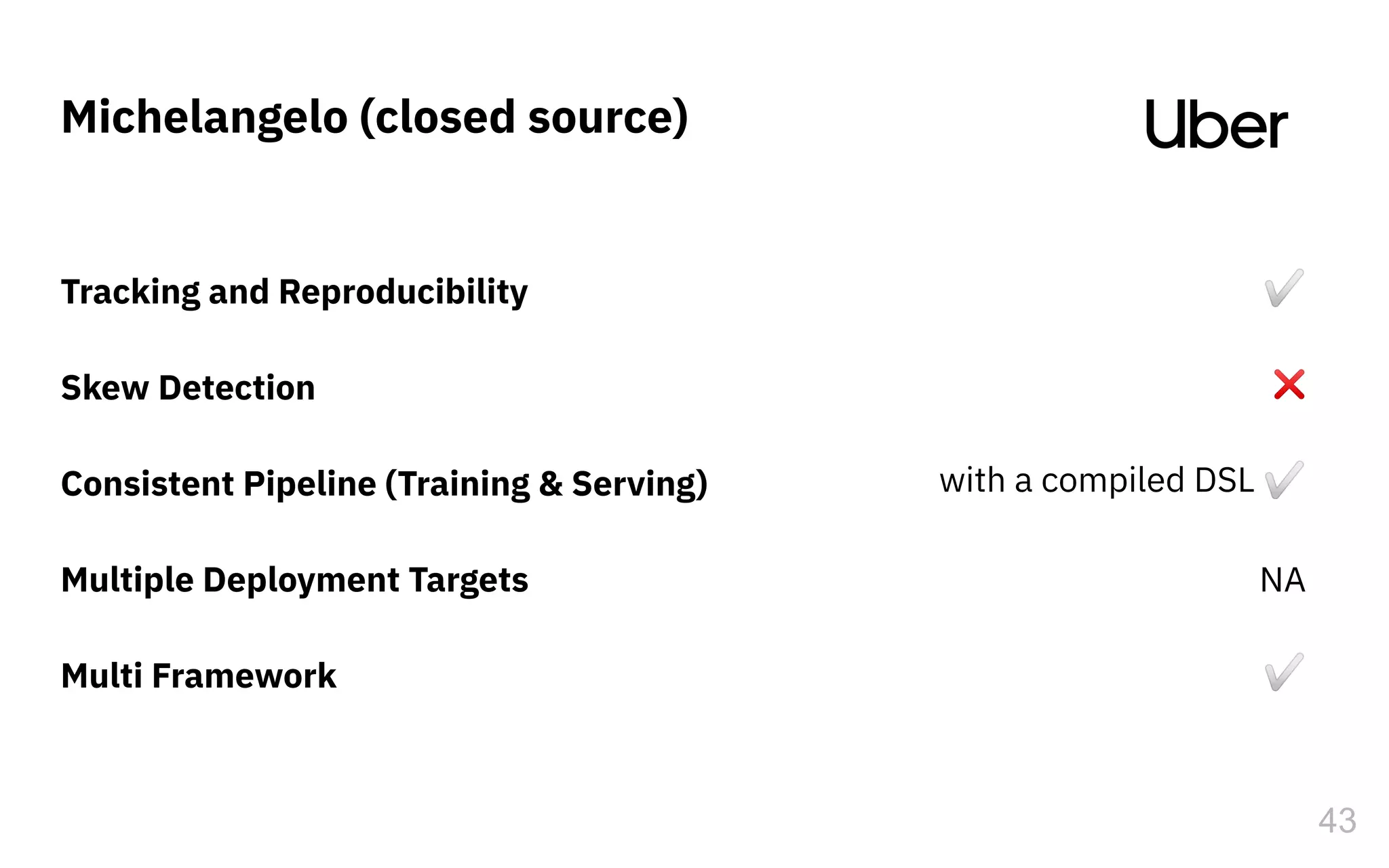
Michelangelo (closed source)
43
✅
Tracking and Reproducibility
Skew Detection
Consistent Pipeline (Training & Serving)
Multiple Deployment Targets
Multi Framework
❌
✅
with a compiled DSL ✅
NA
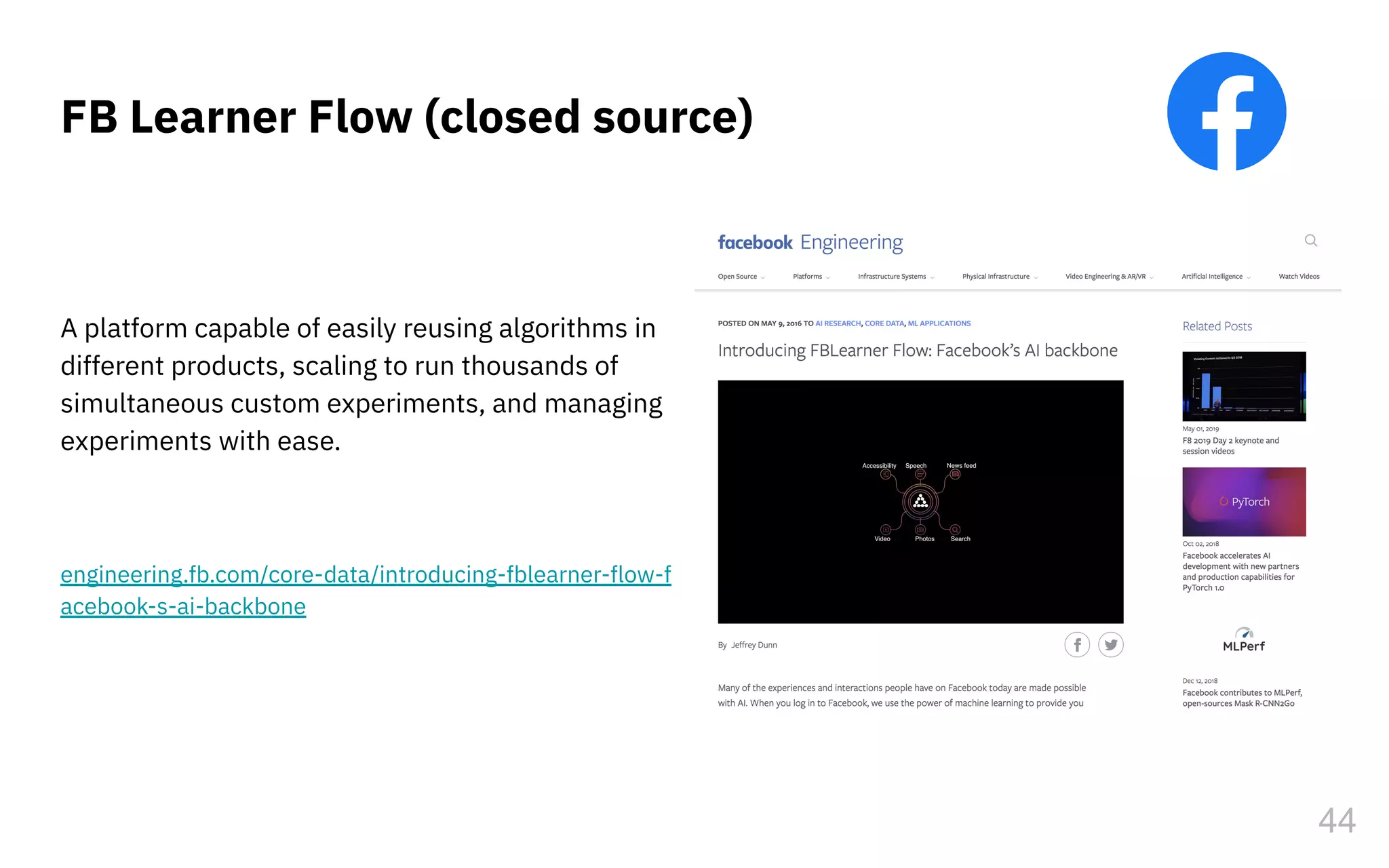
FB Learner Flow (closed source)
A platform capable of easily reusing algorithms in
different products, scaling to run thousands of
simultaneous custom experiments, and managing
experiments with ease.
engineering.fb.com/core-data/introducing-fblearner-flow-f
acebook-s-ai-backbone
44
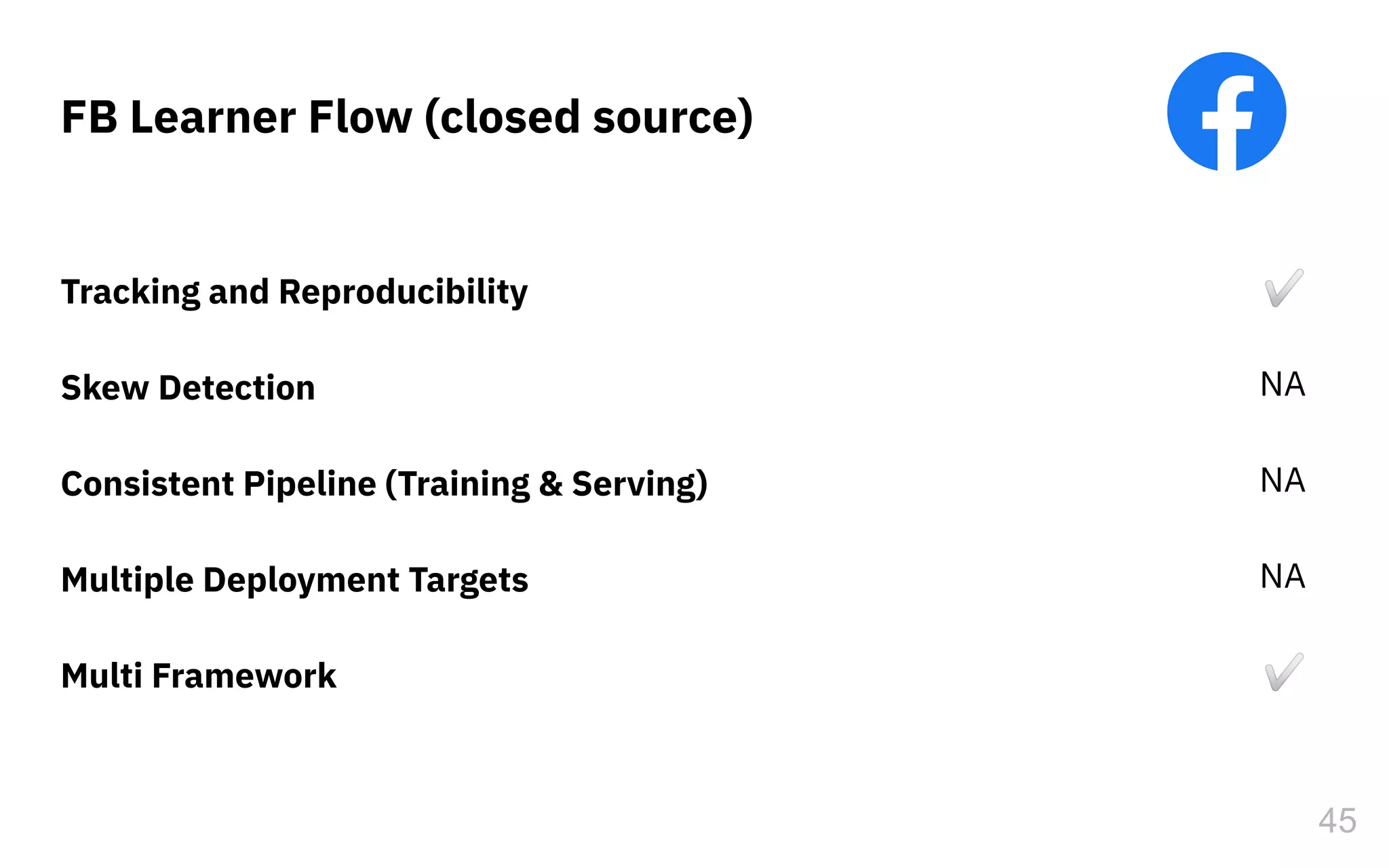
FB Learner Flow (closed source)
45
✅
Tracking and Reproducibility
Skew Detection
Consistent Pipeline (Training & Serving)
Multiple Deployment Targets
Multi Framework
✅
NA
NA
NA
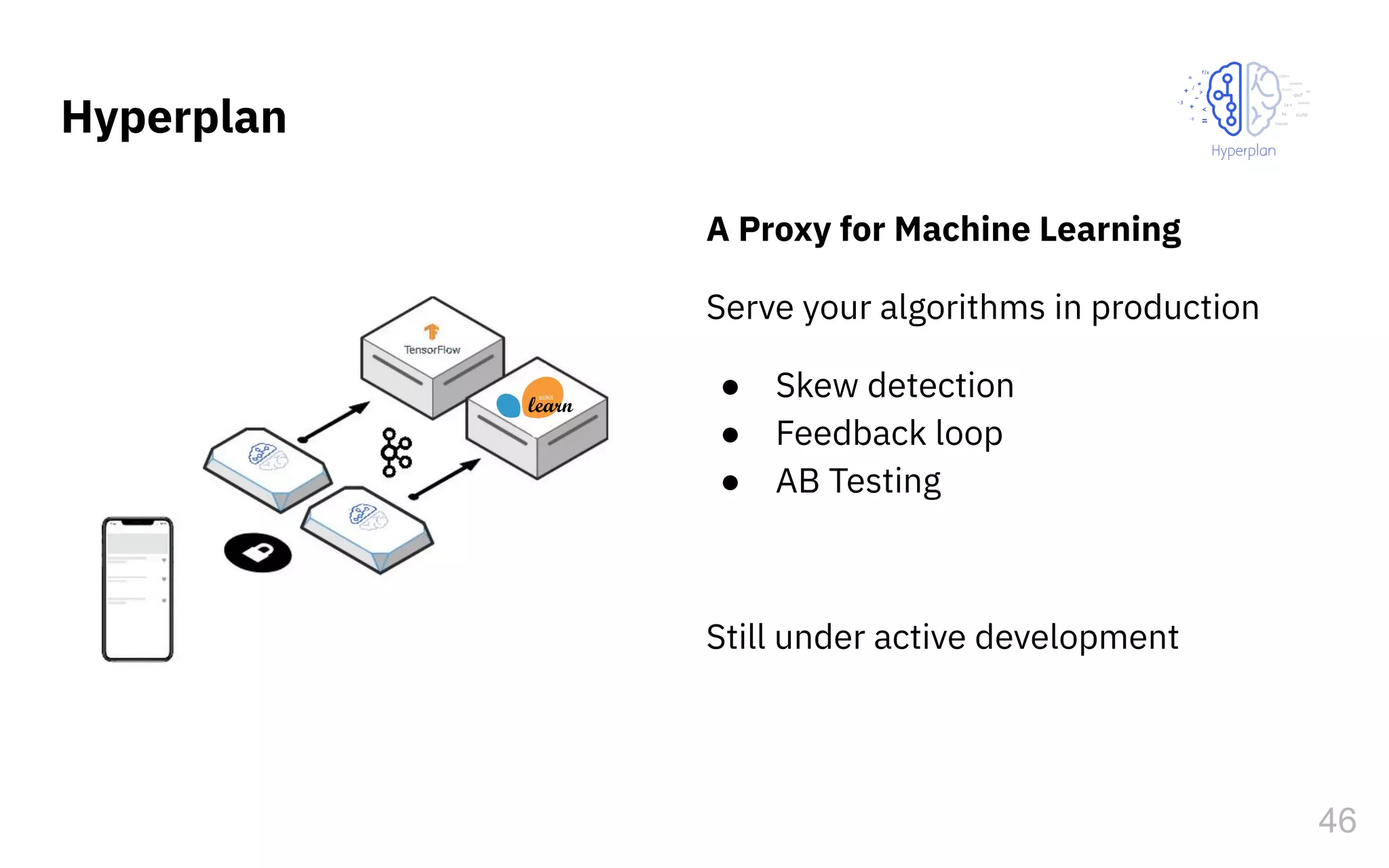
A Proxy for Machine Learning
Serve your algorithms in production
● Skew detection
● Feedback loop
● AB Testing
Still under active development
Hyperplan
46
Hyperplan
47
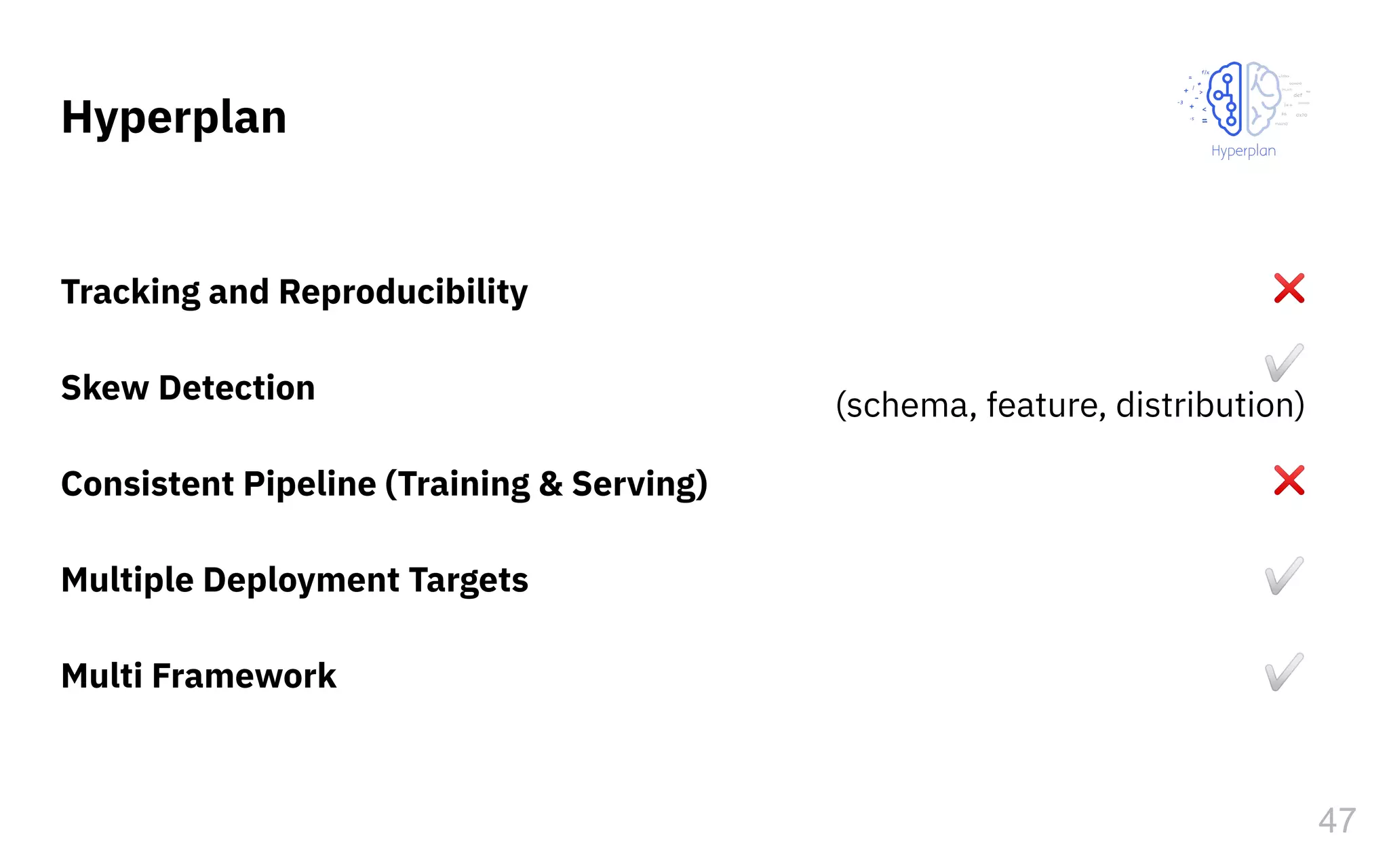
Tracking and Reproducibility
Skew Detection
Consistent Pipeline (Training & Serving)
Multiple Deployment Targets
Multi Framework
❌
✅
(schema, feature, distribution)
❌
✅
✅
48
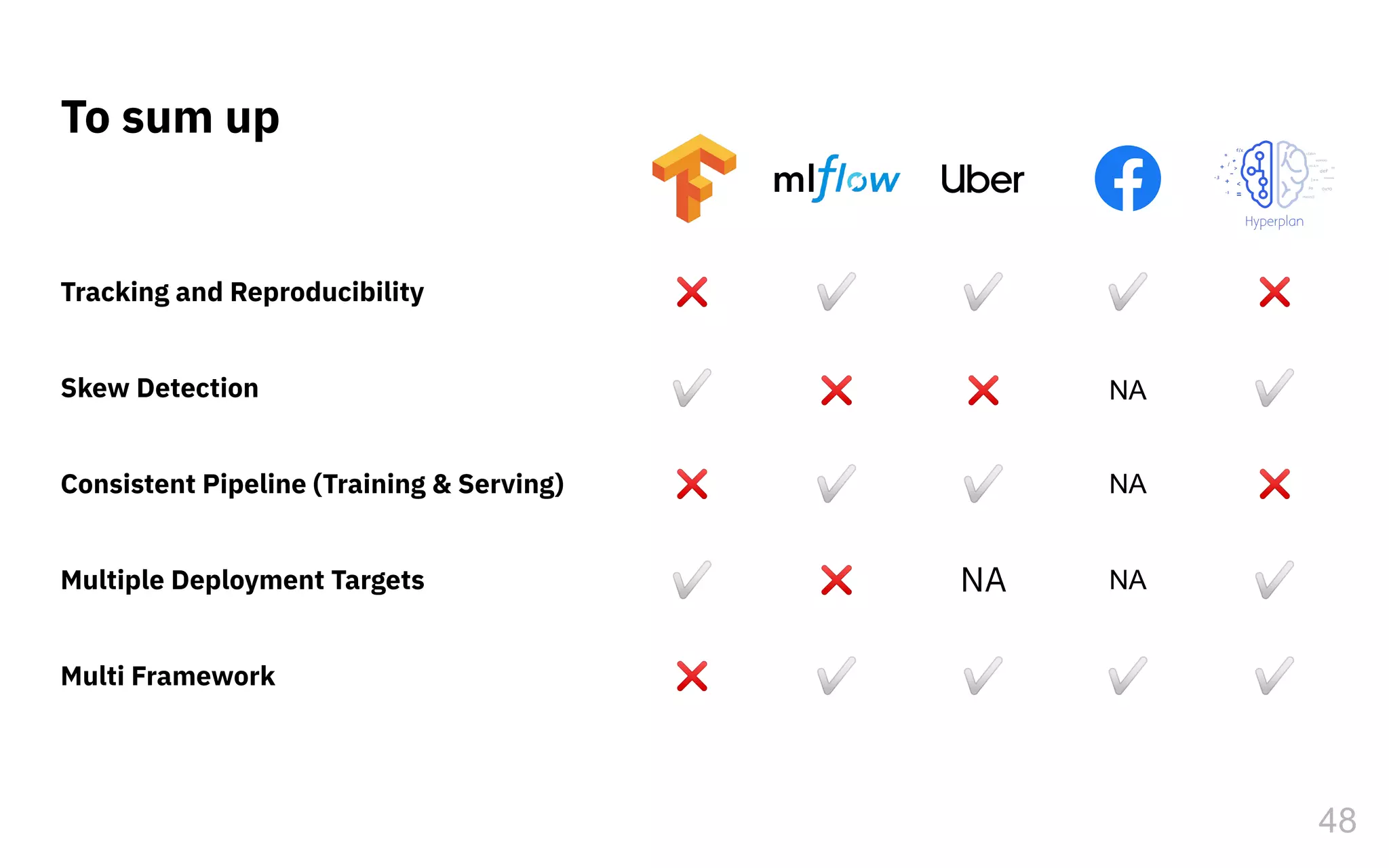
To sum up
Tracking and Reproducibility
Skew Detection
Consistent Pipeline (Training & Serving)
Multiple Deployment Targets
Multi Framework
❌
✅
❌
✅
✅
✅
NA
NA
NA
✅
✅
❌
✅
NA
✅
✅
❌
✅
❌
✅
❌
✅
❌
✅
❌
49
To sum up
TensorFlow Extended and MLFlow are great for big orgs
TFX has a proven record for solving production issues, but only with TensorFlow
MLFlow is still young and targets many problems, pick what you need
Uber and Facebook ?
Designed specifically for their org, huge platforms
Hyperplan is made for small and medium orgs
Benefits of monitoring at a small cost
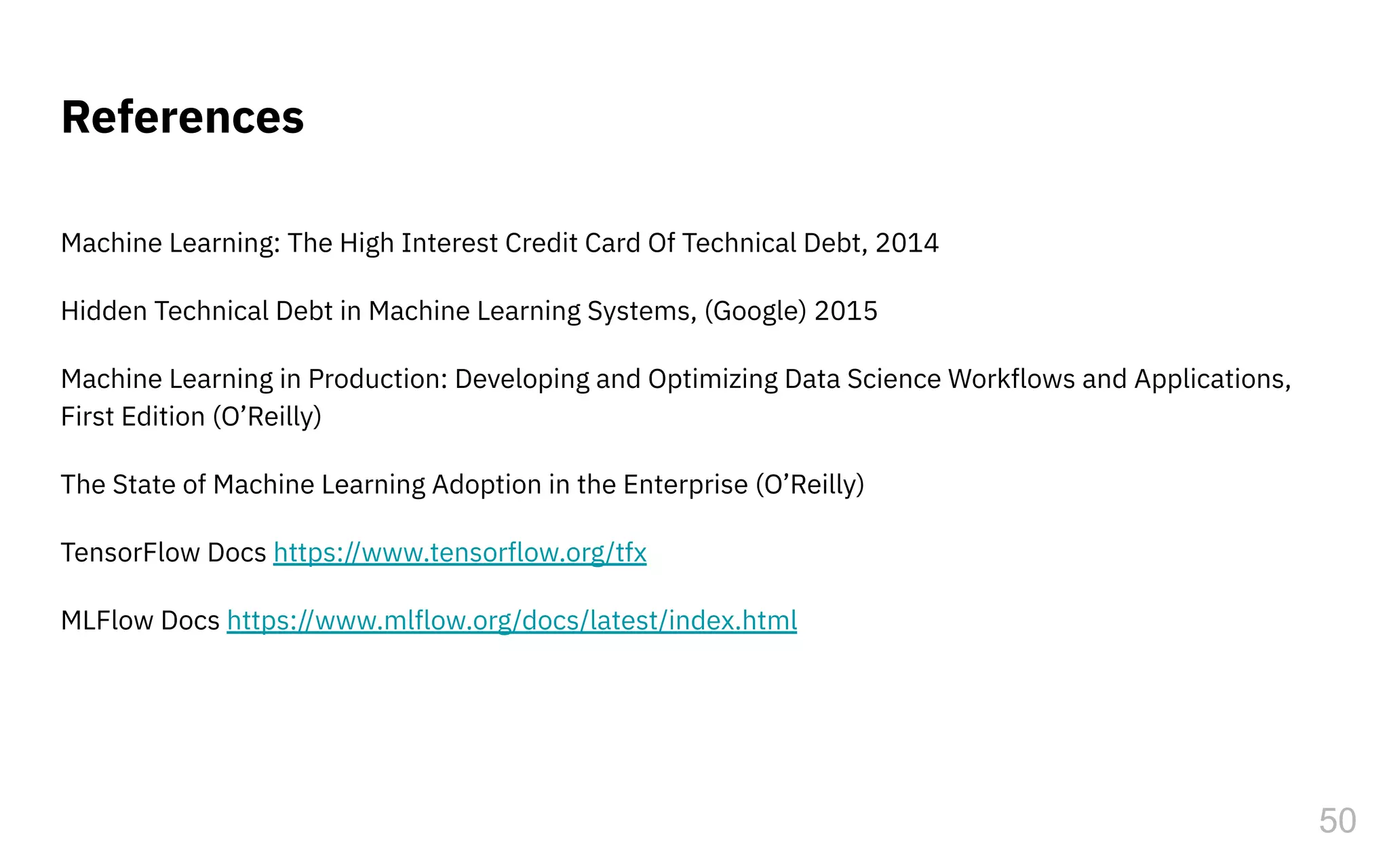
References
Machine Learning: The High Interest Credit Card Of Technical Debt, 2014
Hidden Technical Debt in Machine Learning Systems, (Google) 2015
Machine Learning in Production: Developing and Optimizing Data Science Workflows and Applications,
First Edition (O’Reilly)
The State of Machine Learning Adoption in the Enterprise (O’Reilly)
TensorFlow Docs https://www.tensorflow.org/tfx
MLFlow Docs https://www.mlflow.org/docs/latest/index.html
50
Merci !
@asauray - hyperplan.io

Pitfalls of machine learning in production

  • 1.
    Pitfalls of MachineLearning in production Antoine Sauray - Nantes Machine Learning Meetup - 7/10/19
  • 2.
    Who am I? Antoine Sauray 👋 @asauray Software engineer, Scala dev Founder of Hyperplan ML platform We are hosted at the Halle 6 in Ile de Nantes Previously worked at iAdvize as ML Engineer 4 years exp in mobile dev (Android and iOS native) 2
  • 3.
  • 4.
    4 Machine Learning isa small part of your system Machine Learning “Hidden Technical Debt in Machine Learning Systems” - 2015
  • 5.
    5 Machine Learning isa small part of your system Not Machine Learning “Hidden Technical Debt in Machine Learning Systems” - 2015
  • 6.
    Machine Learning ishard to put in production O’Reilly survey - August 2018 6
  • 7.
    “ML systems havea special capacity for incurring technical debt, because they have all of the maintenance problems of traditional code plus an additional set of ML-specific issues.” Machine Learning creates more tech debt 7 Hidden Technical Debt in Machine Learning Systems - 2015
  • 8.
  • 9.
    9 Strong abstractions OOP, FP Hexagonalarchitecture Tooling Version Control Testing frameworks Monitoring Logging CI Deployments CD A/B tests VS ML practices
  • 10.
    Strong abstractions OOP, FP Hexagonalarchitecture Tooling Version Control Testing frameworks Monitoring Logging CI Deployments CD A/B tests 10 + specific ML issues Python drift concept etc. VS ?
  • 11.
    “ML as softwareengineering” 11
  • 12.
  • 13.
    13 “Working code is a sideeffect” Alberto Brandolini
  • 14.
  • 15.
    Collaboration Data dependencies Training andServing Skews Bad and good patterns Diving into issues 15
  • 16.
  • 17.
    Collaboration difficulties How totrack experiments ? What algorithm has been trained ? When ? On what data ? With which set of parameters ? How can we compare them ? ● Avoid repeating same experiments ● Reuse code 17
  • 18.
    Working with others Collaborationdifficulties 18 Model Websites Front-end developer Backend Back-end developer Mobile apps iOS/Android developer ML scientist
  • 19.
    Working with others Teamsof engineers and researchers have different goals Data scientists and researchers seek quality, at the cost of simplicity Dev and ops like seek simplicity, at the cost of performance Collaboration difficulties 19
  • 20.
  • 21.
    Unstable Data dependencies Amodel can consume signals from: ● An algorithm (possibly ML) that updates over time ● An application that may receive updates Data Dependencies 21 Model Business appAlgorithm CACE: Change Anything Changes Everything
  • 22.
    Underutilized Data dependencies Keepthe features to a strict minimum reduces the multicollinearity risk. ● Legacy Features can be forgotten ● Features can be added as bundles ● ǫ-Features are complex and bring little value Underutilized dependencies can be detected via exhaustive leave-one-feature-out evaluations. Data Dependencies 22
  • 23.
    According to theTensorFlow doc, 4 skews: ● Schema ● Feature ● Distribution ● Scoring and Serving 23 Training and Serving Skews
  • 24.
    Training and ServingSkews Schema skew Example: after a migration/the deprecation of a field. This may be undetected and cause you model to silently fail. 24 { "surfaceAppartement": 70, } { "surfaceAppartement": null, "appartmentSurface": 70 }
  • 25.
    Training and ServingSkews 25 features = { # is this milliseconds or # seconds ? 'video_duration': 10 } prediction = clf.predict(features) Feature skew When different teams implement the machine learning models and the documentation is nonexistent or insufficient. This is even more important when serving on multiple platforms with different teams.
  • 26.
    Distribution skew When thedistribution of feature values is different between training and serving. When data scientists train their algorithms with a faulty sampling mechanism. When a different corpus is used for training to overcome lack of initial data. Training and Serving Skews 26
  • 27.
    Training and ServingSkews 27 Model User Data Outcome Scoring and Serving skew A Direct Feedback loop can help you measure the results of your algorithm and generate training data for later. But! Models may influence the data they will be trained on later. Exploration / Exploitation trade off
  • 28.
    Training and ServingSkews 28 Scoring and Serving skew Hardcoded thresholds can lead to errors because they are model specific. If model is automatically trained with new batches of data, the previous threshold is invalidated But thresholds can be learnt. def keep_above_threshold(prediction, t): for p in predictions: if p.prob > t: yield p clf = load('model1.joblib') predictions = clf.predict(features) return keep_above_threshold(predictions, 0.6) clf = load('model2.joblib') predictions = clf.predict(features) return keep_above_threshold(predictions, 0.6)
  • 29.
    Bad and goodpatterns 29
  • 30.
    Bad and goodpatterns Bad: Glue code Wikipedia: “... executable code that serves solely to «adapt» different parts of code that would otherwise be incompatible”. Problems Maintenance is hard Complexity is high 30
  • 31.
    Bad: Pipeline jungle Whenthinking about data collection after creating the algorithms. It is often hard to gather data in real time for the execution of the algorithm. ● Many collection steps ● SQL Join everywhere ● Intermediate results This is fragile → Rethink the pipeline as a whole Bad and good patterns 31
  • 32.
    Bad: Dead experimentalcodepath Shortcuts taken by developers to implement features faster. Avoid conditional branching in production because of ● Cyclomatic complexity ● Things break unexpectedly Bad and good patterns 32 if customer_id == "1": # but customer 1 does not exist anymore return clf1.predict(data) else: return clf2.predict(data)
  • 33.
    Bad and goodpatterns 33 Client API 1 API 2 Heuristic Model 2 Model 3 API 3 Schema 1 Schema 2 Schema 3 Bad: No Abstraction Client handle different APIs for the same problem. ● More code client side ● Duplication of code in APIs ● Failover and AB tests are managed on the client
  • 34.
    Good: Abstraction An interfacebetween the client and the models Advantages: ● Start with simple heuristics to get data early ● Add data on the API schema progressively ● Ship a new model safely with rollbacks ● Write less code on the client side Bad and good patterns 34 Heuristic Client API Model 2 Model 3 Schema Transformations
  • 35.
  • 36.
    The basics We havesome basics tools like classic software Versioning ● Git LFS ● DVC Tracking platforms ● Weights and biases wandb.com ● Datmo github.com/datmo/datmo ● MLFlow Tracking 36
  • 37.
    TensorFlow Extended End-to-end platformfor deploying production ML pipelines Since 2018 37
  • 38.
    TensorFlow Extended End-to-end platformfor deploying production ML pipelines Since 2018 38
  • 39.
    TensorFlow Extended 39 Tracking andReproducibility Skew Detection Consistent Pipeline (Training & Serving) Multiple Deployment Targets Multi Framework ❌ ✅ (schema, feature, distribution) ✅ (only tf.Serving and Apache Beam) ✅ (API, browser, on device) ❌ (possible via TensorFlow 2.0)
  • 40.
    MLFlow Machine Learning Platformfor ML Lifecycle management v1: summer 2019 40
  • 41.
    ✅ MLFlow 41 Tracking and Reproducibility SkewDetection Consistent Pipeline (Training & Serving) Multiple Deployment Targets Multi Framework ✅ ❌ ✅ (via save_model) ❌ (only REST API)
  • 42.
    Since 2016 “Seamlessly build,deploy, and operate machine learning solutions at Uber’s scale” eng.uber.com/michelangelo Michelangelo (closed source) 42
  • 43.
    Michelangelo (closed source) 43 ✅ Trackingand Reproducibility Skew Detection Consistent Pipeline (Training & Serving) Multiple Deployment Targets Multi Framework ❌ ✅ with a compiled DSL ✅ NA
  • 44.
    FB Learner Flow(closed source) A platform capable of easily reusing algorithms in different products, scaling to run thousands of simultaneous custom experiments, and managing experiments with ease. engineering.fb.com/core-data/introducing-fblearner-flow-f acebook-s-ai-backbone 44
  • 45.
    FB Learner Flow(closed source) 45 ✅ Tracking and Reproducibility Skew Detection Consistent Pipeline (Training & Serving) Multiple Deployment Targets Multi Framework ✅ NA NA NA
  • 46.
    A Proxy forMachine Learning Serve your algorithms in production ● Skew detection ● Feedback loop ● AB Testing Still under active development Hyperplan 46
  • 47.
    Hyperplan 47 Tracking and Reproducibility SkewDetection Consistent Pipeline (Training & Serving) Multiple Deployment Targets Multi Framework ❌ ✅ (schema, feature, distribution) ❌ ✅ ✅
  • 48.
    48 To sum up Trackingand Reproducibility Skew Detection Consistent Pipeline (Training & Serving) Multiple Deployment Targets Multi Framework ❌ ✅ ❌ ✅ ✅ ✅ NA NA NA ✅ ✅ ❌ ✅ NA ✅ ✅ ❌ ✅ ❌ ✅ ❌ ✅ ❌ ✅ ❌
  • 49.
    49 To sum up TensorFlowExtended and MLFlow are great for big orgs TFX has a proven record for solving production issues, but only with TensorFlow MLFlow is still young and targets many problems, pick what you need Uber and Facebook ? Designed specifically for their org, huge platforms Hyperplan is made for small and medium orgs Benefits of monitoring at a small cost
  • 50.
    References Machine Learning: TheHigh Interest Credit Card Of Technical Debt, 2014 Hidden Technical Debt in Machine Learning Systems, (Google) 2015 Machine Learning in Production: Developing and Optimizing Data Science Workflows and Applications, First Edition (O’Reilly) The State of Machine Learning Adoption in the Enterprise (O’Reilly) TensorFlow Docs https://www.tensorflow.org/tfx MLFlow Docs https://www.mlflow.org/docs/latest/index.html 50
  • 51.
    Merci ! @asauray -hyperplan.io