Assignment on
Data Mining Wireless Sensor Network
Course Title: Data Mining and Machine Learning
Course Code: CSE-5209
Submitted To:
Md. Ashraf Uddin
Assistant Professor
Department of Computer Science & Engineering
Submitted By:
Mesbah-Ul Islam
ID: M160305571
Department of Computer Science & Engineering
1
Fundamentals of Data Mining in WSNs
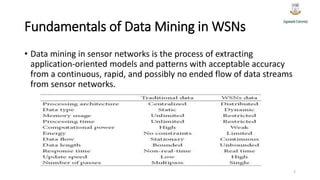
• Data mining in sensor networks is the process of extracting
application-oriented models and patterns with acceptable accuracy
from a continuous, rapid, and possibly no ended flow of data streams
from sensor networks.
2
Data Mining Techniques for WSNs
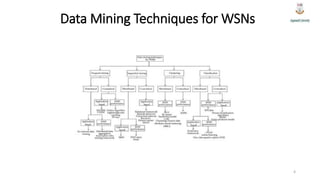
• A classification scheme for existing approaches designed for mining WSNs
data is presented. The highest-level classification is based upon the general
data mining classes used such as frequent pattern mining, sequential
pattern mining, clustering, and classification. Most of the frequent pattern
mining and sequential pattern mining approaches have adapted the
traditional frequent mining techniques such as the Apriori and frequent
pattern (FP) growth-based algorithms to find the association among large
WSNs data. Cluster-based approaches have adapted the K-mean,
hierarchical, and data correlation-based clustering, based upon the
distance among the data point, whereas, classification-based approaches
have adapted the traditional classification techniques such as decision tree,
rule-based, nearest neighbor, and support vector
3
Data Mining Techniques for WSNs
4
Frequent Pattern Mining
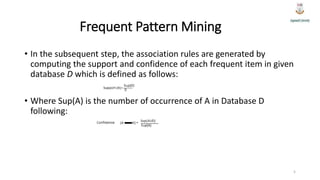
• In the subsequent step, the association rules are generated by
computing the support and confidence of each frequent item in given
database D which is defined as follows:
• Where Sup(A) is the number of occurrence of A in Database D
following:
5
Sequential Pattern Mining (SPM)
• The sequential pattern mining techniques in sensor network based on
either traditional sequential mining algorithms such as Apriori-like
algorithm , Apriori-based methods: GSP PSP , and pattern growth
approaches: FreeSpan and PrefixSpanor some new algorithm are
devised specifically to work with sensor network environment.
6
Sequential Pattern Mining (SPM)
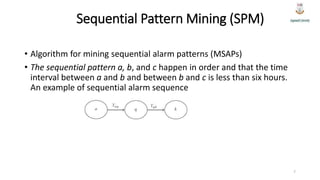
• Algorithm for mining sequential alarm patterns (MSAPs)
• The sequential pattern a, b, and c happen in order and that the time
interval between a and b and between b and c is less than six hours.
An example of sequential alarm sequence
7
Clustering
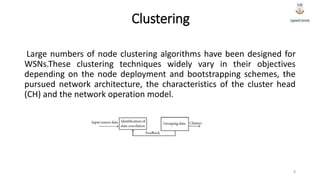
Large numbers of node clustering algorithms have been designed for
WSNs.These clustering techniques widely vary in their objectives
depending on the node deployment and bootstrapping schemes, the
pursued network architecture, the characteristics of the cluster head
(CH) and the network operation model.
8
Classification
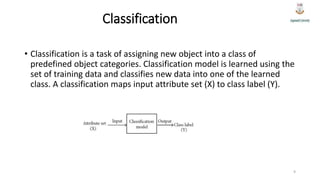
• Classification is a task of assigning new object into a class of
predefined object categories. Classification model is learned using the
set of training data and classifies new data into one of the learned
class. A classification maps input attribute set (X) to class label (Y).
9
Maximize WSNs' Performance
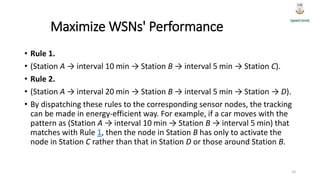
• Rule 1.
• (Station A → interval 10 min → Station B → interval 5 min → Station C).
• Rule 2.
• (Station A → interval 20 min → Station B → interval 5 min → Station → D).
• By dispatching these rules to the corresponding sensor nodes, the tracking
can be made in energy-efficient way. For example, if a car moves with the
pattern as (Station A → interval 10 min → Station B → interval 5 min) that
matches with Rule 1, then the node in Station B has only to activate the
node in Station C rather than that in Station D or those around Station B.
10
To Solve WSNs' Application-Based Issues
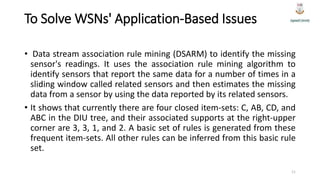
• Data stream association rule mining (DSARM) to identify the missing
sensor's readings. It uses the association rule mining algorithm to
identify sensors that report the same data for a number of times in a
sliding window called related sensors and then estimates the missing
data from a sensor by using the data reported by its related sensors.
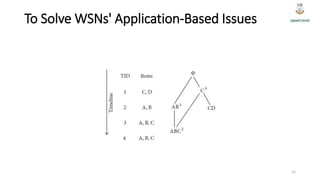
• It shows that currently there are four closed item-sets: C, AB, CD, and
ABC in the DIU tree, and their associated supports at the right-upper
corner are 3, 3, 1, and 2. A basic set of rules is generated from these
frequent item-sets. All other rules can be inferred from this basic rule
set.
11
To Solve WSNs' Application-Based Issues
12
Future Research Directions
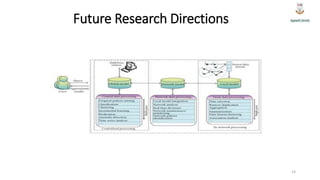
• WSN, a hybrid data mining framework is proposed in this framework,
sensor nodes use their processing abilities to locally carry out mining
processing and transmit only the required and partially processed
data called local models. Single-pass algorithms are applied for
network data processing as the data is continuously arriving.
13
Future Research Directions
14
Conclusion
• The emerging need for the data mining techniques in the field of
WSNs resulted in the development of numerous algorithms. Each one
of these algorithms solves certain issues related to the appropriate
15
• Thank you Sir
16

Data ming wsn

  • 1.
    Assignment on Data MiningWireless Sensor Network Course Title: Data Mining and Machine Learning Course Code: CSE-5209 Submitted To: Md. Ashraf Uddin Assistant Professor Department of Computer Science & Engineering Submitted By: Mesbah-Ul Islam ID: M160305571 Department of Computer Science & Engineering 1
  • 2.
    Fundamentals of DataMining in WSNs • Data mining in sensor networks is the process of extracting application-oriented models and patterns with acceptable accuracy from a continuous, rapid, and possibly no ended flow of data streams from sensor networks. 2
  • 3.
    Data Mining Techniquesfor WSNs • A classification scheme for existing approaches designed for mining WSNs data is presented. The highest-level classification is based upon the general data mining classes used such as frequent pattern mining, sequential pattern mining, clustering, and classification. Most of the frequent pattern mining and sequential pattern mining approaches have adapted the traditional frequent mining techniques such as the Apriori and frequent pattern (FP) growth-based algorithms to find the association among large WSNs data. Cluster-based approaches have adapted the K-mean, hierarchical, and data correlation-based clustering, based upon the distance among the data point, whereas, classification-based approaches have adapted the traditional classification techniques such as decision tree, rule-based, nearest neighbor, and support vector 3
  • 4.
  • 5.
    Frequent Pattern Mining •In the subsequent step, the association rules are generated by computing the support and confidence of each frequent item in given database D which is defined as follows: • Where Sup(A) is the number of occurrence of A in Database D following: 5
  • 6.
    Sequential Pattern Mining(SPM) • The sequential pattern mining techniques in sensor network based on either traditional sequential mining algorithms such as Apriori-like algorithm , Apriori-based methods: GSP PSP , and pattern growth approaches: FreeSpan and PrefixSpanor some new algorithm are devised specifically to work with sensor network environment. 6
  • 7.
    Sequential Pattern Mining(SPM) • Algorithm for mining sequential alarm patterns (MSAPs) • The sequential pattern a, b, and c happen in order and that the time interval between a and b and between b and c is less than six hours. An example of sequential alarm sequence 7
  • 8.
    Clustering Large numbers ofnode clustering algorithms have been designed for WSNs.These clustering techniques widely vary in their objectives depending on the node deployment and bootstrapping schemes, the pursued network architecture, the characteristics of the cluster head (CH) and the network operation model. 8
  • 9.
    Classification • Classification isa task of assigning new object into a class of predefined object categories. Classification model is learned using the set of training data and classifies new data into one of the learned class. A classification maps input attribute set (X) to class label (Y). 9
  • 10.
    Maximize WSNs' Performance •Rule 1. • (Station A → interval 10 min → Station B → interval 5 min → Station C). • Rule 2. • (Station A → interval 20 min → Station B → interval 5 min → Station → D). • By dispatching these rules to the corresponding sensor nodes, the tracking can be made in energy-efficient way. For example, if a car moves with the pattern as (Station A → interval 10 min → Station B → interval 5 min) that matches with Rule 1, then the node in Station B has only to activate the node in Station C rather than that in Station D or those around Station B. 10
  • 11.
    To Solve WSNs'Application-Based Issues • Data stream association rule mining (DSARM) to identify the missing sensor's readings. It uses the association rule mining algorithm to identify sensors that report the same data for a number of times in a sliding window called related sensors and then estimates the missing data from a sensor by using the data reported by its related sensors. • It shows that currently there are four closed item-sets: C, AB, CD, and ABC in the DIU tree, and their associated supports at the right-upper corner are 3, 3, 1, and 2. A basic set of rules is generated from these frequent item-sets. All other rules can be inferred from this basic rule set. 11
  • 12.
    To Solve WSNs'Application-Based Issues 12
  • 13.
    Future Research Directions •WSN, a hybrid data mining framework is proposed in this framework, sensor nodes use their processing abilities to locally carry out mining processing and transmit only the required and partially processed data called local models. Single-pass algorithms are applied for network data processing as the data is continuously arriving. 13
  • 14.
  • 15.
    Conclusion • The emergingneed for the data mining techniques in the field of WSNs resulted in the development of numerous algorithms. Each one of these algorithms solves certain issues related to the appropriate 15
  • 16.