Priyanka
 Tree pruning is performed in order to
remove overfitting in the training data due
to noise or outliers.
 The pruned trees are smaller and less
complex.
 Two strategies for “pruning” the decision
tree:
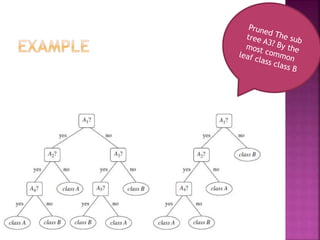
 Postpruning - take a fully-grown decision tree
and discard unreliable parts(sub trees)
 Prepruning - stop growing a branch when
information becomes unreliable
 The efficiency of existing decision tree
algorithms has been well established for
relatively small data sets.
 Efficiency becomes an issue of concern when
these algorithms are applied to the mining of
very large real-world databases.
 As in the data mining application, millions of
tuples are common in the data set. Which
needs to fit in the memory(As per the
decision tree restriction)
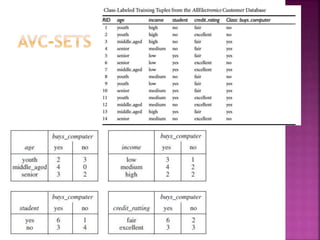
 The AVC-set of an attribute A at node N gives
the class label counts for each value of A for
the tuples at N.
 The set of all AVC-sets at a node N is the
AVC-group of N.
 The size of an AVC-set for attribute A at
node N depends only on the number of
distinct values of A and the number of
classes in the set of tuples at N.
 Typically, this size should fit in memory,
even for real-world data.
 It uses a statistical technique known as
“bootstrapping” to create several smaller
samples (or subsets) of the given training
data, each of which fits in memory.
 Each subset is used to construct a tree,
resulting in several trees. The trees are
examined and used to construct a new tree,
 T`, that turns out to be “very close” to the
tree that would have been generated if all
the original training data had fit in memory.
 Faster in constructing tree
 Insertion and deletion is easy without
constructing the tree from scratch
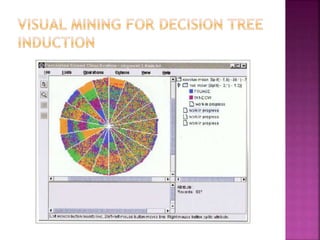
 (PBC) Perception based classification is an
interactive approach based on
multidimensional visualization techniques.
 It allows the user to incorporate background
knowledge about the data when building a
decision tree.
 By visually interacting with the data, the user is
also likely to develop a deeper understanding of
the data.
 The resulting trees tend to be smaller than those
built using traditional decision tree induction
methods and so are easier to interpret, while
achieving about the same accuracy.
Tree pruning

Tree pruning

  • 1.
  • 2.
     Tree pruningis performed in order to remove overfitting in the training data due to noise or outliers.  The pruned trees are smaller and less complex.  Two strategies for “pruning” the decision tree:  Postpruning - take a fully-grown decision tree and discard unreliable parts(sub trees)  Prepruning - stop growing a branch when information becomes unreliable
  • 4.
     The efficiencyof existing decision tree algorithms has been well established for relatively small data sets.  Efficiency becomes an issue of concern when these algorithms are applied to the mining of very large real-world databases.  As in the data mining application, millions of tuples are common in the data set. Which needs to fit in the memory(As per the decision tree restriction)
  • 5.
     The AVC-setof an attribute A at node N gives the class label counts for each value of A for the tuples at N.  The set of all AVC-sets at a node N is the AVC-group of N.  The size of an AVC-set for attribute A at node N depends only on the number of distinct values of A and the number of classes in the set of tuples at N.  Typically, this size should fit in memory, even for real-world data.
  • 7.
     It usesa statistical technique known as “bootstrapping” to create several smaller samples (or subsets) of the given training data, each of which fits in memory.  Each subset is used to construct a tree, resulting in several trees. The trees are examined and used to construct a new tree,  T`, that turns out to be “very close” to the tree that would have been generated if all the original training data had fit in memory.
  • 8.
     Faster inconstructing tree  Insertion and deletion is easy without constructing the tree from scratch
  • 10.
     (PBC) Perceptionbased classification is an interactive approach based on multidimensional visualization techniques.  It allows the user to incorporate background knowledge about the data when building a decision tree.  By visually interacting with the data, the user is also likely to develop a deeper understanding of the data.  The resulting trees tend to be smaller than those built using traditional decision tree induction methods and so are easier to interpret, while achieving about the same accuracy.