PRESENTATION BY :-
ANJALI GAUTAM (9910103506)
AMAN BALUTIA (9910103504)
OWHAT ARE FAULTS ?
ODeviation from expected behavior
ODueto a variety of factors:
– Hardware failure
– Software bugs
– Operator errors
Networkerrors/outages
 Three categories
–> transient faults
–> intermittent faults
–> permanent faults
 Any fault may be
–> fail-silent (fail-stop)
–> Byzantine
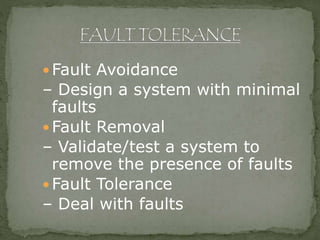
 Fault Avoidance
– Design a system with minimal
faults
 Fault Removal
– Validate/test a system to
remove the presence of faults
 Fault Tolerance
– Deal with faults
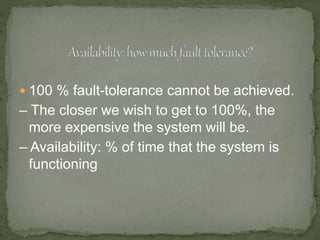
 100 % fault-tolerance cannot be achieved.
– The closer we wish to get to 100%, the
more expensive the system will be.
– Availability: % of time that the system is
functioning
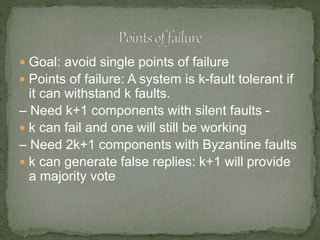
 Goal: avoid single points of failure
 Points of failure: A system is k-fault tolerant if
it can withstand k faults.
– Need k+1 components with silent faults -
 k can fail and one will still be working
– Need 2k+1 components with Byzantine faults
 k can generate false replies: k+1 will provide
a majority vote
 Modern day systems are equipped with Java
Runtime Environment (ver. 1.3 or above).
 This project deploys this to its advantage
and a routing simulator that runs on this
platform is developed.
 Since JDK is necessary for other processes
in an operating system, this is almost a
platform independent simulator as it can run
with JDK 1.3 or any other version above this
one.
 Fault Tolerance is an important issue in
Distributed Computing. Fault-tolerant
describes a computer system or component
designed so that, in the event that a
component fails, a backup component or
procedure can immediately take its place
with no loss of service. In real time
distributed system feasibility of task is very
important.
 The major point of all is to make system
functioning even if any part goes off. This
 SYNCHRONOUS MODEL : Uses time bounds.
 ASYNCHRONOUS MODEL : Time bounds are absent.
 HARDWARE SPECIFICATION
 Processor : Any Processor above 500 Mhz.
 Ram : 128Mb.
 Hard Disk : 10 Gb.
 Compact Disk : 650 Mb.
 Input device : Standard Keyboard and Mouse.
 Output device : VGA and High Resolution Monitor.
 SOFTWARE SPECIFICATION
 Operating System : Windows 2000 server Family.
 Techniques : JDK 1.5
 Data Bases : Microsoft Sql Server
 Front End : Java Swing
 Back End : Sql Server
 Execution qualities, such as security and
usability, which are observable at run
time.
 Evolution qualities, such as testability,
maintainability, extensibility and
scalability, which are embodied in the
static structure of the software system
 The synchronous distributed computing
model provides processes with bounds on
processing time and message transfer
delay. These bounds, explicitly known by
the processes, can be used to safely
detect process crashes and consequently
allow the non-crashed processes to
progress with safe views of the system
state.
 In these systems, a system designer can
 Our programming model provides the
upper-layer applications with sufficient
process state information (the sets) that
can be used in order to adapt to the
available system synchrony or QoS (in
terms of timely and untimely channels),
providing more efficient solutions to fault
tolerant problems when possible.
 FRONT END: JAVA
programming (JVM & Java API)
 BACK END: MYSQL server
(ODBC & JDBC)
The system design can be divided into
the following modules:
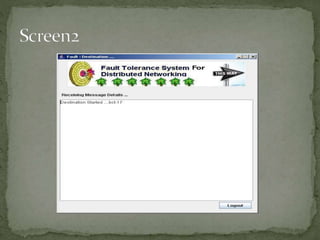
 Identify the status of Node
 Message Transmission
 Change status
 Update status
 There are many classes that need to be coded for completing the
simulator :
 For example :All the faulty nodes (server and client) must be coded
into different classes , and are dependent to the class that selects these
algorithms and link them to the interface .
 Class dependencies work along with a Jfree Chart which is a library of
professional graphs and can be updated when integration of
functionalities is done.
 Integrationof classes will be done once alltheunit modules
are coded completely and testedfor errors.
 The project includes various dependencies among classes ,
like inheritance, polymorphism etc.
 Integrationand Integratedtestingwill be performed by
creating batch files thatintegratesvarious parts of the
program.
 Usingsocket programming for integration.
 Integrationof two language modules (SQL & java swing) is
a difficulttask.
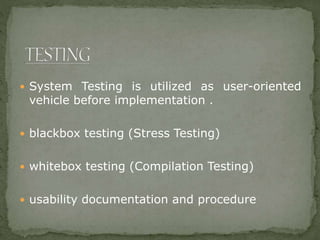
 System Testing is utilized as user-oriented
vehicle before implementation .
 blackbox testing (Stress Testing)
 whitebox testing (Compilation Testing)
 usability documentation and procedure
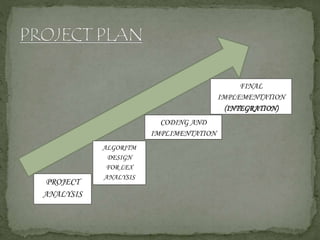
PROJECT
ANALYSIS
ALGORITM
DESIGN
FOR LEX
ANALYSIS
CODING AND
IMPLIMENTATION
FINAL
IMPLEMENTATION
(INTEGRATION)
Sites referred:
 http://java.sun.com
 http://www.sourcefordgde.com
 http://www.jfree.org/
 http://www.networkcomputing.com/
Fault tolerance

Fault tolerance

  • 1.
    PRESENTATION BY :- ANJALIGAUTAM (9910103506) AMAN BALUTIA (9910103504)
  • 2.
    OWHAT ARE FAULTS? ODeviation from expected behavior ODueto a variety of factors: – Hardware failure – Software bugs – Operator errors Networkerrors/outages
  • 3.
     Three categories –>transient faults –> intermittent faults –> permanent faults  Any fault may be –> fail-silent (fail-stop) –> Byzantine
  • 4.
     Fault Avoidance –Design a system with minimal faults  Fault Removal – Validate/test a system to remove the presence of faults  Fault Tolerance – Deal with faults
  • 5.
     100 %fault-tolerance cannot be achieved. – The closer we wish to get to 100%, the more expensive the system will be. – Availability: % of time that the system is functioning
  • 6.
     Goal: avoidsingle points of failure  Points of failure: A system is k-fault tolerant if it can withstand k faults. – Need k+1 components with silent faults -  k can fail and one will still be working – Need 2k+1 components with Byzantine faults  k can generate false replies: k+1 will provide a majority vote
  • 7.
     Modern daysystems are equipped with Java Runtime Environment (ver. 1.3 or above).  This project deploys this to its advantage and a routing simulator that runs on this platform is developed.  Since JDK is necessary for other processes in an operating system, this is almost a platform independent simulator as it can run with JDK 1.3 or any other version above this one.
  • 8.
     Fault Toleranceis an important issue in Distributed Computing. Fault-tolerant describes a computer system or component designed so that, in the event that a component fails, a backup component or procedure can immediately take its place with no loss of service. In real time distributed system feasibility of task is very important.  The major point of all is to make system functioning even if any part goes off. This
  • 9.
     SYNCHRONOUS MODEL: Uses time bounds.  ASYNCHRONOUS MODEL : Time bounds are absent.
  • 10.
     HARDWARE SPECIFICATION Processor : Any Processor above 500 Mhz.  Ram : 128Mb.  Hard Disk : 10 Gb.  Compact Disk : 650 Mb.  Input device : Standard Keyboard and Mouse.  Output device : VGA and High Resolution Monitor.  SOFTWARE SPECIFICATION  Operating System : Windows 2000 server Family.  Techniques : JDK 1.5  Data Bases : Microsoft Sql Server  Front End : Java Swing  Back End : Sql Server
  • 11.
     Execution qualities,such as security and usability, which are observable at run time.  Evolution qualities, such as testability, maintainability, extensibility and scalability, which are embodied in the static structure of the software system
  • 12.
     The synchronousdistributed computing model provides processes with bounds on processing time and message transfer delay. These bounds, explicitly known by the processes, can be used to safely detect process crashes and consequently allow the non-crashed processes to progress with safe views of the system state.  In these systems, a system designer can
  • 13.
     Our programmingmodel provides the upper-layer applications with sufficient process state information (the sets) that can be used in order to adapt to the available system synchrony or QoS (in terms of timely and untimely channels), providing more efficient solutions to fault tolerant problems when possible.
  • 14.
     FRONT END:JAVA programming (JVM & Java API)  BACK END: MYSQL server (ODBC & JDBC)
  • 15.
    The system designcan be divided into the following modules:  Identify the status of Node  Message Transmission  Change status  Update status
  • 16.
     There aremany classes that need to be coded for completing the simulator :  For example :All the faulty nodes (server and client) must be coded into different classes , and are dependent to the class that selects these algorithms and link them to the interface .  Class dependencies work along with a Jfree Chart which is a library of professional graphs and can be updated when integration of functionalities is done.
  • 17.
     Integrationof classeswill be done once alltheunit modules are coded completely and testedfor errors.  The project includes various dependencies among classes , like inheritance, polymorphism etc.  Integrationand Integratedtestingwill be performed by creating batch files thatintegratesvarious parts of the program.  Usingsocket programming for integration.  Integrationof two language modules (SQL & java swing) is a difficulttask.
  • 21.
     System Testingis utilized as user-oriented vehicle before implementation .  blackbox testing (Stress Testing)  whitebox testing (Compilation Testing)  usability documentation and procedure
  • 22.
  • 23.
    Sites referred:  http://java.sun.com http://www.sourcefordgde.com  http://www.jfree.org/  http://www.networkcomputing.com/