
Data Governance: A Business
Value-Driven Approach
A White Paper
by Dr. Walid el Abed
CEO
January 2011
Copyright Global Data Excellence 2011Copyright Global Data Excellence 2011
Contents
Executive Summary . . . . . . . . . . . . . . . . . . . . . . . . . . . . . . . . . . . . . . . . . . . . . . . . . . . . . . 3
Introduction . . . . . . . . . . . . . . . . . . . . . . . . . . . . . . . . . . . . . . . . . . . . . . . . . . . . . . . . . . . . 4
Barriers to Overcome . . . . . . . . . . . . . . . . . . . . . . . . . . . . . . . . . . . . . . . . . . . . . . . . . . . . 4
The Data Excellence Maturity Model  . . . . . . . . . . . . . . . . . . . . . . . . . . . . . . . . . . . . . . . 5
The Data Excellence Framework . . . . . . . . . . . . . . . . . . . . . . . . . . . . . . . . . . . . . . . . . . . 6
The Data Quality Dimensions . . . . . . . . . . . . . . . . . . . . . . . . . . . . . . . . . . . . . . . . . . . . . . 7
Data Governance by Business Rules . . . . . . . . . . . . . . . . . . . . . . . . . . . . . . . . . . . . . . . . 8
The Data Quality Key Value Indicators  . . . . . . . . . . . . . . . . . . . . . . . . . . . . . . . . . . . . . . 9
Sustainable Data Excellence . . . . . . . . . . . . . . . . . . . . . . . . . . . . . . . . . . . . . . . . . . . . . . 10
The Data Excellence Governance Model . . . . . . . . . . . . . . . . . . . . . . . . . . . . . . . . . . . . 11
The Technological Platform  . . . . . . . . . . . . . . . . . . . . . . . . . . . . . . . . . . . . . . . . . . . . . . 12
Conclusions . . . . . . . . . . . . . . . . . . . . . . . . . . . . . . . . . . . . . . . . . . . . . . . . . . . . . . . . . . . 14
Data gouvernance : a business value driven approach2
Executive Summary
Successful organizations come in all shapes in sizes. One characteristic common among these
companies is a focus on capturing their full potential by maximizing customer service while
optimizing business process execution. They recognize that customer service and business processes
depend on “fit for purpose” data. They are like more and more companies today – benefiting from
their investment in high-quality enterprise data.
In contrast, organizations who do not pay appropriate attention to data quality end up with delayed
invoicing, slow cash collection processes, inefficient sales and marketing and reduced confidence in
reporting and decision making. This in turn will impact customer service and customer trust.
What can you do now? Start by measuring how bad your data is – perform a data quality audit. Link
the resulting metrics to business impact i.e. how much cost are you incurring due to low quality
data. Calculate the business value you could generate with high quality data. You will be more than
pleasantly surprised.
Take rapid action by immediately focusing on the most critical operational issues. Demand
improvement within the next three months. Build on early successes and change the culture to
“first time right”. Sustain the momentum. Define the critical business rules which rely on high
quality data to execute. Measure the efficiency of core processes by the quality of the data. Assign
data ownership within each business unit, application environment and enterprise business process.
Hold the owners accountable. The right people are already within the organization – there are no
majoradditional headcountcosts.CollaboratewithIT.Enjoytheresults.Thisistruedatagovernance.
Data governance is not a “nice to have” initiative but a real value add and risk management program.
Only those organizations with an effective data strategy embedded within the business strategy will
be able to turn data into a real competitive advantage, deliver short and longer term value and
ensure business success and sustainability.
3Data gouvernance : a business value driven approach
Introduction
Volumes of data continue to increase as organizations grow organically and through acquisition.
More and more silos of data are being created within departments and business units. As new
channels to market are opened, the result is the sharing of data with new partners outside the
firewall. The cloud is a more recent example of enterprise data being entered into systems owned
or controlled by third parties. Data fragmentation results in lower quality data as data standards are
more difficult to enforce. As processes are integrated, departmental silos are merged, exposing
data quality issues often for the first time. These data quality issues result in project
and business process failures, lack of adoption of new applications and loss of confidence in
enterprise data.
Business modernization programs typically focus on process standardization to gain the benefits of
efficient repeatable, measurable processes. Enterprise resource planning (ERP) technologies fulfill
the process standardization requirements and have now become a central point for management
of business processes. However, ERP systems do not prevent low quality data from entering the
systems nor do they measure its impact on the efficiency of a business process. Most organizations
today are using the same ERP systems (SAP or Oracle) that were configured by the same
consultancies. Therefore, the uniqueness and the scope for competitive advantage of any
organization are defined by the people and the data.
Master data management (MDM) may be part of the longer term solution; However, MDM will not
deliver short-term value. The challenge is in the time paradox where the priority of the business is
to run operations and address the critical business issues to deliver immediate value while an MDM
project, in contrast, is a strategic initiative focused on delivering longer-term value. How can we
combine the near and far?
Only an economically focused, non-invasive and progressive approach, taking the short and long
term business objectives into consideration, will be accepted and executed by the business. The
objective of this white paper is to present a proven, executable framework that enables an effective
and sustainable data governance strategy, delivering immediate business value and supports
longer-term sustainable process improvement.
4 Data gouvernance : a business value driven approach
Barriers to Overcome
High quality data is needed to capture the full potential of the enterprise and deliver all the benefits
of ERP systems, customer relationship management (CRM) and business intelligence (BI) initiatives,
compliance and data warehousing solutions. Conversely, low quality data causes transactions,
processes and projects to fail, leading to increased costs, additional risks, reduced confidence in
enterprise data and potential business losses. ERP systems are often seen as the solution to data
quality and data governance given their centralized role in capturing and maintaining data. However,
ERP systems were never designed to manage data quality. And not all enterprise data resides in ERP
systems. In fact, the responsibility for data quality often rests with data governance or data
management teams who act in an advisory capacity only, report to IT and have very little power or
influence over budgets and the quality of business data. For any large organization, the budget and
resources allocated to an ERP system are typically exhausted on the acquisition and implementation
of the application software. Less attention is given to sustainable data quality processes across the
enterprise.
The uniqueness
and the scope
for competitive
advantage of any
organization are
defined by the
people and
the data.
Low quality data
causes
transactions,
processes and
projects to fail,
leading to
increased costs,
additional risks,
reduced
confidence in
enterprise data
and potential
business losses.
Although budget owning managers understand that high-quality data leads to
improved process efficiency and increased confidence, there is often no
understanding of:
•	 How to justify the cost or value of data stewards
•	 The process or roles focused on managing data as an asset
•	 The business impact and value generation potential of a data quality
team
As a result, most organizations are struggling to build data quality initiatives
causing the implementation and ongoing management of data quality
processes to fail. In turn, this leads to underutilization and lack of confidence
in the ERP system (in this example).
The time it takes for a large organization to progress through the incremental stages is related to the
level of misalignment that is often observed between data governance program objectives and
business objectives. The data excellence framework supports a “near and far” approach, thus
delivering immediate value while subscribing to the long-term business vision.
5Data gouvernance : a business value driven approach
The business
purpose of the
data excellence
maturity model
is to position an
organization in
terms of its ability
to generate
business value
from enterprise
data.
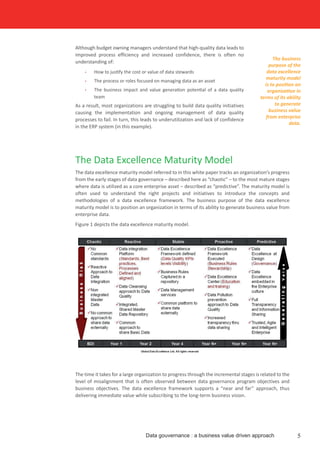
The Data Excellence Maturity Model
The data excellence maturity model referred to in this white paper tracks an organization’s progress
from the early stages of data governance – described here as “chaotic” – to the most mature stages
where data is utilized as a core enterprise asset – described as “predictive”. The maturity model is
often used to understand the right projects and initiatives to introduce the concepts and
methodologies of a data excellence framework. The business purpose of the data excellence
maturity model is to position an organization in terms of its ability to generate business value from
enterprise data.
Figure 1 depicts the data excellence maturity model.
The Data Excellence Framework
The data excellence framework describes the methodology, processes and roles required to
generate business value while improving business processes using data quality and business rules.
The framework supports the creation of a new cultural shift focused on data excellence, motivating
the broader team and supporting collaboration between the stakeholders. The framework takes
intoconsiderationthatthesolution,althoughsimpletoarticulate,iscomplexwithmanydimensions.
Therefore, it is critical to focus on culture as a key to a sustainable solution. A key difference about
the data excellence framework is that it is focused on generating value in comparison to most
initiatives relating to data which are only focused on reducing costs.
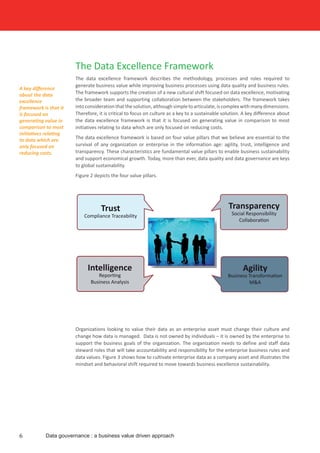
The data excellence framework is based on four value pillars that we believe are essential to the
survival of any organization or enterprise in the information age: agility, trust, intelligence and
transparency. These characteristics are fundamental value pillars to enable business sustainability
and support economical growth. Today, more than ever, data quality and data governance are keys
to global sustainability.
Figure 2 depicts the four value pillars.
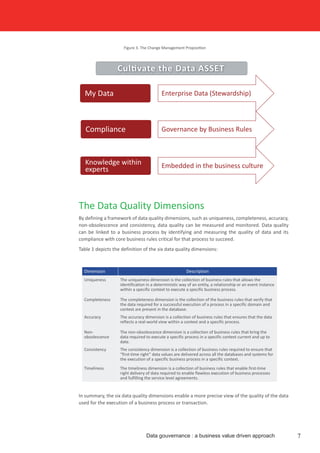
Organizations looking to value their data as an enterprise asset must change their culture and
change how data is managed. Data is not owned by individuals – it is owned by the enterprise to
support the business goals of the organization. The organization needs to define and staff data
steward roles that will take accountability and responsibility for the enterprise business rules and
data values. Figure 3 shows how to cultivate enterprise data as a company asset and illustrates the
mindset and behavioral shift required to move towards business excellence sustainability.
A key difference
about the data
excellence
framework is that it
is focused on
generating value in
comparison to most
initiatives relating
to data which are
only focused on
reducing costs.
Data gouvernance : a business value driven approach6
Transparency
Social Responsibility
Collaboration
Agility
Business Transformation
M&A
Intelligence
Reporting
Business Analysis
Trust
Compliance Traceability
Figure 3. The Change Management Proposition
The Data Quality Dimensions
By defining a framework of data quality dimensions, such as uniqueness, completeness, accuracy,
non-obsolescence and consistency, data quality can be measured and monitored. Data quality
can be linked to a business process by identifying and measuring the quality of data and its
compliance with core business rules critical for that process to succeed.
Table 1 depicts the definition of the six data quality dimensions:
In summary, the six data quality dimensions enable a more precise view of the quality of the data
used for the execution of a business process or transaction.
Dimension Description
Uniqueness The uniqueness dimension is the collection of business rules that allows the
identification in a deterministic way of an entity, a relationship or an event instance
within a specific context to execute a specific business process.
Completeness The completeness dimension is the collection of the business rules that verify that
the data required for a successful execution of a process in a specific domain and
context are present in the database.
Accuracy The accuracy dimension is a collection of business rules that ensures that the data
reflects a real-world view within a context and a specific process.
Non-
obsolescence
The non-obsolescence dimension is a collection of business rules that bring the
data required to execute a specific process in a specific context current and up to
date.
Consistency The consistency dimension is a collection of business rules required to ensure that
“first-time right” data values are delivered across all the databases and systems for
the execution of a specific business process in a specific context.
Timeliness The timeliness dimension is a collection of business rules that enable first-time
right delivery of data required to enable flawless execution of business processes
and fulfilling the service level agreements.
Data gouvernance : a business value driven approach 7
Cultivate the Data ASSET
My Data
Compliance
Knowledge within
experts
Enterprise Data (Stewardship)
Governance by Business Rules
Embedded in the business culture
Data Governance by Business Rules
The data excellence framework defines business rules as “a set of rules with which the data should
comply in order to execute business processes properly.” For each data object (e.g. customer,
supplier, bank, material, asset, location, etc.) and for each data quality dimension, a specific set of
business rules should be identified, documented and managed. The data object must always be
contextualized and linked to the business process during the definition of any business rule related
to it. It is important to adopt a practical approach to data quality and to focus on a smaller set of
critical business rules rather than seeking 100 percent data quality, which may never be achieved or
required. An optimal level of data quality needs to be targeted in order to maximize the business
value and avoid delays. The set of business rules supporting data quality grows over time as part of
the process of continuous improvement.
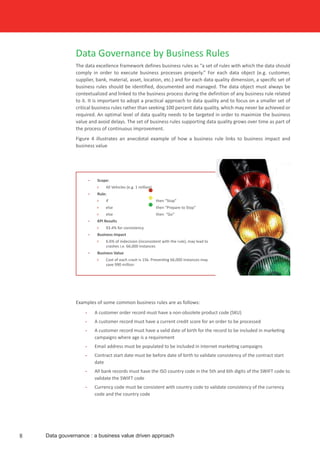
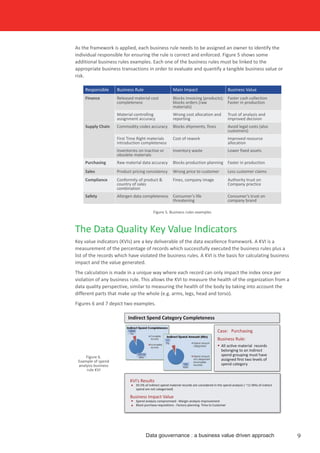
Figure 4 illustrates an anecdotal example of how a business rule links to business impact and
business value
Examples of some common business rules are as follows:
•	 A customer order record must have a non-obsolete product code (SKU)
•	 A customer record must have a current credit score for an order to be processed
•	 A customer record must have a valid date of birth for the record to be included in marketing
campaigns where age is a requirement
•	 Email address must be populated to be included in internet marketing campaigns
•	 Contract start date must be before date of birth to validate consistency of the contract start
date
•	 All bank records must have the ISO country code in the 5th and 6th digits of the SWIFT code to
validate the SWIFT code
•	 Currency code must be consistent with country code to validate consistency of the currency
code and the country code
•	 Scope:
»» All Vehicles (e.g. 1 million)
•	 Rule:
»» if			 then “Stop”
»» else			 then “Prepare to Stop”
»» else			 then “Go”
•	 KPI Results
»» 93.4% for consistency
•	 Business Impact
»» 6.6% of indecision (inconsistent with the rule), may lead to
crashes i.e. 66,000 instances
•	 Business Value
»» Cost of each crash is 15k. Preventing 66,000 instances may
save 990 million
Data gouvernance : a business value driven approach8
As the framework is applied, each business rule needs to be assigned an owner to identify the
individual responsible for ensuring the rule is correct and enforced. Figure 5 shows some
additional business rules examples. Each one of the business rules must be linked to the
appropriate business transactions in order to evaluate and quantify a tangible business value or
risk.
Figure 5. Business rules examples
Responsible Business Rule Main Impact Business Value
Finance Released material cost
completeness
Blocks invoicing (products);
blocks orders (raw
materials)
Faster cash collection
Faster in production
Material controlling
assignment accuracy
Wrong cost allocation and
reporting
Trust of analysis and
improved decision
Supply Chain Commodity codes accuracy Blocks shipments, fines Avoid legal costs (also
customers)
First Time Right materials
introduction completeness
Cost of rework Improved resource
allocation
Inventories on inactive or
obsolete materials
Inventory waste Lower fixed assets
Purchasing Raw material data accuracy Blocks production planning Faster in production
Sales Product pricing consistency Wrong price to customer Less customer claims
Compliance Conformity of product &
country of sales
combination
Fines, company image Authority trust on
Company practice
Safety Allergen data completeness Consumer’s life
threatening
Consumer’s trust on
company brand
Figure 6.
Example of spend
analysis business
rule KVI
The Data Quality Key Value Indicators
Key value indicators (KVIs) are a key deliverable of the data excellence framework. A KVI is a
measurement of the percentage of records which successfully executed the business rules plus a
list of the records which have violated the business rules. A KVI is the basis for calculating business
impact and the value generated.
The calculation is made in a unique way where each record can only impact the index once per
violation of any business rule. This allows the KVI to measure the health of the organization from a
data quality perspective, similar to measuring the health of the body by taking into account the
different parts that make up the whole (e.g. arms, legs, head and torso).
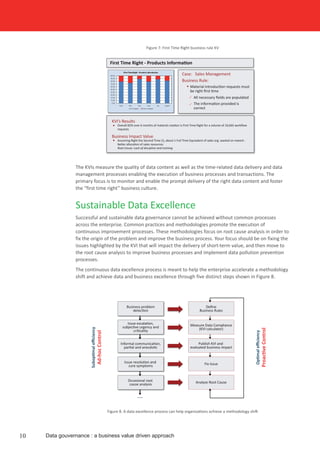
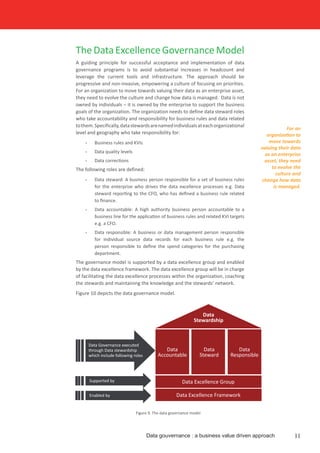
Figures 6 and 7 depict two examples.
Data gouvernance : a business value driven approach 9
Indirect Spend Category Completeness
Case: Purchasing
Business Rule:
KVI’s Results
93.5% of indirect spend material records are considered in the spend analysis ( ~11 Milo of indrect
spend are not categorized)
Business Impact Value
Spend analysis compromised - Margin analysis improvement
Block purchase requisitions - Factory planning. Time to Customer
All active material records
belonging to an indirect
spend grouping must have
assigned first two levels of
spend category
The KVIs measure the quality of data content as well as the time-related data delivery and data
management processes enabling the execution of business processes and transactions. The
primary focus is to monitor and enable the prompt delivery of the right data content and foster
the “first time right” business culture.
Sustainable Data Excellence
Successful and sustainable data governance cannot be achieved without common processes
across the enterprise. Common practices and methodologies promote the execution of
continuous improvement processes. These methodologies focus on root cause analysis in order to
fix the origin of the problem and improve the business process. Your focus should be on fixing the
issues highlighted by the KVI that will impact the delivery of short-term value, and then move to
the root cause analysis to improve business processes and implement data pollution prevention
processes.
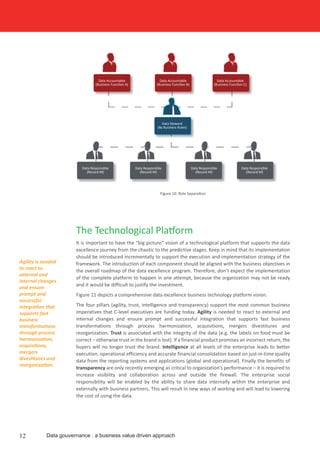
The continuous data excellence process is meant to help the enterprise accelerate a methodology
shift and achieve data and business excellence through five distinct steps shown in Figure 8.
Figure 7: First Time Right business rule KV
Figure 8. A data excellence process can help organizations achieve a methodology shift
Data gouvernance : a business value driven approach10
First Time Right - Products Information
Case: Sales Management
Business Rule:
KVI’s Results
Overall 82% over 6 months of material creation is First Time Right for a volume of 10,665 workflow
requests
Business Impact Value
Assuming Right the Second Time (!), about 1 Full Time Equivalent of sales org. wasted on rework -
Better allocation of sales resources
Root Cause: Lack of discipline and training
Material introduction requests must
be right first time
All necessary fields are populated
The information provided is
correct
Suboptimalefficiency
Ad-hocControl
Optimalefficiency
ProactiveControl
Measure Data Compliance
(KVI calculator)
Publish KVI and
evaluated business impact
Fix Issue
Analyze Root Cause
Define
Business Rules
Issue escalation,
subjective urgency and
criticality
Business problem
detection
Informal communication,
partial and anecdotic
Issue resolution and
cure symptoms
Occasional root
cause analysis
...
TheDataExcellenceGovernanceModel
A guiding principle for successful acceptance and implementation of data
governance programs is to avoid substantial increases in headcount and
leverage the current tools and infrastructure. The approach should be
progressive and non-invasive, empowering a culture of focusing on priorities.
For an organization to move towards valuing their data as an enterprise asset,
they need to evolve the culture and change how data is managed. Data is not
owned by individuals – it is owned by the enterprise to support the business
goals of the organization. The organization needs to define data steward roles
who take accountability and responsibility for business rules and data related
tothem.Specifically,datastewardsarenamedindividualsateachorganizational
level and geography who take responsibility for:
•	 Business rules and KVIs
•	 Data quality levels
•	 Data corrections
The following roles are defined:
•	 Data steward: A business person responsible for a set of business rules
for the enterprise who drives the data excellence processes e.g. Data
steward reporting to the CFO, who has defined a business rule related
to finance.
•	 Data accountable: A high authority business person accountable to a
business line for the application of business rules and related KVI targets
e.g. a CFO.
•	 Data responsible: A business or data management person responsible
for individual source data records for each business rule e.g. the
person responsible to define the spend categories for the purchasing
department.
The governance model is supported by a data excellence group and enabled
by the data excellence framework. The data excellence group will be in charge
of facilitating the data excellence processes within the organization, coaching
the stewards and maintaining the knowledge and the stewards’ network.
Figure 10 depicts the data governance model.
Figure 9. The data governance model
For an
organization to
move towards
valuing their data
as an enterprise
asset, they need
to evolve the
culture and
change how data
is managed.
Data gouvernance : a business value driven approach 11
Data
Accountable
Data
Steward
Data
Responsible
Data
Stewardship
Data Excellence Group
Data Excellence Framework
Data Governance executed
through Data stewardship
which include following roles
Supported by
Enabled by
The Technological Platform
It is important to have the “big picture” vision of a technological platform that supports the data
excellence journey from the chaotic to the predictive stages. Keep in mind that its implementation
should be introduced incrementally to support the execution and implementation strategy of the
framework. The introduction of each component should be aligned with the business objectives in
the overall roadmap of the data excellence program. Therefore, don’t expect the implementation
of the complete platform to happen in one attempt, because the organization may not be ready
and it would be difficult to justify the investment.
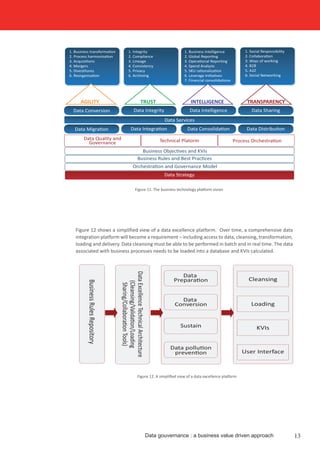
Figure 11 depicts a comprehensive data excellence business technology platform vision.
The four pillars (agility, trust, intelligence and transparency) support the most common business
imperatives that C-level executives are funding today. Agility is needed to react to external and
internal changes and ensure prompt and successful integration that supports fast business
transformations through process harmonization, acquisitions, mergers divestitures and
reorganization. Trust is associated with the integrity of the data (e.g. the labels on food must be
correct – otherwise trust in the brand is lost). If a financial product promises an incorrect return, the
buyers will no longer trust the brand. Intelligence at all levels of the enterprise leads to better
execution, operational efficiency and accurate financial consolidation based on just-in-time quality
data from the reporting systems and applications (global and operational). Finally the benefits of
transparency are only recently emerging as critical to organization’s performance – it is required to
increase visibility and collaboration across and outside the firewall. The enterprise social
responsibility will be enabled by the ability to share data internally within the enterprise and
externally with business partners. This will result in new ways of working and will lead to lowering
the cost of using the data.
Figure 10. Role Separation
Agility is needed
to react to
external and
internal changes
and ensure
prompt and
successful
integration that
supports fast
business
transformations
through process
harmonization,
acquisitions,
mergers
divestitures and
reorganization.
Data gouvernance : a business value driven approach12
Data Responsible
(Record M)
Data Responsible
(Record M)
Data Responsible
(Record M)
Data Responsible
(Record M)
Data Accountable
(Business Function A)
Data Accountable
(Business Function B)
Data Accountable
(Business Function C)
Data Steward
(By Business Rules)
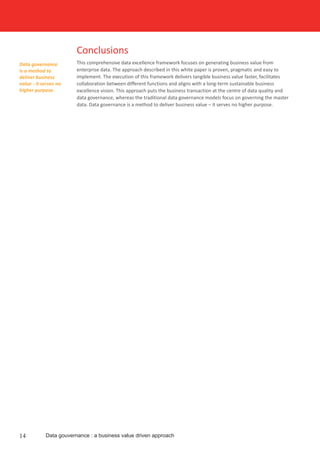
Figure 12 shows a simplified view of a data excellence platform. Over time, a comprehensive data
integration platform will become a requirement – including access to data, cleansing, transformation,
loading and delivery. Data cleansing must be able to be performed in batch and in real time. The data
associated with business processes needs to be loaded into a database and KVIs calculated.
Figure 11. The business technology platform vision
Figure 12. A simplified view of a data excellence platform
Data gouvernance : a business value driven approach 13
1. Business transformation
2. Process harmonisation
3. Acquisitions
4. Mergers
5. Divestitures
6. Reorganisation
1. Business Intelligence
2. Global Reporting
3. Operational Reporting
4. Spend Analysis
5. SKU rationalization
6. Leverage Initiatives
7. Financial consolidatione
1. Integrity
2. Compliance
3. Lineage
4. Consistency
5. Privacy
6. Archiving
1. Social Responsibility
2. Collaboration
3. Ways of working
4. B2B
5. A2Z
6. Social Networking
AGILITY
Data Conversion Data Integrity Data Intelligence Data Sharing
TRUST INTELLIGENCE TRANSPARENCY
Data Quality and
Governance Technical Platorm Process Orchestration
Data Services
Business Objectives and KVIs
Business Rules and Best Practices
Orchestration and Governance Model
Data Strategy
Data Migration Data Integration Data Consolidation Data Distribution
Data
Data
Conversion
Sustain
BusinessRulesRepository
DataExcellenceTechnicalArchitecture
Cleansing
Loading
KVIs
User Interface
Conclusions
This comprehensive data excellence framework focuses on generating business value from
enterprise data. The approach described in this white paper is proven, pragmatic and easy to
implement. The execution of this framework delivers tangible business value faster, facilitates
collaboration between different functions and aligns with a long-term sustainable business
excellence vision. This approach puts the business transaction at the centre of data quality and
data governance, whereas the traditional data governance models focus on governing the master
data. Data governance is a method to deliver business value – it serves no higher purpose.
Data governance
is a method to
deliver business
value - it serves no
higher purpose.
14 Data gouvernance : a business value driven approach
Data gouvernance : a business value driven approach 15
Copyright 2011 Global Data Excellence Ltd. All Rights Reserved.
Contact Details:
Email: info@globaldataexcellence.com
Tel: +41 22 795 78 18
Website: www.globaldataexcellence.com

Data Governance a Business Value Driven Approach

  • 1.
    Data Governance: ABusiness Value-Driven Approach A White Paper by Dr. Walid el Abed CEO January 2011 Copyright Global Data Excellence 2011Copyright Global Data Excellence 2011
  • 2.
    Contents Executive Summary .. . . . . . . . . . . . . . . . . . . . . . . . . . . . . . . . . . . . . . . . . . . . . . . . . . . . . 3 Introduction . . . . . . . . . . . . . . . . . . . . . . . . . . . . . . . . . . . . . . . . . . . . . . . . . . . . . . . . . . . . 4 Barriers to Overcome . . . . . . . . . . . . . . . . . . . . . . . . . . . . . . . . . . . . . . . . . . . . . . . . . . . . 4 The Data Excellence Maturity Model . . . . . . . . . . . . . . . . . . . . . . . . . . . . . . . . . . . . . . . 5 The Data Excellence Framework . . . . . . . . . . . . . . . . . . . . . . . . . . . . . . . . . . . . . . . . . . . 6 The Data Quality Dimensions . . . . . . . . . . . . . . . . . . . . . . . . . . . . . . . . . . . . . . . . . . . . . . 7 Data Governance by Business Rules . . . . . . . . . . . . . . . . . . . . . . . . . . . . . . . . . . . . . . . . 8 The Data Quality Key Value Indicators . . . . . . . . . . . . . . . . . . . . . . . . . . . . . . . . . . . . . . 9 Sustainable Data Excellence . . . . . . . . . . . . . . . . . . . . . . . . . . . . . . . . . . . . . . . . . . . . . . 10 The Data Excellence Governance Model . . . . . . . . . . . . . . . . . . . . . . . . . . . . . . . . . . . . 11 The Technological Platform . . . . . . . . . . . . . . . . . . . . . . . . . . . . . . . . . . . . . . . . . . . . . . 12 Conclusions . . . . . . . . . . . . . . . . . . . . . . . . . . . . . . . . . . . . . . . . . . . . . . . . . . . . . . . . . . . 14 Data gouvernance : a business value driven approach2
  • 3.
    Executive Summary Successful organizationscome in all shapes in sizes. One characteristic common among these companies is a focus on capturing their full potential by maximizing customer service while optimizing business process execution. They recognize that customer service and business processes depend on “fit for purpose” data. They are like more and more companies today – benefiting from their investment in high-quality enterprise data. In contrast, organizations who do not pay appropriate attention to data quality end up with delayed invoicing, slow cash collection processes, inefficient sales and marketing and reduced confidence in reporting and decision making. This in turn will impact customer service and customer trust. What can you do now? Start by measuring how bad your data is – perform a data quality audit. Link the resulting metrics to business impact i.e. how much cost are you incurring due to low quality data. Calculate the business value you could generate with high quality data. You will be more than pleasantly surprised. Take rapid action by immediately focusing on the most critical operational issues. Demand improvement within the next three months. Build on early successes and change the culture to “first time right”. Sustain the momentum. Define the critical business rules which rely on high quality data to execute. Measure the efficiency of core processes by the quality of the data. Assign data ownership within each business unit, application environment and enterprise business process. Hold the owners accountable. The right people are already within the organization – there are no majoradditional headcountcosts.CollaboratewithIT.Enjoytheresults.Thisistruedatagovernance. Data governance is not a “nice to have” initiative but a real value add and risk management program. Only those organizations with an effective data strategy embedded within the business strategy will be able to turn data into a real competitive advantage, deliver short and longer term value and ensure business success and sustainability. 3Data gouvernance : a business value driven approach
  • 4.
    Introduction Volumes of datacontinue to increase as organizations grow organically and through acquisition. More and more silos of data are being created within departments and business units. As new channels to market are opened, the result is the sharing of data with new partners outside the firewall. The cloud is a more recent example of enterprise data being entered into systems owned or controlled by third parties. Data fragmentation results in lower quality data as data standards are more difficult to enforce. As processes are integrated, departmental silos are merged, exposing data quality issues often for the first time. These data quality issues result in project and business process failures, lack of adoption of new applications and loss of confidence in enterprise data. Business modernization programs typically focus on process standardization to gain the benefits of efficient repeatable, measurable processes. Enterprise resource planning (ERP) technologies fulfill the process standardization requirements and have now become a central point for management of business processes. However, ERP systems do not prevent low quality data from entering the systems nor do they measure its impact on the efficiency of a business process. Most organizations today are using the same ERP systems (SAP or Oracle) that were configured by the same consultancies. Therefore, the uniqueness and the scope for competitive advantage of any organization are defined by the people and the data. Master data management (MDM) may be part of the longer term solution; However, MDM will not deliver short-term value. The challenge is in the time paradox where the priority of the business is to run operations and address the critical business issues to deliver immediate value while an MDM project, in contrast, is a strategic initiative focused on delivering longer-term value. How can we combine the near and far? Only an economically focused, non-invasive and progressive approach, taking the short and long term business objectives into consideration, will be accepted and executed by the business. The objective of this white paper is to present a proven, executable framework that enables an effective and sustainable data governance strategy, delivering immediate business value and supports longer-term sustainable process improvement. 4 Data gouvernance : a business value driven approach Barriers to Overcome High quality data is needed to capture the full potential of the enterprise and deliver all the benefits of ERP systems, customer relationship management (CRM) and business intelligence (BI) initiatives, compliance and data warehousing solutions. Conversely, low quality data causes transactions, processes and projects to fail, leading to increased costs, additional risks, reduced confidence in enterprise data and potential business losses. ERP systems are often seen as the solution to data quality and data governance given their centralized role in capturing and maintaining data. However, ERP systems were never designed to manage data quality. And not all enterprise data resides in ERP systems. In fact, the responsibility for data quality often rests with data governance or data management teams who act in an advisory capacity only, report to IT and have very little power or influence over budgets and the quality of business data. For any large organization, the budget and resources allocated to an ERP system are typically exhausted on the acquisition and implementation of the application software. Less attention is given to sustainable data quality processes across the enterprise. The uniqueness and the scope for competitive advantage of any organization are defined by the people and the data. Low quality data causes transactions, processes and projects to fail, leading to increased costs, additional risks, reduced confidence in enterprise data and potential business losses.
  • 5.
    Although budget owningmanagers understand that high-quality data leads to improved process efficiency and increased confidence, there is often no understanding of: • How to justify the cost or value of data stewards • The process or roles focused on managing data as an asset • The business impact and value generation potential of a data quality team As a result, most organizations are struggling to build data quality initiatives causing the implementation and ongoing management of data quality processes to fail. In turn, this leads to underutilization and lack of confidence in the ERP system (in this example). The time it takes for a large organization to progress through the incremental stages is related to the level of misalignment that is often observed between data governance program objectives and business objectives. The data excellence framework supports a “near and far” approach, thus delivering immediate value while subscribing to the long-term business vision. 5Data gouvernance : a business value driven approach The business purpose of the data excellence maturity model is to position an organization in terms of its ability to generate business value from enterprise data. The Data Excellence Maturity Model The data excellence maturity model referred to in this white paper tracks an organization’s progress from the early stages of data governance – described here as “chaotic” – to the most mature stages where data is utilized as a core enterprise asset – described as “predictive”. The maturity model is often used to understand the right projects and initiatives to introduce the concepts and methodologies of a data excellence framework. The business purpose of the data excellence maturity model is to position an organization in terms of its ability to generate business value from enterprise data. Figure 1 depicts the data excellence maturity model.
  • 6.
    The Data ExcellenceFramework The data excellence framework describes the methodology, processes and roles required to generate business value while improving business processes using data quality and business rules. The framework supports the creation of a new cultural shift focused on data excellence, motivating the broader team and supporting collaboration between the stakeholders. The framework takes intoconsiderationthatthesolution,althoughsimpletoarticulate,iscomplexwithmanydimensions. Therefore, it is critical to focus on culture as a key to a sustainable solution. A key difference about the data excellence framework is that it is focused on generating value in comparison to most initiatives relating to data which are only focused on reducing costs. The data excellence framework is based on four value pillars that we believe are essential to the survival of any organization or enterprise in the information age: agility, trust, intelligence and transparency. These characteristics are fundamental value pillars to enable business sustainability and support economical growth. Today, more than ever, data quality and data governance are keys to global sustainability. Figure 2 depicts the four value pillars. Organizations looking to value their data as an enterprise asset must change their culture and change how data is managed. Data is not owned by individuals – it is owned by the enterprise to support the business goals of the organization. The organization needs to define and staff data steward roles that will take accountability and responsibility for the enterprise business rules and data values. Figure 3 shows how to cultivate enterprise data as a company asset and illustrates the mindset and behavioral shift required to move towards business excellence sustainability. A key difference about the data excellence framework is that it is focused on generating value in comparison to most initiatives relating to data which are only focused on reducing costs. Data gouvernance : a business value driven approach6 Transparency Social Responsibility Collaboration Agility Business Transformation M&A Intelligence Reporting Business Analysis Trust Compliance Traceability
  • 7.
    Figure 3. TheChange Management Proposition The Data Quality Dimensions By defining a framework of data quality dimensions, such as uniqueness, completeness, accuracy, non-obsolescence and consistency, data quality can be measured and monitored. Data quality can be linked to a business process by identifying and measuring the quality of data and its compliance with core business rules critical for that process to succeed. Table 1 depicts the definition of the six data quality dimensions: In summary, the six data quality dimensions enable a more precise view of the quality of the data used for the execution of a business process or transaction. Dimension Description Uniqueness The uniqueness dimension is the collection of business rules that allows the identification in a deterministic way of an entity, a relationship or an event instance within a specific context to execute a specific business process. Completeness The completeness dimension is the collection of the business rules that verify that the data required for a successful execution of a process in a specific domain and context are present in the database. Accuracy The accuracy dimension is a collection of business rules that ensures that the data reflects a real-world view within a context and a specific process. Non- obsolescence The non-obsolescence dimension is a collection of business rules that bring the data required to execute a specific process in a specific context current and up to date. Consistency The consistency dimension is a collection of business rules required to ensure that “first-time right” data values are delivered across all the databases and systems for the execution of a specific business process in a specific context. Timeliness The timeliness dimension is a collection of business rules that enable first-time right delivery of data required to enable flawless execution of business processes and fulfilling the service level agreements. Data gouvernance : a business value driven approach 7 Cultivate the Data ASSET My Data Compliance Knowledge within experts Enterprise Data (Stewardship) Governance by Business Rules Embedded in the business culture
  • 8.
    Data Governance byBusiness Rules The data excellence framework defines business rules as “a set of rules with which the data should comply in order to execute business processes properly.” For each data object (e.g. customer, supplier, bank, material, asset, location, etc.) and for each data quality dimension, a specific set of business rules should be identified, documented and managed. The data object must always be contextualized and linked to the business process during the definition of any business rule related to it. It is important to adopt a practical approach to data quality and to focus on a smaller set of critical business rules rather than seeking 100 percent data quality, which may never be achieved or required. An optimal level of data quality needs to be targeted in order to maximize the business value and avoid delays. The set of business rules supporting data quality grows over time as part of the process of continuous improvement. Figure 4 illustrates an anecdotal example of how a business rule links to business impact and business value Examples of some common business rules are as follows: • A customer order record must have a non-obsolete product code (SKU) • A customer record must have a current credit score for an order to be processed • A customer record must have a valid date of birth for the record to be included in marketing campaigns where age is a requirement • Email address must be populated to be included in internet marketing campaigns • Contract start date must be before date of birth to validate consistency of the contract start date • All bank records must have the ISO country code in the 5th and 6th digits of the SWIFT code to validate the SWIFT code • Currency code must be consistent with country code to validate consistency of the currency code and the country code • Scope: »» All Vehicles (e.g. 1 million) • Rule: »» if then “Stop” »» else then “Prepare to Stop” »» else then “Go” • KPI Results »» 93.4% for consistency • Business Impact »» 6.6% of indecision (inconsistent with the rule), may lead to crashes i.e. 66,000 instances • Business Value »» Cost of each crash is 15k. Preventing 66,000 instances may save 990 million Data gouvernance : a business value driven approach8
  • 9.
    As the frameworkis applied, each business rule needs to be assigned an owner to identify the individual responsible for ensuring the rule is correct and enforced. Figure 5 shows some additional business rules examples. Each one of the business rules must be linked to the appropriate business transactions in order to evaluate and quantify a tangible business value or risk. Figure 5. Business rules examples Responsible Business Rule Main Impact Business Value Finance Released material cost completeness Blocks invoicing (products); blocks orders (raw materials) Faster cash collection Faster in production Material controlling assignment accuracy Wrong cost allocation and reporting Trust of analysis and improved decision Supply Chain Commodity codes accuracy Blocks shipments, fines Avoid legal costs (also customers) First Time Right materials introduction completeness Cost of rework Improved resource allocation Inventories on inactive or obsolete materials Inventory waste Lower fixed assets Purchasing Raw material data accuracy Blocks production planning Faster in production Sales Product pricing consistency Wrong price to customer Less customer claims Compliance Conformity of product & country of sales combination Fines, company image Authority trust on Company practice Safety Allergen data completeness Consumer’s life threatening Consumer’s trust on company brand Figure 6. Example of spend analysis business rule KVI The Data Quality Key Value Indicators Key value indicators (KVIs) are a key deliverable of the data excellence framework. A KVI is a measurement of the percentage of records which successfully executed the business rules plus a list of the records which have violated the business rules. A KVI is the basis for calculating business impact and the value generated. The calculation is made in a unique way where each record can only impact the index once per violation of any business rule. This allows the KVI to measure the health of the organization from a data quality perspective, similar to measuring the health of the body by taking into account the different parts that make up the whole (e.g. arms, legs, head and torso). Figures 6 and 7 depict two examples. Data gouvernance : a business value driven approach 9 Indirect Spend Category Completeness Case: Purchasing Business Rule: KVI’s Results 93.5% of indirect spend material records are considered in the spend analysis ( ~11 Milo of indrect spend are not categorized) Business Impact Value Spend analysis compromised - Margin analysis improvement Block purchase requisitions - Factory planning. Time to Customer All active material records belonging to an indirect spend grouping must have assigned first two levels of spend category
  • 10.
    The KVIs measurethe quality of data content as well as the time-related data delivery and data management processes enabling the execution of business processes and transactions. The primary focus is to monitor and enable the prompt delivery of the right data content and foster the “first time right” business culture. Sustainable Data Excellence Successful and sustainable data governance cannot be achieved without common processes across the enterprise. Common practices and methodologies promote the execution of continuous improvement processes. These methodologies focus on root cause analysis in order to fix the origin of the problem and improve the business process. Your focus should be on fixing the issues highlighted by the KVI that will impact the delivery of short-term value, and then move to the root cause analysis to improve business processes and implement data pollution prevention processes. The continuous data excellence process is meant to help the enterprise accelerate a methodology shift and achieve data and business excellence through five distinct steps shown in Figure 8. Figure 7: First Time Right business rule KV Figure 8. A data excellence process can help organizations achieve a methodology shift Data gouvernance : a business value driven approach10 First Time Right - Products Information Case: Sales Management Business Rule: KVI’s Results Overall 82% over 6 months of material creation is First Time Right for a volume of 10,665 workflow requests Business Impact Value Assuming Right the Second Time (!), about 1 Full Time Equivalent of sales org. wasted on rework - Better allocation of sales resources Root Cause: Lack of discipline and training Material introduction requests must be right first time All necessary fields are populated The information provided is correct Suboptimalefficiency Ad-hocControl Optimalefficiency ProactiveControl Measure Data Compliance (KVI calculator) Publish KVI and evaluated business impact Fix Issue Analyze Root Cause Define Business Rules Issue escalation, subjective urgency and criticality Business problem detection Informal communication, partial and anecdotic Issue resolution and cure symptoms Occasional root cause analysis ...
  • 11.
    TheDataExcellenceGovernanceModel A guiding principlefor successful acceptance and implementation of data governance programs is to avoid substantial increases in headcount and leverage the current tools and infrastructure. The approach should be progressive and non-invasive, empowering a culture of focusing on priorities. For an organization to move towards valuing their data as an enterprise asset, they need to evolve the culture and change how data is managed. Data is not owned by individuals – it is owned by the enterprise to support the business goals of the organization. The organization needs to define data steward roles who take accountability and responsibility for business rules and data related tothem.Specifically,datastewardsarenamedindividualsateachorganizational level and geography who take responsibility for: • Business rules and KVIs • Data quality levels • Data corrections The following roles are defined: • Data steward: A business person responsible for a set of business rules for the enterprise who drives the data excellence processes e.g. Data steward reporting to the CFO, who has defined a business rule related to finance. • Data accountable: A high authority business person accountable to a business line for the application of business rules and related KVI targets e.g. a CFO. • Data responsible: A business or data management person responsible for individual source data records for each business rule e.g. the person responsible to define the spend categories for the purchasing department. The governance model is supported by a data excellence group and enabled by the data excellence framework. The data excellence group will be in charge of facilitating the data excellence processes within the organization, coaching the stewards and maintaining the knowledge and the stewards’ network. Figure 10 depicts the data governance model. Figure 9. The data governance model For an organization to move towards valuing their data as an enterprise asset, they need to evolve the culture and change how data is managed. Data gouvernance : a business value driven approach 11 Data Accountable Data Steward Data Responsible Data Stewardship Data Excellence Group Data Excellence Framework Data Governance executed through Data stewardship which include following roles Supported by Enabled by
  • 12.
    The Technological Platform Itis important to have the “big picture” vision of a technological platform that supports the data excellence journey from the chaotic to the predictive stages. Keep in mind that its implementation should be introduced incrementally to support the execution and implementation strategy of the framework. The introduction of each component should be aligned with the business objectives in the overall roadmap of the data excellence program. Therefore, don’t expect the implementation of the complete platform to happen in one attempt, because the organization may not be ready and it would be difficult to justify the investment. Figure 11 depicts a comprehensive data excellence business technology platform vision. The four pillars (agility, trust, intelligence and transparency) support the most common business imperatives that C-level executives are funding today. Agility is needed to react to external and internal changes and ensure prompt and successful integration that supports fast business transformations through process harmonization, acquisitions, mergers divestitures and reorganization. Trust is associated with the integrity of the data (e.g. the labels on food must be correct – otherwise trust in the brand is lost). If a financial product promises an incorrect return, the buyers will no longer trust the brand. Intelligence at all levels of the enterprise leads to better execution, operational efficiency and accurate financial consolidation based on just-in-time quality data from the reporting systems and applications (global and operational). Finally the benefits of transparency are only recently emerging as critical to organization’s performance – it is required to increase visibility and collaboration across and outside the firewall. The enterprise social responsibility will be enabled by the ability to share data internally within the enterprise and externally with business partners. This will result in new ways of working and will lead to lowering the cost of using the data. Figure 10. Role Separation Agility is needed to react to external and internal changes and ensure prompt and successful integration that supports fast business transformations through process harmonization, acquisitions, mergers divestitures and reorganization. Data gouvernance : a business value driven approach12 Data Responsible (Record M) Data Responsible (Record M) Data Responsible (Record M) Data Responsible (Record M) Data Accountable (Business Function A) Data Accountable (Business Function B) Data Accountable (Business Function C) Data Steward (By Business Rules)
  • 13.
    Figure 12 showsa simplified view of a data excellence platform. Over time, a comprehensive data integration platform will become a requirement – including access to data, cleansing, transformation, loading and delivery. Data cleansing must be able to be performed in batch and in real time. The data associated with business processes needs to be loaded into a database and KVIs calculated. Figure 11. The business technology platform vision Figure 12. A simplified view of a data excellence platform Data gouvernance : a business value driven approach 13 1. Business transformation 2. Process harmonisation 3. Acquisitions 4. Mergers 5. Divestitures 6. Reorganisation 1. Business Intelligence 2. Global Reporting 3. Operational Reporting 4. Spend Analysis 5. SKU rationalization 6. Leverage Initiatives 7. Financial consolidatione 1. Integrity 2. Compliance 3. Lineage 4. Consistency 5. Privacy 6. Archiving 1. Social Responsibility 2. Collaboration 3. Ways of working 4. B2B 5. A2Z 6. Social Networking AGILITY Data Conversion Data Integrity Data Intelligence Data Sharing TRUST INTELLIGENCE TRANSPARENCY Data Quality and Governance Technical Platorm Process Orchestration Data Services Business Objectives and KVIs Business Rules and Best Practices Orchestration and Governance Model Data Strategy Data Migration Data Integration Data Consolidation Data Distribution Data Data Conversion Sustain BusinessRulesRepository DataExcellenceTechnicalArchitecture Cleansing Loading KVIs User Interface
  • 14.
    Conclusions This comprehensive dataexcellence framework focuses on generating business value from enterprise data. The approach described in this white paper is proven, pragmatic and easy to implement. The execution of this framework delivers tangible business value faster, facilitates collaboration between different functions and aligns with a long-term sustainable business excellence vision. This approach puts the business transaction at the centre of data quality and data governance, whereas the traditional data governance models focus on governing the master data. Data governance is a method to deliver business value – it serves no higher purpose. Data governance is a method to deliver business value - it serves no higher purpose. 14 Data gouvernance : a business value driven approach
  • 15.
    Data gouvernance :a business value driven approach 15
  • 16.
    Copyright 2011 GlobalData Excellence Ltd. All Rights Reserved. Contact Details: Email: info@globaldataexcellence.com Tel: +41 22 795 78 18 Website: www.globaldataexcellence.com