DISTRIBUTED SYSTEMS
RPC: Part 2
Data Encoding in Remote Procedure Calls
1
2
Sending data over the network
Stream of bytes
3
struct item {
char name[64];
unsigned long id;
int number_in_stock;
float rating;
double price;
} scratcher = {
"Bear Claw Black Telescopic Back Scratcher",
00120,
332,
4.6,
5.99
}
gets stored in memory as:
42 65 61 72 20 43 6c 61 77 20 42 6c 61 63 6b 20 54 ...
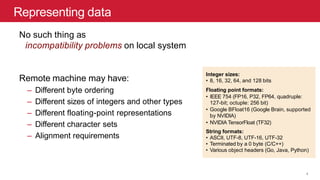
Representing data
4
No such thing as
incompatibility problems on local system
Remote machine may have:
– Different byte ordering
– Different sizes of integers and other types
– Different floating-point representations
– Different character sets
– Alignment requirements
Integer sizes:
• 8, 16, 32, 64, and 128 bits
Floating point formats:
• IEEE 754 (FP16, P32, FP64, quadruple:
127-bit; octuple: 256 bit)
• Google BFloat16 (Google Brain, supported
by NVIDIA)
• NVIDIA TensorFloat (TF32)
String formats:
• ASCII, UTF-8, UTF-16, UTF-32
• Terminated by a 0 byte (C/C++)
• Various object headers (Go, Java, Python)
Representing data
IP (headers) forced all to use big endian byte ordering for 16- and 32-bit values
Big endian: Most significant byte in low memory
– Jave Virtual Machine, OpenRISC, Atmel AVR32, IBM z-series, SPARC < V9, Motorola 680x0, older PowerPC
Little endian: Most significant byte in high memory
– Intel/AMD IA-32, x64
Bi-endian: Processor may operate in either mode
– ARM, PowerPC, MIPS, SPARC V9, IA-64 (Intel Itanium)
main() {
unsigned int n;
char *a = (char *)&n;
n = 0x11223344;
printf("%02x, %02x, %02x, %02xn",
a[0], a[1], a[2], a[3]);
}
Output on an Intel CPU:
44, 33, 22, 11
Output on a PowerPC:
11, 22, 33, 44
IP headers use big endian
5
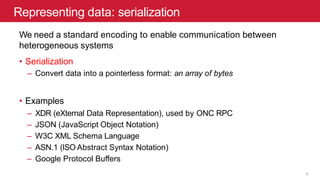
Representing data: serialization
6
We need a standard encoding to enable communication between
heterogeneous systems
• Serialization
– Convert data into a pointerless format: an array of bytes
• Examples
– XDR (eXternal Data Representation), used by ONC RPC
– JSON (JavaScript Object Notation)
– W3C XML Schema Language
– ASN.1 (ISO Abstract Syntax Notation)
– Google Protocol Buffers
Serializing data
Implicit typing
– only values are transmitted, not data types or parameter info
– e.g., ONC XDR (RFC 4506)
Explicit typing
– Type is transmitted with each value
– e.g., ISO’s ASN.1, XML, protocol buffers, JSON
Marshaling vs. serialization – almost synonymous – serialization is used in marshaling:
Serialization: converting an object into a sequence of bytes that can be sent over a network
7
Marshaling: bundling parameters into a form that can be reconstructed (unmarshaled) by
another process. May include object ID or other state. Marshaling uses
serialization.
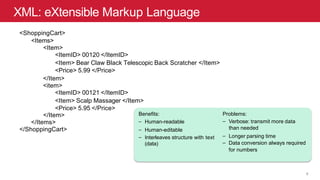
XML: eXtensible Markup Language
<ShoppingCart>
<Items>
<Item>
<ItemID> 00120 </ItemID>
<Item> Bear Claw Black Telescopic Back Scratcher </Item>
<Price> 5.99 </Price>
</Item>
<item>
<ItemID> 00121 </ItemID>
<Item> Scalp Massager </Item>
<Price> 5.95 </Price>
</Item>
</Items>
</ShoppingCart>
Benefits:
– Human-readable
– Human-editable
– Interleaves structure with text
(data)
8
Problems:
– Verbose: transmit more data
than needed
– Longer parsing time
– Data conversion always required
for numbers
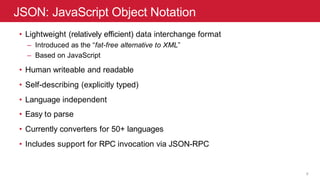
JSON: JavaScript Object Notation
9
• Lightweight (relatively efficient) data interchange format
– Introduced as the “fat-free alternative to XML”
– Based on JavaScript
• Human writeable and readable
• Self-describing (explicitly typed)
• Language independent
• Easy to parse
• Currently converters for 50+ languages
• Includes support for RPC invocation via JSON-RPC
JSON Data Encoding Example
{
"items": [
{
"item_id": 00120,
"item:": " Bear Claw Black Telescopic Back Scratcher",
"cost": "5.99"
}
{
"item_id": 00121,
"item:": " Scalp Massager r",
"cost": "5.95"
}
]
}
1
0
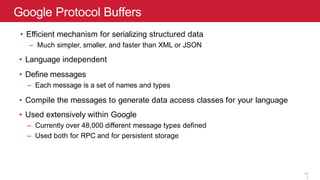
Google Protocol Buffers
11
• Efficient mechanism for serializing structured data
– Much simpler, smaller, and faster than XML or JSON
• Language independent
• Define messages
– Each message is a set of names and types
• Compile the messages to generate data access classes for your language
• Used extensively within Google
– Currently over 48,000 different message types defined
– Used both for RPC and for persistent storage
1
1
Example (from the Developer Guide)
12
http://code.google.com/apis/protocolbuffers/docs/overview.html
message Person {
required string name = 1;
required int32 id = 2;
optional string email = 3;
enum PhoneType {
MOBILE = 0;
HOME = 1;
WORK = 2;
}
message PhoneNumber {
required string number = 1;
optional PhoneType type = 2 [default = HOME];
}
repeated PhoneNumber phone = 4;
}
1
2
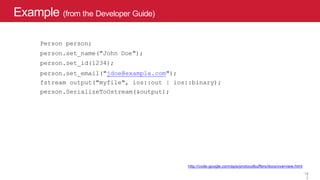
Example (from the Developer Guide)
http://code.google.com/apis/protocolbuffers/docs/overview.html
13
Person person;
person.set_name("John Doe");
person.set_id(1234);
person.set_email("jdoe@example.com");
fstream output("myfile", ios::out | ios::binary);
person.SerializeToOstream(&output);
1
3
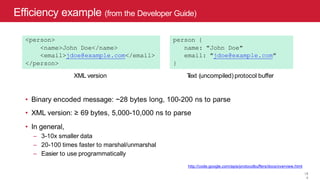
Efficiency example (from the Developer Guide)
http://code.google.com/apis/protocolbuffers/docs/overview.html
14
• Binary encoded message: ~28 bytes long, 100-200 ns to parse
• XML version: ≥ 69 bytes, 5,000-10,000 ns to parse
• In general,
– 3-10x smaller data
– 20-100 times faster to marshal/unmarshal
– Easier to use programmatically
<person>
<name>John Doe</name>
<email>jdoe@example.com</email>
</person>
person {
name: "John Doe"
email: "jdoe@example.com"
}
XML version T
ext (uncompiled) protocol buffer
1
4
15
The End
1
5

Data Encoding in Remote Procedure calls.

  • 1.
    DISTRIBUTED SYSTEMS RPC: Part2 Data Encoding in Remote Procedure Calls 1
  • 2.
  • 3.
    Stream of bytes 3 structitem { char name[64]; unsigned long id; int number_in_stock; float rating; double price; } scratcher = { "Bear Claw Black Telescopic Back Scratcher", 00120, 332, 4.6, 5.99 } gets stored in memory as: 42 65 61 72 20 43 6c 61 77 20 42 6c 61 63 6b 20 54 ...
  • 4.
    Representing data 4 No suchthing as incompatibility problems on local system Remote machine may have: – Different byte ordering – Different sizes of integers and other types – Different floating-point representations – Different character sets – Alignment requirements Integer sizes: • 8, 16, 32, 64, and 128 bits Floating point formats: • IEEE 754 (FP16, P32, FP64, quadruple: 127-bit; octuple: 256 bit) • Google BFloat16 (Google Brain, supported by NVIDIA) • NVIDIA TensorFloat (TF32) String formats: • ASCII, UTF-8, UTF-16, UTF-32 • Terminated by a 0 byte (C/C++) • Various object headers (Go, Java, Python)
  • 5.
    Representing data IP (headers)forced all to use big endian byte ordering for 16- and 32-bit values Big endian: Most significant byte in low memory – Jave Virtual Machine, OpenRISC, Atmel AVR32, IBM z-series, SPARC < V9, Motorola 680x0, older PowerPC Little endian: Most significant byte in high memory – Intel/AMD IA-32, x64 Bi-endian: Processor may operate in either mode – ARM, PowerPC, MIPS, SPARC V9, IA-64 (Intel Itanium) main() { unsigned int n; char *a = (char *)&n; n = 0x11223344; printf("%02x, %02x, %02x, %02xn", a[0], a[1], a[2], a[3]); } Output on an Intel CPU: 44, 33, 22, 11 Output on a PowerPC: 11, 22, 33, 44 IP headers use big endian 5
  • 6.
    Representing data: serialization 6 Weneed a standard encoding to enable communication between heterogeneous systems • Serialization – Convert data into a pointerless format: an array of bytes • Examples – XDR (eXternal Data Representation), used by ONC RPC – JSON (JavaScript Object Notation) – W3C XML Schema Language – ASN.1 (ISO Abstract Syntax Notation) – Google Protocol Buffers
  • 7.
    Serializing data Implicit typing –only values are transmitted, not data types or parameter info – e.g., ONC XDR (RFC 4506) Explicit typing – Type is transmitted with each value – e.g., ISO’s ASN.1, XML, protocol buffers, JSON Marshaling vs. serialization – almost synonymous – serialization is used in marshaling: Serialization: converting an object into a sequence of bytes that can be sent over a network 7 Marshaling: bundling parameters into a form that can be reconstructed (unmarshaled) by another process. May include object ID or other state. Marshaling uses serialization.
  • 8.
    XML: eXtensible MarkupLanguage <ShoppingCart> <Items> <Item> <ItemID> 00120 </ItemID> <Item> Bear Claw Black Telescopic Back Scratcher </Item> <Price> 5.99 </Price> </Item> <item> <ItemID> 00121 </ItemID> <Item> Scalp Massager </Item> <Price> 5.95 </Price> </Item> </Items> </ShoppingCart> Benefits: – Human-readable – Human-editable – Interleaves structure with text (data) 8 Problems: – Verbose: transmit more data than needed – Longer parsing time – Data conversion always required for numbers
  • 9.
    JSON: JavaScript ObjectNotation 9 • Lightweight (relatively efficient) data interchange format – Introduced as the “fat-free alternative to XML” – Based on JavaScript • Human writeable and readable • Self-describing (explicitly typed) • Language independent • Easy to parse • Currently converters for 50+ languages • Includes support for RPC invocation via JSON-RPC
  • 10.
    JSON Data EncodingExample { "items": [ { "item_id": 00120, "item:": " Bear Claw Black Telescopic Back Scratcher", "cost": "5.99" } { "item_id": 00121, "item:": " Scalp Massager r", "cost": "5.95" } ] } 1 0
  • 11.
    Google Protocol Buffers 11 •Efficient mechanism for serializing structured data – Much simpler, smaller, and faster than XML or JSON • Language independent • Define messages – Each message is a set of names and types • Compile the messages to generate data access classes for your language • Used extensively within Google – Currently over 48,000 different message types defined – Used both for RPC and for persistent storage 1 1
  • 12.
    Example (from theDeveloper Guide) 12 http://code.google.com/apis/protocolbuffers/docs/overview.html message Person { required string name = 1; required int32 id = 2; optional string email = 3; enum PhoneType { MOBILE = 0; HOME = 1; WORK = 2; } message PhoneNumber { required string number = 1; optional PhoneType type = 2 [default = HOME]; } repeated PhoneNumber phone = 4; } 1 2
  • 13.
    Example (from theDeveloper Guide) http://code.google.com/apis/protocolbuffers/docs/overview.html 13 Person person; person.set_name("John Doe"); person.set_id(1234); person.set_email("jdoe@example.com"); fstream output("myfile", ios::out | ios::binary); person.SerializeToOstream(&output); 1 3
  • 14.
    Efficiency example (fromthe Developer Guide) http://code.google.com/apis/protocolbuffers/docs/overview.html 14 • Binary encoded message: ~28 bytes long, 100-200 ns to parse • XML version: ≥ 69 bytes, 5,000-10,000 ns to parse • In general, – 3-10x smaller data – 20-100 times faster to marshal/unmarshal – Easier to use programmatically <person> <name>John Doe</name> <email>jdoe@example.com</email> </person> person { name: "John Doe" email: "jdoe@example.com" } XML version T ext (uncompiled) protocol buffer 1 4
  • 15.