Data-Driven Approaches
to Empirical Discovery
Pat Langley
Jan M. Zytkow
Szymon Klarman
sklarman@science.uva.nl
December 6, 2006
Outline
 Introduction
 Basic Framework
 Logic of Scientific Discovery
 Inductive Systems
 Function Induction System
 BACON
 FAHRENHEIT
 IDS
 Summary
 Recap
 Final remarks
P. Langley, J.M. Zytkow, Data-Driven Approaches to Empirical Discovery
Empirical Discovery
Discovery as unsupervised learning
 Conceptual clustering
 Induction of descriptive regularities
 Providing good explanations
 Introduction
 Inductive systems
 Summary
Basic Framework
Logic of Scientific Discovery
P. Langley, J.M. Zytkow, Data-Driven Approaches to Empirical Discovery
Empirical Discovery
Discovery as unsupervised learning
 Conceptual clustering
 Induction of descriptive regularities
 Providing good explanations
Given: A set of observations or data.
Task: Find one or more general laws that
summarize these data.
 Introduction
 Inductive systems
 Summary
Basic Framework
Logic of Scientific Discovery
P. Langley, J.M. Zytkow, Data-Driven Approaches to Empirical Discovery
Machine Discovery
Features of machine discovery
systems:
 Defining theoretical terms
e.g. momentum as a product of mass and velocity
P. Langley, J.M. Zytkow, Data-Driven Approaches to Empirical Discovery
 Introduction
 Inductive systems
 Summary
Basic Framework
Logic of Scientific Discovery
Machine Discovery
Features of machine discovery
systems:
 Defining theoretical terms
 Data-driven heuristics
 proposing laws
 defining new terms
 determining scope of laws
 Introduction
 Inductive systems
 Summary
Basic Framework
Logic of Scientific Discovery
P. Langley, J.M. Zytkow, Data-Driven Approaches to Empirical Discovery
Machine Discovery
Features of machine discovery
systems:
 Defining theoretical terms
 Data-driven heuristics
 Recursive application of used
methods
 Introduction
 Inductive systems
 Summary
Basic Framework
Logic of Scientific Discovery
P. Langley, J.M. Zytkow, Data-Driven Approaches to Empirical Discovery
Logic of Scientific Discovery
 Are there any rules directing the
process of scientific discovery?
 Can we find and formalize them?
 Introduction
 Inductive systems
 Summary
Basic Framework
Logic of Scientific Discovery
P. Langley, J.M. Zytkow, Data-Driven Approaches to Empirical Discovery
Inductive Machine...?
The question whether an inductive logic with exact rules is at all
possible is still controversial. But in one point the present
opinions of most philosophers and scientists seem to agree,
namely, that the inductive procedure is not, so to speak, a
mechanical procedure prescribed by fixed rules.
[...] it is not possible to construct an inductive machine [...], meant
as a mechanical contrivance that, when fed an observational
report, would furnish a suitable hypothesis, just as a computing
machine when supplied with two factors furnishes their product.
I am completely in agreement that an inductive machine
of this kind is not possible.
R. Carnap, Logical Foundations of Probability (1950)
 Introduction
 Inductive systems
 Summary
Basic Framework
Logic of Scientific Discovery
P. Langley, J.M. Zytkow, Data-Driven Approaches to Empirical Discovery
Inductive Machine...?
Induction is sometimes conceived as a method that leads, by
means of mechanically applicable rules, from observed facts to
corresponding general principles. In this case, the rules of
inductive inference would provide effective canons of scientific
discovery; [...]
Actually, however, no such general and mechanical
induction procedure is available at present; [...]. Nor
can the discovery of such a procedure ever be expected.
C.G. Hempel, Philosophy of Natural Science (1966)
 Introduction
 Inductive systems
 Summary
Basic Framework
Logic of Scientific Discovery
P. Langley, J.M. Zytkow, Data-Driven Approaches to Empirical Discovery
Inductive Systems
 Function Induction System (1974)
 BACON (1978)
 FAHRENHEIT (1986)
 IDS (1986)
 Introduction
 Inductive systems
 Summary
FIS
BACON
FAHRENHEIT
IDS
P. Langley, J.M. Zytkow, Data-Driven Approaches to Empirical Discovery
Inductive Systems
 Function Induction System (1974)
 BACON (1978)
 FAHRENHEIT (1986)
 IDS (1986)
 Form of laws and theoretical terms discovered.
 Ability to determine the scope and context of laws.
 Ability to design experiments.
 Introduction
 Inductive systems
 Summary
FIS
BACON
FAHRENHEIT
IDS
P. Langley, J.M. Zytkow, Data-Driven Approaches to Empirical Discovery
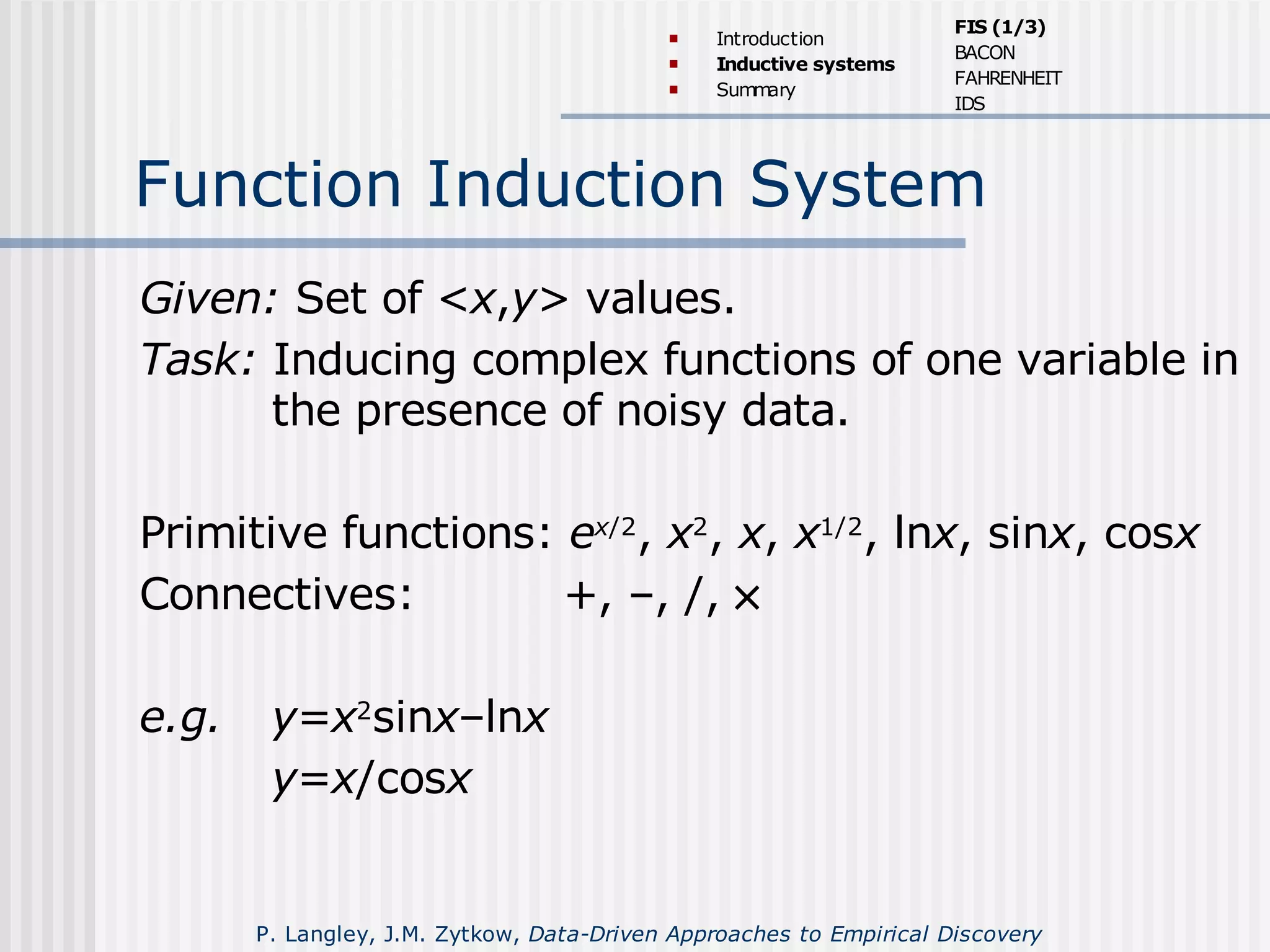
Function Induction System
Given: Set of <x,y> values.
Task: Inducing complex functions of one variable in
the presence of noisy data.
Primitive functions: ex/2
, x2
, x, x1/2
, lnx, sinx, cosx
Connectives: +, –, /, ×
e.g. y=x2
sinx–lnx
y=x/cosx
 Introduction
 Inductive systems
 Summary
FIS (1/3)
BACON
FAHRENHEIT
IDS
P. Langley, J.M. Zytkow, Data-Driven Approaches to Empirical Discovery
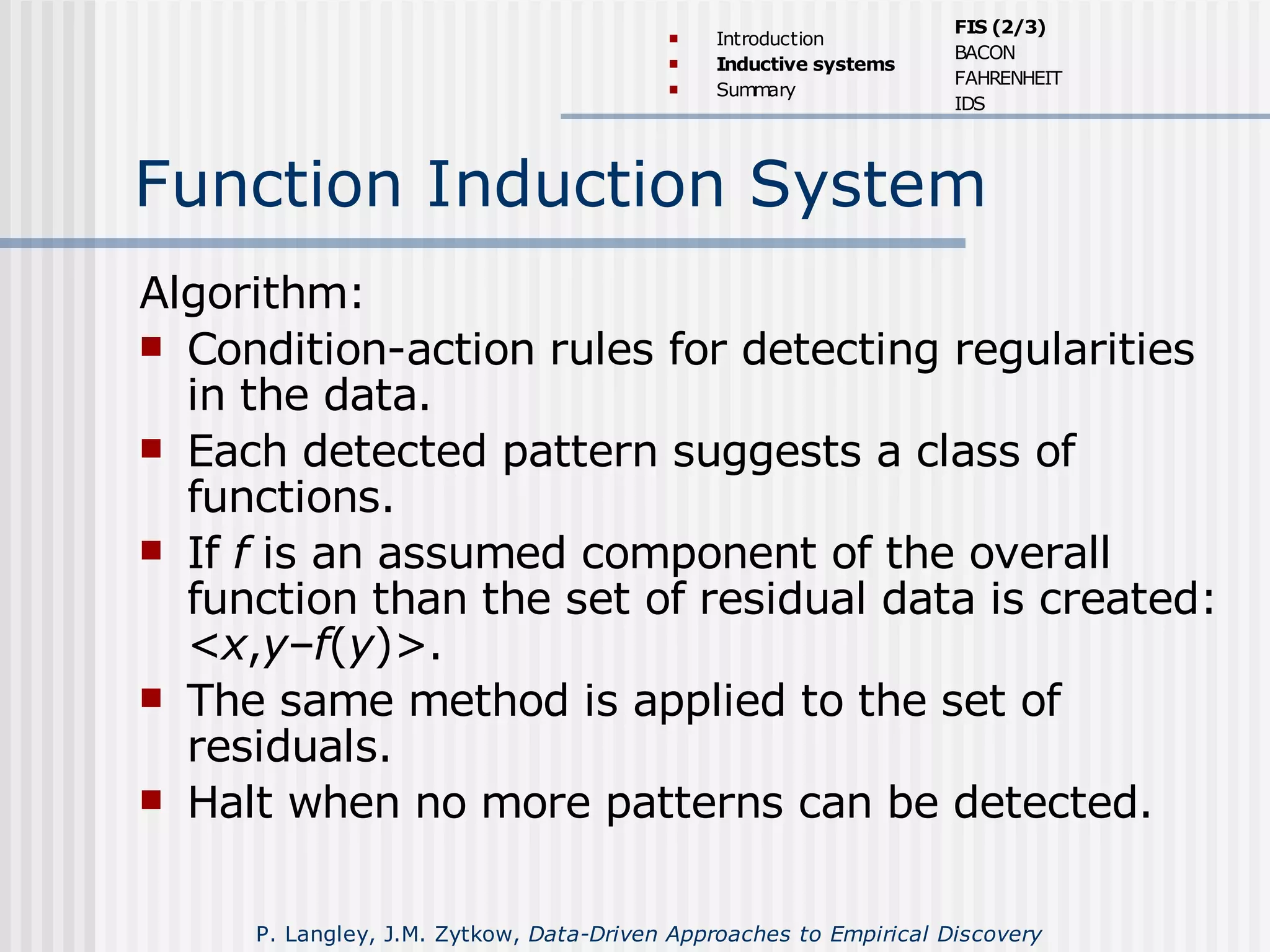
Function Induction System
Algorithm:
 Condition-action rules for detecting regularities
in the data.
 Each detected pattern suggests a class of
functions.
 If f is an assumed component of the overall
function than the set of residual data is created:
<x,y–f(y)>.
 The same method is applied to the set of
residuals.
 Halt when no more patterns can be detected.
 Introduction
 Inductive systems
 Summary
FIS (2/3)
BACON
FAHRENHEIT
IDS
P. Langley, J.M. Zytkow, Data-Driven Approaches to Empirical Discovery
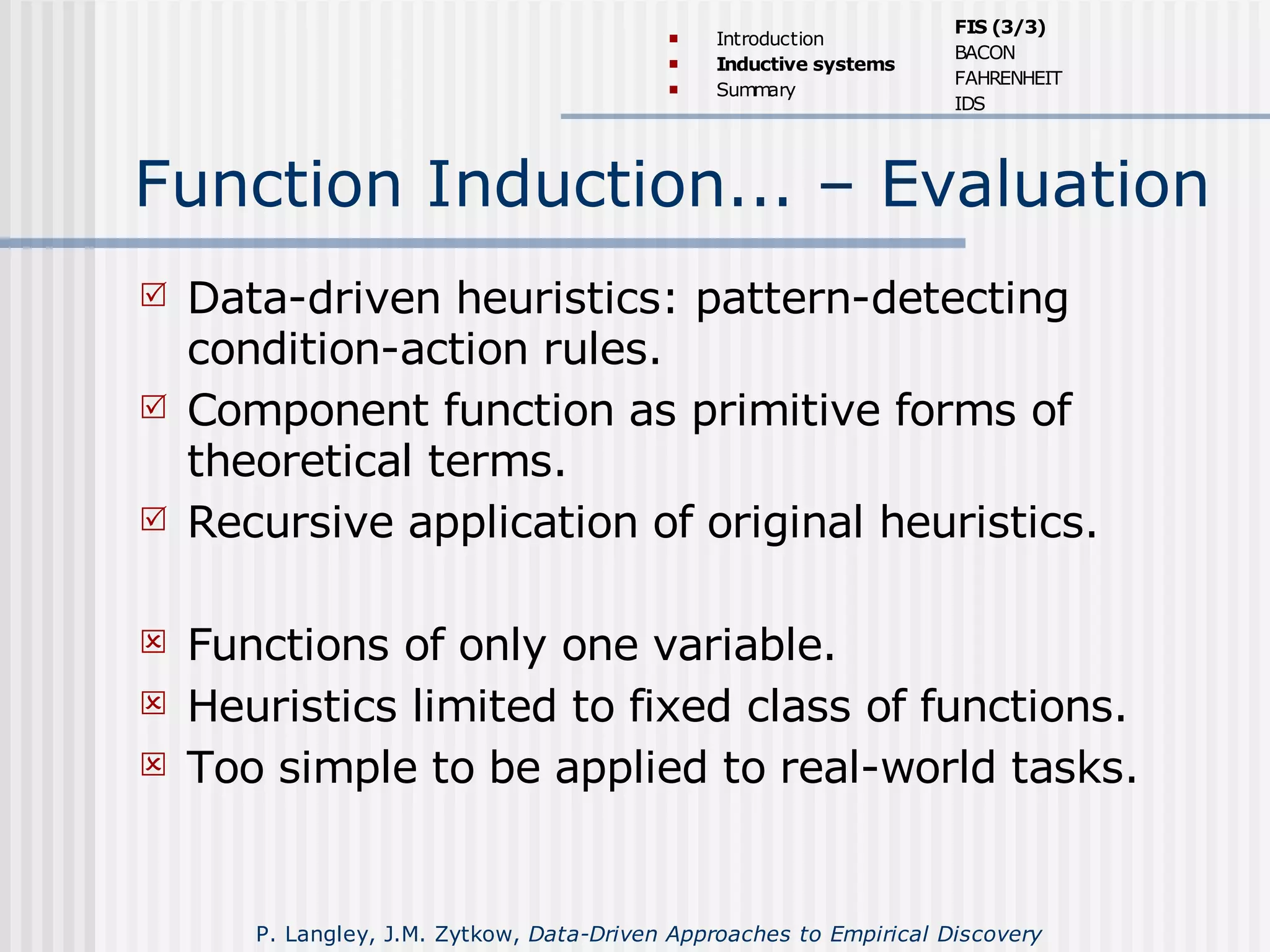
Function Induction... – Evaluation
 Data-driven heuristics: pattern-detecting
condition-action rules.
 Component function as primitive forms of
theoretical terms.
 Recursive application of original heuristics.
 Functions of only one variable.
 Heuristics limited to fixed class of functions.
 Too simple to be applied to real-world tasks.
 Introduction
 Inductive systems
 Summary
FIS (3/3)
BACON
FAHRENHEIT
IDS
P. Langley, J.M. Zytkow, Data-Driven Approaches to Empirical Discovery
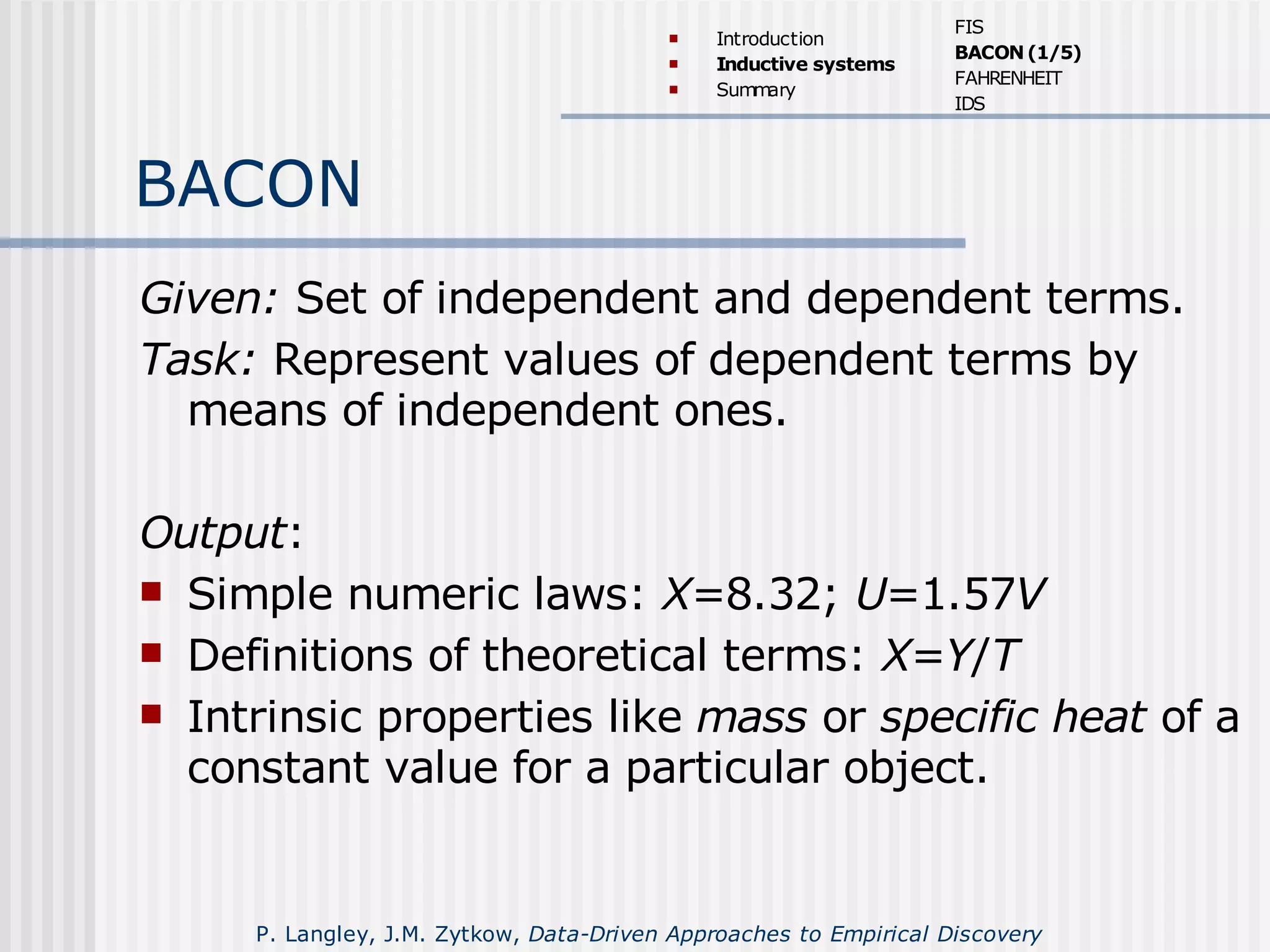
BACON
Given: Set of independent and dependent terms.
Task: Represent values of dependent terms by
means of independent ones.
Output:
 Simple numeric laws: X=8.32; U=1.57V
 Definitions of theoretical terms: X=Y/T
 Intrinsic properties like mass or specific heat of a
constant value for a particular object.
 Introduction
 Inductive systems
 Summary
FIS
BACON(1/5)
FAHRENHEIT
IDS
P. Langley, J.M. Zytkow, Data-Driven Approaches to Empirical Discovery
BACON
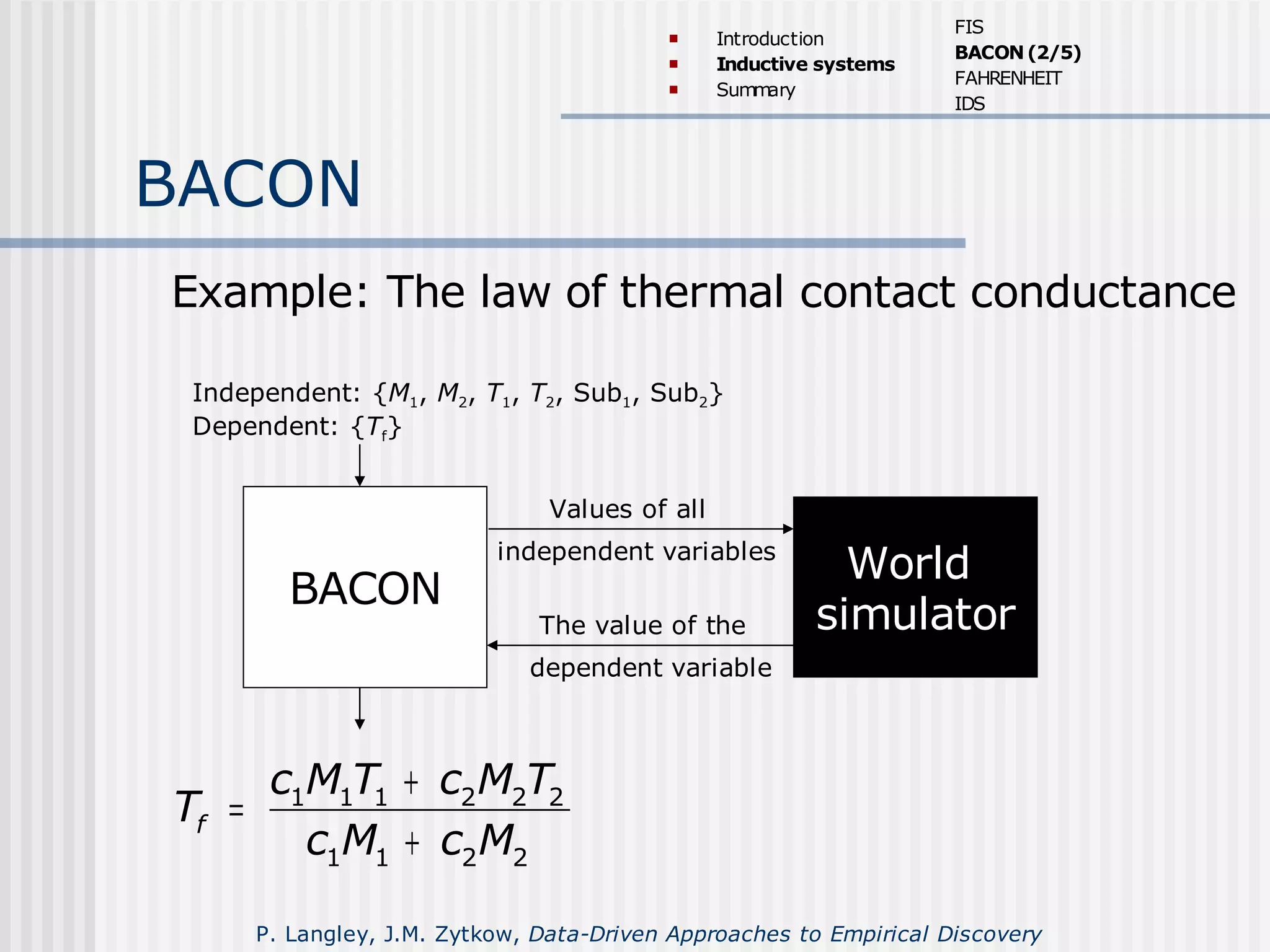
BACON
Example: The law of thermal contact conductance
World
simulator
Values of all
independent variables
The value of the
dependent variable
Independent: {M1, M2, T1, T2, Sub1, Sub2}
Dependent: {Tf}
1 1 1 2 2 2
1 1 2 2
f
c M T c M T
T
c M c M
+
=
+
 Introduction
 Inductive systems
 Summary
FIS
BACON(2/5)
FAHRENHEIT
IDS
P. Langley, J.M. Zytkow, Data-Driven Approaches to Empirical Discovery
BACON
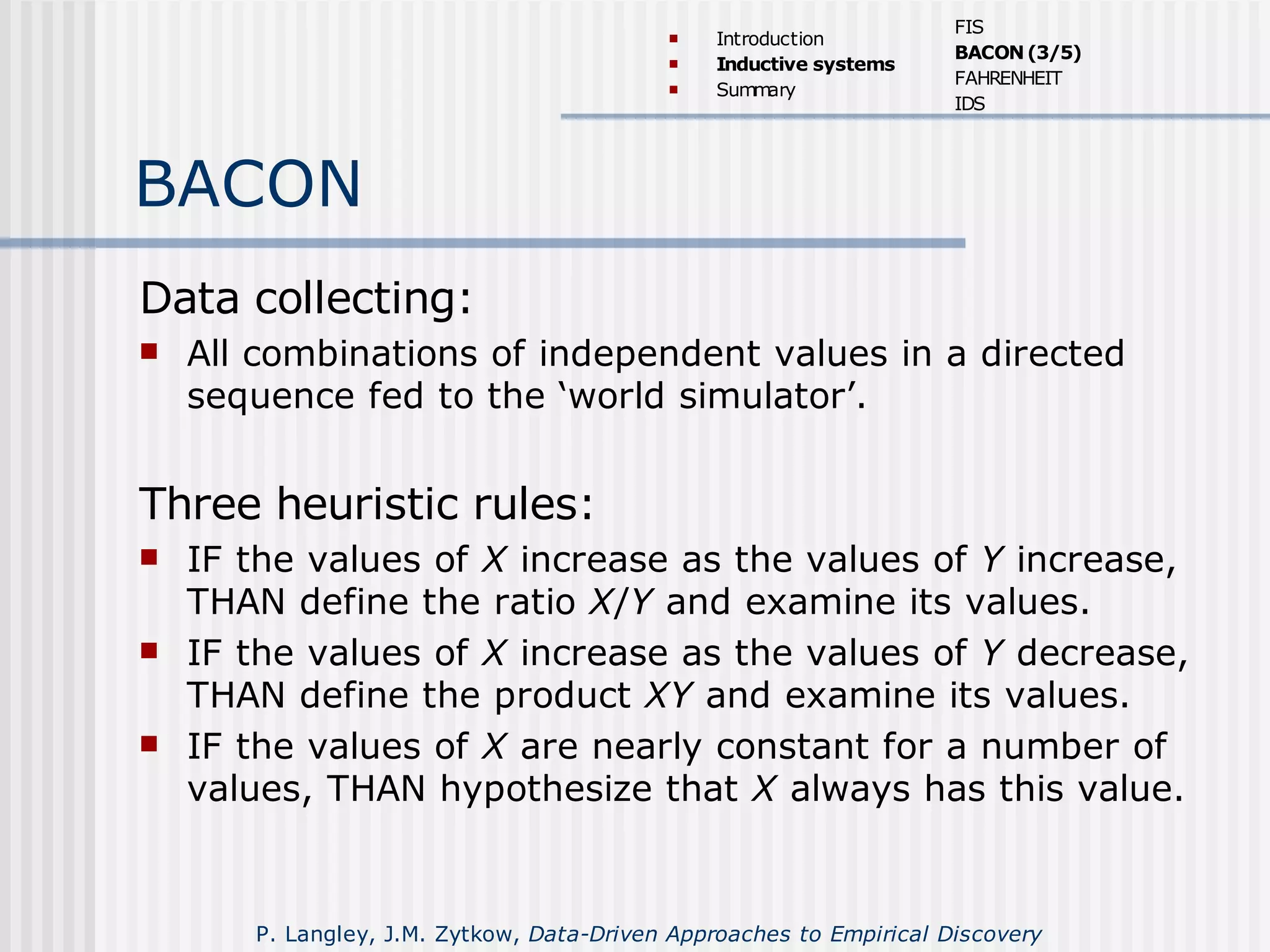
Data collecting:
 All combinations of independent values in a directed
sequence fed to the ‘world simulator’.
Three heuristic rules:
 IF the values of X increase as the values of Y increase,
THAN define the ratio X/Y and examine its values.
 IF the values of X increase as the values of Y decrease,
THAN define the product XY and examine its values.
 IF the values of X are nearly constant for a number of
values, THAN hypothesize that X always has this value.
 Introduction
 Inductive systems
 Summary
FIS
BACON(3/5)
FAHRENHEIT
IDS
P. Langley, J.M. Zytkow, Data-Driven Approaches to Empirical Discovery
BACON
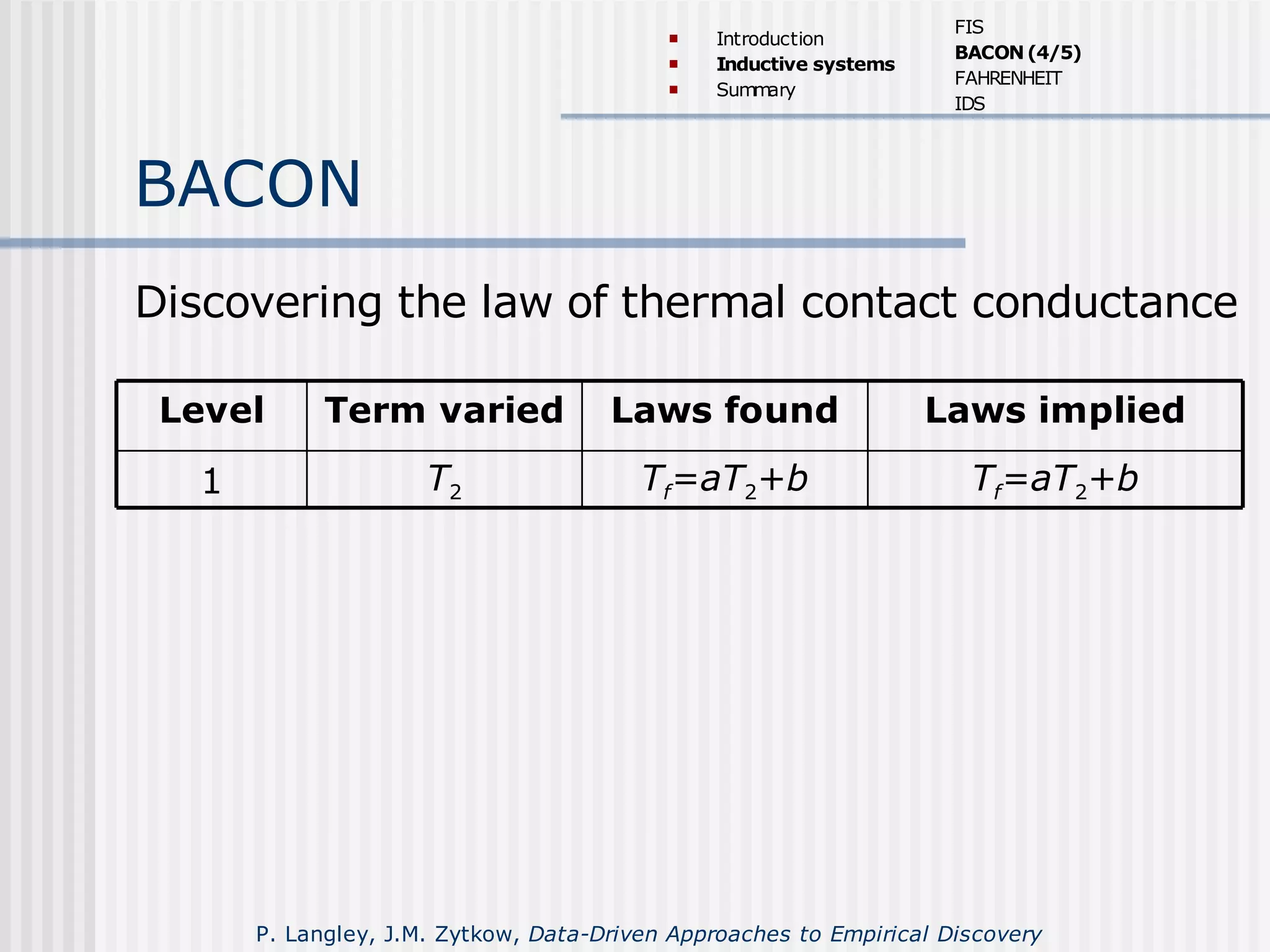
Tf=aT2+bTf=aT2+bT21
Laws impliedLaws foundTerm variedLevel
Discovering the law of thermal contact conductance
 Introduction
 Inductive systems
 Summary
FIS
BACON(4/5)
FAHRENHEIT
IDS
P. Langley, J.M. Zytkow, Data-Driven Approaches to Empirical Discovery
BACON
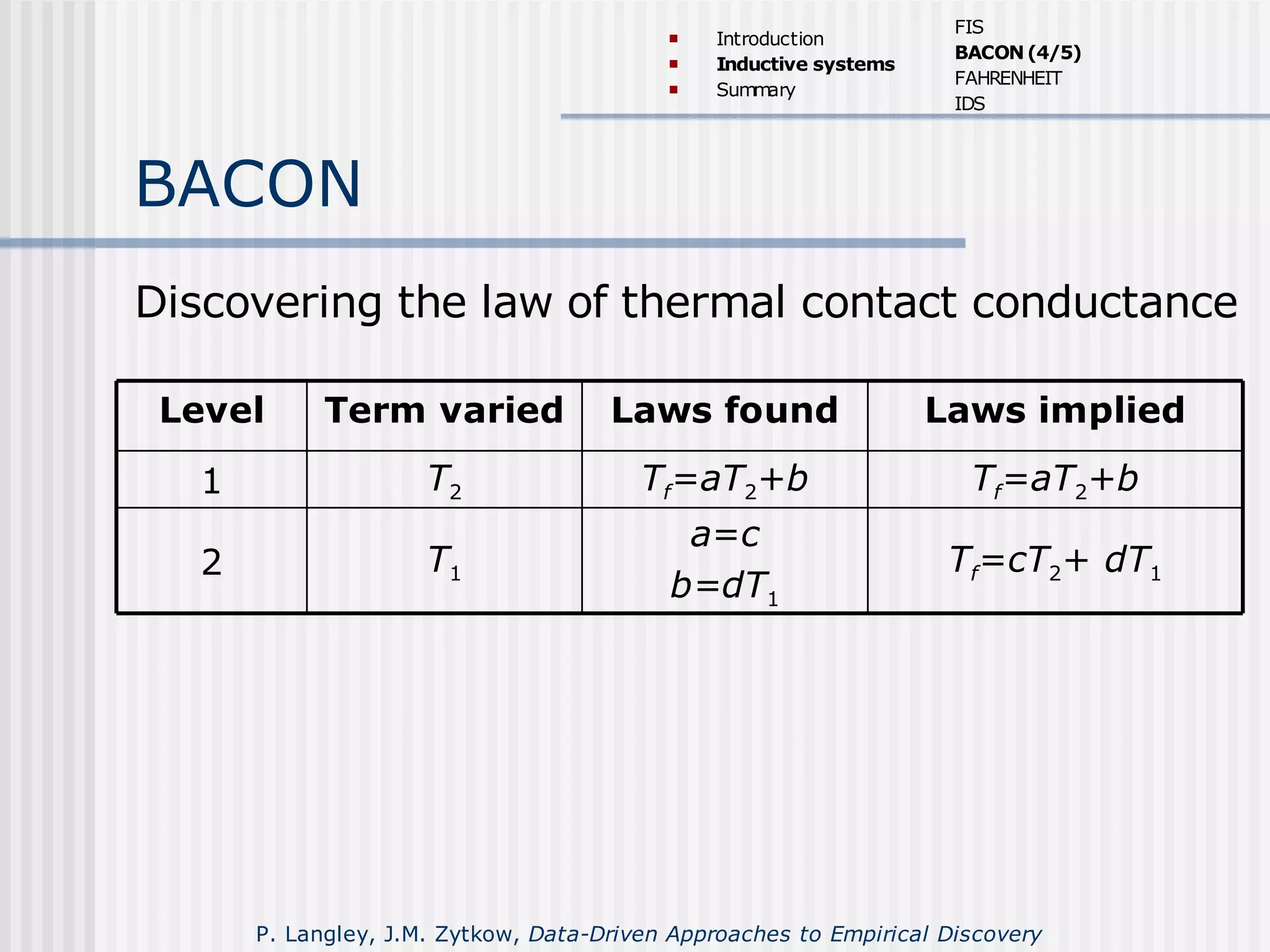
Tf=aT2+bTf=aT2+bT21
Tf=cT2+ dT1
a=c
b=dT1
T12
Laws impliedLaws foundTerm variedLevel
Discovering the law of thermal contact conductance
 Introduction
 Inductive systems
 Summary
FIS
BACON(4/5)
FAHRENHEIT
IDS
P. Langley, J.M. Zytkow, Data-Driven Approaches to Empirical Discovery
BACON
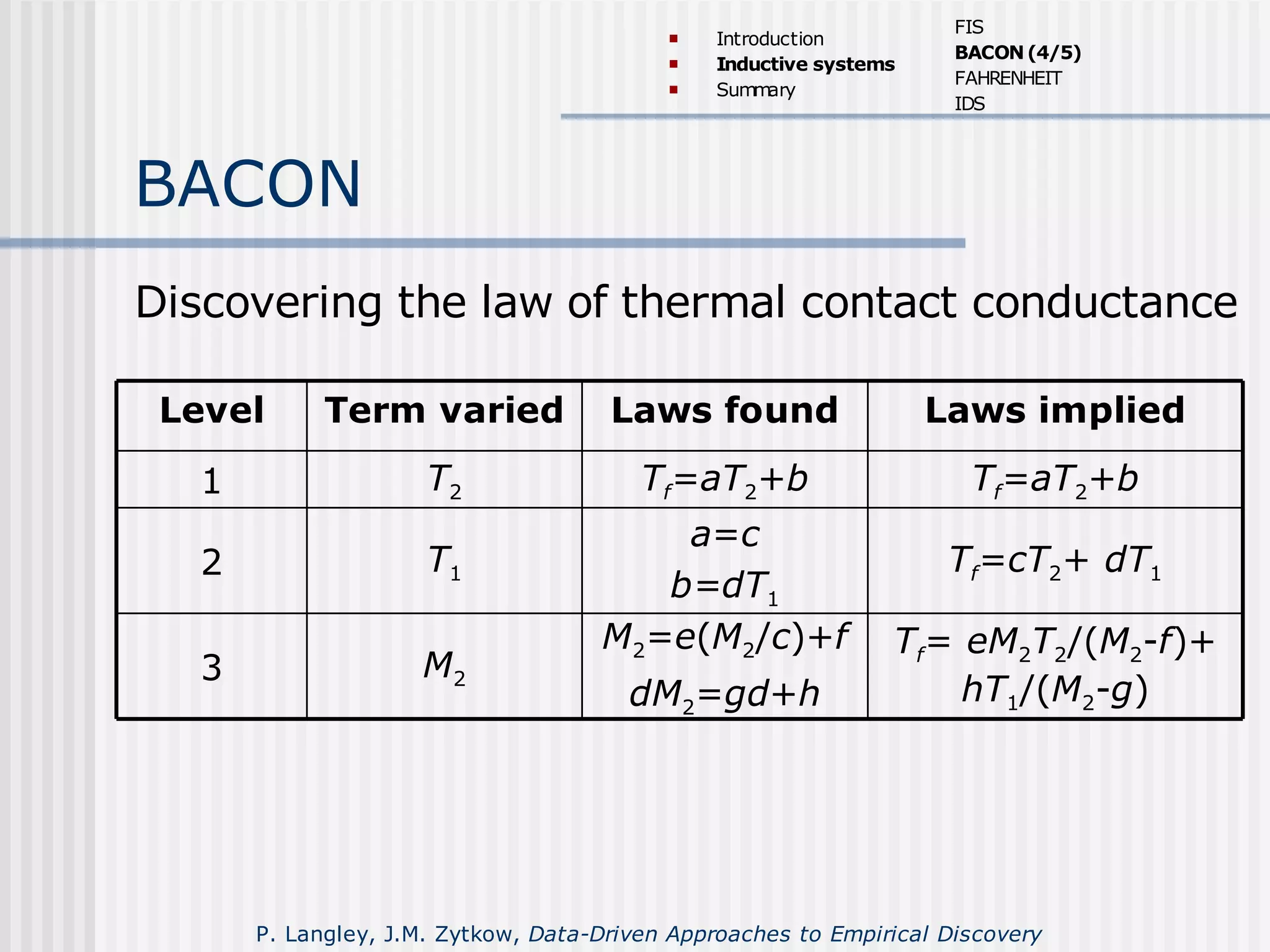
Tf=cT2+ dT1
a=c
b=dT1
T12
Tf=aT2+bTf=aT2+bT21
Tf= eM2T2/(M2-f)+
hT1/(M2-g)
M2=e(M2/c)+f
dM2=gd+h
M23
Laws impliedLaws foundTerm variedLevel
Discovering the law of thermal contact conductance
 Introduction
 Inductive systems
 Summary
FIS
BACON(4/5)
FAHRENHEIT
IDS
P. Langley, J.M. Zytkow, Data-Driven Approaches to Empirical Discovery
BACON
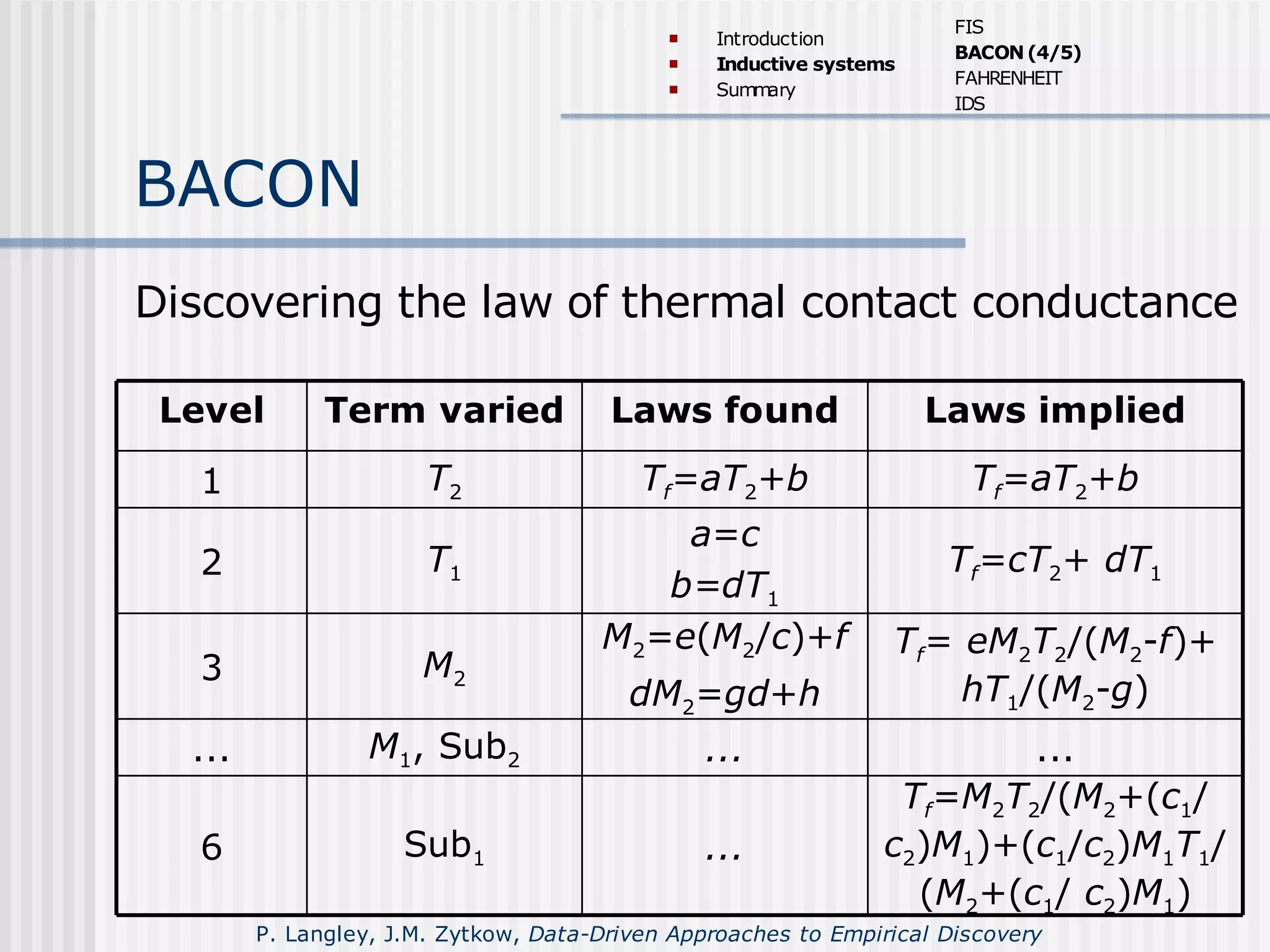
......M1, Sub2...
Tf= eM2T2/(M2-f)+
hT1/(M2-g)
M2=e(M2/c)+f
dM2=gd+h
M23
Tf=cT2+ dT1
a=c
b=dT1
T12
Tf=aT2+bTf=aT2+bT21
Tf=M2T2/(M2+(c1/
c2)M1)+(c1/c2)M1T1/
(M2+(c1/ c2)M1)
...Sub16
Laws impliedLaws foundTerm variedLevel
Discovering the law of thermal contact conductance
 Introduction
 Inductive systems
 Summary
FIS
BACON(4/5)
FAHRENHEIT
IDS
P. Langley, J.M. Zytkow, Data-Driven Approaches to Empirical Discovery
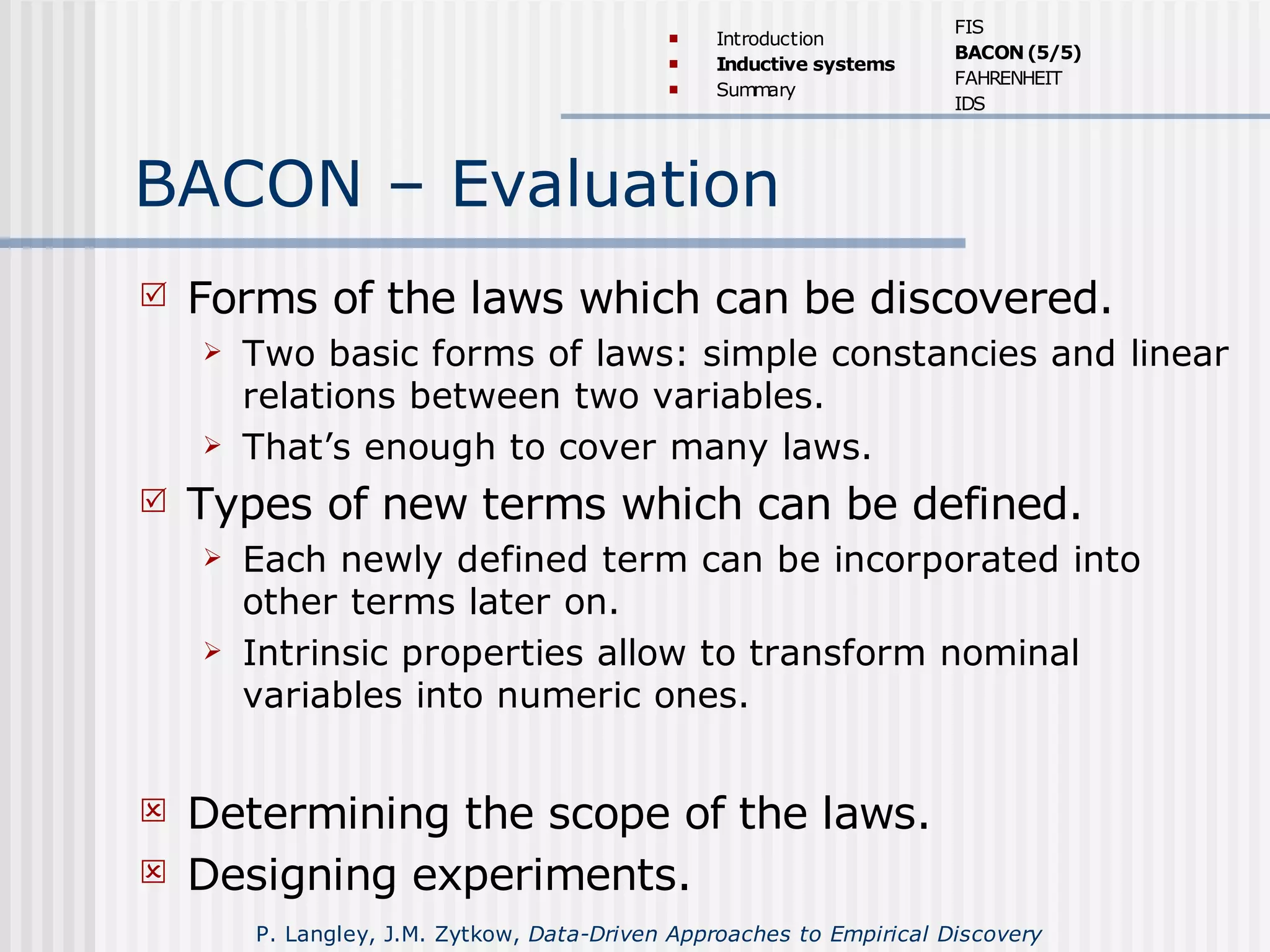
BACON – Evaluation
 Forms of the laws which can be discovered.
 Two basic forms of laws: simple constancies and linear
relations between two variables.
 That’s enough to cover many laws.
 Types of new terms which can be defined.
 Each newly defined term can be incorporated into
other terms later on.
 Intrinsic properties allow to transform nominal
variables into numeric ones.
 Determining the scope of the laws.
 Designing experiments.
 Introduction
 Inductive systems
 Summary
FIS
BACON(5/5)
FAHRENHEIT
IDS
P. Langley, J.M. Zytkow, Data-Driven Approaches to Empirical Discovery
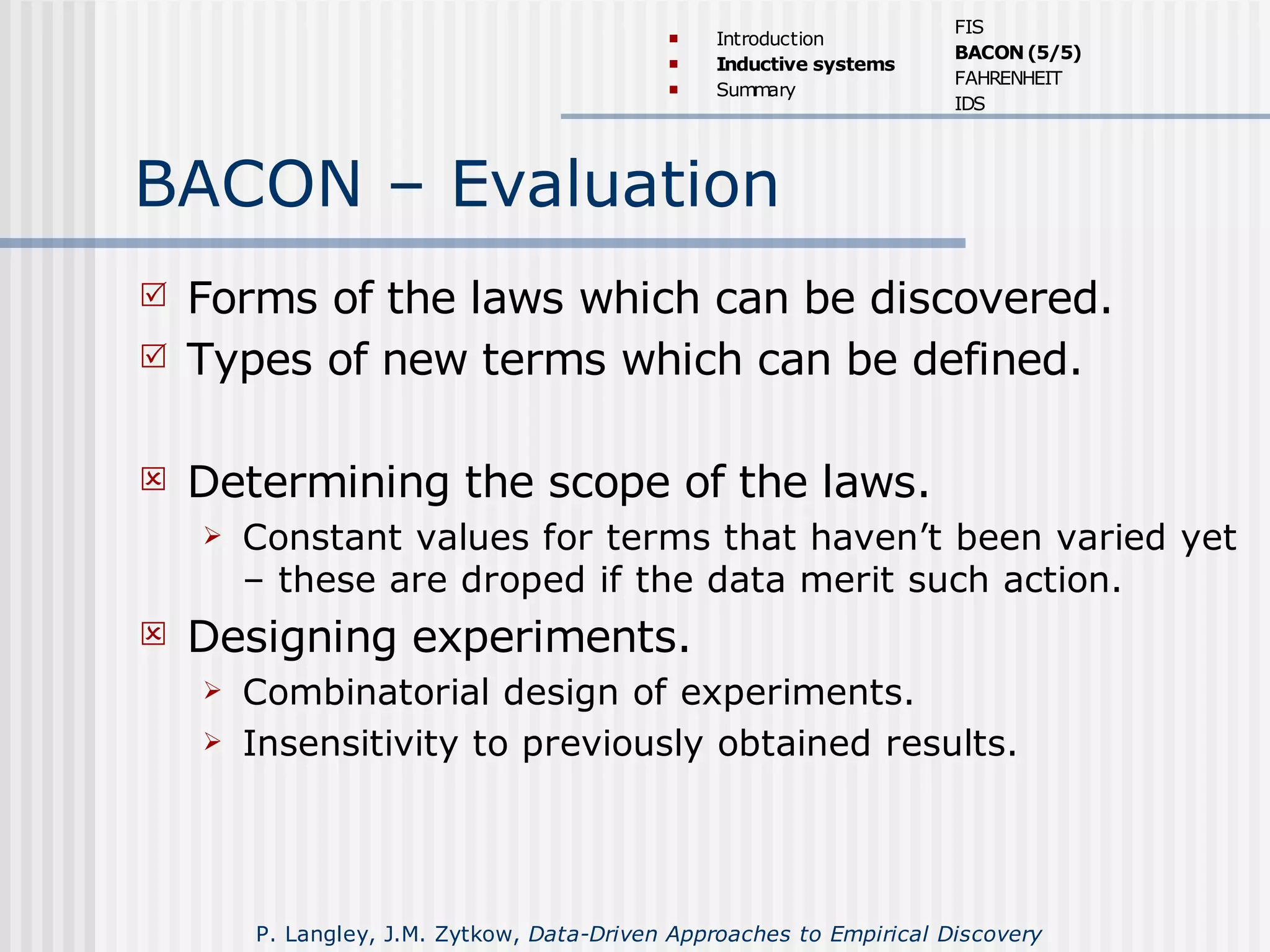
BACON – Evaluation
 Forms of the laws which can be discovered.
 Types of new terms which can be defined.
 Determining the scope of the laws.
 Constant values for terms that haven’t been varied yet
– these are droped if the data merit such action.
 Designing experiments.
 Combinatorial design of experiments.
 Insensitivity to previously obtained results.
 Introduction
 Inductive systems
 Summary
FIS
BACON(5/5)
FAHRENHEIT
IDS
P. Langley, J.M. Zytkow, Data-Driven Approaches to Empirical Discovery
FAHRENHEIT
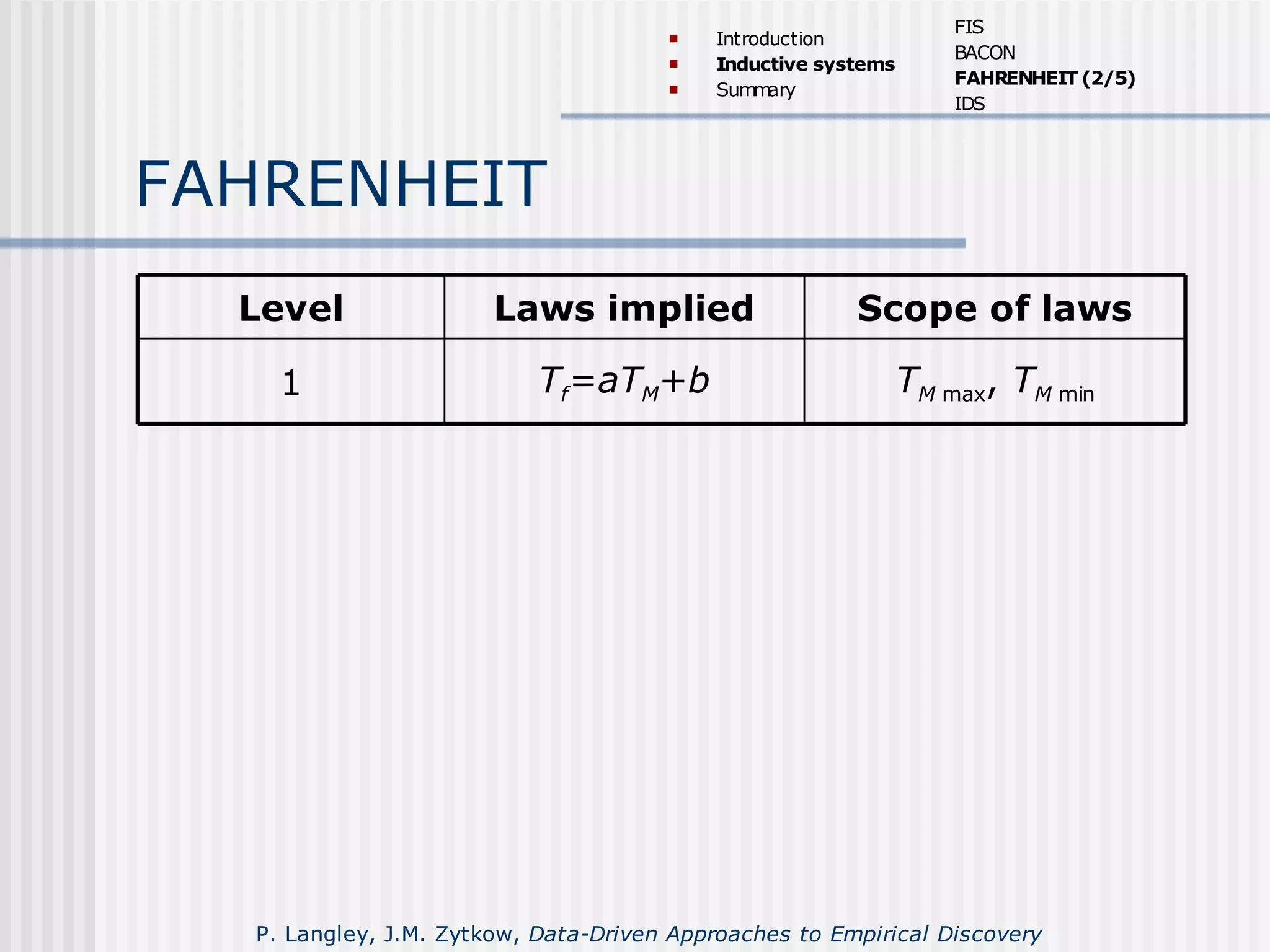
 The same heuristics for discovering laws as in
BACON.
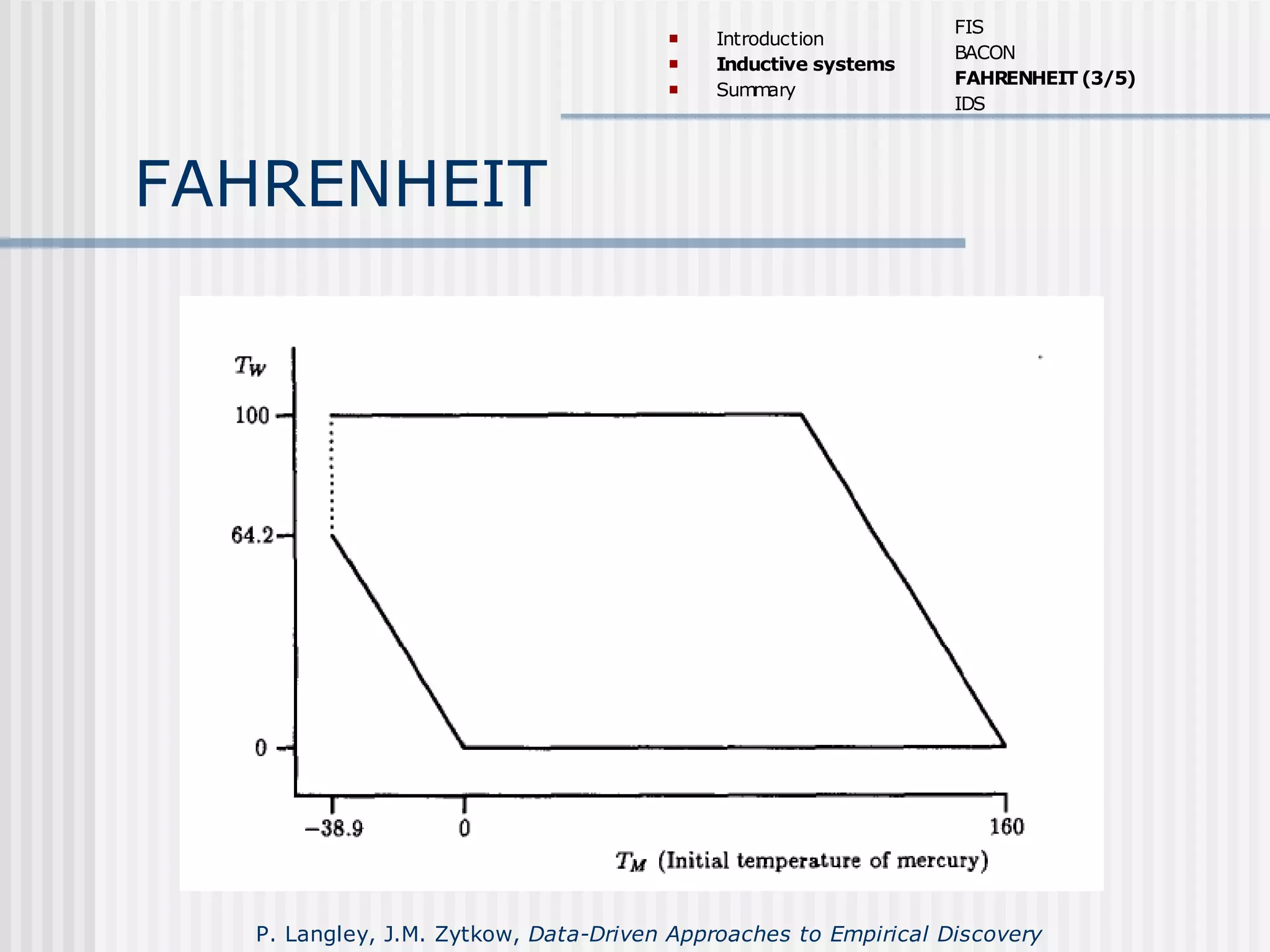
 Scope of derived laws defined by separate
numeric laws.
 Introduction
 Inductive systems
 Summary
FIS
BACON
FAHRENHEIT (1/5)
IDS
P. Langley, J.M. Zytkow, Data-Driven Approaches to Empirical Discovery
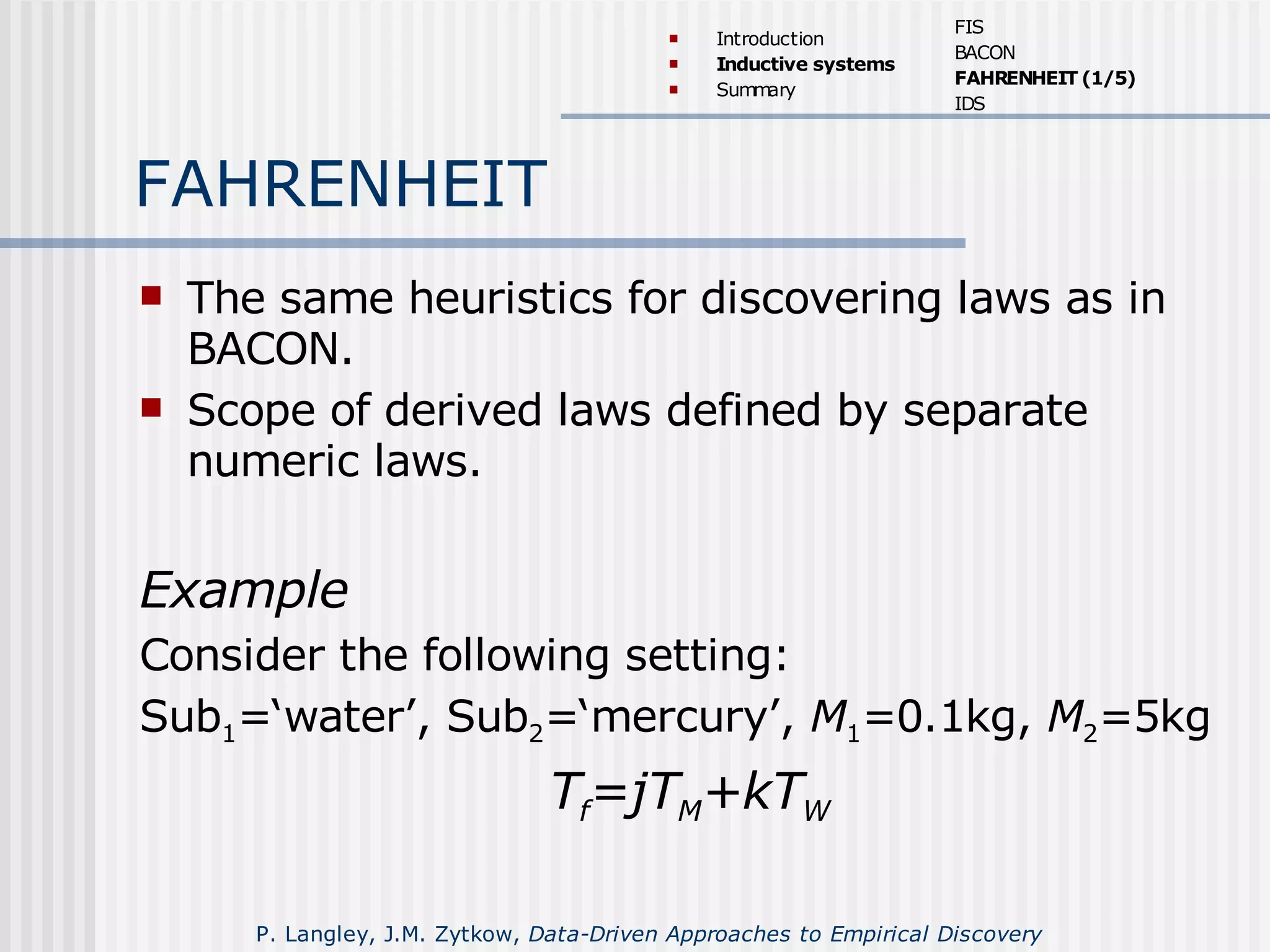
FAHRENHEIT
 The same heuristics for discovering laws as in
BACON.
 Scope of derived laws defined by separate
numeric laws.
Example
Consider the following setting:
Sub1=‘water’, Sub2=‘mercury’, M1=0.1kg, M2=5kg
Tf=jTM+kTW
 Introduction
 Inductive systems
 Summary
FIS
BACON
FAHRENHEIT (1/5)
IDS
P. Langley, J.M. Zytkow, Data-Driven Approaches to Empirical Discovery
FAHRENHEIT
TM max, TM minTf=aTM+b1
Scope of lawsLaws impliedLevel
 Introduction
 Inductive systems
 Summary
FIS
BACON
FAHRENHEIT (2/5)
IDS
P. Langley, J.M. Zytkow, Data-Driven Approaches to Empirical Discovery
FAHRENHEIT
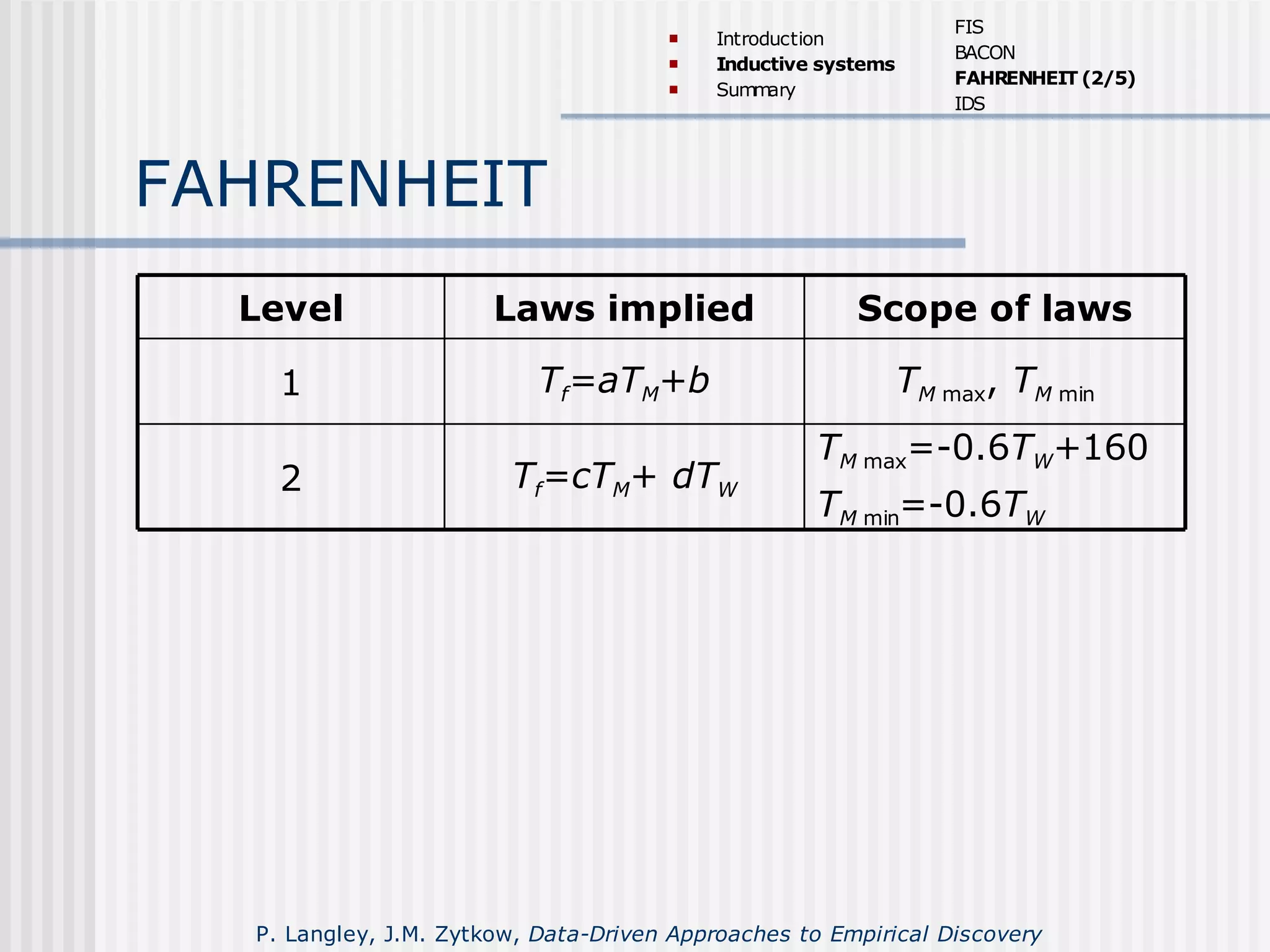
TM max=-0.6TW+160
TM min=-0.6TW
Tf=cTM+ dTW2
TM max, TM minTf=aTM+b1
Scope of lawsLaws impliedLevel
 Introduction
 Inductive systems
 Summary
FIS
BACON
FAHRENHEIT (2/5)
IDS
P. Langley, J.M. Zytkow, Data-Driven Approaches to Empirical Discovery
FAHRENHEIT
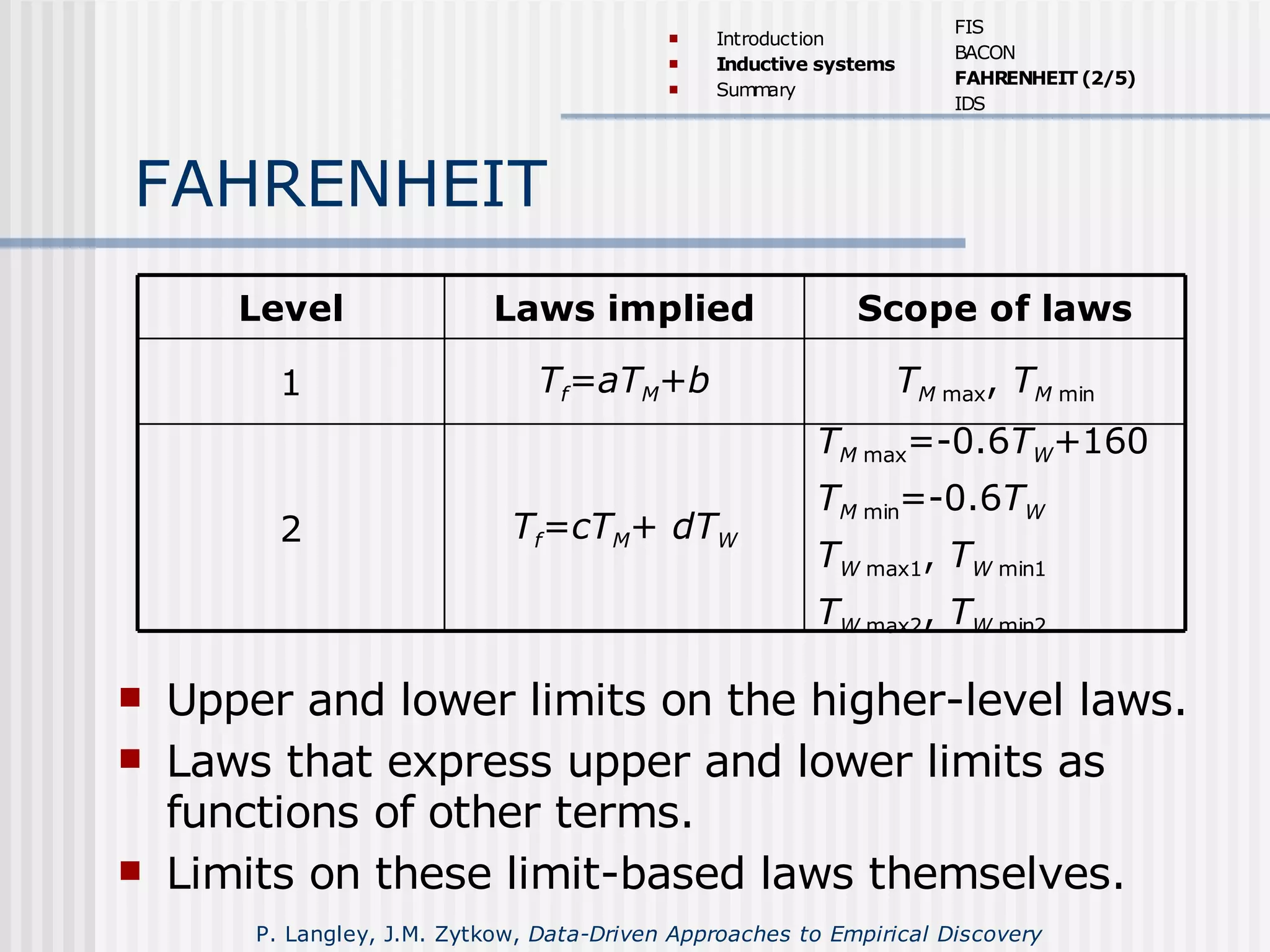
TM max=-0.6TW+160
TM min=-0.6TW
TW max1, TW min1
TW max2, TW min2
Tf=cTM+ dTW2
TM max, TM minTf=aTM+b1
Scope of lawsLaws impliedLevel
 Upper and lower limits on the higher-level laws.
 Laws that express upper and lower limits as
functions of other terms.
 Limits on these limit-based laws themselves.
 Introduction
 Inductive systems
 Summary
FIS
BACON
FAHRENHEIT (2/5)
IDS
P. Langley, J.M. Zytkow, Data-Driven Approaches to Empirical Discovery
FAHRENHEIT
 Introduction
 Inductive systems
 Summary
FIS
BACON
FAHRENHEIT (3/5)
IDS
P. Langley, J.M. Zytkow, Data-Driven Approaches to Empirical Discovery
FAHRENHEIT
Other interesting features:
 Good handling of the irrelevant attributes in the
experiment design.
 Attributes once discovered to be irrelevant are skipped
in further experiments.
 Robust to the order of varying variables.
 Backtracking and experimenting with alternative
orders of variables in case of failure.
 Introduction
 Inductive systems
 Summary
FIS
BACON
FAHRENHEIT (4/5)
IDS
P. Langley, J.M. Zytkow, Data-Driven Approaches to Empirical Discovery
FAHRENHEIT – Evaluation
 Providing numeric context for validity of laws.
 More intelligent data gathering.
 More sophisticated heuristics.
 Ignores the qualitative structure of phenomena
being described.
 Introduction
 Inductive systems
 Summary
FIS
BACON
FAHRENHEIT (5/5)
IDS
P. Langley, J.M. Zytkow, Data-Driven Approaches to Empirical Discovery
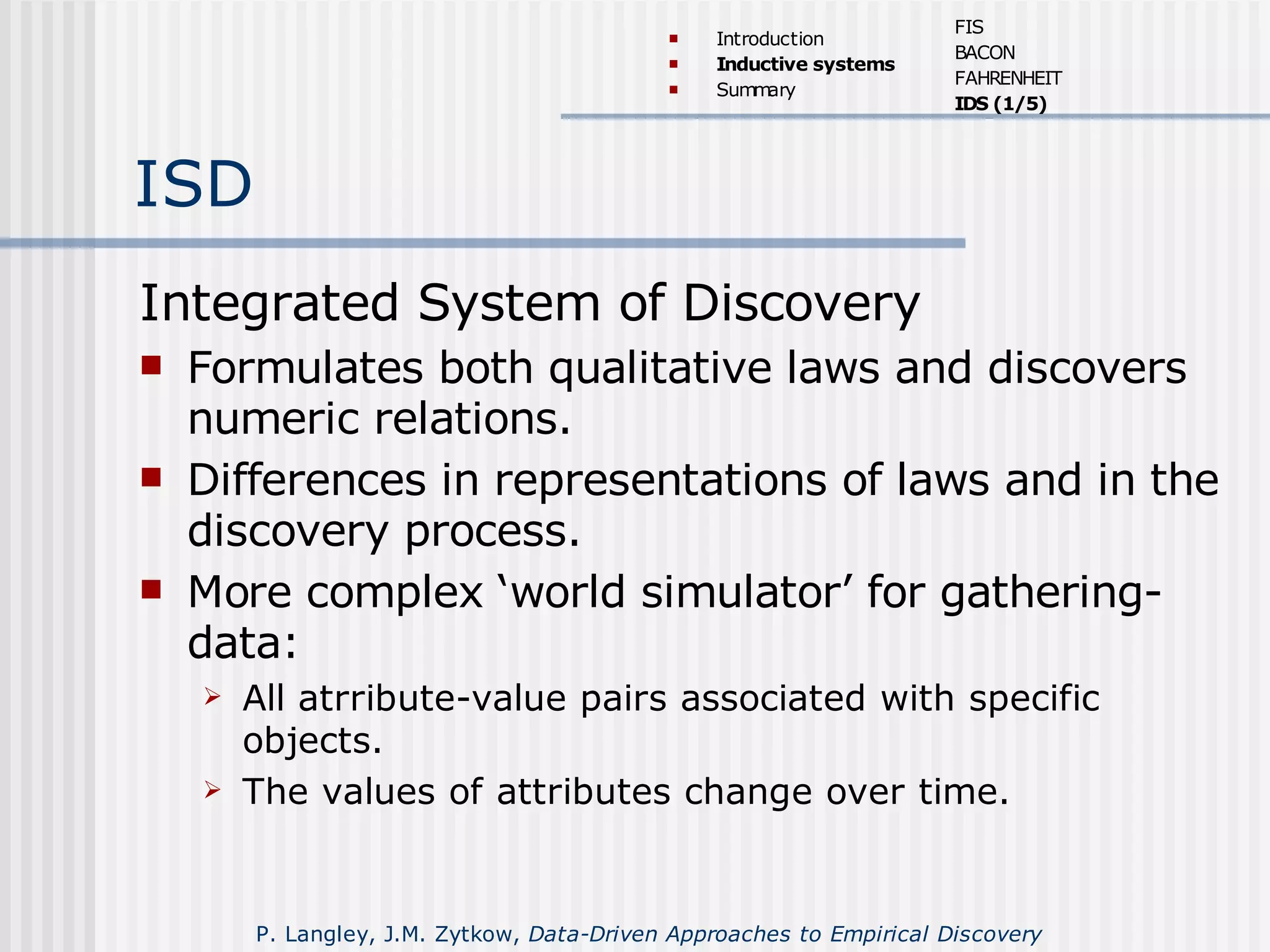
ISD
Integrated System of Discovery
 Formulates both qualitative laws and discovers
numeric relations.
 Differences in representations of laws and in the
discovery process.
 More complex ‘world simulator’ for gathering-
data:
 All atrribute-value pairs associated with specific
objects.
 The values of attributes change over time.
 Introduction
 Inductive systems
 Summary
FIS
BACON
FAHRENHEIT
IDS (1/5)
P. Langley, J.M. Zytkow, Data-Driven Approaches to Empirical Discovery
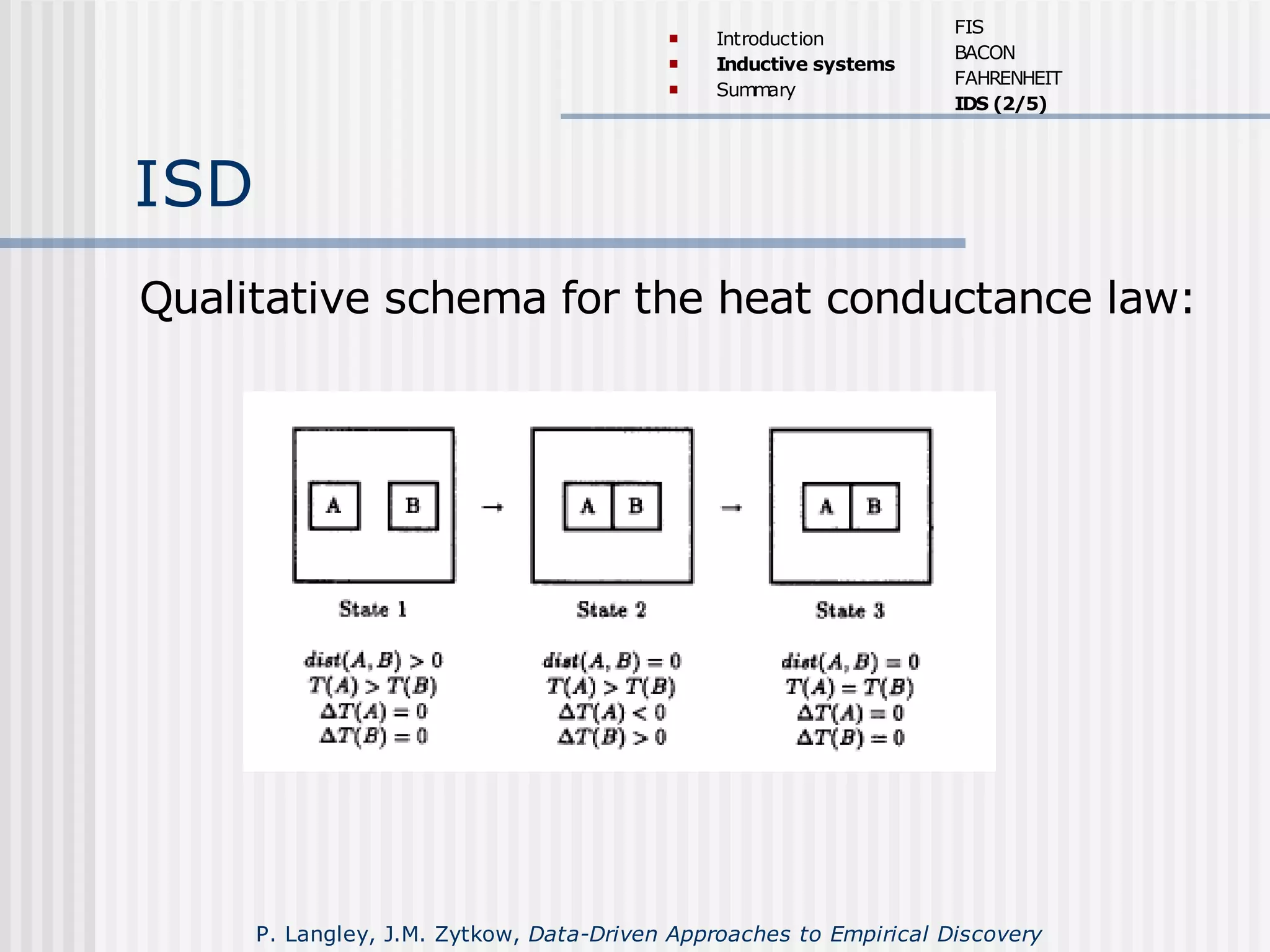
ISD
Qualitative schema for the heat conductance law:
 Introduction
 Inductive systems
 Summary
FIS
BACON
FAHRENHEIT
IDS (2/5)
P. Langley, J.M. Zytkow, Data-Driven Approaches to Empirical Discovery
ISD
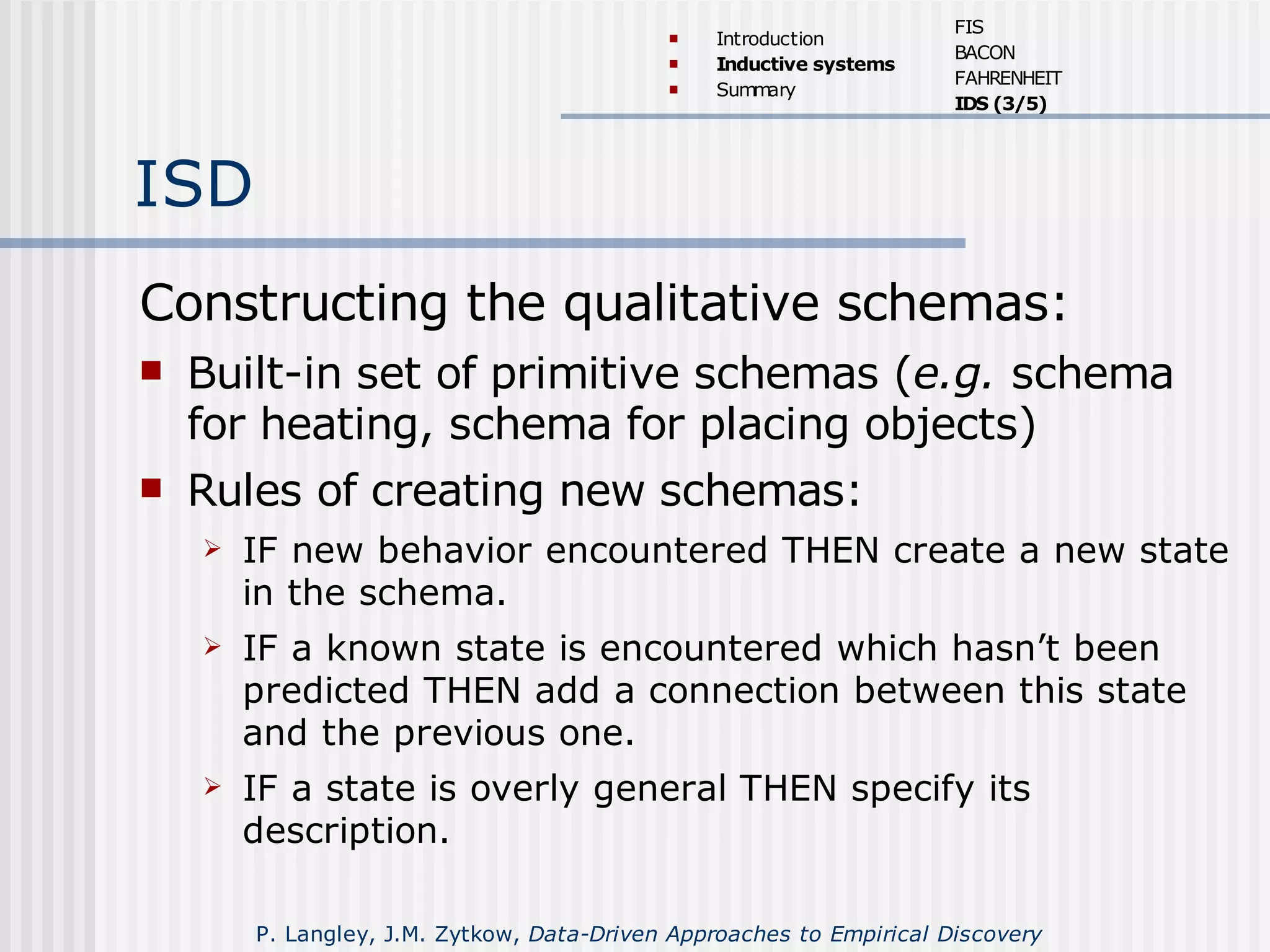
Constructing the qualitative schemas:
 Built-in set of primitive schemas (e.g. schema
for heating, schema for placing objects)
 Rules of creating new schemas:
 IF new behavior encountered THEN create a new state
in the schema.
 IF a known state is encountered which hasn’t been
predicted THEN add a connection between this state
and the previous one.
 IF a state is overly general THEN specify its
description.
 Introduction
 Inductive systems
 Summary
FIS
BACON
FAHRENHEIT
IDS (3/5)
P. Langley, J.M. Zytkow, Data-Driven Approaches to Empirical Discovery
ISD
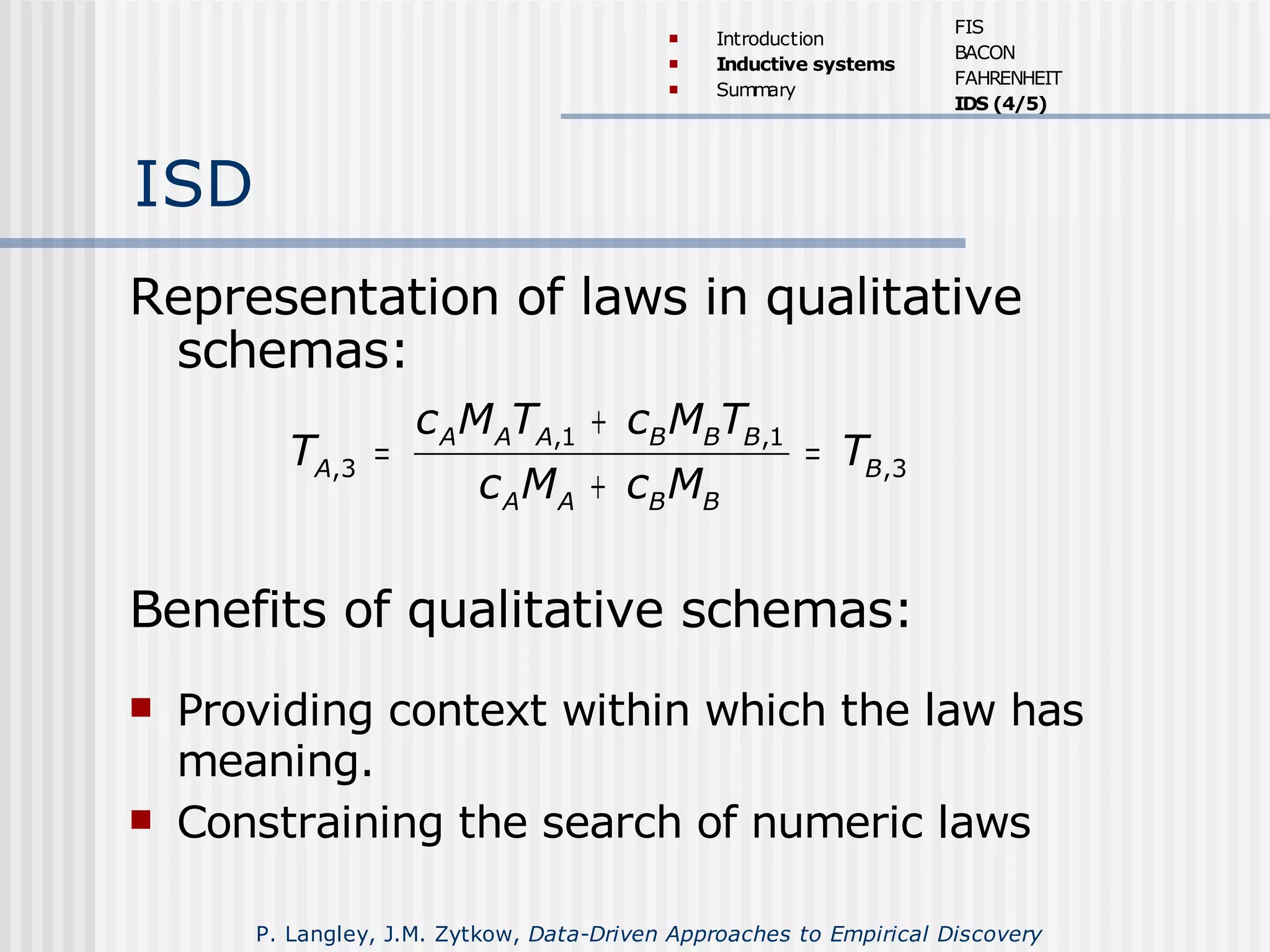
Representation of laws in qualitative
schemas:
,1 ,1
,3 ,3
A A A B B B
A B
A A B B
c M T c M T
T T
c M c M
+
= =
+
Benefits of qualitative schemas:
 Providing context within which the law has
meaning.
 Constraining the search of numeric laws
 Introduction
 Inductive systems
 Summary
FIS
BACON
FAHRENHEIT
IDS (4/5)
P. Langley, J.M. Zytkow, Data-Driven Approaches to Empirical Discovery
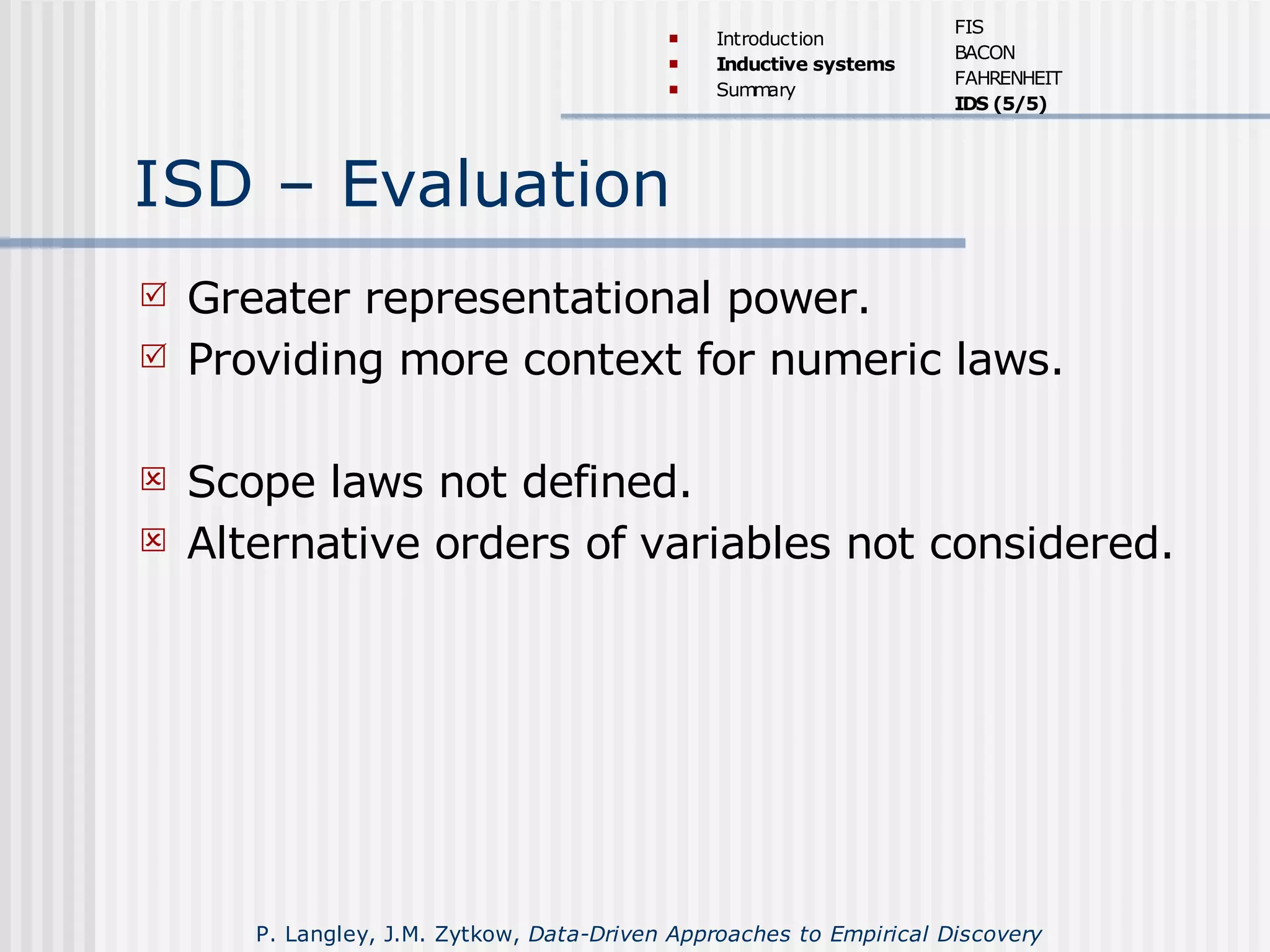
ISD – Evaluation
 Greater representational power.
 Providing more context for numeric laws.
 Scope laws not defined.
 Alternative orders of variables not considered.
 Introduction
 Inductive systems
 Summary
FIS
BACON
FAHRENHEIT
IDS (5/5)
P. Langley, J.M. Zytkow, Data-Driven Approaches to Empirical Discovery
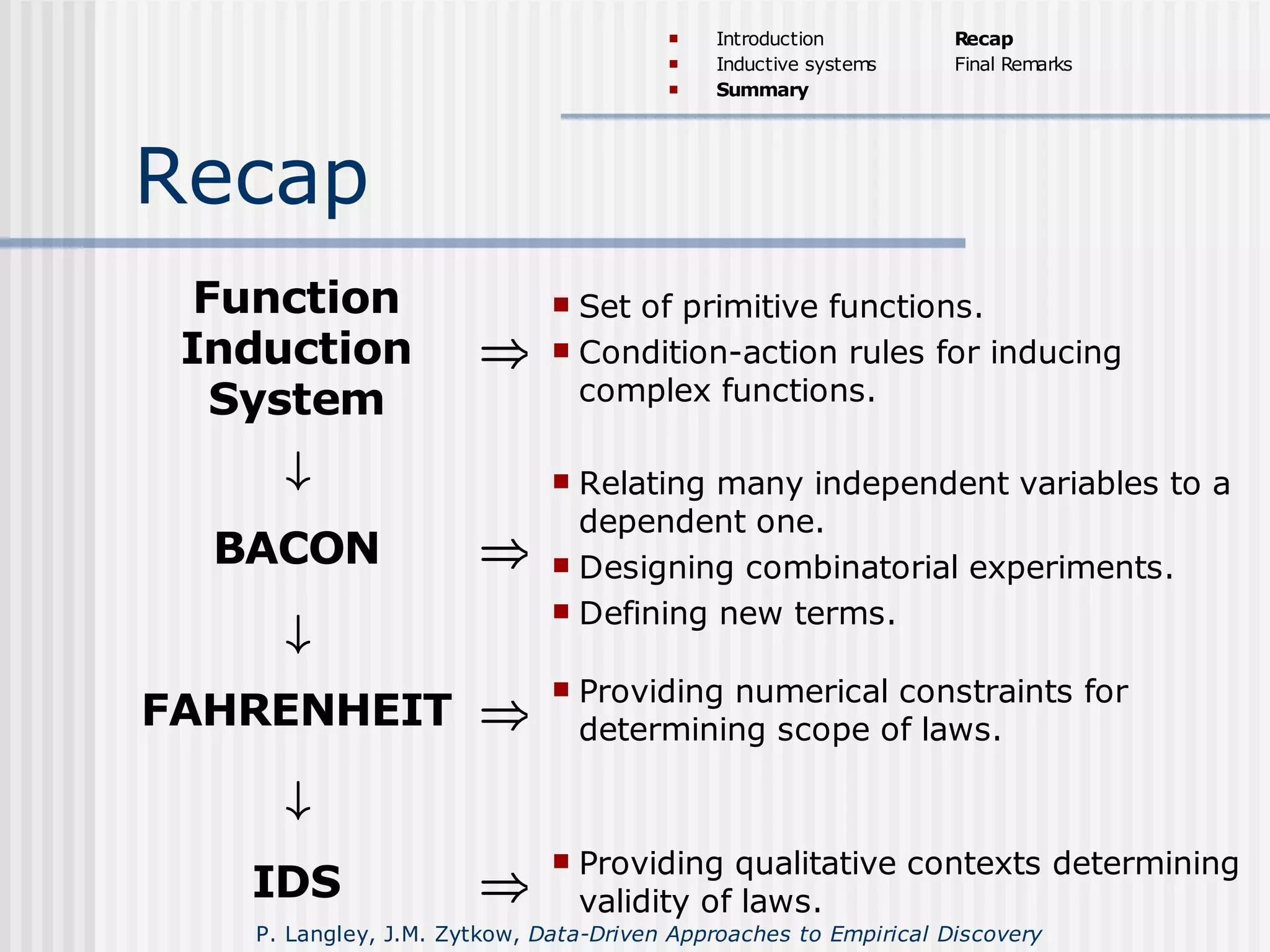
Recap
 Providing qualitative contexts determining
validity of laws.IDS

 Providing numerical constraints for
determining scope of laws.FAHRENHEIT

 Relating many independent variables to a
dependent one.
 Designing combinatorial experiments.
 Defining new terms.
BACON

 Set of primitive functions.
 Condition-action rules for inducing
complex functions.

Function
Induction
System
 Introduction
 Inductive systems
 Summary
Recap
Final Remarks
P. Langley, J.M. Zytkow, Data-Driven Approaches to Empirical Discovery
Further Philosophical Issues
 Machine discovery systems may provide
computational models of the historical discovery
process.
 They may also provide normative standards to
direct the process of scientific discovery.
 When is a machine discovery system successful?
 When it can rediscover many known laws?
 When it can replay the evolution of some discoveries?
 When it can derive new, useful laws?
 Introduction
 Inductive systems
 Summary
Recap
Final Remarks
P. Langley, J.M. Zytkow, Data-Driven Approaches to Empirical Discovery

Data driven approaches to empirical discovery

  • 1.
    Data-Driven Approaches to EmpiricalDiscovery Pat Langley Jan M. Zytkow Szymon Klarman sklarman@science.uva.nl December 6, 2006
  • 2.
    Outline  Introduction  BasicFramework  Logic of Scientific Discovery  Inductive Systems  Function Induction System  BACON  FAHRENHEIT  IDS  Summary  Recap  Final remarks P. Langley, J.M. Zytkow, Data-Driven Approaches to Empirical Discovery
  • 3.
    Empirical Discovery Discovery asunsupervised learning  Conceptual clustering  Induction of descriptive regularities  Providing good explanations  Introduction  Inductive systems  Summary Basic Framework Logic of Scientific Discovery P. Langley, J.M. Zytkow, Data-Driven Approaches to Empirical Discovery
  • 4.
    Empirical Discovery Discovery asunsupervised learning  Conceptual clustering  Induction of descriptive regularities  Providing good explanations Given: A set of observations or data. Task: Find one or more general laws that summarize these data.  Introduction  Inductive systems  Summary Basic Framework Logic of Scientific Discovery P. Langley, J.M. Zytkow, Data-Driven Approaches to Empirical Discovery
  • 5.
    Machine Discovery Features ofmachine discovery systems:  Defining theoretical terms e.g. momentum as a product of mass and velocity P. Langley, J.M. Zytkow, Data-Driven Approaches to Empirical Discovery  Introduction  Inductive systems  Summary Basic Framework Logic of Scientific Discovery
  • 6.
    Machine Discovery Features ofmachine discovery systems:  Defining theoretical terms  Data-driven heuristics  proposing laws  defining new terms  determining scope of laws  Introduction  Inductive systems  Summary Basic Framework Logic of Scientific Discovery P. Langley, J.M. Zytkow, Data-Driven Approaches to Empirical Discovery
  • 7.
    Machine Discovery Features ofmachine discovery systems:  Defining theoretical terms  Data-driven heuristics  Recursive application of used methods  Introduction  Inductive systems  Summary Basic Framework Logic of Scientific Discovery P. Langley, J.M. Zytkow, Data-Driven Approaches to Empirical Discovery
  • 8.
    Logic of ScientificDiscovery  Are there any rules directing the process of scientific discovery?  Can we find and formalize them?  Introduction  Inductive systems  Summary Basic Framework Logic of Scientific Discovery P. Langley, J.M. Zytkow, Data-Driven Approaches to Empirical Discovery
  • 9.
    Inductive Machine...? The questionwhether an inductive logic with exact rules is at all possible is still controversial. But in one point the present opinions of most philosophers and scientists seem to agree, namely, that the inductive procedure is not, so to speak, a mechanical procedure prescribed by fixed rules. [...] it is not possible to construct an inductive machine [...], meant as a mechanical contrivance that, when fed an observational report, would furnish a suitable hypothesis, just as a computing machine when supplied with two factors furnishes their product. I am completely in agreement that an inductive machine of this kind is not possible. R. Carnap, Logical Foundations of Probability (1950)  Introduction  Inductive systems  Summary Basic Framework Logic of Scientific Discovery P. Langley, J.M. Zytkow, Data-Driven Approaches to Empirical Discovery
  • 10.
    Inductive Machine...? Induction issometimes conceived as a method that leads, by means of mechanically applicable rules, from observed facts to corresponding general principles. In this case, the rules of inductive inference would provide effective canons of scientific discovery; [...] Actually, however, no such general and mechanical induction procedure is available at present; [...]. Nor can the discovery of such a procedure ever be expected. C.G. Hempel, Philosophy of Natural Science (1966)  Introduction  Inductive systems  Summary Basic Framework Logic of Scientific Discovery P. Langley, J.M. Zytkow, Data-Driven Approaches to Empirical Discovery
  • 11.
    Inductive Systems  FunctionInduction System (1974)  BACON (1978)  FAHRENHEIT (1986)  IDS (1986)  Introduction  Inductive systems  Summary FIS BACON FAHRENHEIT IDS P. Langley, J.M. Zytkow, Data-Driven Approaches to Empirical Discovery
  • 12.
    Inductive Systems  FunctionInduction System (1974)  BACON (1978)  FAHRENHEIT (1986)  IDS (1986)  Form of laws and theoretical terms discovered.  Ability to determine the scope and context of laws.  Ability to design experiments.  Introduction  Inductive systems  Summary FIS BACON FAHRENHEIT IDS P. Langley, J.M. Zytkow, Data-Driven Approaches to Empirical Discovery
  • 13.
    Function Induction System Given:Set of <x,y> values. Task: Inducing complex functions of one variable in the presence of noisy data. Primitive functions: ex/2 , x2 , x, x1/2 , lnx, sinx, cosx Connectives: +, –, /, × e.g. y=x2 sinx–lnx y=x/cosx  Introduction  Inductive systems  Summary FIS (1/3) BACON FAHRENHEIT IDS P. Langley, J.M. Zytkow, Data-Driven Approaches to Empirical Discovery
  • 14.
    Function Induction System Algorithm: Condition-action rules for detecting regularities in the data.  Each detected pattern suggests a class of functions.  If f is an assumed component of the overall function than the set of residual data is created: <x,y–f(y)>.  The same method is applied to the set of residuals.  Halt when no more patterns can be detected.  Introduction  Inductive systems  Summary FIS (2/3) BACON FAHRENHEIT IDS P. Langley, J.M. Zytkow, Data-Driven Approaches to Empirical Discovery
  • 15.
    Function Induction... –Evaluation  Data-driven heuristics: pattern-detecting condition-action rules.  Component function as primitive forms of theoretical terms.  Recursive application of original heuristics.  Functions of only one variable.  Heuristics limited to fixed class of functions.  Too simple to be applied to real-world tasks.  Introduction  Inductive systems  Summary FIS (3/3) BACON FAHRENHEIT IDS P. Langley, J.M. Zytkow, Data-Driven Approaches to Empirical Discovery
  • 16.
    BACON Given: Set ofindependent and dependent terms. Task: Represent values of dependent terms by means of independent ones. Output:  Simple numeric laws: X=8.32; U=1.57V  Definitions of theoretical terms: X=Y/T  Intrinsic properties like mass or specific heat of a constant value for a particular object.  Introduction  Inductive systems  Summary FIS BACON(1/5) FAHRENHEIT IDS P. Langley, J.M. Zytkow, Data-Driven Approaches to Empirical Discovery
  • 17.
    BACON BACON Example: The lawof thermal contact conductance World simulator Values of all independent variables The value of the dependent variable Independent: {M1, M2, T1, T2, Sub1, Sub2} Dependent: {Tf} 1 1 1 2 2 2 1 1 2 2 f c M T c M T T c M c M + = +  Introduction  Inductive systems  Summary FIS BACON(2/5) FAHRENHEIT IDS P. Langley, J.M. Zytkow, Data-Driven Approaches to Empirical Discovery
  • 18.
    BACON Data collecting:  Allcombinations of independent values in a directed sequence fed to the ‘world simulator’. Three heuristic rules:  IF the values of X increase as the values of Y increase, THAN define the ratio X/Y and examine its values.  IF the values of X increase as the values of Y decrease, THAN define the product XY and examine its values.  IF the values of X are nearly constant for a number of values, THAN hypothesize that X always has this value.  Introduction  Inductive systems  Summary FIS BACON(3/5) FAHRENHEIT IDS P. Langley, J.M. Zytkow, Data-Driven Approaches to Empirical Discovery
  • 19.
    BACON Tf=aT2+bTf=aT2+bT21 Laws impliedLaws foundTermvariedLevel Discovering the law of thermal contact conductance  Introduction  Inductive systems  Summary FIS BACON(4/5) FAHRENHEIT IDS P. Langley, J.M. Zytkow, Data-Driven Approaches to Empirical Discovery
  • 20.
    BACON Tf=aT2+bTf=aT2+bT21 Tf=cT2+ dT1 a=c b=dT1 T12 Laws impliedLawsfoundTerm variedLevel Discovering the law of thermal contact conductance  Introduction  Inductive systems  Summary FIS BACON(4/5) FAHRENHEIT IDS P. Langley, J.M. Zytkow, Data-Driven Approaches to Empirical Discovery
  • 21.
    BACON Tf=cT2+ dT1 a=c b=dT1 T12 Tf=aT2+bTf=aT2+bT21 Tf= eM2T2/(M2-f)+ hT1/(M2-g) M2=e(M2/c)+f dM2=gd+h M23 LawsimpliedLaws foundTerm variedLevel Discovering the law of thermal contact conductance  Introduction  Inductive systems  Summary FIS BACON(4/5) FAHRENHEIT IDS P. Langley, J.M. Zytkow, Data-Driven Approaches to Empirical Discovery
  • 22.
    BACON ......M1, Sub2... Tf= eM2T2/(M2-f)+ hT1/(M2-g) M2=e(M2/c)+f dM2=gd+h M23 Tf=cT2+dT1 a=c b=dT1 T12 Tf=aT2+bTf=aT2+bT21 Tf=M2T2/(M2+(c1/ c2)M1)+(c1/c2)M1T1/ (M2+(c1/ c2)M1) ...Sub16 Laws impliedLaws foundTerm variedLevel Discovering the law of thermal contact conductance  Introduction  Inductive systems  Summary FIS BACON(4/5) FAHRENHEIT IDS P. Langley, J.M. Zytkow, Data-Driven Approaches to Empirical Discovery
  • 23.
    BACON – Evaluation Forms of the laws which can be discovered.  Two basic forms of laws: simple constancies and linear relations between two variables.  That’s enough to cover many laws.  Types of new terms which can be defined.  Each newly defined term can be incorporated into other terms later on.  Intrinsic properties allow to transform nominal variables into numeric ones.  Determining the scope of the laws.  Designing experiments.  Introduction  Inductive systems  Summary FIS BACON(5/5) FAHRENHEIT IDS P. Langley, J.M. Zytkow, Data-Driven Approaches to Empirical Discovery
  • 24.
    BACON – Evaluation Forms of the laws which can be discovered.  Types of new terms which can be defined.  Determining the scope of the laws.  Constant values for terms that haven’t been varied yet – these are droped if the data merit such action.  Designing experiments.  Combinatorial design of experiments.  Insensitivity to previously obtained results.  Introduction  Inductive systems  Summary FIS BACON(5/5) FAHRENHEIT IDS P. Langley, J.M. Zytkow, Data-Driven Approaches to Empirical Discovery
  • 25.
    FAHRENHEIT  The sameheuristics for discovering laws as in BACON.  Scope of derived laws defined by separate numeric laws.  Introduction  Inductive systems  Summary FIS BACON FAHRENHEIT (1/5) IDS P. Langley, J.M. Zytkow, Data-Driven Approaches to Empirical Discovery
  • 26.
    FAHRENHEIT  The sameheuristics for discovering laws as in BACON.  Scope of derived laws defined by separate numeric laws. Example Consider the following setting: Sub1=‘water’, Sub2=‘mercury’, M1=0.1kg, M2=5kg Tf=jTM+kTW  Introduction  Inductive systems  Summary FIS BACON FAHRENHEIT (1/5) IDS P. Langley, J.M. Zytkow, Data-Driven Approaches to Empirical Discovery
  • 27.
    FAHRENHEIT TM max, TMminTf=aTM+b1 Scope of lawsLaws impliedLevel  Introduction  Inductive systems  Summary FIS BACON FAHRENHEIT (2/5) IDS P. Langley, J.M. Zytkow, Data-Driven Approaches to Empirical Discovery
  • 28.
    FAHRENHEIT TM max=-0.6TW+160 TM min=-0.6TW Tf=cTM+dTW2 TM max, TM minTf=aTM+b1 Scope of lawsLaws impliedLevel  Introduction  Inductive systems  Summary FIS BACON FAHRENHEIT (2/5) IDS P. Langley, J.M. Zytkow, Data-Driven Approaches to Empirical Discovery
  • 29.
    FAHRENHEIT TM max=-0.6TW+160 TM min=-0.6TW TWmax1, TW min1 TW max2, TW min2 Tf=cTM+ dTW2 TM max, TM minTf=aTM+b1 Scope of lawsLaws impliedLevel  Upper and lower limits on the higher-level laws.  Laws that express upper and lower limits as functions of other terms.  Limits on these limit-based laws themselves.  Introduction  Inductive systems  Summary FIS BACON FAHRENHEIT (2/5) IDS P. Langley, J.M. Zytkow, Data-Driven Approaches to Empirical Discovery
  • 30.
    FAHRENHEIT  Introduction  Inductivesystems  Summary FIS BACON FAHRENHEIT (3/5) IDS P. Langley, J.M. Zytkow, Data-Driven Approaches to Empirical Discovery
  • 31.
    FAHRENHEIT Other interesting features: Good handling of the irrelevant attributes in the experiment design.  Attributes once discovered to be irrelevant are skipped in further experiments.  Robust to the order of varying variables.  Backtracking and experimenting with alternative orders of variables in case of failure.  Introduction  Inductive systems  Summary FIS BACON FAHRENHEIT (4/5) IDS P. Langley, J.M. Zytkow, Data-Driven Approaches to Empirical Discovery
  • 32.
    FAHRENHEIT – Evaluation Providing numeric context for validity of laws.  More intelligent data gathering.  More sophisticated heuristics.  Ignores the qualitative structure of phenomena being described.  Introduction  Inductive systems  Summary FIS BACON FAHRENHEIT (5/5) IDS P. Langley, J.M. Zytkow, Data-Driven Approaches to Empirical Discovery
  • 33.
    ISD Integrated System ofDiscovery  Formulates both qualitative laws and discovers numeric relations.  Differences in representations of laws and in the discovery process.  More complex ‘world simulator’ for gathering- data:  All atrribute-value pairs associated with specific objects.  The values of attributes change over time.  Introduction  Inductive systems  Summary FIS BACON FAHRENHEIT IDS (1/5) P. Langley, J.M. Zytkow, Data-Driven Approaches to Empirical Discovery
  • 34.
    ISD Qualitative schema forthe heat conductance law:  Introduction  Inductive systems  Summary FIS BACON FAHRENHEIT IDS (2/5) P. Langley, J.M. Zytkow, Data-Driven Approaches to Empirical Discovery
  • 35.
    ISD Constructing the qualitativeschemas:  Built-in set of primitive schemas (e.g. schema for heating, schema for placing objects)  Rules of creating new schemas:  IF new behavior encountered THEN create a new state in the schema.  IF a known state is encountered which hasn’t been predicted THEN add a connection between this state and the previous one.  IF a state is overly general THEN specify its description.  Introduction  Inductive systems  Summary FIS BACON FAHRENHEIT IDS (3/5) P. Langley, J.M. Zytkow, Data-Driven Approaches to Empirical Discovery
  • 36.
    ISD Representation of lawsin qualitative schemas: ,1 ,1 ,3 ,3 A A A B B B A B A A B B c M T c M T T T c M c M + = = + Benefits of qualitative schemas:  Providing context within which the law has meaning.  Constraining the search of numeric laws  Introduction  Inductive systems  Summary FIS BACON FAHRENHEIT IDS (4/5) P. Langley, J.M. Zytkow, Data-Driven Approaches to Empirical Discovery
  • 37.
    ISD – Evaluation Greater representational power.  Providing more context for numeric laws.  Scope laws not defined.  Alternative orders of variables not considered.  Introduction  Inductive systems  Summary FIS BACON FAHRENHEIT IDS (5/5) P. Langley, J.M. Zytkow, Data-Driven Approaches to Empirical Discovery
  • 38.
    Recap  Providing qualitativecontexts determining validity of laws.IDS   Providing numerical constraints for determining scope of laws.FAHRENHEIT   Relating many independent variables to a dependent one.  Designing combinatorial experiments.  Defining new terms. BACON   Set of primitive functions.  Condition-action rules for inducing complex functions.  Function Induction System  Introduction  Inductive systems  Summary Recap Final Remarks P. Langley, J.M. Zytkow, Data-Driven Approaches to Empirical Discovery
  • 39.
    Further Philosophical Issues Machine discovery systems may provide computational models of the historical discovery process.  They may also provide normative standards to direct the process of scientific discovery.  When is a machine discovery system successful?  When it can rediscover many known laws?  When it can replay the evolution of some discoveries?  When it can derive new, useful laws?  Introduction  Inductive systems  Summary Recap Final Remarks P. Langley, J.M. Zytkow, Data-Driven Approaches to Empirical Discovery