DATA CUBES
• Siddhartha Jain
siddhartha.j37@gmail.com
https://www.linkedin.com/in/siddhartha-jain-25160170/
What is data cube?
• A data cube is generally used to easily interpret data. It is especially
useful when representing data together with dimensions as certain
measures of business requirements
Why do we need Cubes? What are its benefits
over regular data warehouse?
Speed: Aggregating the data for performance. During cube process SSAS
will pre calculate and physically store aggregation of facts.
Make Business User more capable
Multi-Dimensional Analysis: slice, dice and drill down.
Can Store Hierarchy: Parent Child Relationship.
No Need for Joins.
Security: Can restrict cube slice access according to relevance of data
with the user.
SCD: Slowly Changing Dimension
KPI
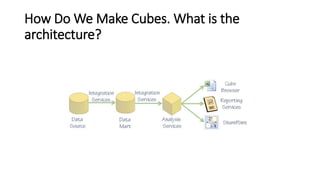
How Do We Make Cubes. What is the
architecture?
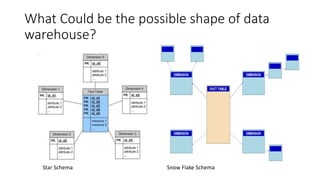
What Could be the possible shape of data
warehouse?
Star Schema Snow Flake Schema
Fact Table vs. Dimension Table
• Fact tables contain the data corresponding to a particular business process.
Each row represents a single event associated with a process and contains
the measurement data associated with that event.
Example: a retail organization might have fact tables related to customer
purchases, qty, discount, and product returns.
• Dimensions describe the objects involved in a business intelligence effort.
While facts correspond to events, dimensions correspond to people, items,
or other objects.
Example: In the retail scenario used in the example above, we discussed that
purchases, returns, and calls are facts. On the other hand, customers,
employees, items, and stores are dimensions and should be contained in
dimension tables.
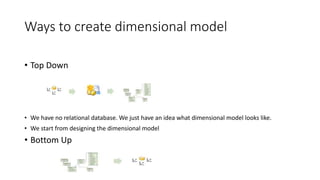
Ways to create dimensional model
• Top Down
• We have no relational database. We just have an idea what dimensional model looks like.
• We start from designing the dimensional model
• Bottom Up
Thank You

Data cubes

  • 1.
    DATA CUBES • SiddharthaJain siddhartha.j37@gmail.com https://www.linkedin.com/in/siddhartha-jain-25160170/
  • 2.
    What is datacube? • A data cube is generally used to easily interpret data. It is especially useful when representing data together with dimensions as certain measures of business requirements
  • 3.
    Why do weneed Cubes? What are its benefits over regular data warehouse? Speed: Aggregating the data for performance. During cube process SSAS will pre calculate and physically store aggregation of facts. Make Business User more capable Multi-Dimensional Analysis: slice, dice and drill down. Can Store Hierarchy: Parent Child Relationship. No Need for Joins. Security: Can restrict cube slice access according to relevance of data with the user. SCD: Slowly Changing Dimension KPI
  • 4.
    How Do WeMake Cubes. What is the architecture?
  • 5.
    What Could bethe possible shape of data warehouse? Star Schema Snow Flake Schema
  • 6.
    Fact Table vs.Dimension Table • Fact tables contain the data corresponding to a particular business process. Each row represents a single event associated with a process and contains the measurement data associated with that event. Example: a retail organization might have fact tables related to customer purchases, qty, discount, and product returns. • Dimensions describe the objects involved in a business intelligence effort. While facts correspond to events, dimensions correspond to people, items, or other objects. Example: In the retail scenario used in the example above, we discussed that purchases, returns, and calls are facts. On the other hand, customers, employees, items, and stores are dimensions and should be contained in dimension tables.
  • 7.
    Ways to createdimensional model • Top Down • We have no relational database. We just have an idea what dimensional model looks like. • We start from designing the dimensional model • Bottom Up
  • 8.